Oersted's Electromagnetism Discovery: The Compass Needle That Changed Physics
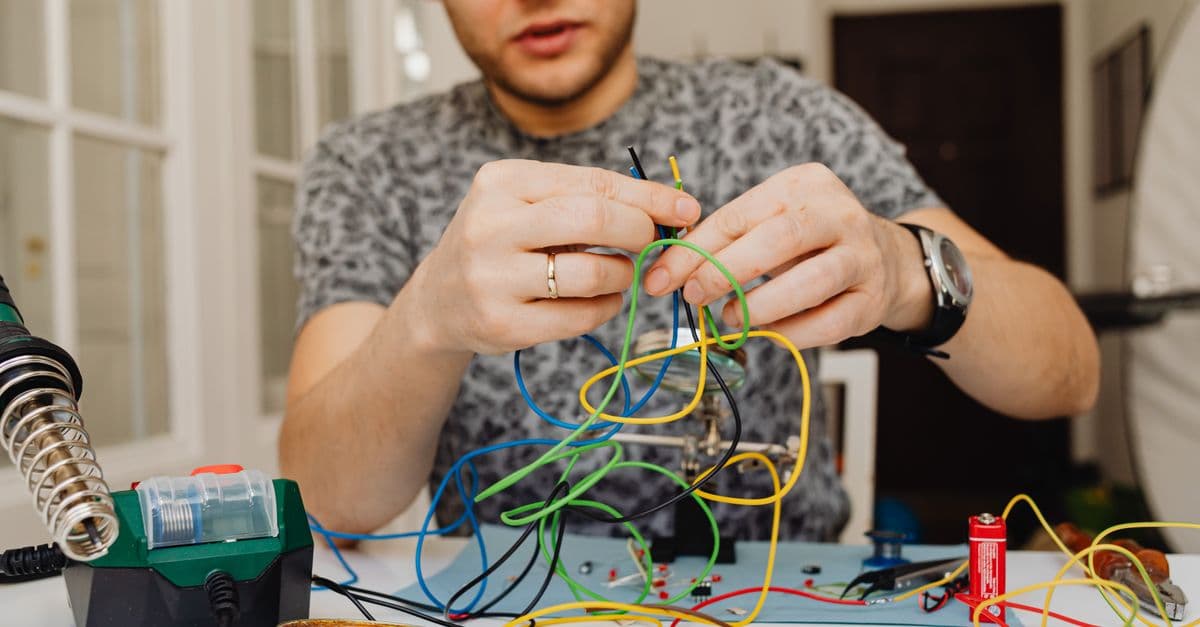
Photo: www.kaboompics.com / Pexels
A compass needle deflecting away from north is not normally physics-altering. But when it happens in response to an electric current rather than another magnet, it means that two forces physicists thought were completely separate are actually one. That is what Hans Christian Oersted observed on April 21, 1820, in Copenhagen, possibly during a lecture demonstration. The observation took minutes. Its consequences took decades to fully unpack, and they included the electric motor, the generator, the transformer, and James Clerk Maxwell's unified field theory of electromagnetism — arguably the greatest synthesis in nineteenth-century physics.
The State of Knowledge Before 1820
In 1820, electricity and magnetism were considered completely distinct phenomena. Electricity was the force that made amber attract straw when rubbed, that produced lightning, and that flowed through voltaic piles (early batteries) to power galvanic experiments. Magnetism was the force that aligned compass needles, attracted iron filings into characteristic patterns around lodestones, and had been navigating ships for centuries.
The idea that these two forces were related was not absurd — various thinkers had noticed that lightning could magnetize iron, and that Leyden jar discharges could affect compass needles, but these effects were scattered, poorly reproducible, and not taken as evidence of a deep connection. The prevailing view was that electricity and magnetism were analogous phenomena (both involving attraction and repulsion between objects) but not the same phenomenon.
Oersted was unusual in his era for actively believing that the forces of nature were interconnected. He had been influenced by the Naturphilosophie movement, a German philosophical tradition associated with Schelling and Kant's followers, which held that nature's apparent diversity masked underlying unity. This was not mainstream science — it was closer to philosophy — but it motivated Oersted to keep looking for connections that more conventionally minded physicists might not have bothered seeking.
Source: Stauffer, R. C. (1953), "Speculation and experiment in the background of Oersted's discovery of electromagnetism," Isis, 44(1–2), 33–50 — historical analysis of Oersted's philosophical motivations and the Naturphilosophie context.
Voltaic pile — an early electrochemical battery invented by Alessandro Volta in 1800, consisting of alternating zinc and copper discs separated by brine-soaked cloth. It was the first device to produce a continuous, controllable electric current, making systematic electrical experiments possible.
The Moment of Discovery — What Actually Happened
The exact circumstances of Oersted's discovery are somewhat disputed, and the romantic version — a sudden inspiration during a lecture that caused him to try the experiment on the spot — is probably embellished.
What is documented is that Oersted had been trying to demonstrate electrical effects on magnets since at least 1818, without consistent results. The unreliable early voltaic piles he used may have produced too little current. By April 1820, he had access to a more powerful galvanic pile.
On April 21, 1820, Oersted placed a compass needle near a wire connected to a voltaic pile and passed a current through the wire. The needle deflected. He noticed — critically — that it deflected perpendicular to the wire, not along it. When he reversed the current, the needle deflected to the opposite side, symmetrically. When he interposed non-magnetic materials (wood, glass) between the wire and compass, the deflection was unaffected. Only magnetic materials could shield it.
Source: Oersted, H. C. (1820), "Experimenta circa effectum conflictus electrici in acum magneticam," private pamphlet circulated July 21, 1820; English translation published in Annals of Philosophy, 16(4), 273–276 — the original announcement of the discovery, describing the experimental setup and observations.
The perpendicularity was the crucial clue. Previous thinkers who had imagined a connection between electricity and magnetism assumed the electric force would act along the direction of current flow, the way gravitational and electrostatic forces act along the line joining two objects. Oersted's compass needle moved at right angles to the wire — not toward it or away from it, but around it. This meant the magnetic influence of a current was not a simple attractive or repulsive force but something geometrically different: a circular effect, distributed around the wire.
What the Experiment Showed — the Right-Hand Rule
The rule governing the direction of deflection is now taught as the right-hand rule: if you point the thumb of your right hand in the direction of conventional current flow (from positive to negative), your curled fingers indicate the direction of the magnetic field circles around the wire. The compass needle aligns with those circles — pointing tangentially around the wire rather than radially toward or away from it.
Magnetic field — a vector field that exerts force on moving charges and magnetic materials. At any point in space around a current-carrying wire, the magnetic field points in a direction perpendicular both to the wire and to the line from the wire to that point — forming closed circles around the wire.
Oersted's 1820 pamphlet described this geometry qualitatively. He observed that a compass above the wire deflected in one direction, and a compass below the wire deflected in the opposite direction — consistent with the circular field pattern. He also found that the effect weakened with distance from the wire, and was stronger when the current was larger.
What he could not do, with the instruments available to him, was measure the strength of the magnetic field quantitatively. That task fell to Ampere, who worked on it immediately.
Ampere's Response — the Fastest Theory in Physics History
Dominique François Jean Arago learned of Oersted's result and announced it to the French Académie des Sciences on September 11, 1820 — approximately six weeks after Oersted's pamphlet was circulated. André-Marie Ampere was in the audience.
What followed is one of the most rapid theoretical developments in the history of physics. Within days of hearing about Oersted's result, Ampere began his own experiments. Within weeks, he had discovered that two parallel wires carrying current attract each other (if the currents flow in the same direction) or repel each other (if the currents flow in opposite directions). He derived the mathematical law for the force between two parallel current-carrying wires.
Within months of September 1820, Ampere published the first of a series of papers laying the mathematical foundation of what he called electrodynamics — the quantitative theory of how electric currents produce and respond to magnetic forces.
Source: Ampere, A.-M. (1820–1826), "Mémoire sur la théorie mathématique des phénomènes électrodynamiques," published in multiple parts in Mémoires de l'Académie Royale des Sciences de Paris — Ampere's comprehensive mathematical treatment of electrodynamics, building directly on Oersted's observation.
Ampere's law, in its integral form, relates the magnetic field around a closed loop to the electric current passing through the loop's interior. It is one of Maxwell's four equations. Ampere derived it in 1826 from experimental measurements that trace directly back to Oersted's April 1820 observation.
The speed of this theoretical response — from observation to quantitative law in a matter of months — has few parallels. Faraday's discovery of electromagnetic induction (1831) was similarly rapid in inspiring theoretical work. But Oersted-to-Ampere in the autumn of 1820 remains a remarkable example of an observation instantly triggering a theoretical revolution.
The Timeline
| Date | Event |
|---|---|
| 1800 | Volta invents the voltaic pile; controllable electric current becomes possible |
| 1807–1820 | Oersted attempts to find a connection between electricity and magnetism; early attempts fail |
| April 21, 1820 | Oersted observes compass needle deflection by current-carrying wire in Copenhagen |
| July 21, 1820 | Oersted circulates his Latin pamphlet, Experimenta circa effectum conflictus electrici in acum magneticam, to physicists and scientific societies |
| September 11, 1820 | Arago announces Oersted's discovery to the French Académie des Sciences; Ampere is in the audience |
| September–November 1820 | Ampere conducts experiments on current-carrying wires; discovers attraction/repulsion between parallel currents |
| 1820 | Oersted receives the Copley Medal from the Royal Society and 3,000 francs from the French Academy |
| 1820–1826 | Ampere develops full mathematical theory of electrodynamics |
| 1821 | Michael Faraday produces the first electromagnetic rotation — precursor to the electric motor |
| 1831 | Faraday discovers electromagnetic induction — the reverse of Oersted's effect; current generated by changing magnetic field |
| 1873 | Maxwell publishes his unified Treatise on Electricity and Magnetism — four equations that encompass Oersted's discovery |
| 1960 | International SI unit of magnetic field strength, the "oersted" (in Gaussian units), named in his honor |
Faraday's Inversion — the Generator and the Motor
Oersted had shown that electricity produces magnetism. The natural question was whether the reverse was possible: can magnetism produce electricity?
Michael Faraday spent much of the 1820s trying to answer this. He finally succeeded in August 1831. He found that a changing magnetic field — not a steady one — induces an electric current in a nearby conducting loop. The key word is "changing": a static magnetic field does nothing. But a field that grows, shrinks, or rotates induces a current. This is Faraday's law of electromagnetic induction.
Source: Faraday, M. (1831), "Experimental Researches in Electricity," Philosophical Transactions of the Royal Society, 122, 125–162 — the paper reporting electromagnetic induction, including the specific experiments with a wire coil and a magnet.
The relationship between Oersted's and Faraday's discoveries is like two sides of the same phenomenon. Oersted: current in wire → magnetic field around wire. Faraday: changing magnetic field through a loop → current in loop. Together they imply that electricity and magnetism are not merely related but are fundamentally the same physical phenomenon seen from different perspectives — a connection that Maxwell formalized in 1865.
Electromagnetic induction — the production of an electric current in a conductor by a changing magnetic field through or near the conductor. The rate of change, not the magnitude of the field itself, determines the induced voltage (EMF).
Every electric motor on earth operates on Oersted's principle: a current-carrying coil in a magnetic field experiences a force that causes rotation. Every electric generator operates on Faraday's principle: rotating a coil in a magnetic field changes the magnetic flux through the coil, inducing current. These two devices are physical inverses of each other, connected by Oersted's compass needle.
Why the Effect Was Perpendicular
The perpendicularity of the magnetic force to the current direction is not an arbitrary fact — it follows from the mathematical structure of electromagnetism and has deep consequences.
Gravitational and electrostatic forces are central forces: they point along the line joining the two interacting objects. A magnetic force on a moving charge is perpendicular to the charge's velocity. This perpendicularity means a magnetic force does no work on a moving charge (since force and displacement are always at right angles, their dot product is zero). A magnetic field can change the direction of a moving charge's motion but not its speed.
This is why the magnetic field circles around the wire rather than radiating outward. It is a geometrical expression of the fact that the magnetic force acts perpendicular to the current. Oersted observed the consequence of this structure with a compass needle. The mathematical reason did not become clear until Ampere, and did not reach its full form until Maxwell.
Source: Maxwell, J. C. (1865), "A dynamical theory of the electromagnetic field," Philosophical Transactions of the Royal Society, 155, 459–512 — the paper presenting Maxwell's equations, within which Oersted's observation becomes one consequence of the equation relating curl of the magnetic field to the current density.
Oersted's Own Interpretation — Where He Got It Right and Wrong
Oersted's Latin pamphlet contains a mixture of accurate observation and incorrect theoretical interpretation that is instructive to examine. He got the key experimental facts right: the deflection is perpendicular to the wire, it reverses when the current reverses, non-magnetic materials do not block it. These observations were precise and reproducible.
His theoretical interpretation was less successful. Oersted proposed that the current in the wire set up a kind of "conflict" — he used the term conflictus electrici in his pamphlet title — between opposing electrical forces rotating in circles around the wire. This was not entirely wrong as a description of the geometry, but it was couched in the language of a now-obsolete theory of electricity as two distinct "fluids" rather than as a unified electromagnetic field.
Ampere replaced Oersted's descriptive language with quantitative mathematics within months. The idea of circular "conflict" became the mathematical concept of the magnetic field as a vector with curl — its rotation around the wire — determined by the current density. This is Ampere's law as incorporated into Maxwell's equations:
∇ × B = μ₀J
where B is the magnetic field vector, J is the current density vector, and μ₀ is the permeability of free space. The curl operator (∇ ×) measures exactly the kind of rotational structure around the wire that Oersted's compass needle detected.
Permeability of free space (μ₀) — the fundamental physical constant relating magnetic field strength to current, with value 4π × 10⁻⁷ T·m/A. It sets the scale of the magnetic force produced by a given current.
Oersted's pamphlet also described the effect as extending in all directions around the wire — not just above and below it, but at any angle. A compass positioned to the side of the wire, or at any angle, would be deflected by the circular field. This three-dimensional symmetry was another observation that his contemporaries confirmed and that Ampere's law captures exactly.
Source: Caneva, K. L. (1980), "Ampere, the Etherians, and the Oersted Connexion," British Journal for the History of Science, 13(2), 121–138 — analysis of the competing theoretical frameworks in 1820 and how Ampere transformed Oersted's qualitative description into mathematical electrodynamics.
Oersted Beyond 1820 — His Other Contributions
Oersted is remembered almost entirely for the 1820 discovery, but his scientific career extended another three decades. He founded what became the Danish Meteorological Institute, served as secretary of the Royal Danish Society of Sciences for decades, and established a tradition of public science communication in Denmark that influenced European science education.
In 1825, Oersted produced the first sample of metallic aluminum — then an exotic and expensive material — by reducing aluminum chloride with potassium amalgam. Aluminum in the early nineteenth century was so rare and difficult to extract that it was considered a precious metal. The Washington Monument, completed in 1884, was capped with aluminum as a symbol of technological achievement. Oersted's aluminum extraction method was a precursor to the industrial processes that eventually made aluminum commonplace.
Source: Krebs, R. E. (2006), The History and Use of Our Earth's Chemical Elements, Greenwood Press — history of aluminum isolation, crediting Oersted's 1825 experiment as the first successful production of metallic aluminum.
He also made contributions to the theory of acoustics, studied the compressibility of liquids, and conducted research into the thermoelectric effect (the production of current by temperature differences between junctions of different metals, related to the Seebeck effect discovered in 1821). None of these contributions rivaled the electromagnetism discovery, but they establish Oersted as a broadly capable experimenter rather than a one-hit theorizer.
Practical Legacy — Everything That Uses Electromagnetism
It would be difficult to list all technologies that trace directly to Oersted's April 1820 observation. A partial accounting:
Electric motors use a current-carrying coil in a magnetic field. Every electric vehicle, power tool, household appliance with a rotating component, and industrial machine relies on Oersted's effect. Global installed electric motor capacity in 2020 was estimated at over 40 billion watts.
Electric generators use Faraday's induction (the complement of Oersted's discovery). Every power plant — coal, gas, nuclear, hydroelectric, wind — converts mechanical rotation into electrical current through generators operating on Faraday's law.
Transformers use changing magnetic fields to transfer power between circuits at different voltages. Every wall adapter, power grid step-up and step-down transformer, and transmission line system uses this principle.
Electromagnets are direct descendants of Oersted's experiment. MRI machines use superconducting electromagnets with fields up to 3 tesla. Electric cranes, particle accelerators, and maglev trains all use controllable electromagnetic forces.
Radio and wireless communication depend on Maxwell's equations, which are the complete mathematical description of electromagnetism initiated by Oersted's observation.
Source: International Energy Agency (2021), Improving Energy Efficiency through Better Motor Systems — estimates global electric motor electricity consumption at approximately 40–45% of global electricity use, all traceable to the Oersted effect.
The Non-Magnetic Shield Test
One of the most important aspects of Oersted's original experiment was his test with intervening materials. He interposed wood and glass between the current-carrying wire and the compass needle, and the deflection was unchanged. He tried copper — unchanged. He then tried iron — the effect was altered.
This test established that the influence of the current on the compass was not an electrical effect (which would be blocked by a metal shield) and not a gravitational effect (which would pass through everything equally). It was a genuinely new kind of force that interacted only with magnetic materials and was not blocked by non-magnetic insulators or conductors.
The result established that Oersted had found something categorically new, not a variant of known electrical or gravitational phenomena. This was crucial for convincing a skeptical scientific community that the effect was real and fundamental, not an artifact of the apparatus.
Maxwell's Unification — the Full Consequence of the Compass Needle
The chain from Oersted's 1820 observation to Maxwell's 1865 equations covers 45 years and represents perhaps the greatest theoretical achievement of the nineteenth century. Understanding the steps makes the enormity of the compass needle's consequences clear.
Oersted showed (1820): a current produces a magnetic field. Ampere showed (1820–1826): the field strength and direction are precisely predictable from the current geometry. Faraday showed (1831): a changing magnetic field induces an electric current. Faraday also introduced the concept of the electromagnetic field — not as a mathematical convenience but as a physical reality, with energy stored in the space between conductors.
Maxwell's contribution was to realize that Faraday's field concept, expressed mathematically, was inconsistent. Ampere's law as Ampere stated it was only valid for steady (non-changing) currents. Maxwell showed that for time-varying situations, an additional term was needed: the "displacement current," proportional to the time rate of change of the electric field. Adding this term not only fixed the mathematical inconsistency but had a startling consequence.
The corrected equations — Maxwell's four equations — predicted that disturbances in electric and magnetic fields would propagate through space as self-sustaining waves. The speed of these waves, calculated from the electric and magnetic constants (ε₀ and μ₀) that had been measured independently in the laboratory, was:
c = 1 / √(ε₀μ₀) ≈ 3 × 10⁸ m/s
This was the known speed of light. Maxwell concluded that light was an electromagnetic wave — the same phenomenon as Oersted's magnetic field around a wire, oscillating at frequencies of roughly 10¹⁴ Hz instead of 0 Hz for a DC current.
Source: Maxwell, J. C. (1865), "A dynamical theory of the electromagnetic field," Philosophical Transactions of the Royal Society, 155, 459–512 — the paper presenting Maxwell's equations and the prediction that light is an electromagnetic wave.
Hertz (the same physicist whose nephew would share a name with the unit of frequency) confirmed experimentally in 1888 that electromagnetic waves with the properties Maxwell predicted could be generated and detected from oscillating currents. Radio had been predicted from the same chain of reasoning that started with Oersted's compass deflection in 1820.
The SI unit of magnetic field strength in Gaussian units (older system still used in some fields) is the "oersted," formally adopted by the international standards community in his honor. In SI proper, the unit of magnetic field (B) is the tesla, and the unit of magnetic field intensity (H) is the ampere per meter — Ampere's name on the unit that Oersted's observation made possible.
What People Get Wrong About Oersted's Discovery
"Oersted's discovery was entirely accidental." Oersted had been actively seeking a connection between electricity and magnetism since at least 1818. He placed the compass near the current-carrying wire because he expected — or at least hoped — something might happen. The discovery was the result of a principled search, even if the specific moment had elements of fortunate timing.
"The compass needle pointed toward the wire." It deflected perpendicular to the wire — a crucial distinction. Pointing toward the wire would have suggested a simple attractive force similar to gravity or electrostatics. Perpendicular deflection indicated something geometrically new, which is what made the result so surprising and theoretically rich.
"Ampere's law came much later." Ampere published his first experimental results within weeks of hearing about Oersted's discovery, and his quantitative law for the force between parallel currents followed within months. The mathematical theory was largely in place by 1821 — within one year of Oersted's announcement.
"Oersted was a theorist, not an experimenter." He was primarily a physicist and chemist with strong philosophical inclinations, but the 1820 experiment was an empirical investigation. He conducted systematic follow-up tests with different materials, different current directions, and different compass positions. The 1820 pamphlet describes a careful experimenter, not a philosopher who stumbled on something.
FAQs
Q: What exactly deflects a compass needle near a current-carrying wire?
A: The electric current creates a magnetic field that forms closed loops around the wire. A compass needle is a small permanent magnet that aligns with any external magnetic field. In the presence of the current's circular magnetic field, the needle swings to point in the direction of that field at the needle's location — perpendicular to the wire, not toward or away from it.
Q: Why did Oersted publish in Latin?
A: In 1820, Latin was still the international language of scientific communication in Europe, particularly for formal scientific announcements. Oersted wrote his 1820 pamphlet, Experimenta circa effectum conflictus electrici in acum magneticam, in Latin to ensure it would be readable by physicists across France, Germany, Britain, and other European countries regardless of national language. It was quickly translated into French, German, and English.
Q: Why didn't earlier scientists find this effect?
A: Before 1800, there was no reliable source of continuous electric current. The voltaic pile, invented by Volta in 1800, was the first such source. Without sustained current flow, the magnetic effect is too brief and weak to produce a detectable compass deflection. Additionally, most experimenters positioned their apparatus with the wire parallel to the compass needle, which produces no deflection — only a wire perpendicular to the needle's plane shows the effect clearly. Oersted's orientation happened to be revealing.
Q: How did Oersted's discovery lead to the electric motor?
A: Oersted showed that a current-carrying wire experiences a force in a magnetic field. In 1821, Michael Faraday demonstrated that this force could produce continuous rotation by arranging a current-carrying wire to rotate around a fixed magnet. Faraday's "electromagnetic rotation" device was the conceptual ancestor of all electric motors: replace the rotating wire with a rotating coil, add a commutator to keep the current direction correct relative to the magnet, and you have a working DC motor.
Q: What is Ampere's law and how does it relate to Oersted's discovery?
A: Ampere's law states that the magnetic field integrated around any closed loop equals the electric current passing through the loop multiplied by a constant (the permeability of free space, μ₀). It is the quantitative mathematical expression of what Oersted observed qualitatively: electric currents produce magnetic fields. Ampere derived this law from careful measurements on current-carrying wires in the months following Oersted's 1820 announcement.
Q: How strong was the effect Oersted observed?
A: At a distance of a few centimeters from a wire carrying a few amperes, the magnetic field is on the order of 10⁻⁵ to 10⁻⁴ tesla. Earth's magnetic field is about 5 × 10⁻⁵ tesla. So Oersted's current-wire field was comparable to Earth's field — strong enough to deflect a sensitive compass needle noticeably, but not by a dramatic amount. A more powerful voltaic pile (more cells, more current) would have produced a larger deflection.
The Takeaway
Oersted's compass needle moved about three millimeters from north, and physics was never the same. The deflection established that electricity and magnetism were not two separate forces but two aspects of one. That insight, developed mathematically by Ampere and then Faraday and then Maxwell, produced the theoretical framework for every electrical technology that followed — and for the understanding that light itself is an electromagnetic wave. The experiment required nothing more exotic than a voltaic pile, a wire, and a compass. The preparation required years of looking for a connection that most physicists were not even searching for.
Read next:
Weekly digest
Stay ahead of the curve
Get the best science, AI, and tech stories delivered to your inbox every week. No spam — unsubscribe any time.
About the Author
SciHub101 is an independent science and technology publication founded and edited by Buğra Sözeri, a software engineer and app developer based in Türkiye. Articles are drafted against peer-reviewed literature and primary sources, fact-checked, and edited by a human before publication. Where we compare products, anything built by our own team is labelled as such — see the editorial guidelines and About page for how corrections and disclosures work.
Related Articles

The OPERA Faster-Than-Light Neutrino Anomaly: A Loose Cable and a Physics Scare
In 2011, the OPERA experiment reported neutrinos arriving 60 nanoseconds faster than light. Six months later the culprit was a fiber-optic cable not properly plugged in. Here is what really happened.

The Oak School Pygmalion Experiment: How Teacher Expectations Change Children
In 1968, Rosenthal and Jacobson told teachers that certain students were about to 'bloom.' Those randomly chosen students gained more IQ points. The Pygmalion effect was born.
The Electric Motor: From Faraday's Wire to the EV Revolution — SciHub101
Michael Faraday's 1821 rotating wire became the device that now consumes 50% of the world's electricity. Here's how the electric motor works and why Tesla's AC design won.
Faraday's Induction: From Magnets to Electricity
In 1831, Michael Faraday discovered that changing magnetic fields induce electric currents. This fundamental discovery enabled electric motors, generators, and transformed civilization.