What Is Ethereum — And How Is It Different From Bitcoin?
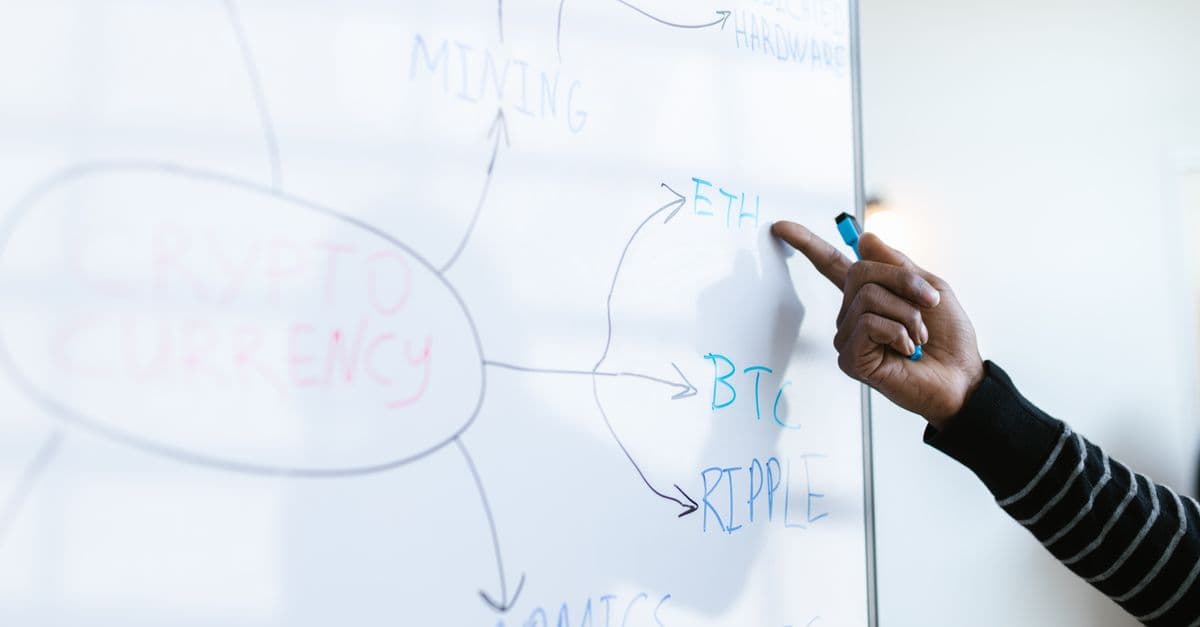
Photo: RDNE Stock project / Pexels
Bitcoin gave us digital money without a bank. Ethereum took that idea further: a worldwide computer where anyone can run programs that no single company controls. After ten years, Ethereum settles hundreds of billions of dollars in transactions and powers most of "Web3." Here's what it really is, how it differs from Bitcoin, and why it matters.
Educational only — not financial advice. Investing involves risk of loss; past performance does not guarantee future results. Consult a licensed financial advisor before making investment decisions.
Key takeaways
- Bitcoin is a payment network. Ethereum is a programmable computing platform.
- Smart contracts are programs that run automatically when their conditions are met.
- Ethereum's currency is ETH — used to pay for computation ("gas").
- In 2022 Ethereum switched from mining (proof-of-work) to proof-of-stake, cutting energy use ~99.9%.
- The network supports stablecoins, NFTs, decentralised exchanges, and most other crypto applications.
The core idea
Bitcoin's job is simple: move value from A to B without a bank. Its scripting language is intentionally limited.
Ethereum, launched in 2015 by Vitalik Buterin and others, was designed for arbitrary computation. Anyone can deploy code to the network, and that code will run exactly as written — no take-downs, no human in the loop. This is the "smart contract."
A smart contract is just a small program living on the blockchain. When someone sends it a message, the network runs the code and updates the state. Examples:
- Lending: deposit ETH, borrow stablecoins against it.
- Trading: swap tokens through an automated market maker.
- Token issuance: anyone can launch their own currency.
- Identity, voting, royalties — anywhere you'd want code to run without a trusted middleman.
How transactions work
Every action on Ethereum costs gas — paid in ETH. Gas is the computational resource. Sending ETH costs little. Running a complex contract costs more. Gas prices fluctuate with network demand: when usage spikes, fees rise.
A transaction goes through three steps:
- Submit: you sign a transaction with your private key.
- Validate: the network of validators checks it.
- Include: a validator includes it in the next block, which is added to the chain roughly every 12 seconds.
Once included, the transaction is permanent.
Proof-of-stake — the big shift
Bitcoin secures itself through mining — burning electricity to solve cryptographic puzzles. Ethereum used the same mechanism until September 2022, when it transitioned to proof-of-stake in an event called The Merge.
Under proof-of-stake, validators put up 32 ETH as collateral. The network randomly picks one to propose each block. Misbehave, and the validator loses their stake.
The switch dropped Ethereum's energy consumption by approximately 99.95%. Today the entire network uses less electricity than a small town.
Layer 2: scaling Ethereum
Ethereum's mainnet processes roughly 15-30 transactions per second. Not enough for a global financial system. The solution: Layer 2 networks like Arbitrum, Optimism, and Base. They batch transactions off-chain and post compressed proofs back to Ethereum, achieving thousands of transactions per second at a fraction of the cost.
Most everyday Ethereum activity in 2026 happens on Layer 2.
What's actually built on it
- Stablecoins — USDC and USDT (dollar-pegged tokens) settle hundreds of billions in monthly volume.
- Decentralised exchanges like Uniswap let people swap tokens without a centralised order book.
- DeFi lending through protocols like Aave.
- NFTs — most non-fungible tokens (digital art, game items, identity badges) live on Ethereum.
Bitcoin vs Ethereum at a glance
| Bitcoin | Ethereum | |
|---|---|---|
| Purpose | Digital cash / store of value | Programmable platform |
| Currency | BTC | ETH |
| Block time | ~10 min | ~12 sec |
| Supply | 21 million cap | No hard cap; net deflationary |
| Consensus | Proof-of-work (mining) | Proof-of-stake |
| Smart contracts | Limited | Yes — Turing-complete |
What it is not
Ethereum is not anonymous — every transaction is public. It's not free — every action has a gas cost. It's not infallible — smart-contract bugs have led to multi-million-dollar exploits. And ETH's price is volatile. This transparency is a trade-off with Bitcoin's approach: Bitcoin's simplicity reduces bugs but limits innovation, while Ethereum's flexibility enables applications but increases complexity and risk.
Development and Upgrades: Maintaining an Immutable System
Ethereum, unlike traditional software, cannot be patched centrally. If a bug is discovered, code can't simply be "fixed" on the live network — every change must achieve consensus from thousands of independent validators.
This creates a governance problem: how does code evolve?
Hard forks: Major upgrades require a fork—a coordinated change where all validators upgrade to new software at a specific block height. If some validators don't upgrade, the network splits into two (one running old code, one running new). Forks are rare and require overwhelming consensus.
Major upgrades (2020-2024):
- The Merge (2022): Proof-of-stake transition (discussed earlier). This was arguably the largest upgrade any blockchain has attempted—switching consensus mechanisms while the network processes live transactions.
- Shanghai (2023): Enabled staking withdrawals (previously, staked ETH was locked indefinitely).
- Dencun (2024): Reduced Layer 2 fees by 10-100x through data availability improvements.
Each upgrade is months of development, community discussion, and testnet validation before deployment.
The governance challenge: Bitcoin updates slowly (controversial changes can block for years). Ethereum updates faster but faces the risk of controversial forks. Neither is ideal—Bitcoin trades agility for stability; Ethereum trades stability for agility.
Decentralization: How Many Validators Does It Take?
Bitcoin's security depends on mining being distributed. Currently, roughly 5,000 nodes run the full Bitcoin network. Ethereum has roughly 500,000 validators (anyone with 32 ETH can participate). > Source: Etherscan, December 2023; Bitcoin node count from BitNodes.
Decentralization depth:
- Bitcoin: Distributed, but mining pools concentrate power. Roughly 6 pools control 50%+ of hash power, meaning that in theory, collusion among a small number of mining operations could dominate consensus.
- Ethereum: More distributed by validator count, but wealth concentration is similar (top 10% of stakers control 50%+ of stake). A staking service provider like Lido controls ~30% of all staked ETH, raising centralization concerns despite protocol-level distribution.
Both networks remain resistant to 51% attacks (an attacker would need to control 51% of the network), but neither is perfectly decentralized. Decentralization is a spectrum, not binary. Ethereum's validator count is higher, but node operations require different skills—less energy and hardware than mining, but more technical knowledge for non-custodial staking.
The Energy Question Revisited: Where Ethereum Stands
Proof-of-stake reduced Ethereum's energy consumption from approximately 160 TWh/year (roughly equivalent to Argentina's total annual electricity consumption) to approximately 0.0026 TWh/year—a reduction of roughly 99.95% or about 60,000-fold. > Source: Ethereum Foundation, Energy consumption post-merge (2023); Carbon footprint analysis by Digiconomist.
Context: The entire Ethereum network today consumes less electricity than a large data center or a small city's power grid. By contrast, Bitcoin still consumes approximately 140 TWh/year (roughly 0.5% of global electricity generation), which remains a point of contention among environmentalists and critics. The difference is fundamental: Ethereum's proof-of-stake eliminates the computational "race" where thousands of miners compete simultaneously; Ethereum's validators are chosen sequentially by the protocol, avoiding redundant work.
For end users: An Ethereum transaction now emits approximately 0.00002 kg of CO2-equivalent (comparing to a typical credit card transaction at approximately 0.0005 kg CO2). Layer 2 transactions are even lower, at approximately 0.0000002 kg CO2-equivalent. This means Ethereum's environmental footprint is now comparable to many traditional digital payment systems, though verification claims vary by methodology.
Smart Contracts in Practice: Real-World Examples
Uniswap and automated market makers: Uniswap is a decentralized exchange built on Ethereum using smart contracts. Instead of traditional order books with buyers and sellers, Uniswap uses liquidity pools. Users deposit pairs of tokens (e.g., ETH and USDC) into a contract. When traders swap tokens, a smart contract automatically calculates the price based on pool ratios (the more of one token traders remove, the more expensive that token becomes). No central company operates this; code executes automatically. Uniswap processes billions of dollars monthly.
Aave and collateralized lending: Aave is a lending protocol where users deposit crypto assets and earn interest. Borrowers deposit collateral (e.g., ETH) and borrow stablecoins. Smart contracts automatically: (1) accrue interest, (2) adjust borrow rates based on utilization, (3) liquidate undercollateralized positions. The protocol requires zero managers; code enforces all rules. Aave handles billions in total value locked.
Stablecoins and payment rails: USDC and USDT (dollar-pegged tokens) run on Ethereum smart contracts. The contract simply tracks who owns what. When someone sends USDC to another address, the contract updates balances. This enables nearly instant, borderless payments. Institutions use Ethereum stablecoins for international settlement because they're faster and cheaper than traditional banking (which can take 1-3 business days).
Source: Uniswap V3 whitepaper (2021); Aave lending analytics, Dune Analytics (2024); Circle, USDC reserves and audits (2023).
The Cost of Computation: Understanding Gas Fees
Gas is Ethereum's metering system. Every operation has a cost: sending ETH to another address costs 21,000 gas units; deploying a smart contract costs 50,000-100,000+ gas units depending on complexity. Gas price (in wei, tiny fractions of ETH) fluctuates with network demand.
Historical context: Early Ethereum (2015-2016) had minimal congestion; gas costs were negligible. As the network became popular (especially during the 2017 ICO boom and the 2020-2021 DeFi explosion), gas prices exploded. In 2021, simple transfers cost $50-100 in peak periods. This prompted urgent scaling solutions.
Layer 2 solutions (Arbitrum, Optimism, Base, zkSync): Layer 2 networks batch thousands of transactions into a single transaction posted to Ethereum. Costs drop by 10-100x. A $10 Ethereum transfer might cost $0.10 on Arbitrum. This has made Ethereum practical for everyday users and small transactions. > Source: Optimism and Arbitrum transaction costs, L2Beat analytics (2024).
Maximal Extractable Value (MEV) and Transaction Ordering
One of Ethereum's subtler challenges is MEV — the profit validators can make by controlling transaction order within a block. If you submit a transaction to swap token A for token B, a validator can see your transaction before it's included in a block. That validator could front-run your trade: submit their own swap first, move the price, and then include your transaction at a worse price. Your cost increases; the validator's profit is your loss.
This is not a bug—it's a feature of how Ethereum's transparent mempool works. Every transaction is visible before inclusion. Validators are economically incentivized to extract MEV. MEV-focused actors use complex strategies:
- Sandwich attacks: Place a profitable trade before and after your transaction
- Liquidations: Monitor lending protocols and liquidate underwater positions before other liquidators can
- Arbitrage: Detect profitable price differences and exploit them
MEV extraction costs users real money. Studies estimate users lose hundreds of millions annually to MEV. This is especially painful for Uniswap swaps and DeFi transactions, where large orders inevitably create exploitable price movement.
Ethereum and Layer 2 networks are developing mitigations:
- Encrypted mempools: Hide transactions until they're included, preventing front-runners from seeing them
- Proposer-builder separation: Divide roles so proposers (who choose validators) cannot directly extract MEV
- PBS (Proposer-Builder Separation): A protocol upgrade to further isolate the validator role from MEV-extraction incentives
- Private relays: Services like MEV-Protect route transactions through encrypted channels
No perfect solution exists yet. The core tension: Ethereum's transparency (which makes it trustless) inherently exposes transactions to ordering manipulation. Bitcoin has minimal MEV because its simple scripting language doesn't support complex DeFi logic—there's less to front-run. Ethereum's flexibility creates more MEV opportunities.
Source: Ethereum Research, MEV-Explore (2023); Flashbots MEV analysis and mitigation research (2024).
Bitcoin's Approach: Intentional Limitations
Bitcoin deliberately avoided smart contracts and general computation. Satoshi Nakamoto (Bitcoin's pseudonymous creator) and subsequent Bitcoin developers prioritized security and simplicity. Bitcoin can do payment validation and basic scripting (multisig, timelocks) but cannot run arbitrary programs.
Trade-offs: Bitcoin's limitation makes it:
- Simpler to audit — smaller attack surface
- Less prone to bugs — fewer possible code paths
- More stable — fewer changes, fewer surprises
- Harder to innovate on — adding features requires consensus and is controversial
Ethereum chose the opposite: maximize flexibility, enabling any application. This makes Ethereum:
- More innovative — new financial applications emerge constantly
- Riskier — bugs in smart contracts cost users real money (e.g., the $50M loss from the Parity wallet bug in 2017)
- Subject to rapid change — can feel unstable to conservative users
Neither approach is "correct"—they represent different philosophical bets about how technology should evolve.
Economic Model: Inflation, Deflation, and Value Capture
Bitcoin: Fixed supply of 21 million coins. No new Bitcoin creation after ~2140. This creates digital scarcity; some view it as "sound money." However, it also means no way for the protocol to reward security except through transaction fees (which may not be enough once mining rewards halve away).
Ethereum: ETH has no hard supply cap, but its economics are more complex. Historically, ETH had ~8% annual inflation from block rewards. However, in 2021 (London upgrade), Ethereum introduced fee burn: a portion of gas fees is permanently destroyed (removed from circulation). In recent years, ETH burned has exceeded new issuance, making ETH deflationary. This changes the narrative from "infinite supply" to "deflationary if usage is high." > Source: Ethereum Foundation, London Upgrade analysis (2021); Ultrasound Money, ETH burn tracking (2024).
This economic difference is philosophically important:
- Bitcoin maximalists argue fixed supply = better store of value
- Ethereum advocates argue deflationary mechanics + innovation = better long-term value
Market reality: Both have appreciated dramatically since inception, and both have experienced brutal bear markets. Supply mechanics alone do not determine price.
The takeaway
Bitcoin and Ethereum are fundamentally different technologies serving different purposes. Bitcoin is digital money—a peer-to-peer payment system designed for simplicity, security, and store-of-value properties. Ethereum is a worldwide computer, where anyone can deploy programs that execute automatically without a trusted middleman. Bitcoin intentionally limited its scripting language to avoid bugs; Ethereum maximized flexibility to enable innovation. Bitcoin continues to consume ~140 TWh/year through proof-of-work mining, while Ethereum reduced its energy consumption by 99.95% after switching to proof-of-stake in 2022. Layer 2 scaling solutions now make Ethereum practical for billions of everyday transactions at a fraction of prior costs. Both networks have survived over a decade of skepticism, hacks, and competition. The cryptocurrency space has learned that they are not competitors for a single crown but complementary technologies—Bitcoin excels as digital gold, Ethereum as infrastructure for decentralized applications.
Frequently Asked Questions
Q: Should I be worried that Ethereum will replace Bitcoin or vice versa?
A: No. They serve fundamentally different purposes and have proven able to coexist for over a decade. Bitcoin is primarily a store of value (often compared to digital gold), while Ethereum is a computing platform for running applications. Bitcoin maximalists and Ethereum advocates debate which will "win," but markets have shown they serve different needs. More likely: both remain entrenched, with Bitcoin dominant as a long-term value store and Ethereum dominant as a smart-contract application platform. This dynamic is not zero-sum; different technologies can flourish for different reasons.
Q: What risks exist if I store ETH on a Layer 2 network and the Layer 2 fails?
A: Layer 2 risks are real but vary by platform. Arbitrum and Optimism (the two largest Layer 2s) have undergone extensive security audits, hold over $10 billion in total value locked, and have demonstrated robust security over multiple years of operation. Earlier Layer 2 systems did fail: Ronin (a game-focused Layer 2) was hacked for $650 million in 2022, though Ethereum's main bridge remained secure. When evaluating a Layer 2, examine its security audits, team track record, code open-source status, and transparent reserve verification. Established platforms with institutional backing and proven security records pose significantly lower risk than new, untested systems.
Q: If Ethereum smart contracts are immutable, how can they ever be fixed when bugs are discovered?
A: Smart contracts themselves cannot be changed once deployed, but developers can design contracts with proxy patterns: deploy a new contract version and have the original address forward all requests to the new implementation. This maintains backward compatibility while allowing upgrades. However, this flexibility introduces risks—if the contract owner (even if well-intentioned) has upgrade authority, they could change behavior maliciously. This represents a trade-off: flexibility and bug-fixing capability versus centralized upgrade control. Some protocols use governance (voting by token holders) to control upgrades, distributing power rather than centralizing it.
Q: Why would users choose Ethereum over Bitcoin if Bitcoin is simpler and more established?
A: Bitcoin's simplicity is intentional and valued by many, but Ethereum's programmability enables applications Bitcoin cannot support. Ethereum powers automated market makers (Uniswap), collateralized lending (Aave), stablecoins (USDC, USDT), identity protocols, and thousands of other applications. Bitcoin cannot do these without dramatically increasing complexity (and risking the security that simplicity provides). Users choose based on their use case: store of value and portfolio diversification favor Bitcoin; involvement in decentralized finance, staking, or token-based applications favor Ethereum. Many investors hold both.
Q: Is Ethereum truly decentralized or does Vitalik Buterin control it?
A: Vitalik Buterin is the creator and an influential voice, but he does not "control" Ethereum in any technical sense. The network is run by ~500,000 independent validators who can choose whether to adopt proposed changes. Ethereum governance is decentralized—decisions require consensus from developers, stakers, and the broader community. Vitalik has outsized influence (the community respects his technical judgment), but unilateral control is impossible. The network would fork away from changes Vitalik proposed that the community rejected, as happened historically when the community rejected Vitalik's proposals for ASIC-resistant mining algorithms.
Q: How does Ethereum's fee burn mechanism make ETH deflationary, and what does that mean for value?
A: During the 2021 London upgrade, Ethereum introduced a base fee component of gas costs that is automatically burned (permanently removed from circulation) rather than paid to miners/validators. When network usage is high, more fees are burned than new ETH created as block rewards, making ETH deflationary in supply. This contrasts with Bitcoin's fixed 21 million coin cap and Ethereum's earlier inflationary model. Deflationary supply is often associated with increasing scarcity and value, but macroeconomic outcomes depend on demand. If network usage falls dramatically, new issuance may exceed burns and ETH becomes inflationary despite the mechanism. Supply mechanics alone do not determine price; both Bitcoin and Ethereum have experienced 80%+ bear market declines despite favorable supply dynamics, showing demand and sentiment matter more than supply algorithms.
Read next
Follow new articles
Add SciHub101 to your feed reader to see new science and technology stories.
About the Author
SciHub101 is an independent science and technology publication founded and edited by Buğra Sözeri, a software engineer and app developer based in Türkiye. AI tools assist with drafting and research. Source documentation in the existing archive is uneven, and articles are being reviewed and corrected. The Editorial Team byline identifies editorial responsibility; it does not certify specialist or independent human review. Where we compare products, anything built by our own team is labelled as such — see the editorial guidelines and About page for how corrections and disclosures work.
Related Articles

What Is Bitcoin — and How Does It Actually Work?
Bitcoin is digital money that nobody controls. Sounds simple — but underneath is a remarkable feat of cryptography, economics, and game theory. Here's how it really works.

What Are Stablecoins — And Why Do They Matter?
Stablecoins are crypto's least exciting invention and probably its most consequential. Here is how they hold a peg, what backs them, how they fail, and why regulators are paying attention.

How Decentralized Finance Works: Smart Contracts, Lending, and Real Risks
Decentralized finance (DeFi) replaces banks with automated smart contracts running on blockchain networks. Instead of submitting a loan application to a bank, you deposit collateral into a smart contract; instead of a savings account earning interest, you provide liquidity to a decentralized exchange and earn transaction fees. DeFi operates on the premise that financial infrastructure can be transparent, permissionless, and governed by code rather than institutions. The mechanisms are real and operational, handling tens of billions in assets. The risks are equally real: smart contract bugs have erased hundreds of millions in user funds, 'rug pull' scams have vaporized billions, and impermanent loss is a mathematical cost of providing liquidity to automated trading pools. This article explains how DeFi works mechanically and examines the structural risks that distinguish it from traditional finance.

Ethereum in 2026: How It Works and What to Know
Ethereum is a blockchain network that extends cryptocurrency beyond Bitcoin's payments functionality to programmable contracts and decentralized applications. Unlike Bitcoin, which is primarily a peer-to-peer currency, Ethereum allows developers to deploy software (smart contracts) that executes agreements automatically without intermediaries. The Ethereum network operates on a proof-of-stake consensus mechanism (as of 2022), meaning validators stake cryptocurrency to secure the network rather than competing to solve mathematical puzzles. Ethereum's cryptocurrency, Ether (ETH), is used to pay for transaction fees (gas) and to incentivize validators. Ethereum has become the largest platform for decentralized finance (DeFi), non-fungible tokens (NFTs), and decentralized autonomous organizations (DAOs). This article explains how Ethereum works technically, the role of smart contracts and validators, current layer 2 scaling solutions, real use cases, and informed criticisms of the system. This is educational information about mechanisms, not investment advice.

Blockchain Explained — Beyond Bitcoin
How blockchains actually work, consensus mechanisms compared, smart contracts, what blockchain is good for, and what it isn't — balanced view for 2026.

AI + Blockchain: Fighting Financial Crime & AML
How machine learning detects money laundering on blockchain.