The Typewriter: How QWERTY Conquered the Written World
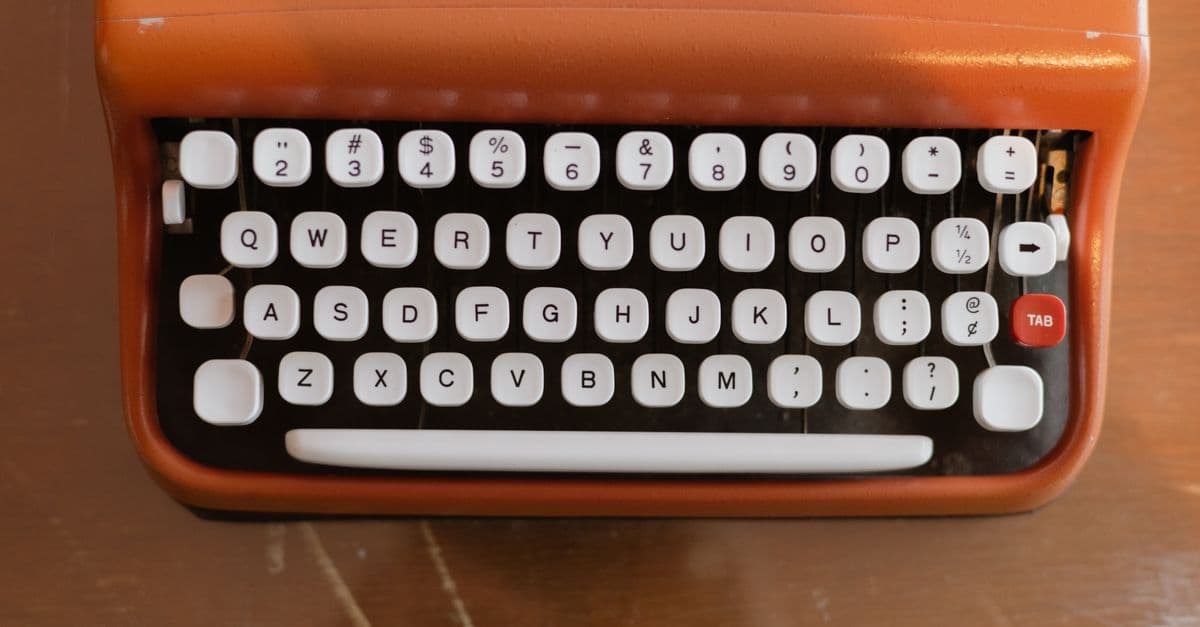
Photo: Josh Withers / Pexels
On June 23, 1868, Christopher Latham Sholes, Carlos Glidden, and Samuel Soulé received U.S. Patent No. 79,265 for a "type-writing machine." Within five years, Sholes had sold his rights to a firearms manufacturer that needed peacetime business. Within twenty, over 100,000 machines bearing the keyboard layout Sholes designed were in American offices. Within a century, every computer keyboard in the world used the same letter arrangement, even though the mechanical problem that layout was designed to solve had ceased to exist. The typewriter is the story of how a mechanical constraint, once encoded in human habit, outlasted the machine that created it by generations.
What the Typewriter Changed
Definition: A typewriter is a mechanical or electromechanical device that produces printed text on paper by pressing keys that cause corresponding type bars (or, later, a type element) to strike an inked ribbon against the paper. Each keystroke produces one printed character. The typewriter mechanized handwriting, producing standardized, legible text at speeds that handwriting could not match.
Before the typewriter, written communication was handwritten or professionally typeset — the latter requiring a printing press and trained compositors. Handwriting was personal, variable in legibility, slow, and unsuitable for producing multiple identical copies. The typewriter created a new category of worker (the typist, predominantly female from the 1880s onward), a new standard for business communication (typed correspondence replaced handwritten letters in commercial contexts within two decades), and a new form of text whose uniformity would eventually define the visual language of modernity.
The typewriter also collapsed the time between thought and text for writers. Mark Twain claimed to be the first author to submit a typewritten manuscript to a publisher — the precise claim is disputed, but he was among the first wave of literary adopters in the early 1870s. Twain's enthusiasm was typical of early users: typing was faster than handwriting for most people once proficiency was achieved, and the output was immediately readable.
Source: Britannica — "Christopher Latham Sholes: QWERTY keyboard, typewriter, printer," britannica.com.
Source: Sholes and Glidden typewriter — Wikipedia.
Christopher Latham Sholes and the Path to Patent
The typewriter was not Christopher Latham Sholes's first invention, and it was not his idea alone. Sholes was a Wisconsin newspaper editor and politician — a man of words, appropriately — who had previously patented a machine for numbering book pages. In 1867, working in a Milwaukee machine shop with Carlos Glidden (a lawyer and inventor) and Samuel Soulé (a printer), he began serious development of a writing machine.
Writing machines had been attempted before. The first U.S. patent for a writing machine was granted to William Austin Burt in 1829, for his "typographer." Charles Thurber patented a machine in 1843. Henry Mill had received an English patent as early as 1714 for "an artificial machine or method for the impressing or transcribing of letters, one after another." None of these machines achieved commercial viability. They were too slow, too bulky, or too difficult to operate.
Sholes's version, patented in 1868, had a piano-like keyboard with two rows of characters. The mechanism worked by pressing a key that caused a type bar — a metal arm with the corresponding letter embossed at its tip — to swing upward and strike an inked ribbon against paper held around a cylindrical platen. After each keystroke, the platen advanced one space. At the end of a line, the typist manually returned the carriage and the platen moved to a new line.
The basic mechanical design Sholes created — type bars, inked ribbon, moving carriage — remained essentially unchanged in manual typewriters for nearly a century.
Source: National Inventors Hall of Fame — "Christopher Sholes," invent.org.
Source: EBSCO Research Starters — "Practical Typewriter is Patented," ebsco.com.
| Year | Event |
|---|---|
| 1714 | Henry Mill patents first writing machine (England) |
| 1829 | William Austin Burt patents "typographer" (first U.S. writing machine) |
| 1867 | Sholes, Glidden, and Soulé begin typewriter development in Milwaukee |
| 1868 | U.S. Patent No. 79,265 granted to Sholes, Glidden, and Soulé |
| 1873 | Sholes sells rights to E. Remington & Sons; manufacturing begins |
| 1874 | Remington No. 1 (Sholes & Glidden typewriter) goes on sale, July 1 |
| 1878 | QWERTY keyboard layout patented by Sholes (U.S. Patent No. 207,559) |
| 1890 | Over 100,000 QWERTY Remington typewriters sold |
| 1906 | Royal Typewriter Company founded in New York |
| 1932 | August Dvorak patents Dvorak Simplified Keyboard |
| 1961 | IBM Selectric typewriter introduced, July 31 |
| 1981 | IBM PC introduces QWERTY keyboard to personal computers |
The QWERTY Layout: Jam Prevention or Something Else?
The most-repeated explanation for the QWERTY keyboard is that Sholes deliberately separated frequently paired letters to prevent type-bar jams. The story has a satisfying internal logic: when two adjacent type bars were struck in rapid succession, their arms could collide mid-swing and jam. By placing commonly paired letters (like T and H) far apart on the keyboard, the typist was forced to alternate hands more often, giving each type bar time to fall back before the next was struck.
The historical evidence partially supports this explanation but does not fully confirm it. Sholes modified the keyboard layout multiple times between 1868 and 1878. The first documented version, from 1868, used a different arrangement. The QWERTY layout as we know it was not finalized until Sholes received U.S. Patent No. 207,559 on August 27, 1878, explicitly for "an improvement in type-writing machines" that included the keyboard arrangement.
An alternative hypothesis, advanced by researchers including Koichi Yasuoka and Motoko Yasuoka in a 2011 paper in the journal Transactions of the Japan Society for the History of Science and Technology, argues that QWERTY was partly influenced by the needs of telegraph operators who used early typewriters to transcribe Morse code and needed frequently used Morse-code pairs accessible on adjacent keys. The evidence is suggestive but not conclusive.
What is certain: by 1890, over 100,000 Remington QWERTY typewriters were in use. The layout had embedded itself in the fingers of an entire generation of typists. The market standard was set.
Source: Wikipedia — "Christopher Latham Sholes," citing QWERTY patent and design history.
Source: Hagley Museum — "On this date in 1878," hagley.org/research/news.
Remington: From Rifles to Typewriters
Eliphalet Remington II had built one of America's most successful firearms manufacturers in Ilion, New York. After the Civil War, demand for military weapons collapsed and Remington needed new products for its precision metalworking facilities. When a Remington executive saw Sholes's typewriter, the match was obvious: the device required exactly the kind of precision tolerances that arms manufacturing had mastered.
In 1873, Remington acquired the rights to Sholes's typewriter design. E. Remington & Sons refined the machine over the following year, adding a spring-return carriage and improving the type bar mechanism. On July 1, 1874, the Sholes & Glidden typewriter — commercially known as the Remington No. 1 — went on sale.
Early sales were slow. The machine typed only in capitals (a shift key was not added until the Remington No. 2 in 1878). The price was $125 (equivalent to roughly $3,200 in 2024 dollars). It typed on the underside of the platen, meaning the typist could not see the text being produced until the carriage was raised — a design flaw called "blind writing" that persisted until the Underwood typewriter of 1895 introduced visible writing, with the type bars striking the front of the platen.
Despite the limitations, the Remington typewriter created a market. By 1890, competitors including Underwood, Caligraph, and Yost were manufacturing QWERTY machines, cementing the layout's dominance through competitive imitation rather than design superiority.
Source: Wikipedia — "Sholes and Glidden typewriter," citing Remington manufacturing history.
Source: Invent.org — "Christopher Sholes," National Inventors Hall of Fame.
August Dvorak and the Road Not Taken
In 1932, August Dvorak, an educational psychologist and professor at the University of Washington, and his brother-in-law William Dealey patented the Dvorak Simplified Keyboard (DSK), explicitly designed to correct QWERTY's inefficiencies.
Dvorak's analysis of QWERTY found that it placed too many keystrokes on the weaker left hand, required excessive finger travel between rows, and did not optimize for common letter combinations in English. His redesign placed the five vowels (A, O, E, U, I) on the left home row and the five most common consonants (D, H, T, N, S) on the right home row, with the logic that most English words alternate vowels and consonants, enabling smoother two-handed typing.
Dvorak obtained data suggesting trained Dvorak typists reached higher speeds with fewer errors than QWERTY typists, but this data came largely from studies Dvorak himself conducted, introducing questions of bias. Independent studies, most notably a 1956 study by Earle Strong commissioned by the U.S. General Services Administration, found no significant speed advantage for Dvorak over QWERTY for trained typists.
The more fundamental problem was path dependence. By the 1930s, an enormous installed base of QWERTY typewriters existed, along with training curricula, textbooks, and a workforce trained on QWERTY. Switching required retraining the entire workforce for a benefit that remained contested. The Dvorak layout never gained commercial traction, though it remains available on most modern operating systems as an alternative input method.
This is a classic lock-in problem: like the VHS-Betamax competition or early railroad gauge standardization, the format that wins is not necessarily the technically superior one. It is the one that achieves critical market mass first.
Source: Day in Tech History — "May 12, 1936: The Dvorak Keyboard Patented," dayintechhistory.com.
Source: Dvorak keyboard layout — Wikipedia.
The IBM Selectric: The Golf Ball That Changed Offices
By 1960, the mechanical typewriter had been refined but not fundamentally redesigned since the 1870s. Type bars still swung upward to strike a ribbon. Carriages still returned with a mechanical bell and lever. Changing typefaces required changing the entire machine.
On July 31, 1961, IBM introduced the Selectric typewriter. It solved all three problems in a single design.
The Selectric replaced the traditional basket of 88 individual type bars with a single spherical type element — the "golf ball" — bearing all characters embossed on its surface. Rather than the carriage moving, the golf ball moved horizontally across the page while the carriage remained stationary. To print a character, the ball rotated and tilted to position the correct letter, then struck the ribbon in a fraction of a second. To change typeface, the user simply snapped out one golf ball and inserted another.
The typing element was designed by an engineering team led by Horace "Bud" Beattie. The industrial design of the Selectric was refined by Eliot Noyes, IBM's director of corporate design, whose clean lines made the machine as much a design object as a writing tool.
IBM sold 80,000 Selectrics in the first year — four times the company's own projections. Over the Selectric's production life, more than 13 million units were sold, dominating the electric typewriter market from 1961 through the early 1980s. The Selectric became the standard office typewriter of the 1960s and 1970s and influenced the design of the IBM Displaywriter word processor and, indirectly, the IBM PC keyboard introduced in 1981.
The Dvorak layout was, as a footnote, available as a factory-installed option on the original Selectric — confirming both IBM's awareness of the alternative and the market's lack of interest in it.
Source: IBM — "The IBM Selectric," ibm.com/history/selectric.
Source: Wikipedia — "IBM Selectric," citing sales figures and design history.
Source: Irish Times — "Design Moment: IBM 'Golf Ball', 1961," irishtimes.com.
Unintended Consequences: The Feminization of Office Work
The typewriter's introduction coincided with the transformation of office work from an exclusively male domain to a mixed or predominantly female one. In 1870, essentially all office workers in the United States were men. By 1900, women constituted 77 percent of typists and stenographers. By 1930, office work was one of the largest categories of female employment in the industrialized world.
The causal mechanisms were multiple and overlapping. Typewriter manufacturers, particularly Remington, actively marketed the typewriter as a suitable tool for women — clean, sedentary, requiring "delicate" finger work, with no heavy lifting. Typing schools opened specifically for women, providing vocational training that offered better wages and conditions than factory or domestic service work.
The wages were, however, lower than those of the male clerks the typists replaced. The feminization of office work was partly driven by employers' ability to pay women less for the same output. The typewriter did not create gender wage inequality in the office — it inherited and perpetuated it.
The female typist became a cultural archetype: the beginning of the word "secretary" as we understand it, the template for millions of depictions in 20th century literature and film. The gender demographics of typing as a skill persisted into the computer era; early typing instruction in schools was directed primarily at girls preparing for office careers.
Source: Britannica — "Christopher Latham Sholes," britannica.com/biography.
Royal, Olivetti, and the Age of Typewriter Brands
The typewriter market between 1880 and 1980 was dominated by a handful of major manufacturers whose brand names became synonymous with the machines themselves.
The Royal Typewriter Company, founded in New York in 1906, became the primary U.S. rival to Remington and Underwood, introducing innovations including a friction-free writing element and, later, portable models that brought the typewriter out of the office and into the home. Royal's portable typewriters of the 1950s and 1960s were the instrument of choice for journalists, academics, and writers who needed to type outside the office.
Olivetti, the Italian manufacturer founded in 1908 by Camillo Olivetti, produced some of the most admired industrial designs in typewriter history. The Olivetti Lettera 22 (1950) was named one of the 100 best-designed objects of the 20th century by the Illinois Institute of Technology. Adriano Olivetti, Camillo's son, pursued a philosophy of integrating beautiful design with worker welfare that made Olivetti unusual among industrial manufacturers of any era.
In Germany, Triumph and Adler (later merged as Triumph-Adler) and Olympia built typewriters that competed in European markets through the mid-20th century.
All of these manufacturers were displaced within roughly two decades by the word processor and personal computer. Remington — the company that had launched the commercial typewriter — filed for bankruptcy in 1986. The typewriter, which had dominated written communication for over a century, effectively disappeared from commercial use within the space of a single decade.
Source: Wikipedia — "Sholes and Glidden typewriter," citing typewriter market history.
Tom Hanks, the Typewriter Revival, and Its Direct Keyboard Lineage
The personal computer killed the commercial typewriter but not the object's cultural life. Typewriters now attract a devoted collector and writer community — the "typosphere" — whose members use restored machines for everything from fiction writing to political correspondence.
Tom Hanks, whose collection of typewriters numbers in the hundreds, has described the appeal precisely: a typewriter demands commitment. You cannot delete a word; you must retype or correct with white-out. This constraint, which writers of the digital age experience as a feature rather than a bug, forces deliberate composition.
The collector market for vintage typewriters — Remington Portables, Hermes 3000s, Royal Quiete De Luxe models, Olivetti Lettera 32s — has grown steadily through the 2010s and 2020s. Artisan typewriter repair shops, previously on the verge of extinction, have reopened in major cities. The website Typewriter Database catalogs hundreds of thousands of individual machines by serial number.
The typewriter's deepest legacy is, of course, the keyboard. Every computer keyboard produced anywhere in the world uses the QWERTY layout that Sholes finalized in 1878. The type bars that required that layout are gone. The ink ribbon, the carriage, the platen, the mechanical action — all gone. The letter arrangement remains, embedded in every phone's software keyboard, every programmer's mechanical keyboard, every tablet's on-screen touch interface. Sholes shaped the physical relationship between human fingers and written text for at least two centuries. His patent's particular solution — keep frequently paired letters apart to prevent jamming — has outlasted every other element of the device it was designed for.
This connects to the broader history of writing technology: from the printing press that mechanized text reproduction, to the personal computer that digitized it, the keyboard Sholes designed in 1878 has been the constant bridge between human intention and written word. For the history of the writing instrument that preceded the typewriter, see the pencil.
Source: IBM — "The IBM Selectric," ibm.com/history/selectric.
Source: INVENT.org — Christopher Sholes entry, National Inventors Hall of Fame.
Where the Typewriter Stands Today
The last major typewriter manufacturer to sell new machines to the general public, Godrej & Boyce in India, ceased typewriter production in 2011. Brazil's Olivetti continued servicing machines until recently. Government agencies in several countries — most notably India, where typewriters retained official status in court documents — maintained fleets through the 2010s.
The typewriter survives as a niche tool and cultural object, a musical instrument (avant-garde composers have written pieces for typewriter, including Leroy Anderson's "The Typewriter" from 1950), and a philosophical statement about deliberate writing.
More practically, the typewriter survives in its child: the keyboard. Every time you type T-H-E and your index fingers automatically find T on the left and H on the right, Sholes's 1878 problem — the jam prevention of adjacent type bars — is briefly, invisibly, pointlessly solved again.
Source: IBM Selectric — Wikipedia, citing sales and production history.
FAQs
Q: Who invented the typewriter?
A: Christopher Latham Sholes, Carlos Glidden, and Samuel Soulé received U.S. Patent No. 79,265 for a typewriter on June 23, 1868. Sholes subsequently refined the design and sold the rights to E. Remington & Sons in 1873. Remington manufactured the first commercial typewriter — the Remington No. 1 — beginning in 1874.
Q: Why is the keyboard QWERTY and not alphabetical?
A: The QWERTY layout, patented by Sholes in 1878, was designed primarily to reduce type-bar jams in mechanical typewriters by placing frequently paired letters on opposite sides of the keyboard, forcing typists to alternate hands. An alternative explanation suggests it also accommodated telegraph operators transcribing Morse code. Both factors likely played a role.
Q: Is Dvorak actually better than QWERTY?
A: Dvorak's designer claimed significant speed advantages, but independent studies — most notably a 1956 U.S. General Services Administration study — found no significant advantage for trained typists. The primary reason QWERTY persists is path dependence: an enormous installed base of equipment and training made switching costs prohibitive regardless of any marginal performance advantage.
Q: What was the IBM Selectric "golf ball"?
A: The IBM Selectric (1961) replaced the traditional basket of 88 individual type bars with a single spherical typing element — informally called the "golf ball" — that rotated and tilted to position the correct character before striking the ribbon. This allowed typeface changes by swapping elements, eliminated type-bar jams, and kept the carriage stationary. IBM sold over 13 million Selectrics.
Q: When did the typewriter die commercially?
A: The typewriter was displaced by word processors and personal computers in the 1980s. Most major manufacturers ceased production by the late 1980s to early 2000s. Godrej & Boyce in India, often cited as the last typewriter manufacturer selling to the general public, ended production in 2011.
Q: How did the typewriter change gender roles in the workplace?
A: Between 1870 and 1900, women went from essentially no presence in U.S. office work to constituting approximately 77 percent of typists and stenographers. Typewriter manufacturers actively marketed to women; typing schools provided vocational training. The wages were lower than the male clerks they replaced, but office work offered better conditions than factory or domestic service. The feminization of clerical work, driven partly by the typewriter, shaped gender economics in the office through the 20th century.
Read next:
Weekly digest
Stay ahead of the curve
Get the best science, AI, and tech stories delivered to your inbox every week. No spam — unsubscribe any time.
About the Author
SciHub101 is an independent science and technology publication founded and edited by Buğra Sözeri, a software engineer and app developer based in Türkiye. Articles are drafted against peer-reviewed literature and primary sources, fact-checked, and edited by a human before publication. Where we compare products, anything built by our own team is labelled as such — see the editorial guidelines and About page for how corrections and disclosures work.
Related Articles
The Vacuum Cleaner: From Puffing Billy to Roomba
The vacuum cleaner's full history: Booth's 1901 horse-drawn machine, Spangler's 1907 portable upright, Hoover, Dyson's 5,127 prototypes, and iRobot's Roomba in 2002.

The Television: How a Farm Boy Beat a Corporate Giant to Invent TV
On September 7, 1927, 21-year-old Philo Farnsworth transmitted the first all-electronic television image in San Francisco. His battle with RCA to receive credit defines the invention's full history.