The Pencil: How a Graphite Deposit Changed Writing Forever
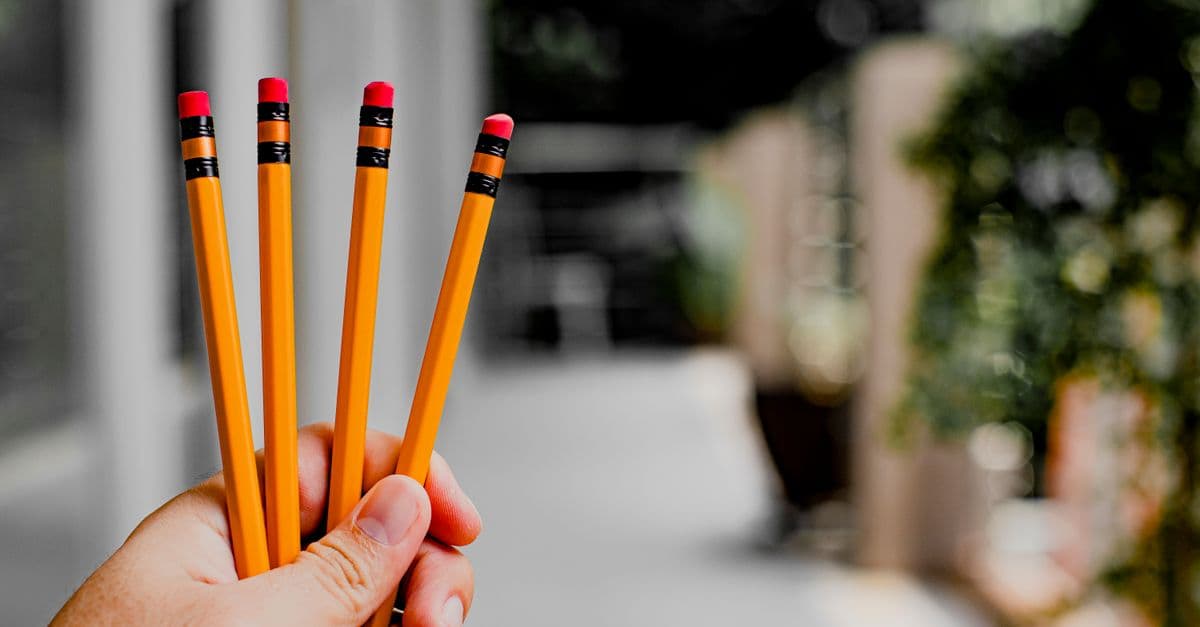
Photo: Nothing Ahead / Pexels
In 1564, shepherds in the Borrowdale Valley of England's Lake District discovered a dark, waxy mineral that looked like coal but did not burn. They used it to mark their sheep. Within a generation, it had given the world the pencil — a writing instrument so effective, so cheap, and so universal that approximately 14 billion of them are manufactured every year, roughly one and a half per person alive. The pencil seems too simple to have a complicated history. It is, instead, one of the most instructive stories in the history of technology: how a geological accident in a remote English valley, filtered through the pressures of war, commerce, and industrial chemistry, produced the world's most reliable writing tool.
What a Pencil Actually Is
Definition: A pencil is a writing instrument consisting of a core of graphite mixed with clay, encased in a wooden cylinder (typically cedar) or mechanical housing. The "lead" in a pencil contains no lead whatsoever — it is a mixture of graphite (a crystalline form of carbon) and clay binder, fired in a kiln to produce a stable, controllable hardness. The proportion of clay to graphite determines hardness: more clay makes a harder, lighter-marking pencil (H grades); more graphite makes a softer, darker one (B grades).
The confusion about "lead" is etymological, not chemical. When the Borrowdale graphite was first discovered, it was mistaken for a form of lead ore — technically, a material called plumbago (from the Latin plumbum, lead). The name stuck for centuries even after chemists established that the substance was actually pure crystalline carbon, subsequently named graphite by the geologist Abraham Gottlob Werner in 1789.
The pencil is an analog tool with a deceptively precise mechanism. The act of writing or drawing with a pencil transfers tiny graphite particles onto the paper surface through a combination of pressure and friction — graphite layers shear apart (it has a layered molecular structure, as does graphene), and those layers adhere loosely to paper fibers. This is why graphite marks can be erased: the adherence is mechanical rather than chemical, and a rubber eraser disrupts the bond without damaging the paper.
Source: Pencil — Wikipedia, citing graphite chemistry and pencil manufacturing processes.
Source: British Library — "The history of the pencil," blogs.bl.uk/untoldlives (2019).
The Borrowdale Deposit: Purest Graphite Ever Found
In 1564, a deposit of pure graphite was found in the Borrowdale Valley, near Keswick in what is now the English Lake District. The circumstances of discovery vary in the telling — the most commonly repeated story involves a fallen tree during a storm revealing a dark mineral seam — but the key fact is undisputed: the Borrowdale graphite was of extraordinary purity, solid enough to be cut into sticks, and unlike any material previously known.
Its first use was practical and agricultural: farmers and shepherds cut chunks into small pieces to mark their livestock. The dark waxy mineral left clear, permanent marks on wool and skin. It did not crumble easily, held its shape, and could be sharpened.
Within a few decades, craftsmen had recognized that thin sticks of Borrowdale graphite, wrapped in string or sheepskin to protect the fingers, could produce precise, controlled lines on paper. This was a significant improvement over quill pens, which required constant re-inking, deposited wet ink that smeared until dry, and could not produce a continuous line without interruption. A graphite stick required no ink, worked at any angle, and produced marks immediately without waiting to dry.
The Borrowdale deposits remained the world's primary source of high-quality graphite for over two centuries. The site is now a National Historic Landmark. The graphite found there was, and remains, the purest ever discovered anywhere in the world — a geological accident whose quality has never been replicated.
Source: The Pen Company Blog — "The remarkable history of the pencil," thepencompany.com.
Source: British Library — "The history of the pencil," blogs.bl.uk/untoldlives (2019).
| Year | Event |
|---|---|
| 1564 | Borrowdale graphite deposit discovered, Keswick, England |
| 1565 | Swiss naturalist Conrad Gessner first describes graphite writing in Treatise on Fossils |
| 1600s | Keswick pencil-making industry established; graphite encased in wood |
| 1761 | Kaspar Faber founds pencil-making workshop in Stein, Germany |
| 1789 | Geologist Abraham Werner names the mineral "graphite" |
| 1795 | Nicholas-Jacques Conté patents graphite-clay mixture process in France |
| 1802 | Koh-I-Noor patents graphite-clay lead production method |
| 1812 | William Monroe, Massachusetts, first American wood-cased pencil |
| 1858 | Hymen Lipman patents pencil with attached eraser |
| 1900 | Faber-Castell becomes global pencil market leader |
| 1930s | Mechanical (propelling) pencil patents proliferate |
| 2023 | Estimated 14+ billion pencils manufactured globally per year |
Kaspar Faber and the German Pencil Industry
The industrial manufacture of pencils — as opposed to cottage craft production in Keswick — began in central Germany, where the Nuremberg region had been a center of graphite processing since the late 16th century. The forests of Bavaria provided cedar wood; the trade routes of southern Germany provided markets.
In 1761, Kaspar Faber, a cabinetmaker born in 1730, established a pencil-making workshop in Stein, near Nuremberg. He was not the first German pencil maker, but his business survived when most did not, and it did so through consistent quality and the dynastic management that would define the Faber-Castell story for eight generations.
In 1771, recognizing that pure graphite pencils crumbled and broke too easily, Faber undertook experiments mixing ground graphite with sulfur, antimony, and binding resins to produce a more durable core. The results were better than pure graphite sticks but chemically inconsistent — the technique varied across batches and manufacturers, making quality control difficult.
The business passed to Kaspar's son Anton Wilhelm, who incorporated it as A.W. Faber — initials that would stamp Faber products for a century. By the mid-19th century, A.W. Faber was exporting pencils across Europe and to the United States, capitalizing on growing literacy rates and the expansion of clerical work that came with industrialization.
In 1900, Lothar von Faber's granddaughter Ottilie married Count Alexander von Castell-Rüdenhausen, and the company was renamed Faber-Castell — the name it carries today, one of the oldest family businesses in the world at over 260 years. Faber-Castell currently manufactures approximately 2 billion pencils annually in more than 120 colors.
Source: Wikipedia — "Faber-Castell," citing company history.
Source: Hamilton Pen Company — "Faber-Castell: Pens, Pencils and a Whole lot of History," hamiltonpens.com.
The Conté Revolution: How Napoleon Made the Pencil Better
The Borrowdale deposit was the world's only source of solid graphite pure enough to be cut into writing sticks. For two centuries, the English had a near-monopoly on pencil-quality graphite. Then came Napoleon.
During the Napoleonic Wars, the British naval blockade cut France off from English graphite. French pencil manufacturers faced a supply crisis. Nicholas-Jacques Conté, a scientist and artist serving in Napoleon's army, was tasked with finding a solution.
In 1795, Conté developed and patented a process that changed pencil manufacturing permanently. Rather than relying on pure graphite, he powdered lower-quality graphite from other sources (or recycled scrap), mixed it with clay, formed it into a paste, extruded it into thin rods, and fired those rods in a kiln at high temperature. The kiln-firing fused the graphite and clay into a hard, stable, precisely calibrated core.
The critical insight was that the clay-to-graphite ratio controlled hardness. Increase the clay fraction: harder, lighter-marking pencil. Increase the graphite fraction: softer, darker marks. By adjusting the ratio, Conté could produce pencils calibrated to specific purposes — drafting, writing, artistic shading — with consistent, repeatable results.
This is still, in its essentials, how pencil cores are made today. Every HB pencil (a medium hardness used in most writing pencils) produced anywhere in the world uses a variation of Conté's 230-year-old formulation. The Conté process also freed pencil manufacturing from dependence on the Borrowdale deposit, opening the market to German, French, American, and eventually East Asian manufacturers.
Conté received a French patent for his process, though the exact date of the patent varies between 1795 and 1802 depending on the source. Koh-I-Noor, a Czech stationery company, separately patented a similar process in 1802.
Source: Enchanted Learning — "Invention of the Pencil," enchantedlearning.com.
Source: British Library — "The history of the pencil," blogs.bl.uk/untoldlives (2019).
The "I, Pencil" Argument: A Supply Chain Like No Other
In 1958, Leonard Read, founder of the Foundation for Economic Education, published a short essay titled "I, Pencil," written in the first person from the perspective of a pencil. It became one of the most widely read essays in economic philosophy, used by everyone from Milton Friedman to Ronald Reagan to illustrate the spontaneous order of markets.
The pencil's point — pun intended — was that no single person on Earth knows how to make a pencil from scratch. The cedar wood comes from Oregon, logged with saws made from steel, powered by engines running on petroleum refined in Louisiana, delivered by trucks using tires from Malaysian rubber. The graphite comes from Sri Lanka, mixed with clay from Mississippi, with an ammonium hydroxide binding agent from a chemical plant. The brass ferrule holding the eraser is mined in Zimbabwe, smelted in Pennsylvania, formed in Connecticut. The eraser contains rapeseed oil from the Dutch East Indies, sulfur monochloride from a chemical plant, and pumice from Italy.
Read's essay was a philosophical argument about decentralized coordination — that millions of people, none planning to produce a pencil, collectively produce 14 billion of them annually through price signals alone. The pencil becomes a proof of concept for spontaneous economic order.
Whether or not one accepts Read's libertarian conclusions, the supply chain he described is accurate. The humble pencil is, in terms of international supply chain complexity, comparable to a semiconductor chip: an object whose production requires coordinating raw material sources, industrial processes, and distribution networks across dozens of countries. The difference is that the pencil has been doing this since the 1800s.
Think of the pencil as a supply chain crystal: it makes visible, in the simplest possible object, the invisible global web of interdependencies that underlies all manufactured goods. As the printing press made information transmissible across space and time, the pencil made the drafts, notes, and calculations that preceded every major invention of the industrial age.
Source: Leonard Read — "I, Pencil," Foundation for Economic Education (1958), fee.org.
The Science of Hardness Grades
Walk into an art supply store and you'll find pencils labeled from 9H to 9B, with F and HB in the middle. This grading system is Conté's legacy.
The H scale (H for hardness) runs from H to 9H. More clay, less graphite. Harder cores, lighter marks, more resistance to breakage. Architects, technical drafters, and anyone needing precise, fine lines prefer hard pencils.
The B scale (B for blackness) runs from B to 9B. More graphite, less clay. Softer cores, darker marks, more smudge-prone but capable of rich tonal variation. Artists prefer soft pencils for shading and expressive drawing.
HB sits at the middle — roughly 50:50 in terms of hardness and blackness. It is the writing pencil standard. The British "HB" roughly corresponds to the American "#2" (both denote the same hardness range), which is why standardized tests have specified #2 pencils since optical mark recognition machines were calibrated to the graphite density of that grade.
The number 2 in the American grading system goes back to Hyman Lipman's 1858 patent for the pencil with an attached eraser (later invalidated because the patent merely combined two existing products). The American grading system using numbers 1–4 was developed by the Eagle Pencil Company in the early 20th century.
Source: The Pen Company Blog — "The remarkable history of the pencil," thepencompany.com.
Source: Graphography — "Mechanical Pencil Month – Day 1: Borrowdale Plumbago," graphography.org (2022).
Unintended Consequences: The Graphite Economy and Mechanical Pencils
The Borrowdale discovery triggered an economic ripple that its discoverers could not have anticipated. Because solid graphite was so valuable and so scarce, the English Crown restricted its export. Smuggling Borrowdale graphite became a capital offense in the 18th century. The mine was worked only a few weeks a year to control supply and keep prices high. This artificial scarcity, rather than depleting the deposit, actually preserved it — the Borrowdale mine was still operational (as a tourist attraction) in the 20th century.
The Conté process had the opposite effect: by making graphite quality fungible, it collapsed prices and democratized pencil access. By the 1820s, a pencil was no longer a luxury item. By the 1880s, a Faber standard pencil cost fractions of a cent. Universal education — the spread of literacy through state school systems in Europe and America — consumed pencils by the billion.
The mechanical pencil, which advances a replaceable graphite rod through a ratchet mechanism, was developed in multiple forms through the 19th century, with the first workable patent often attributed to Sampson Mordan in 1822 in England. The modern propelling pencil — with a twist or click mechanism advancing the lead — became widespread in the 20th century, particularly in Japan, where companies including Pentel and Pilot developed precision mechanical pencils with 0.5 mm and 0.3 mm graphite rods suited for densely written Japanese characters.
The environmental footprint of the traditional wooden pencil is modest but real. Approximately 82,000 trees are cut annually to produce the 14 billion wooden pencils manufactured each year. Most pencils use incense cedar (Calocedrus decurrens), a western North American tree valued for its straight grain and workability; California-grown cedar was the gold standard for pencil manufacturers through most of the 20th century.
Source: World Atlas — "The World's Top Producers of Pencils and Crayons," worldatlas.com.
Source: World Atlas — "How Many Trees Are Cut Down Each Year To Make Pencils?" worldatlas.com.
Priority and Patents: Who Owns the Pencil?
The pencil's invention is genuinely diffuse. No single person invented it in the way that Robert Goddard invented the liquid-fuel rocket or Haber invented ammonia synthesis. The key steps were: (1) the geological accident of the Borrowdale discovery; (2) the empirical craft knowledge of Keswick pencil makers who figured out how to case graphite in wood; (3) Conté's 1795 formulation, which was the crucial manufacturing breakthrough; and (4) the German manufacturing tradition, particularly Faber, that scaled production industrially.
Several specific patents in pencil history are worth noting. Hymen Lipman of Philadelphia patented the pencil with an attached eraser in 1858 (U.S. Patent No. 19,783), licensing his patent until it was invalidated by the Supreme Court in 1875 on the grounds that the patent merely combined two already-existing inventions without producing a new result. Joseph Reckendorfer had bought the patent from Lipman and was attempting to enforce it against the Faber company; the Supreme Court's decision in Reckendorfer v. Faber (1875) established important precedent about what constitutes patentable novelty.
The hexagonal cross-section of most modern pencils — which prevents rolling off desks — was introduced by Lothar von Faber in the mid-19th century and became an industry standard.
Source: Encyclopedia.com — "Pencils," citing manufacturing history.
Source: Invention of pencil history — gosharpener.com.
Where the Pencil Stands Today
Despite digital technology — tablets, styluses, voice recognition — pencil production has not declined significantly. Approximately 14–20 billion pencils are produced globally each year, with China as the dominant manufacturer and exporter. The United States alone produces over 2 billion annually.
The pencil's survival in the digital age reflects properties that digital tools have not replicated: zero battery requirement, zero boot time, function at extreme temperatures, operation underwater, and a tactile feedback that many users, particularly in drawing and writing practice, prefer. NASA famously spent $6 million developing the Fisher Space Pen to work in microgravity — the Russians, as the well-known anecdote goes, used a pencil. (The truth is more complicated: loose graphite particles in space were considered a fire hazard, and both agencies eventually adopted the Space Pen.)
The pencil connects to the history of other writing instruments examined in this series. As the printing press industrialized writing's distribution, the pencil industrialized writing's creation. Every architect's blueprint, every scientist's notebook margin, every student's draft begins with the same Conté-formulated graphite-clay core, a Borrowdale shepherd's mark on the world.
Source: World Atlas — "The World's Top Producers of Pencils and Crayons," worldatlas.com.
Source: Pencil — Wikipedia, citing global production statistics.
FAQs
Q: When was the pencil invented?
A: The modern pencil as we know it traces to 1564, when the Borrowdale graphite deposit was discovered in England, allowing graphite sticks to be encased in wood. The key manufacturing innovation — the graphite-clay mixture fired in a kiln — was patented by Nicholas-Jacques Conté in 1795, and this process, with refinements, is still used today.
Q: Does a pencil contain lead?
A: No. Pencil "leads" contain graphite (a crystalline form of carbon) mixed with clay. The name "lead" persists because early graphite was mistaken for lead ore (plumbago) when first discovered at Borrowdale in 1564. The geologist Abraham Werner established it was carbon, not lead, and named it graphite in 1789.
Q: What do pencil hardness grades mean?
A: Pencil hardness grades reflect the ratio of clay to graphite in the core. H grades (H to 9H) contain more clay, making harder, lighter-marking pencils used for technical drafting. B grades (B to 9B) contain more graphite, making softer, darker pencils preferred by artists. HB (or #2 in the American system) is the standard writing grade.
Q: What was the Conté process and why did it matter?
A: Nicholas-Jacques Conté, a French army scientist, developed a process in 1795 that mixed powdered graphite with clay, formed the mixture into rods, and fired them in a kiln. This freed pencil manufacturing from dependence on the scarce Borrowdale graphite deposit, allowed precise hardness calibration by adjusting the clay-graphite ratio, and is the basis for all modern pencil manufacturing.
Q: How many pencils are made each year?
A: Approximately 14 billion pencils are manufactured globally each year by most estimates, with China as the dominant producer. Some sources estimate as many as 20 billion. This translates to roughly 82,000 trees cut annually for pencil cedar wood.
Q: What is the "I, Pencil" essay?
A: "I, Pencil" is a 1958 essay by economist Leonard Read, written from the first-person perspective of a pencil. It argues that no single person knows how to make a pencil — the cedar, graphite, clay, rubber, brass ferrule, and lacquer each require entire global supply chains and industries. Read used this observation to argue for the spontaneous coordination properties of free markets.
Read next:
Weekly digest
Stay ahead of the curve
Get the best science, AI, and tech stories delivered to your inbox every week. No spam — unsubscribe any time.
About the Author
SciHub101 is an independent science and technology publication founded and edited by Buğra Sözeri, a software engineer and app developer based in Türkiye. Articles are drafted against peer-reviewed literature and primary sources, fact-checked, and edited by a human before publication. Where we compare products, anything built by our own team is labelled as such — see the editorial guidelines and About page for how corrections and disclosures work.
Related Articles
The Radio: Marconi, Tesla, and the Invention That Wired the Air
How Guglielmo Marconi's 1895 wireless experiments — and a disputed 1943 Supreme Court ruling crediting prior patents — built the radio into the foundation of all modern wireless communication.

The Paperclip: Supply Chains, Myths, and 11 Billion Units a Year
The paperclip's true origin is more complicated than Johan Vaaler. Here's the real history of the Gem design, the WWII resistance myth, and 11 billion units per year.
Battery Invention: From Volta Pile to Lithium-Ion
The battery begins with Volta's pile, but modern batteries evolved through chemistry, materials, portability, and rechargeable systems.
The Air Conditioner: The Invention That Reshaped Where Humans Can Live
Willis Carrier set out to fix a printing problem in 1902 Brooklyn. The machine he designed ended up reshaping cities, enabling the Sun Belt, and creating a climate paradox.
The Mechanical Clock: How Humanity Learned to Slice Time
From the verge escapement of 1275 to atomic clocks accurate to one second in 300 million years — the 750-year story of how timekeeping reshaped civilization.

The Safety Elevator: The Invention That Built the Modern City
How Elisha Otis's 1853 rope-cutting stunt solved humanity's fear of falling and made the skyscraper — and the modern vertical city — structurally possible.