The Radio: Marconi, Tesla, and the Invention That Wired the Air
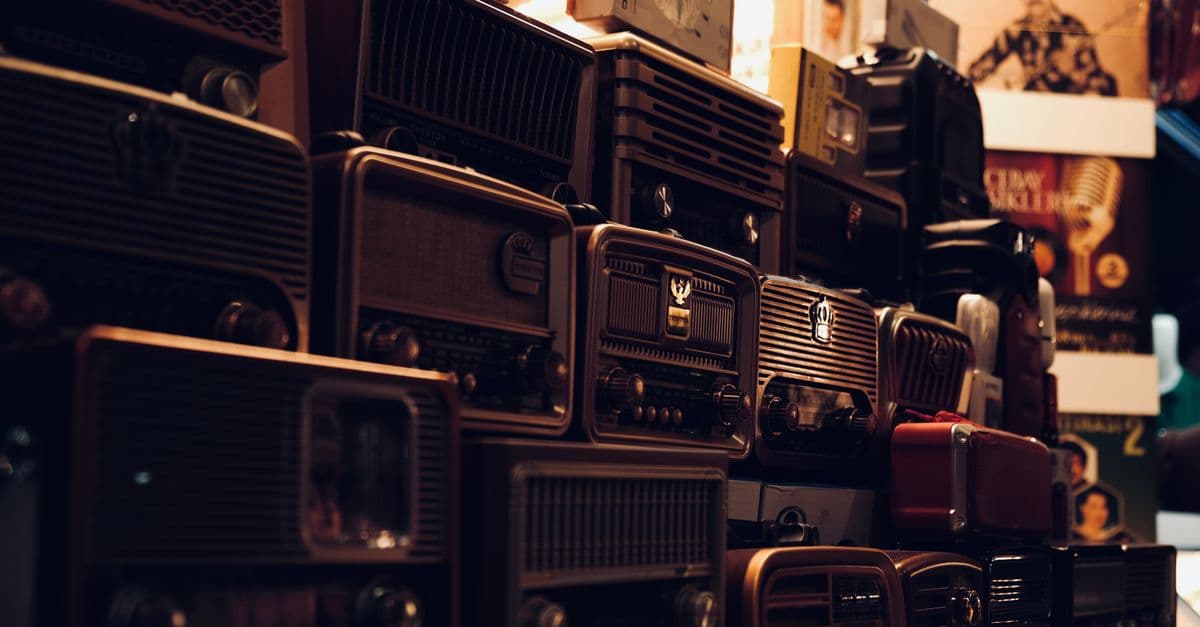
Photo: Müşerref İkizoğlu / Pexels
In 1887, Heinrich Hertz proved that invisible electromagnetic waves could travel through space at the speed of light. He had no practical application in mind. Within eight years, a 21-year-old Italian entrepreneur in his parents' attic had turned Hertz's physics into a working wireless telegraph. Within fourteen years, Marconi claimed to have sent a signal across the Atlantic Ocean. The radio was not one invention — it was a relay race, with discoveries passing between physicists and engineers across three countries and two decades. The question of who deserves credit for the final product has occupied lawyers, historians, and national pride ever since.
The Story Behind the Discovery
Electromagnetic wave — a self-propagating disturbance in the electromagnetic field, consisting of oscillating electric and magnetic components at right angles to each other and to the direction of travel. Radio waves are electromagnetic waves at frequencies below approximately 300 GHz.
James Clerk Maxwell, the Scottish physicist, predicted in 1865 that oscillating electric charges would generate waves of electromagnetic energy that would propagate through space at the speed of light. Maxwell's equations were the theoretical framework; he never built a transmitter or receiver. He died in 1879 without seeing his prediction verified experimentally.
Heinrich Rudolf Hertz took on that task. Working at the University of Karlsruhe in 1887, Hertz constructed an apparatus consisting of a spark gap transmitter — a metal rod with a gap in the center, connected to an induction coil that produced oscillating sparks — and a copper ring with its own small gap as a receiver. When the transmitter sparked, the receiver sparked too, across the room, with no physical connection between them. Hertz had created and detected radio waves.
Source: KIT (Karlsruhe Institute of Technology) — "Research into Electromagnetic Waves by Heinrich Hertz" — the institute where Hertz conducted his 1887 experiments documents the original apparatus and methodology.
Hertz measured the wavelength and velocity of his waves and confirmed they matched Maxwell's prediction exactly — the velocity of light. He demonstrated that the waves exhibited reflection, refraction, and polarization, just as light does. He published his results and moved on to other problems. When asked about practical applications of his discovery, Hertz reportedly said he couldn't see any. He died of a bone disease in 1894, aged 36.
The technology Hertz dismissed as impractical was about to change the world.
How Marconi Built the Radio
Guglielmo Marconi was 20 years old when he read about Hertz's experiments in a scientific obituary in 1894. The article noted Hertz's death and summarized his work on electromagnetic waves. Marconi recognized immediately that if you could generate electromagnetic waves and detect them at a distance, you had wireless telegraphy — a telegraph that required no physical wire.
This idea was not original to Marconi. Several other experimenters had the same thought within months of Hertz's death, including Oliver Lodge in England and Augusto Righi in Italy (who was Marconi's professor in Bologna). What Marconi did that the others did not was pursue the practical engineering problem with single-minded focus.
In his family's attic at the Villa Griffone near Bologna, Marconi began systematic experiments in 1894. He used a Hertz-type spark transmitter, added a Morse key to produce dots and dashes, connected the transmitter to a vertical wire antenna, and connected the receiver to both a wire antenna and a ground connection. By the summer of 1895, he was transmitting signals roughly 1.5 km (about 1 mile) across his family's estate.
Source: Ericsson Historical Archives — "Early Developments: Bell, Gray and the invention of the telephone" and parallel coverage of Marconi's development — documents the 1895 Villa Griffone experiments.
Coherer — the detection device Marconi initially used, invented by Edouard Branly and improved by Oliver Lodge. A glass tube filled with metal filings between two electrodes; the filings "cohere" (clump together and reduce resistance) when a radio signal passes through them, allowing current to flow and trigger a recording device. It was crude and had to be tapped to reset after each signal, but it worked.
Marconi's Italian government showed no interest. He traveled to England in 1896, where his mother's family connections gave him access to the British Post Office. He demonstrated his system to William Preece, the Post Office's chief engineer. Preece was impressed and helped Marconi arrange a series of public demonstrations.
The Transmitter and Receiver: How Radio Actually Works
Understanding radio requires distinguishing two separate problems: generating a useful signal, and extracting that signal from the noise of everything else in the electromagnetic environment.
Generating the Signal
Marconi's spark gap transmitter generated an electromagnetic wave by forcing a spark across a gap. The spark is an oscillating discharge — electrons rushing back and forth across the gap create oscillating electromagnetic fields that radiate outward as waves. The frequency of the oscillation is determined by the electrical properties of the circuit (inductance and capacitance). This is analogous to a guitar string: the length and tension determine the pitch (frequency). In a radio circuit, inductance and capacitance play the roles of tension and length.
Modulation — the encoding of information onto a radio wave by varying one of its properties. Early radio used spark transmitters that produced a burst of waves to represent a Morse dot or dash — essentially on/off switching, called amplitude modulation at its crudest. Modern radio encodes information by varying the amplitude (AM), the frequency (FM), or the phase of the carrier wave.
Carrier wave — a continuous sinusoidal radio wave at a specific frequency, onto which information is modulated. The carrier wave itself carries no information; it is the variation in its properties that carries the signal.
The Tuning Problem and Karl Braun's Contribution
Marconi's early spark transmitters produced a broad, messy burst of energy across a wide range of frequencies — like shouting in a crowded room rather than speaking at a specific pitch. If two transmitters were operating simultaneously nearby, they would interfere. As radio use grew, this became an acute problem.
Karl Ferdinand Braun, a German physicist, solved it. In 1898, Braun developed the coupled circuit transmitter: a closed resonant circuit (with a precise inductance-capacitance combination that oscillated at a specific frequency) was loosely coupled to the antenna. This focused the radiated energy onto a narrow frequency band, like a tuned musical instrument instead of random noise. The result was much greater transmission efficiency at a specific frequency and much less interference with other stations.
Source: University of Würzburg, Physics Faculty — "Karl Ferdinand Braun (1909)" — Nobel Prize documentation for Braun's contributions to wireless telegraphy.
Braun also developed the crystal detector — a pointed wire (cat's whisker) touching a crystal of galena — as a receiver. This was the technology inside every crystal radio set of the early twentieth century, and it worked without any battery or external power supply: the energy of the radio wave itself powered the detector.
For his improvements to Marconi's system, Karl Braun shared the 1909 Nobel Prize in Physics with Marconi. Their joint citation was "for their contributions to the development of wireless telegraphy."
How a Receiver Works
The receiving antenna is a wire that electromagnetic waves push electrons back and forth in — a tiny current, in the microampere range, oscillating at the frequency of the incoming wave. The receiver's job is to:
- Select the desired frequency and reject all others (tuning circuit — a variable inductor or capacitor that resonates at the desired frequency, like a wine glass that rings only to its own pitch).
- Detect the modulation — extract the information from the carrier wave (detector circuit).
- Amplify the result — the detected signal is too weak to drive a loudspeaker without amplification (amplifier).
Vacuum tubes enabled step 3 and transformed radio from a Morse code curiosity into a medium for voice and music. Lee de Forest's Audion triode vacuum tube (1906) was the first practical amplifier for radio signals. Transistors replaced vacuum tubes in the 1950s; integrated circuits replaced discrete transistors; software-defined radios (SDRs) now perform most of these functions in software on a general-purpose processor.
The People Involved
Guglielmo Marconi (1874–1937)
Marconi was the son of a wealthy Italian landowner and an Irish mother (Annie Jameson, of the Jameson whiskey family), which gave him connections in both Italy and England and comfortable funding for his early experiments. He was not primarily a physicist — he never produced original theoretical work — but he was a superb practical engineer and an exceptionally aggressive businessman.
He founded the Marconi Wireless Telegraph Company in 1897 and turned radio into a global industry. His strategy was to lease equipment and operators rather than sell transmitters, maintaining control of the wireless communication network. By 1910, Marconi's company operated coastal stations around the Atlantic and provided ship-to-shore communication for most of the world's major shipping lines.
The role of Marconi's radio in the Titanic disaster (1912) — where wireless distress calls summoned rescue ships that saved over 700 lives — established radio as a safety technology and accelerated government support for wireless regulation. Marconi personally met the Titanic's survivors when they reached New York.
Source: History.com — "First radio transmission sent across the Atlantic Ocean, December 12, 1901" — documents the Marconi transatlantic claim and the subsequent verified tests in February 1902.
Marconi was awarded the Nobel Prize in Physics in 1909 (shared with Braun). He remained active in radio development until his death and in later life became associated with Mussolini's Italy, serving in the Italian Senate and accepting several fascist party honors. His political associations are part of his historical record, though separate from his scientific contributions.
Nikola Tesla (1856–1943)
Tesla's position in the radio story is genuine and complicated, and has been distorted in both directions — both understated for decades and then wildly overstated in popular internet mythology.
Tesla filed US Patent 645,576 in 1897, covering a system of wireless transmission that described a four-circuit tuned arrangement: two tuned circuits in the transmitter and two in the receiver. This is a more sophisticated design than what Marconi initially used. Tesla had demonstrated wireless signal transmission in 1893 at the Chicago World's Columbian Exposition, predating Marconi's Villa Griffone experiments.
In 1900, the US Patent Office initially rejected several of Marconi's patent applications, citing Tesla's prior patents. Marconi revised his applications. In 1904 — after Marconi had achieved fame with his transatlantic claim — the Patent Office reversed course and granted Marconi the key patents over Tesla's prior art. Tesla sued Marconi in 1915.
Source: Justia US Supreme Court — "Marconi Wireless Tel. Co. v. United States, 320 U.S. 1 (1943)" — the primary source for the Supreme Court's 1943 decision on Marconi's patents.
Tesla died in January 1943, bankrupt and largely forgotten. Six months later, on June 21, 1943, the US Supreme Court decided Marconi Wireless Telegraph Co. v. United States — a case that Marconi's estate had brought against the US government for wartime use of radio technology. The Court ruled that Marconi's key patent was invalid, having been anticipated by prior work — including Tesla's patents, but also those of Oliver Lodge and John Stone Stone. The ruling did not declare Tesla the inventor of radio; it invalidated Marconi's specific patent claims on the grounds of prior art by multiple inventors.
Read more about Tesla's life and work in the Nikola Tesla biography.
Heinrich Hertz (1857–1894)
Hertz's experimental confirmation of Maxwell's electromagnetic wave theory in 1887 was pure physics with no intended application. He demonstrated that electromagnetic waves travel at the speed of light, reflect off conductors, and can be polarized. Without his experimental proof, there would have been no foundation for Marconi's practical work. Radio waves were called "Hertzian waves" until about 1910, and the unit of frequency — the hertz (Hz) — is named for him. He died at 36, too young to see what his laboratory discoveries became.
Timeline: From Maxwell to 5G
| Year | Event |
|---|---|
| 1865 | Maxwell publishes electromagnetic wave equations — theoretical prediction only |
| 1887 | Hertz experimentally confirms electromagnetic waves at University of Karlsruhe |
| 1893 | Tesla demonstrates wireless transmission at Chicago World's Fair |
| 1894 | Marconi reads Hertz obituary; begins attic experiments |
| 1895 | Marconi achieves ~1.5 km transmission at Villa Griffone |
| 1896 | Marconi demonstrates system to British Post Office; files first British patent |
| 1897 | Marconi Wireless Telegraph Company founded; Tesla files US Patent 645,576 |
| 1898 | Braun develops coupled circuit transmitter — focused, tunable frequencies |
| December 12, 1901 | Marconi claims to receive transatlantic signal (letter "S") at Signal Hill, Newfoundland |
| 1902 | SS Philadelphia tests verify Marconi can receive signals up to 2,100 miles at sea |
| 1906 | Lee de Forest patents Audion triode — enables voice transmission by radio |
| December 24, 1906 | Reginald Fessenden broadcasts voice and music from Brant Rock, Massachusetts — first radio broadcast |
| 1909 | Nobel Prize in Physics awarded jointly to Marconi and Braun |
| 1912 | RMS Titanic uses Marconi radio to send distress signals |
| 1920 | KDKA Pittsburgh begins first regularly scheduled commercial radio broadcasts |
| 1933 | Edwin Armstrong invents FM radio — dramatically reduced noise |
| 1943 | US Supreme Court invalidates Marconi's key radio patent (prior art) |
| 1947 | Transistor invented at Bell Labs — replaces vacuum tubes in receivers |
| 1960s–70s | Satellite radio begins; digital radio signals emerge |
| 1983 | First commercial cellular telephone network (1G) launched |
| 1991 | 2G (GSM) digital cellular standard |
| 2020 | 5G commercial deployment begins globally |
The 1901 Transatlantic Signal: Achievement or Myth?
The most famous moment in Marconi's career — and the most disputed — is the December 12, 1901 transatlantic transmission. Marconi, at Signal Hill in St. John's, Newfoundland, claimed to have received three faint clicks representing the Morse letter "S" transmitted from Poldhu in Cornwall, England, over 3,500 km (2,170 miles) away.
The problem is that this may not have been physically possible with the technology available in 1901. Radio waves at Marconi's frequencies travel in a straight line — they don't follow the curvature of the Earth. For a signal to travel over the Atlantic, it would need to be reflected off the ionosphere (the electrically charged upper atmosphere). The ionosphere's reflective behavior at Marconi's frequencies is highly variable and is generally much weaker during the day. The December daylight conditions at Marconi's frequencies should have made the transatlantic path unreliable at best.
Source: Engineering and Technology History Wiki — "Milestones: Reception of Transatlantic Radio Signals, 1901" — the IEEE's official assessment of the 1901 claim and the February 1902 verification tests.
Later researchers concluded that Marconi may have heard atmospheric static — lightning noise — rather than the transmitted signal. The signal was received on a telephone headset by two listeners; there was no recording. Marconi himself was one of the two people who heard it.
What is not disputed: in February 1902, aboard the SS Philadelphia sailing west from Britain, Marconi produced coherer-tape recordings of Poldhu signals up to 2,500 km (1,550 miles) and audio reception up to 3,400 km (2,100 miles). The transatlantic signal was real; whether it was real on December 12, 1901 specifically is uncertain.
Unintended Consequences
Broadcasting and Mass Culture
Nobody in 1895 imagined radio as a mass entertainment medium. The initial application was ship-to-shore telegraphy — a direct replacement for the wire telegraph in places where wires couldn't go. Voice transmission by radio was demonstrated by Reginald Fessenden on Christmas Eve 1906, when he broadcast voice and music to ship operators in the Atlantic who expected Morse code. They were reported to have been astonished.
Commercial broadcasting — the model of a single transmitter sending to many receivers simultaneously — emerged in the early 1920s. KDKA in Pittsburgh began regularly scheduled broadcasts in November 1920. By 1923, the US had over 500 licensed broadcast stations. Radio became the first mass medium that could reach people simultaneously regardless of literacy, in real time, in their homes. It transformed politics (Roosevelt's fireside chats), entertainment, advertising, and warfare.
Source: ETHW — "First Transatlantic Telegraphic Radio Transmission" covers the transition from point-to-point telegraphy to broadcast applications.
Military Applications and Electronic Warfare
Radio's military applications were understood almost immediately. Naval vessels equipped with Marconi radio could coordinate operations at sea in ways that had been impossible with flag signals and heliographs. World War I made radio-equipped artillery spotters standard. World War II introduced radar — radio direction and ranging — which used reflected radio waves to detect aircraft and ships at distances far beyond visual range. The Allies' radar advantage was a significant factor in the Battle of Britain.
Electronic warfare — jamming, spoofing, and intercepting radio communications — is now a major military discipline. Every modern armed force maintains dedicated units for electromagnetic spectrum operations.
The Foundation of All Modern Wireless
Every wireless technology operating today is a direct descendant of Marconi's demonstration that electromagnetic waves could carry information through air. WiFi, Bluetooth, GPS, cellular networks from 2G through 5G, satellite communication, remote controls, garage door openers, RFID tags — all use electromagnetic waves modulated to carry information, detected by receivers that distinguish the desired signal from noise. The radio is not a historical curiosity. It is the physics layer underneath the entire wireless economy.
Where Radio Stands Today
Broadcast AM and FM radio, the medium that dominated entertainment and news for most of the twentieth century, is in structural decline. US AM radio stations peaked in number in the 1990s and have been decreasing since. FM stations are more stable, but streaming services (Spotify, Apple Music, Podcasts) now consume more audio listening hours in most demographics under 45.
But the radio spectrum is more intensively used than at any point in history. 5G cellular networks, now deployed commercially in most major cities globally, operate at frequencies from under 1 GHz to over 50 GHz. The spectrum they occupy was allocated by national regulators according to frameworks established by international radio treaties — treaties whose structure traces directly to the International Radiotelegraph Conference of 1906, convened partly in response to the chaos of competing early radio operators.
Source: IEEE Spectrum and US FCC spectrum allocation documentation — documents modern spectrum management.
Software-defined radio (SDR) has transformed radio hardware. A traditional radio receiver is a fixed-function analog circuit tuned to a specific technology and frequency range. An SDR is a general-purpose computing platform: the antenna connects to an analog-to-digital converter, and software performs all the demodulation, filtering, and decoding. A single SDR device can receive AM broadcasts, FM broadcasts, aircraft transponders, weather satellites, and GPS simultaneously, switching between them in software. The hardware that Marconi built in a family attic in 1894 has become a software application running on silicon.
FAQs
Q: Who invented radio — Marconi or Tesla? A: The honest answer is neither alone. Hertz proved electromagnetic waves existed. Lodge, Tesla, and Popov made early demonstrations of wireless transmission. Marconi combined existing ideas into the first practical, commercially viable system and built an industry around it. The 1943 Supreme Court ruling invalidated Marconi's key patent as anticipated by prior art (including Tesla's), but it did not name any single person as "the inventor of radio."
Q: Did the Supreme Court rule that Tesla invented radio? A: No. The Court ruled in Marconi Wireless Tel. Co. v. United States (1943) that Marconi's specific patent claims were invalid because they were anticipated by prior patents from multiple inventors, including Tesla, Oliver Lodge, and John Stone Stone. The ruling was about Marconi's patent being invalid, not about Tesla being the inventor. The popular claim that "the Supreme Court gave radio to Tesla" overstates what the decision said.
Q: Did Marconi really send a signal across the Atlantic in 1901? A: He claimed to receive three clicks representing the Morse letter "S" on December 12, 1901. The claim is disputed because the physics of ionospheric propagation at his frequencies in December daylight conditions makes reliable transatlantic reception questionable. By February 1902, he had produced recorded documentation of transatlantic reception. The 1901 date is uncertain; verified transatlantic radio communication by 1902 is not.
Q: What did Karl Braun contribute to radio? A: Braun developed the coupled circuit transmitter (1898), which focused radio energy on a specific, tunable frequency rather than spraying it across a broad spectrum. This made radio practical for multiple simultaneous users and dramatically improved transmission efficiency. He shared the 1909 Nobel Prize in Physics with Marconi for this work.
Q: What is the difference between AM and FM radio? A: AM (amplitude modulation) encodes information by varying the strength (amplitude) of the carrier wave. FM (frequency modulation), invented by Edwin Armstrong in 1933, encodes information by varying the frequency of the carrier wave. FM produces much lower noise because most interference affects wave amplitude, not frequency. FM audio quality is significantly better than AM for music; AM travels further over long distances, especially at night.
Q: How does a cell phone's radio differ from Marconi's original system? A: In principle, both use electromagnetic waves modulated to carry information. In practice, they differ on every technical dimension. Marconi used frequencies of roughly 1 MHz and spark-gap transmitters producing crude amplitude modulation. A 5G smartphone uses frequencies from 600 MHz to 50 GHz, digital phase modulation encoding hundreds of megabits per second, and performs dozens of simultaneous frequency channels using OFDM (Orthogonal Frequency Division Multiplexing). The physics is the same; the engineering is unrecognizably different.
Q: What happened to AM radio? A: AM broadcast radio is in decline. US AM stations have decreased in number since their 1990s peak, and several major AM stations have converted to FM or ceased operations. Listening to AM radio has been displaced by FM, streaming audio, and podcasts in most markets. The AM broadcast band itself — 535 to 1705 kHz — remains allocated for AM broadcasting, but spectrum regulators are discussing potential reallocation as AM's audience shrinks.
Q: What is software-defined radio? A: An SDR is a radio system where functions traditionally performed by analog hardware — filtering, modulation, demodulation — are instead performed by software on a digital processor. The antenna connects to an analog-to-digital converter, and all signal processing happens computationally. A single SDR device can receive many different types of radio signals by changing software rather than hardware, making it highly flexible for research, monitoring, and experimental applications.
The Takeaway
Radio's story is a lesson in the gap between scientific discovery and practical invention. Hertz proved electromagnetic waves existed and declared them useless. Maxwell's equations predicted them years earlier and he never built a transmitter. Tesla demonstrated wireless transmission but couldn't build a business. Marconi, working from others' physics with a businessman's focus, turned a parlor curiosity into global infrastructure in under a decade. The 1943 Supreme Court ruling that invalidated his key patent was a legal footnote; the industry he created was a permanent fact. Every time a signal travels through air from a transmitter to a receiver — in a cell phone, a WiFi router, a GPS satellite, a 5G tower — it follows the path Marconi traced in his parents' attic in 1894.
Read next:
Follow new articles
Add SciHub101 to your feed reader to see new science and technology stories.
About the Author
SciHub101 is an independent science and technology publication founded and edited by Buğra Sözeri, a software engineer and app developer based in Türkiye. AI tools assist with drafting and research. Source documentation in the existing archive is uneven, and articles are being reviewed and corrected. The Editorial Team byline identifies editorial responsibility; it does not certify specialist or independent human review. Where we compare products, anything built by our own team is labelled as such — see the editorial guidelines and About page for how corrections and disclosures work.
Related Articles

The Refrigerator: How Mechanical Cooling Changed Food, Medicine, and Cities
How the refrigerator was invented, from Cullen's ether experiments and Perkins's patent to Linde, Freon, the ozone fight, and today's refrigerants.

The Pencil: How a Graphite Deposit Changed Writing Forever
From the 1564 Borrowdale graphite discovery to Conté's clay-graphite process and 14 billion pencils made annually — the complete story of the world's simplest tool.
The Electric Power Grid — How Edison, Tesla, and Insull Wired the Modern World
From Edison's Pearl Street DC station in 1882 to the AC war of currents, Insull's monopoly model, and today's smart grid, the electrical power grid shaped every hour of modern life.
The Electric Motor: From Faraday's Wire to the EV Revolution
Michael Faraday's 1821 rotating wire became the device that now consumes 50% of the world's electricity. Here's how the electric motor works and why Tesla's AC design won.

The Radar — How Bouncing Radio Waves Changed War and Weather
From Hülsmeyer's 1904 ship detector to Watson-Watt's Chain Home network, radar reshaped warfare, aviation safety, and meteorology in under a century.