The Telephone: How Bell's Patent Changed Communication Forever
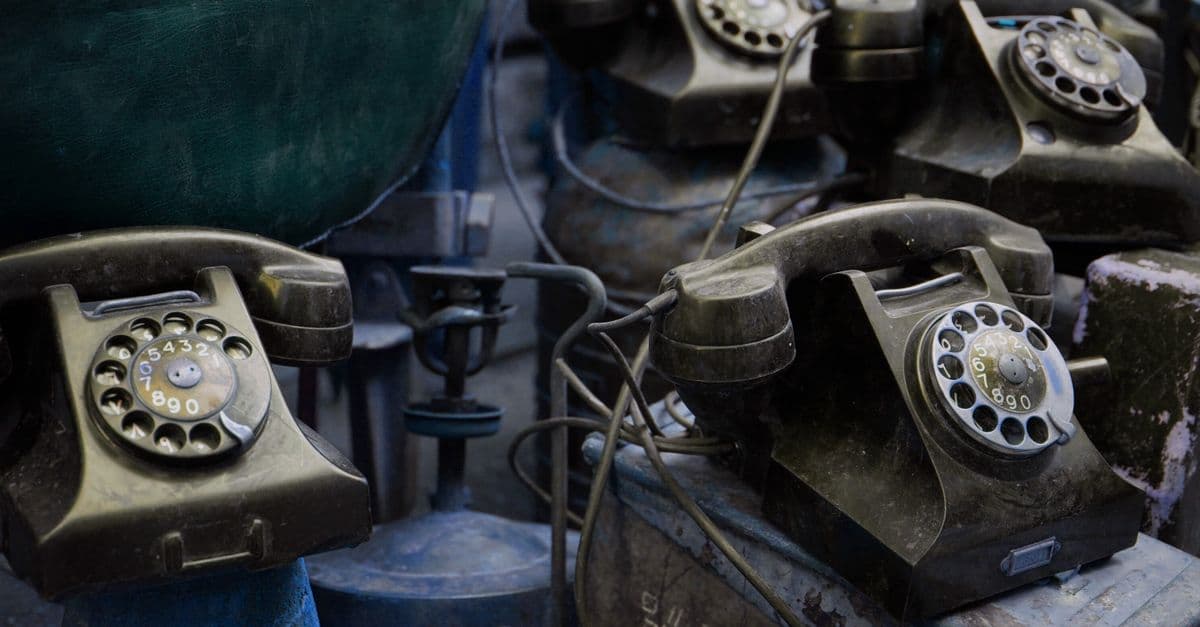
Photo: Ahmet Bozkus / Pexels
On February 14, 1876, two inventors arrived at the US Patent Office with applications for the same idea: a device that could transmit the human voice over an electric wire. One filed as a formal patent. The other filed a caveat — a notice of intent. The gap between them was measured in hours, possibly less. That razor-thin margin settled a dispute that would define one of the most consequential inventions in human history and hand one man a monopoly worth billions.
The Story Behind the Race to the Patent Office
Alexander Graham Bell was a 28-year-old Scottish-born elocution teacher living in Boston when he began serious work on what he called the "harmonic telegraph" — a device he hoped could carry multiple telegraph signals simultaneously by varying their pitch. His real interest, though, was voice. His mother was hard of hearing. His wife, Mabel Hubbard, was deaf. Bell had spent his professional life studying sound and speech physiology. The competing claims are examined further in the Bell, Gray and Meucci patent race.
Elisha Gray was 40 years old, an established electrical engineer, and co-founder of what would become Western Electric. He had independently arrived at the same concept: use a varying electric current to reproduce the vibrations of the human voice at a distant receiver. Both men understood the basic physics. Both were racing to be first.
On February 14, 1876, Bell's attorney Gardiner Hubbard filed Bell's patent application at the US Patent Office in Washington. It was the fifth application recorded that day. Gray's attorney filed a caveat — a preliminary claim, not a full patent — for a similar invention. It was recorded as the 39th document filed that day.
Source: Ericsson Historical Archives — "Bell, Gray and the invention of the telephone" chronicles the parallel development and the February 14 filing sequence.
The gap was enough. The patent examiner, Zenas Wilber, later swore in an affidavit that he was an alcoholic deeply indebted to Bell's attorney, that he had shown Bell the confidential details of Gray's caveat during a visit to Washington, and that Bell had paid him $100 in cash. Bell denied it. Gray eventually abandoned his caveat and did not contest Bell's priority in court.
Bell's US Patent 174,465 was granted on March 7, 1876. Three days later came the moment that sealed the legend.
"Mr. Watson, Come Here" — The First Telephone Call
The device Bell patented on March 7 used a liquid transmitter: a needle connected to a diaphragm, dipping into acidulated water. When Bell spoke into it, his voice vibrated the diaphragm, the needle, and therefore the electrical current flowing through the liquid. That fluctuating current traveled a wire to a receiver, where it reproduced the vibrations in another diaphragm — and sound emerged.
On March 10, 1876, Bell was working in his Boston laboratory at 5 Exeter Place with his assistant Thomas Watson. Watson was in an adjoining room. Bell spoke into the transmitter. Watson heard every word: "Mr. Watson, come here. I want to see you."
Source: History.com / HISTORY — "First speech transmitted by telephone, March 10, 1876" — the call's text is documented in Bell's own laboratory notebook, now held at the Library of Congress.
Watson rushed in and confirmed he had heard each word clearly. Bell's notebook entry that day recorded the event in measured, almost dry scientific prose — no triumph, just data. Which is fitting: Bell was a scientist first.
The liquid-transmitter design was soon abandoned as impractical. The device that the public would actually use came from a different direction entirely.
How the Telephone Actually Works
Bell's original telephone operated on a principle that is easier to understand if you think of it as a translation machine. Sound is pressure waves in air. The telephone's job is to translate those pressure waves into electrical signals, send them along a wire, and then translate them back.
Diaphragm — a thin membrane that vibrates in response to sound pressure waves, mimicking the eardrum.
Transducer — any device that converts one form of energy into another. In a telephone, the transmitter transduces acoustic energy into electrical energy; the receiver does the reverse.
In Bell's original design, the diaphragm moved a needle in liquid, varying resistance. A cleaner analogy: think of a garden hose with your thumb over the end. The more you squeeze (more pressure), the faster the water flows. Bell's needle-in-liquid did the same thing with electrons — voice pressure varied the current.
The problem was sensitivity and reliability. Bell's liquid transmitter could barely carry a voice across a room reliably. What made the telephone commercially viable came from two other inventors working in parallel.
The Carbon Microphone: Edison and Hughes
The device that actually went into millions of telephone handsets was not Bell's. It was the carbon granule microphone, developed independently around 1877–1878 by Thomas Edison in the United States and David Edward Hughes in England.
In Edison's design, loose carbon granules sit between two metal plates. Sound waves compress the granules, which changes their electrical resistance. A steady DC current passing through the granules fluctuates in exact proportion to the sound pressure — a clean, high-sensitivity signal. Hughes demonstrated his version before witnesses in London but chose not to patent it, offering his invention freely to the world.
Source: Wikipedia — "Carbon microphone" — documents the parallel independent development by Edison (US patent, mid-1877) and Hughes (demonstrated 1878, not patented).
Edison received the first patent. The ensuing dispute between Edison and Bell's company was settled by a revenue-sharing agreement: Edison's carbon microphone design went into Bell's telephones, and the combination became the standard instrument for the better part of a century.
Electromagnetic receiver — the earpiece side, which Bell got right from the start. A varying current passes through a coil wrapped around a magnet. The fluctuating magnetic field vibrates an iron diaphragm, which pushes air and creates sound. It is an electric motor scaled down to a whisper.
The Analog Signal Chain
For the first hundred years of telephony, every call traveled as an analog electrical signal: a continuously varying voltage that mirrored the waveform of the speaker's voice. Like a river whose level rises and falls with rainfall, the telephone wire carried a current whose amplitude went up and down with every syllable.
At the exchange, human operators — and later automatic switching equipment — connected the circuit between caller and recipient. The entire path was a closed electrical loop: current from the sending microphone, through the wire, through the receiver's earpiece magnet, back along the return wire.
Long distances introduced attenuation: the signal weakened over miles of wire. Amplifiers (originally vacuum tubes, later transistors) were installed at intervals along trunk lines to boost the signal. Transatlantic telephone cables, starting with TAT-1 in 1956, used submersible amplifiers at intervals across the ocean floor.
The People Involved
Alexander Graham Bell (1847–1922)
Bell was born in Edinburgh, Scotland, and grew up in a family obsessed with speech. His grandfather Alexander Bell was an elocutionist. His father, Melville Bell, invented Visible Speech — a phonetic notation system for teaching the deaf to speak. Alexander absorbed all of it.
He moved to Canada with his family in 1870, then to Boston in 1871 to teach methods of Visible Speech at the Boston School for the Deaf. His work with deaf students brought him the patronage of Gardiner Hubbard, whose deaf daughter Mabel Bell would marry. Hubbard funded Bell's telephone experiments.
After the patent was granted, Bell became wealthy but restless. He largely stepped away from telephone development and pursued a range of other problems. He served as president of the National Geographic Society from 1898 to 1903, helped shape its character as a popular science publication, and conducted serious scientific work on aeronautics and hydrofoils. His tetrahedral kite experiments in Nova Scotia between 1895 and 1910 produced structures of remarkable structural efficiency. His HD-4 hydrofoil, built with partner Frederick Baldwin, set a world water-speed record of 87 km/h (54 mph) in 1919 — a record that stood until 1963.
Source: Wikipedia — "Alexander Graham Bell" — covers his later scientific career including the Aerial Experiment Association, the HD-4 hydrofoil, and his eugenics research.
The less comfortable part of Bell's legacy is his engagement with eugenics. Bell believed in hereditary selection and hoped to eliminate hereditary deafness. In a 1883 memoir, "Memoir upon the Formation of a Deaf Variety of the Human Race," he argued that schools for the deaf that segregated deaf students from the hearing population were breeding grounds for a permanent deaf community, which he saw as undesirable. He advocated against sign language in education and pushed oralism — training deaf individuals to speak and lip-read rather than use sign language. The deaf community has consistently viewed this aspect of Bell's career as an attack on their culture and community identity.
Thomas Watson (1854–1934)
Watson was Bell's machinist and technical collaborator, a skilled craftsman from Salem, Massachusetts. He built the instruments Bell designed and was present for every key experiment. After the telephone's success, Watson left the Bell company and had a remarkable second career: he studied geology, became a ship-builder, and even acted in Shakespearean theater. He outlived Bell by twelve years and gave public lectures about the invention until old age.
Elisha Gray (1835–1901)
Gray was in many ways the more experienced electrical engineer of the two rivals. He held patents in telegraph multiplex systems and was co-founder of the Gray & Barton company, which became Western Electric. His telephone caveat described a workable voice transmission system. Whether Gray or Bell arrived first — and whether Bell's attorney engaged in fraud — remains disputed by historians. Gray never ceased believing he had been wronged. He died in 1901 still pursuing alternative claims.
Patent and Priority Disputes
The controversy did not end with Bell's 1876 patent. Over the following decade, the Bell Telephone Company fought more than 600 patent challenges — the most sustained patent litigation in American history up to that point.
| Year | Event |
|---|---|
| February 14, 1876 | Bell patent application filed (5th of the day); Gray caveat filed (39th of the day) |
| March 7, 1876 | US Patent 174,465 granted to Bell |
| March 10, 1876 | First successful voice transmission: "Mr. Watson, come here" |
| 1877 | Bell Telephone Company founded |
| 1878 | Edison's carbon microphone patent issued; revenue-sharing agreement with Bell |
| 1879 | Western Union (backed by Edison and Gray) settles patent dispute with Bell, exits telephone market |
| 1885 | American Telephone and Telegraph (AT&T) incorporated as long-distance subsidiary |
| 1887 | US government moves to annul Bell's patent on grounds of fraud |
| 1888 | US Supreme Court upholds Bell's patent |
| 1893–94 | Bell's original patents expire; competition begins |
| 1913 | Kingsbury Commitment — AT&T agrees to limited competition to avoid antitrust breakup |
| 1984 | AT&T broken up by antitrust consent decree into seven "Baby Bells" |
The 1887 government fraud investigation was serious. Examiner Wilber's affidavit alleged that Bell's attorney had bribed him and shown Bell the details of Gray's caveat. The case wound through nine years of litigation before the Supreme Court upheld Bell's patent in 1888, though the Court did not resolve the fraud allegations directly — it ruled on technical grounds that Bell's application was the first proper patent submission.
Source: WIPO Magazine — "IP Intrigue: From Patent Battle to Bestseller" — covers the Wilber affidavit and the subsequent Supreme Court proceedings.
Western Union, the dominant communications company of the era, initially dismissed the telephone as a toy. They declined to buy Bell's patent for $100,000 — a decision later described as one of the most costly rejections in business history. When Western Union reversed course and entered the telephone market using Gray's design and Edison's carbon microphone, Bell sued and won in 1879. Western Union paid Bell royalties for 17 years and left the telephone business.
The Birth of AT&T and the Monopoly Years
The Bell Telephone Company, founded in 1877, reorganized as American Bell Telephone in 1880 and incorporated its long-distance subsidiary, American Telephone and Telegraph (AT&T), in 1885. When Bell's patents expired in 1893 and 1894, hundreds of independent telephone companies rushed into the market. By 1907, more Americans had access to independent telephone service than to Bell service.
AT&T, under new management led by Theodore Vail, responded with a strategy of acquisition and predatory pricing. By 1913, AT&T controlled most long-distance lines, which independent companies needed to connect their local customers. The federal government intervened. The Kingsbury Commitment of 1913 — a negotiated settlement with the Justice Department — allowed AT&T to keep its long-distance monopoly in exchange for agreeing to allow independent companies to interconnect and to stop acquiring independents without approval.
Source: IEEE History Center, Engineering and Technology History Wiki — Pearl Street Station and telephone network development records.
AT&T's monopoly endured, with modifications, for another seven decades. The 1984 consent decree — the result of a decade-long antitrust suit filed in 1974 — broke AT&T into seven regional Bell Operating Companies ("Baby Bells": Ameritech, Bell Atlantic, BellSouth, NYNEX, Pacific Telesis, Southwestern Bell, US West) plus a long-distance AT&T. The Baby Bells have since reconsolidated substantially; the modern AT&T Inc. is largely the former Southwestern Bell, which acquired the AT&T brand in 2005.
Unintended Consequences
The telephone was expected to transmit music and news — a one-to-many broadcast medium, like a newspaper delivered by wire. Early telephone companies in Hungary and the United States experimented with "telephone newspapers" that delivered news, stock prices, and live musical performances to subscribers in the 1880s and 1890s. What the telephone became instead was something nobody had planned: a private two-way communication channel between individuals.
This shift had profound social effects. For the first time in history, people could have real-time conversations across distances of hundreds or thousands of miles. Business coordination became faster. The telegraph had enabled rapid information exchange, but only in written Morse code, routed through telegraph offices, and delivered as a physical document. The telephone let you argue, reassure, negotiate, comfort — in real time, in your own voice.
It also created anxieties that now seem quaint but were genuine at the time. Newspapers worried that the telephone would make letter-writing obsolete (it didn't, immediately). Physicians warned that listening to electrical voices would damage the ear. There was widespread unease about the permeable boundary between public and private that the telephone created: someone could now reach you in your home, uninvited, at any hour.
The telephone also restructured urban geography. Before the telephone, businesses needed to locate their headquarters near their customers. After it, coordination across distance became cheap and reliable enough that decentralization became feasible. The telephone enabled the modern corporate structure — distributed operations, regional offices, supply chains that span continents.
Source: Science Museum (London) — "Ahoy! Alexander Graham Bell and the first telephone call" — discusses Bell's original vision of broadcasting versus the actual two-way private use that emerged.
Where the Telephone Stands Today
The telephone number assigned to a line by the Bell System's Numbering Plan in 1947 — the North American Numbering Plan, with its three-digit area codes and seven-digit local numbers — is still the backbone of the public switched telephone network (PSTN) in North America.
But the copper wire that carried those calls for a century is largely gone. Today's calls travel as packets of digital data: Voice over Internet Protocol (VoIP), where the voice signal is sampled thousands of times per second, compressed, chopped into data packets, routed across the internet, and reassembled at the destination. Services like WhatsApp, Skype, FaceTime, and Zoom are all telephones in the original sense — real-time voice transmission between two parties — implemented entirely in software over the internet.
Source: BankMyCell — "How Many People Have Smartphones Worldwide (2026)" — reports over 5.4 billion mobile phone users globally as of 2024.
As of 2024, there are over 5.4 billion mobile phone users globally — roughly two-thirds of the entire human population. The United States alone has 276 million smartphone users, representing an 81.6% penetration rate. Landline telephone subscriptions have been collapsing: in the US, landline households fell from about 95% in 2000 to under 30% by 2020, with the decline accelerating each year.
The fixed telephone network that Bell's company built — and AT&T operated as a monopoly for most of a century — is being quietly decommissioned. AT&T has sought regulatory approval to discontinue PSTN copper service. The last of Bell's original infrastructure is being retired, replaced entirely by fiber and wireless.
Meanwhile, the telephone has become something Bell could not have imagined: the primary computing device for most of humanity. The smartphone is a telephone in name only. It is a computer, camera, navigator, payment terminal, and entertainment platform that also happens to let you call someone. The voice call has become one of the least-used features on the device named after it.
Source: Investigative Post — "Global Trends in Mobile Penetration" — global mobile penetration statistics as of 2024.
FAQs
Q: Who really invented the telephone — Bell or Gray? A: Bell holds the patent, granted March 7, 1876, and his patent was upheld by the US Supreme Court in 1888 despite fraud allegations. Gray independently developed a workable design at roughly the same time and filed a caveat on the same day as Bell's patent application. Most historians credit Bell as the legal inventor while acknowledging Gray's parallel, independent work.
Q: What did Bell actually say in the first telephone call? A: According to Bell's own laboratory notebook, the first words transmitted were "Mr. Watson, come here. I want to see you," spoken on March 10, 1876. Thomas Watson confirmed hearing each word clearly.
Q: Did Bell steal Gray's design? A: The allegation rests primarily on Patent Examiner Zenas Wilber's 1886 affidavit claiming he showed Bell confidential details of Gray's caveat in exchange for a $100 bribe. Bell denied it. The Supreme Court upheld Bell's patent in 1888 but did not adjudicate the fraud question directly. The historical record is unresolved.
Q: Why is the first telephone transmission called the "liquid transmitter" experiment? A: Bell's March 10 device used a needle suspended in acidulated water (water with a small amount of sulfuric acid). Speaking into the attached diaphragm moved the needle, varying the electrical resistance of the liquid and thus the current. This design was quickly abandoned in favor of the carbon microphone.
Q: What is VoIP and how does it differ from the original telephone? A: Voice over Internet Protocol converts the analog voice signal into digital data, compresses it, and transmits it as internet packets. The original telephone carried a continuously varying analog electrical signal over a dedicated copper circuit. VoIP is fundamentally a software application running over general-purpose data networks; the original telephone was dedicated hardware running over a dedicated physical circuit.
Q: What happened to AT&T's monopoly? A: The US Department of Justice filed an antitrust suit against AT&T in 1974. A 1982 consent decree, effective January 1, 1984, broke AT&T into seven regional Bell Operating Companies (the "Baby Bells") and a long-distance AT&T. The Baby Bells subsequently reconsolidated; the current AT&T Inc. is primarily the former Southwestern Bell, which purchased the AT&T brand name in 2005.
Q: How did the telephone change daily life? A: The telephone replaced letters and personal visits for time-sensitive communication, enabled distributed corporate structures, and created the first infrastructure for real-time long-distance personal relationships. It also generated the first modern telemarketing industry, the first concerns about electronic privacy, and the first debates about the appropriate boundary between public and private life.
Q: What is Alexander Graham Bell's complicated legacy regarding the deaf community? A: Bell held that hereditary deafness should be eliminated through selective marriage practices, and he actively opposed sign language as a primary mode of deaf education, favoring oralism (spoken speech). His 1883 memoir argued that schools for the deaf inadvertently promoted the formation of a permanent deaf community, which he considered undesirable. The deaf community widely views this work as an attack on their culture; Bell's defense was that he wanted to help deaf individuals integrate into hearing society, not that he viewed deafness as inferior.
The Takeaway
The telephone was not one invention — it was a collision of at least three: Bell's basic electromagnetic transducer design, Gray's parallel development of voice transmission, and Edison and Hughes's carbon microphone that made the device actually work in practice. What Bell held was not the best technical solution but the best-filed patent on the most important date in American patent history. From that moment, everything followed: a legal monopoly, a national communications infrastructure, and a century-long experiment in what it means when humans can speak to each other across any distance in real time. The voice call is now a minor footnote on a smartphone screen — but the infrastructure, the standards, and the habits of mind that the telephone created are still the skeleton of the global communications world.
Read next:
Follow new articles
Add SciHub101 to your feed reader to see new science and technology stories.
About the Author
SciHub101 is an independent science and technology publication founded and edited by Buğra Sözeri, a software engineer and app developer based in Türkiye. AI tools assist with drafting and research. Source documentation in the existing archive is uneven, and articles are being reviewed and corrected. The Editorial Team byline identifies editorial responsibility; it does not certify specialist or independent human review. Where we compare products, anything built by our own team is labelled as such — see the editorial guidelines and About page for how corrections and disclosures work.
Related Articles

The Television: How a Farm Boy Beat a Corporate Giant to Invent TV
On September 7, 1927, 21-year-old Philo Farnsworth transmitted the first all-electronic television image in San Francisco. His battle with RCA to receive credit defines the invention's full history.

The Tampon: Patent, Crisis, and a Century of Contested Design
Earle Haas patented the tampon in 1929 and sold it for $32,000. Mary Kenner improved it and was rejected by investors because she was Black. The 1980 TSS crisis changed everything.

Telephone Invention: Bell, Gray, Meucci, and the Patent Race
The telephone's invention involved Alexander Graham Bell, Elisha Gray, Antonio Meucci, patents, and the race to transmit speech electrically.
Battery Invention: From Volta Pile to Lithium-Ion
The battery begins with Volta's pile, but modern batteries evolved through chemistry, materials, portability, and rechargeable systems.

The Air Conditioner: The Invention That Reshaped Where Humans Can Live
Willis Carrier set out to fix a printing problem in 1902 Brooklyn. The machine he designed ended up reshaping cities, enabling the Sun Belt, and creating a climate paradox.
The Mechanical Clock: How Humanity Learned to Slice Time
From the verge escapement of 1275 to atomic clocks accurate to one second in 300 million years — the 750-year story of how timekeeping reshaped civilization.