The Light Bulb: Edison, Swan, and the Race to Illuminate the World
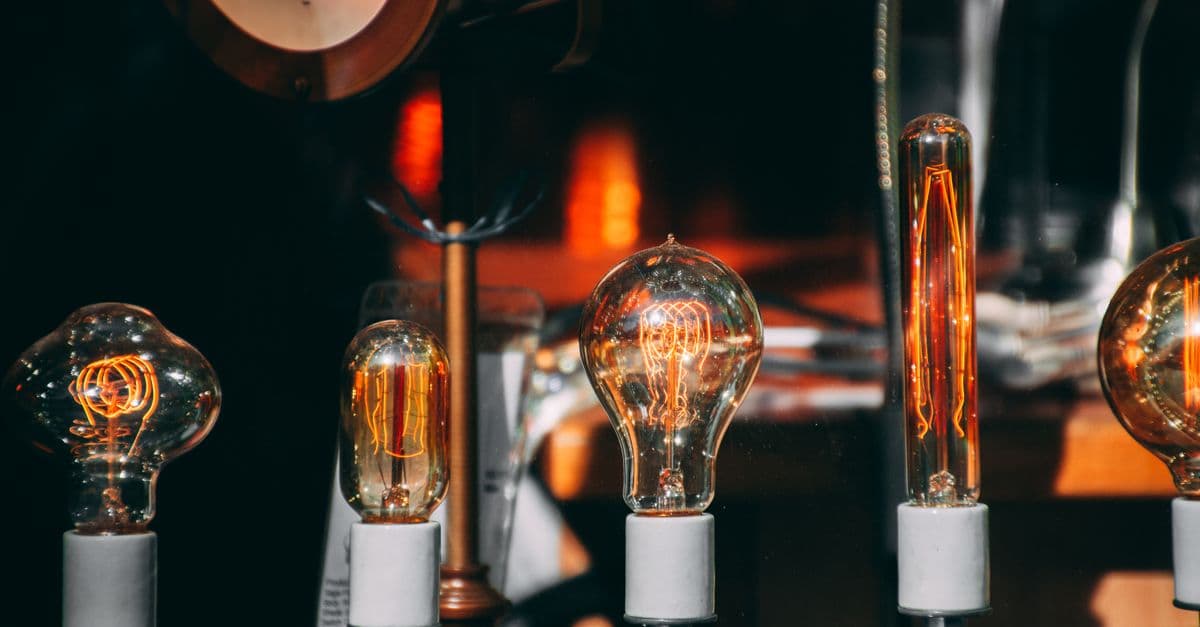
Photo: Matthis Volquardsen / Pexels
On October 21, 1879, at his Menlo Park laboratory in New Jersey, Thomas Edison passed an electric current through a carbonized cotton thread sealed inside an evacuated glass bulb. It glowed for 14.5 hours. That thread — fragile, unremarkable, already used for sewing — became the first commercially viable incandescent filament. It was not the first electric light, and Edison was not the only person working on the problem. But it was the first solution that could be sold, and Edison built an entire industry around selling it.
The Story Behind the Discovery
The incandescent principle — heating a material until it glows — was not Edison's idea. As early as 1802, English chemist Humphry Davy produced light by passing current through a platinum wire, but it burned out in seconds and produced no practical heat-to-light ratio useful for daily life. A procession of inventors followed over the next seven decades, each solving part of the problem but none solving all of it.
Incandescence — the emission of light by a material heated to high temperature by an electric current passing through it.
Vacuum — the critical variable that most early experimenters missed: in the presence of oxygen, a hot filament oxidizes (burns) almost instantly. Remove the oxygen and the filament lasts.
The challenge was threefold: find a filament material that would glow brightly at a temperature it could sustain for hundreds of hours; seal that filament in a glass bulb from which nearly all air had been removed; and operate it at a voltage and current that made sense for a practical electrical distribution system.
Joseph Wilson Swan, a British chemist and physicist, came remarkably close in 1860. He demonstrated an evacuated glass bulb with a carbonized paper filament that produced light in Newcastle upon Tyne. The problem was the vacuum: the pumping technology of 1860 could not remove enough air to prevent rapid oxidation. Swan's 1860 bulb worked in demonstration but burned out too quickly to be practical.
Source: US Department of Energy — "The History of the Light Bulb" — documents Edison's October 1879 cotton-thread filament test and earlier work by Swan and others.
Swan returned to the problem in 1875, now armed with better vacuum pumps developed by physicist Hermann Sprengel. By 1878 he had a working bulb with a carbonized paper filament in a proper vacuum. On December 18, 1878, Swan gave a public lecture in Newcastle demonstrating his improved lamp. He received a British patent for it in 1880. In the United States and most of Europe, Edison would receive the credit for inventing the practical light bulb. In Britain, Swan had a credible competing claim.
How It Actually Works
An incandescent light bulb is a thermal device, not a quantum one. Understanding it requires no particle physics — just the relationship between temperature and light.
Every object above absolute zero emits electromagnetic radiation. At room temperature, objects emit mostly infrared (heat) radiation invisible to the human eye. As temperature rises, the peak of that emission spectrum shifts toward shorter wavelengths. At around 1,000°C (1,832°F), an object begins to glow a dull red. At 2,500°C (4,532°F) — approximately the operating temperature of a tungsten filament in a modern incandescent bulb — it glows a warm white.
Tungsten — the metal used in incandescent filament bulbs from about 1910 onward, replacing carbon. Tungsten has the highest melting point of any metal at 3,422°C (6,192°F), which allows it to operate at temperatures where it produces useful white light without melting.
Edison's 1879 bulb used carbonized cotton thread, not tungsten. Carbon has a high enough melting point but sublimes (converts directly from solid to vapor) at high temperatures, depositing carbon on the inside of the bulb and causing the filament to thin and eventually fail. Edison found he could extend filament life substantially by improving the vacuum — less gas meant less convective cooling and less oxidation — and by reducing the current, which meant a longer, thinner filament of higher electrical resistance.
Source: Edison Tech Center — "Edison's Incandescent Lamp" / Engineering and Technology History Wiki — documents the sequence of filament materials tested.
The resistance relationship is central. If you double the length of a wire, you double its resistance and reduce the current for the same voltage. Less current means less heat per unit time, which extends filament life — but also reduces brightness. Edison's engineering problem was finding the balance point: maximum useful light output at the minimum current consistent with long filament life.
Why the Filament Needs a Vacuum
Think of the filament as a campfire ember held in your fingers. In air, the ember would burn your fingers and itself. In the absence of oxygen, the same ember can sit glowing for much longer without consuming itself — except the combustion pathway is blocked. Edison's bulb does the same thing: it eliminates the oxygen pathway. The filament glows white-hot but has nothing to react with.
A perfect vacuum is never achieved — traces of gas always remain. Edison's team found that certain inert gases, introduced at low pressure, actually extended filament life by reducing the rate at which carbon sublimed off the filament surface. Modern incandescent bulbs use nitrogen or argon fill gases at partial pressure for exactly this reason.
From Carbon to Bamboo to Tungsten
After the cotton thread filament, Edison's team systematically tested hundreds of materials. The discovery of carbonized bamboo was serendipitous: Edison's associate John Segredor found that Japanese bamboo, carbonized by heating in the absence of oxygen, produced a filament that lasted approximately 1,200 hours — compared to about 14 hours for the best cotton thread. Bamboo became the standard filament for Edison's commercial bulbs for the next decade.
Source: Smithsonian Magazine — "How Thomas Edison Tricked the Press Into Believing He'd Invented the Light Bulb" — covers the prior art landscape and the carbonized bamboo filament development.
Tungsten filaments, introduced around 1906 and commercialized by General Electric researchers (notably William Coolidge's 1910 ductile tungsten process), were brighter, more efficient, and longer-lasting than any carbon filament. By 1915, tungsten had entirely replaced carbon in commercial incandescent bulbs, and remained the standard for a hundred years.
The People Involved
Thomas Edison (1847–1931)
Edison was 32 years old when he produced the first successful carbonized cotton-thread filament in October 1879. He had set up his Menlo Park laboratory in 1876 specifically as an organized invention factory — the first industrial research and development laboratory in history. Menlo Park employed up to 60 researchers and machinists working on multiple problems simultaneously. Edison's method was systematic experimentation at scale: test every material, record every result, iterate relentlessly.
The Menlo Park operation was funded by investors who expected commercial returns. Edison understood this clearly. He did not simply want to make a light that worked; he wanted to make a light that could be manufactured, sold, and powered by a commercial electrical distribution system he would also design and sell. From the beginning, the light bulb was one component of a complete electrical business system.
Edison held 1,093 US patents over his lifetime — the most of any individual in American history. He is also associated with the development of the phonograph (1877), the motion picture camera and kinetoscope (1891), the alkaline storage battery, and many improvements to the telegraph. Read more about his life and methods in the Thomas Edison biography.
Joseph Swan (1828–1914)
Swan was a quieter figure than Edison — a careful experimental chemist who did foundational work in photography (he invented the dry gelatin photographic plate, still the basis of photographic film) before turning to electric lighting. His British patent on the incandescent lamp predated Edison's in the UK. When Edison launched his electric lighting business in Britain, Swan threatened patent infringement proceedings.
Source: Science Museum Group Collection — "Edison's electric carbon filament lamp" — documents the Swan-Edison patent dispute and the formation of their joint company.
Rather than litigate to exhaustion, the two men negotiated. In 1883, they formed the Edison & Swan United Electric Light Company — immediately nicknamed "Ediswan" — which held a joint monopoly on incandescent lighting in Britain. The joint venture produced lamps under the Ediswan brand until Swan's patents expired and General Electric reorganized the British operations. Swan received a knighthood in 1904, a recognition that implicitly acknowledged the priority of his British work.
Charles Batchelor and John Kruesi
Edison's success depended critically on two skilled collaborators: Charles Batchelor, a British-born machinist and Edison's most trusted experimental assistant, who ran most of the hands-on testing at Menlo Park; and John Kruesi, a Swiss clockmaker who ran the machine shop and translated Edison's rough sketches into working hardware. Neither became famous. Both were essential.
Timeline: The Light Bulb from Arc to LED
| Year | Event |
|---|---|
| 1802 | Humphry Davy produces light from platinum wire — not practical |
| 1835 | James Lindsay demonstrates a constant electric light in Dundee, Scotland |
| 1860 | Joseph Swan demonstrates carbon paper filament lamp — vacuum inadequate |
| 1875 | Swan returns to the problem with improved Sprengel vacuum pumps |
| 1878 | Swan public demonstration of improved bulb, December 18, Newcastle |
| 1879 | Edison carbonized cotton thread filament glows 14.5 hours, October 21; patent filed November 1 |
| 1880 | Swan British patent granted; Edison switches to carbonized bamboo filament (1,200-hour life) |
| 1882 | Pearl Street Station opens September 4 — world's first commercial central power plant |
| 1883 | Edison & Swan United Electric Light Company ("Ediswan") formed in Britain |
| 1906 | General Electric patents tungsten filament process |
| 1910 | William Coolidge develops ductile tungsten, enabling mass production of tungsten filaments |
| 1926 | Frosted glass bulb interior introduced by Marvin Pipkin (GE), reducing glare |
| 1938 | Fluorescent lamps introduced commercially by GE |
| 1962 | Nick Holonyak Jr. (GE) invents the first visible-spectrum LED (red) |
| 1993 | Shuji Nakamura (Nichia) invents the blue LED, enabling white light from LEDs |
| 2012 | EU completes incandescent phase-out |
| August 2023 | US federal ban on sale of bulbs below 45 lumens per watt takes effect |
The Pearl Street Station: Building the World's First Grid
The light bulb alone was not enough. Edison understood something that most inventors of his era did not: a useful product requires a complete system. A light bulb requires electricity. Electricity, at the scale Edison envisioned, required generating stations, distribution cables, meters, junction boxes, fuses, and switches — all of which had to be invented or redesigned from scratch.
Edison chose to demonstrate the complete system in lower Manhattan. He selected a two-block area of the financial district as his test grid, laid insulated copper cables in underground conduits (to avoid the overhead wire tangle that was already disfiguring Manhattan's skyline), and constructed a generating station at 255–257 Pearl Street, a few blocks south of Fulton Street.
On September 4, 1882, Edison threw the switch at Pearl Street Station. The station's six dynamos — each roughly the size of a room, weighing 27 tons, nicknamed "Jumbo" dynamos after P.T. Barnum's famous elephant — began generating 110 volts of direct current. The initial load: 400 electric lamps in 82 customer premises.
Source: Engineering and Technology History Wiki (ETHW) — "Milestones: Pearl Street Station, 1882" — the IEEE's official designation of Pearl Street Station as the birthplace of the commercial electric utility industry.
By 1884, Pearl Street Station served 508 customers operating 10,164 lamps. The station ran almost continuously until a fire destroyed it on January 2, 1890. It had demonstrated that commercial electrical distribution was economically viable — a demonstration that launched the global electric utility industry.
Edison insisted on direct current (DC) for Pearl Street and all his subsequent distribution systems. This would create his most consequential conflict: the War of Currents.
The Patent Wars and the War of Currents
Edison and Swan's patent dispute was settled by merger. Edison's war with Nikola Tesla and George Westinghouse was less tidy.
The fundamental problem with DC distribution is voltage: Edison's 110-volt DC system suffered severe power losses over distances greater than about 1.5 km (1 mile), requiring a generating station every mile or two. This was workable in dense Manhattan but impractical for suburbs or rural areas.
Alternating current (AC), by contrast, could be stepped up to very high voltages for efficient long-distance transmission and then stepped back down at the point of use — using transformers that only work with AC. Nikola Tesla, who briefly worked for Edison before a payment dispute drove them apart, had developed a complete AC motor and generator system. George Westinghouse bought Tesla's AC patents and began promoting AC distribution.
Source: See the full account in Thomas Edison's biography and Nikola Tesla's biography.
Edison responded with a public campaign arguing that high-voltage AC was too dangerous. He demonstrated AC's lethality by publicly electrocuting animals at Menlo Park. He lobbied state governments against AC and supported the adoption of AC for the electric chair — arguing that it was a suitable tool for killing. The campaign was cynical and ultimately unsuccessful. AC's technical advantages were too great. By 1892, the newly formed General Electric — the company Edison's enterprise had become after a merger with Thomson-Houston — began manufacturing AC equipment alongside DC. The War of Currents was effectively over.
Unintended Consequences
The incandescent light bulb's most dramatic effect was on human sleep. For all of prior human history, the length of the active day was constrained by daylight and the dim, expensive light of candles and oil lamps. Electric light made the night economically free. Factory shifts extended. Shops stayed open. Restaurants and entertainment venues operated on schedules that would have been prohibitively expensive in the candle era.
Chronobiologists now recognize that the blue-spectrum component of incandescent and LED light suppresses melatonin production, delaying the circadian clock. The widespread adoption of artificial lighting has shifted average human sleep timing later by roughly 1 to 2 hours compared to pre-industrial populations. Whether this represents a net health cost is still debated.
Source: Department of Energy — "Debunking Myths about Phasing Out the Incandescent Lightbulb" — documents the energy efficiency data driving the transition to LED.
The bulb also transformed architecture. Interior spaces in the pre-electric era were designed around natural light: high ceilings, large windows, skylights. With reliable artificial light available anywhere, rooms could be any size, any depth into a building, with no windows at all. The modern office building interior, the shopping mall, the hospital operating theater, the cinema, the factory floor — all are architectural consequences of cheap artificial light.
And the light bulb catalyzed the electrical utility industry, which in turn enabled the electric motor, the refrigerator, the radio, the television, and the computer. The grid is the infrastructure on which the modern economy runs. Pearl Street Station was its genesis.
Where the Light Bulb Stands Today
The incandescent bulb that Edison patented in 1879 is now, for practical purposes, illegal to sell in the United States. A federal energy efficiency rule that took effect on August 1, 2023, requires all general-service lamps to produce at least 45 lumens per watt. Standard incandescent bulbs produce about 10–15 lumens per watt; LEDs produce 80–120 lumens per watt. The rule effectively ends the commercial life of the technology that lit the world for 144 years.
Source: US Department of Energy — "Debunking Myths about Phasing Out the Incandescent Lightbulb" (2023 rule) and SuperBrightLEDs — "Light Bulb Ban 2023."
The transition to LEDs is already well advanced. LED bulbs' share of US households' primary lighting rose from 4% in 2015 to 47% in 2020, while incandescent and halogen bulbs fell from 31% to 15% in the same period. By 2028, a tighter standard of 120 lumens per watt will take effect — a level that only LEDs can currently meet.
The LED light-emitting diode produces light through electroluminescence — electrons falling across a semiconductor junction and releasing photons — rather than through heat. No heat means no wasted energy on infrared radiation. A LED converts approximately 40–50% of input electrical energy to visible light; an incandescent bulb converts about 5%. The LED is, in energy terms, roughly ten times more efficient.
The Nobel Physics Prize awarded in 2014 to Isamu Akasaki, Hiroshi Amano, and Shuji Nakamura for the blue LED acknowledged that their 1993 invention completed the LED toolkit. Without blue LEDs, white light from LEDs is impossible, because white light requires mixing red, green, and blue wavelengths.
The technology inside a 2026 LED lamp is unrecognizable to Edison. But the socket it screws into — Edison's E26 screw base, standardized in the 1880s — is the same socket that held his bamboo-filament carbon bulb. That standard has survived 145 years because it was designed for the infrastructure Edison built, and the infrastructure proved too widespread to change.
FAQs
Q: Did Edison really invent the light bulb? A: Edison developed the first commercially practical incandescent light bulb — one that could be manufactured, sold, and powered by a practical electrical distribution system. Joseph Swan in Britain demonstrated a working incandescent bulb in 1878 and received a British patent in 1880. The two eventually resolved their dispute by forming a joint company. Edison's contribution was as much the complete electrical system as the bulb itself.
Q: How long did Edison's first light bulb actually last? A: The carbonized cotton thread filament tested on October 21, 1879 glowed for 14.5 hours. Later bamboo filament bulbs achieved approximately 1,200 hours. Modern LED bulbs are rated for 15,000–25,000 hours.
Q: What was the Pearl Street Station and why does it matter? A: Pearl Street Station, opened September 4, 1882, was the world's first commercial central electric power plant. It supplied 110-volt DC power to 82 initial customers in lower Manhattan. It established the model for the electric utility industry — centralized generation, underground distribution, metered consumption — that the entire world has used ever since.
Q: Why did Edison use DC instead of AC? A: Edison's distribution system used 110-volt direct current (DC) because the motors and lamps of the early 1880s were designed for DC. He had also built his entire business around DC infrastructure. AC's ability to be transformed to different voltages over long distances — Tesla and Westinghouse's key advantage — was not something Edison's DC system could match. By the early 1890s, AC had won the commercial debate on technical merits.
Q: Why is the incandescent bulb being phased out? A: Standard incandescent bulbs convert only about 5% of electrical energy into visible light; the rest becomes heat. LEDs convert 40–50%. A US federal rule effective August 2023 requires general-service lamps to produce at least 45 lumens per watt — a threshold incandescent bulbs cannot meet. The EU completed its phase-out in 2012. The energy savings from the global transition to LEDs are substantial: the US Department of Energy projects annual savings of approximately 569 terawatt-hours by 2035 from widespread LED adoption.
Q: What is the E26 base and why does it still exist? A: The E26 is the screw-base socket Edison standardized in the 1880s for his commercial lamp system. The "E" stands for Edison, and "26" is the diameter in millimeters. It has survived because it became so widely adopted in North American electrical infrastructure that replacing it would require replacing hundreds of millions of fixtures. LEDs are manufactured with E26 bases specifically to maintain backward compatibility with existing sockets.
Q: How did the light bulb change sleep patterns? A: Before widespread artificial light, human activity largely followed the solar cycle. Electric light extended commercially viable nighttime hours, shifted entertainment, work, and social activity later into the evening, and — through the blue-spectrum component of artificial light — suppressed the melatonin production that triggers sleep onset. Chronobiological research suggests modern populations sleep roughly 1–2 hours later than pre-industrial populations.
Q: Who won the 2014 Nobel Prize related to the light bulb? A: Isamu Akasaki, Hiroshi Amano, and Shuji Nakamura shared the 2014 Nobel Prize in Physics for the invention of the blue light-emitting diode. Blue LEDs had proved elusive for decades; without them, white LED lighting was impossible. Their work in the early 1990s completed the LED color palette and enabled the lighting revolution now replacing incandescent bulbs worldwide.
The Takeaway
The light bulb's story is not a story about a single invention — it is a story about systems. Edison's genius was not in discovering incandescence, which had been known for decades, or even in finding a viable filament, which Swan had partly solved first. It was in understanding that a practical light required a complete commercial electrical ecosystem: generating stations, underground cable networks, metered supply, standardized sockets, and mass-manufactured bulbs that could be replaced when they failed. He built all of it simultaneously. The Pearl Street Station was as much the invention as the bulb it powered, and the E26 socket that survived every subsequent technological revolution is the most durable monument to that systems-level thinking.
Read next:
Follow new articles
Add SciHub101 to your feed reader to see new science and technology stories.
About the Author
SciHub101 is an independent science and technology publication founded and edited by Buğra Sözeri, a software engineer and app developer based in Türkiye. AI tools assist with drafting and research. Source documentation in the existing archive is uneven, and articles are being reviewed and corrected. The Editorial Team byline identifies editorial responsibility; it does not certify specialist or independent human review. Where we compare products, anything built by our own team is labelled as such — see the editorial guidelines and About page for how corrections and disclosures work.
Related Articles

The Modem: From SAGE Air Defense to the 56K Era
The modem began in 1958 as SAGE air-defense hardware. See how it became the Hayes Smartmodem, the 56K V.90 standard, and the DSL and cable links of today.
The Jet Engine: How Two Engineers on Opposite Sides of a War Changed Flight
Frank Whittle patented the jet engine in 1930. Hans von Ohain flew one in 1939. Neither knew the other existed. Their parallel invention and eventual friendship is the story of modern aviation.
Thomas Edison: The Napping Inventor Who Tested His Guests With Soup
Thomas Edison's life, verified quirks, and scientific legacy: steel-ball naps, soup job interviews, the AC/DC war, and what he actually invented.
Battery Invention: From Volta Pile to Lithium-Ion
The battery begins with Volta's pile, but modern batteries evolved through chemistry, materials, portability, and rechargeable systems.
The Electric Power Grid — How Edison, Tesla, and Insull Wired the Modern World
From Edison's Pearl Street DC station in 1882 to the AC war of currents, Insull's monopoly model, and today's smart grid, the electrical power grid shaped every hour of modern life.
The Air Conditioner: The Invention That Reshaped Where Humans Can Live
Willis Carrier set out to fix a printing problem in 1902 Brooklyn. The machine he designed ended up reshaping cities, enabling the Sun Belt, and creating a climate paradox.