The Jet Engine: How Two Engineers on Opposite Sides of a War Changed Flight
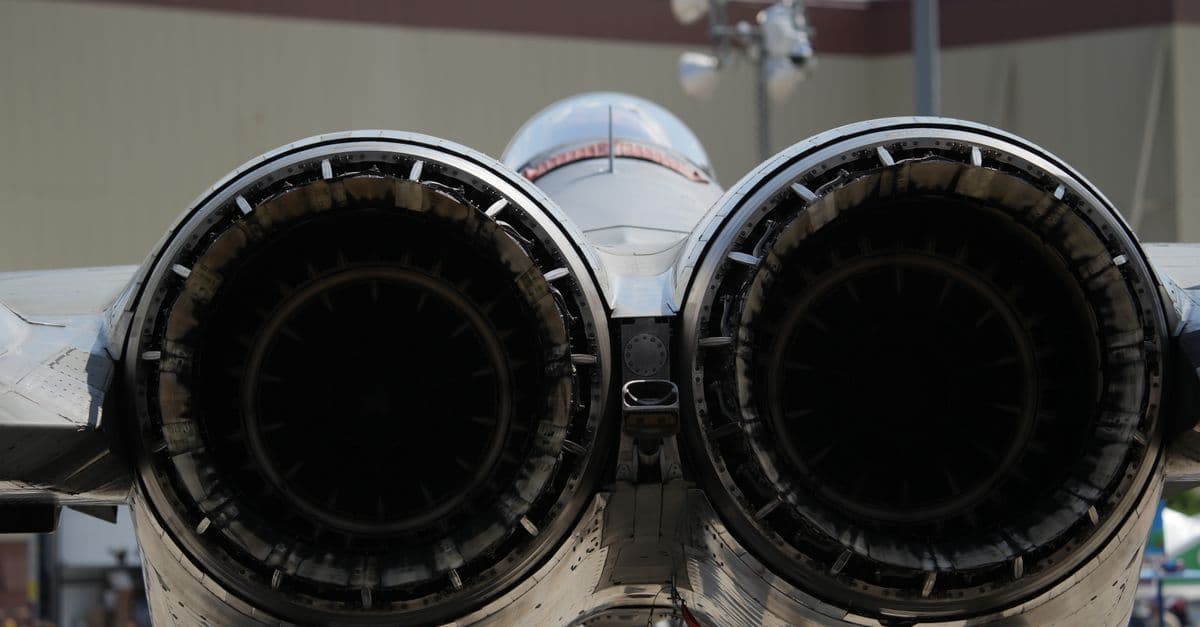
Photo: Jaxon Matthew Willis / Pexels
In August 1939, days before Germany invaded Poland and the Second World War began, a small propeller-less aircraft taxied down a runway near Rostock and accelerated into the air under a completely new type of engine. The pilot, Erich Warsitz, was flying the Heinkel He 178 — the world's first aircraft powered entirely by a turbojet. Its engine had been designed by a 27-year-old German physicist named Hans von Ohain. Across the English Channel, a Royal Air Force officer named Frank Whittle had patented essentially the same concept nine years earlier, had spent years fighting his own government's indifference to fund development, and would not get his engine into the air until 1941. When the two men finally met in person in 1978, at Wright-Patterson Air Force Base in Ohio, they reportedly spent hours in animated discussion, two old engineers who had independently invented the same future and outlived the war that had separated them.
The Story Behind the Discovery
Turbojet engine — a jet propulsion system in which all ingested air passes through a combustion chamber, producing thrust entirely from the hot exhaust; the simplest and earliest jet architecture, now largely replaced by turbofans in commercial aviation.
The piston engine that powered aircraft through the First World War and into the 1930s had a fundamental ceiling. A piston engine burns fuel in discrete strokes — intake, compression, power, exhaust — cycling at a few thousand revolutions per minute. Above roughly 10 km altitude, air density drops so sharply that a piston engine loses most of its power. Propeller efficiency also falls at high airspeeds because the blade tips approach the speed of sound.
The jet engine resolves both problems through continuous combustion. Air enters the front, gets compressed by a series of rotating blades, has fuel injected and ignited in a combustion chamber, and the hot expanding gases exit through a turbine and nozzle at the rear. The reaction to that rearward exhaust pushes the aircraft forward. There are no reciprocating pistons. The energy conversion is continuous rather than intermittent, and the engine's performance does not fall off at altitude the way a piston engine does.
The thermodynamic concept had been described by engineers before either Whittle or von Ohain. René Lorin in France published papers on jet propulsion concepts in 1913. The turbine technology existed in steam engineering. What required a new insight was combining an air compressor, a combustion chamber, and a turbine into a self-sustaining cycle where the turbine, driven by the hot exhaust, could power the compressor — with enough energy left over to produce thrust.
Frank Whittle was the first to formalize this into a patent.
| Year | Event |
|---|---|
| 1913 | René Lorin publishes jet propulsion concepts in France |
| 1928 | Frank Whittle submits RAF thesis proposing jet propulsion at high altitude |
| January 16, 1930 | Frank Whittle files British patent for a turbojet engine |
| 1935 | Patent lapses; Whittle cannot afford £5 renewal fee; Air Ministry declines to help |
| 1935 | Hans von Ohain files German patent for a turbojet engine |
| 1936 | Von Ohain approaches Ernst Heinkel; Heinkel funds development |
| April 12, 1937 | Whittle's W.1 engine runs on a test stand for the first time |
| August 27, 1939 | Heinkel He 178 makes first jet-powered flight using von Ohain's He S 3B engine |
| May 15, 1941 | Gloster E.28/39 aircraft flies using Whittle's W.1 engine |
| 1943 | Gloster Meteor enters RAF service as first Allied jet aircraft |
| 1944 | Messerschmitt Me 262 enters Luftwaffe service as first operational jet fighter |
| 1952 | De Havilland Comet enters service as world's first jet airliner |
| 1958 | Boeing 707 enters commercial service |
| 1969 | Boeing 747 inaugurates widebody commercial aviation |
| 1969 | First high-bypass turbofan (Pratt & Whitney JT9D) enters service on 747 |
| 1978 | Whittle and von Ohain meet at Wright-Patterson Air Force Base |
How the Jet Engine Actually Works
At its core, a jet engine is a machine for continuously accelerating air. Every thrust-producing jet engine — turbojet, turbofan, turboprop, or turboshaft — operates on the Brayton cycle: compress, combust, expand. The engineering complexity lies in making those three steps happen reliably at temperatures above 1,500 degrees Celsius, rotation rates above 10,000 rpm, and pressures exceeding 40 atmospheres, for tens of thousands of hours before overhaul.
Brayton cycle — the thermodynamic cycle underlying gas turbine engines: isentropic compression, constant-pressure combustion, isentropic expansion. Named for George Brayton, who proposed it in the 1870s for a different application.
The compressor stages are a series of rotating disc-like blades (rotor stages) alternating with stationary blades (stator stages). Each stage compresses air slightly. A modern high-bypass turbofan compressor may have 15 to 20 stages, achieving overall compression ratios of 40:1 or higher. The energy to drive this compression comes entirely from the turbine stages at the back of the engine.
The combustion chamber receives compressed air at roughly 600 degrees Celsius and high pressure. Fuel (kerosene, called Jet-A in aviation) is injected and ignited. The flame burns continuously — unlike a piston engine where combustion is intermittent. Exit temperatures from the combustion chamber reach 1,500 to 1,700 degrees Celsius, which exceeds the melting point of the nickel alloys used to make turbine blades. The blades survive because they contain internal cooling channels that circulate cooler air, and because they are coated with thermal barrier ceramics. A turbine blade in a modern commercial engine operates in gas temperatures that would destroy it in seconds without active cooling.
The turbine extracts energy from the hot gas to drive the compressor — this is the self-sustaining loop. In a turbojet, the remaining energy exits as a hot, high-velocity exhaust that produces thrust directly. In a turbofan — the engine type on virtually all modern commercial aircraft — the turbine also drives a large fan at the front of the engine. This fan moves a much larger mass of air around the engine core at lower velocity. Because thrust equals mass flow times velocity change, moving more air slowly is thermodynamically more efficient than moving less air very fast.
Think of the difference between a fire hose and a sprinkler: the fire hose delivers its water in a concentrated high-speed stream; the sprinkler covers a wider area at lower velocity. For propelling an aircraft at 900 km/h, the sprinkler approach — high bypass ratio — consumes significantly less fuel per unit of thrust.
Bypass ratio — the ratio of air mass flowing around the engine core to air mass flowing through it; modern commercial turbofans have bypass ratios of 5:1 to 12:1; the CFM LEAP engine on the Boeing 737 MAX has a bypass ratio of approximately 9:1.
The turboprop takes this further: almost all the turbine's energy drives a propeller, with only a small residual jet exhaust. Turboprops are more fuel-efficient than turbofans at low speeds and altitudes, which is why they remain standard on regional aircraft.
The People Involved
Frank Whittle
Frank Whittle (1907–1996) was the son of a mechanic in Coventry. He joined the RAF as a boy apprentice at 16 and trained as a pilot. In 1928, as an officer cadet at RAF Cranwell, he wrote a thesis arguing that future high-altitude, high-speed aircraft would require either rockets or a new type of gas turbine. His instructors were sufficiently impressed to give the thesis high marks but insufficiently impressed to act on it.
Whittle refined the concept and filed a patent on January 16, 1930, for a turbojet engine. The Air Ministry examined the patent and decided the concept was not of sufficient military value to fund or classify — a decision that left the patent public and available to anyone who cared to read it, including Hans von Ohain's patent attorney five years later.
Source: Air and Space Forces Magazine (2006) — "The Converging Paths of Whittle and von Ohain"; Whittle's 1930 patent and RAF response confirmed.
The patent lapsed in 1935 because Whittle could not afford the £5 renewal fee. The Air Ministry again declined to help. Whittle's engine concept existed only on paper until 1936, when two former RAF officers helped him form Power Jets Ltd. with private investment of £2,000. The RAF provided limited support but maintained an arm's-length relationship that frustrated Whittle throughout the development period.
Whittle's W.1 engine ran on a test stand on April 12, 1937 — ten years after he had first conceived the idea. The Gloster E.28/39 experimental aircraft flew on May 15, 1941. By then von Ohain's engine had been flying for nearly two years.
Whittle was knighted in 1948. He immigrated to the United States in 1976 and taught at the United States Naval Academy. He died in 1996.
Hans von Ohain
Hans Joachim Pabst von Ohain (1911–1998) was completing his doctorate in physics at the University of Göttingen when he began working on jet propulsion in 1935. He was reportedly troubled by the noise and vibration of piston-engine aircraft and sought something smoother.
Von Ohain filed a German patent for a turbojet in November 1935. His patent attorney provided him with a copy of Whittle's 1930 patent — technically public because it had lapsed — and von Ohain has stated that he read it and recognized the similarity. His attorney required him to modify his application to avoid infringing Whittle's claims, which von Ohain did.
Source: Hans von Ohain biography, National Academies of Sciences (2001) — Chapter on von Ohain's patent history and relationship to Whittle's work.
Von Ohain then approached Ernst Heinkel, one of Germany's most ambitious aircraft manufacturers. Heinkel provided laboratory space, engineers, and effectively unlimited development funding — the institutional backing that Whittle had been denied. Von Ohain's first hydrogen-fueled demonstrator engine, the He S 1, ran in March 1937. The operational He S 3B engine, burning kerosene, powered the He 178 on August 27, 1939.
After the war, von Ohain was brought to the United States under Operation Paperclip, the program that recruited German scientists and engineers. He worked at Wright-Patterson Air Force Base's Aero Propulsion Laboratory for three decades. He became a US citizen and received numerous honors, including sharing the Charles Stark Draper Prize with Whittle in 1991.
Source: Smithsonian Institution (2024) — Records of the 1978 Whittle-von Ohain encounter at Wright-Patterson; Draper Prize records.
The two men's 1978 meeting at Wright-Patterson was formally documented by Colonel Philippe Bouchard, who hosted a two-day session. According to accounts, they got along extraordinarily well — two engineers who had arrived at the same answer independently, now free to compare notes across the gulf of the war that had separated them.
Patent and Priority Disputes
The Whittle-versus-von Ohain priority question was never formally adjudicated because the two men developed their engines in different countries during wartime. There was no single international patent regime under which priority could be established.
What the historical record shows:
- Whittle's British patent was filed on January 16, 1930 — five years before von Ohain's German patent.
- Whittle's engine ran on a test stand in April 1937; von Ohain's demonstrator also ran in 1937.
- Von Ohain's engine flew first, in the He 178 on August 27, 1939; Whittle's flew May 15, 1941.
- Von Ohain saw Whittle's patent before filing his own; Whittle did not know von Ohain existed until after the war.
Most aviation historians credit Whittle with prior patent filing and independent development, and von Ohain with first successful flight application. Both men consistently acknowledged each other's contributions and rejected any framing that cast one as the sole inventor.
Power Jets Ltd., the company Whittle had established, was nationalized by the British government in 1944 without adequate compensation — a decision that Whittle regarded as a serious injustice for the rest of his life. The government's argument was that the technology was too strategically important to remain under private control. Whittle received a one-time payment of £100,000 in 1948, widely regarded as insufficient given the technology's commercial and military value.
Source: Frank Whittle Wikipedia / Air and Space Forces Magazine (2024) — Power Jets nationalization details and Whittle's compensation.
Unintended Consequences
The jet engine did not simply make aircraft faster. It restructured the global economy, reshaped geopolitics, created the modern tourist industry, and made possible supply chains that would have seemed fictional to a pre-jet generation.
The first jet airliner, the de Havilland Comet, entered service in 1952. Early Comet models suffered catastrophic structural failures due to metal fatigue around the square windows — a consequence of pressurization cycles that the pre-jet era had not needed to worry about. The Comet was grounded and redesigned. Boeing's 707, which entered service in 1958 with lessons from the Comet disasters already incorporated into its design, established the template for commercial jet aviation.
Source: NASA (historical records) — De Havilland Comet accident investigation; metal fatigue and pressurization cycles documented.
The 747, which entered service in 1969, made mass air travel economically viable. Seat-mile costs fell so dramatically that by the 1980s flying from New York to Los Angeles was cheaper in real terms than driving. This democratization of air travel created a global tourism industry of a scale that had no precedent. International tourist arrivals rose from approximately 25 million per year in 1950 to over 1.5 billion in 2019 (pre-pandemic peak).
Source: UNWTO (World Tourism Organization) — International tourist arrivals statistics, 1950–2019.
The aviation industry's environmental footprint is substantial and difficult to address. Commercial aviation accounts for approximately 2.5 percent of global CO2 emissions directly, but its total climate impact — including the warming effects of contrails, water vapor, and NOx at cruise altitude — may be two to four times larger by some estimates.
Source: ATAG (Air Transport Action Group) (2024) — Aviation climate impact; approximately 2.5% of global CO2 emissions directly from aviation.
The jet engine also redefined military power. Nuclear weapons could be delivered by jet bombers, then by jet-powered missiles. The Cuban Missile Crisis involved U-2 spy planes (jet-powered) photographing Soviet missiles. Air superiority in modern warfare depends entirely on jet aircraft performance. No major military conflict since the Korean War has been fought without jet aircraft playing a central role.
Where It Stands Today
The global commercial aircraft fleet in 2024 contained approximately 28,400 aircraft, virtually all jet-powered. Airlines carried approximately 4.5 billion passengers in 2023, recovering past pre-pandemic 2019 levels.
Source: IATA (2024) — Global Commercial Aircraft Fleet report; 28,400 aircraft confirmed.
The turbofan has been optimized for decades, and modern engines like the CFM LEAP and Pratt and Whitney PW1000G geared turbofan achieve thermal efficiencies approaching 50 percent — meaning about half the chemical energy in the fuel is converted to useful work, with the rest lost as heat. A World War II piston engine achieved 25 to 30 percent thermal efficiency; a turbofan in 2024 achieves almost double that.
Sustainable aviation fuel (SAF) — made from waste oils, municipal solid waste, or synthesized from hydrogen and captured CO2 — can be used as a drop-in replacement for conventional Jet-A kerosene without engine modifications. SAF can reduce lifecycle CO2 emissions by up to 80 percent compared to fossil kerosene, but production currently supplies less than 1 percent of aviation fuel demand. Scaling SAF to meaningful volumes requires either massive subsidies or carbon pricing that makes fossil Jet-A more expensive.
Source: IATA (2024) — SAF production volumes; less than 1% of aviation fuel demand as of 2023.
Electric and hydrogen aviation are under development but face fundamental physics constraints. Batteries have energy densities roughly 50 times lower than jet fuel, making battery-electric flight practical only for short regional routes with small aircraft. Hydrogen has a higher energy density by weight than kerosene, but requires cryogenic storage at -253 degrees Celsius, adding enormous system complexity. Airbus has announced hydrogen-powered commercial aircraft targets for the 2035 timeframe, but the fuel distribution infrastructure does not yet exist.
Frank Whittle's 1930 patent described a machine that could compress air, inject fuel, combust it, and produce thrust. Today's GE9X engine, which powers the Boeing 777X, produces 105,000 pounds of thrust (467 kN) from a fan diameter of 3.4 m (134 inches) — rotating at 2,500 rpm while its core turbine spins at over 22,000 rpm. The conceptual gap between Whittle's patent drawing and that engine is enormous. The logical gap is not.
FAQs
Q: Who invented the jet engine — Whittle or von Ohain? A: Both invented it independently. Frank Whittle filed the first patent in Britain in January 1930, five years before Hans von Ohain filed his German patent. Von Ohain's engine flew first (August 1939 in Germany) because he received immediate industrial backing from Heinkel, while Whittle spent years fighting bureaucratic indifference in Britain. Most aviation historians credit Whittle with priority in conception and von Ohain with priority in flight application.
Q: Did von Ohain copy Whittle's patent? A: Von Ohain's patent attorney gave him a copy of Whittle's lapsed 1930 patent before he filed his own application in 1935. Von Ohain acknowledged reading it. His attorney then required him to modify his application to avoid infringing Whittle's claims. Von Ohain has consistently stated he developed his concept independently before seeing Whittle's patent; there is no documented evidence of deliberate copying.
Q: What is the difference between a turbojet and a turbofan? A: A turbojet passes all ingested air through the combustion core and produces thrust entirely from hot exhaust. A turbofan uses a large front fan to push a larger mass of air around the outside of the engine core. Moving more air at lower velocity is thermodynamically more efficient for subsonic flight, which is why virtually all modern commercial aircraft use turbofans. Military fighter jets still use turbojets or low-bypass turbofans because high-speed dash performance matters more than fuel efficiency.
Q: Why didn't Britain develop jet aircraft before Germany? A: Institutional conservatism. Whittle's concept was technically sound when he filed his patent in 1930, but the Air Ministry repeatedly declined to fund development, judging the technology too speculative. Germany's advantage came not from better engineers but from better institutional support — Ernst Heinkel provided von Ohain with immediate, well-funded resources. Whittle's underfunded Power Jets Ltd. had to fight for every pound of development money.
Q: Why does aviation only account for 2.5% of CO2 but its climate impact is larger? A: Aviation emits CO2, but it also emits water vapor and nitrogen oxides at cruise altitude where their effects differ from ground-level emissions. Contrails (condensation trails) formed behind aircraft can persist and spread into cirrus clouds that trap heat. Some climate scientists estimate that these non-CO2 effects may multiply aviation's total climate impact by a factor of two to four compared to CO2 alone, though quantifying this remains an active research area.
Q: What is sustainable aviation fuel and can it replace jet fuel? A: Sustainable aviation fuel (SAF) is produced from biological feedstocks (waste oils, agricultural residue) or synthesized from green hydrogen and captured CO2. It is chemically similar to conventional Jet-A kerosene and can be blended with it or used as a drop-in replacement without engine modifications. Lifecycle CO2 emissions can be 50 to 80 percent lower than fossil kerosene. The barrier is cost and production volume — SAF currently costs two to five times more than conventional jet fuel and supplies less than 1 percent of aviation fuel demand.
The Takeaway
The jet engine's history is a case study in how the same idea can arrive independently when the underlying physics and engineering knowledge reach maturity simultaneously in different places. Whittle had the concept first, on paper. Von Ohain got it into the air first, with better institutional support. The war kept them apart during the years that would otherwise have forced legal or commercial collision. When they finally met in 1978, they demonstrated what patent proceedings rarely allow: two inventors recognizing, with evident mutual respect, that the same intellectual terrain can be crossed by more than one path. The aircraft that carried them both to that Ohio air base traveled at 900 km/h in pressurized comfort at 11 km altitude — an experience made possible entirely by the engines that both men had invented, separately, a lifetime earlier.
Read next:
Follow new articles
Add SciHub101 to your feed reader to see new science and technology stories.
About the Author
SciHub101 is an independent science and technology publication founded and edited by Buğra Sözeri, a software engineer and app developer based in Türkiye. AI tools assist with drafting and research. Source documentation in the existing archive is uneven, and articles are being reviewed and corrected. The Editorial Team byline identifies editorial responsibility; it does not certify specialist or independent human review. Where we compare products, anything built by our own team is labelled as such — see the editorial guidelines and About page for how corrections and disclosures work.
Related Articles
The Light Bulb: Edison, Swan, and the Race to Illuminate the World
How Thomas Edison's 1879 carbon filament patent at Menlo Park — and the rivalry with Joseph Swan — launched commercial electricity and permanently changed human civilization.

The Safety Elevator: The Invention That Built the Modern City
How Elisha Otis's 1853 rope-cutting stunt solved humanity's fear of falling and made the skyscraper — and the modern vertical city — structurally possible.
How Jet Engines Work: The Physics of Flight Power
A single GE90-115B turbofan is rated at 115,300 pounds-force of thrust. The physics behind it is a short chain of ideas: squeeze air, burn fuel in it, and let the hot gas do work.
Airplane Invention: The Wright Brothers and Controlled Flight
The Wright brothers solved controlled powered flight, but gliders, engines, wind tunnels, and earlier aviation pioneers all mattered.
The Helicopter: From da Vinci's Sketch to Mars
How Paul Cornu's 1907 hop, Focke's 1936 twin-rotor, and Sikorsky's 1939 VS-300 solved the problem of vertical controlled flight — and where it went next.
The Jet Airliner — From the Comet's Fatal Flaw to the Age of Mass Air Travel
The de Havilland Comet launched the jet age in 1952, then killed 56 people through metal fatigue. How aviation rebuilt trust and shaped the modern world in its wake.