The Vacuum Cleaner: From Puffing Billy to Roomba
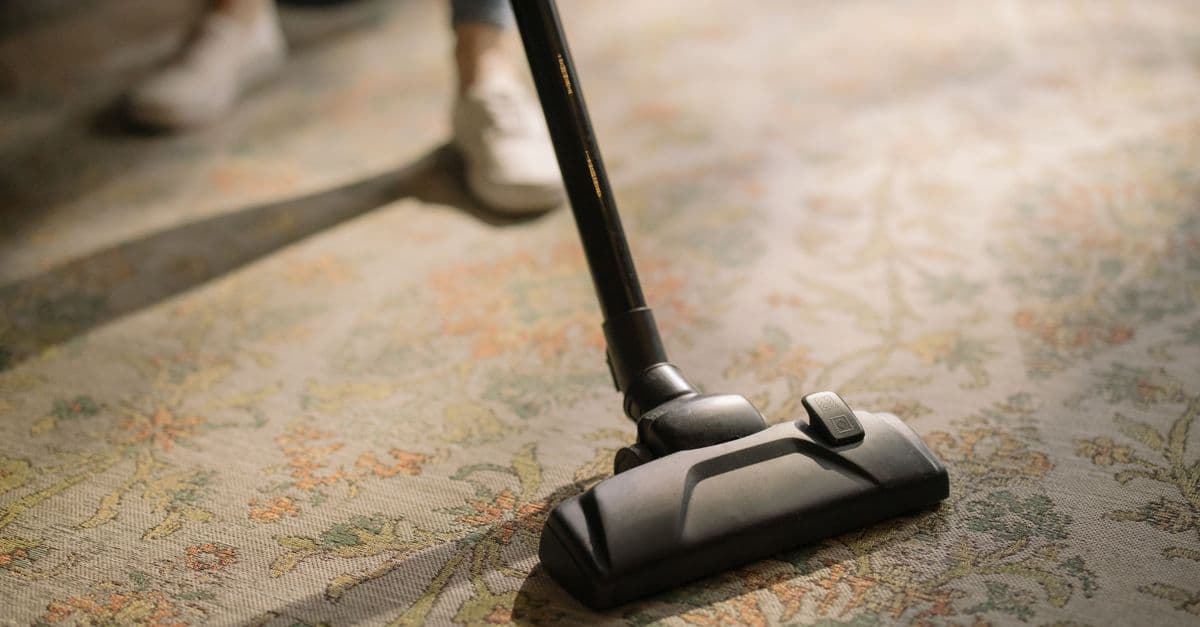
Photo: cottonbro studio / Pexels
In 1901, a British engineer named Hubert Cecil Booth demonstrated his new suction-cleaning machine to a group of potential investors by kneeling on the floor, placing a handkerchief over the carpet, and sucking through it. When the handkerchief showed a disc of accumulated dust and debris, his audience was convinced. The machine he would build to commercialize that demonstration weighed several tons, required a horse to transport it, and had to park outside the buildings it cleaned. Within a century, Booth's concept would shrink to fit under a sofa and navigate autonomously on its own schedule.
What a Vacuum Cleaner Does
A vacuum cleaner uses a fan or pump to create a region of lower-than-ambient air pressure — a partial vacuum — at an inlet. Atmospheric pressure outside the machine drives air toward this low-pressure zone, and that rushing air carries loose particles (dust, dirt, hair, debris) with it into a collection container. The air then passes through a filter before being exhausted, trapping the particles inside the machine.
The distinction between vacuum cleaner designs is largely about how the reduced pressure is created and how particles are separated from the air stream. Older designs use a porous bag as both collection container and filter. Bagless cyclone designs (Dyson's innovation) use centrifugal force to spin particles out of the air stream and into a separate bin, so the filter never clogs with the bulk of the debris. Robotic designs add navigation and autonomy, leaving the fluid mechanics largely unchanged.
Definition: A cyclone separator uses centrifugal force rather than a filter bag to remove particles from an air stream. Air enters a conical chamber tangentially, spinning rapidly. Particles, which are denser than air, are flung outward to the walls and fall into a collection bin. The cleaner air exits through the center. Because no fabric filter clogs with use, suction remains constant throughout the cleaning cycle.
The Story: From Booth's Carriage to Dyson's Shed
Hubert Cecil Booth and Puffing Billy (1901)
Hubert Cecil Booth was a British civil and mechanical engineer, born in 1871, who specialized in large structures — he designed the Ferris wheels for the Earl's Court exhibition in London. In 1901, he attended a demonstration at the Empire Music Hall of an American-made machine that cleaned by blowing air through a floor — the Whirlwind, invented by John Thurman in 1899. The blowing approach worked by dislodging dust so it fell to a different part of the room.
Booth concluded that sucking rather than blowing was the correct approach. He applied for a British patent on August 30, 1901, for a machine that reversed the airflow principle: instead of pushing air through dust, it drew air and dust through a fine filter. He built a proof of concept by kneeling on a restaurant chair and sucking air through a piece of cloth pressed to the seat — the accumulated dust on the cloth proved suction could work.
Source: Hubert Cecil Booth — Wikipedia
The machine Booth built to commercialize his patent was not portable. Called "Puffing Billy" (a reference to the steam locomotives of the time, on account of its noise and size), it was a large piston-pump device mounted on a horse-drawn carriage painted bright red. Operators parked the carriage outside the client's building, ran long flexible hoses through windows and doorways, and cleaned the interior while the machine powered from outside.
Despite its size, Booth's Puffing Billy attracted prestigious clients. According to accounts of the time, Booth's company was hired to clean the blue ceremonial carpet in Westminster Abbey before the coronation of Edward VII in 1902, removing years of accumulated dust that manual beating had not dislodged. The story of Booth being called to Buckingham Palace to demonstrate the machine became part of the popular mythology around his invention; contemporary sources confirm the royal household was among his clients.
| Year | Device / Development | Inventor / Company |
|---|---|---|
| 1899 | Whirlwind: motor-powered blowing carpet cleaner | John Thurman, USA |
| 1901 | Puffing Billy: horse-drawn suction machine | Hubert Cecil Booth, UK |
| 1907 | First portable electric upright vacuum | James Murray Spangler, USA |
| 1908 | Hoover Company buys Spangler's patent | William H. Hoover |
| 1926 | Hoover Model 700: suction plus agitator brush | Hoover Company |
| 1947 | Lewyt Model 30: first bagless canister | Lewyt Corp, USA |
| 1983 | G-Force: first bagless cyclone vacuum | James Dyson, UK |
| 1986 | G-Force commercial launch in Japan | James Dyson |
| 1993 | DC01 launched in UK market | Dyson |
| 2002 | Roomba: first commercially successful robot vacuum | iRobot, USA |
| 2016 | Global robot vacuum market reaches $1B+ annually | Multiple manufacturers |
James Murray Spangler and the Portable Upright (1907)
The vacuum cleaner became a household product through a far less dramatic set of circumstances than Booth's royal contracts. James Murray Spangler was a janitor in Canton, Ohio, who suffered from asthma and found that the carpet sweeper he used at work aggravated his symptoms by recirculating dust into the air. In 1907, he built a portable electric machine from a fan motor, a pillowcase (as the collection bag), and a rotating brush made from a broom handle.
Spangler's device combined two functional elements that remain standard in upright vacuums: motorized suction and a mechanical agitator brush that loosened embedded carpet fibers before the suction carried them away. The combination proved more effective on carpets than suction alone.
He patented the design and, lacking manufacturing capital, sold the rights to a cousin's husband: William H. Hoover. Hoover recognized the commercial potential, acquired the patent rights in 1908, hired Spangler as plant superintendent, and began manufacturing the "Electric Suction Sweeper" under the Hoover brand.
Source: HISTORY — How the Vacuum Cleaner Evolved From Horse-Drawn to Electric
Hoover's marketing was as important as the engineering. The company offered free 10-day home trials — potential buyers could take a machine home and try it before committing to purchase. The approach capitalized on the machine's immediate visible efficacy: a single pass over a carpet produced a collection bag full of debris that householders had not known was there. This "try before you buy" model proved so effective that Hoover's brand name became generic for the entire product category in British English, where "hoovering" still means vacuuming regardless of manufacturer.
Source: Eufy — Who Invented the Vacuum Cleaner? Exploring the History
James Dyson and the 5,127-Prototype Problem (1978–1993)
James Dyson was born in 1947 in Cromer, Norfolk, England. He studied at the Royal College of Art and worked as an industrial designer before turning to product invention. In the late 1970s, he became frustrated with his Hoover Junior vacuum cleaner's progressive loss of suction as its bag filled with dust — a fundamental limitation of bag-based systems.
Dyson's insight was that the solution already existed in industrial settings. Large-scale sawmills and chemical plants used industrial cyclone separators — cone-shaped chambers that used centrifugal force to separate particles from air without any filter — to manage airborne debris. He reasoned that the same principle could be applied at household scale.
In 1978, Dyson built a cardboard and tape prototype using a cyclone cut from a cornflakes box. It worked. Over the next five years, working in the barn behind his house in the Cotswolds while his wife Deirdre supported the family on her salary as an art teacher, Dyson built 5,127 prototypes — changing one variable per iteration.
Source: James Dyson — Wikipedia
James Dyson built 5,127 prototypes before his cyclone vacuum cleaner worked as intended. The iteration period lasted five years. His wife's teacher's salary funded the project while Dyson accumulated debt. Prototype 5,127 was the one he took to manufacturers — every one of whom turned him down.
Prototype 5,127 worked. Dyson took it to every major vacuum manufacturer in Europe and North America — Hoover, Electrolux, Black and Decker. Every company declined. The conventional vacuum bag represented a replacement-parts revenue stream worth approximately $500 million globally per year; a bagless machine threatened that income.
Unable to sell the design to an incumbent, Dyson licensed it to a Japanese company, which launched the G-Force cyclone vacuum in Japan in 1986 at approximately $2,000. Its pink and lavender design was treated as a status object and design statement by Japanese consumers. The Japanese market success gave Dyson the financial resources and proof-of-concept evidence he needed to manufacture under his own brand.
In 1993, Dyson launched the DC01 in the United Kingdom through a direct-to-retail strategy, bypassing vacuum cleaner specialty stores. Within two years, it was the UK's best-selling vacuum cleaner. Dyson's company became one of the most valuable privately held manufacturing enterprises in Europe.
Source: LinkedIn Pulse — Dyson: The 5127 Prototypes That Revolutionized Vacuuming
How Dyson's Cyclone Technology Works
A conventional bag vacuum operates on filter-and-clog logic. Air and debris enter together, the filter bag traps debris and lets air through, and suction degrades as the bag fills because a loaded bag is a progressively poorer filter.
A Dyson cyclone operates on fluid dynamics. Dirty air enters the conical cyclone chamber tangentially — meaning it enters at the chamber's edge and is immediately forced into a circular path. Particles in the spinning air, which are denser than the air molecules, experience greater centrifugal force and are flung outward to the chamber walls. They fall by gravity into the collection bin below. Cleaner air spirals inward toward the center of the cone and exits upward through the machine.
A key number here is the centrifugal acceleration inside a Dyson cyclone: modern designs achieve accelerations over 150,000 times the force of gravity in the smallest cyclone stages. By comparison, a standard centrifuge used in medical laboratories operates at 3,000–5,000 g. This means particles as small as 0.5 microns in diameter — smaller than most bacteria — are separated from the air stream.
Modern Dyson vacuums use multiple cyclone stages in series. A primary large cyclone removes coarse debris. Secondary cyclones arranged in parallel remove fine particles that the primary stage misses. The result is near-constant suction throughout the cleaning cycle, because the filter never becomes progressively clogged.
The iRobot Roomba: Making Vacuuming Autonomous (2002)
The Roomba's origin is military. iRobot was founded in 1990 in Burlington, Massachusetts, by three MIT roboticists: Colin Angle, Helen Greiner, and Rodney Brooks. The company's first commercial products were robots for military and industrial applications, including the PackBot, which was used for reconnaissance and improvised explosive device inspection by US military forces in Afghanistan and Iraq from 2001 onward.
The consumer vacuum project began when the company sought a commercially viable product that could leverage its robotics expertise at a mass-market price. A partnership with S.C. Johnson initially advanced the project; when S.C. Johnson withdrew after spending $1–2 million, iRobot continued independently.
The original Roomba launched on September 18, 2002. It sold for $199.95 and was available at Brookstone, The Sharper Image, and Hammacher Schlemmer. It used infrared sensors to detect obstacles and cliff sensors to avoid falls at stairs. Its cleaning path was not a systematic grid but a combination of spiral, edge-following, and random-direction patterns that empirically achieved reasonable floor coverage.
Source: iRobot — Roomba Intelligent FloorVac Press Release, September 18, 2002
Less than three years after launch, iRobot was selling a million Roomba units per year. The company has reported cumulative Roomba sales exceeding 40 million units across more than two decades of production. Amazon acquired iRobot in 2023 for approximately $1.7 billion, though the deal faced regulatory scrutiny.
Source: National Museum of American History — Roomba Robot Vacuum Cleaner
Patent Disputes in the Vacuum Industry
Booth's original 1901 patents were broadly worded but limited by the technology's commercial immaturity. His company, the British Vacuum Cleaner Company, held a dominant market position in commercial cleaning services for several years but never fully controlled the consumer market, in part because his large-machine designs were not suited to household use.
Dyson's cyclone patents became the subject of the industry's most consequential litigation in the 2000s. In 2000, Dyson sued Hoover UK for patent infringement, alleging that Hoover's Triple Vortex vacuum cleaner copied the cyclone separation principle. The UK High Court ruled in Dyson's favor in 2001, awarding approximately £4 million in damages.
Source: James Dyson — Wikipedia
Dyson has pursued aggressive IP protection throughout its corporate history, filing thousands of patents on vacuum, fan, hair dryer, and air purifier technology. The company has also been on the receiving end of patent claims from competitors including SharkNinja and Vax. The vacuum cleaner IP landscape is dense with cross-claims, particularly as cordless and robotic designs have proliferated.
Unintended Consequences
The hygiene standard ratchet. The vacuum cleaner made it possible to remove embedded carpet dust that hand-beating and broom sweeping could not reach. One consequence was that cleanliness standards for domestic spaces rose to match the new capability — floors that were acceptable before the machine became unacceptable after it. The machine did not reduce the total labor burden of housecleaning as much as advocates predicted, because the definition of a clean floor changed.
The dust-mite problem. Vacuum cleaners improved indoor air quality but also drew attention to a previously invisible source of allergens: house dust mites, microscopic arachnids that live in carpet fibers and bedding and whose fecal particles are among the most common triggers of indoor allergies and asthma. High-efficiency particulate air (HEPA) filters, which trap particles as small as 0.3 microns, were adopted by vacuum manufacturers beginning in the 1990s specifically to address this problem. A vacuum without a HEPA filter can actually worsen air quality by redistributing fine dust particles.
Source: Asthma and Allergy Foundation of America — Dust Mites
Cordless technology's impact on the bag industry. The shift toward cordless stick vacuums — powered by lithium-ion batteries — has restructured the consumer vacuum market in the 2010s and 2020s. Brands including Dyson (V-series), Shark, and Miele have made portable, cordless cleaning machines with suction performance comparable to corded uprights. The bag replacement market that was the original reason established manufacturers resisted Dyson's design has been further eroded as bagless designs dominate sales.
The robot vacuum data problem. Modern robot vacuums — including later Roomba models and competitors from Ecovacs, Roborock, and Samsung — build floor maps of users' homes using LIDAR or camera sensors. These maps are stored on company servers in some implementations. Consumer advocates and regulators have raised privacy concerns about household spatial data: a floor plan of a home, combined with the timing of cleaning runs (which indicates when residents are home), is a non-trivial data asset. iRobot's privacy policies became a specific subject of Federal Trade Commission scrutiny in the context of Amazon's acquisition.
Source: MIT Technology Review — iRobot's Roomba Was Caught Photographing Intimate Home Situations, 2022
Where the Vacuum Cleaner Stands Today
The global vacuum cleaner market was valued at approximately $14.5 billion in 2023, with the robotic segment growing fastest. Robot vacuums now represent approximately 20% of global vacuum sales by value and are the primary growth driver in markets including China, South Korea, and Western Europe.
Cordless stick vacuums have overtaken corded uprights as the most popular format for household use in the UK, Germany, and several other European markets, driven largely by Dyson's V-series and competing products from Shark and others. The traditional bag-based upright — the form Spangler and Hoover popularized — now represents a declining share of new purchases, sustained primarily by buyers who prefer the larger dust capacity for infrequent deep-cleaning.
Source: S&P Global Market Intelligence — Vacuum Cleaner Market Analysis, 2024
The frontier in robotic cleaning is self-emptying and self-cleaning systems. Multiple manufacturers now sell robot vacuums with docking stations that automatically empty the robot's dustbin into a larger bag after each cleaning run, reducing the human intervention required to roughly once per month. Models with combined vacuuming and mopping capability launched commercially from 2020 onward, though the mopping performance of robotic systems has remained weaker than the vacuuming performance relative to manual alternatives.
Q: Who invented the vacuum cleaner? Hubert Cecil Booth received the first vacuum cleaner patent on August 30, 1901, in the UK, for a suction-based cleaning device. His horse-drawn "Puffing Billy" was the first commercial vacuum cleaner. James Spangler's 1907 portable electric upright, sold to William H. Hoover in 1908, established the household vacuum cleaner as a consumer product.
Q: How many prototypes did James Dyson build? James Dyson built 5,127 prototypes over five years, from 1978 to 1983, before arriving at a cyclone design that worked reliably. He worked in the barn behind his house in the Cotswolds while his wife's salary as a teacher supported the family. When Dyson took the working prototype to major vacuum manufacturers, every company declined to license or purchase the design.
Q: How does a Dyson cyclone vacuum work without a bag? A Dyson cyclone vacuum spins dirty air inside a conical chamber at high velocity. The centrifugal force acting on particles (which are denser than air) throws them outward to the chamber wall, where they fall by gravity into a collection bin. The cleaner air spirals to the center and exits through the machine. Because no fabric filter accumulates debris, suction remains near-constant throughout the cleaning cycle.
Q: When was the Roomba invented? iRobot launched the original Roomba autonomous vacuum cleaner on September 18, 2002. It sold for $199.95 and was developed by MIT roboticists Colin Angle, Helen Greiner, and Rodney Brooks. iRobot had cumulatively sold over 40 million Roomba units as of the early 2020s. Amazon acquired iRobot in 2023 for approximately $1.7 billion.
Q: Why do robot vacuums raise privacy concerns? Modern robot vacuums with LIDAR or camera navigation build spatial maps of users' homes to navigate efficiently. These maps, stored on company servers in some implementations, constitute a floor plan of the home. Combined with usage logs (which reveal when residents are present), such data represents a private behavioral and spatial profile. Consumer advocacy groups and regulators have raised concerns about how this data is stored, shared, and used, particularly following Amazon's acquisition of iRobot.
Q: What is a HEPA filter in a vacuum cleaner? HEPA stands for High-Efficiency Particulate Air. A HEPA filter is defined by its ability to trap at least 99.97% of particles that are 0.3 microns in diameter — a size range that includes house dust mite allergens, pollen, mold spores, and some bacteria. Standard vacuum cleaner filters do not meet this threshold and can exhaust fine particles back into the room. HEPA filters were adopted in consumer vacuums from the 1990s onward primarily for allergy management.
The Takeaway
The vacuum cleaner's history compresses 120 years of engineering into a progression that tracks closely with available power sources and materials science. Booth's machine was as large as a vehicle because motors, pumps, and the structural materials needed to contain them at scale could not be miniaturized in 1901. Spangler's machine fit in a hand because fractional-horsepower electric motors became available and cheap by 1907. Dyson's machine freed itself from the bag because cyclon fluid dynamics were well-understood in industrial settings but had not been translated to consumer scale. The Roomba's machine freed itself from human guidance because cheap sensors, microcontrollers, and lithium-ion batteries converged in the early 2000s. Each innovation was possible when it happened because the enabling technologies had just become affordable — and not before.
Read next:
Weekly digest
Stay ahead of the curve
Get the best science, AI, and tech stories delivered to your inbox every week. No spam — unsubscribe any time.
About the Author
SciHub101 is an independent science and technology publication founded and edited by Buğra Sözeri, a software engineer and app developer based in Türkiye. Articles are drafted against peer-reviewed literature and primary sources, fact-checked, and edited by a human before publication. Where we compare products, anything built by our own team is labelled as such — see the editorial guidelines and About page for how corrections and disclosures work.
Related Articles
The X-Ray: Röntgen's Accidental Discovery That Transformed Medicine
How Wilhelm Röntgen's accidental November 1895 discovery of X-rays — using a Crookes tube and a glowing screen — earned the first Nobel Prize in Physics and created modern medical imaging.
The Typewriter: How QWERTY Conquered the Written World
Christopher Latham Sholes patented the typewriter in 1868, sold it to Remington in 1873, and QWERTY spread worldwide — a complete history of the machine and its keyboard.