Skip to content
ISSUE 11.08.26/24 CATEGORIES

world-records

70 articles tagged with #world-records

A detailed close-up of a hand adjusting controls on a vintage reel-to-reel tape recorder.
World Records

The Largest Structures Ever Built: Towers, Bridges, Dams, and Walls

The Burj Khalifa in Dubai stands 828 meters tall — for context, you could stack almost two Empire State Buildings on top of each other and still not reach its antenna. But height is only one dimension of 'largest.' The world's longest bridge stretches 164.8 km across China. The Great Wall of China, including all branches, runs over 21,000 km. The largest building by floor area is a Boeing factory in Washington State that covers 398,000 square meters under a single roof. What engineering limits the next record depends on which dimension you're measuring and why physics makes every additional meter harder than the last.


Editorial Team·June 3, 2026·15 min
A nostalgic room with vintage audio equipment, tapes, and a retro TV.
World Records

The Loudest Sounds Ever Recorded: Krakatoa, Tonga, Sperm Whales, and the Physics of Decibels

On August 27, 1883, the island of Krakatoa in Indonesia exploded with a sound estimated at 310 decibels at source — the loudest sound ever produced on Earth's surface by any event in the historical record. The pressure wave circled the globe four times. It ruptured eardrums of sailors 64 kilometers away, was heard in Rodrigues Island near Mauritius 4,800 kilometers distant, and registered on barometers across the world. On January 15, 2022, the eruption of Hunga Tonga-Hunga Ha'apai produced the loudest infrasound event of the modern era, with pressure waves detectable globally. These events reveal something surprising: there is a hard physical ceiling on how loud a sound in air can ever be — 194 decibels — and Krakatoa probably exceeded it.

Editorial Team·June 3, 2026·17 min
Close-up of vintage vinyl records in a music store display, emphasizing classic album covers.
World Records

The Most Abundant Elements in the Universe: Why the Cosmos Is Mostly Hydrogen and Helium

Hydrogen makes up approximately 74% of all ordinary matter in the universe by mass — about 92% of all atoms. Helium accounts for roughly 24% of ordinary mass. Everything else — every carbon atom in every living cell, every silicon atom in every rock, every iron atom in every star's core — adds up to approximately 2% of the universe's total atomic mass. The dominance of hydrogen and helium is not a coincidence or a geological quirk. It is a direct record of the conditions that existed in the first three minutes after the Big Bang. Understanding why the cosmos is almost entirely these two lightest elements tells you how the universe was born and how it will eventually end.

Editorial Team·June 3, 2026·19 min
Panoramic aerial view of a sprawling cityscape under a bright sunset sky.
World Records

The Most Extreme Temperatures in the Universe: From Absolute Zero to the Planck Limit

In 2021, physicists at the University of Bremen cooled a cloud of rubidium atoms to 38 picokelvin — 38 trillionths of a degree above absolute zero — the coldest temperature ever recorded in a laboratory. At the opposite extreme, the ALICE experiment at CERN produced quark-gluon plasma at 5.5 trillion kelvin in 2012, the hottest temperature ever achieved by human hands. Above both records, the Planck temperature — 1.416 × 10^32 kelvin — marks the point where physics itself breaks down. Between these endpoints, the temperature scale encompasses every phenomenon in the universe, from interstellar clouds barely above nothing to the supernovae that forge heavy elements.

Editorial Team·June 3, 2026·16 min
Close-up of vintage vinyl records displayed on a rustic brick wall, creating an artistic, nostalgic atmosphere.
World Records

The Most Powerful Machines Ever Built: Rockets, Dams, Engines, and Colliders

A Starship Super Heavy booster pushes with roughly 74 meganewtons, a force equal to the weight of about 7,500 tonnes. Three Gorges Dam can generate 22,500 megawatts. The LHC stores 362 megajoules in a single proton beam. Each is a record, and none of them is measuring the same thing. This article sorts the contenders by thrust, power, stored energy, and mass moved, shows the arithmetic that links them, and corrects a few popular comparisons that do not survive the numbers.

Editorial Team·June 3, 2026·25 min
A collection of classic vintage vinyl records displayed on a textured background, evoking nostalgia and musical history.
World Records

The Most Radioactive Places on Earth: Chernobyl, Ramsar, Oklo, and the Science of Exposure

The Red Forest surrounding Chernobyl's reactor number four registers up to 100 microsieverts per hour in some areas — enough to deliver a full year's worth of normal background radiation in approximately one hour. Yet in Ramsar, Iran, people have lived for generations in homes that sit on naturally radioactive hot spring mineral deposits delivering up to 260 millisieverts per year — more than 80 times the global average background dose — with no statistically detectable increase in cancer rates. Radiation is one of the most misunderstood topics in public science communication. Understanding the most radioactive places on Earth requires understanding what radiation actually is, how it is measured, and what dose levels actually pose health risks.

Editorial Team·June 3, 2026·17 min
A colorful display of vintage cassette tapes arranged on a wall, evoking retro music nostalgia.
World Records

The Most Extreme Organisms: Extremophiles and the Limits of Life

Tardigrades — eight-legged microscopic animals roughly half a millimeter long — have survived exposure to the vacuum of outer space, temperatures from -272°C to 150°C, pressures six times the deepest ocean trench, and radiation doses 1,000 times the lethal threshold for humans. They accomplish this not by being indestructible, but by entering a state of suspended animation called cryptobiosis that effectively stops time in their cells. The study of these organisms has redrawn the boundary of where life can exist — and raised serious questions about what might be alive elsewhere in the solar system.

Editorial Team·June 2, 2026·16 min
Close-up of a vintage vinyl record spinning on a turntable.
World Records

The Strongest Materials in the Universe: From Graphene to Nuclear Pasta

A single layer of carbon atoms one atom thick — graphene — is 200 times stronger than steel by weight and flexible enough to wrap around a pencil. Carbon nanotubes theoretically approach 100 GPa tensile strength. Diamond resists compression better than any other naturally occurring mineral. Yet all of these materials are demolished in comparison to what forms inside neutron stars: nuclear pasta, a substance requiring approximately 10 billion times the force needed to shatter steel. The physics behind each record reveals something fundamental about how matter itself is held together.

Editorial Team·June 2, 2026·16 min
A creative studio setup showcasing a wall of vinyl records and soft lighting.
World Records

The Biggest Explosions in History: From Chicxulub to Tsar Bomba

The asteroid that ended the Cretaceous period 66 million years ago released energy equivalent to roughly 100 million megatons of TNT — more than a billion times the bomb dropped on Hiroshima. That is not a metaphor. Scientists have calculated this from the crater geometry, the global debris layer, and the seismic signature preserved in rock. Understanding how energy scales from a hand grenade to a world-altering asteroid impact requires only arithmetic — and it reveals why some explosions leave no survivors within thousands of kilometers.

Editorial Team·June 2, 2026·15 min
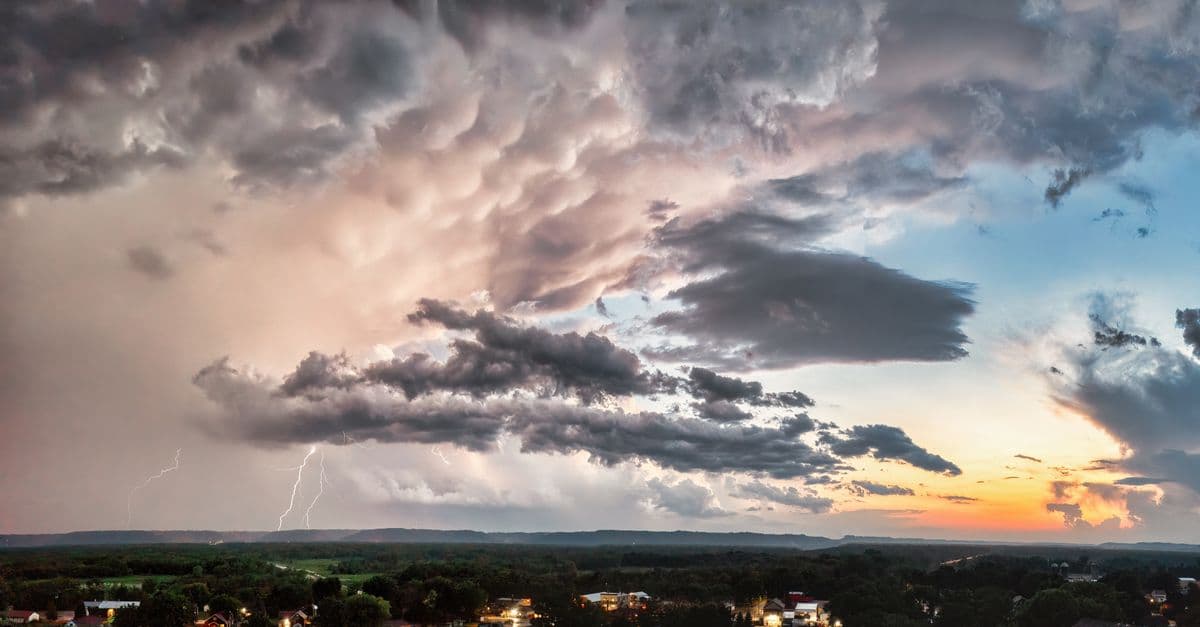
A dramatic thunderstorm over Nelson, WI with lightning and a vibrant sunset.
World Records

The Most Extreme Weather Records: Wind, Hail, Rain, and Lightning

On April 10, 1996, an automated anemometer on Barrow Island off the northwest coast of Australia measured a three-second wind gust of 408 km/h (253.5 mph) during Tropical Cyclone Olivia — the highest surface wind speed ever officially recorded on Earth. Tornadoes have exceeded even that. A hailstone in South Dakota weighed 878 g (1.94 lb). A Venezuelan lake generates up to 1,600 lightning bolts per hour, every night, for 300 nights per year. These records are not flukes. Each one follows from specific, explainable atmospheric physics.

Editorial Team·June 2, 2026·16 min
Hands raising a globe against a lush green tree backdrop, symbolizing environmental awareness.
World Records

The Driest and Wettest Places on Earth: Extreme Precipitation Records

Some corners of the Atacama Desert have received no measurable rainfall since weather records began. Others, 400 meters above sea level in northeast India, average nearly 12,000 mm of rain every year — enough to submerge a four-story building. The gap between Earth's driest and wettest places is not just meteorological curiosity. It is a product of ocean currents, mountain geometry, and atmospheric circulation that shapes everything from agriculture to geology to the evolution of life itself.

Editorial Team·June 2, 2026·16 min