The Largest Structures Ever Built: Towers, Bridges, Dams, and Walls

Photo: cottonbro studio / Pexels
The Burj Khalifa in Dubai reaches 828 meters into the sky, and at any given moment its upper floors are buffeted by winds its lobby-level visitors never feel. Its structural engineers had to account for temperature differentials that cause the steel frame to expand and contract by several centimeters between summer and winter. Its concrete was pumped to the uppermost floors at pressures that had never been achieved in construction before. Height — just one dimension of "largest" — already pushes every material and every engineering discipline to its limit. The Danyang-Kunshan Grand Bridge in China extends 164.8 km, longer than the distance from New York City to Philadelphia. Three Gorges Dam holds back 39.3 cubic kilometers of the Yangtze River. These structures represent humanity's maximum expression of specific engineering categories — and the physics of why they cannot simply be made larger tells you as much as the records themselves.
Defining "Largest": Why the Category Determines the Champion
Structure size can be measured in at least six meaningful ways, each of which produces a different record-holder: Vessels are another category; see the largest ships ever built.
Height — vertical distance from base to structural top. Burj Khalifa leads at 828 m.
Length — horizontal extent. Danyang-Kunshan Grand Bridge leads at 164.8 km.
Volume — total enclosed space. Boeing Everett factory in Washington State leads at approximately 13.3 million cubic meters.
Floor area — usable interior space. Also the Boeing Everett factory at approximately 398,000 m² (4.3 million sq ft) of factory floor.
Total mass — the Three Gorges Dam, containing approximately 27.2 million cubic meters of concrete, takes this category for constructed structures.
Linear span — the Great Wall of China at over 21,000 km for all branches combined, though individual construction campaigns are significantly shorter.
Each record illustrates a different engineering challenge. Towers fight gravity and wind. Bridges fight gravity and dynamic loading. Dams fight hydrostatic pressure. The Great Wall fought terrain and logistics. Understanding each structure requires understanding the specific problem it was built to solve.
The Tallest Buildings: Racing Toward the Sky
| Rank | Building | Height (m) | Floors | City | Completed |
|---|---|---|---|---|---|
| 1 | Burj Khalifa | 828 | 163 | Dubai, UAE | 2010 |
| 2 | Merdeka 118 | 679 | 118 | Kuala Lumpur, Malaysia | 2023 |
| 3 | Shanghai Tower | 632 | 128 | Shanghai, China | 2015 |
| 4 | Abraj Al-Bait Clock Tower | 601 | 120 | Mecca, Saudi Arabia | 2012 |
| 5 | Ping An Finance Centre | 599 | 115 | Shenzhen, China | 2017 |
| 6 | Lotte World Tower | 555 | 123 | Seoul, South Korea | 2017 |
| 7 | One World Trade Center | 541 | 104 | New York, USA | 2014 |
| 8 | Guangzhou CTF Finance Centre | 530 | 111 | Guangzhou, China | 2016 |
| — | Jeddah Tower (under construction) | 1,000+ | 167 | Jeddah, Saudi Arabia | Target: ~2028 |
Source: Council on Tall Buildings and Urban Habitat (CTBUH) Global Tall Building Database (2024) — official height rankings using CTBUH methodology (height to architectural top, excluding antennas).
Burj Khalifa: How Engineers Got a Building to 828 Meters
The Burj Khalifa, designed by Adrian Smith at the firm Skidmore, Owings and Merrill (SOM) and completed in January 2010, solved several problems simultaneously that no previous structure had faced at that scale.
Wind loads. At 828 m, the upper floors of the Burj Khalifa experience sustained wind speeds that would qualify as gale-force at ground level. The tower's distinctive Y-shaped plan — three "petals" arranged around a central core — was specifically designed to disrupt the coherent vortex shedding (the periodic swirling eddies that form behind a blunt object in wind) that causes structural resonance. By changing the cross-sectional shape at each setback level, the architects ensured that no wind frequency would persist long enough to set up dangerous oscillations in the structure.
Concrete pumping. The concrete for Burj Khalifa's foundations and structural core was pumped to heights above 600 m — a record at the time. Concrete pump pressure increases with height because the weight of the concrete column in the pipe works against the pump. Above a certain height, standard concrete becomes too viscous to pump; the Burj Khalifa required specially formulated high-strength concrete with modified water-to-cement ratios and chilled mixing water to manage heat of hydration.
Foundation depth. The tower sits on 192 concrete piles, each 1.5 m in diameter and approximately 50 m deep, driven into weak limestone and sandy gravel beneath Dubai. The foundation mat alone contains 12,500 cubic meters of concrete and took 12,000 man-hours to pour continuously over four days.
The analogy: the Burj Khalifa's structural system is like a bundled set of pencils — each "petal" is a tube structure that resists overturning loads independently, and the bundled arrangement is far more rigid than any single tube would be.
Source: SOM / Skidmore, Owings and Merrill engineering documentation; Council on Tall Buildings and Urban Habitat — Burj Khalifa technical case study (2010).
The Physics Limit on Building Height
Why can buildings not simply be made taller? Several interacting constraints impose practical ceilings.
Material compressive strength. The most commonly cited limit involves the compressive strength of the foundation material and the structural columns at the base. As height increases, the dead load (the weight of the structure itself) grows faster than the cross-sectional area available to support it. At some point, the column cross-sections required to support the load would consume the entire floor plate — leaving no usable space and making the building economically absurd.
For steel, the theoretical self-compression limit (where the material at the bottom yields under its own weight) is far beyond any practical building height — roughly 64 km for a steel column of uniform cross-section. The practical limit is not material failure but economic and functional feasibility: elevators, utilities, structural stiffening, and wind systems consume an increasing fraction of floor space as height increases.
Wind-induced resonance. Tall slender structures have natural resonant frequencies. If the frequency of vortex shedding from wind equals the structure's natural frequency, amplitude of oscillation grows (a phenomenon called aeroelastic resonance, or "vortex-induced vibration"). This can be damped mechanically — the Taipei 101 uses an 800-metric-ton steel pendulum (a tuned mass damper) — but managing it gets progressively harder as aspect ratio increases.
Elevator inefficiency. Above approximately 500 m, the number of elevators required to serve the floor population, and the shaft space they consume, begins to make upper floors economically non-viable without dedicated sky lobby transfer systems. The Burj Khalifa uses double-deck elevators and sky lobbies at multiple levels to manage this.
The Jeddah Tower, targeting 1,000 m, is designed to address each of these constraints with next-generation solutions. Its progress has been interrupted by financial and construction delays; as of 2026, a completion date remains uncertain.
Source: CTBUH Journal (2011) — "Tall Buildings in Numbers: Energy Consumption and the Height Premium"; MIT Department of Civil Engineering — structural height limit analysis.
The Longest Bridges: Spanning Impossible Distances
| Rank | Bridge | Total Length (km) | Type | Country | Opened |
|---|---|---|---|---|---|
| 1 | Danyang-Kunshan Grand Bridge | 164.8 | Viaduct (rail) | China | 2011 |
| 2 | Langfang-Qingxian Viaduct | 113.7 | Viaduct (rail) | China | 2011 |
| 3 | Tianjin Grand Bridge | 113.7 | Viaduct (rail) | China | 2011 |
| 4 | Cangde Grand Bridge | 105.8 | Viaduct (rail) | China | 2010 |
| 5 | Weinan Weihe Grand Bridge | 79.7 | Viaduct (rail) | China | 2008 |
| 6 | Bang Na Expressway | 55.0 | Elevated highway | Thailand | 2000 |
| 7 | Beijing Grand Bridge | 48.2 | Viaduct (rail) | China | 2011 |
Source: Guinness World Records (2024) — Danyang-Kunshan Grand Bridge confirmed as world's longest bridge at 164.8 km.
The Danyang-Kunshan Grand Bridge is part of the Beijing-Shanghai High-Speed Railway. It stretches 164.8 km (102.4 miles) across the Yangtze River Delta, crossing rivers, lakes, rice paddies, and canals. Construction took four years and employed approximately 10,000 workers at a cost of $8.5 billion. For most of its length, the bridge serves as an elevated viaduct keeping the high-speed rail line above the complex, flood-prone terrain of the Yangtze Delta.
The top seven longest bridges in the world are all in China, and six of the top seven are elevated viaducts for high-speed rail — a consequence of China's massive investment in rail infrastructure over the past two decades and the engineering necessity of crossing the country's extensive river systems without imposing grade changes that would slow trains.
Three Gorges Dam: The Largest Concrete Structure
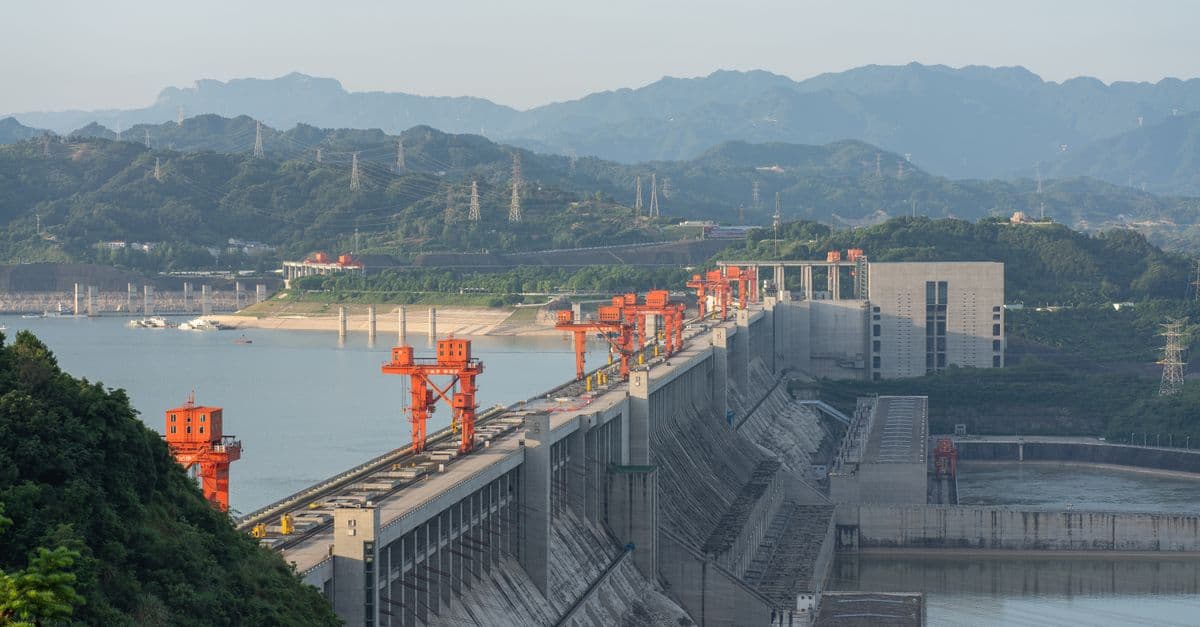
The Three Gorges Dam on the Yangtze River in Hubei Province, China, holds several superlatives simultaneously. It is the world's largest power station by installed capacity (22,500 MW). It is also among the largest concrete structures ever built, containing approximately 27.2 million cubic meters of concrete — enough to build more than two Hoover Dams.
The dam's statistics resist intuitive comparison. At 2,335 m (7,661 ft) long and 185 m (607 ft) tall, it stretches nearly 2.5 km across one of the world's largest rivers, impounding a reservoir that reaches approximately 600 km upstream. When the reservoir filled to operational level, it displaced approximately 1.3 million people from towns and villages that were submerged — the largest deliberate human displacement for a single infrastructure project in history.
The structural engineering challenge was managing the Yangtze's tremendous flow, which peaks during seasonal monsoons at rates exceeding 75,000 cubic meters per second. Twenty-two sluice gates allow the dam to pass flood flows when the reservoir approaches capacity. In 2020, the dam successfully managed the worst Yangtze flooding in decades, demonstrating its flood control function — though at the cost of operating the reservoir at dangerously high levels.
Source: China Three Gorges Corporation (2024) — official dam statistics. USGS Water Science School (2024) — reservoir volume and engineering figures.
The Great Wall: The Longest Structure
The Great Wall of China is the longest structure ever built by humans, though the total length figure depends heavily on which walls you count. China's State Administration of Cultural Heritage conducted a comprehensive survey between 2007 and 2012 and found that the total length of all walls built during the Great Wall's construction history — across multiple dynasties spanning over 2,000 years — exceeds 21,196 km (13,171 miles).
The most famous sections, built during the Ming Dynasty (1368–1644), run approximately 8,850 km. These are the stone-and-brick sections most commonly photographed. Earlier walls, built during the Qin Dynasty (221–206 BCE) and the Han Dynasty (206 BCE – 220 CE), used rammed earth and were often less durable; many sections have eroded completely.
The engineering challenge of the Great Wall was not height or span but logistics. The wall crosses some of the most difficult terrain in Asia — mountain ridges, desert margins, and river valleys — in regions that were remote and difficult to supply in antiquity. Historians estimate that millions of laborers worked on various wall construction projects over the centuries, with mortality rates among workers in certain periods reaching into the hundreds of thousands.
Rammed earth — a construction technique in which layers of moist soil and sometimes lime are compacted into forms to create dense, durable walls. The technique was well understood in antiquity and remains in use in sustainable building today. The earliest Great Wall sections used this method; later Ming-era sections switched to fired brick and stone, which is why they survive better.
Source: China State Administration of Cultural Heritage — Great Wall Survey 2012, total length 21,196 km for all wall sections combined.
The Largest Building by Volume: Boeing's Everett Factory
The world's largest building by volume is not a stadium or an airport terminal. It is a factory. The Boeing Everett Production Facility in Everett, Washington, covers approximately 398,000 square meters (4.3 million square feet) of floor space and encloses approximately 13.3 million cubic meters of space under a single roof.
The building was originally constructed in 1967 to build the Boeing 747, which at the time was nearly twice the size of any commercial aircraft previously manufactured. The factory had to be large enough to accommodate the fuselage, wings, and assembly tooling of a double-deck wide-body aircraft, which required unprecedented clear-span interior spaces. It has since been expanded multiple times and now also produces the 767, 777, and 787 Dreamliner.
One often-cited consequence of the factory's size: in the early days before the HVAC system was properly designed, the interior was large enough to develop its own localized weather patterns. Fog reportedly formed near the ceiling on cold days. Boeing subsequently installed a climate control system sufficient to manage the air mass.
The factory employs approximately 30,000 workers across its multiple production lines, making it one of the largest single-site employers in the United States.
Source: Boeing Company — Everett Production Facility factsheet. Guinness World Records — largest building by volume recognition for Boeing Everett facility.
What Comes After the Current Records?
Architectural ambition is not static. Several structures either under construction or in advanced design phases will challenge the records above.
The Jeddah Tower in Saudi Arabia, designed to reach 1,000 m (3,281 ft), will surpass the Burj Khalifa's height by 172 m when completed. The project has faced significant delays — construction was suspended in 2018 and resumed in 2023 — but the structural engineering has been completed for the lower floors.
China continues expanding its high-speed rail viaduct network; additional multi-hundred-kilometer bridges remain possible as the rail system extends into more complex terrain in western China.
In bridge span (not total length), the Çanakkale Bridge in Turkey, opened in 2022 with a main span of 2,023 m, surpassed the previous record held by Japan's Akashi Kaikyō Bridge (1,991 m, opened 1998). Ultra-long suspended spans push the limits of cable materials and aerodynamic stability; proposed bridges across the Messina Strait (Italy-Sicily) and the Øresund crossing extensions continue to be studied.
The ultimate limit on building height, beyond economic constraints, may be wind management and elevator technology. Both are areas of active research, and the engineering consensus is that structures meaningfully above 1,000 m are achievable with current or near-future technology — the bottleneck is economic justification, not physics.
Source: CTBUH (2024) — Jeddah Tower project status; General Authority for Statistics (Saudi Arabia) — construction resumption confirmation 2023.
Frequently Asked Questions
Q: How tall is the Burj Khalifa exactly, and what is the difference between "height to top" and "architectural height"?
A: The Burj Khalifa's architectural height — measured to the top of the spire, which is the CTBUH standard — is 828 m (2,717 ft). Its roof height (to the highest occupied floor) is lower at 585 m. The antenna/broadcast facilities at the very top are typically not counted toward the official building height under CTBUH rules, which is why some buildings appear shorter than they are physically when measured tip-to-top.
Q: Is the Great Wall of China visible from space?
A: No, not with the naked eye. The Great Wall averages 4–5 meters wide — narrower than a highway. The human eye cannot resolve objects that narrow from orbit. Chinese astronaut Yang Liwei reported not being able to see it during his 2003 spaceflight, and NASA has confirmed that the claim, while popular, is a myth. The wall would need to be hundreds of meters wide to be visible without optical aids from low Earth orbit.
Q: How long did it take to build the Burj Khalifa?
A: Ground was broken in January 2004 and the tower officially opened on January 4, 2010 — approximately six years of construction. At peak construction, more than 12,000 workers were on site daily. The concrete and rebar structure was topped out in January 2009, with the final year spent on cladding, interior work, and systems installation.
Q: Why are the world's longest bridges all in China?
A: China's high-speed rail buildout — the world's largest, at over 45,000 km of high-speed track as of 2024 — required thousands of kilometers of elevated viaducts to maintain the level gradients that high-speed trains require. In the flat, flood-prone Yangtze Delta, elevating the rail line above the terrain also reduces conflicts with road traffic and agriculture. The combination of national scale, government funding, and terrain constraints produced a concentration of long-bridge construction with no parallel elsewhere.
Q: What is the largest structure by mass ever built?
A: By total mass of material moved or incorporated, the Great Pyramid of Giza — at approximately 5.9 million metric tons of stone — is the largest structure by mass completed in the ancient world. Among modern structures, Three Gorges Dam incorporates approximately 27.2 million cubic meters of concrete at roughly 2.4 metric tons per cubic meter, giving a total concrete mass of approximately 65 million metric tons. The dam's total fill mass, including earth and rock, is higher still.
Q: Will any building surpass 1,000 meters in height in the near future?
A: The Jeddah Tower is designed to reach approximately 1,007 m and is currently the only funded, permitted, and partially constructed building targeting that height. Its completion timeline remains uncertain as of 2026. Beyond 1,000 m, no other project has reached the funded construction phase. The engineering challenges — particularly wind management and elevator system design — are understood and solvable; the limiting factor is economic viability of usable space at extreme heights.
For more on the machines that built these structures, see the most powerful machines ever built. For a broader perspective on how human scales compare to cosmic ones, see the most massive objects in the universe and the most abundant elements in the universe.
Follow new articles
Add SciHub101 to your feed reader to see new science and technology stories.
About the Author
SciHub101 is an independent science and technology publication founded and edited by Buğra Sözeri, a software engineer and app developer based in Türkiye. AI tools assist with drafting and research. Source documentation in the existing archive is uneven, and articles are being reviewed and corrected. The Editorial Team byline identifies editorial responsibility; it does not certify specialist or independent human review. Where we compare products, anything built by our own team is labelled as such — see the editorial guidelines and About page for how corrections and disclosures work.
Related Articles

The Loudest Sounds Ever Recorded: Krakatoa, Tonga, Sperm Whales, and the Physics of Decibels
On August 27, 1883, the island of Krakatoa in Indonesia exploded with a sound estimated at 310 decibels at source — the loudest sound ever produced on Earth's surface by any event in the historical record. The pressure wave circled the globe four times. It ruptured eardrums of sailors 64 kilometers away, was heard in Rodrigues Island near Mauritius 4,800 kilometers distant, and registered on barometers across the world. On January 15, 2022, the eruption of Hunga Tonga-Hunga Ha'apai produced the loudest infrasound event of the modern era, with pressure waves detectable globally. These events reveal something surprising: there is a hard physical ceiling on how loud a sound in air can ever be — 194 decibels — and Krakatoa probably exceeded it.

The Highest and Lowest Points on Earth: Everest, Challenger Deep, and the Full Vertical Range
Mount Everest's summit reaches 8,848.86 meters above sea level, measured in a joint 2020 China-Nepal survey using GPS and gravity data — 86 centimeters higher than the figure used for most of the 20th century. The floor of Challenger Deep in the Mariana Trench sits 10,935 meters below sea level. The total measured vertical range of Earth's surface is therefore approximately 19,784 meters — about 19.8 kilometers from the lowest ocean floor to the highest mountain peak. Buried under 2.7 kilometers of Antarctic ice, the Denman Glacier trough reaches 3,500 meters below sea level: the deepest point on continental land, and the place where the next large ice loss could have catastrophic consequences.
The Tallest Buildings in the World: Burj Khalifa and the Race to a Kilometre
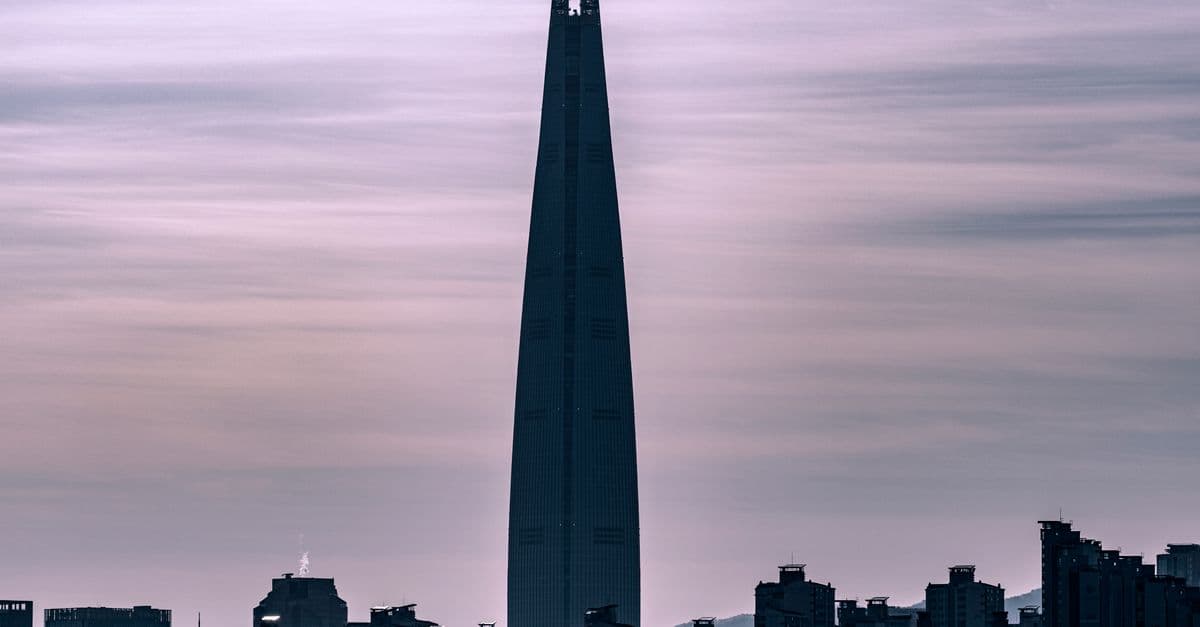
At 828 metres, Dubai's Burj Khalifa has held the title of world's tallest building since 2010 — and as of 2026 nothing completed has come close. The runner-up, Kuala Lumpur's Merdeka 118, tops out at 678.9 metres, nearly 150 metres shorter. But the real story is the building rising in Jeddah: a tower designed to break one kilometre, a height engineers once argued was physically impractical. How tall can we actually build, and what stops us?
The Longest Bridges in the World: The 164-Kilometre Crossing
The longest bridge on Earth runs for 164 kilometres — roughly the distance from London to Birmingham — carrying high-speed trains across the rice paddies and rivers of eastern China. The Danyang–Kunshan Grand Bridge is so long that calling it a 'bridge' almost understates it; it is an elevated railway the length of a small country. But the real engineering drama lies elsewhere: in the bridges that span the widest single gaps without touching the ground.