The Tallest Buildings in the World: Burj Khalifa and the Race to a Kilometre
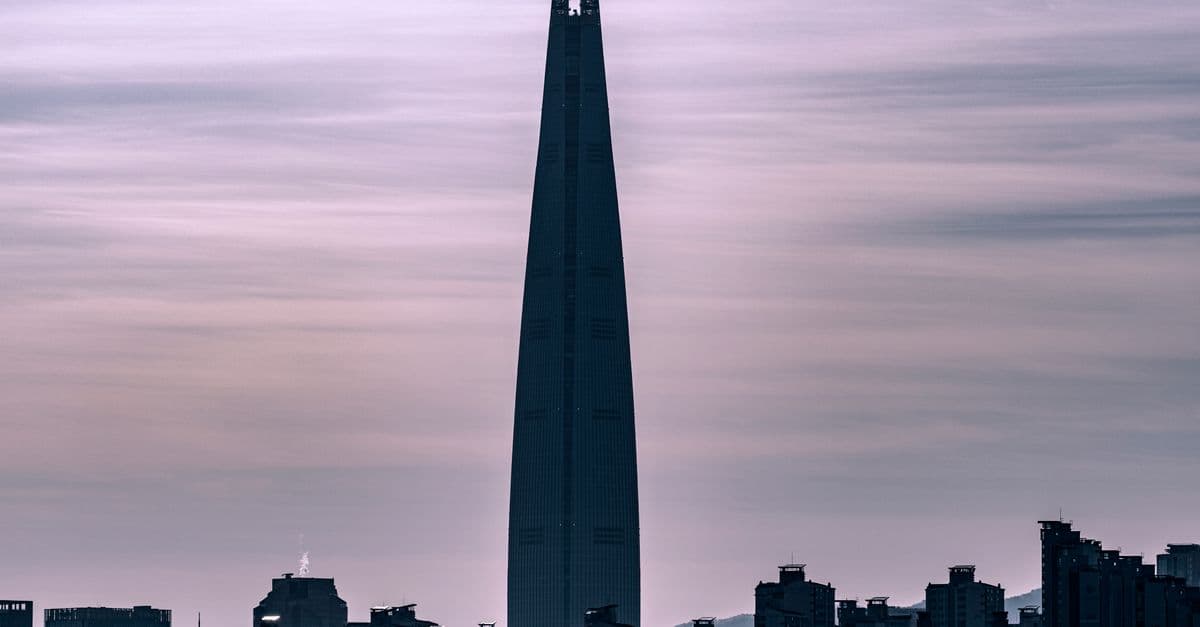
Photo: 정규송 Nui MALAMA / Pexels
As of 2026, the tallest building in the world is the Burj Khalifa in Dubai, at 828 metres (2,717 feet). It has held that title since 2010, and the gap to second place is so large — nearly 150 metres — that no completed building has seriously challenged it in over a decade. The next true contender, the Jeddah Tower in Saudi Arabia, is designed to break one kilometre. Construction on it resumed at full speed in January 2025, and by early 2026 it had already passed the 100th floor.
This is the story of how skyscrapers got this tall, exactly what ranks where today, why the limiting factor is rarely the strength of steel and concrete, and what happens to a building's engineering, economics, and even its residents once it crosses the kilometre line.
The Short Answer: Tallest Completed Buildings (2026)
Table: The world's tallest completed buildings, ranked by architectural height, 2026
| Rank | Building | City | Height | Floors | Completed |
|---|---|---|---|---|---|
| 1 | Burj Khalifa | Dubai, UAE | 828 m (2,717 ft) | 163 | 2010 |
| 2 | Merdeka 118 | Kuala Lumpur, Malaysia | 678.9 m (2,227 ft) | 118 | 2023 |
| 3 | Shanghai Tower | Shanghai, China | 632 m (2,073 ft) | 128 | 2015 |
| 4 | Makkah Royal Clock Tower | Mecca, Saudi Arabia | 601 m (1,971 ft) | 120 | 2012 |
| 5 | Ping An Finance Centre | Shenzhen, China | 599 m (1,966 ft) | 115 | 2017 |
| 6 | Lotte World Tower | Seoul, South Korea | 555 m (1,819 ft) | 123 | 2017 |
| 7 | One World Trade Center | New York, USA | 541.3 m (1,776 ft) | 94 | 2014 |
| 8 | Guangzhou CTF Finance Centre | Guangzhou, China | 530 m (1,739 ft) | 111 | 2016 |
| 9 | Tianjin CTF Finance Centre | Tianjin, China | 530 m (1,739 ft) | 97 | 2019 |
| 10 | CITIC Tower (China Zun) | Beijing, China | 528 m (1,732 ft) | 108 | 2018 |
Heights follow the standard "architectural top" measure (including spires but not antennas) used by the Council on Tall Buildings and Urban Habitat (CTBUH), the body that officially adjudicates these records. Seventeen of the world's twenty tallest buildings are now in Asia, with the only non-Asian entry in the global top ten being One World Trade Center at number seven.
Why Burj Khalifa Stands Alone
The Burj Khalifa didn't just beat the previous record, it shattered it. When it opened in January 2010, it was over 60% taller than the building it replaced, Taipei 101 (508 m). That kind of leap is rare in the history of any engineering record; it's the equivalent of the marathon world record dropping by twenty minutes in a single race.
Its secret is a structural idea called the buttressed core: a central hexagonal concrete spine braced by three wings arranged in a Y shape. Each wing supports the others, the way the legs of a tripod stabilize a camera even though no single leg could hold it up alone. The Y-plan also lets the tower "step back" as it rises, 27 setbacks arranged in a spiral, which confuses the wind. A steady wind hitting a uniform, straight-sided tower can set it swaying at its natural frequency, the same way pushing a swing at the right moment builds up momentum. An irregular, tapering, spiraling shape breaks up those organized gusts so no single resonant sway builds.
That wind problem, not gravity, is the real enemy of supertall buildings. The materials easily bear the weight; a modern concrete core could theoretically support a structure several kilometres tall. The harder challenge is keeping the top from swaying enough that occupants on the 150th floor feel seasick on a windy afternoon.
The Burj Khalifa's construction pushed several other records along the way. Workers set a world record for vertical concrete pumping, lifting a specially formulated mix 605 metres up the building's core in May 2008, surpassing the previous record held by Taipei 101 (Construction Week Online). The tower used roughly 330,000 cubic metres of concrete and 39,000 tonnes of steel rebar, assembled across 22 million labor hours over roughly six years of construction (property market cost breakdowns citing official project figures). Its double-decker elevators travel at 10 metres per second, among the fastest passenger elevators anywhere, and one bank of cars rides 504 vertical metres in a single continuous trip to an observation deck at 638 metres, itself the highest occupied outdoor observation deck on Earth (Construction Week Online).
How We Got Here: A Century of Climbing
Skyscrapers became possible only after two 19th-century inventions converged: the safety elevator, patented by Elisha Otis in 1853, and steel-frame construction. Before steel frames, a building's outer walls carried its entire weight, so going higher meant impossibly thick walls at the base; a 100-storey masonry tower would need ground-floor walls many metres thick just to hold itself up. The steel skeleton moved the load-bearing job to an internal frame, the way a coat hanger's wire frame holds a coat's shape rather than the fabric holding itself up. That freed the exterior walls to be thin, light, and eventually glass.
The milestones since track a shifting global center of gravity for capital and ambition:
- 1931 — Empire State Building (381 m), New York: held the record for roughly 40 years, the longest reign of the modern skyscraper era, built during the Great Depression in just over a year using a then-radical assembly-line construction method.
- 1972-73 — World Trade Center, then Sears Tower (442 m, 1974), USA: the American era of supertalls, both built in Chicago-school steel-tube construction.
- 1998 — Petronas Towers (452 m), Kuala Lumpur: the record moved to Asia for the first time, and it never came back to the West.
- 2004 — Taipei 101 (508 m), Taiwan: the first building to break half a kilometre, using a giant 660-tonne tuned mass damper visible to visitors to counteract typhoon-force winds and seismic sway.
- 2010 — Burj Khalifa (828 m), Dubai: the Gulf era, and the leap to where the record stands today.
The pattern is unmistakable: the tallest building on Earth moved from New York to Chicago to Kuala Lumpur to Taipei to Dubai over roughly 80 years, tracking almost exactly where new capital and state ambition concentrated at each moment.
For other record-breaking feats of construction, see the largest structures ever built and the longest bridges in the world.
Why did the record move to Asia and the Gulf, and not stay in the US?
Building a supertall skyscraper requires three things at once: enormous available capital, a government or developer willing to absorb a project that rarely pays for itself in rent alone, and a symbolic reason to want the record. Petronas, Taipei 101, and the Burj Khalifa were each explicitly framed by their sponsors as national or civic prestige projects, not primarily as real estate investments.
The Kilometre Barrier: Jeddah Tower
The Jeddah Tower (formerly Kingdom Tower) in Saudi Arabia is designed to reach roughly 1,000 metres, the first building intended to break the one-kilometre mark. Construction began in 2013 but paused in 2018 amid financial complications tied to its original developer, Kingdom Holding, and broader disruptions in the Saudi construction sector. Full-scale work resumed in January 2025, and by that point the site had already become, in the words of engineers quoted by industry press, a "blistering" pace of construction, with crews adding a new floor roughly every three to four days (IndexBox construction update, 2026).
By April 2026, the tower had reached its 100th floor and roughly 400 metres, and by the following month it had climbed to about 430 metres, according to construction-industry reporting and photographs of the site (Dezeen, April 2026; Thornton Tomasetti, structural engineer of record). That places the tower roughly halfway to its planned height, with developers now targeting completion around August 2028.
At a full kilometre, new problems appear that the Burj Khalifa, at 828 metres, only hinted at:
- Elevators: steel cables have a maximum practical length before their own weight becomes the limiting load on the hoist motor. A single cable run to 1,000 metres would weigh several tonnes on its own, so kilometre-tall towers rely on sky-lobby transfers, where riders change elevators partway up the way passengers change trains at a hub station, or increasingly on cable-less, magnetically driven elevator systems still being piloted in a handful of supertall projects worldwide.
- Water and air: pumping water and conditioning air across a vertical kilometre requires staged mechanical systems, similar to how a mountain is divided into altitude zones with their own weather. Pressure that would blow out a pipe at ground-level pump pressure has to be broken up floor by floor.
- Construction logistics: concrete has to be pumped higher than the Burj Khalifa's own 605-metre record, often at night, when cooler ambient temperatures slow the curing reaction enough to prevent the concrete from cracking as it sets. That technique, refined on the Burj Khalifa, is now standard practice on Jeddah Tower.
None of these are about the building falling down. They are about whether a kilometre of usable floor space makes economic and logistical sense, which is exactly why the true limit on height today is money and usability, not structural strength.
How much does a kilometre-tall building cost to insure and maintain?
Public figures for Jeddah Tower's total project cost are not confirmed by its developer, Jeddah Economic Company, though early estimates before the 2018 pause put the tower and its surrounding district in the multi-billion-dollar range. Ongoing costs, elevator maintenance, façade cleaning at extreme height, and wind-monitoring systems, scale with height in ways that are not fully public for any completed megatall building.
Tallest by Other Measures
"Tallest building" has a strict technical definition: a structure that is mostly occupiable floors, stacked vertically, supporting itself. Other height records belong to entirely different categories, and mixing them up is one of the most common errors in casual "tallest" lists.
- Tallest free-standing structure of any kind: the Burj Khalifa also holds this broader record, since it beats every tower, mast, and chimney on Earth regardless of whether the structure is occupied.
- Tallest tower, non-occupiable (broadcast, observation): the Tokyo Skytree (634 m), completed in 2012, holds this category since it is a lattice broadcast tower, not a building with floors of offices or apartments.
- Tallest structure ever built, of any kind including guyed masts: the Warsaw Radio Mast in Poland (646 m) held this record until it collapsed during maintenance work in 1991. Guyed masts, held up by tensioned steel cables anchored to the ground rather than by their own base, can exceed free-standing buildings in height precisely because the cables share the structural load the way tent guy-lines share the load of holding up a tent pole.
- Tallest structure that ever existed, including today: the KVLY-TV mast in North Dakota (628.8 m) is currently the tallest human-made structure of any kind still standing, though it is a guyed mast, not a building.
The distinction matters because records are awarded by category. A radio mast and an office tower are not competing in the same contest, any more than a marathon runner and a sprinter are competing for the same medal.
Is the Burj Khalifa the tallest structure on Earth, or just the tallest building?
It is the tallest building and the tallest free-standing structure, but not the tallest structure of any kind. Guyed masts like the KVLY-TV mast in North Dakota exceed it in raw height because cables, not a self-supporting base, carry part of their load, a fundamentally different engineering approach that would be impractical for an occupied building full of people.
What It Actually Takes to Build a Supertall Tower
Skyscraper engineers use "supertall" for any building over 300 metres and "megatall" for anything over 600 metres, a category that currently contains only a handful of buildings on Earth. Crossing each threshold multiplies the engineering challenge rather than simply adding to it.
Foundations: building down before building up
A supertall tower's foundation has to distribute its weight, hundreds of thousands of tonnes for a building like the Burj Khalifa, into ground that was never meant to bear that much load in one spot. The Burj Khalifa sits on a reinforced concrete mat nearly 3.7 metres thick, resting on 194 bored concrete piles driven roughly 50 metres into the ground, deep enough to reach load-bearing rock rather than the looser sand near the surface. Think of it the way a snowshoe spreads a person's weight across soft snow instead of letting a boot sink straight through; the wide mat spreads the tower's weight across a much larger footprint of ground than the tower itself occupies.
Wind: the invisible opponent
Every supertall building is, from an engineering standpoint, mostly a wind problem wearing a real-estate disguise. As buildings climb past 300 metres, wind speeds increase substantially compared to street level, because friction from the ground and nearby buildings slows air near the surface but has far less effect higher up. A tower has to survive not just steady wind pressure but vortex shedding, the phenomenon where wind flowing around a tall, narrow object peels off in alternating swirls on each side, creating a rhythmic side-to-side push. If that rhythm happens to match the building's own natural sway frequency, the swaying can amplify the way pushing a swing in time with its arc builds up height with very little added force.
Engineers fight this two ways: by shaping the building itself, tapering, twisting, or adding setbacks so the wind never organizes into a single rhythm, and by adding tuned mass dampers, enormous pendulum weights, sometimes hundreds of tonnes, suspended near the top of the building that swing out of phase with the structure's own motion to cancel it out. Taipei 101's damper, a 660-tonne steel sphere visible to visitors through a viewing window, is one of the most famous examples anywhere.
People: getting a city's worth of residents up and down every day
A tower like the Burj Khalifa or Jeddah Tower is effectively a vertical small city, and moving that many people through a handful of elevator shafts every morning and evening is its own logistics problem. Sky lobbies, intermediate floors where slower local elevators meet faster express elevators, exist for the same reason airport hub-and-spoke routing exists: it is more efficient to move large numbers of people over a long distance in a few big, fast trips and then redistribute them locally than to run every single elevator car the full height of the building.
Frequently Asked Questions
Q: What is the tallest building in the world in 2026? A: The Burj Khalifa in Dubai, at 828 metres (2,717 feet), completed in January 2010. It remains the tallest completed building by a wide margin — the second-place Merdeka 118 in Kuala Lumpur, completed in 2023, is nearly 150 metres shorter.
Q: Will the Jeddah Tower be taller than the Burj Khalifa? A: Yes, by design. The Jeddah Tower in Saudi Arabia is planned to reach roughly one kilometre, which would make it over 170 metres taller than the Burj Khalifa. Construction resumed at full pace in January 2025 after a seven-year pause, and the tower passed its 100th floor and roughly 430 metres by mid-2026, with completion targeted for August 2028. Until it opens and is officially certified, the Burj Khalifa keeps the title.
Q: How tall can a building theoretically be? A: Far taller than anything built so far — structural engineers have sketched designs for towers several kilometres high, including concepts using carbon fiber or advanced composite cores. The real limits are practical: elevator cable weight, wind sway, the cost of pumping water and air upward through staged mechanical systems, and whether enough usable floor space justifies the expense. Strength of materials is rarely the binding constraint at heights built or planned so far.
Q: Why don't tall buildings fall over in strong wind? A: Their shape is engineered to disrupt the wind. Tapering, setbacks, and rounded or irregular cross-sections break up the organized gusts that would otherwise set a tower swaying at its natural resonant frequency. Many supertalls also use a tuned mass damper, a huge weight near the top that swings opposite to the building's motion to cancel it out, the way Taipei 101's visible 660-tonne steel sphere does during typhoons.
Q: Who decides which building is officially the tallest? A: The Council on Tall Buildings and Urban Habitat (CTBUH), an independent nonprofit organization headquartered in Chicago that sets the measurement rules used industry-wide. It counts height to the "architectural top," including spires that are a permanent part of the design but excluding antennas, signage, and flagpoles, so buildings can be compared on a consistent basis.
Q: What was the tallest building before the Burj Khalifa? A: Taipei 101 in Taiwan, completed in 2004 at 508 metres, held the title for about six years until the Burj Khalifa opened in January 2010. Before Taipei 101, the Petronas Towers in Kuala Lumpur (452 m, completed 1998) held it, and before that, the Sears Tower in Chicago (442 m, completed 1974).
Q: How many floors does the Burj Khalifa have? A: The Burj Khalifa has 163 occupiable floors, plus additional mechanical and service levels above that, for a total structure height of 828 metres.
Q: Is the tallest building in the world always in the Middle East or Asia? A: Currently, yes — every building in the global top ten is in Asia or the Gulf, with the sole exception of One World Trade Center in New York at number seven. The record has not belonged to a North American building since the Sears Tower lost the title to the Petronas Towers in 1998.
Q: What is the difference between "supertall" and "megatall"? A: These are standard industry categories from the Council on Tall Buildings and Urban Habitat. "Supertall" describes any building over 300 metres; "megatall" describes any building over 600 metres. Only a small number of buildings worldwide, including the Burj Khalifa, Merdeka 118, Shanghai Tower, and the Makkah Royal Clock Tower, currently qualify as megatall.
Q: Does the Burj Khalifa have the highest observation deck in the world? A: Yes. Its "At the Top, SKY" observation level sits at 638 metres, reached by elevators traveling 504 metres in a single continuous trip, making it the highest outdoor observation deck open to the public anywhere on Earth as of 2026.
The Takeaway
The Burj Khalifa's 16-year reign is not really a story about how strong modern concrete and steel are; it is a story about how rarely a government or developer decides that a symbolic height record is worth the enormous, largely non-financial cost of chasing one. The physics of building a kilometre-tall tower were understood decades before anyone attempted it seriously. What changed in Jeddah was political and financial will, not material science. When the tower tops out around 2028, it will prove the same lesson the Burj Khalifa already proved in 2010: the ceiling on how tall we can build has moved from engineering to economics, and it keeps moving every time someone decides the record is worth the price.
Read next:
- The Largest Empires in History
- The Longest Bridges in the World
- The Largest Structures Ever Built
- The Tallest Mountains on Earth
Sources
- Council on Tall Buildings and Urban Habitat (CTBUH) — The Skyscraper Center global building database, official height and rank arbitration
- Construction Week Online — Burj Khalifa elevator and construction facts
- PropertyFinder — Burj Khalifa cost and construction breakdown
- Dezeen, April 2026 — Jeddah Tower reaches 100th floor
- Thornton Tomasetti — Jeddah Tower construction update, structural engineer of record
- IndexBox — Jeddah Tower reaches 430 metres, construction statistics 2026
- Wikipedia, cross-referenced with CTBUH data — Lotte World Tower, Tianjin CTF Finance Centre, CITIC Tower height figures
Bottom line: The Burj Khalifa still rules in 2026, but the one-kilometre Jeddah Tower is coming, and it is rising faster than almost anyone expected after its seven-year pause. The race upward was never limited by what we can build, only by what we can afford, insure, and fill with people willing to ride an elevator higher than any elevator has gone before.
Last verified: July 2026
Follow new articles
Add SciHub101 to your feed reader to see new science and technology stories.
About the Author
SciHub101 is an independent science and technology publication founded and edited by Buğra Sözeri, a software engineer and app developer based in Türkiye. AI tools assist with drafting and research. Source documentation in the existing archive is uneven, and articles are being reviewed and corrected. The Editorial Team byline identifies editorial responsibility; it does not certify specialist or independent human review. Where we compare products, anything built by our own team is labelled as such — see the editorial guidelines and About page for how corrections and disclosures work.
Related Articles

The Most Extreme Pressure Conditions on Earth and Beyond
At the Challenger Deep, pressure reaches 1,086 bar — crushing enough to compress foam to thimble size. But Earth's extremes pale compared to the pressures inside neutron stars, where one teaspoon of matter weighs as much as Mount Everest. This guide explains the physics of pressure across the universe, from laboratory breakthroughs to the conditions that forge new elements.
The Longest Rivers in the World: The Nile, the Amazon, and a Measurement Fight
For over a century, the Nile has been called the longest river on Earth at about 6,650 kilometres. But a stubborn group of scientists argues the Amazon is actually longer — and the disagreement isn't sloppiness. It comes down to a genuinely hard question: where does a river begin, and where does it end? The answer changes the ranking, and reveals why even something as basic as 'how long is this river' has no single correct number.
The Largest Structures Ever Built: Towers, Bridges, Dams, and Walls
The Burj Khalifa in Dubai stands 828 meters tall — for context, you could stack almost two Empire State Buildings on top of each other and still not reach its antenna. But height is only one dimension of 'largest.' The world's longest bridge stretches 164.8 km across China. The Great Wall of China, including all branches, runs over 21,000 km. The largest building by floor area is a Boeing factory in Washington State that covers 398,000 square meters under a single roof. What engineering limits the next record depends on which dimension you're measuring and why physics makes every additional meter harder than the last.
How Skyscrapers Are Built: The Engineering of Vertical Cities
Building a skyscraper means solving physics problems at enormous scale — wind, weight, sway, and the challenge of going higher.