The Fastest Roller Coasters in the World
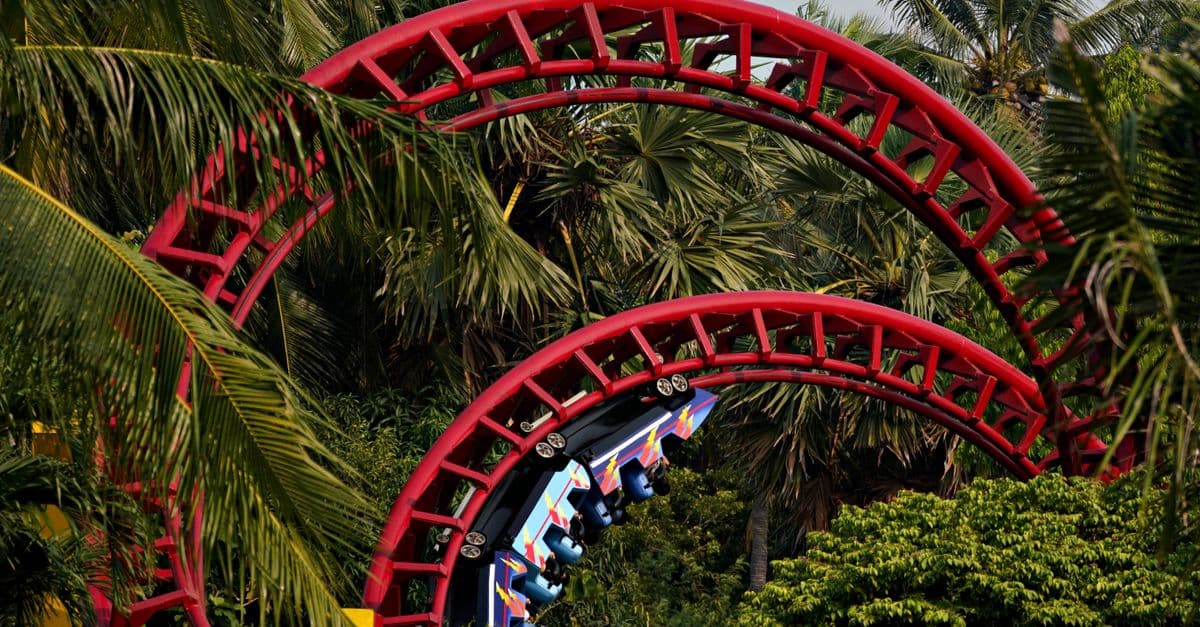
Photo: hartono subagio / Pexels
Falcon's Flight at Six Flags Qiddiya City in Saudi Arabia reaches 250 km/h (155.3 mph), the fastest roller coaster ever built, using more than 700 linear synchronous motor (LSM) modules instead of a chain lift. It opened on December 31, 2025, ending the reign of Ferrari World Abu Dhabi's Formula Rossa, which had held the title since 2010 at 240 km/h (149.1 mph) using a hydraulic launch. This piece explains how these two very different launch systems generate speeds a Formula 1 car needs a straightaway to reach, why the human body caps how much faster coasters can realistically get, and why "fastest" is a harder question than it looks.
Key takeaways
- Falcon's Flight (Six Flags Qiddiya City, Saudi Arabia) holds the current speed record at 250 km/h (155.3 mph), launched by linear synchronous motors.
- Formula Rossa (Ferrari World, Abu Dhabi) held the record from 2010 to 2025 at 240 km/h (149.1 mph), reaching that speed in 4.9 seconds via a hydraulic launch.
- Coasters get fast through launch systems (hydraulic, linear motor, or compressed air) rather than the traditional chain-lift-and-gravity method, which cannot generate comparable speed on a park-sized footprint.
- G-force and jerk limits, not motor power, are the real ceiling on how fast a coaster can safely go — ASTM F2291 caps sustained vertical G-force at roughly 5 to 6 G for only brief peaks.
- Speed records are hard to break further because rider tolerance, track material fatigue, and wind resistance all scale unfavorably as velocity increases.
Why speed records matter in coaster engineering
A roller coaster's top speed is not really a measure of how "extreme" a park wants to seem. It is a direct readout of how much kinetic energy an engineering team can safely put into a vehicle carrying unrestrained human passengers, then safely take back out again within a few kilometers of track. That framing matters because it explains why the record has moved so slowly compared to, say, land speed records for cars: a coaster train has to accelerate and decelerate people who are not wearing helmets or five-point racing harnesses, using medium that has to double as a thrilling public attraction.
The distinction most casual fans miss is between top speed and launch acceleration. A coaster's headline speed number tells you how fast the train is moving at its fastest point, usually right after launch or at the bottom of a first drop. Launch acceleration tells you how quickly it got there — Formula Rossa goes from 0 to 100 km/h (62 mph) in about two seconds, a figure that would embarrass most production supercars. Both numbers matter to the rider experience, and both are constrained by different engineering limits: top speed by aerodynamic drag and track geometry, launch acceleration by the G-forces a human torso can absorb without injury.
Records like these also function as genuine engineering proof points. Building a coaster that survives 250 km/h (155 mph) repeated launches, thousands of times a year, in desert heat, without fatiguing its track or restraint systems, requires materials science and structural engineering that eventually filters down into how every other coaster on the market is designed. The current record holder, Falcon's Flight, is also the world's tallest and longest coaster, meaning its engineers had to solve for speed, height, and distance simultaneously (Intamin Amusement Rides, 2026).
For context on how engineered records get set and broken in general, see the most powerful machines ever built, which covers the thrust and power metrics behind record-setting rockets and turbines — a useful comparison for understanding how "fastest" and "most powerful" are related but distinct claims.
The current fastest roller coasters, ranked
The record has changed hands three times this decade. Kingda Ka at Six Flags Great Adventure, which held the title from 2005 to 2010, was permanently closed in November 2024 and its 456-foot tower was demolished in February 2025, removing it from the active rankings entirely. That leaves a top tier defined by two very different launch philosophies: hydraulic pistons and linear motors.
| Rank | Coaster | Park & Location | Top Speed | Launch System | Opened |
|---|---|---|---|---|---|
| 1 | Falcon's Flight | Six Flags Qiddiya City, Saudi Arabia | 250 km/h (155.3 mph) | Linear synchronous motor (LSM) | Dec 2025 |
| 2 | Formula Rossa | Ferrari World, Abu Dhabi, UAE | 240 km/h (149.1 mph) | Hydraulic launch | 2010 |
| 3 | Top Thrill 2 | Cedar Point, Ohio, USA | 193 km/h (120 mph) | Triple LSM launch | 2024 |
| 4 | Red Force | Ferrari Land, PortAventura, Spain | 180 km/h (111.8 mph) | LSM launch | 2017 |
| 5 (retired) | Kingda Ka | Six Flags Great Adventure, USA | 206 km/h (128 mph) | Hydraulic launch | 2005–2024 |
Formula Rossa remains the fastest hydraulic-launch coaster in the world; Falcon's Flight is now the outright record holder using linear motor technology. Kingda Ka is listed for historical context — it no longer operates.
Note the gap between rank two and rank three. Formula Rossa at 240 km/h (149.1 mph) is nearly 50 km/h (30 mph) faster than the next active coaster, Top Thrill 2. That gap illustrates a broader pattern in this list: only a handful of parks have ever invested in the launch infrastructure needed to clear 200 km/h (124 mph), because the cost and engineering complexity scale up sharply once you leave the 160–190 km/h (100–120 mph) band that most "hypercoasters" occupy.
How hydraulic and linear-motor launches actually work
Traditional roller coasters use a chain lift: a motorized chain drags the train up a tall first hill, and gravity does the rest of the work as the train descends and speeds through the course. That system is cheap, reliable, and has been used since the late 19th century, but it has a hard physical ceiling. To reach 240 km/h (149.1 mph) through gravity alone, a coaster would need a first drop roughly 300 meters (nearly 1,000 feet) tall — taller than most skyscrapers and far beyond what any park has ever built. Launch systems solve this by injecting energy directly into the train at ground level instead of relying on stored height.
Hydraulic launch — used by Formula Rossa and, historically, Kingda Ka — works like an enormous slingshot. A hydraulic system pressurizes fluid to drive a catch car along a cable beneath the track; that catch car grabs the coaster train and flings it forward, converting stored fluid pressure into kinetic energy almost instantaneously. Think of it the way a pressure washer converts a static tank of water into a high-velocity jet the moment you pull the trigger: the energy was sitting there the whole time, and the launch mechanism just releases it all at once. This is why hydraulic launches produce such violent acceleration — 0 to 100 km/h (62 mph) in about two seconds for Formula Rossa — but it also means the system needs to fully re-pressurize between rides, which limits hourly rider capacity.
Linear synchronous motor (LSM) launch — used by Falcon's Flight, Top Thrill 2, and Red Force — works more like a very powerful maglev train. Magnets embedded in the track and in fins beneath the train interact in a precisely timed sequence, with the track's magnetic field pulses "chasing" the train's magnets forward the way a carrot on a stick pulls forward the animal chasing it, except the carrot moves exactly as fast as needed to keep pulling without ever being caught. Falcon's Flight uses more than 700 individual LSM modules stacked across multiple launch sections, roughly six times as many as a typical launched coaster, which is how it builds up to 250 km/h (155.3 mph) across a longer runway rather than in one violent burst (Intamin Amusement Rides, 2026).
Why isn't every coaster launched this way?
Launch systems cost dramatically more than a standard chain lift and require far more electrical infrastructure, maintenance staff, and downtime for recalibration. A conventional chain-lift coaster remains the more economical choice for parks that want a strong ride without chasing a speed record, which is why launch coasters make up a small fraction of the roughly 3,000 operating roller coasters worldwide (Roller Coaster DataBase, 2026).
Why G-forces set the real speed limit
Motors and hydraulics can, in principle, keep getting more powerful. The reason coaster speeds have crept up by tens of km/h per decade rather than doubling is that the limiting factor has shifted from "can we build a stronger launch" to "can a human body tolerate what that launch does to it." In the United States, the relevant engineering standard is ASTM F2291, which caps peak positive vertical G-force at roughly 5 to 6 G for only brief moments, restricts negative vertical force to around −2 G, and holds lateral force to about ±1.5 G, with progressively lower ceilings the longer any of those forces are sustained (ASTM International, 2025).
That last clause is the important one. Engineers do not just ask "how many Gs," they ask "how many Gs for how long," which is why Formula Rossa's 4.8 G peak is tolerable: it lasts roughly two seconds, not thirty. A sustained 4.8 G, the kind fighter pilots train specifically to withstand, would be dangerous for an untrained rider on a family attraction. Ride designers also manage jerk, the rate at which G-force itself changes. A sudden, jarring onset of force feels far worse and carries more injury risk than the same peak force reached smoothly, which is why modern launch tracks use gradual transition curves rather than abrupt geometry (ANSI/ASTM guidance, 2025).
How many Gs do roller coaster riders actually experience?
Most launch coasters produce peak G-forces between 3.5 and 5 G for one to two seconds, similar to what fighter pilots and Formula 1 drivers experience during hard maneuvers. Formula Rossa's 4.8 G peak is near the top of what ASTM F2291 permits for a brief duration; sustained forces above roughly 6 G risk loss of consciousness even in trained individuals.
This is the honest explanation for why the speed record has moved by roughly 10 km/h (6 mph) per decade rather than leaping the way, say, computer processing speed has. The human cardiovascular system, not the available engineering budget, is the binding constraint. Riders with certain heart conditions, pregnancy, or recent surgeries are typically advised against launch coasters for exactly this reason — the forces involved are genuinely comparable to what professional racing drivers and pilots train specifically to tolerate.
Why track materials and wind resistance also fight against higher speeds
G-force tolerance gets most of the attention, but two other constraints make each additional 10 km/h (6 mph) of top speed progressively harder to engineer.
Aerodynamic drag increases with the square of velocity, meaning a coaster moving at 250 km/h (155 mph) faces roughly 2.7 times the air resistance of one moving at 150 km/h (93 mph), even though it is only about 67 percent faster. That drag has to be overcome by the launch system and fought throughout the ride, which is part of why Falcon's Flight needed hundreds of LSM modules stacked across a longer runway rather than one dramatic burst.
Track and wheel fatigue is the other constraint. Every high-speed run flexes the steel track and stresses the polyurethane wheels that grip it, and those stresses scale up sharply at higher speeds and G-loads. Parks running record-speed coasters typically run more frequent non-destructive testing (ultrasonic and magnetic-particle inspection of welds and axles) than standard coasters require, and some launch systems, including Formula Rossa's, have historically needed extended maintenance windows to manage this wear. This is also why speed-record coasters tend to have shorter operating seasons or more frequent scheduled downtime than a park's other attractions — the record comes with a maintenance bill attached.
Put together, these three constraints — human G-force tolerance, quadratically increasing drag, and material fatigue — explain why coaster engineers describe further speed records as a matter of diminishing returns rather than impossible physics. Reaching 300 km/h (186 mph) is not fundamentally different physics from reaching 250 km/h; it is a much steeper cost curve for a much smaller marginal thrill.
Common mistakes people make about coaster speed records
Treating "fastest" as the only meaningful superlative. A coaster can be the fastest without being the tallest, longest, or most intense by other measures — the tallest buildings in the world makes a similar point about how records get awarded by strict, separate categories rather than one overall "biggest" title. Falcon's Flight happens to hold speed, height, and length titles simultaneously, which is unusual; most record-holders lead in only one category.
Assuming higher speed always means a more intense ride. Sustained G-force, inversions, and airtime moments (the split-second feeling of weightlessness at the top of a hill) often matter more to perceived intensity than raw top speed. A coaster running 130 km/h (80 mph) through a tightly packed sequence of inversions can feel more extreme than a 250 km/h (155 mph) straight-line launch coaster with a single big drop.
Confusing top speed with launch acceleration. As covered above, these measure different things — how fast the train ultimately goes versus how quickly it got there — and a coaster can lead in one without leading in the other.
Ignoring that records get retired, not just broken. Kingda Ka held second place in the world for nearly two decades after losing the outright record in 2010, but it was demolished in 2025 for reasons related to aging hydraulic infrastructure and maintenance cost, not because it became unsafe to operate on its own terms. Rankings of "fastest active coasters" and "fastest coasters ever built" are not the same list.
What determines how a park chooses its target speed
Parks do not simply chase the highest number the technology allows. A speed record is a marketing and engineering investment decision shaped by several practical factors:
- Available land footprint. Higher speeds require longer straightaways and larger turning radii to keep lateral G-forces within ASTM limits, so a park needs substantial acreage before a record attempt is even feasible.
- Climate. Hydraulic fluid viscosity and track material behavior both shift with temperature, which is part of why desert parks like Ferrari World Abu Dhabi and Six Flags Qiddiya City design their launch systems around extreme heat tolerance from the outset.
- Hourly rider capacity. Hydraulic systems need to re-pressurize between launches, capping throughput; LSM systems can often cycle faster, which matters enormously for a park expecting tens of thousands of daily visitors.
- Budget for ongoing maintenance, not just construction. A record-speed coaster is typically among the most expensive rides in a park's portfolio to keep running, given the inspection cadence high-speed steel track requires.
This is also why record attempts cluster in newer mega-parks with large capital budgets — Ferrari World, Cedar Point's most recent expansion, and Six Flags Qiddiya City — rather than appearing evenly across the roughly 3,000 coasters operating worldwide.
The takeaway
The fastest roller coaster in the world is not simply the one with the strongest motor. Falcon's Flight beat Formula Rossa's fifteen-year reign by using hundreds of linear motors to build speed gradually across a long runway, rather than by out-muscling the hydraulic slingshot approach in one violent burst. Both designs ultimately answer to the same limiting factor: the human body's tolerance for G-force and jerk, codified in ASTM F2291, which has kept the world record creeping up by roughly 10 km/h (6 mph) per decade rather than leaping. The next speed record, whenever it arrives, will not come from a fundamentally new form of physics — it will come from squeezing a little more launch distance, a little better aerodynamics, and a little more track durability out of the same basic hydraulic-or-magnetic toolkit engineers have used since the 1990s.
Frequently asked questions
Q: What is the fastest roller coaster in the world in 2026? A: Falcon's Flight at Six Flags Qiddiya City in Saudi Arabia, which opened December 31, 2025, and reaches 250 km/h (155.3 mph) using more than 700 linear synchronous motor modules. It surpassed Formula Rossa's 240 km/h (149.1 mph) record, which had stood since 2010.
Q: How fast is Formula Rossa and how does its launch work? A: Formula Rossa reaches 240 km/h (149.1 mph), accelerating from 0 to 100 km/h (62 mph) in about two seconds using a hydraulic launch system: pressurized fluid drives a catch car that grabs the train and flings it forward, similar to a slingshot converting stored pressure into instant velocity.
Q: What happened to Kingda Ka, the former record holder? A: Kingda Ka held the world speed record from 2005 to 2010 at 206 km/h (128 mph), then remained the fastest coaster in North America until Six Flags permanently closed it in November 2024. Its 456-foot tower was demolished by implosion in February 2025.
Q: How many Gs do you experience on the fastest roller coasters? A: Formula Rossa's launch produces roughly 4.8 G for about two seconds, comparable to what Formula 1 drivers experience under hard cornering. US safety standard ASTM F2291 caps sustained peak vertical G-force at roughly 5 to 6 G for brief durations only.
Q: Why don't roller coasters just keep getting faster every year? A: Three constraints slow progress: human G-force and jerk tolerance (governed by ASTM F2291), aerodynamic drag that increases with the square of velocity, and steel track and wheel fatigue that worsens sharply at higher speeds. Each additional increment of speed costs disproportionately more to engineer safely.
Q: What launch system does the fastest roller coaster use? A: Falcon's Flight uses a linear synchronous motor (LSM) launch, in which timed magnetic pulses along the track pull magnetized fins on the train forward in sequence, similar in principle to maglev train propulsion. This differs from the hydraulic piston launch used by Formula Rossa and the retired Kingda Ka.
Sources
- Guinness World Records (2026) — Formula Rossa launch speed and G-force verification
- Intamin Amusement Rides (2026) — Falcon's Flight technical specifications and LSM launch system
- ASTM International, F2291-25 — Standard Practice for Design of Amusement Rides and Devices
- Six Flags Qiddiya City (2026) — Falcon's Flight official ride data
- Coasterpedia — Kingda Ka closure and demolition timeline (2024–2025)
Read next:
Follow new articles
Add SciHub101 to your feed reader to see new science and technology stories.
About the Author
SciHub101 is an independent science and technology publication founded and edited by Buğra Sözeri, a software engineer and app developer based in Türkiye. AI tools assist with drafting and research. Source documentation in the existing archive is uneven, and articles are being reviewed and corrected. The Editorial Team byline identifies editorial responsibility; it does not certify specialist or independent human review. Where we compare products, anything built by our own team is labelled as such — see the editorial guidelines and About page for how corrections and disclosures work.
Related Articles



The Largest Structures Ever Built: Towers, Bridges, Dams, and Walls
The Burj Khalifa in Dubai stands 828 meters tall — for context, you could stack almost two Empire State Buildings on top of each other and still not reach its antenna. But height is only one dimension of 'largest.' The world's longest bridge stretches 164.8 km across China. The Great Wall of China, including all branches, runs over 21,000 km. The largest building by floor area is a Boeing factory in Washington State that covers 398,000 square meters under a single roof. What engineering limits the next record depends on which dimension you're measuring and why physics makes every additional meter harder than the last.

Largest Ships Ever Built: Tankers, Container Ships, and Floating Cities
The largest ship ever built was a 458-meter supertanker. Compare record-holders by length, tonnage, and cargo capacity, from supertankers to floating LNG plants.

Largest Stadiums in the World by Capacity
The world's largest stadiums ranked by capacity: Narendra Modi Stadium, Rungrado, Michigan Stadium and more, plus how capacity is counted and why it shifts.