How Noise Canceling Headphones Work
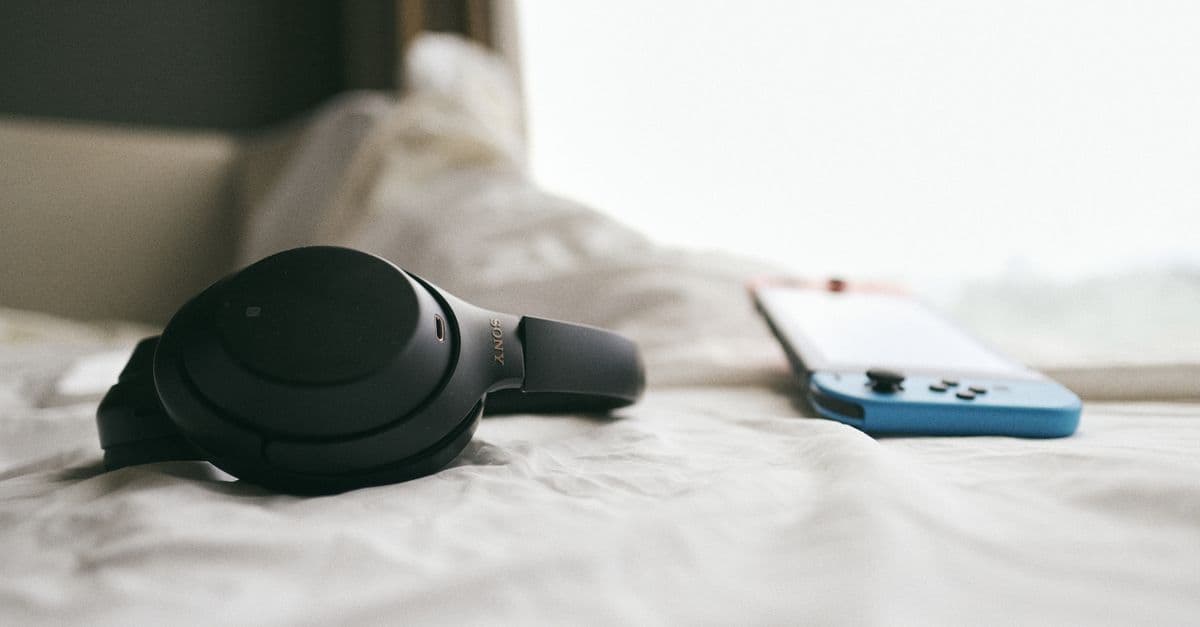
Photo: Garrison Gao / Pexels
The low, droning rumble of a jet engine can vanish almost entirely the moment you switch on active noise cancellation, even though the physical noise around you has not changed at all. The trick is not blocking sound, it is fighting sound with sound: microphones sample the ambient noise, a processor builds a mirror-image wave, and a speaker plays that inverted wave so it cancels the original before it reaches your eardrum. The idea traces back to a single frustrating flight in 1978 and now sits inside tens of millions of headphones.
The physics: fighting a wave with its mirror image
Sound is a wave of alternating high and low air pressure moving outward from its source. When two sound waves of the same frequency and amplitude meet perfectly out of phase, with the peaks of one lined up against the troughs of the other, they add together to produce close to zero net pressure change. Physicists call this destructive interference, and it is the same principle that lets engineers cancel vibration in machinery or reduce echo in a concert hall, according to Scientific American's explainer on the technology.
Active noise-canceling headphones put that physics to work with three components working in a tight loop. Tiny microphones, mounted on the outside of the earcup, the inside, or both, continuously sample the sound pressure around your ears. A digital signal processor, essentially a small dedicated computer chip, analyzes that incoming waveform in real time. It then generates an "anti-noise" signal, an inverted copy of the ambient wave, which a small speaker inside the earcup plays back layered underneath your music or podcast.
The entire loop, from microphone pickup to speaker output, has to happen in a few milliseconds. If the anti-noise wave arrives even slightly out of sync with the real noise it is supposed to cancel, the two waves stop aligning peak to trough and the cancellation falls apart. This is the central engineering constraint of the whole technology, and it explains almost everything about where active noise cancellation succeeds and where it fails.
It helps to picture the pressure wave of a jet engine as a slow, predictable ripple on a pond, rising and falling in a steady rhythm several hundred times per second. A processor watching that ripple can predict where the next crest will be almost before it fully forms, because the pattern barely changes from one cycle to the next. A sudden clap or a spoken syllable, by contrast, is more like a single stone dropped into still water: there is no repeating rhythm to anticipate, only a one-off disturbance that has already passed by the time the system has finished analyzing it.
The 1978 flight that started it all
Active noise cancellation is not a recent invention dressed up in modern marketing. Its origin story is well documented and centers on one specific transatlantic flight. In 1978, Dr. Amar Bose, an MIT electrical engineering professor and the founder of Bose Corporation, was flying from the United States to Switzerland and was handed a pair of airline headphones to listen to music. The drone of the jet engines was so loud that he could barely make out the audio, according to Bose's own corporate history of the technology.
Rather than shrug it off, Bose reportedly began sketching the mathematics of a system that could sense that engine noise and cancel it electronically, working out the foundational concept during the flight itself. When he returned, he assembled a dedicated research group inside Bose Corporation to pursue active noise cancellation as a formal engineering problem, a project that would run for more than two decades before reaching consumers.
That timeline matters because it shows how hard the real-time signal-processing problem actually is. Bose's aviation-focused noise-canceling headsets reached professional and commercial pilots in the 1980s and 1990s, well before the technology was compact, cheap, or power-efficient enough for a consumer pair of over-ear headphones. Bose brought the first noise-canceling headsets to airline first and business-class passengers in 1999, and the company's first mass-market consumer noise-canceling headphones followed shortly after, more than 20 years after that original transatlantic flight.
The lag between the 1978 insight and a shippable consumer product is itself a lesson in engineering: canceling a wave in theory is straightforward algebra, but doing it with cheap, small, low-power microphones and processors, fast enough to matter and reliably enough to sell to the public, took decades of iteration.
Why did it take so long to reach consumer headphones?
Early digital signal processors were too large, too power-hungry, and too slow to run the real-time cancellation loop inside a battery-powered, ear-sized device. As chips shrank and processing speed increased through the 1980s and 1990s, the same mathematics Bose sketched in 1978 finally became practical to package into a pair of headphones people could wear on a commute.
Feedforward versus feedback designs
Two microphone placements produce two different strategies, and most modern noise-canceling headphones combine both in a hybrid system rather than relying on just one.
A feedforward system places its microphone on the outside of the earcup, sampling ambient noise before it has passed through any of the headphone's own physical sound insulation. Because the microphone hears the noise slightly before it reaches your ear, the processor gets a little extra lead time to compute and generate a canceling wave. The tradeoff is that a feedforward microphone cannot account for noise that leaks in around imperfections in the earcup seal itself, since it never measured that leaked sound in the first place.
A feedback system places its microphone inside the earcup, right next to your ear, sampling the sound that actually made it through the headphone's physical barrier, including any leaks around the cushion seal. This design catches errors the feedforward microphone would completely miss. The tradeoff runs the other way: because the internal microphone only detects the noise after it has already leaked through, the system has a shorter time window between detection and correction, which makes the cancellation slightly less precise for very fast-changing sounds.
Hybrid systems, now standard in most premium noise-canceling headphones, run both loops simultaneously, letting the feedforward loop handle steady ambient noise with maximum lead time while the feedback loop corrects for whatever leaks past the seal. Running two correction loops at once also demands more processing power and more careful tuning to prevent the two loops from interfering with each other, which is one reason high-end noise-canceling headphones command a price premium over basic models.
| Design | Microphone location | Main advantage | Main limitation | Best suited for |
|---|---|---|---|---|
| Feedforward | Outside earcup | More lead time to compute the cancellation wave | Cannot detect noise that leaks past the seal | Predictable ambient hum, e.g. airplane cabins |
| Feedback | Inside earcup, near eardrum | Catches leaked noise the outside mic misses | Shorter reaction window for fast changes | Correcting for a poor or shifting earcup seal |
| Hybrid (both) | Outside and inside earcup | Combines lead time with leak correction | Higher cost, more complex tuning | Most modern premium noise-canceling headphones |
Hybrid designs dominate the premium tier because they trade added cost and complexity for coverage of both categories of noise error.
Why doesn't active noise cancellation work well on human voices?
Voices and other transient, high-frequency sounds change amplitude and pitch too quickly and unpredictably for the processor to reliably detect, invert, and emit a matching counter-wave before the original sound has already passed. Low-frequency drones, by contrast, are steady and repetitive, giving the system a stable, predictable wave pattern it can continuously match and counter cycle after cycle.
Passive noise isolation is doing real work too
None of the active electronics matter much without a good physical seal. The dense foam or memory-foam ear cushions on noise-canceling headphones physically block a meaningful share of ambient sound before any electronics get involved, the same way foam earplugs do, simply by absorbing and reflecting sound energy rather than canceling it through interference. This is passive noise isolation, a purely physical, non-electronic form of noise reduction that works on any pair of well-sealed headphones, powered or not.
Manufacturers combine passive isolation with active cancellation because the two approaches are strong in complementary frequency ranges. Passive isolation, being purely a physical barrier, is considerably better at blocking higher-frequency sound than active electronic cancellation is, because the wavelengths of high-frequency sound are short enough that dense foam can meaningfully absorb them. Active cancellation, meanwhile, handles the low frequencies that pass straight through foam largely unaffected, since low-frequency sound waves are long enough to bend around and through soft physical barriers with minimal loss.
A useful analogy: active noise cancellation is like two people holding opposite ends of a rope, one shaking it up while the other shakes it down in perfect rhythm, flattening the motion of the rope between them through timed, opposing energy. Passive isolation is more like simply weighing the rope down with a heavy blanket so it cannot shake as vigorously in the first place, a purely physical dampening with no timing or electronics involved. Good headphones use both strategies together because each one handles a different part of the noise spectrum, and neither alone would deliver the quiet a listener expects on a flight or a loud commute.
A second, complementary analogy helps explain why the combination matters so much: think of an orchestra pit with two separate soundproofing measures, thick carpet on the floor to dampen footsteps and vibration (passive isolation) plus a conductor actively cueing musicians to play softer whenever the room gets too loud (active cancellation). The carpet works all the time without needing to "understand" the sound. The conductor's real-time correction only works because they can hear and react fast enough, and it fails if the room noise changes too abruptly for them to respond. Passive and active noise reduction split the same job the same way.
What noise cancellation actually measures in decibels
Manufacturers typically describe noise reduction performance in terms of attenuation, the amount by which sound pressure is reduced, measured in decibels (dB) across different frequency bands. Attenuation is rarely uniform: a headphone might reduce a 100 Hz engine drone by a large margin while barely touching a 3,000 Hz conversation, because the underlying physics of destructive interference works best on the low end of the spectrum where wave patterns are slow and repetitive.
This frequency-dependent performance is why review outlets and audio engineers measure noise-canceling headphones across a full frequency sweep rather than reporting a single decibel number. A single top-line "up to X dB of noise reduction" figure on a product box, without specifying the frequency range it applies to, tells a shopper very little about how that pair of headphones will actually perform on an airplane versus in an open office with human chatter.
Do noise-canceling headphones protect hearing the way earplugs do?
Passive isolation from the earcup seal does provide some of the same physical hearing protection as foam earplugs, but active cancellation is not designed or rated as hearing protection. It targets specific, predictable frequency ranges for listening comfort rather than blocking the full spectrum of potentially damaging sound the way certified hearing-protection devices do.
Common misconceptions
A frequent misconception is that noise-canceling headphones create silence. In reality, they reduce specific, predictable frequency ranges substantially, typically the low rumble of engines and machinery, while leaving higher-pitched or sudden sounds largely untouched. A rider on a train still hears the conductor's announcement and a nearby conversation even with active noise cancellation switched fully on, because those sounds sit outside the frequency range where destructive interference is effective.
Another misconception is that turning on noise cancellation always improves audio quality. Some listeners perceive a faint hiss or a subtle pressure sensation from the electronics themselves, sometimes described as an "ear suck" feeling caused by the changing air pressure inside the sealed earcup as the anti-noise signal plays. The anti-noise signal, while inaudible as a discrete, separate sound to most listeners, is technically an additional audio signal being mixed into the earcup alongside your music, and highly sensitive listeners can sometimes detect its presence as a change in the character of the soundstage.
A third misconception, closely related to the first two, is that more expensive noise-canceling headphones simply cancel "more" noise across the board. In practice, price differences between models more often reflect how well-tuned the hybrid feedforward and feedback loops are, how effectively the passive seal is engineered for a range of head shapes, and how much processing power is dedicated to adapting the cancellation profile in real time, rather than a single dial being turned up higher on one product than another.
Battery life, latency, and the tradeoffs engineers accept
Running continuous microphone sampling, real-time digital signal processing, and a constantly active speaker output all draws power, which is why active noise cancellation measurably shortens a headphone's battery life compared to running the same headphones with cancellation switched off. Engineers accept this tradeoff because the alternative, a lower-powered but slower processor, would widen the timing gap between detecting ambient noise and emitting the canceling wave, degrading the cancellation itself.
Latency, the delay between an input and its corresponding output, is the single most important engineering constraint in the whole system. Every additional millisecond of processing delay shrinks the window in which the anti-noise wave can still meaningfully overlap and cancel the original sound wave, which is part of why manufacturers invest heavily in custom, purpose-built chips for noise cancellation rather than relying on general-purpose processors that were not designed for this specific, time-critical task.
How the same electronics power transparency mode and hearing aids
The microphones and processor that make active noise cancellation possible can just as easily run in reverse. Transparency mode (sometimes called "ambient sound" or "hear-through" mode) uses the same external microphones, but instead of generating an inverted anti-noise wave, the processor picks up the ambient sound and pipes it back into the earcup largely unaltered, mixed in alongside whatever audio is playing, according to industry explainers on how transparency mode differs from ANC (Soundcore, "What Is Transparency Mode"). It's the same hardware loop, microphone in, processor, speaker out, just pointed toward the opposite goal: let the world in instead of shutting it out.
That overlap is why the line between consumer noise-canceling headphones and hearing aids has started to blur. At the Appliance & Electronics World Expo in Shanghai in March 2026, hearing-aid maker ORKA introduced what it described as one of the first receiver-in-canal hearing aids to add active noise cancellation, built on Bose's ANC technology (HearingTracker, ORKA/AWE 2026 coverage). Researchers at Bose, in a paper published in the journal Trends in Hearing, described how active noise cancellation could improve the signal-to-noise ratio inside a hearing aid, the same underlying measurement that determines how easily a wearer can pick a voice out of background clutter.
The engineering challenge is harder for a hearing aid than for a pair of over-ear headphones, though, because a hearing aid's entire purpose is to amplify certain sounds, particularly speech frequencies, while a noise-canceling headphone's default purpose is to suppress nearly everything external. Blending those two goals in one small in-ear device means the processor has to distinguish between noise worth canceling and speech worth boosting in real time, a more selective version of the same feedforward-and-feedback loop used in consumer ANC headphones, rather than simply canceling everything indiscriminately the way a pair of flight headphones does.
This convergence also explains why many premium consumer earbuds now market adaptive transparency, which selectively suppresses sudden loud sounds like a jackhammer or a siren while still letting normal conversation and ambient sound through. It's a hybrid behavior, built from the same underlying microphone-and-DSP architecture as both full ANC and full transparency mode, tuned to switch between suppression and amplification on a sound-by-sound basis rather than applying one blanket setting to everything the microphones pick up.
The takeaway
Noise-canceling headphones do not remove sound, they add a precisely inverted copy of it, timed to arrive at your ear the instant the original sound does so the two cancel through destructive interference. The physics works best on steady, low-frequency noise, which traces directly back to the timing constraint Dr. Amar Bose first sketched out on a noisy 1978 flight and which engineers spent more than two decades turning into a consumer product. That same timing constraint is exactly why the technology became popular for flights, trains, and commutes rather than for blocking a conversation across the room.
Read next:
- How NFC payments work securely
- How fiber-optic cables transmit data
- How your inner ear controls balance
FAQ
Q: What is the physics behind noise-canceling headphones?
They use destructive interference, generating a sound wave that is an inverted mirror image of the ambient noise, so the peaks of one wave cancel the troughs of the other when they combine at your ear.
Q: Why don't noise-canceling headphones block voices well?
Voices and other sudden, high-frequency sounds change too quickly for the processor to detect, invert, and emit a matching counter-wave in time, while steady low-frequency drones are predictable enough to cancel continuously.
Q: What is the difference between feedforward and feedback noise cancellation?
Feedforward systems use an external microphone to sample noise before it reaches the ear, allowing more processing time; feedback systems use an internal microphone near the eardrum to catch noise that leaked past the physical seal, catching more errors but with less time to react.
Q: Do noise-canceling headphones work without power?
The active cancellation electronics require power and stop functioning when the battery dies, but the passive physical seal of the ear cushions still blocks some ambient sound on its own, independent of any electronics.
Q: Who invented active noise cancellation, and why?
Dr. Amar Bose, an MIT professor and founder of Bose Corporation, began developing the concept after a noisy 1978 transatlantic flight where engine drone drowned out the airline headphones he was given, and he formed a dedicated research group to pursue the technology afterward.
Q: Why do noise-canceling headphones drain battery faster than regular headphones?
The microphones, digital signal processor, and cancellation speaker output all run continuously in real time to keep the anti-noise wave synchronized with incoming ambient sound, and that constant processing draws meaningfully more power than simply playing audio alone.
Follow new articles
Add SciHub101 to your feed reader to see new science and technology stories.
About the Author
SciHub101 is an independent science and technology publication founded and edited by Buğra Sözeri, a software engineer and app developer based in Türkiye. AI tools assist with drafting and research. Source documentation in the existing archive is uneven, and articles are being reviewed and corrected. The Editorial Team byline identifies editorial responsibility; it does not certify specialist or independent human review. Where we compare products, anything built by our own team is labelled as such — see the editorial guidelines and About page for how corrections and disclosures work.
Related Articles
How Microphones Work — From Sound Waves to Electrical Signals
A microphone is a transducer that converts pressure waves in air into electrical signals, and there are at least six fundamentally different ways to accomplish that conversion, each with trade-offs in sensitivity, ruggedness, and frequency response.