How Ancient Egyptians Made Their Art: The Chemistry of 5,000-Year-Old Colors
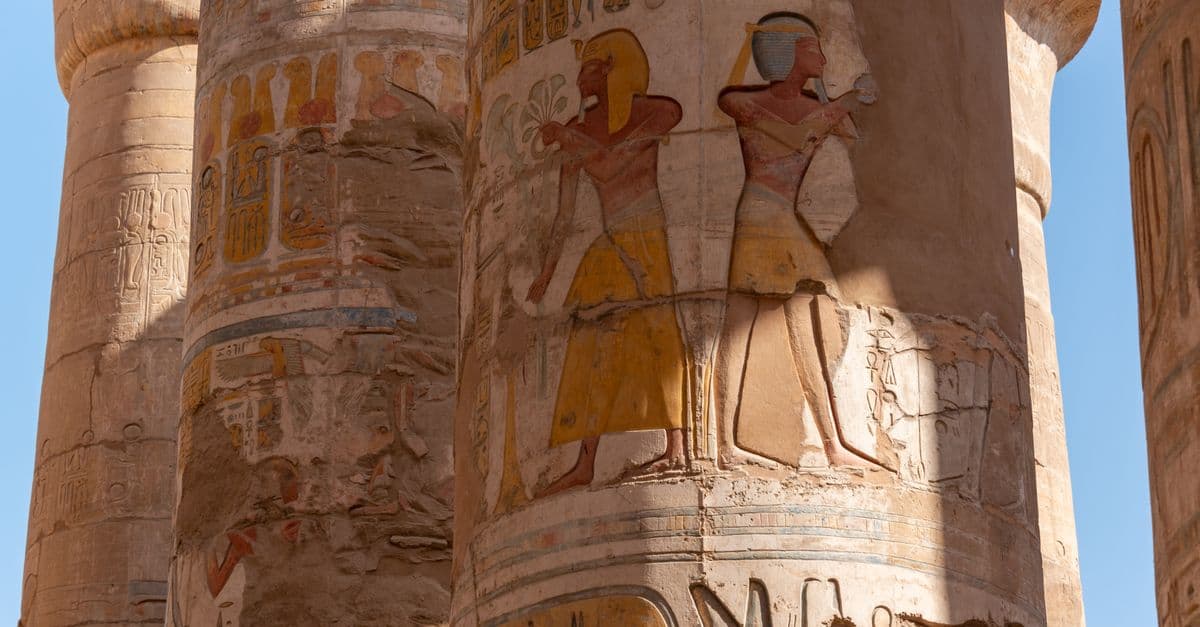
Photo: Diego F. Parra / Pexels
In 1798, when Napoleon's army entered the tomb of Nefertari in the Valley of the Queens, they encountered paintings so vivid that soldiers reportedly thought they had been freshly made. The walls glowed with deep blues, warm yellows, brilliant reds, and a green so saturated it seemed lit from within. These paintings were 3,000 years old. They are 5,200 years old today, and they still glow.
How? The answer is not mystical — it is chemical. Ancient Egyptian artists were, without the vocabulary of chemistry, brilliant applied chemists. They ground minerals, synthesized inorganic compounds, refined binding media, and tested preparations across generations until they had a palette of pigments with extraordinary lightfastness and durability. Some of their materials were not independently rediscovered by European chemists for millennia.
Key takeaways
- Egyptian Blue (CaCuSi₂O₆) was the world's first synthetic pigment, manufactured at scale from around 2500 BCE
- Many Egyptian pigments were mineral compounds of extreme chemical stability, explaining their survival over millennia
- The Egyptians used egg tempera, oils, and gum arabic as binders — each chosen for specific surfaces and conditions
- Color in Egyptian art had symbolic meaning as well as aesthetic function — color choice was a code
- Modern analysis using X-ray fluorescence and Raman spectroscopy has decoded exactly what these pigments were
Egyptian Blue: The World's First Synthetic Pigment
Of all the accomplishments of ancient Egyptian chemistry, the most remarkable may be Egyptian Blue — the world's first known synthetic pigment, manufactured at least as early as 2500 BCE during the Old Kingdom.
The compound's modern chemical name is calcium copper silicate (CaCuSi₂O₆). Producing it requires heating a precise mixture of copper compounds (malachite or azurite), calcium carbonate (limestone), and silica (sand) to approximately 850–1,000°C in an oxidizing atmosphere. The result is a crystalline blue material of extraordinary brilliance and stability. It does not fade, does not react with other pigments, and survives burial for millennia without degradation.
This synthesis was not a simple discovery. It required the controlled combination of three specific starting materials at precise temperatures — essentially a ceramics process. Egyptian blue makers were industrial chemists, operating kilns and optimizing recipes. Archaeological evidence shows dedicated production workshops, some capable of producing the material in large quantities for export throughout the Mediterranean.
The Romans called it caeruleum and used it extensively. Then, inexplicably, the technique was lost after the fall of Rome, and was not independently rediscovered by European chemists until the early nineteenth century. Modern analysis confirmed that blue colors on Roman and Egyptian artifacts previously attributed to other materials were in fact Egyptian Blue.
In a strange postscript, twenty-first century physicists discovered that Egyptian Blue is a nanomaterial: when ground very fine, individual crystals disperse as nanosheets that fluoresce strongly in near-infrared radiation. This property is now being investigated for applications in biomedical imaging and solar energy.
The Mineral Palette
Beyond Egyptian Blue, the core pigment palette was largely mineral — crushed, ground, levigated (washed to separate particle sizes), and refined:
Red and Yellow Ochres — iron oxides of different oxidation states: red hematite (Fe₂O₃) and yellow goethite (FeO(OH)). These were among the most ancient pigments in human use, found in cave paintings over 40,000 years old. The Egyptians sourced high-quality ochres from desert deposits and processed them carefully. Red ochre could be manufactured from yellow by gentle heating, which converts goethite to hematite — an early example of intentional pigment synthesis.
Malachite and Azurite — green and blue copper carbonates respectively. Malachite (Cu₂(CO₃)(OH)₂) was the primary green pigment; azurite (Cu₃(CO₃)₂(OH)₂) provided a deep blue. Both were ground copper minerals from mining sites in the Sinai and Eastern Desert. Their main disadvantage was instability relative to Egyptian Blue: azurite tends to convert to malachite over time, which is why some "blue" areas in ancient paintings have turned green.
Orpiment and Realgar — arsenic sulfide minerals (As₂S₃ and AsS respectively) used for yellow-gold and orange-red respectively. These are genuinely toxic materials; Egyptian artists handling them routinely were exposing themselves to arsenic compounds. The vivid yellow-gold of orpiment was valued enough to accept the risk. Both pigments are chemically unstable and react with lead-containing pigments, which the Egyptians knew to avoid pairing.
Carbon Black and White Huntite — charred bone or plant material for black; huntite (a magnesium calcium carbonate) or gypsum for white. Simple, stable, widely available.
Binding Media and Application
A pigment is only as useful as its binder — the substance that holds ground mineral to a surface. Egyptian artists used different binding media for different applications, demonstrating a sophisticated understanding of material properties.
Egg tempera was widely used: the egg yolk or white (or both) creates a fast-drying, hard, durable paint film. On stone and plaster, it provides excellent adhesion. The protein cross-linking in egg as it dries produces a stable matrix that holds pigment particles effectively.
Gum arabic — a water-soluble polysaccharide from acacia trees — was another primary binder, producing paints similar to modern watercolors. On papyrus, gum arabic works better than egg tempera because it remains slightly flexible and does not crack with the rolling and unrolling of scrolls.
Animal-hide glue was used for some applications, particularly where a slightly more flexible binder was needed on wooden surfaces.
The support surface also mattered: tomb paintings were often applied to a two-coat plaster ground (coarse followed by fine) that absorbed and anchored the paint. The limestone substrate itself could react with binders to create a near-cement bond. This is partly why these paintings have survived — the paint is not simply resting on the wall, it has become chemically integrated with it.
Color Symbolism: A Visual Code
Egyptian art was not decorative in the casual modern sense — color choices carried precise symbolic meaning that literate viewers would read as clearly as text:
Gold (achieved with actual gold leaf or yellow pigments) represented the eternal, the divine, the sun. The skin of gods was often depicted gold. Green (malachite) meant fertility, growth, rebirth — associated with Osiris, god of resurrection, who was typically depicted with green skin. Red (hematite) was power, violence, and danger; Set, god of chaos, was red. White (huntite/gypsum) meant purity, sacred space, and the sacred. Black (carbon) paradoxically meant fertility and rebirth, because of the dark Nile silt that made Egypt agriculturally possible.
Blue occupied a special register: it meant the sky, the Nile, and divine protection. Egyptian Blue was not merely expensive and technically sophisticated — it was theologically loaded. Using it was a statement of divine presence.
This means that when modern analysis reveals the exact pigments in a painting, it tells us not just the chemistry but the meaning the artist encoded — and what the viewer was intended to understand. The palette was a semantic system as much as an aesthetic one.
The Art of Pigment Preparation: From Raw Mineral to Paint
Knowing what pigments the Egyptians used is one thing; understanding how they prepared them is another. The conversion from raw material to usable paint involved multiple steps of refinement.
For mineral pigments like ochre, the process was:
- Mining — sourcing high-quality ore deposits from the desert
- Crushing — reducing large chunks to smaller fragments with stone mortars
- Grinding — repeated grinding with stone pestles to create fine powder
- Levigation — washing the powder in water to separate by particle size, removing impurities, and creating a uniform grain size (smaller particles produce more vibrant color)
- Drying — sun-drying the purified powder
- Mixing with binder — combining pigment powder with egg tempera or gum arabic
This process was labor-intensive and required skill. Finer grinding and better levigation produced superior pigments. Archaeological evidence suggests dedicated pigment workshops existed, likely staffed by specialized workers. The finest pigments were probably reserved for important commissions — a trade-off between labor cost and quality.
For Egyptian Blue, the process was even more technical: precise measurement of starting materials, controlled heating in a kiln, grinding the resulting crystalline material, and often additional processing. This wasn't casual artisanship — it was proto-industrial chemistry.
Source: Klinowski, J., et al., "Ancient Egyptian Pigments" (Accounts of Chemical Research, 2010).
Comparing Egyptian Pigments to Other Ancient Civilizations
The Egyptians weren't alone in developing sophisticated pigment chemistry, but they were remarkably advanced.
China: Chinese cinnabar (mercury sulfide, HgS) production dates to around 1000 BCE, and Chinese reds and yellows from iron oxides parallel Egyptian techniques. However, Chinese ink (carbon black mixed with gum) became the dominant medium for painting and calligraphy, not pigmented tempera. Different choice, equal sophistication.
Mesopotamia: Lapis lazuli (a complex silicate containing lazurite, (Na,Ca)₈(Al,Si)₁₂O₂₄(S,SO₄,Cl)₂) was mined in Afghanistan and traded to Mesopotamia. It produced a deep blue unmatched by other natural sources and was extraordinarily expensive. This pigment, used for painting and in sculpture inlays, represents a different strategy — imported luxury rather than local synthesis.
Mesoamerica: Maya blue (indigo + palygorskite clay mineral complex) is a remarkable achievement. The Maya discovered that mixing indigo (an organic dye) with a specific clay produced a pigment of extraordinary durability and lightfastness. It survives in murals exposed to tropical sunlight for 1,200+ years. Remarkably, the mechanism wasn't understood until the 1990s — the indigo molecules bond to the clay structure at the molecular level.
Rome: Roman purple (from Murex snails, thousands of snails harvested to produce tiny amounts of dye) was a marker of imperial status. The chemistry is complex — the dye precursor (indole compounds) is extracted from snail glands and must be exposed to sunlight and oxidation to produce the final color. Loss of the technique led to "Tyrian purple" becoming legendary (and impossibly expensive) in medieval Europe.
Compared to these traditions, Egyptian Blue stands out not for uniqueness but for systematization — the Egyptians industrialized synthetic pigment production at a scale that predates European chemistry by thousands of years.
Source: Eastaugh, N., et al., "Pigment Compendium: A Dictionary and Optical Determinations of Historical Pigments" (Butterworth-Heinemann, 2004).
Pigment Degradation and Fading: Why Some Paintings Change Color Over Time
Not all Egyptian paintings have survived in their original colors. Some blues have turned green (azurite converting to malachite). Some reds have darkened or faded. Understanding these changes requires understanding pigment chemistry after painting.
Azurite → Malachite: Azurite (Cu₃(CO₃)₂(OH)₂) is inherently unstable. In the presence of moisture and carbon dioxide (from air), it slowly converts to malachite (Cu₂(CO₃)(OH)₂). This is a chemical weathering process, not a loss of pigment but a transformation. The color shifts from deep blue to green over centuries. Some scholars now deliberately look for areas of "greened blue" in Egyptian paintings as evidence of original azurite use — the degradation products reveal the starting material.
Iron oxide darkening: Red ochre (Fe₂O₃) is stable, but the fine particles can oxidize further or be altered by acidic conditions. Some reds have darkened to near-black over millennia. This is typically irreversible.
Lead white (ceruse): Egyptian artists occasionally used lead white (2PbCO₃·Pb(OH)₂), though less frequently than later Roman painters. Lead white darkens when exposed to sulfur compounds (from air pollution, sulfides in soil) through formation of lead sulfide (PbS), which is black. This is why some European old master paintings show darkened white areas in urban museums — the lead white reacted with industrial-era air pollution.
Understanding these degradation pathways is essential for conservation. Restorers need to know: Is this blue-turned-green a loss of azurite or a conversion? If conversion, should it be reversed to restore the original blue (scientifically possible but destructive) or left as is (historically accurate to the current state but not the original intent)?
Source: Gettens, R. J. & Stout, G. L., "Painting Materials: A Short Encyclopaedia" (Dover Publications, 1966).
Modern Recreation: Reconstructing Ancient Recipes
Since the 1990s, chemists and archaeologists have attempted to recreate Egyptian pigments using ancient methods, for both historical understanding and practical conservation.
Egyptian Blue reconstruction: Multiple research groups have successfully synthesized Egyptian Blue by heating mixtures of calcium carbonate, copper ore, and silica to 850–1,000°C. The modern synthesis confirms the ancient recipe and reveals that the Egyptians achieved remarkable consistency — surviving Egyptian Blue samples cluster tightly in chemical composition, suggesting standardized production procedures.
What's striking: Once made, Egyptian Blue is less chemically reactive than expected. It doesn't fade, doesn't sulfidize (darken from sulfur), doesn't convert like azurite does. It's almost inert — a pigment designed (or accidentally achieved) for extreme permanence.
Organic pigment recreation: Attempts to recreate indigo dyes and madder-based reds have proven both the sophistication and the experimentation involved. Madder (Rubia tinctorum plant) produces different shades depending on pH, temperature of extraction, and binding chemistry. The vivid reds in surviving papyri suggest careful control of these variables — not accidental but engineered.
Modern recreations have been used in conservation projects. When a pigment needs matching (for filling losses in damaged papyri), conservators sometimes recreate the original pigment rather than use modern synthetic equivalents, ensuring visual and chemical compatibility.
Source: Irug, M. & Madariaga, J. M., "Archaeometric study of the painting of Nubian artifacts" (Journal of Archaeological Science, 2007).
Scientific Analysis: X-ray Fluorescence and Beyond
Modern pigment analysis rests on several techniques that allow non-invasive (or minimally invasive) chemical identification.
X-ray fluorescence (XRF): A focused X-ray beam excites atoms in the pigment, causing them to emit characteristic fluorescent radiation. By detecting these emissions, researchers identify elements present (copper, lead, iron, etc.). Resolution is good down to parts-per-thousand concentrations. XRF is non-destructive — you can analyze a priceless artifact without damaging it.
Raman spectroscopy: Shines laser light on the sample; the scattered light has a characteristic "signature" for each compound. Azurite scatters differently than malachite. Egyptian Blue has a unique Raman signature that distinguishes it from other blues. High specificity; requires microscopic sample size.
Scanning electron microscopy (SEM): Reveals the microscopic structure of pigment particles — their size, shape, agglomeration. Often coupled with elemental analysis (SEM-EDX, energy-dispersive X-ray spectroscopy). Shows whether particles are uniform (good preparation) or heterogeneous (poor grinding).
Visible and infrared spectroscopy: Measures light absorption across a range of wavelengths. Different pigments absorb different wavelengths; some are visible to human eyes (the color we see), others absorb in infrared. This can reveal layers of paint or degradation products invisible to visual inspection.
These techniques, used in combination, can completely map the chemical composition of a painted surface. A painting might show (layer by layer) original Egyptian Blue, later restoration attempts with 19th-century Prussian Blue (a different chemical compound), and modern overpainting with acrylic — all identified without removing paint.
Source: Russ, J. C., "Fundamentals of Energy Dispersive X-Ray Analysis" (Butterworth-Heinemann, 1984).
Frequently Asked Questions
Q: Why have Egyptian paintings survived thousands of years?
A: Multiple factors combine: chemically stable mineral pigments that do not react with air or light; the extremely dry climate of Egypt, which prevents fungal and bacterial degradation; the sealed tomb environment with minimal temperature fluctuation; and the chemical bonding of paint into plaster supports. Many paints are essentially geologically stable mineral compounds — the oldest "natural" rocks on Earth, like hematite and ochre, are more stable than pigments.
Q: What is Egyptian Blue and why is it important?
A: Egyptian Blue (calcium copper silicate, CaCuSi₂O₆) is the oldest known synthetic pigment, manufactured in Egypt from at least 2500 BCE. It requires controlled high-temperature synthesis of three specific materials — a remarkable achievement in ancient chemistry. The technique was lost after Rome's fall and not rediscovered until the 1800s. Modern physicists found it also has useful nanomaterial properties for biomedical imaging.
Q: Were Egyptian artists aware of the toxicity of their pigments?
A: Probably not scientifically, but they may have observed health effects from handling arsenic-containing pigments like orpiment and realgar. There is no surviving ancient Egyptian text describing pigment toxicity. The risk was likely an occupational hazard, much as lead white was accepted by European painters for centuries despite observable health effects.
Q: How do modern scientists analyze ancient Egyptian pigments?
A: Primary techniques include X-ray fluorescence (XRF), which identifies elemental composition non-destructively; Raman spectroscopy, which identifies molecular compounds uniquely; and scanning electron microscopy (SEM), which reveals particle size and morphology. These techniques allow complete chemical mapping without removing or damaging artwork.
Q: Did Egyptians use any organic pigments?
A: Yes. While the core palette was mineral, organic pigments appeared in some work. Indigo from plants was used for blue-black tones. The vivid red in certain papyri is identified as madder (a plant-derived lake pigment). However, organic pigments are generally less stable than mineral ones — oxidation, photodegradation, and microbial attack degrade them over centuries, which is why mineral pigments dominate surviving works.
Q: Why don't we find Egyptian Blue in later Roman paintings?
A: The production technique was lost after the fall of Rome, possibly due to disruption of trade routes or the knowledge dying with craftspeople. Roman painters substituted Prussian Blue (discovered accidentally in 1704) and other alternatives. Egyptian Blue wasn't independently rediscovered until modern chemists analyzing artifacts recognized its unique crystalline structure and reverse-engineered production.
Pigment Sources, Mining, and Supply Chains
Creating art at scale requires reliable pigment supplies. The Egyptians sourced pigments from specific geographic locations, developing early supply chains that spanned the Mediterranean and Africa.
Ochres: High-quality red and yellow ochres came from desert mining sites in Upper Egypt (around Asswan) and the Eastern Desert (near the Red Sea). Ochre deposits are relatively accessible — surface mining without deep excavation. Multiple ochre sources existed, but certain deposits produced more vibrant colors. This likely created regional specialization: a workshop might prefer "Aswan red" or "Eastern Desert yellow" based on their reputation and properties.
Copper minerals (azurite and malachite): These came from the Sinai Peninsula and Eastern Desert copper deposits. Mining copper ore is more labor-intensive than surface ochre scraping. Sinai mines were actively worked during the New Kingdom, with evidence of organized mining operations, worker settlements, and copper smelting. Egyptologists have found ancient mine tailings and abandoned tools. The investment in copper mining suggests the pigments were valuable enough to justify mining infrastructure.
Calcium carbonate and silica (for Egyptian Blue synthesis): Limestone and sand are abundantly available in Egypt — any desert region has both. Dedicated Egyptian Blue workshops likely sourced locally, which reduced costs compared to imported materials. The availability of local raw materials may partly explain why the Egyptians developed synthetic pigment production — they had the ingredients at hand.
Lapis lazuli (rare import): The deep blue lapis lazuli came from Afghanistan, thousands of miles away. This required long-distance trade — either direct contact or through intermediaries. Lapis lazuli was extraordinarily expensive, reserved for the richest patrons or gods. A painting using actual lapis lazuli (versus Egyptian Blue) communicated both divine status and economic power. This created a luxury market: a cheaper Egyptian Blue for routine commissions, expensive lapis lazuli for sacred spaces.
International trade: Archaeological evidence shows obsidian (from volcanic regions), cedar (from Lebanon), and other trade materials flowing into Egypt. This trade network, complex enough to supply raw materials for monumental building and art production, suggests institutional organization — likely royal monopolies on pigment production and trade. The pharaoh controlled supply, ensuring consistent quality and the political power of controlling color itself.
The geographic distribution of pigment sources across Egypt and beyond required: (1) knowledge of where materials occurred, (2) labor to extract them, (3) transport systems, and (4) quality standards to ensure usable material reached workshops. This wasn't ad-hoc craft work — it was proto-industrial supply-chain management.
Source: Shaw, I. (ed.), "The Oxford History of Ancient Egypt" (Oxford University Press, 2000) — chapters on mining and economic organization.
Conservation and Restoration: Challenges of Ancient Pigments
Modern conservation of Egyptian artifacts presents unique challenges because restorers must balance preservation of current state with restoration of original appearance.
Color alteration over time: Some blues have greened (azurite degradation), some blacks have faded. A conservator must decide: restore the presumed original colors (knowledge from analysis), or conserve the current degraded state (historical authenticity of the object as it exists now)? Different conservation philosophies lead to different choices.
Previous restorations: Many Egyptian artifacts have been handled and "restored" over centuries — by nineteenth-century museums, by local conservators, by tomb robbers who applied crude fixes. Layers of previous restorations sometimes cover or obscure original work. Modern analysis can identify these layers (SEM-EDX shows compositional differences) but removing them risks damaging the original.
Humidity control: The dry Egyptian climate that preserved pigments for millennia is now threatened by tourism, climate change, and humidity exposure when artifacts are moved to climate-controlled museums. Rapid humidity changes can cause plaster and paint to flake. Conservation labs must provide environmental stability — precisely controlled temperature and humidity to prevent further degradation.
Microbial growth: In wet conditions, mold and bacteria can colonize paint surfaces, sometimes producing visible discoloration. Treatments must kill microbes without damaging pigments — a chemical tightrope. Some conservators use UV light or carefully selected biocides; others keep artifacts in stable low-humidity conditions where microbes can't thrive.
The goal of modern conservation is to stop further degradation and allow future generations to study the artifacts. This is different from restoration (making it look "good") — conservation is about preservation for posterity.
Source: Corfield, M., "Conservation and Restoration of Works of Art," Journal of the American Institute for Conservation (ongoing research).
The takeaway
Ancient Egyptian artists were proto-chemists. They discovered and systematized the creation of pigments whose stability rivals modern synthetic compounds. They understood (without the language of chemistry) principles of chemical stability, particle size, and material science. The proof is in survival — their paintings glow across millennia while later works fade. For modern conservators and chemists, these 5,000-year-old pigments pose a humbling lesson: ancient craftspeople achieved sophistication through iteration, experimentation, and trade knowledge passed down through generations. What we now reverse-engineer as molecular chemistry, they discovered through practice.
Read next:
Follow new articles
Add SciHub101 to your feed reader to see new science and technology stories.
About the Author
SciHub101 is an independent science and technology publication founded and edited by Buğra Sözeri, a software engineer and app developer based in Türkiye. AI tools assist with drafting and research. Source documentation in the existing archive is uneven, and articles are being reviewed and corrected. The Editorial Team byline identifies editorial responsibility; it does not certify specialist or independent human review. Where we compare products, anything built by our own team is labelled as such — see the editorial guidelines and About page for how corrections and disclosures work.
Related Articles

Deep Learning in Animation: How AI Is Transforming Motion Capture and Visual Effects
AI is reshaping animation pipelines from motion capture cleanup to full character synthesis — and it's moving faster than Hollywood expected.

AI Architecture: How Generative Design Is Reshaping Buildings and Cities
AI is not just generating images of buildings — it is learning to optimize their structure, energy use, and spatial experience from the ground up.

Why Colors Fade: The Chemistry of Pigments, Light, and Conservation
Van Gogh's sunflowers are turning brown. The culprit is not age but a photochemical reaction where ultraviolet light breaks chemical bonds, converting bright chrome yellow to invisible green—a process happening to artworks worldwide.

How Renaissance Artists Used Science to Reinvent Painting
The Renaissance was not only an art movement. Painters borrowed geometry, optics, and anatomy to make flat surfaces read as three-dimensional worlds, and they argued about how.

How Ancient Cave Paintings Were Made
Tens of thousands of years before canvas or brushes, humans were creating stunning art on stone walls deep inside caves. How they did it, and how researchers know, tells us something about being human.
How Impressionism Changed Art History
When Monet and a group of painters rejected the Salon's rules, they changed more than technique. They changed what a painting was supposed to record.