How We Know What Dinosaurs Ate
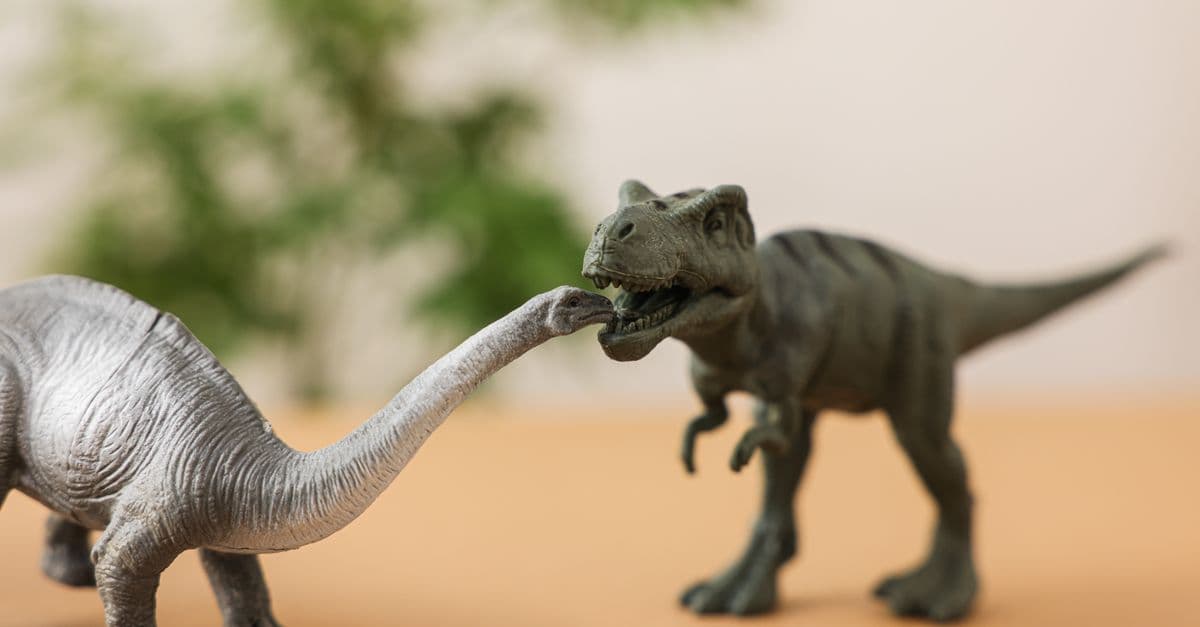
Photo: Cup of Couple / Pexels
In 1998, paleontologist Karen Chin and colleagues described a 44-centimeter (17-inch) fossilized dropping recovered from Saskatchewan, Canada, in which crushed bone fragments made up between roughly a third and a half of its volume (Chin et al., Nature, 1998). The specimen's size and its proximity to Tyrannosaurus rex remains led the team to attribute it to that animal, and it remains one of the most direct, physically documented records of what a specific individual dinosaur had eaten. Bones alone rarely provide that kind of detail. Reconstructing dinosaur diet is a forensic exercise built from several independent, and individually imperfect, lines of physical evidence.
No paleontologist looks at a single fossil and declares a diet solved. Tooth shape, fossilized dung, rare preserved gut contents, bite marks on bone, and microscopic wear patterns on enamel each answer a different, narrower question, and the strength of a dietary conclusion comes from how many of those independent answers agree. This piece walks through each line of evidence, what it can and cannot tell you, and why paleontologists treat convergence across methods as the real standard of proof.
Tooth shape sets the range, but it doesn't settle the question
Tooth shape is the first and most obvious diet clue available in almost any dinosaur fossil, since teeth are dense, mineral-rich, and preserve far better than soft tissue or gut contents. The logic paleontologists apply comes directly from comparative anatomy in living animals: carnivorous mammals and reptiles today tend to have narrow, pointed, often serrated teeth suited to gripping and slicing flesh, while herbivores tend toward broad, flat, or ridged teeth suited to crushing and grinding plant material. Applied to dinosaurs, the same correlation holds up reasonably well as a first-pass filter.
Tyrannosaurus rex teeth are the textbook carnivore example: laterally compressed, curved, and finely serrated along both edges, a shape engineered for slicing through soft tissue and, as bite-force research has shown, withstanding enormous compressive loads when the animal bit down on bone. Hadrosaurs like Edmontosaurus sit at the opposite extreme, carrying dental batteries, dense packed arrays of hundreds to well over a thousand interlocking teeth arranged in continuously replacing columns, built to grind tough, fibrous plant matter down before it reached the gut. The sheer tooth count in a dental battery is itself a functional signal: an animal replacing worn grinding surfaces on that scale is chewing through abrasive plant material constantly, not occasionally.
But tooth shape is a probability statement, not a verdict, and paleontology has several documented cases where it misled researchers for years. Therizinosaurs are the clearest example: several species in this group carry small, leaf-shaped, weakly serrated teeth that superficially resemble those of some carnivorous theropods, yet postcranial anatomy, gut-region features, and comparative analysis have led most researchers to interpret therizinosaurs as predominantly herbivorous, or at least omnivorous, despite teeth that look more predatory at a glance than they behaviorally were. The lesson paleontologists draw from cases like this is that tooth morphology constrains plausible diet without confirming actual diet, and it needs to be checked against other evidence whenever possible.
Can tooth shape alone reliably tell you what a dinosaur ate?
No. Tooth shape narrows the plausible range of diet, sharp serrated teeth suggest carnivory, broad ridged teeth suggest heavy plant processing, but it doesn't confirm actual behavior. Therizinosaurs, which have teeth resembling those of some carnivores yet are now widely interpreted as herbivorous or omnivorous based on other anatomical evidence, are the standard example paleontologists cite for why tooth shape needs corroboration.
Coprolites: fossilized dung as the most direct physical record of a meal
Coprolites, the technical term for fossilized feces, are trace fossils rather than body fossils, meaning they record behavior and biology rather than preserving the animal itself. That distinction matters because a coprolite captures a literal snapshot of digestion in progress: whatever the animal had eaten in the hours before defecating, preserved in mineralized form.
The Saskatchewan specimen Karen Chin and coauthors described in their 1998 Nature paper, "A king-sized theropod coprolite," remains the most cited example in the popular and scientific literature on dinosaur diet, and for good reason. At 44 centimeters (about 17 inches) long, 15 centimeters (6 inches) high, and 13 centimeters (5 inches) wide, it is far larger than any known coprolite attributable to a non-avian herbivorous dinosaur, and its size, combined with its recovery near T. rex skeletal remains in the same Late Cretaceous Frenchman Formation, is what led the authors to attribute it to that species specifically rather than another large Cretaceous carnivore. Bone fragments made up roughly a third to a half of the coprolite's volume, broken into pieces small enough that the authors interpreted them as evidence of powerful crushing during the bite itself, not just tearing of soft tissue around bone. Because those bone fragments were only partially dissolved rather than fully broken down, the authors also argued that whatever produced the coprolite had relatively fast digestive transit or moderate stomach acidity, an inference about physiology that tooth shape alone could never have supported.
Herbivore coprolites tell a parallel but structurally different story. Rather than bone fragments, they preserve plant material directly, phytoliths (microscopic silica structures that form inside plant cells and survive digestion and fossilization far better than the soft plant tissue around them), fossilized fern fragments, conifer needles, and other identifiable botanical remains. Because different plant families and even different plant tissues leave distinctive phytolith shapes, researchers working with well-preserved herbivore coprolites have in some cases been able to identify specific plant taxa a dinosaur had actually ingested, rather than simply inferring likely diet from tooth shape and whatever vegetation grew in the animal's environment at the time.
Coprolites do have real limits. Assigning a coprolite to a specific species, rather than a general size class or broad taxonomic group, is difficult and sometimes impossible, since feces rarely carry an anatomical signature as clean as a tooth or a skull. Most coprolite attributions, including the Saskatchewan specimen, rely on circumstantial evidence, size, associated fossils, and geological context, rather than direct proof the producing animal is now correctly identified beyond reasonable doubt.
Preserved gut contents: rare, but the closest thing to catching an animal mid-meal
Body fossils that preserve actual stomach or gut contents are exceptionally rare, requiring a specific and unlikely sequence of events: an animal has to die with a recent meal still undigested in its body cavity, and burial has to happen fast enough, in low-oxygen, fine-grained sediment, to prevent scavenging and normal decay from destroying the soft evidence before mineralization sets in. When that sequence does happen, though, the resulting fossil is about as close as paleontology gets to directly observing a specific meal.
Microraptor, a small, four-winged dromaeosaurid from the Early Cretaceous of China, is one of the best-documented examples. Multiple Microraptor specimens preserve identifiable gut contents, and taken together across specimens, researchers have documented at least four distinct prey categories: fish scales and disarticulated bony-fish skeletal fragments (identified in one well-known specimen as belonging to the osteoglossiform fish genus Jinanichthys), small mammal bones, bird bones swallowed head-first, and, in one striking specimen, an entire small lizard, formally described and named Indrasaurus wangi, preserved whole inside the body cavity. Taken together, these finds established Microraptor as a generalist predator that hunted across multiple environments, an ecological conclusion that tooth shape or coprolites alone would have struggled to demonstrate with the same specificity.
Cases like Microraptor's are genuinely uncommon. Across the entire fossil record of carnivorous dinosaurs, researchers have documented only a small number of specimens, cited in recent literature as roughly two dozen, that preserve identifiable last-meal contents inside the body cavity. That rarity is exactly what makes each one valuable: a preserved gut-content fossil resolves a specific dietary question with a level of directness no other line of evidence can match, even though it can only ever describe one meal from one individual, not a species-wide dietary pattern.
Have any dinosaur fossils actually preserved stomach contents?
Yes, though such finds are rare. Microraptor specimens have preserved fish scales, small mammal bones, bird bones, and, in one case, an entire small lizard (Indrasaurus wangi) inside the body cavity, interpreted as last meals preserved through rapid burial shortly after death. Researchers estimate only a small number of carnivorous dinosaur fossils, roughly two dozen documented specimens, preserve identifiable gut contents at all.
Bite marks, tooth wear, and what jaw mechanics research adds
Fossilized bones occasionally preserve tooth marks left behind by a feeding predator or scavenger: gouges, punctures, or drag marks whose spacing and cross-sectional shape can sometimes be matched against the tooth spacing and serration pattern of a specific candidate species. When bite marks are well preserved and clearly associated with a specific bone, they can establish that predation or scavenging happened, though distinguishing an active kill from opportunistic scavenging of an already-dead carcass from bite marks alone is often genuinely difficult, and paleontologists are typically cautious about overclaiming here.
Dental microwear analysis works at a much finer scale. Under magnification, tooth enamel worn by different food textures develops characteristically different microscopic scratch and pit patterns, tough, fibrous, phytolith-rich plant material tends to leave dense, fine scratching, while softer material leaves comparatively smoother wear. Researchers have applied both traditional two-dimensional microwear analysis and newer three-dimensional dental microwear texture analysis (DMTA) to hadrosaurid and sauropod teeth specifically. One PNAS study on hadrosaurid dental microwear found that the orientation of wear scratches provided direct evidence about how the jaws actually moved during chewing, information that skeletal anatomy alone could suggest but not confirm. More recent DMTA work on Late Jurassic sauropod faunas, published in Nature Ecology & Evolution, found that microwear texture varied meaningfully between sauropod taxa living in the same environment, evidence those different species were partitioning available plant resources rather than eating identically, a level of ecological detail tooth shape alone cannot deliver.
Jaw biomechanics research, including finite element analysis (a computer modeling technique, borrowed from engineering, that simulates how stress and strain distribute through a complex structure like a skull under load), adds yet another layer by testing whether a candidate diet is physically plausible given an animal's skull architecture and estimated muscle forces. Bite-force studies on Tyrannosaurus rex have estimated maximum bite forces in the range of 35,000 to 60,000 newtons, among the highest estimated for any terrestrial animal, and finite element models of the T. rex skull have shown its cranial architecture is well suited to resisting both the compressive stress of a crushing bite and the torsional stress of pulling and twisting flesh, a combination researchers have used to support the "puncture-pull" feeding hypothesis for how the animal actually processed a carcass once it had bitten down. That bite-force estimate, notably, is also the kind of evidence that made the crushed bone in the Saskatchewan coprolite mechanically plausible rather than merely suggestive.
Dental battery — a densely packed array of continuously replacing teeth, arranged in interlocking columns, found in herbivorous dinosaurs like hadrosaurs and adapted for sustained grinding of abrasive plant material.
Comparing the evidence types side by side
| Evidence type | What it reveals | Reliability / limitation |
|---|---|---|
| Tooth shape | General diet category (carnivore, herbivore, omnivore) | Sets a plausible range only; therizinosaurs show carnivore-shaped teeth can belong to largely herbivorous animals |
| Coprolites | Specific food items in an individual meal (bone fragments, phytoliths, plant fragments) | Species-level attribution is often circumstantial, even for well-studied specimens like the Saskatchewan find |
| Preserved gut contents | The exact last meal of one individual | Extremely rare; roughly two dozen documented carnivorous-dinosaur specimens preserve identifiable gut contents |
| Bite marks on bone | Evidence that predation or scavenging occurred | Distinguishing active predation from scavenging is often not possible from marks alone |
| Dental microwear / DMTA | Texture and abrasiveness of habitually eaten food, and resource partitioning between species | Requires well-preserved, minimally weathered enamel; reflects recent diet before death, not lifetime diet |
| Jaw biomechanics / bite-force studies | Whether a candidate diet or feeding behavior is mechanically plausible given skull architecture | Models physical capability, not actual behavior; assumes soft-tissue and muscle reconstructions are accurate |
Six independent evidence types, none conclusive alone, but increasingly convincing wherever two or more point to the same conclusion.
Why agreement across methods matters more than any single clue
The reason paleontologists rarely rest a dietary conclusion on one type of evidence is that each method has a distinct blind spot, and those blind spots don't overlap. Tooth shape can mislead about actual behavior, as therizinosaurs demonstrate. Coprolites capture only one meal, and species attribution is often circumstantial. Preserved gut contents are so rare that they can never establish species-wide dietary patterns from a single find. Bite marks can't always distinguish killing from scavenging. Microwear reflects only the animal's last stretch of feeding before death, not necessarily its lifetime diet. And biomechanical modeling tests only what an animal was capable of doing, not what it actually did.
What makes the T. rex bone-crushing case genuinely convincing, rather than merely suggestive, is that multiple independent methods converge on the same conclusion. Tooth shape indicates a carnivore built for slicing and puncturing. Bite-force studies and finite element modeling of the skull independently show the animal was mechanically capable of generating crushing forces in the tens of thousands of newtons, more than enough to shatter bone. And the Saskatchewan coprolite provides direct physical evidence that a large Cretaceous theropod, in that same geological formation, actually did crush and swallow bone as part of at least one real meal. No single method proved bone-crushing on its own; the combination of anatomy, physics, and direct trace-fossil evidence is what turned a hypothesis into a well-supported conclusion.
This same convergence logic applies across paleoecology more broadly. When dental microwear data on sauropod species from the same Late Jurassic ecosystem shows measurably different wear textures between coexisting species, and that pattern lines up with differences in skull shape and estimated feeding height, researchers treat resource partitioning as a much stronger conclusion than either line of evidence would support in isolation. Convergence, not any single fossil, is what dietary paleontology treats as proof.
What paleontologists still can't answer with confidence
It's worth being honest about the limits here, since overstating certainty is exactly the kind of claim serious paleontology tries to avoid. Even the best-documented cases describe individual meals or individual animals, not necessarily species-wide or lifetime dietary patterns. The Saskatchewan coprolite tells researchers what one large Cretaceous theropod ate on one occasion; it doesn't establish that all T. rex individuals regularly crushed and swallowed bone as a routine feeding strategy, only that they were capable of it and did so at least once. Similarly, a Microraptor specimen with fish scales in its gut demonstrates that individual ate fish; broader claims about how often Microraptor as a species hunted in or near water rely on combining multiple specimens and inferring a pattern, which is a weaker form of evidence than a single direct observation.
Seasonal, regional, and age-related diet variation is almost certainly invisible in most of the fossil record. A juvenile dinosaur likely ate differently from an adult of the same species, the way many living reptiles and birds shift diet substantially as they grow, but catching that kind of ontogenetic dietary shift in the fossil record requires multiple well-preserved specimens spanning different growth stages, which exist for only a small number of species. Paleontologists are also limited by taphonomic bias, the tendency for fossilization to preferentially preserve certain conditions, environments, and body types over others, meaning the diet evidence that has survived to be studied is not necessarily a random or representative sample of what any given species actually ate across its full range and lifespan.
The takeaway
Reconstructing a dinosaur's diet works less like reading a label and more like building a legal case from independent, individually imperfect witnesses: tooth shape, fossilized dung, rare preserved gut contents, bite marks, microscopic enamel wear, and biomechanical modeling of jaw and skull architecture. None of these settles the question alone, and each has a specific, well-documented blind spot. What makes a dietary conclusion strong is convergence, multiple methods independently pointing at the same answer, the way tooth shape, bite-force modeling, and the Saskatchewan coprolite together made T. rex's bone-crushing bite a well-supported conclusion rather than a guess. The most direct evidence of what a dinosaur ate is sometimes not found in its skeleton at all, but in what it left behind, or, in the rarest cases, in what was still inside it when it died.
Read next:
- How CT Scans Reveal Fossil Skulls
- How Dinosaur Footprints Preserve Behavior
- Why Sauropods Grew So Large
FAQ
Q: What is a coprolite and why is it important for studying dinosaur diet?
A coprolite is fossilized feces, and it preserves actual undigested remnants of a meal, providing direct physical evidence of what an animal ate rather than an inference drawn from tooth shape alone. The Saskatchewan coprolite attributed to Tyrannosaurus rex, described by Karen Chin and colleagues in a 1998 Nature paper, contained crushed bone fragments making up roughly a third to a half of its volume.
Q: Can tooth shape alone reliably determine what a dinosaur ate?
Not with certainty. Tooth shape correlates with likely diet, serrated blade-like teeth suggest carnivory, broad ridged teeth suggest heavy plant grinding, but some species with carnivore-shaped teeth, like therizinosaurs, are now interpreted as largely herbivorous based on other anatomical evidence, showing tooth shape sets a range rather than confirming behavior.
Q: Have any dinosaur fossils preserved actual stomach contents?
Yes, though rarely. Multiple Microraptor specimens have preserved fish scales, mammal bones, bird bones, and, in one case, an entire small lizard (Indrasaurus wangi) inside the body cavity, interpreted as the animal's last meal preserved through rapid, low-oxygen burial shortly after death. Researchers estimate only around two dozen carnivorous-dinosaur fossils worldwide preserve identifiable gut contents.
Q: What is dental microwear analysis?
It's a technique that examines microscopic scratches and pits on fossilized tooth enamel under magnification or with 3D surface-texture scanning (DMTA), since tough, fibrous plant material and softer material leave characteristically different wear patterns. Studies have applied it to hadrosaurs and sauropods to reconstruct jaw movement and even show that coexisting species were eating measurably different food textures.
Q: How strong was Tyrannosaurus rex's bite force, and how do we know?
Bite-force studies combining jaw muscle reconstruction, multi-body dynamics modeling, and finite element analysis of the skull have estimated maximum T. rex bite forces in the range of 35,000 to 60,000 newtons, among the highest estimated for any land animal. That estimate helps explain how the animal could have produced the crushed bone fragments found in the Saskatchewan coprolite.
Follow new articles
Add SciHub101 to your feed reader to see new science and technology stories.
About the Author
SciHub101 is an independent science and technology publication founded and edited by Buğra Sözeri, a software engineer and app developer based in Türkiye. AI tools assist with drafting and research. Source documentation in the existing archive is uneven, and articles are being reviewed and corrected. The Editorial Team byline identifies editorial responsibility; it does not certify specialist or independent human review. Where we compare products, anything built by our own team is labelled as such — see the editorial guidelines and About page for how corrections and disclosures work.
Related Articles
What Did Dinosaurs Eat? Herbivores, Carnivores, and the Evidence
Dinosaur diets are not guesswork. Fossilized teeth, stomach contents, coprolites, bone bite marks, and isotope chemistry all leave chemical and physical signatures that paleontologists read like a menu. From the grinding dental batteries of hadrosaurs to the bone-cracking bite of T. rex, from gastroliths in sauropod ribcages to grass seeds inside a titanosaur coprolite, the fossil record has preserved an unexpectedly detailed picture of who ate what — and how plants and dinosaurs co-evolved over 165 million years.
Did Dinosaurs Roar?
Dinosaur sounds are hard to reconstruct, but fossils, living relatives, and anatomy suggest they may have boomed, hissed, rumbled, or cooed.
How Fast Could Dinosaurs Run?
Dinosaur speed estimates come from tracks, bones, muscle models, and biomechanics. This guide explains what scientists can and cannot know.