Game Sound Design: How Audio Creates Immersion

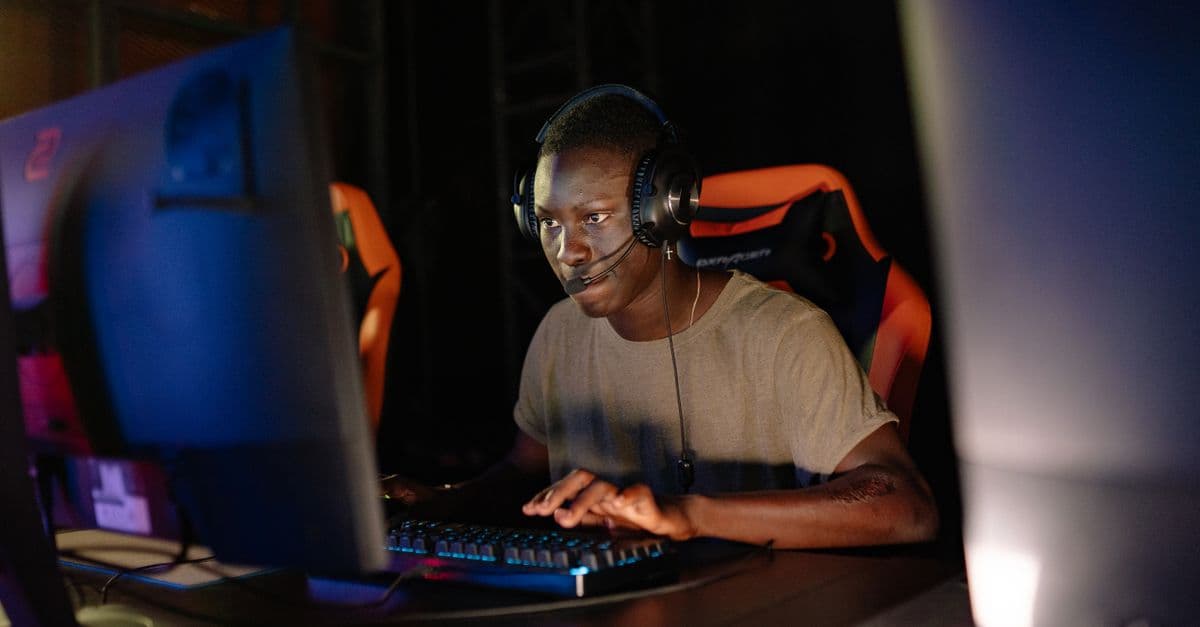
Photo: RDNE Stock project / Pexels
In a famous experiment, researchers showed participants the same film clip with three different soundtracks: the original score, an alternative score, and silence. Viewers rated the clip's emotional intensity, storytelling clarity, and perceived production quality dramatically higher when audio was present — and the specific choice of music shifted their emotional response significantly. This effect — that sound shapes how we perceive reality, not just how we hear it — is the foundation of game audio design.
Key takeaways
- Psychoacoustics — the psychology of hearing — underpins all audio design decisions: how humans localize sounds, what frequencies feel threatening, and how context changes perceived loudness.
- Binaural audio uses Head-Related Transfer Functions to simulate 3D spatial sound through headphones, allowing games to position sounds accurately in 360° space.
- Dynamic music systems respond to gameplay state in real time, blending stems and layers rather than playing linear tracks.
- FMOD and Wwise are the dominant audio middleware platforms, providing the tools for interactive audio behavior that game engines alone cannot replicate.
- Sound effects are rarely recorded literally: A rain impact in a movie sounds like bacon frying; a punch sound is a watermelon being smashed — perceptual accuracy trumps literal accuracy.
Psychoacoustics: the science of perceived sound
Psychoacoustics is the field that studies how humans perceive sound, which differs substantially from physical acoustics — the study of sound as a purely physical phenomenon of pressure waves. A physical acoustics measurement will tell you the exact decibel level and frequency content of a sound; psychoacoustics tells you how a person actually experiences that sound, which is filtered through attention, memory, expectation, and the quirks of human ear anatomy. Understanding psychoacoustics is prerequisite to effective audio design, because a designer isn't mixing for a microphone — they're mixing for a nervous system.
Frequency and perceived pitch: Humans hear frequencies from approximately 20 Hz to 20,000 Hz, with sensitivity peaking between 1,000 and 4,000 Hz — the frequency range of human speech. We are less sensitive to very low (infrasound) and very high frequencies. The equal-loudness contours, first mapped by Harvey Fletcher and Wilden Munson at Bell Labs in 1933 and later standardized internationally as ISO 226, show that sounds at different frequencies require different physical intensities to sound equally loud (ISO 226:2003, revised 2023). A 100 Hz tone must be roughly 20 dB louder than a 1,000 Hz tone to match its perceived loudness — meaning your ear is a wildly nonlinear instrument, not a flat microphone.
This has direct design implications. Game footsteps often have frequencies artificially boosted in the 2–4 kHz range to enhance detectability in competitive games like Counter-Strike. Enemy voicelines are mixed brighter (more high-frequency content) than ambient sounds to cut through the soundscape. Think of it like a lighting designer choosing a spotlight color that the human eye is naturally drawn to rather than picking a color at random — the designer is working with the sense organ's built-in biases, not against them.
Auditory masking: A loud sound can make nearby (in time or frequency) quieter sounds inaudible — frequency masking in spectral space, temporal masking before and after the loud sound. Sounds that would be clearly audible in isolation disappear in a dense game soundscape. Audio designers use this to their advantage (hiding problematic sounds behind music hits) and must work around it (ensuring critical gameplay cues like reload warnings are in unmasked frequency ranges).
The cocktail party effect: Humans can selectively attend to a single audio source in a noisy environment, a phenomenon first described by British cognitive scientist Colin Cherry in 1953. We use interaural time differences (the slight delay between when a sound reaches the left vs. right ear, on the order of microseconds), interaural level differences (the sound is louder on the near side because the head casts an acoustic shadow), and spectral coloring from ear pinnae to locate sounds spatially. Game audio must preserve or enhance these cues to let players focus on relevant sounds, the same way a good crowd scene in a film keeps the lead actor's dialogue intelligible over background chatter.
Binaural audio and spatial positioning
Binaural audio attempts to reproduce the full three-dimensional spatial experience of sound through headphones, rather than conventional stereo's simple left-right panning. Stereo panning tells your brain "this sound is somewhere between your ears," a flat left-to-right slider. Binaural audio tells your brain "this sound is behind you and slightly above your head," reconstructing a full sphere of positions rather than a single line.
The key concept is the Head-Related Transfer Function (HRTF). When a real sound source is at a specific position in space, it reaches your ears through a complex acoustic path: it diffracts around your head, reflects off your shoulders, and gets shaped by the specific geometry of your outer ear (pinna) before entering the ear canal. These transformations are frequency-dependent and unique to each source position. The HRTF encodes all of this spectral shaping for every possible source direction as a pair of filters.
To render binaural audio, the game: 1) places a virtual sound source in 3D space, 2) determines the HRTF corresponding to that position, 3) convolves the audio signal with the HRTF filter, and 4) delivers the result to headphones. The brain receives the same spectral cues it would from a real sound source at that location. It's the audio equivalent of a game rendering a fake shadow that nonetheless convinces your visual system an object is really sitting on the ground.
Generic vs. individual HRTFs are a significant challenge. Human ear geometries vary; a generic HRTF provides reasonable externalization for some listeners but sounds "inside the head" for others — the sound source feels glued to your skull instead of existing in the room. Personalized HRTF systems (like Apple's spatial audio on AirPods Pro, which measures your ear geometry using the device's camera) dramatically improve accuracy.
How does Alien: Isolation use audio to build tension?
Alien: Isolation (2014, developed by Creative Assembly) built a context-driven audio system in which the mix reprioritizes in real time based on player state. Sound designers Byron Bullock and Sam Cooper described a system where rising strings play as the xenomorph approaches and ambient layers drop out to concentrate the player's attention on the alien's footsteps and vocalizations when hiding, so the sound design itself becomes the primary gameplay information channel (The Sound Architect interview; MCV/DEVELOP). The team also interviewed Terry Rawlings, editor of Ridley Scott's original 1979 film, to keep the sound palette anchored to the movie's analog, tactile 1970s vision of the future.
Games like Hellblade: Senua's Sacrifice (2017, developed by Ninja Theory) pushed binaural technique into narrative territory. Paul Fletcher, a psychiatrist at the University of Cambridge with a research focus on psychosis, served as the game's mental health advisor. The voices Senua hears throughout the game were recorded binaurally so that they would move around the player's head — sometimes whispering from behind, sometimes crowding in from both sides — replicating the spatial quality some people with psychosis describe their own auditory hallucinations having (University of Cambridge). Fletcher also connected the studio with Recovery College East, a group of people with lived experience of psychosis, who helped shape how the voices behaved throughout development. The result is a sound experience that clinicians and people with psychosis alike have described as an unusually accurate representation, a rare case of a horror game's audio design doubling as a piece of applied mental health communication.
Why does spatial audio sound different on headphones than on speakers?
Speaker mixes rely on the physical distance between two speakers and the room's own reflections to build a sense of space, while binaural mixes encode spatial cues directly into the waveform using HRTF filters meant for headphone playback. Playing a binaural mix over speakers collapses the spatial illusion, and playing a speaker-oriented mix over headphones can sound flat or "stuck inside the head." Games increasingly ship separate headphone and speaker mix modes to address the mismatch.
Dynamic music: composing for interactivity
Traditional music is linear — it plays from start to finish at a fixed tempo and structure, whether in a film scene or a symphony hall. Game music must instead respond to moment-to-moment gameplay state: increasing in intensity during combat, becoming sparse during exploration, and transitioning smoothly as the player's situation changes in ways no composer can fully predict in advance.
Early games handled this with simple conditional playback: calm music stops, combat music starts. The result is jarring transitions that break immersion, the audio equivalent of a movie cutting mid-shot to a completely different scene with no transition.
Horizontal re-sequencing plays different musical sections based on game state, with composers writing transitions between each section so the seams are less audible. Monkey Island 2: LeChuck's Revenge (1991) pioneered this with LucasArts' iMUSE system, designed by Michael Land and Peter McConnell, which synchronized music changes to game events down to the bar level rather than cutting abruptly between tracks.
Vertical layering (additive mixing) adds or removes musical layers (stems) based on game state. A base layer of ambient pads plays continuously; a percussion stem fades in when enemies are nearby; a brass melody stem adds when combat begins. The game world's state is mapped to stem volumes, and composers write all stems to work harmoniously at any combination, much like a chef designing a dish where any subset of the ingredients still tastes coherent. Mass Effect 3 and The Last of Us use variations of this approach.
Dynamic parameter control in middleware systems allows game code to drive musical parameters in real time. A "combat intensity" parameter might range from 0 to 1 based on enemy count and health, smoothly crossfading between calm and intense variations of the same musical idea. This avoids the audible "switch" between discrete states.
Procedural music generation takes the next step: using algorithmic systems to compose music on the fly rather than crossfading between pre-written pieces. Spore (2008) used Brian Eno's procedural music system, built with programmer Peter Chilvers, to produce unique soundscapes for each planet the player generated. No Man's Sky generates adaptive music in collaboration with composer Paul Weir, where musical motifs are algorithmically assembled from planet-type parameters so that no two star systems sound identical.
How does Red Dead Redemption 2's score adapt to gameplay?
Composer Woody Jackson built the game's roughly 60 hours of music around 11 recurring stem loops of four to five minutes each, which shift depending on the player's actions, location, and emotional context of the moment (Rockstar Games Newswire). The soundtrack is split into three functional categories: narrative score for scripted missions, interactive score for open-world roaming and multiplayer, and environmental music, such as a character singing at a campfire, that exists diegetically inside the game world rather than as a mixed-in score. That three-way split lets the game reserve its most emotionally loaded orchestral cues for story beats while keeping the open world's ambient music from feeling repetitive across dozens of hours of play.
FMOD and Wwise: middleware for interactive audio
Game engines provide basic audio capabilities: play a sound file, adjust pitch, set volume. The sophisticated interactive audio behaviors described above require purpose-built middleware, tools built specifically to sit between the raw audio assets and the game engine's runtime logic.
FMOD Studio (by Firelight Technologies, based in Melbourne, Australia) and Wwise (by Audiokinetic, based in Montreal, Canada) are the two dominant audio middleware platforms, used across a large share of commercially shipped games. Both allow audio designers to work largely outside of programmer time, building complex interactive behavior visually rather than in code.
Create event-based audio: Rather than attaching sounds directly to code events, designers create "Audio Events" that bundle together multiple sounds, randomization settings, and behaviors. A footstep event might randomly select from eight surface-appropriate samples and apply pitch variation, keeping footsteps from sounding robotic — the same trick a drummer uses when they never hit a snare exactly the same way twice.
Design interactive music: Both platforms have dedicated music systems supporting horizontal re-sequencing, vertical layering, and tempo synchronization. Wwise's Interactive Music Hierarchy is particularly sophisticated, with state-driven transitions that can wait for the next bar, beat, or phrase before switching, so a combat cue never interrupts mid-phrase in a way that sounds like a scratched record.
Mix in 3D space: Audio objects in FMOD and Wwise have full 3D positioning, attenuation curves (how volume falls off with distance), and effects that respond to environment type (reverb, filtering through walls). Wwise's Spatial Audio component supports geometry-based occlusion and acoustic portals — sounds heard through doorways are differently filtered than sounds in the open, approximating how a real building muffles noise from one room to the next.
Profile and debug: Both tools provide real-time profilers showing which sounds are playing, their CPU and memory costs, and voice counts. Voice limiting — automatically cutting lower-priority sounds when the polyphony limit is reached — is configured here, which matters because a busy battle scene can easily ask for more simultaneous sounds than any sound card can actually play.
What is procedural audio and how is it different from middleware playback?
Procedural audio synthesizes sound in real time from underlying physics parameters — velocity, material, surface contact — instead of triggering a pre-recorded sample. A car engine built procedurally can respond continuously to RPM and load rather than crossfading between a handful of recorded engine loops. Our companion piece How Procedural Audio Creates Sound covers the synthesis techniques in depth; middleware like FMOD and Wwise increasingly host procedural DSP graphs alongside traditional sample playback, blurring the line between the two approaches.
Sound effects: creative lies in service of truth
One of the most counter-intuitive aspects of professional sound design is that recorded sounds rarely sound "right" in context. The acoustic properties of recorded sounds don't translate perceptually to playback environments, because a microphone captures a sound the way it physically exists, not the way an audience expects it to feel.
The Foley art of creating game and film sounds involves substantial creative invention, a tradition named after Hollywood sound artist Jack Foley, who pioneered live, in-studio sound effect performance in the 1920s:
| Sound in-game | What was actually recorded | Why the substitute works |
|---|---|---|
| Punches and combat impacts | Meat impacts, celery snapping, watermelon strikes | Real punch recordings sound dull and quiet compared to the sharp crack film and game conditioning has taught audiences to expect |
| Fire and cooking | Cellophane crumpled near a microphone | Real fire crackle is thin and inconsistent on a mic; crumpled plastic gives a denser, more textured "roar" |
| Rain impacts | Bacon or butter sizzling in a hot pan | The high-frequency sizzle reads as "wet surface impact" more convincingly than rain recorded on location |
| Footsteps on snow | Cornstarch squeezed inside a leather glove | Actual snow recordings lack the satisfying crunch audiences expect from film conditioning |
| Laser guns and sci-fi weapons | Slinky toys struck against metal cables, wire fence springs, and FM synthesis | Ben Burtt's sound design for the original Star Wars (1977) set the genre template that games still reference today |
| Bone breaks | Frozen vegetables or breadsticks snapping | Real bone-break sounds are largely inaudible without amplification that introduces unwanted noise |
Table 1. Common Foley substitutions in game and film sound design, and the perceptual reasoning behind each choice.
The psychoacoustic principle behind this: humans don't have strong memory for what punches actually sound like, since almost nobody has been in enough real fistfights to build an accurate sonic memory. We do have strong learned associations from decades of film and game conditioning about what punches should sound like. Sound designers are therefore designing for learned expectations rather than physical reality — a form of perceptual shorthand not unlike how a cartoonist draws a "whoosh" line behind a running character even though real motion produces no visible line at all.
Adaptive mixing ensures the audio mix adjusts dynamically to maintain clarity. During dialogue, music ducks (temporarily lowers in volume). During intense combat, ambient sounds compress. Player-critical sounds — enemy attacks, UI feedback, health warnings — are mixed to cut through whatever else is playing using sidechain compression (where one sound automatically lowers another's volume when it plays) and priority-based voice limiting.
Why do game footsteps sound different from real footsteps?
Real footsteps are quiet, inconsistent, and easily masked by other environmental noise, which makes them useless as a gameplay information source if reproduced literally. Game footsteps are boosted in frequency and volume, layered with material-specific recordings (concrete, grass, metal grating), and randomized in pitch and sample choice so a player can both hear and identify surface type and direction without the sound becoming a repetitive, robotic loop over hours of play.
Common misconceptions about game audio
A widespread assumption among players is that more speakers or a higher sample rate automatically produces better spatial audio. In reality, a well-implemented HRTF over stereo headphones frequently outperforms a poorly calibrated 5.1 or 7.1 speaker setup for directional accuracy, because HRTF encodes the elevation and depth cues that a flat ring of speakers physically cannot reproduce.
Another common misconception is that game music is simply a looping soundtrack, the same as an album played on repeat. As the Red Dead Redemption 2 and Monkey Island 2 examples above show, contemporary game scores are closer to modular systems with dozens of interchangeable stems and transition rules than to a fixed piece of music, and the "loop" a player hears is usually a real-time reassembly rather than a single repeating file.
A third misconception is that sound effects aim for realism. As the Foley table above demonstrates, the goal is nearly always perceptual plausibility, not acoustic accuracy — designers are reverse-engineering audience expectation, not measuring the physical world. For the wider context of game technology, design and psychology, see the Complete Gaming Guide 2026.
FAQ
Q: Why does game audio often sound different on headphones vs. speakers? A: Mixes are typically done on studio monitors (speakers) in acoustically treated rooms. Binaural rendering for headphones is an additional post-process. Games not explicitly mixed for headphones may sound congested or have poor spatial positioning through them. Many games now offer "headphone" mix modes that apply binaural processing and EQ compensation.
Q: What is the "listener" in game audio and why does it matter? A: The audio listener is a component attached to the active camera (or player character) that serves as the "ear position" for 3D audio calculations. All sound positions are evaluated relative to the listener's location and orientation. If the listener is placed incorrectly (attached to a camera that spins independently of the player), spatial audio breaks down.
Q: How many simultaneous sounds can a game engine play? A: Hardware voice limits depend on the audio hardware and software mixer. Modern games typically target 64 to 256 "real voices" (sounds actually mixed and sent to hardware) with many more "virtual voices" managed by priority systems. Sounds below a volume threshold or behind the camera are virtualized (paused or simplified) to stay within hardware limits.
Q: What is room acoustics simulation in games? A: Systems like Steam Audio and Wwise Spatial Audio simulate how sound reflects off geometry to produce reverb, occlusion (sounds muffled through walls), and diffraction (sounds bending around corners). Rather than using static reverb presets, these systems ray trace sound paths through the scene geometry in real time, producing acoustically accurate environments. Half-Life: Alyx is a prominent showcase of spatial audio done well.
Q: Who composes game music differently from film music? A: Game composers must write music that loops without feeling repetitive (often two- to five-minute loops for exploration areas that players inhabit for hours), transitions between states without audible seams, and works without a fixed picture. Film composers write to picture — every beat hits a visual moment. Game composers write systems that the player drives. Composers like Yoko Shimomura (Kingdom Hearts), Jesper Kyd (Assassin's Creed), and Austin Wintory (Journey) are celebrated for mastering this distinction.
Q: What is an HRTF and why can't a single generic one work for everyone? A: A Head-Related Transfer Function is a filter that encodes how a listener's specific head, shoulders, and outer ear shape reflect and color sound arriving from a given direction. Because ear geometry varies significantly between individuals, a generic HRTF built from an averaged ear shape localizes sound convincingly for some listeners but produces a flat, "inside the head" sensation for others, which is why personalized HRTF capture (as on Apple's AirPods Pro) improves accuracy.
Q: Does frame rate affect how game audio feels, the way it affects visuals? A: Indirectly, yes. Audio events are often triggered by animation frames or physics steps, so an unstable or low frame rate can cause sound cues, such as footstep timing or impact hits, to fire late or out of sync with the visual action, which breaks the sense of cause and effect the sound is meant to reinforce. For a deeper look at how frame timing affects overall responsiveness, see Why Frame Rate Changes Game Feel.
Q: Why do competitive shooters emphasize footstep and reload audio so heavily? A: In games like Counter-Strike or Valorant, audio is a primary information channel for enemy position, distinguishable from visual information the moment an enemy is out of sight. Designers boost the frequency range of footsteps and weapon sounds specifically because it falls in the band of highest human auditory sensitivity, effectively turning the mix into a competitive information system as much as an aesthetic one.
Q: Can bad sound design make a technically impressive game feel cheap? A: Yes. Because audio operates partly below conscious attention, players often cannot articulate why a scene feels unconvincing even when the visuals are polished, but a mistimed foley hit, an unmixed dialogue line, or an abrupt music cut is frequently the actual cause. Sound is frequently the last department funded and the first thing a player unconsciously judges.
Q: How does lighting rendering relate to sound design in modern engines? A: Both systems are, at their core, simulations of how energy (light or sound waves) propagates through and interacts with 3D geometry, and both increasingly rely on real-time ray tracing rather than pre-baked approximations. Modern spatial audio occlusion systems borrow techniques conceptually similar to those used in real-time lighting; see How Game Engines Render Lighting for the visual-rendering counterpart to this problem.
The takeaway
Game audio works because it exploits the same perceptual shortcuts that let humans survive in the physical world long before video games existed: we localize danger by sound before we see it, we recognize threat in specific frequency bands, and we accept a watermelon strike as a punch because our brains were trained on decades of film and game conditioning rather than real violence. The tools have gotten more sophisticated, from iMUSE's bar-synced transitions in 1991 to Wwise's geometry-aware occlusion today, but the underlying goal has stayed the same: make the mix match what the player's nervous system already expects to hear. The next time a game makes your pulse spike before you've consciously registered why, that's not an accident. It's psychoacoustics, engineered.
Read next:
Follow new articles
Add SciHub101 to your feed reader to see new science and technology stories.
About the Author
SciHub101 is an independent science and technology publication founded and edited by Buğra Sözeri, a software engineer and app developer based in Türkiye. AI tools assist with drafting and research. Source documentation in the existing archive is uneven, and articles are being reviewed and corrected. The Editorial Team byline identifies editorial responsibility; it does not certify specialist or independent human review. Where we compare products, anything built by our own team is labelled as such — see the editorial guidelines and About page for how corrections and disclosures work.
Related Articles

History of Video Game Graphics: From Pong to Photorealism
Video game graphics have advanced further in 50 years than almost any other technology. The journey from two white rectangles bouncing a dot to real-time ray-traced worlds is a story of engineering leaps, creative constraints, and an endless push to make the virtual look real.
Neural Networks and Physics Simulation: How AI Is Rewriting the Rules of Game Engines
Neural networks are replacing traditional physics equations in game engines, enabling more realistic simulation of fluids, cloth, destruction, and character motion at real-time speed.
The Science of Speedrunning: How Glitches and Exploits Work
Completing a 50-hour game in 20 minutes sounds impossible, but speedrunners do it by exploiting the fundamental gap between what a game looks like and how it actually works in memory. Understanding how glitches work is essentially a course in low-level computer science.

Game AI: How NPC Behavior Actually Works
The guard who patrols a hallway, the ghost that hunts you through a maze, the flock of birds that scatters when you approach — none of it runs on anything resembling real intelligence. Here's the classic toolkit that makes NPCs feel alive.

How VR Tricks the Brain: The Science of Virtual Reality
Put on a VR headset and step off a virtual ledge — your heart races, your palms sweat, your muscles brace for impact. But nothing real happened. Virtual reality exploits fundamental vulnerabilities in human perception that evolution never anticipated.

Procedural Generation: How Minecraft Builds Infinite Worlds
Minecraft's world spans roughly 60 million blocks in each direction, yet it fits in a few bytes of seed data. The mathematics behind biomes, caves, and mountains from a single number is one of gaming's most elegant engineering achievements.