VR Gaming: Full Immersion and Presence in Virtual Worlds
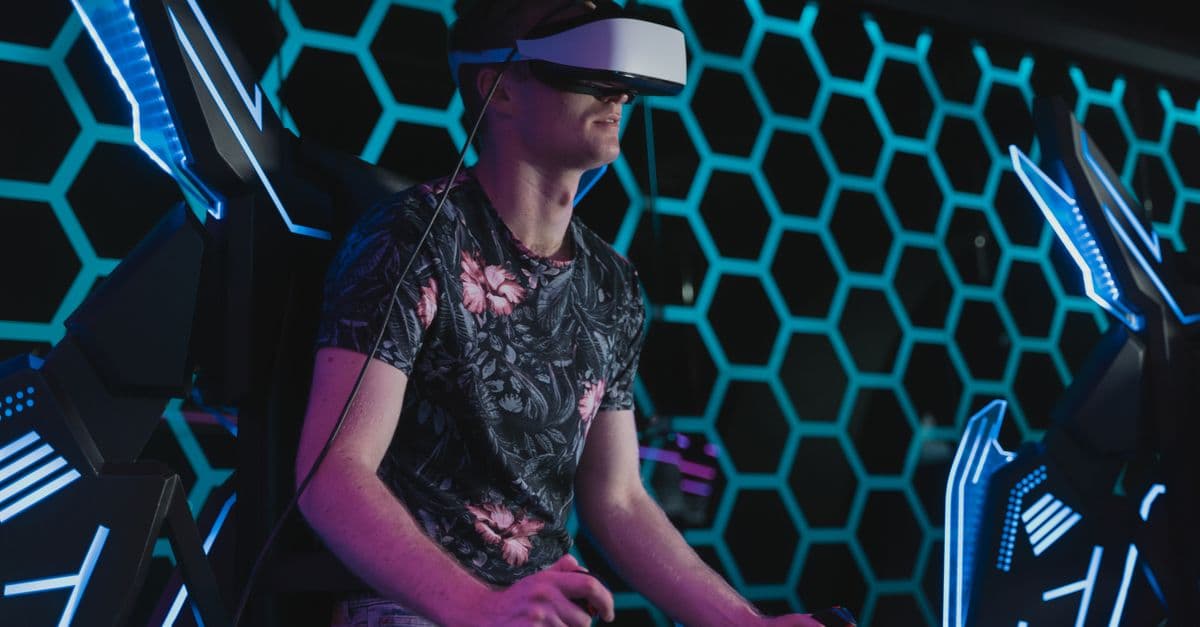
Photo: Tima Miroshnichenko / Pexels
Traditional gaming asks you to watch a screen and move a thumb. VR asks your body to believe it is somewhere else. Strap on a headset, and your visual field is replaced entirely, your head movements steer the camera in real time, and your hands appear in front of you as tracked avatars. Researchers call the resulting sensation "presence" — the feeling of being physically located in a place your rational brain knows is fake. That single psychological shift is why VR gaming behaves less like a graphics upgrade and more like a new medium, with its own strengths, its own physiological costs, and its own stubbornly small but fiercely loyal audience.
What makes VR different from a screen
A television or monitor is a window you look through. A VR headset replaces the window with the room itself. The distinction matters because the brain's spatial systems do not process "watching a world" and "occupying a world" the same way.
Four technical ingredients combine to produce that occupying sensation. First, stereoscopic, wide field-of-view optics fill your peripheral vision the way real environments do, unlike a monitor that occupies a fraction of your gaze. Second, six-degrees-of-freedom head tracking updates the rendered view the instant you turn your head, so looking behind you actually reveals what's behind you. Third, spatial audio places sound sources in 3D space around your head rather than through two static speakers. Fourth, hand or controller tracking projects a version of your hands into the scene, so reaching for a virtual object involves the same motor planning as reaching for a real one.
None of these four elements alone is new. Surround sound existed before VR; so did head-mounted displays for flight simulators. What's new is running all four simultaneously, at low enough latency that the brain stops flagging the mismatch between "I moved my head" and "the world didn't move accordingly." Researcher Mel Slater, who has spent three decades studying VR psychology, calls this technical achievement "place illusion" — the sense of "being there" produced specifically by low-latency tracking, high frame rate, and accurate 1:1 body tracking (Slater, place illusion and plausibility research, PMC). Slater separates it from a second, independent illusion called "plausibility" — whether the virtual world behaves coherently enough that you respond to it as if it were real, even while knowing it isn't.
How presence rewires the emotional response
Presence is not a marketing term. It describes a measurable shift in how the nervous system treats simulated stimuli, and it's the mechanism underneath everything that makes VR gaming feel different from playing the same content on a monitor.
When place illusion and plausibility illusion combine successfully, the brain's threat-detection and reward systems respond to virtual events with something closer to their response to real events than to their response to a movie or a flat-screen game. A jump scare in a horror film triggers a mild startle. The same jump scare in VR, where the monster is inches from your face and your peripheral vision confirms there's nowhere to look away to, triggers a stronger and more sustained physiological response, because the visual and spatial cues line up with what a real threat would produce.
This is not the same as saying VR "tricks" the brain into thinking the danger is real — players know perfectly well they're wearing a headset. What changes is the intensity and automaticity of the response, not the belief. It's the same reason a rollercoaster feels thrilling even though you know the track is engineered to be safe: the body's threat-response system reacts to the sensory input, not to your intellectual assessment of risk.
Why do virtual environments feel emotionally real if I know they're fake?
Presence operates below conscious belief. Wide field-of-view visuals, accurate head tracking, and spatial audio give your brain's spatial and threat-detection systems the same input pattern real environments would, so they respond with genuine arousal, fear, or excitement even while your explicit knowledge says "this is a game."
The physiological cost: cybersickness
Presence has a downside baked into the same mechanism that produces it. VR sickness, more precisely called cybersickness, comes from a mismatch between what your eyes report (motion) and what your inner ear reports (stillness, since you're actually sitting or standing in place). That sensory conflict is the same root cause behind seasickness and car sickness, just triggered by visual rather than physical motion.
The scale of the problem is larger than casual VR marketing suggests. Roughly 40 to 70 percent of first-time VR users report some degree of motion sickness symptoms within the first fifteen minutes of use, and around a third of the general population is highly susceptible to motion sickness across environments generally, VR included (VR sickness prevalence data, gitnux 2026). In controlled studies of VR flight simulation specifically, 68 percent of participants reported experiencing cybersickness during the session (sensorimotor mismatch and VR sickness trial, Journal of NeuroEngineering and Rehabilitation). Susceptibility isn't evenly distributed either: women report cybersickness symptoms at roughly twice the rate men do, and users over 50 tolerate visual-vestibular mismatch worse than users in their 20s, with some clinical studies seeing dropout rates as high as 22 percent among older participants due to nausea severity (age-related cybersickness trial, PMC).
Game design has responded with specific countermeasures rather than waiting for hardware to solve the problem. Teleportation locomotion — pressing a button to instantly relocate rather than walking with a joystick — removes the continuous visual motion that triggers most symptoms, at the cost of breaking spatial continuity. Static "cockpit" framing, borrowed from racing and flight games, gives the eye a fixed reference point (a dashboard, a car frame) that reduces the sensory mismatch the same way looking at the horizon helps with seasickness. Comfort settings that narrow the field of view during fast movement, sometimes called vignetting, reduce the amount of peripheral motion the visual system has to reconcile. None of these fully eliminates the problem; they manage it for a majority of users while a meaningful minority remains highly susceptible regardless of design choices.
Does VR sickness go away with repeated use?
For most users, yes. Repeated exposure produces habituation, a form of sensory adaptation where the brain recalibrates its expectations for the visual-vestibular mismatch, similar to how sailors develop "sea legs." Habituation typically builds over five to ten sessions, though a minority of highly susceptible users see little improvement regardless of practice.
Hand presence and haptic feedback
Seeing a tracked representation of your own hands in the virtual scene is a separate contributor to presence from the head-tracking and visual immersion described above, and it activates a different psychological mechanism: body ownership. When a virtual hand moves in sync with your real hand's movement, your brain begins to treat the virtual hand as an extension of your body, a phenomenon closely related to the classic rubber-hand illusion studied in cognitive neuroscience.
Reaching for and grabbing a virtual object triggers the same predictive motor planning your brain uses for real objects, which is part of why VR interactions feel qualitatively different from pressing a controller button to trigger an on-screen animation. Haptic feedback — vibration in the controller timed to a virtual impact, or resistance simulating weight — closes part of the sensory loop that pure visual tracking leaves open, reinforcing the illusion that the object has physical properties.
The technology is still visibly incomplete. Standard consumer controllers vibrate but can't simulate texture, resistance, or genuine weight, so grabbing a virtual sword and grabbing a virtual feather produce identical haptic sensations on most hardware. Hand-tracking cameras (used without controllers) remove the physical object from your hand entirely but introduce their own problem: fingers occasionally clip through virtual surfaces or fail to register a grip precisely, breaking the illusion at exactly the moment it matters most.
Where VR gaming actually works today
VR's commercial and cultural success has concentrated in a handful of genres where the presence-and-embodiment mechanism produces a categorically different experience rather than a marginally better one.
Rhythm and fitness games are the clearest commercial success story. Beat Saber, which has players physically swing controllers to slice oncoming blocks in time with music, turned an intuitive full-body motion into one of the best-selling VR titles ever made, precisely because the "controller" here — your arms — requires no explanation. Fitness-focused VR titles extend the same logic: because the movement is the gameplay rather than an input abstraction, players burn real calories without the experience registering as exercise in the way a treadmill does. A University of Pennsylvania-adjacent line of research on gamified exercise interventions has found that immersive, game-based physical activity produces meaningfully higher adherence than non-gamified exercise programs, because engagement substitutes for willpower.
Horror is the second clear win, for reasons directly tied to the presence mechanism described above: the same sensory conflict between "I know this is fake" and "my nervous system is responding as if it's real" that produces cybersickness also produces unusually intense fear responses, because a jump scare that fills your entire visual field and surrounds you with spatial audio gives the threat-detection system nowhere to disengage from.
Training and simulation is the domain with the most rigorous outside evidence. Surgical education researchers have run multiple randomized controlled trials comparing VR-based simulator training against traditional training methods, and a majority of these studies found VR training produced measurably better subsequent operating-room performance — mean improvements in standardized skill scores ranging from roughly 1.3 to 14 points across different trial designs, though results are not uniform across every procedure and outcome measure tested (VR surgical training meta-analysis, PMC; randomized trial, PubMed). That's a case where presence isn't just entertaining, it's functionally useful: rehearsing a procedure with your actual hands and actual spatial judgment transfers to the real task better than watching a video does.
Where VR gaming still loses to a screen
The honest counterpoint to presence is that most game genres don't benefit from it and some are actively worse for it. Long, sedentary narrative games — the kind players finish over 40 or 60 hours across weeks — are uncomfortable in a headset that most people can wear for at most 60 to 90 minutes before eye strain, neck fatigue, or heat buildup around the face forces a break. Strategy games, deep RPGs with dense menus and inventory management, and anything requiring precise reading of small text remain meaningfully worse in VR than on a monitor, because a headset's effective resolution and the need to physically gesture through menus add friction that a mouse and keyboard don't.
Social presence in VR is genuinely stronger than a video call, with research finding that avatar-based interaction incorporating eye contact and gesture produces psychological connection closer to physical presence than to a flat video feed (social presence in virtual worlds research). But the social graph is tiny by comparison to any mainstream platform: a Discord voice channel or a console party chat reaches an established friend group instantly, while VR social spaces require everyone involved to own compatible hardware, a real adoption bottleneck that has nothing to do with the technology's quality and everything to do with its cost and unfamiliarity.
Cost remains the largest practical barrier. Entry-level standalone headsets run from roughly $300 to $500, and full PC VR setups with a capable graphics card easily exceed $1,500 to $2,000 once the headset, controllers, and a VR-ready computer are accounted for. Compare that to the sunk cost of a smartphone most people already own, and VR gaming is competing for discretionary spending against an entertainment option with effectively zero marginal hardware cost.
What people get wrong about VR gaming
The most common misconception is treating VR's flat adoption numbers as proof the technology "failed." That framing conflates breadth of adoption with depth of engagement, and the two are running in opposite directions. VR headsets remain a rounding error next to the roughly 3 billion smartphone users worldwide, and shipments actually declined again through 2024 and 2025 (market shipment data, virtual.reality.news). But among people who do own a headset and keep using it, engagement is unusually intense and sustained, closer to a hobbyist community than a mass-market habit, which is a very different failure mode than a technology nobody wants.
The second common misconception is that VR is on a trajectory to replace traditional gaming the way smartphones replaced flip phones. That analogy breaks down on inspection. Smartphones solved a universal problem — computing you carry everywhere — with a form factor that fit into an existing behavior (carrying a phone). VR solves a much narrower problem — deeper immersion during a specific, scheduled play session — with a form factor that adds friction (a headset you must put on, in a cleared physical space, for a limited comfortable duration). Those are structurally different adoption curves, and there's no evidence VR is following the smartphone's.
The third misconception is that better hardware alone will fix the sickness and adoption problems. Higher resolution and faster frame rates genuinely help reduce visual latency-driven discomfort, but the sensory-conflict root cause of cybersickness is physiological, not a rendering bug, and no display specification eliminates the mismatch between "your eyes see motion" and "your inner ear feels stillness" for a standing or seated player. Locomotion design choices, not GPU horsepower, are what actually move the needle on comfort.
The takeaway
VR gaming's core achievement is not visual fidelity, it's presence: a measurable psychological and physiological shift that makes virtual events register more like lived experience than observed entertainment. That shift is genuinely valuable in specific domains, rhythm and fitness games, horror, and skills training foremost among them, where multiple randomized studies now back up the claims rather than just marketing copy. But presence comes bundled with real physiological costs, real hardware costs, and real genre limitations that keep VR a deep niche rather than a mainstream replacement for screens. The technology isn't failing to become smartphones. It was never going to be smartphones, and the more useful question is what it's actually good for.
Frequently Asked Questions
Q: Does VR cause motion sickness for everyone? A: No, but the base rates are higher than casual users expect. Roughly 40 to 70 percent of first-time users experience some symptoms in their first fifteen minutes, and about a third of the general population is highly susceptible to motion sickness broadly, VR included. Repeated exposure produces habituation for most people within five to ten sessions, though a persistently susceptible minority remains regardless of practice.
Q: Is VR worth a $500-plus hardware investment? A: It depends heavily on which genres you actually want. For fitness games, rhythm games, horror, or social VR, the presence mechanism produces experiences a flat screen genuinely cannot replicate, and heavy users who log hundreds of hours annually get strong value per dollar. For long narrative RPGs, strategy games, or anything menu-heavy, a monitor and controller remain more comfortable and more capable.
Q: Will VR ever reach smartphone-level mainstream adoption? A: Unlikely in its current headset form factor. Global VR shipments fell for a third consecutive year through 2024, and the market has consolidated around one dominant vendor rather than broadened (market data, Spyglass). Smartphones solved a universal, always-on problem; VR solves a narrower, session-based immersion problem, which produces a fundamentally different, shallower adoption curve regardless of how much cheaper hardware gets.
Q: What is "presence" in VR, technically? A: Presence is the combination of two illusions researcher Mel Slater identified: "place illusion," the sense of physically being in the virtual location produced by low-latency, high-frame-rate, accurately tracked visuals, and "plausibility illusion," the sense that the virtual world behaves coherently enough to respond to as if it were real. Both together, not graphics alone, are what make VR feel different from watching a screen.
Q: Why do women report VR sickness more often than men? A: Research on cybersickness prevalence finds women report symptoms at roughly twice the rate men do, though the exact physiological mechanisms behind the gender gap (candidate explanations include differences in interpupillary distance relative to headset optics, and differences in vestibular sensitivity) are still being actively studied rather than fully settled.
Q: Can VR training actually replace hands-on practice for skills like surgery? A: Current evidence supports VR as a strong supplement, not a full replacement. Randomized controlled trials comparing VR simulator training to traditional training found most studies (eight of eleven in one meta-analysis) showed measurable improvements in subsequent real-world performance, but results vary by procedure and outcome measure, and none of the major trials position VR as eliminating hands-on supervised practice entirely.
Q: What's the actual difference between cybersickness and traditional motion sickness? A: Both stem from the same underlying sensory-conflict mechanism between visual and vestibular (inner-ear) systems, but traditional motion sickness usually involves real physical motion the eyes don't fully register (like reading in a moving car), while cybersickness inverts it: the eyes report motion through the headset's visuals while the vestibular system correctly reports that the body is stationary.
Q: Why hasn't VR headset hardware solved the sickness problem yet? A: Because the root cause is physiological sensory conflict, not a technical rendering limitation. Higher resolution and lower latency reduce one contributing factor, but they cannot eliminate the fundamental mismatch between visual motion and vestibular stillness for a player who is seated or standing still in the real world. That's why locomotion design (teleportation, cockpit framing) matters as much as raw hardware specs.
Q: Is Meta's dominance in VR headsets a sign the market is healthy? A: Not necessarily. Meta's market share climbed above 80 percent in some 2024 quarters even as its own Quest shipments declined and the overall VR headset market contracted for a third straight year. High market share within a shrinking market reflects consolidation among fewer surviving competitors more than it reflects broad consumer demand.
Read next:
Follow new articles
Add SciHub101 to your feed reader to see new science and technology stories.
About the Author
SciHub101 is an independent science and technology publication founded and edited by Buğra Sözeri, a software engineer and app developer based in Türkiye. AI tools assist with drafting and research. Source documentation in the existing archive is uneven, and articles are being reviewed and corrected. The Editorial Team byline identifies editorial responsibility; it does not certify specialist or independent human review. Where we compare products, anything built by our own team is labelled as such — see the editorial guidelines and About page for how corrections and disclosures work.
Related Articles
Roblox: User-Generated Games and Virtual World Economy
Roblox is platform where users create games. Millions of user-created experiences generate billions in revenue through virtual economy.

Rhythm Games: From Guitar Hero to Beat Saber
Rhythm games transform music into interactive experience. Guitar Hero popularized genre; Beat Saber perfected it in VR. Music and gaming converge.

How VR Tricks the Brain: The Science of Virtual Reality
Put on a VR headset and step off a virtual ledge — your heart races, your palms sweat, your muscles brace for impact. But nothing real happened. Virtual reality exploits fundamental vulnerabilities in human perception that evolution never anticipated.

Complete Gaming Guide 2026 — Technology, Design, Esports, and Psychology
The complete guide to gaming in 2026: how game engines work, gaming hardware, esports, game design psychology, industry trends, and what makes games engaging and addictive.