How Lightning Works — From Cloud to Ground
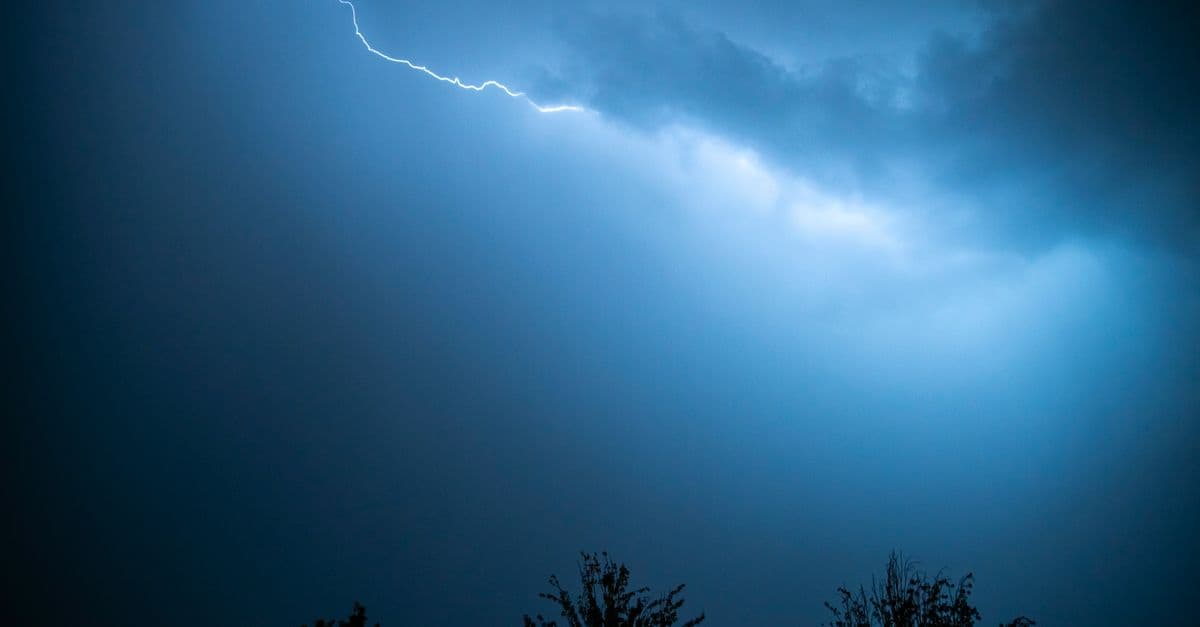
Photo: Jose Manuel Gonzalez Lupiañez Photography / Pexels
Right now, somewhere on Earth, lightning is striking. About 100 times every second, in fact — roughly 8 million bolts a day, channeling tens of thousands of amperes through a finger-thin column of air heated to temperatures higher than the surface of the Sun. Lightning is the most powerful electrical phenomenon most humans will ever witness, and yet for centuries no one knew what it actually was. Today we do — and the physics is even more interesting than the spectacle.
It Starts with a Cumulonimbus
Lightning is born inside cumulonimbus clouds — towering thunderheads that can stretch from a kilometer above the ground to the stratosphere, 12+ km up. Inside these clouds, powerful updrafts of 20–40 m/s lift warm, moist air, where it cools, condenses, and forms a chaotic mix of:
- Liquid water droplets
- Ice crystals (small, light)
- Graupel — soft hail pellets (larger, denser)
- Supercooled water (liquid below 0°C)
The updrafts and downdrafts inside the cloud constantly fling these particles into each other, and that's where the electricity comes from.
Charge Separation: How a Cloud Becomes a Battery
The leading theory is non-inductive charging. When tiny ice crystals collide with heavier graupel pellets in the presence of supercooled water, electrons hop between them. The direction of the transfer depends on temperature, but the net result is consistent:
- Light ice crystals end up positively charged and get carried to the top of the cloud by updrafts.
- Heavy graupel ends up negatively charged and sinks to the lower-middle of the cloud.
The result is a sky-sized capacitor: a positive top and negative bottom, separated by several kilometers, with a smaller pocket of positive charge sometimes lingering at the cloud base. The voltage difference between top and bottom can exceed 100 million volts.
The negatively charged underside of the cloud, in turn, induces a positive charge shadow on the ground directly below it — concentrated on tall objects like trees, towers, and unfortunately, golfers.
The Stepped Leader and the Return Stroke
When the electric field becomes strong enough to ionize air (about 3 million volts per meter, less in humid air), a faint, branching channel called the stepped leader begins to fight its way down from the cloud. It moves in jagged ~50-meter jumps, each step taking a microsecond, searching for the path of least resistance.
As it nears the ground, upward streamers of positive charge leap from tall objects to meet it. When they connect — usually 10–100 meters above the surface — a conductive channel is suddenly complete from cloud to ground.
That's when the real show happens. The return stroke is a colossal surge of positive charge racing upward through the channel at one-third the speed of light. In about 30 microseconds it dumps roughly 30,000 amperes of current, with peaks above 200,000 A in extreme bolts. The air in the channel — only a few centimeters wide — is super-heated to ~30,000°C, about five times hotter than the Sun's visible surface.
What you see as "the flash" is usually this return stroke. The branching, flickering quality comes from the fact that several return strokes often follow the same channel within a fraction of a second.
Thunder Is a Shock Wave
That instantly heated air doesn't have time to expand smoothly — it explodes outward as a shock wave. Within a few meters this shock decays into a powerful sound wave: thunder. Because light travels essentially instantaneously over a few kilometers but sound travels at ~343 m/s, you can estimate distance: every 3 seconds between flash and rumble equals about 1 kilometer. The deep rolling sound is the same shock wave reaching you from different parts of the kilometer-long channel at slightly different times.
The Many Forms of Lightning
Cloud-to-ground lightning is iconic, but it's only one of several types — and not even the most common.
| Type | Where | % of strikes | Notes |
|---|---|---|---|
| Intracloud (IC) | Within a single cloud | ~75% | Most common; seen as "sheet lightning" lighting up a cloud from inside |
| Cloud-to-ground (CG), negative | Cloud base to ground | ~20% | The classic bolt; negative charge transferred down |
| Cloud-to-ground, positive | Cloud top to ground | <5% | Rarer but extremely powerful; can strike far from the storm ("bolt from the blue") |
| Cloud-to-cloud (CC) | Between separate clouds | Variable | Long horizontal bolts |
| Cloud-to-air | Cloud into clear air | Rare | Diffuse, branching discharges |
| Transient Luminous Events (TLEs) | Above thunderstorms | Very rare | Sprites, elves, jets — discovered 1989+ |
Positive CG bolts are particularly dangerous: they originate from the high positive charge at the cloud top, carry far more energy, and can strike many kilometers from the visible storm — the source of the "bolt from the blue" phenomenon.
Sprites, Elves, and Other Sky Ghosts
For decades, pilots reported brief reddish flashes high above thunderstorms. They were dismissed until a 1989 accidental video confirmed them. We now know there's a whole zoo of Transient Luminous Events (TLEs) in the mesosphere and lower ionosphere:
- Sprites: Red, jellyfish-shaped discharges at 50–90 km altitude, lasting milliseconds.
- Elves: Expanding red rings of light at ~100 km, caused by electromagnetic pulses from strong CG strikes.
- Blue jets: Narrow blue cones shooting upward from cloud tops.
- Gigantic jets: Massive discharges connecting cloud tops to the ionosphere.
These phenomena hint that thunderstorms are electrically connected to the upper atmosphere far more than we suspected. For more on the electrical environment beyond Earth, see our piece on how space weather affects Earth.
Staying Safe
Lightning kills roughly 6,000–24,000 people globally each year. The safety physics is simple:
- Faraday cage: A metal car body (not convertible) conducts the charge around you, not through you.
- Lightning rods: Provide a low-resistance path to ground, protecting structures by giving the charge somewhere predictable to go (Benjamin Franklin, 1752).
- 30/30 rule: If you hear thunder within 30 seconds of a flash, you're within strike range. Wait 30 minutes after the last thunder to go back outside.
Avoid open fields, isolated trees, water, and metal objects. Indoors, stay off corded phones and away from plumbing.
Why We Still Can't Fully Predict It
Despite high-speed cameras, radar networks, and decades of field campaigns, the precise trigger inside a thunderstorm that initiates a bolt is still debated. One leading idea involves relativistic runaway electrons — cosmic-ray-seeded electrons accelerated to nearly light-speed by the cloud's field, ionizing a path others can follow. If true, every lightning bolt may have a particle physics fingerprint.
For more on the chaotic atmospheres of other worlds, see what would happen if Jupiter exploded.
The History of Lightning Science
For millennia, lightning was attributed to gods, demons, or divine anger. The ancient Greeks noticed it was more common near mountains and near water. Aristotle theorized about electrical phenomena (amber rubbed with cloth attracts straw), but didn't connect it to lightning.
The turning point came with Benjamin Franklin (1752), who flew a kite in a thunderstorm to prove lightning was electrical. This wasn't reckless entertainment — it was brilliant experimental physics. Franklin reasoned that if lightning was electricity, then a pointed conductor should bleed off charge safely. His lightning rod, invented the same year, reduced building fires dramatically.
The 19th century brought:
- Michael Faraday (1830s) experiments on electrical discharge in low-pressure gas, revealing branching patterns similar to lightning
- Joseph Henry (1840s) improved understanding of induction and electromagnetic effects
- George Fitzgerald (1880s) proposed that oscillatory discharge could produce electromagnetic waves (precursor to radio)
But despite this progress, the detailed mechanism remained mysterious until high-speed photography and electrical measurement technology improved. By the late 1900s, researchers like Arthur Few and Heinz Kasemir could record lightning at microsecond resolution, revealing the two-stage process (stepped leader + return stroke) we now understand.
Space-age contributions came from satellites. TRMM and OTD satellites mapped global lightning distribution (2014 data showed ~40-45 flashes per second globally, higher than earlier ground-based estimates). Understanding the full picture required seeing lightning as a global phenomenon.
Source: Kasemir, H. W. (1960). A Contribution to the Electrostatic Theory of a Lightning Formation. Journal of Geophysical Research, 65(7), 1873-1878. Foundational paper on charge separation mechanisms.
Global Lightning Patterns and Distribution
Lightning isn't random. It concentrates in specific regions based on geography, season, and time of day.
Hotspots:
- Congo Basin (Africa): The world's most active lightning region. Warm, moist air from the Atlantic, combined with topography, produces frequent storms. Ground stations measure ~150 lightning days/year in some locations.
- Amazon Basin (South America): Similarly active; the combination of warm tropical air and convective lifting from topography creates intense storms.
- Gulf Coast (USA): Collision of warm Gulf air with cooler continental air generates frequent thunderstorms, especially in spring/early summer.
- Himalayas and Central Asian mountains: Topographic lifting creates strong convection.
- Subtropical oceans: Slightly less active than continental regions but significant.
Diurnal cycle (daily pattern): Global lightning is 2-3× more active in afternoon/evening than overnight — driven by solar heating. The afternoon peak is strongest over land; oceans lag by several hours (water has higher heat capacity, warming slower).
Seasonal cycle:
- Tropics (near equator): Lightning relatively constant year-round (high temperatures always present).
- Temperate zones (30-60° latitude): Peak in summer when warm, moist air masses collide with cooler air; minimal in winter.
- Poles: Extremely rare lightning due to insufficient energy for convection.
The global distribution affects Earth's electrical circuit (discussed in atmospheric electricity section), affecting magnetic field measurements and radio propagation.
Atmospheric Electricity and the Global Circuit
Lightning is just the most dramatic part of a planetary-scale electrical system. The atmosphere is normally a good insulator, but a persistent potential difference of ~100,000 volts exists between the ionosphere (positive) and the ground (negative). This is maintained by an estimated 2,000 thunderstorms happening simultaneously worldwide.
The global electrical circuit:
- Fair-weather current: In clear-weather regions, positive current flows from the ionosphere to the ground at ~1–3 picoamperes per square meter.
- Thunderstorm current: Active thunderstorms generate negative current (the return stroke), partially discharging the global system.
- Lightning balance: The 2,000 storms' collective discharge roughly balances the fair-weather leakage.
If this system stopped (no thunderstorms), the global potential would decay in ~1 hour. The fact that the ionosphere stays charged tells us thunderstorms are electrifying Earth's upper atmosphere constantly.
This has implications for cosmic ray physics, atmospheric chemistry (ozone production), and possibly even climate (though evidence is subtle and debated).
Lightning and Atmospheric Chemistry
The extreme temperature in a lightning channel temporarily creates conditions that don't otherwise occur in the atmosphere:
Nitrogen oxides (NOₓ) production: The ~30,000 K heat splits N₂ and O₂ molecules, allowing them to form NO and NO₂. A single strong stroke can produce grams of NOₓ. Globally, lightning-produced NOₓ contributes ~5-10% of tropospheric NOₓ (human activities contribute ~90%). These react with other compounds to form tropospheric ozone, a key air pollutant.
Ozone (O₃): The smell after a thunderstorm — fresh, electric-smelling — is ozone. The extreme UV and heat in the channel split O₂ into oxygen atoms, which recombine as O₃. This is a tiny contribution to global ozone (the stratospheric ozone layer is affected by different chemistry involving CFCs), but locally can affect air quality.
Hydrogen peroxide (H₂O₂): The extreme heat also allows formation of hydrogen peroxide, which is important for atmospheric oxidation processes.
Net effect: Lightning makes the atmosphere slightly more oxidizing, accelerating chemical reactions that break down pollutants (like methane) but also forming secondary pollutants like ozone.
Source: Schumann, U., & Huntrieser, H. (2007). The Global Lightning-Induced Nitrogen Oxides Source. Atmospheric Chemistry and Physics, 7, 3823-3907. Comprehensive review of NOₓ production mechanisms.
Biological Effects: Lightning Injury and Survival
About 10% of lightning strike victims die; 70% suffer serious long-term effects (neurological, cardiac, or psychological). Understanding the mechanism helps explain why some survive apparently "direct" strikes.
Injury mechanisms:
- Direct contact: The lightning channel passes through tissue, causing thermal burn and electrical damage to nerves and muscles.
- Side flash: The main channel branches near the victim, but the discharge also jumps sideway through the air/skin, causing surface burns.
- Ground current: After striking an object, lightning spreads radially through the ground. Someone standing nearby experiences voltage gradient across their body.
- Blunt trauma: The shock wave from the channel can throw the victim or cause internal injuries.
- Cardiac arrest: The massive current can disrupt the heart's electrical rhythm (ventricular fibrillation), stopping the heart. Immediate CPR can restore it.
Why some survive:
The human body is a relatively good conductor (our cells are ~70% water). A lightning strike doesn't pass through the heart's electrical pathways purely by chance or timing — the current's path depends on where the strike enters/exits. Strikes entering the head or upper torso are more likely to disrupt cardiac rhythm; strikes entering the foot and exiting the opposite foot might spare the heart.
Additionally, the strike's duration is extremely brief (tens to hundreds of microseconds). The body's tissues survive if the power dissipation isn't too extreme. Wet skin has lower resistance (faster burn), while dry skin has higher resistance (less current depth penetration, so slightly more survivable in some cases paradoxically).
Long-term effects: Survivors often report memory loss, chronic pain, personality changes, and electrical sensitivity (sensitivity to artificial electromagnetic fields). The exact mechanism (neurological damage, PTSD, or other) remains incompletely understood, but the effects are real and debilitating.
Can We Harness Lightning Energy?
Lightning stores enormous energy: a typical stroke carries 15 coulombs of charge at ~30,000 amps, releasing ~1–5 billion joules (250 kWh equivalent). This is theoretically attractive for harvesting, but practical barriers are immense:
Why it doesn't work:
- Predictability: Lightning strikes are random. You'd need an enormous collection area with many rods to capture even a small fraction of strikes.
- Efficiency: The voltage is huge (hundreds of millions of volts) but the current is high and duration brief. Converting this to usable electrical form (lower voltage, higher current, longer duration) has efficiency losses. Capacitors and transformers designed for this would be expensive.
- Cost-benefit: A single typical lightning strike is
250 kWh equivalent. But capturing and storing it costs orders of magnitude more than buying electricity from the grid ($0.10/kWh). You'd spend $100+ in equipment to harvest $25 worth of electricity. - Durability: Lightning is destructive. Any capture device would be damaged frequently and need replacement.
Current research: Electrostatic levitation and plasma physics groups explore lightning energy capture experimentally, but no commercial applications exist. The idea resurfaces every few decades with new technology (supercapacitors, new materials) but economics remain unfavorable.
A more practical approach: use lightning rods to protect infrastructure (already done), and use lightning detection networks (already done) to avoid lightning during outdoor activities.
Lightning Detection Networks
Modern weather radars and satellite systems detect lightning in real-time globally:
Ground-based networks:
- Earth Networks (Vaisala): ~400 ground stations monitoring electromagnetic signals from lightning worldwide. Detects ~90% of strikes globally.
- National Weather Service (USA): Network of ~130 ground-based electromagnetic sensors.
Space-based:
- GOES satellites (NOAA): Geostationary satellites with optical lightning sensors covering North/South America.
- Sentinel Asia: International real-time disaster information system.
Accuracy: Modern networks locate strikes to within ~100 m horizontally and can detect both cloud-to-ground and intracloud lightning. Data feeds into weather warnings: if lightning is detected within ~10 km, "lightning warning" is issued.
Applications:
- Emergency services redirect personnel away from lightning risk.
- Airports delay flights during active lightning.
- Utilities track lightning-caused power outages.
- Scientists use data to study global electricity and climate.
Climate change implications: if atmospheric instability increases, lightning frequency may increase, detected by these networks. Preliminary studies show subtle increases over the last 20 years, but attribution to climate change vs natural variability is still debated.
Frequently Asked Questions
Q: Can lightning really strike the same place twice?
A: Yes — easily. The Empire State Building is struck around 25 times per year. Tall, isolated, conductive objects are repeat targets because they provide the easiest path for stepped leader and return stroke.
Q: How hot is a lightning bolt, exactly?
A: The channel reaches roughly 30,000°C (54,000°F). The Sun's visible surface is about 5,500°C, so the bolt is roughly 5 times hotter — though only for tens of microseconds, making the total energy small despite the temperature.
Q: Why does lightning zigzag?
A: The stepped leader finds the path of least resistance step by step through a turbulent, non-uniform atmosphere. Each branch represents a microscopic difference in air conductivity, moisture, and particle density.
Q: Can lightning happen without thunder?
A: Every lightning bolt produces thunder, but if the strike is more than ~20 km away the sound is absorbed and refracted away before reaching you. That silent flash is called "heat lightning."
Q: Are airplanes safe from lightning?
A: Yes. Aircraft are designed as Faraday cages; the current flows over the skin and exits without harming passengers or electronics. Commercial jets are struck on average about once per year each, with essentially no incidents.
Q: Does lightning produce ozone or fix nitrogen?
A: Both. The extreme heat splits O₂ and N₂ molecules, producing ozone (that "after-the-storm" smell) and nitrogen oxides that contribute to tropospheric chemistry and natural soil fertilization.
Read next:
- How Thunderstorms Form and Intensify
- Weather Prediction: Why Forecasts Get Better and Worse
- How Space Weather Affects Earth
Sources
Source: Rakov, V. A., & Uman, M. A. (2007). Lightning: Physics and Effects. Cambridge University Press. Comprehensive reference on lightning physics and engineering.
Source: NOAA National Severe Storms Laboratory. (2024). Severe Weather 101: Lightning. Educational resource with current understanding.
Source: Dwyer, J. R., & Uman, M. A. (2014). The Physics of Lightning. Physics Reports, 534(4), 147-241. Advanced review of lightning mechanisms.
Source: Kasemir, H. W., & Winn, W. P. (1970). Concerning Positive and Negative Stepped Leaders and Their Relation to Ground Discharges. Journal of Geophysical Research, 75(6), 1051-1070. Early work on stepped leader physics.
Source: NASA. (2023). Transient Luminous Events in Earth's Upper Atmosphere. Educational overview of TLE phenomena.
Source: National Weather Service. (2024). Lightning Safety. Official safety guidelines and fatality statistics.
Follow new articles
Add SciHub101 to your feed reader to see new science and technology stories.
About the Author
SciHub101 is an independent science and technology publication founded and edited by Buğra Sözeri, a software engineer and app developer based in Türkiye. AI tools assist with drafting and research. Source documentation in the existing archive is uneven, and articles are being reviewed and corrected. The Editorial Team byline identifies editorial responsibility; it does not certify specialist or independent human review. Where we compare products, anything built by our own team is labelled as such — see the editorial guidelines and About page for how corrections and disclosures work.
Related Articles

Ocean Science: How Oceans Work Explained
How oceans work: depth zones, the conveyor-belt circulation, acidification, hydrothermal vents, tides, and plastics, with figures from NOAA and the IPCC.
How LED Lights Work — Science of Solid State Light
How LEDs turn electricity into light using semiconductors, why they're 10x more efficient than bulbs, and the Nobel-winning blue LED story.

Why Do We See Our Breath When It's Cold? The Science
Exhaled air is warm and close to saturated with water vapor. When it mixes into cold air, the mixture cannot hold all of that vapor, and a small cloud of liquid droplets appears.
Why Is the Sky Blue? Scattering, Sunsets, and Perception
Why is the sky blue? Learn how air scatters sunlight, why sunsets turn red, and how dust and human color vision change the colors we see overhead.
Faraday's Induction: From Magnets to Electricity
In 1831, Michael Faraday discovered that changing magnetic fields induce electric currents. This fundamental discovery enabled electric motors, generators, and transformed civilization.