Pythagoras: The Theorem, the Brotherhood, and the Man Who Feared Beans

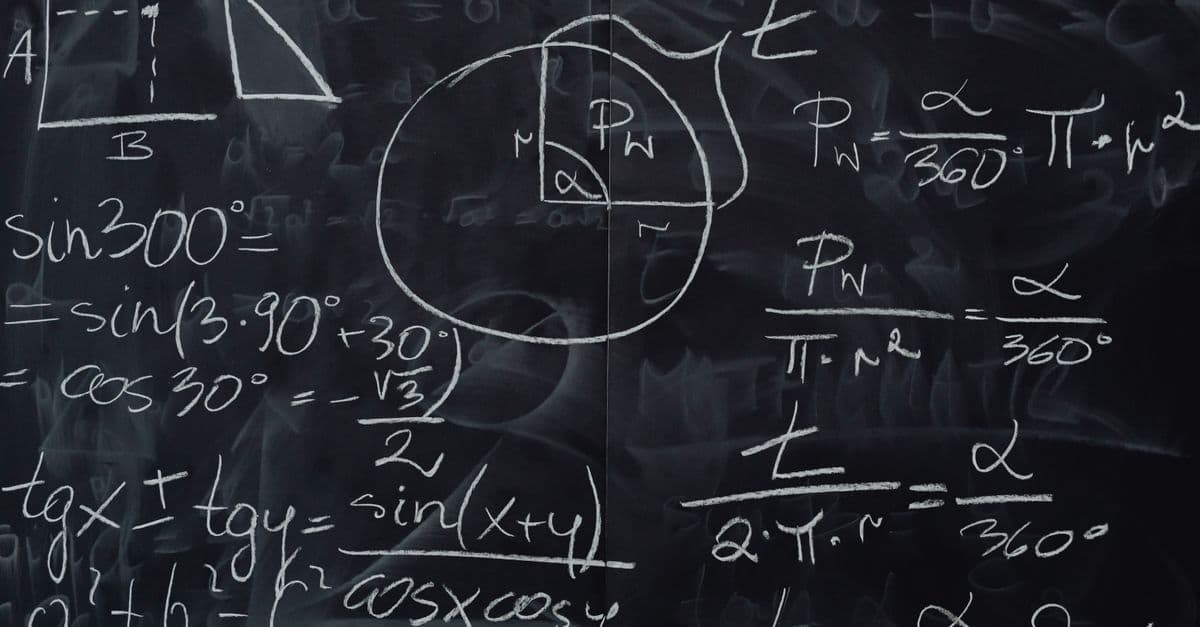
Photo: www.kaboompics.com / Pexels
Pythagoras of Samos (c. 570–495 BCE) is one of the most famous names in the history of mathematics, attached to a theorem he almost certainly did not discover. The Babylonians knew the relationship between the sides of a right triangle more than a thousand years before he was born. What Pythagoras contributed — and the evidence is frustratingly indirect — was probably the first general proof that the relationship holds for all right triangles, not merely specific integer triples. He then founded a religious and philosophical community in Croton, in southern Italy, built around the conviction that number was the underlying structure of reality. The Brotherhood he created had dietary prohibitions, political ambitions, secret doctrines, and a peculiar hostility to beans that philosophers have been arguing about ever since. Almost none of Pythagoras's own writings survive — there is genuine scholarly debate about whether he wrote anything at all — which means nearly everything attributed to him comes from sources written centuries after his death.
Quick Biography
Pythagoras was born on the island of Samos, in the eastern Aegean, around 570 BCE. Ancient sources credit him with extensive travels: to Egypt, where he studied with priests; to Babylon, where he may have encountered mathematical traditions that influenced his later work; possibly to Phoenicia and Persia. How much of this itinerary is historical and how much is later embellishment by admirers eager to give him the best possible education is impossible to determine now. The Egyptian connection at least is plausible given the flow of Greek scholars to Egypt in the 6th century BCE.
Around 530 BCE he emigrated to Croton, a Greek colony on the toe of Italy's boot, then a prosperous city with a reputation for athletics and medicine. There he founded the community that ancient sources call the Pythagorean Brotherhood (or Pythagorean School). The community attracted followers from across the Greek world, included both men and women — unusual for the period — and operated with a combination of philosophical education, ethical discipline, and what modern observers would recognize as cult-like social structures.
Members were reportedly divided into two tiers: the akousmatikoi (listeners), who received oral teachings and followed the rules, and the mathematikoi (learners), who engaged more deeply with the mathematical and philosophical doctrines. New initiates observed a five-year silence before being permitted to speak in Pythagoras's presence — a discipline aimed, by his account, at developing patience and reducing the noise of unconsidered speech.
The Brotherhood acquired political influence in Croton and across Magna Graecia. This eventually provoked a backlash. Around 508–505 BCE, a politician named Cylon led a popular uprising against Pythagorean influence. Pythagorean meeting houses were burned, members were killed or expelled, and Pythagoras himself either fled to Metapontum (another southern Italian city) or was already there. Ancient sources give contradictory accounts of his death; most place it in Metapontum, some suggesting he starved himself, others that he was killed in the violence. He was somewhere between 70 and 80 years old.
Major Contributions
The Pythagorean Theorem — and the Question of Priority
The theorem that bears his name states that in a right triangle, the square of the hypotenuse equals the sum of the squares of the other two sides: a² + b² = c². It is one of the most useful relationships in all of mathematics, foundational to geometry, trigonometry, and, via the distance formula, to coordinate geometry and much of physics.
The historical problem is that Babylonian clay tablets from roughly 1800 BCE — the Plimpton 322 tablet, among others — list Pythagorean triples (integer solutions such as 3-4-5 and 5-12-13) with apparent systematic knowledge of the relationship. Egyptian builders used 3-4-5 rope triangles to construct right angles. Indian mathematicians recorded the relationship in the Sulba Sutras, dating to around 800 BCE or earlier.
What Pythagoras or his school plausibly added was a general proof valid for all right triangles, not just integer examples. Greek mathematics was uniquely concerned with proof — with demonstrating that a relationship must hold, not merely that it appears to hold in checked cases. Whether Pythagoras himself constructed the proof or whether it was developed within his school and attributed to its founder by later tradition is genuinely unknown. Archimedes, working three centuries later, operated in a mathematical tradition that had absorbed and extended Pythagorean foundations.
Number as the Basis of Reality
More philosophically ambitious — and more distinctively Pythagorean — was the claim that number is the fundamental substance of the cosmos. Pythagoras and his followers observed that musical harmony corresponds to simple numerical ratios: an octave is a 2:1 ratio, a perfect fifth is 3:2, a perfect fourth is 4:3. From this they extrapolated (with what most philosophers would call too much enthusiasm) that all of reality is structured by number, that the planets move in musical harmonies (the "music of the spheres"), and that understanding number is understanding the universe.
This conviction drove genuine mathematical work. The Pythagoreans investigated odd and even numbers, triangular and square numbers, and the concept of mathematical proof in ways that fed directly into Aristotle's later systematization of logic and ultimately into Euclid's Elements. The philosophical ambition, however outsized, produced useful mathematics.
Music Theory and Pythagorean Tuning
The mathematical investigation of musical harmony was one of the Brotherhood's most concrete scientific achievements. By observing that a string half as long as another produces a note exactly one octave higher — and that the ratios 3:2 and 4:3 produce the perfect fifth and perfect fourth — the Pythagoreans built the first systematic theory of musical intervals grounded in arithmetic rather than aesthetic intuition.
What became known as Pythagorean tuning builds a full musical scale by stacking perfect fifths (3:2 ratios) against each other, then adjusting by octaves (2:1 ratios) to keep all the notes within one octave. The resulting scale is mathematically elegant and closely matches what Western music used for roughly a thousand years. Its limitation — and this is also a mathematical result the Pythagoreans were aware of — is that no finite number of perfect fifths ever returns you exactly to the octave you started from. Twelve perfect fifths come close but land slightly sharp; the discrepancy is called the Pythagorean comma. The equal temperament system that pianos use today distributes that comma across all twelve intervals, a practical solution Pythagoras did not live to see but whose problem he had correctly identified.
This musical mathematics linked directly to the broader claim about number and cosmos: if the most pleasurable sounds emerge from simple integer ratios, then perhaps beauty, harmony, and truth are all expressions of the same underlying numerical structure. The argument was circular and not rigorous by any modern standard, but it was not ridiculous, and it drove serious inquiry.
The practical consequences of Pythagorean tuning lasted more than a millennium. Medieval plainchant, early polyphony, and the music of the Renaissance all relied on Pythagorean interval relationships. The tuning problem — what to do with the comma — became one of the central technical questions of Western music theory from the 14th century onward, eventually producing mean-tone temperament, well temperament, and finally the equal temperament system standardized in the 18th century. Isaac Newton, who worked on optics and color, also spent considerable time on the mathematics of musical scales, a fact that illustrates how deeply the Pythagorean connection between mathematics and harmonics persisted into early modern science.
Transmigration of Souls
Pythagoras taught metempsychosis — the transmigration of souls across human, animal, and possibly plant bodies across successive lives. This was not metaphor; it was presented as literal doctrine. The 4th-century BCE philosopher Xenophanes, a near-contemporary, mocked him: he reportedly claimed that Pythagoras once stopped a man from beating a dog, saying he recognized the voice of a dead friend in the dog's yelping.
This belief had practical implications. It motivated the vegetarianism practiced by at least some Pythagoreans (eating animals might mean eating a reincarnated person) and connected the Brotherhood's ethical rules to a cosmological framework. The soul, for Pythagoras, was immortal and worked toward purification across multiple lives — a view that influenced Plato's accounts of the soul in the Phaedo and Republic.
Personal Life and Family
Theano: Wife, Student, or Both?
Ancient sources are divided on whether Theano was Pythagoras's wife, his student, or his daughter — a confusion that itself reflects the unusual character of the Pythagorean Brotherhood, where roles blurred in ways that later biographers found difficult to categorize. The most widely cited tradition, reported in multiple ancient sources, identifies her as his wife and as a mathematician and philosopher in her own right.
If the biographical tradition is accepted, Theano of Crotone was the author of treatises on mathematics, physics, medicine, and psychology, and she continued leading the Pythagorean community after Pythagoras died. Works attributed to her survive, though scholarly opinion is divided on whether they are genuinely her compositions or later texts written under her name. What the tradition is consistent about is that she was not a passive domestic figure: she participated in and contributed to the intellectual life of the Brotherhood at the highest level.
Ancient sources credit Theano with particular interest in the application of Pythagorean number theory to the natural world — to medicine, to cosmology, and to what she reportedly called the "golden mean" of proportion in human life. Whether the attribution is accurate or whether later writers projected onto her the ideas they associated with Pythagorean philosophy cannot now be determined.
Pythagoras and Theano, according to Diogenes Laertius, had four children: three daughters named Damo, Myia, and Arignote, and a son named Telauges. All four are credited by ancient sources with participation in Pythagorean philosophy. The existence of daughters among the intellectual heirs is consistent with the Brotherhood's broader openness to women as participants — a stance that distinguished Pythagorean communities from most other philosophical schools of the ancient world.
Damo and the Entrusted Writings
Among the children, Damo occupies a specific and well-documented place in the tradition. According to Diogenes Laertius, drawing on earlier sources, Pythagoras entrusted his writings to his daughter Damo before his death, with instructions that she not share them outside the family. When offered money for the manuscripts — and ancient sources say she was — she refused, preferring poverty to what she regarded as betrayal of her father's instructions.
The story may be legendary, but it was circulating in the ancient biographical tradition and tells us two things worth noting. First, Pythagoras apparently trusted his daughter with his most important intellectual legacy, which speaks to the unusually egalitarian structure of the Brotherhood with respect to women. Second, the story was told approvingly — Damo's refusal to profit from the writings was presented as a model of Pythagorean virtue, the willingness to choose principle over material comfort.
Whether any of what Damo preserved actually survived to later times is unknown. The absence of authentic Pythagorean texts in the later tradition suggests that whatever Damo kept did not make it into the manuscript tradition that reached Alexandria and Rome.
Myia and Arignote: The Other Daughters
Myia, the second daughter, is identified in ancient sources as a physician or healer, consistent with the Brotherhood's interest in medicine and with Croton's reputation as a center of medical practice. A letter attributed to her — addressed to another woman on the subject of nursing infants — circulates in ancient collections of Pythagorean letters, though like most documents attributed to Pythagorean women, its authenticity is contested. The third daughter, Arignote, is credited in some sources with composing works on Bacchic mysteries and sacred rites, suggesting an interest in the religious and ritual dimensions of Pythagorean life rather than its mathematical component. Her name also appears in lists of Pythagorean women compiled by later authors including Iamblichus. Whether these women were real individuals with documented intellectual activity or whether they became vessels for projecting Pythagorean ideals onto an idealized founder's family is a question that scholarship has not definitively resolved, but the consistent pattern across sources of daughters who were active participants in intellectual life is itself historically significant.
Quirks
The Bean Prohibition: Theories, Theories, Theories
The most reliably attested of the Pythagorean peculiarities is the prohibition against eating beans — specifically fava beans (Vicia faba). Ancient sources are unanimous on the fact of the prohibition but offer wildly divergent explanations, which suggests that even in antiquity nobody was quite sure of the real reason.
Diogenes Laertius, writing in the 3rd century CE and drawing on earlier sources, lists several explanations that were circulating in antiquity: beans resemble testicles (anatomical similarity theory); beans contain the souls of the dead (transmigration theory, consistent with the general doctrine); beans cause flatulence, which disturbs the internal quiet necessary for philosophical contemplation; beans were used in Athenian voting procedures (beans as political ballots — avoid political entanglement); the interior of a bean stalk, if examined closely, resembles the gates of Hades.
A more modern hypothesis, proposed in the 20th century, is that many people of Mediterranean descent carry a genetic variant (G6PD deficiency) that causes hemolytic anemia when they eat fava beans — a condition called favism. Under this reading, Pythagoras may have observed that beans made certain people seriously ill and generalized the prohibition to protect the community. This is plausible but entirely speculative; we have no evidence Pythagoras knew about G6PD deficiency, and the ancient explanations suggest doctrinal rather than medical reasoning.
What is well-documented is that the prohibition was treated as serious: some ancient sources claim Pythagoras refused to flee through a bean field when his meeting house was attacked, preferring death to transgression. Whether this anecdote is historical is impossible to verify, but it was circulating within a century or two of his death, which at minimum tells us the prohibition was considered central to Pythagorean identity.
The Five Years of Silence
New initiates to the Pythagorean Brotherhood reportedly served a five-year probationary period during which they were required to listen without speaking in the presence of Pythagoras. The practice is reported by multiple ancient sources including Iamblichus, the 3rd-century CE Neoplatonist who wrote the most detailed surviving biography of Pythagoras. During this period, initiates were called akousmatikoi — listeners.
The rationale, as preserved in ancient sources, was disciplinary: learning to listen before speaking, mastering impatience, and demonstrating commitment before receiving the deeper doctrines. The practice has parallels in other ancient philosophical and religious communities and is not inherently implausible as a social institution, even if the specific five-year figure may be schematic rather than precise.
What makes this particularly interesting is what it implies about the community's structure. A five-year gate before speaking privileges means the Brotherhood was managing information carefully, controlling who had access to the inner doctrines, and creating a hierarchy based on demonstrated patience and loyalty. It is recognizably a cult structure — not in the pejorative sense necessarily, but in the technical sociological sense of a bounded community with secret knowledge and graduated initiation.
Hippasus and the Scandal of Irrational Numbers
The most dramatic story associated with Pythagorean mathematics is the fate of Hippasus of Metapontum, a member of the Brotherhood who allegedly proved that the square root of 2 is irrational — that is, that it cannot be expressed as a ratio of two integers. The proof, which is elegant and almost certainly genuine in its ancient form, proceeds by assuming √2 is rational (p/q in lowest terms), squaring both sides (2 = p²/q²), and deriving a contradiction.
For the Pythagoreans, this was philosophically catastrophic. Their entire worldview rested on the conviction that number — meaning rational number — was the structure of reality. An irrational number was literally an alogos, something that could not be expressed in speech or ratio. Hippasus had found a crack in the foundations.
The story that follows varies by source. In some versions, Hippasus was expelled from the Brotherhood for revealing the secret to outsiders. In the most dramatic version, Hippasus was drowned at sea — either thrown overboard by fellow Pythagoreans or killed by the gods as punishment for impiety. This last version, which is the one most often repeated, appears in late sources and is almost certainly legendary. There is no contemporaneous evidence for a murder, and the story has the structure of a morality tale rather than a historical account.
What is credible is that the discovery of irrational numbers was genuinely disruptive to Pythagorean mathematics and that there was some kind of controversy around Hippasus and the disclosure of this knowledge. The drowning may be embellishment; the philosophical crisis was real.
He May Have Been Recognized by a Thigh
Among the more peculiar claims made by ancient admirers is that Pythagoras had a golden thigh — or, in some versions, that he was once spotted in two cities on the same day. These akousmata (sacred sayings or reports) circulated in the Pythagorean tradition and were treated by followers as evidence of his divine or semi-divine nature. Aristotle mentions the golden thigh in a fragment preserved by later writers, which at least confirms the tradition was old.
The Pythagorean Brotherhood actively cultivated the idea that their founder was exceptional in ways that exceeded the merely human. He was associated in some sources with the god Apollo and was described as having prophetic abilities. Whether Pythagoras promoted these stories himself or whether they accumulated after his death is, like nearly everything about him, impossible to determine. What is clear is that the cult of Pythagoras's personality was as central to the Brotherhood as the mathematical doctrines — the man and the ideas were not easily separated.
The Vegetarianism Debate
Pythagorean vegetarianism was explicitly tied to the doctrine of transmigration: if souls cycle through animal bodies, eating meat might mean consuming a former person. The ban was broad enough that in the ancient world, "Pythagorean diet" was a synonym for meat-free eating well into the early modern period. English vegetarians were sometimes called "Pythagoreans" as late as the 18th century, more than two thousand years after his death.
The internal consistency of this position created awkward collisions with other prohibitions. If animal souls can migrate into beans (one explanation for the bean prohibition), does avoiding beans serve the same purpose as avoiding meat? Some ancient commentators thought so; others treated the bean taboo as a separate, unrelated practice. The Brotherhood's doctrines were not always internally reconciled, and Pythagoras left no written systematic account that might have resolved the contradictions.
The Acousmatic Sayings: Rules That Seem Random Until You Think About Them
Beyond the bean prohibition, the Brotherhood preserved a collection of akousmata — prescriptive sayings attributed to Pythagoras whose rationale was either symbolic, ritual, or practical. The list includes injunctions that strike modern readers as eccentric but were internally coherent within the Pythagorean worldview.
Members were reportedly told: do not stir a fire with a sword (do not provoke anger with sharp words); do not step over a balance or scale (respect justice); do not eat from a whole loaf (do not be selfish); when rising from bed, roll up the bedclothes so the imprint of your body is smoothed out (leave no trace of your physical presence that could be used against you). Iamblichus preserves dozens of these sayings with allegorical interpretations, though whether the interpretations are original or later accretions is unknown.
What is historically interesting is that the akousmata functioned as a living archive of Pythagorean practice at a time when the Brotherhood had no canonical written text. In the absence of Pythagoras's writings — assuming he wrote at all — the oral sayings preserved the community's identity and transmitted its values across generations. They are, in a sense, the closest thing to Pythagorean scripture that survives.
Quotes
"Do not say a little in many words but a great deal in a few."
"Above the clouded sky there is an eternal land."
"Rest satisfied with doing well, and leave others to talk of you as they please."
"In anger we should refrain both from speech and action."
"The oldest, shortest words — yes and no — are those which require the most thought."
Legacy
Pythagoras left no writings, led a community that was suppressed within his own lifetime, and attached his name to a theorem that predated him by a millennium. His actual legacy is larger than any of that suggests. The tradition he founded gave mathematics a philosophical ambition it had not previously possessed — the conviction that number is not merely a tool for calculation but a window into the structure of reality. This conviction, transmitted through Plato (who was deeply influenced by Pythagorean thought) and through Euclid's systematic proof-based geometry, shaped the entire subsequent history of Western mathematics.
His influence on Aristotle, who engaged extensively with Pythagorean ideas even while criticizing them, is well-documented. The concept of mathematical proof as the standard for knowledge, the investigation of irrational numbers, the theory of musical harmony — all of these flowed from the Pythagorean tradition into the mainstream. The theorem named after him is taught in every mathematics classroom on Earth. That the Babylonians knew the numbers first is a footnote; that the proof-based framework for understanding why it is always true came from Pythagoras's tradition is the more important inheritance.
The musical mathematics he pioneered has a direct line into modern acoustics and digital audio. The Pythagorean comma — that small irreconcilable gap between stacked perfect fifths and an octave — was one of the first mathematical results with direct practical consequences for human art. Every piano tuner and digital audio engineer works in the shadow of a problem that the Brotherhood of Croton first identified and could not solve.
The remarkable openness of the Pythagorean community to women as intellectual participants — documented in the traditions around Theano, Damo, Myia, and Arignote — was anomalous in the ancient world. It may reflect a genuine philosophical commitment, or it may reflect the community's self-understanding as set apart from ordinary social norms. Either way, the Pythagorean tradition preserved names and intellectual legacies of women that would otherwise have been entirely lost, making it a minor but real counterexample in the long history of women's exclusion from formal intellectual life.
Q: Did Pythagoras actually prove the theorem that bears his name?
A: Probably not as a solo discovery. The Babylonians knew Pythagorean triples 1,000+ years earlier. What Pythagoras or his school likely contributed was the first general proof that the relationship holds for all right triangles — but no original documents survive, so attribution rests on tradition rather than evidence.
Q: Why did Pythagoreans refuse to eat beans?
A: Ancient sources give multiple contradictory explanations: beans resemble testicles, they contain souls of the dead, they cause flatulence that disturbs contemplation, or they were associated with political voting. A modern hypothesis suggests fava beans are dangerous to people with G6PD deficiency (favism), common in the Mediterranean, but this is speculative.
Q: Was Hippasus really drowned for proving √2 is irrational?
A: The drowning story appears only in late sources and has the structure of a legend rather than a historical account. It is almost certainly not literally true. What is credible is that Hippasus's discovery of irrational numbers was genuinely disruptive to Pythagorean philosophy and that there was real controversy around him.
Q: What was the five-year silence rule?
A: New initiates to the Pythagorean Brotherhood reportedly could not speak in Pythagoras's presence for five years, earning the title akousmatikoi (listeners). The rule emphasized disciplined listening and controlled access to inner doctrines — a recognizable feature of initiatory communities.
Q: Did Pythagoras believe in reincarnation?
A: Yes. He taught metempsychosis — the transmigration of souls through human, animal, and possibly plant bodies across successive lives. A near-contemporary, Xenophanes, mocked him for claiming to recognize a dead friend's soul in a dog's bark. This doctrine influenced Plato's treatment of the soul directly.
Q: How did Pythagoras die?
A: Unknown. Most ancient sources place his death in Metapontum, where he fled after anti-Pythagorean violence in Croton. Some sources say he starved himself; others that he was killed. He was likely in his 70s or 80s. No contemporaneous account survives.
Q: Who was Theano and what was her role in the Brotherhood?
A: Theano of Crotone is identified in most ancient sources as Pythagoras's wife and a mathematician in her own right. She reportedly continued leading the Pythagorean community after his death. Works attributed to her survive, though their authenticity is debated. She and Pythagoras had four children; one daughter, Damo, was entrusted with Pythagoras's writings.
Q: What is Pythagorean tuning?
A: A system of musical intervals built by stacking perfect fifths (ratio 3:2) and adjusting by octaves. It produces a mathematically elegant scale used in Western music for roughly a thousand years. Its limitation — that twelve perfect fifths never exactly equal seven octaves — is called the Pythagorean comma. Equal temperament, the system used in modern pianos, distributes this discrepancy evenly across all twelve semitones.
Q: What were the akousmata and how did they function in the Brotherhood?
A: The akousmata were prescriptive oral sayings attributed to Pythagoras, ranging from dietary rules to behavioral injunctions. In the absence of written canonical texts, they functioned as the community's living archive — a transmitted body of rules and symbolic guidance that preserved Pythagorean identity across generations after the founder's death.
Sources
- Burkert, W. (1972). Lore and Science in Ancient Pythagoreanism. Harvard University Press. (The authoritative modern scholarly treatment.)
- Diogenes Laertius. Lives of the Eminent Philosophers, Book VIII. (3rd century CE; principal ancient source, drawing on earlier material.)
- Iamblichus. Life of Pythagoras. (3rd–4th century CE; detailed but hagiographic.)
- Huffman, C. (2019). "Pythagoras." Stanford Encyclopedia of Philosophy. plato.stanford.edu.
- Robson, E. (2002). "Words and Pictures: New Light on Plimpton 322." American Mathematical Monthly, 109(2), 105–120. (On Babylonian mathematical knowledge.)
- Porphyry. The Life of Pythagoras. (3rd century CE; important secondary source.)
- Encyclopedia.com. "Damo (fl. 6th c. BCE)." encyclopedia.com. (On Damo and Theano; drawing on Diogenes Laertius and secondary scholarship.)
- Waithe, M. E. (ed.) (1987). A History of Women Philosophers, Vol. 1. Martinus Nijhoff. (On Theano, Myia, and Arignote as philosophical figures.)
Follow new articles
Add SciHub101 to your feed reader to see new science and technology stories.
About the Author
SciHub101 is an independent science and technology publication founded and edited by Buğra Sözeri, a software engineer and app developer based in Türkiye. AI tools assist with drafting and research. Source documentation in the existing archive is uneven, and articles are being reviewed and corrected. The Editorial Team byline identifies editorial responsibility; it does not certify specialist or independent human review. Where we compare products, anything built by our own team is labelled as such — see the editorial guidelines and About page for how corrections and disclosures work.
Related Articles

Tycho Brahe: The Astronomer Who Lost His Nose, Owned a Drunk Moose, and Built the Data That Changed Everything
Tycho Brahe made the most precise pre-telescope astronomical measurements in history. He also had a brass nose, a tame moose, and died refusing to leave a royal banquet to urinate.

Lynn Margulis: The Scientist Who Proved We Are All Collaborators
Lynn Margulis overturned evolutionary theory by proving mitochondria and chloroplasts were once free-living bacteria. Rejected 15 times, she was eventually vindicated completely.
Archimedes: The Naked Run, the Claw, and the Man Who Almost Invented Calculus
Archimedes of Syracuse: buoyancy, levers, war machines, and verified quirks — the Eureka story examined, the circle and the soldier, and why he came closer to calculus than anyone for 1,800 years.

Maryam Mirzakhani: The First Woman to Win the Fields Medal
Maryam Mirzakhani's life, discoveries, and verified quirks: painting math on the floor, two IMO gold medals, the Fields Medal in 2014, and dying at 40 of breast cancer.

Joseph-Louis Lagrange: The Mathematician Who Rewrote Mechanics
Lagrange's 1788 Mécanique analytique reformulated Newton using pure algebra. He discovered Lagrange points, invented calculus of variations, and survived the Revolution that killed Lavoisier.

Kurt Gödel: The Logician Who Proved Mathematics Has Limits
Kurt Gödel's incompleteness theorems (1931) shattered the dream of a complete mathematics. His Princeton friendship with Einstein and tragic death reveal a singular mind.