How Gravitational Lensing Magnifies Galaxies
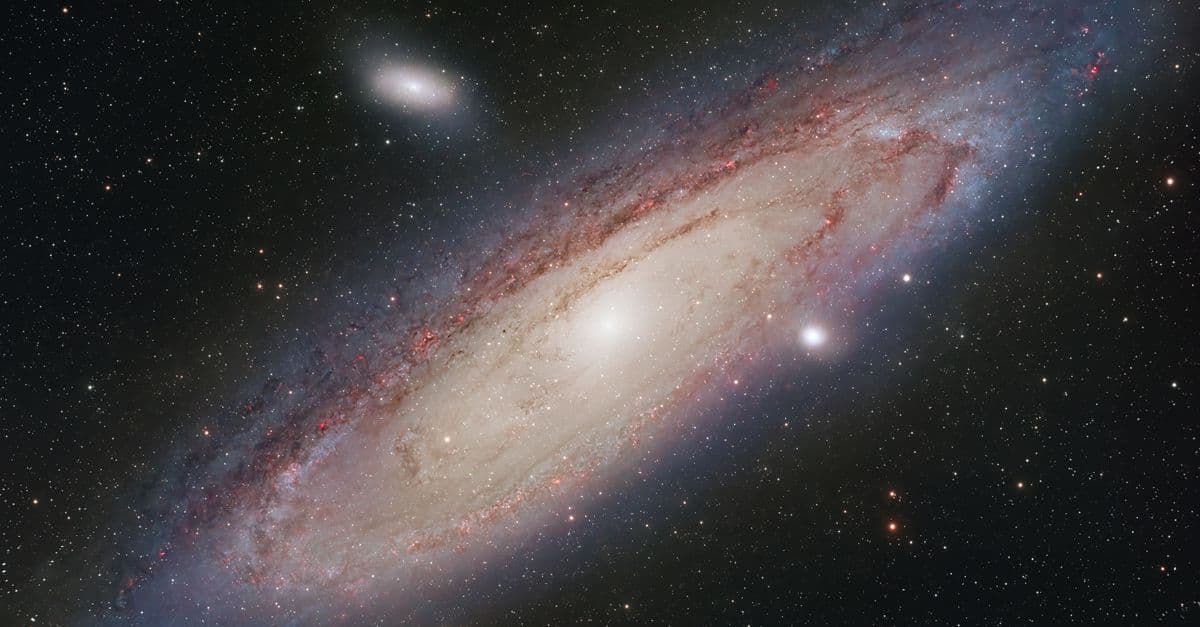
Photo: Alexios Katsarakis / Pexels
Gravitational lensing is the bending of light by the curved spacetime around a massive object, and when that object sits between Earth and a distant galaxy, it can act like a natural telescope, stretching the background galaxy's light into arcs, splitting it into multiple copies, or magnifying it by a factor of thousands. Astronomers using the James Webb Space Telescope now rely on this trick, borrowing the gravity of foreground galaxy clusters to see galaxies and even individual stars from the first billion years of the universe.
What gravitational lensing actually is
Gravitational lensing happens because mass curves the geometry of spacetime, and light traveling through that curved geometry follows a bent path rather than a straight line. Albert Einstein described this consequence of general relativity in 1915, and it remains one of the theory's most visually dramatic and repeatedly confirmed predictions (NASA Science, 2023).
Think of spacetime as a stretched rubber sheet with a bowling ball resting on it. A marble rolled nearby does not travel in a straight line past the ball, it curves around the dent the ball creates. Light behaves the same way around a massive object, except the "dent" is not in a flat sheet but in the four-dimensional fabric of space and time itself, and even a photon with no mass follows that curve.
When the deflecting object, called the lens, lies almost exactly on the line of sight between Earth and a more distant background object, called the source, the bent light paths can reconverge toward Earth from multiple directions at once. The result is not a single, undistorted image of the background galaxy but a warped one: stretched into a crescent, smeared into a long arc, or in cases of near-perfect alignment, wrapped into a complete circle around the lens known as an Einstein ring. The degree of bending depends on the lens's mass and how close the light passes to it, which is why the most striking lensing effects come from the most massive foreground objects: individual stars produce only tiny, brief effects, while entire galaxy clusters, some with a combined mass exceeding a thousand trillion Suns once dark matter is included, can visibly warp the sky around them (NASA Science, "Hubble's Gravitational Lenses," 2023).
The 1919 eclipse that proved light bends
General relativity made a testable prediction: starlight passing near the Sun's edge should be deflected by about 1.75 arcseconds, roughly twice what Newtonian gravity alone would predict. The problem was that the Sun's glare makes nearby stars impossible to see, except during a total solar eclipse, when the Moon blocks the disk and stars near the Sun become briefly visible.
On May 29, 1919, two expeditions led by British astronomer Arthur Eddington, one to the island of Príncipe off West Africa and one to Sobral, Brazil, photographed stars in the Hyades cluster near the eclipsed Sun. When the plates were compared against reference photographs of the same stars taken months earlier, when the Sun was nowhere nearby, the star positions had shifted by an amount consistent with Einstein's prediction rather than the smaller Newtonian one (Dyson, Eddington, and Davidson, Philosophical Transactions of the Royal Society, 1920).
The announcement made global headlines and made Einstein a household name almost overnight, but its scientific significance ran deeper than fame: it was the first empirical demonstration that mass bends the path of light, the foundational physical mechanism behind every gravitational lens astronomers observe today. Every Einstein ring, lensed arc, and magnified early-universe galaxy JWST photographs is, at its core, a much larger and more extreme version of what Eddington measured in two sets of eclipse photographs a century ago.
Why an eclipse was necessary
A total solar eclipse blocks the Sun's overwhelming brightness long enough for faint background stars near its edge to become visible against a darkened sky, which is the only circumstance from Earth's surface where light bending so close to the Sun could be measured with 1919-era instruments. Without the Moon's shadow, the Sun's glare would have completely overwhelmed the faint starlight being measured.
Strong lensing: arcs, rings, and multiple images
Strong gravitational lensing occurs when the alignment between lens and source is close and the lens is massive enough to produce distortions visible in a single image without statistical analysis. It is the most photogenic form of lensing: luminous arcs curving around the edge of a galaxy cluster, near-duplicate images of the same background galaxy appearing at different points around the lens, or full Einstein rings when the alignment is close to perfect.
The galaxy cluster Abell 2218, extensively imaged by the Hubble Space Telescope, is one of the best-known examples, showing dozens of arced and multiply imaged background galaxies distorted by the cluster's combined mass, most of it invisible dark matter rather than the visible stars and gas (NASA Science, 2023). Because the lensing mass is rarely symmetric and rarely perfectly centered on the line of sight, most strong-lensing images are partial arcs rather than complete rings, and the exact shape of the distortion encodes information about how mass is distributed inside the lensing cluster, information astronomers use to build detailed mass maps.
What an Einstein ring is
An Einstein ring is a complete circular image of a background source formed when the lensing mass, the source, and the observer are nearly perfectly aligned along a single line of sight, causing light to bend symmetrically around the lens in every direction at once. True rings are rare because they require almost exact alignment, so most real observations show partial arcs rather than full circles.
Weak lensing: mapping mass you cannot see directly
Weak gravitational lensing produces distortions too subtle to detect in any single background galaxy. Instead of an obvious arc or ring, each galaxy behind a foreground mass concentration gets stretched by a small, statistically measurable amount, a percent-level shift in its apparent shape that only becomes meaningful when averaged across thousands or millions of background galaxies across a wide patch of sky.
This statistical approach makes weak lensing the primary tool cosmologists use to map the distribution of matter, including dark matter, across large volumes of the universe, since the technique traces total gravitational mass regardless of whether that mass emits any light at all (NASA Science, 2023). Surveys built specifically for this purpose, gathering shape measurements of enormous numbers of background galaxies, have produced some of the strongest independent evidence that most of the universe's mass is dark matter rather than ordinary, light-emitting matter, corroborating the same conclusion astronomers reach by measuring how fast stars orbit within individual galaxies, a separate technique explained in how astronomers weigh galaxies.
Microlensing: brightness blips with no visible distortion
Microlensing is a third lensing regime, distinct from both strong and weak lensing, in which the lens is small, typically a single star or planet, and produces no resolvable distortion in the background source's shape at all. Instead, as the lensing object passes almost exactly in front of a background star from Earth's perspective, the background star temporarily and smoothly brightens, then fades back to normal over days to weeks, tracing a distinctive symmetric light curve.
Because the effect depends only on mass and alignment, not on whether the lensing object emits light, microlensing has become a valuable technique for detecting objects that are otherwise invisible or extremely faint: rogue planets not orbiting any star, faint red or brown dwarfs, and even black holes. If the lensing star happens to have a planet, the planet's own gravity can produce a brief secondary blip superimposed on the main brightening curve, which is how astronomers have discovered exoplanets, including some in orbits too wide to detect with the transit or radial-velocity methods used for most confirmed exoplanets.
| Lensing type | Visual effect | What causes it | Primary scientific use |
|---|---|---|---|
| Strong lensing | Arcs, multiple images, Einstein rings | Close alignment with a very massive lens (galaxy or cluster) | Direct imaging of distant, faint background galaxies |
| Weak lensing | Small shape distortion across many background galaxies | Diffuse foreground mass, often dark-matter-dominated | Statistical mapping of dark matter distribution |
| Microlensing | Temporary brightening, no resolved shape change | A single star, planet, or compact object crossing the line of sight | Detecting exoplanets and faint or invisible compact objects |
Three regimes of the same underlying physics, distinguished mainly by the mass and alignment of the foreground lens.
Natural telescopes: how JWST and Hubble use lensing clusters
Massive galaxy clusters positioned between Earth and very distant galaxies act as gravitational magnifying glasses, boosting the apparent brightness and angular size of whatever lies directly behind them. For astronomers hunting the faintest, most distant galaxies in the universe, that magnification is often the difference between detecting an object at all and missing it entirely, since even the largest space telescopes have a hard physical limit on how much light their mirrors can collect.
The clearest demonstration of this technique is Earendel, a star discovered in Hubble Space Telescope images of the Sunrise Arc, a galaxy gravitationally lensed by the cluster WHL0137-08. Earendel sits at a redshift of roughly z = 6.2, corresponding to a lookback time of about 12.9 billion years, meaning its light left the star when the universe was under a billion years old (NASA Science, "Record Broken: Hubble Spots Farthest Star Ever Seen," 2022). Lensing models built from Hubble and later refined with JWST imaging estimate the cluster magnified Earendel's light by a factor of more than 1,000, and by some estimates as high as several thousand, which is what made a single star visible across most of the observable universe's history in the first place (Welch et al., Nature, 2022; Diego et al., IOP Science, 2025).
Without that lensing boost, no telescope currently in operation, including JWST's 6.5-meter primary mirror, could resolve a single star at that distance. JWST has continued imaging the Sunrise Arc and similar strongly lensed fields specifically to exploit this natural magnification, studying early-universe galaxies and stars far fainter than raw telescope aperture alone could ever reach. JWST's own detection capabilities, including how it separates faint infrared light from cosmic background noise, are covered in more detail in how space telescopes see in infrared.
How much can lensing magnify an object
Magnification from strong gravitational lensing varies enormously depending on the mass of the lens and how precisely the background source aligns behind it, but well-studied cases like Earendel show magnification factors in the hundreds to low thousands, occasionally documented above 4,000 in detailed lensing models (Diego et al., IOP Science, 2025). There is no fixed upper limit in principle, since magnification increases sharply as alignment approaches perfect, but extreme magnifications require correspondingly precise, and correspondingly rare, alignments.
What lensing distortion reveals, and what it distorts
Gravitational lensing is not a perfect telescope. It stretches and warps images along with magnifying them, so a lensed galaxy rarely appears as it would through an ordinary, undistorted telescope image; astronomers have to build a lens model, a mathematical reconstruction of exactly how the foreground mass bent the light, before they can reliably interpret the true shape, size, or brightness of the background source. Building that model requires knowing the mass distribution of the lens in detail, which itself depends partly on the very distortions being modeled, a circularity astronomers resolve using multiple lensed images of the same background object, since consistent multiple images place strong constraints on the lens's mass map.
This means that headline magnification numbers, like the factor of more than 1,000 attributed to Earendel, come with real uncertainty. Different research teams building independent lens models of the same cluster sometimes arrive at magnification estimates that differ by a factor of two or more, and that uncertainty propagates into estimates of the background object's true, unlensed brightness and size (Diego et al., IOP Science, 2025). None of this undermines the basic detection, a real, distant, gravitationally lensed source, but it is a genuine limitation astronomers are upfront about when interpreting extreme high-magnification observations.
Lensing also cannot magnify everything equally. Because the effect depends on precise geometric alignment along a single line of sight, only a small patch of sky directly behind any given massive cluster benefits from strong magnification, and most of the distant universe has no convenient foreground lens sitting in exactly the right spot. That is why astronomers deliberately target known massive galaxy clusters, cataloging their mass distributions in advance so they can point JWST and Hubble at the specific coordinates where lensing magnification will be strongest, rather than lensing arcs simply turning up by chance across the whole sky.
Common misconceptions about gravitational lensing
A frequent misunderstanding is that gravitational lensing is a hypothesis still being tested. It is not. Beyond Eddington's 1919 eclipse measurement, gravitational lensing has been confirmed and re-confirmed across nearly every mass scale, from microlensing by individual stars to strong lensing by galaxy clusters to the large-scale statistical patterns weak lensing surveys map across the observable universe (NASA Science, 2023). What remains genuinely uncertain is not whether lensing happens, but the precise mass distributions of individual lenses, which is a measurement problem, not a question about whether the underlying physics is real.
Another common confusion is treating gravitational lensing as equivalent to an ordinary camera zoom. A camera lens magnifies uniformly and predictably; a gravitational lens magnifies unevenly, stretching some parts of an image far more than others depending on exact position relative to the lens's mass concentration, which is why lensed galaxies appear as curved arcs rather than simply larger, undistorted copies of themselves. This uneven stretching is actually useful scientifically, since the specific pattern of distortion encodes the lens's mass distribution, but it does mean a "1,000x magnified" galaxy is not 1,000 times its normal apparent size in every direction, only in the specific combination of directions the lensing geometry favors.
A third misconception conflates gravitational lensing with the completely separate topic of how galaxies' internal mass is measured from the orbital speeds of their own stars and gas. That technique, used to establish that most galaxies contain far more mass than their visible stars account for, relies on orbital dynamics rather than light bending, and is covered separately in how astronomers weigh galaxies. Lensing and orbital-dynamics mass measurements are independent methods that happen to reach the same broad conclusion about dark matter, which is part of why that conclusion is considered so well supported.
The takeaway
Gravitational lensing magnifies distant galaxies because massive foreground objects, mostly galaxy clusters whose gravity is dominated by dark matter, curve spacetime enough to bend and refocus background light much the way a glass lens focuses visible light, a direct and repeatedly confirmed prediction of Einstein's general relativity first tested during the 1919 solar eclipse. That natural magnification, now systematically exploited by Hubble and JWST, has let astronomers detect galaxies and even individual stars like Earendel from over 12 billion years in the past that no telescope could resolve through raw aperture alone. The tradeoff is that lensed images are distorted, not simply enlarged, so every extreme observation built on lensing magnification comes bundled with a modeling uncertainty astronomers have to account for rather than take at face value.
Read next:
- How astronomers weigh galaxies
- How space telescopes see in infrared
- Why Mars lost most of its atmosphere
FAQ
Q: What is gravitational lensing?
Gravitational lensing is the bending of light from a distant object by the curved spacetime of a massive foreground object, such as a galaxy or galaxy cluster, a direct prediction of Einstein's general theory of relativity confirmed observationally in 1919.
Q: How was gravitational lensing first proven?
Arthur Eddington's May 29, 1919 solar eclipse expeditions to Príncipe and Sobral measured the apparent positions of stars near the Sun's edge during totality and found they shifted by an amount matching Einstein's general relativity prediction, roughly twice the shift Newtonian gravity alone would predict.
Q: What is an Einstein ring?
An Einstein ring is a complete circular image of a background galaxy formed when a foreground lensing mass is nearly perfectly aligned with the background source and Earth, causing background light to bend symmetrically all the way around the foreground object.
Q: How does gravitational lensing help find the most distant galaxies?
Massive foreground galaxy clusters can magnify background galaxies and stars by factors of hundreds to thousands, letting telescopes like Hubble and JWST detect objects far fainter and more distant than raw telescope aperture alone could resolve, as with the star Earendel, magnified more than 1,000 times.
Q: What is the difference between strong and weak gravitational lensing?
Strong lensing produces dramatic, individually visible distortions like arcs, multiple images, and Einstein rings, requiring precise alignment with a very massive foreground object. Weak lensing produces subtle distortions detectable only statistically across many background galaxies, used mainly to map dark matter.
Q: Did Einstein believe gravitational lensing would ever be observed?
No. In a 1936 paper in Science, Einstein described the physics of gravitational lensing and the ring effect but wrote that there was "no hope of observing this phenomenon directly" because stars are so far apart, a prediction later disproven as telescopes improved.
Q: What is gravitational microlensing?
Gravitational microlensing is a temporary brightening of a background star caused by a smaller foreground object, such as a star or planet, passing almost exactly along the line of sight, producing no visible image distortion but a measurable, temporary brightness increase used to detect exoplanets and faint compact objects.
Follow new articles
Add SciHub101 to your feed reader to see new science and technology stories.
About the Author
SciHub101 is an independent science and technology publication founded and edited by Buğra Sözeri, a software engineer and app developer based in Türkiye. AI tools assist with drafting and research. Source documentation in the existing archive is uneven, and articles are being reviewed and corrected. The Editorial Team byline identifies editorial responsibility; it does not certify specialist or independent human review. Where we compare products, anything built by our own team is labelled as such — see the editorial guidelines and About page for how corrections and disclosures work.
Related Articles
What Is Gravitational Lensing? How Gravity Bends Light
Gravitational lensing, the deflection of light by mass, was predicted by general relativity and first measured during the 1919 solar eclipse. Strong lensing produces Einstein rings and multiple images, weak lensing maps dark matter statistically, and microlensing reveals planets through brief brightenings of background stars.
Mercury Explained: Iron Core, Polar Ice, Odd Orbit
Mercury has an oversized iron core, ice at its poles, and a day longer than its year. What MESSENGER found and what BepiColombo is due to do in November 2026.