What Is Gravitational Lensing? How Gravity Bends Light
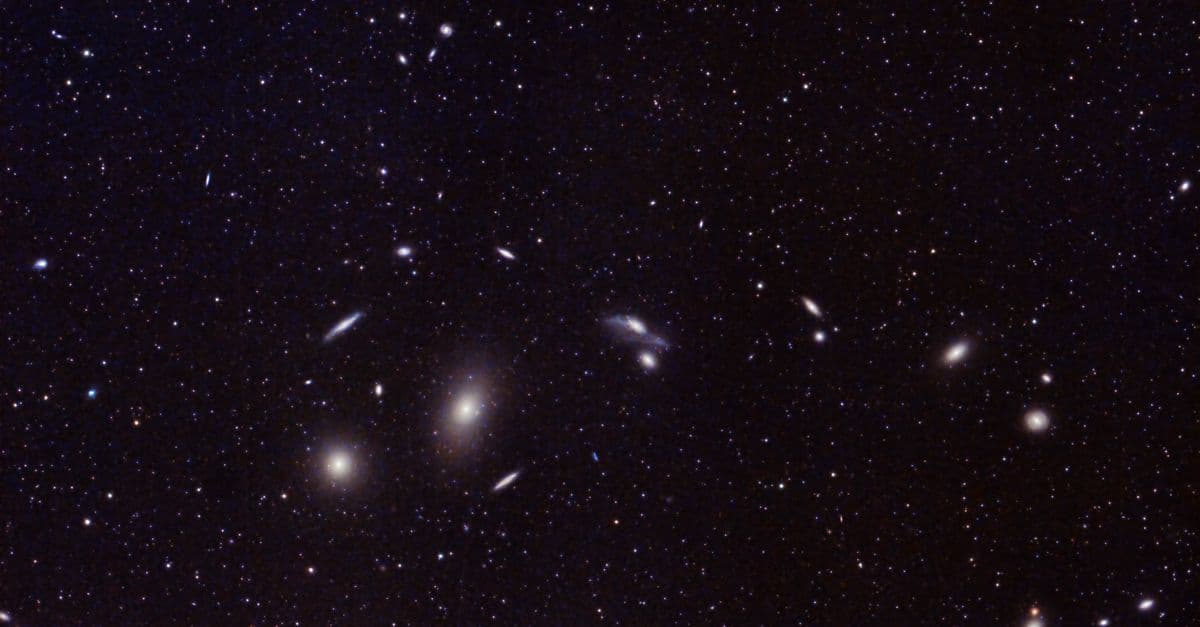
Photo: Luis Felipe Alburquerque Briganti / Pexels
On May 29, 1919, a total solar eclipse darkened the sky over the island of Príncipe, off the coast of West Africa, and British astronomer Arthur Eddington photographed the stars sitting close to the Sun. Their positions had shifted slightly, by an amount that matched general relativity and not Newtonian gravity. That small shift, a bit under two arcseconds at the Sun's edge, was the first measurement of gravitational lensing: the bending of light by mass. A century later the same effect weighs galaxy clusters, maps dark matter, and finds planets.
How gravity bends light
Isaac Newton asked the question first. In his 1704 book Opticks, he wondered whether bodies act on light at a distance and whether starlight might bend near massive objects. In 1804 the German astronomer Johann Georg von Soldner published a calculation of how much a particle of light would be deflected by the Sun, and Einstein rederived essentially the same number in 1911 using only the equivalence principle (the idea that gravity and acceleration are locally indistinguishable). That Newtonian-style value is about 0.83 arcseconds for a ray grazing the Sun.
In 1915 Einstein finished general relativity and found his earlier answer was off by a factor of two. The correct prediction was about 1.75 arcseconds. The reason is geometry. Mass does two things in general relativity: it slows clocks nearby (the "time" part of the curvature) and it stretches the measuring rods of space (the "space" part). Light feels both, and each contributes half of the bending. Newtonian gravity only has the first.
Think of a bowling ball on a trampoline with a marble rolling past. The marble does not feel a force from the ball. It simply follows the straightest available path across a curved surface, and that path bends. Light does the same in curved spacetime, following paths called geodesics (the straightest possible routes through a curved geometry). For more on the spacetime picture, see our explainer on what spacetime is and on how gravity works from Newton to Einstein.
The deflection formula, with a number you can check
For a weak field and a light ray passing a point mass M at distance b (the impact parameter), general relativity gives a deflection angle of
α = 4GM / (b c²)
where G is the gravitational constant and c is the speed of light. Put in the Sun's mass and its radius (about 696,000 km) and the answer is roughly 8.5 millionths of a radian, which is 1.75 arcseconds. For comparison, one arcsecond is the angle a 1 centimeter coin subtends from about two kilometers away.
The formula also explains why lensing is generally a cosmic effect rather than an everyday one. The deflection shrinks as 1/b, so only rays that pass very close to a very massive object bend noticeably. Stars barely bend light from other stars. Galaxies and galaxy clusters, with masses of a trillion to a quadrillion Suns, do.
The solar focal line
Because rays passing the Sun are bent inward, rays at different distances come to a focus at different points along a line extending away from the Sun. Einstein's 1936 calculation put the nearest focus at about 542 astronomical units (AU, where one AU is the Earth-Sun distance, roughly 150 million kilometers). A spacecraft parked out there could in principle use the Sun as a giant lens, which is why the solar gravitational lens keeps appearing in mission concept studies.
What happened in 1919, and how well it held up
Two expeditions went to watch the May 29, 1919 eclipse. Eddington and Edwin Cottingham took the island of Príncipe in the Gulf of Guinea. Andrew Crommelin and Charles Davidson went to Sobral in Ceará, Brazil. Clouds and rain interfered at Príncipe, and Eddington managed 16 photographs. On June 3 he noted that one plate he measured agreed with Einstein.
The results were presented on November 6, 1919, at a joint meeting of the Royal Society and the Royal Astronomical Society, and the newspapers did the rest. Since the 1970s some historians have argued that Eddington leaned on the data he liked. Modern reanalyses suggest his treatment was sound and probably less biased than several later eclipse measurements, and a 1979 remeasurement of the Sobral plates with better equipment supported his result. Radio measurements of quasars passing behind the Sun in the late 1960s then confirmed the full relativistic value without any eclipse at all.
The expedition is covered in more detail in our piece on the 1919 eclipse experiment.
Lensing becomes a research tool
For decades lensing stayed a curiosity, and Einstein himself thought it would never be observed. In 1912 he privately worked out that a star could, in principle, produce multiple images of a more distant one, but he judged the alignment too improbable to ever catch. In 1936 he published the ring effect in Science after being urged to do so by Rudi Mandl. The following year Fritz Zwicky argued that whole galaxies, not stars, would make far better lenses.
| Year | Milestone | Who |
|---|---|---|
| 1784 / 1804 | Newtonian light bending worked out; published in 1804 | Cavendish (unpublished), Soldner |
| 1919 | Deflection measured at a solar eclipse | Eddington, Dyson, Crommelin, and colleagues |
| 1936 | Ring effect published in Science | Einstein |
| 1937 | Galaxies proposed as lenses | Zwicky |
| 1979 | First lens found: the "Twin QSO" SBS 0957+561 | Walsh, Carswell, Weymann |
| 1988 | First Einstein ring (radio, MG 1131+0456) | Hewitt and colleagues |
| 1998 | First complete ring, B1938+666 | King and colleagues |
Timeline items from the Wikipedia history of gravitational lenses and the Einstein ring entry (see Sources).
Strong lensing: arcs, rings, and multiple images
Strong lensing happens when the source, the lens, and the observer line up closely enough that the light splits into several paths. The result can be several separate images of one object, stretched arcs, or a complete ring. A galaxy of more than 100 billion solar masses typically produces image separations of only a few arcseconds. A galaxy cluster produces arcs that can span several arcminutes.
Einstein rings and a worked example
When the alignment is perfect, light from a point source is spread into a ring. The ring's angular radius, the Einstein radius, is
θ_E = √[ (4GM / c²) × D_LS / (D_L × D_S) ]
where D_L is the angular diameter distance (a distance defined by apparent size) to the lens, D_S to the source, and D_LS between the two. On cosmological scales D_LS is not simply D_S minus D_L, because space expands while the light travels.
Here is a rough example. Take a lens of one trillion solar masses. The combination 4GM/c² works out to about 0.19 parsecs. Put the lens at 1 gigaparsec and the source at 2 gigaparsecs, using simplified distances with D_LS of 1 gigaparsec. The Einstein radius comes out near 10 millionths of a radian, which is about 2 arcseconds. That is why galaxy lenses produce rings and arcs that Hubble and the Euclid space telescope can resolve but that the naked eye never could.
Real rings are less tidy. The first one, MG 1131+0456, was found at radio wavelengths by Hewitt and colleagues in 1988, with a lensed quasar smeared into a nearly complete ring. The first complete ring, B1938+666, followed in 1998. Optical examples include the Cosmic Horseshoe, a partial ring around the luminous red galaxy LRG 3-757 discovered in 2007. In 2023 JWST imaged the high-redshift galaxy SPT0418-47 as a nearly perfect ring, and in February 2025 Euclid photographed a near-perfect ring around the galaxy NGC 6505, about 590 million light-years away, bending light from a galaxy roughly 4.42 billion light-years away.
Strong-lens numbers are climbing fast. Early in its survey the Euclid team found about 500 strong-lens candidates in just 0.45% of the survey area, and the mission is expected to turn up about 100,000 over its six-year survey. Rubin Observatory is expected to find 62,000 to 120,000 galaxy-scale lenses over ten years, and Roman about 160,000.
Multiple images, crosses, and clusters as telescopes
More often the alignment is imperfect. A foreground galaxy can produce two images of a background quasar (the most common outcome) or four, arranged in a cross or a diamond. A cluster of galaxies can stretch a background galaxy into long glowing arcs curving around the cluster's center. Clusters are discussed in more detail in our overview of galaxy clusters.
Clusters also work as cosmic telescopes. The lens magnifies a background object by gathering and concentrating its light, so objects too faint to see directly become visible. This is the idea behind Hubble's Frontier Fields program, which pointed deep exposures at massive clusters to look for faint galaxies behind them. The details of that technique are in our article on how gravitational lensing magnifies galaxies.
Earendel: a case study in magnification and caution
In March 2022 astronomers reported WHL0137-LS, nicknamed Earendel, at redshift 6.2 ± 0.1. Its light left about 900 million years after the Big Bang and traveled about 12.9 billion years to reach us. Early lens models suggested the cluster WHL0137-08 magnified it by factors of 1,000 to 40,000, which is why a single star at that distance could be seen at all.
The picture has since become messier, which is the normal course of science. In August 2023 NASA reported JWST colors that pointed to a massive B-type star more than twice as hot as the Sun and about a million times more luminous, with hints of a cooler, redder companion. A 2025 spectroscopic analysis suggested Earendel is most likely a star cluster, specifically a metal-poor globular cluster progenitor, though a single star is not excluded. A separate 2025 study estimates a much smaller magnification of about 43 to 67. If it is a star, it is the most distant one known. If it is a cluster, it is still a remarkable look at an early galaxy's building blocks.
Time delays and the Hubble constant
When a quasar is lensed into several images, the light for each image takes a different path. Paths differ in length and cross different depths of the lens's gravitational potential, so the images arrive at different times, with delays from days to months. Quasars flicker, so astronomers watch each image over years and match the flickers up. The measured delay depends on the lens geometry and on the Hubble constant H₀, the present-day expansion rate of the universe.
The technique, called time-delay cosmography, is independent of both the cosmic microwave background and the supernova distance ladder. That makes it a useful tiebreaker in the "Hubble tension," the disagreement between early-universe and late-universe measurements of H₀.
| Project | Result | Sample | Notes |
|---|---|---|---|
| H0LiCOW (Wong et al., 2019) | H₀ = 73.3 +1.7/−1.8 km/s/Mpc | 6 lensed quasars | 2.4% precision; 3.1σ tension with Planck CMB value |
| TDCOSMO 2025 | H₀ = 71.6 +3.9/−3.3 km/s/Mpc | 8 lensed quasars with time delays, plus 15 lenses without | Flat ΛCDM, combined with Pantheon+ supernovae |
H0LiCOW's six-lens result sat close to the distance-ladder value near 73 and far from the Planck CMB value of 67.4 ± 0.5. The 2025 TDCOSMO analysis used a larger sample and more careful lens modeling, and its error bars are wider. With a central value of 71.6 and an uncertainty of about 3 to 4 units, it overlaps both camps rather than choosing one. The authors report the inference is consistent across the cosmological models they tested. A fair reading is that lensing time delays have not yet broken the tension, and that mass modeling of the lens galaxy is the limiting factor.
Lens modeling itself is a statistical puzzle. Astronomers fit the lens mass with ellipsoidal profiles plus external shear from neighboring structure, then test the fit against the image positions. Neural networks trained on simulated lenses are starting to speed this up for the very large catalogs coming from Euclid and Rubin, though their results still need checking against traditional fits.
Weak lensing: mapping what we cannot see
Weak lensing is the quiet cousin of strong lensing. No arcs or rings appear. Instead, every background galaxy is nudged slightly, and the pattern of nudges across thousands of galaxies reveals the mass in front of them. A cluster distorts background sources by around 10%. Galaxy-galaxy lensing gives shear of about 1%, and the large-scale cosmic shear signal is only about 0.1% to 1%.
The difficulty is that galaxies are not round to begin with. A typical galaxy's intrinsic ellipticity is 3 to 300 times larger than the shear you want to measure. The solution is statistics. Intrinsic shapes point in random directions and cancel out when averaged, while lensing shapes them coherently. It resembles trying to see wind direction by watching a field of wheat: one stalk tells you little, but a million all leaning the same way tells you plenty.
Cosmic shear and dark matter maps
Cosmic shear is weak lensing by the whole cosmic web, the filaments and clumps of matter that fill the universe. The first detections were published in 2000 by four independent groups. Cosmic shear measures how mass is distributed along the line of sight, which constrains Ω_m (how much of the universe is matter) and σ₈ (how clumpy the matter is). It is one of the main tests of the standard ΛCDM model. For context on the structure being probed, see the cosmic web and our explainer on dark matter in 2026.
Because lensing responds to all mass, whether it glows or not, it can show where dark matter sits. This is one of the few direct ways to weigh the invisible. It also relates to the techniques covered in how astronomers weigh galaxies.
The S₈ tension: a story that has been revised
Weak lensing surveys report a combined parameter S₈ = σ₈ (Ω_m / 0.3)^0.5. For several years, results from the Dark Energy Survey, the Kilo-Degree Survey (KiDS), and Hyper Suprime-Cam seemed to give lower values than the CMB predicts, a gap of roughly 2 to 3σ that people called the S₈ tension.
The latest data have not made that gap larger. DES Year 3, covering 5,000 square degrees and about 100 million source galaxies, reported S₈ = 0.776 ± 0.017 from combined galaxy clustering and weak lensing, and the authors described it as consistent with the model favored by Planck 2018 (probability-to-exceed between 0.13 and 0.48). In 2025 the KiDS-Legacy team, using 1,347 square degrees of deep nine-band imaging, measured S₈ = 0.815 +0.016/−0.021 from cosmic shear, which agrees with Planck at 0.73σ. The Planck 2018 parameters (σ₈ = 0.811, Ω_m = 0.315) correspond to S₈ of roughly 0.83. In other words, the weak-lensing tension has shrunk considerably in the newest analysis, while the Hubble tension remains open.
| Survey | S₈ result | Area / sample | Agreement with Planck |
|---|---|---|---|
| DES Year 3 (3×2pt) | 0.776 ± 0.017 | 5,000 deg², about 100 million source galaxies | Consistent (p = 0.13 to 0.48) |
| KiDS-Legacy (cosmic shear) | 0.815 +0.016/−0.021 | 1,347 deg² | Agrees at 0.73σ |
The survey generation now running
Euclid, the European Space Agency's mission launched on July 1, 2023, has a 1.2 meter mirror and observes from a halo orbit around the Sun-Earth L2 point. Over its nominal mission it will image about 15,000 square degrees, roughly a third of the sky, with about one billion galaxies used for weak lensing. Its first cosmology data release (DR1-Foundation) is planned for November 12, 2026.
The Vera C. Rubin Observatory began its 10-year Legacy Survey of Space and Time (LSST) in June 2026, and will revisit each patch of sky about 800 times. The Nancy Grace Roman Space Telescope launched on August 30, 2026 on a Falcon Heavy and is in its 90-day commissioning phase, with arrival at L2 expected in early December. Its 2.4 meter mirror and wide-field camera will add a third large dataset for lensing and microlensing.
The Bullet Cluster: lensing as evidence for dark matter
The Bullet Cluster (1E 0657-558) is a famous natural experiment. It consists of two galaxy clusters that collided at a speed of about 4,500 km/s according to the original analyses, though a more recent study suggests a lower speed near 3,950 km/s. It lies at redshift about 0.296, around 3.7 billion light-years away, and the smaller cluster passed through the center of the larger about 150 million years ago, leaving a bow shock.
In the collision the galaxies, which are mostly stars, passed through each other with little interaction. The hot gas, which holds most of the ordinary matter, collided electromagnetically, slowed down, and stayed near the center. Weak-lensing maps show that most of the mass tracks the galaxies, not the gas. Clowe and colleagues reported the offset between the lensing mass and the X-ray gas at 8σ in a 2006 paper titled "A Direct Empirical Proof of the Existence of Dark Matter."
The result is strong evidence, but it is not the whole of the debate. Angus and colleagues showed in 2006 that MOND (Modified Newtonian Dynamics, a proposal to change gravity at low accelerations instead of adding dark matter) can reproduce the offset in this non-spherical system, though MOND still leaves unexplained mass in several core regions. The simplest reading remains that collisionless dark matter passed through the collision like the galaxies did. Other mergers such as MACS J0025.4-1222 show similar separations.
Microlensing: when a star briefly brightens
Microlensing is lensing with the images too small to separate. When a star or planet drifts almost exactly in front of a more distant star, the background star brightens and fades over days or weeks, without changing color. The shape of the light curve was worked out by Bohdan Paczyński, who in 1986 proposed watching stars in a nearby galaxy for the brightening caused by dark compact objects in our own halo.
For a point lens, the magnification depends on the source-lens separation u, measured in units of the Einstein radius:
μ = (u² + 2) / (u √(u² + 4))
| Separation u | Magnification μ |
|---|---|
| 2.0 | 1.06 |
| 1.0 | 1.34 |
| 0.5 | 2.18 |
| 0.1 | 10.0 |
| 0.01 | 100 |
At u = 1 the source is at the Einstein radius and the brightening is about 34%, which is where astronomers conventionally start counting an event. If the alignment is very good, the peak can be tens of times brighter than normal. The event's timescale depends on the lens mass, distance, and speed all at once, which is why a single event cannot give each quantity separately.
Did dark matter turn out to be compact objects?
If dark matter were made of compact objects, called MACHOs, microlensing surveys aimed at the Large Magellanic Cloud should have seen many events. The MACHO project's data argued against a halo made entirely of such objects, though it found an unexplained excess equal to about 20% of the halo mass. The later EROS survey set tighter upper limits. Whether any remaining excess reflects dark matter at all is still uncertain. Today's consensus, covered in more depth in dark matter and dark energy explained, is that dark matter is not mostly made of dim stars, brown dwarfs, or planets.
Finding planets with a lens
Microlensing has an unusual strength in the planet hunt. When the lensing star has a planet, the planet adds a short spike or dip, lasting hours to a day or two, on top of the star's smooth brightening curve. Because the effect depends on gravity and not on light, it works for planets orbiting faint, dim, and very distant stars, and for planets that orbit far from their stars, near the snow line, where transit and radial-velocity methods struggle. A comparison with those methods appears in our overview of how we find exoplanets.
| Fact | Value | Source note |
|---|---|---|
| Planets found by microlensing | 89 as of April 2020 (the count has grown since) | Wikipedia, citing exoplanet catalogs |
| OGLE-2005-BLG-390Lb | About 5.5 Earth masses (factor-of-two uncertainty); announced January 2006 | Probably the lowest-mass known planet around a regular star at that time |
| Earth-mass free-floating planet | Reported September 2020 by Mróz and colleagues | Not bound to any star |
The trade-off is that microlensing events never repeat. Once the alignment is over, nothing more can be measured, so astronomers rarely get a second look at the planet. Follow-up often means detecting the lens star's light years later, after it has drifted away from the source.
Free-floating planets
Because microlensing responds to mass and not to light, it is also one of the only ways to find planets with no star at all. These are the rogue planets that drift through the galaxy after being ejected from their home systems. The event duration scales with the square root of the lens mass. A typical stellar lens produces an event lasting a few weeks, so an Earth-mass lens, which is about 330,000 times lighter than the Sun, produces one lasting around an hour. Short events like that are the signature astronomers look for.
Roman's microlensing census is designed to find bound planets down to a few Moon masses and free-floating planets down to roughly the mass of Mars. That is a deeper reach than current ground-based surveys such as OGLE, MOA, and KMTNet.
Lensing by black holes
Near a black hole, lensing gets extreme. The photon sphere is the radius at which light can orbit the hole. For a non-spinning (Schwarzschild) black hole it sits at 1.5 times the Schwarzschild radius, where R_s = 2GM/c². Rays arriving just outside it can loop around once or more before escaping, which builds a bright ring of light.
The Event Horizon Telescope images of M87* and Sagittarius A* show this effect: a bright ring around a central dark region called the shadow. For a non-spinning black hole the shadow's diameter is about 5.2 R_s. The shadow is larger than the horizon itself because the hole captures rays that would otherwise pass nearby. Our overview of the first image of a black hole covers the imaging work in more detail.
Spin changes the picture slightly. A rapidly rotating black hole should show a shadow that is flattened on one side. Higher-order photon rings, from light that orbits two or three times, should form thinner and fainter rings just inside the main one. Resolving them would test general relativity in the strongest gravity we can probe, and that is a primary aim of proposed upgrades to the Event Horizon Telescope.
What lensing can and cannot do
Lensing is useful because it responds to total mass, but it has limits worth knowing.
| Strength | Limit |
|---|---|
| Measures total mass, dark and ordinary, with no assumption about how it is distributed | Measures projected mass along the line of sight, not the 3D distribution |
| Needs no assumptions about gas temperature or dynamical equilibrium | Mass-sheet degeneracy: a uniform sheet of mass can mimic or hide part of the signal |
| Magnifies sources too faint to see otherwise | Magnification uncertainty propagates into the measured brightness and size of the source |
| Independent of the distance ladder and the CMB for H₀ | Lens-galaxy mass modeling dominates the error budget |
| Works at any wavelength | Weak lensing is sensitive to photometric-redshift errors and intrinsic alignments of galaxies |
The photometric redshift problem is worth a note. Weak lensing needs to know which galaxies are behind a lens and which are in front or part of it. Spectra are too expensive for billions of galaxies, so surveys estimate distances from colors, and small biases in those estimates can shift the cosmological results. Intrinsic alignment, the tendency of nearby galaxies to align with each other because of shared tidal fields and not because of lensing, is a second source of systematic error.
Why the 1919 result still matters
Every use of lensing described above rests on the same equation that Eddington tested with a handful of photographs. If general relativity were wrong about light bending, the mass maps, the Hubble constant from time delays, and the Bullet Cluster evidence would all need to be re-derived. That is why astronomers also run the logic backward, comparing masses from lensing with masses from stellar motions or hot gas. So far they agree where the systematics are understood.
The picture that emerges is a technique that matured in layers. Eclipse measurements established the effect. Radio and optical surveys in the 1970s through 1990s found strong lenses. Wide-field cameras turned weak lensing into a precision probe in the 2000s. Space telescopes and Rubin are now building catalogs of lenses numbering in the tens or hundreds of thousands, which will make previously rare configurations routine.
Frequently asked questions
Q: What is gravitational lensing in simple terms? A: Gravitational lensing is the bending of light as it passes a massive object. The mass curves spacetime, and light follows the curved path, so background objects appear shifted, magnified, stretched into arcs, or split into multiple images.
Q: Did Einstein or Newton predict that gravity bends light? A: Both frameworks predict bending, but by different amounts. A Newtonian-style calculation, published by Soldner in 1804 and matched by Einstein in 1911, gives about 0.83 arcseconds at the Sun's edge. General relativity gives about 1.75 arcseconds, and the 1919 eclipse observations favored the larger value.
Q: What is the difference between strong, weak, and microlensing? A: Strong lensing produces visible arcs, rings, or multiple images. Weak lensing slightly distorts many background galaxies and is measured statistically. Microlensing is the temporary brightening of a background star as a closer object passes in front of it, with no separately visible images.
Q: How does lensing prove dark matter exists? A: In the Bullet Cluster, lensing maps show most of the mass tracking the galaxies and sitting away from the hot gas that holds most of the ordinary matter. Clowe and colleagues measured that offset at 8σ in 2006. Modified-gravity models can partly reproduce the offset, so it counts as strong evidence rather than a closed case.
Q: Can gravitational lensing measure the expansion rate of the universe? A: Yes. Time delays between the images of a lensed quasar depend on the Hubble constant. H0LiCOW measured 73.3 +1.7/−1.8 km/s/Mpc from six lenses, and TDCOSMO 2025 found 71.6 +3.9/−3.3 km/s/Mpc from eight lenses with time delays, so the method has not yet resolved the Hubble tension.
Q: How does microlensing find planets? A: A planet orbiting the lensing star adds a short spike to the star's brightening curve, lasting hours to days. The shape of the spike gives the planet-to-star mass ratio. About 89 planets had been found this way as of April 2020, including OGLE-2005-BLG-390Lb at roughly 5.5 Earth masses.
Q: What is an Einstein ring? A: An Einstein ring is a ring-shaped image formed when a background source, a massive lens, and the observer line up almost perfectly. Its angular radius depends on the lens mass and the distances involved. Galaxy-scale rings are typically about an arcsecond across, though cluster arcs can be far larger.
The takeaway
Gravitational lensing turns a prediction that looked unmeasurable in 1912 into one of astronomy's main instruments. The physics has not changed since Einstein's 1915 correction: mass curves space, and light follows. What changed is the scale of the data. Euclid, Rubin, and Roman are producing lens catalogs thousands of times larger than anything available a decade ago, and the questions have shifted from "does it happen" to "how tightly can we measure it." The open problems, the Hubble tension and the exact nature of dark matter, are exactly the ones where lensing provides a check that does not depend on the other methods.
Sources
- Gravitational lens, Wikipedia (history, types, formulas, survey expectations)
- Eddington experiment, Wikipedia
- Einstein ring, Wikipedia
- Bullet Cluster, Wikipedia
- Earendel (star), Wikipedia
- Gravitational microlensing, Wikipedia
- Weak gravitational lensing, Wikipedia
- Wong et al., H0LiCOW XIII (arXiv:1907.04869)
- TDCOSMO 2025: Cosmological constraints from strong lensing time delays (arXiv:2506.03023)
- KiDS-Legacy: Cosmological constraints from cosmic shear (arXiv:2503.19441)
- Dark Energy Survey Year 3 Results (arXiv:2105.13549)
- Euclid (spacecraft), Wikipedia
- Nancy Grace Roman Space Telescope, Wikipedia
- Rubin Observatory: Legacy Survey of Space and Time
Follow new articles
Add SciHub101 to your feed reader to see new science and technology stories.
About the Author
SciHub101 is an independent science and technology publication founded and edited by Buğra Sözeri, a software engineer and app developer based in Türkiye. AI tools assist with drafting and research. Source documentation in the existing archive is uneven, and articles are being reviewed and corrected. The Editorial Team byline identifies editorial responsibility; it does not certify specialist or independent human review. Where we compare products, anything built by our own team is labelled as such — see the editorial guidelines and About page for how corrections and disclosures work.
Related Articles
How Do Planetary Magnetic Fields Work? Earth, Jupiter, and Beyond
Planetary magnetic fields are made by dynamos: electrically conducting fluid, stirred by heat and rotation, that regenerates its own field. Earth's runs in liquid iron, Jupiter's in metallic hydrogen, and Uranus and Neptune's in shallower layers that give them tilted, off-center fields. Mars lost its global field billions of years ago.
What Is a Gamma-Ray Burst? The Brightest Explosions in the Universe
Gamma-ray bursts are flashes of gamma rays from collapsing massive stars and merging neutron stars. Learn how they work, how astronomers catch them, and why the brightest one on record, GRB 221009A, still puzzles researchers.
Dark Matter in 2026: Evidence, Candidates, and Current Theories
A complete primer on dark matter — Vera Rubin's galaxy rotation curves, gravitational lensing, CMB, WIMP and axion candidates, what experiments have ruled out, the MOND debate, primordial black holes, and where the science stands in 2026.
Dark Matter and Dark Energy Explained
What is dark matter and dark energy? Discover the invisible forces shaping 95% of the universe — from galaxy rotation curves to the accelerating cosmos.