The Cosmic Web: The Largest Structure in the Universe
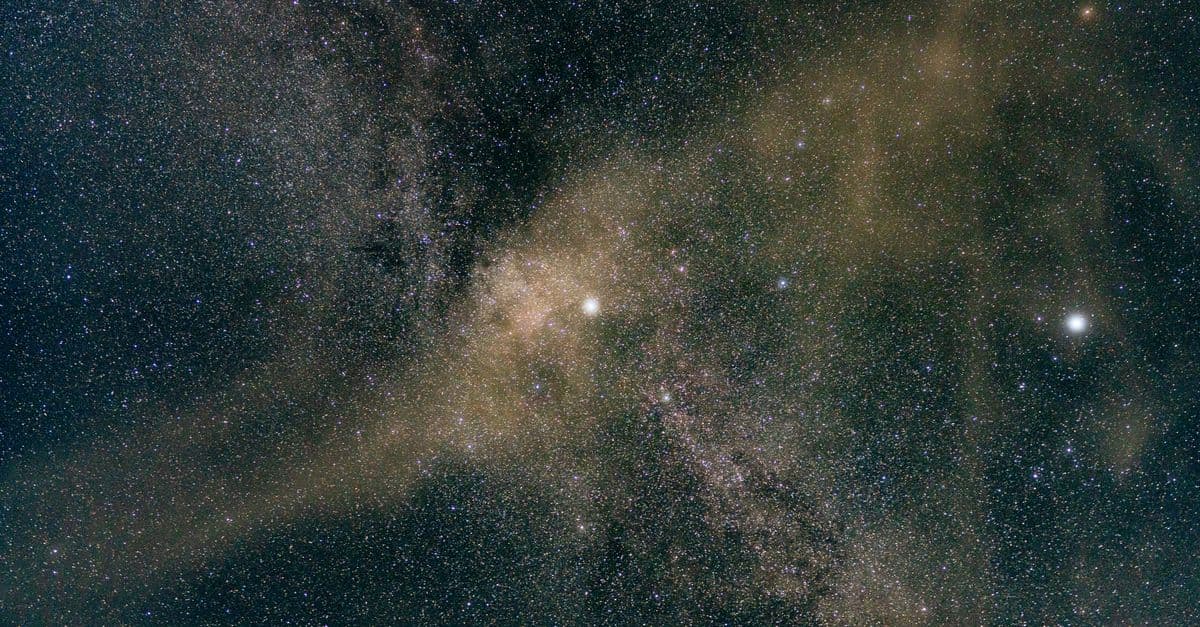
Photo: _mamadvali / Pexels
The cosmic web is the largest pattern in the universe: a three-dimensional network of galaxy filaments, flat walls, dense clusters, and nearly empty voids that stretches across hundreds of millions of light-years. Galaxies are not scattered at random. Gravity has been gathering them along strands since roughly 375,000 years after the Big Bang, guided mostly by dark matter. This article explains how that web formed, how astronomers mapped it with redshift surveys, what it is made of, and which parts of the picture are still contested.
Key takeaways
- The cosmic web has four parts: filaments (long strands of galaxies), nodes (galaxy clusters where filaments meet), walls (sheet-like concentrations), and voids (vast underdense regions).
- It grew from density differences of only a few parts in 100,000 in the early universe. Gravity amplified them over about 13.8 billion years.
- Dark matter supplies the scaffolding. Ordinary gas falls into the dark matter's gravitational wells and traces the same pattern.
- Above a scale of roughly 100 megaparsecs (about 330 million light-years) the universe averages out to near uniformity, so the web is a structure of the large scales, not of the largest ones.
- A 2025 analysis of fast radio bursts put about 76% of the universe's ordinary matter in the diffuse gas between galaxies, most of it in the web.
What the cosmic web looks like, from clusters to voids
At scales below about 10 million light-years the universe looks lumpy in the way you would expect. Stars gather into galaxies, and galaxies gather into groups held together by gravity. The Local Group, which contains the Milky Way and the Andromeda galaxy, spans about 10 million light-years. Nothing about this scale suggests a grand design.
Zoom out a few hundred million light-years and a pattern appears. Astronomers describe it with four building blocks.
- Nodes. Where several filaments meet, matter piles up into galaxy clusters, which hold hundreds to thousands of galaxies, a great deal of hot gas, and a deep dark matter halo (the extended cloud of dark matter surrounding a structure).
- Filaments. Long, thin strands of galaxies and gas that run between nodes. Most of the web's galaxies sit in or near them.
- Walls. Flatter sheets of galaxies, sometimes called sheets or pancakes. The best-known examples are the Great Walls discussed below.
- Voids. The spaces between. A void is not empty, since it holds some galaxies and thin gas, but its density sits far below the cosmic average. Voids take up most of the volume of the universe even though they hold a minority of the mass.
The easiest way to picture this is soap foam. The bubbles are voids. The thin films between neighboring bubbles are walls. The edges where three films meet are filaments, and the corners where several edges meet are nodes. The analogy has limits, because real voids are not sealed spheres and the web's strands are fuzzy, but it captures the connected, foam-like geometry that no scatter of random points would produce.
The next table lays out the scale ladder, with the caveat that some of these structures are defined by convention rather than by sharp edges.
| Structure | Approximate size | Notes |
|---|---|---|
| Local Group | About 10 million light-years | Milky Way, Andromeda, and dozens of smaller galaxies |
| Laniakea Supercluster | About 400 million light-years | Defined in 2014 by galaxy velocity flows; contains about 10¹⁷ solar masses |
| CfA2 Great Wall | At least 500 million light-years long | Reported around 1989 by Margaret Geller and John Huchra |
| Sloan Great Wall | 1.37 billion light-years | Reported in 2003 and published in 2005 from Sloan Digital Sky Survey data |
| Giant Arc | About 1 gigaparsec (about 3.3 billion light-years) | Reported in 2022 from quasar absorption lines at redshift near 0.8 |
| Hercules-Corona Borealis Great Wall | Claimed roughly 10 billion light-years | Proposed in 2013 from gamma-ray burst positions; its reality is disputed |
Sources for the table: Tully and colleagues on Laniakea, Gott and colleagues on the Sloan Great Wall, Lopez and colleagues on the Giant Arc, and the Great Wall entries on Wikipedia.
Where the seeds came from: the early universe
The web did not exist in the early universe. About 375,000 years after the Big Bang, according to NASA's WMAP mission, matter and light decoupled, and the universe became transparent. The light released then is the cosmic microwave background (CMB), the faint afterglow of the Big Bang that you can read more about in our explainer on the cosmic microwave background. It is strikingly smooth. NASA's example puts the temperature at 2.7251 kelvin in one patch of sky and 2.7249 kelvin in another, a difference of about 0.0002 kelvin out of 2.725.
Those minute differences mark places where the early universe was very slightly denser than average. The leading explanation is that they began as quantum fluctuations (random, tiny variations in energy that are a basic feature of quantum physics) during a brief burst of rapid expansion called inflation, which stretched them to astronomical size. That origin story is a model, not something observed directly, but the pattern of the CMB fluctuations matches what it predicts.
A slightly overdense region pulls in a little more matter than its surroundings. A slightly underdense region loses matter to its neighbors. The effect starts as nothing visible and compounds for billions of years. A useful comparison is rain on rolling ground: water does not fall evenly into the final streams and lakes, but the landscape gathers it into them anyway. Gravity does the same with matter, except that the "landscape" is the pattern of density left over from the early universe.
How gravity weaves filaments out of a smooth start
The idea that structure should look stringy is older than the observations that confirmed it. In 1970 the Soviet physicist Yakov Zel'dovich showed that when a smooth cloud of matter collapses under gravity, it flattens into sheets first rather than shrinking into balls. Later theoretical work refined the picture. In 1996 J. Richard Bond, Lev Kofman, and Dmitry Pogosyan argued in Nature that the web's blueprint is already present in the initial density pattern, and that nonlinear gravity mostly sharpens it. In their words, the final web is "present in embryonic form" in the early overdensity pattern. The strongest filaments form between nearby clusters whose tidal fields (the stretching forces produced by uneven gravity) are nearly aligned.
In practice, the build-up goes roughly in this order:
- Dark matter clumps first. Dark matter neither emits nor absorbs light, so it feels only gravity. Ordinary matter, by contrast, was coupled to radiation for the first 375,000 years and could not collapse as freely.
- Matter flows along the steepest directions. Because gravity stretches regions unevenly, collapse is lopsided: it proceeds fastest along one axis, producing flat sheets.
- Sheets collapse along a second axis, producing filaments.
- Filaments drain into their ends, where the matter piles into compact nodes. These are the galaxy clusters.
- Mergers continue. Small structures form early and merge into larger ones over billions of years, the pattern called hierarchical structure formation.
Gas follows the dark matter into these gravitational wells. It heats up as it falls, and some of it cools enough to form stars, which is why galaxies appear along the strands.
Computer simulations test this story. The Virgo Consortium's Millennium Run, carried out in 2005, followed about 10 billion particles of dark matter in a cube roughly 2 billion light-years across. It ran for more than a month on a supercomputer in Garching, Germany. Starting from the CMB fluctuations and including only gravity, dark matter, and dark energy, such runs produce a web that closely resembles the galaxy surveys. This agreement is among the strongest supports for the standard cosmological model, ΛCDM (Lambda cold dark matter), the framework in which dark energy and cold dark matter dominate the universe's contents. For more on the first half of that name, see our explainer on dark matter and dark energy.
How astronomers mapped it
A galaxy's position on the sky is easy to record. Its distance is hard. The standard shortcut is the redshift, the stretching of the galaxy's light caused by cosmic expansion, which increases with distance. By measuring the redshift of thousands of galaxies in a slice of sky, astronomers turn a flat picture into a three-dimensional map.
The first such slices were made at the Harvard-Smithsonian Center for Astrophysics (CfA). A slice published in 1986 showed galaxies arranged along arcs surrounding empty bubbles, which was a surprise to a field that had expected something smoother. The CfA2 Great Wall, a sheet at least 500 million light-years long, followed around 1989. Each later survey sampled more of the sky and reached greater depth.
| Survey | What it did | Key number |
|---|---|---|
| CfA Redshift Survey | First slices showing bubbles and the Great Wall (mid-1980s to 1989) | Galaxies in thin slices of nearby sky |
| 2dF Galaxy Redshift Survey | Mapped two strips and fields of sky using the Anglo-Australian Telescope | 221,414 reliable redshifts over about 1,500 square degrees |
| Sloan Digital Sky Survey | Large-area imaging and spectroscopy | Source of the Sloan Great Wall, reported in 2003 |
| WiggleZ | Mapped distant, star-forming galaxies | Used to measure where the universe becomes homogeneous |
| DESI (Dark Energy Spectroscopic Instrument) | Spectroscopy on the Mayall 4-meter telescope at Kitt Peak | More than 47 million galaxies and quasars observed as of April 15, 2026 |
| Euclid (ESA) | Space-based imaging and spectroscopy, launched July 1, 2023 | Will cover over a third of the sky |
DESI is worth a closer look because it shows how much the field has grown. Its first data release (DR1) contained 18.7 million objects with measured redshifts, including 13.1 million galaxies and 1.6 million quasars. The collaboration says it has completed its originally planned five-year survey, which had a target of 34 million galaxies and quasars, and observations continue. These maps were designed mainly to measure dark energy, but they are also the finest record of the web available. Redshift maps carry one distortion that can mislead. A galaxy's redshift reflects both cosmic expansion and its own motion. Inside a cluster, galaxies move randomly at high speed, which stretches the cluster along the line of sight into a pointing "finger of God" in the map. Infalling galaxies around a cluster do the opposite and look squashed. Astronomers model and correct these effects before drawing conclusions about the web's geometry.
What the web is made of: dark matter, gas, and galaxies
By mass, most of the matter in the web is dark. The Planck satellite's 2018 results give the total matter density as 0.315 of the critical density, with an uncertainty of 0.007 (Planck Collaboration, arXiv:1807.06209). A 2025 estimate of the total baryon density (ordinary matter made of protons and neutrons) is 0.051, so ordinary matter accounts for roughly one-sixth of all matter, and dark matter makes up the other five-sixths. To learn what dark matter might be and how researchers hunt for it, see our explainers on dark matter in 2026 and dark matter detection experiments.
The galaxies you see in a survey are the brightest small fraction of the ordinary matter. Most ordinary matter sits in thin, ionized gas that is hard to detect. The part inside filaments is the warm-hot intergalactic medium (WHIM), with temperatures commonly quoted between about 100,000 and 10 million kelvin. That is too hot to glow in visible light, and too thin to show up easily in X-rays.
For decades this created the missing baryon problem: models predicted more ordinary matter than telescopes could find. Fast radio bursts (brief, intense radio flashes from distant galaxies) offer a way to weigh the gas, because the radio signal is slowed and spread out by every free electron it passes through. A 2025 study led by Liam Connor used a large sample of localized bursts to divide the universe's baryons among the intergalactic medium, galaxy clusters, and galaxies. It found that about 76% of baryons sit in the intergalactic medium, with an uncertainty of roughly 10 percentage points (Connor and colleagues, arXiv:2409.16952). The authors also read their result as evidence that feedback from galaxies is strong enough to push gas out of galactic halos and into the web. Our explainer on fast radio bursts covers what these flashes are.
Astronomers have also begun to see filaments more directly. According to the Wikipedia summary of the field, observers reported light from the brightest part of the web, illuminated by forming galaxies, in 2019. In 2021, observations with the MUSE instrument reported diffuse hydrogen emission (Lyman-alpha light) tracing filaments over scales of 2.5 to 4 comoving megaparsecs. These are faint signals, and each detection is a laboratory for how gas moves along the web.
Why voids matter
Voids can look like the dull part of the picture, but they carry information that clusters do not. The best-known example is the Boötes Void, found in 1981 by Robert Kirshner and colleagues during a redshift survey. A survey of a region of that size would normally turn up about 2,000 galaxies, but only about 60 were found. Its radius is commonly quoted as about 62 megaparsecs (nearly 200 million light-years), though sources differ on how to draw the edge, and popular accounts often give a smaller figure such as 330 million light-years across. That variation is itself informative: a void has no sharp wall, so any size depends on the definition.
Three ideas make voids useful.
- They expand faster than average. With less matter pulling inward, a void is less gravitationally bound and its boundaries drift outward. Galaxies on its edge are nudged toward the neighboring walls and filaments, which sharpens the web over time.
- They are cosmological probes. The sizes, shapes, and statistics of voids depend on the cosmological model, including dark energy. Void catalogs from surveys such as DESI and Euclid are used to test those models independently of cluster counts or supernovae.
- They are different environments. On average, galaxies in voids are bluer, more actively forming stars, and less massive than galaxies in clusters. In dense clusters, gas is stripped from galaxies as they move through hot cluster gas, and galaxies interact more often, which shuts down star formation. This is one of the clearest cases of the web shaping individual galaxies.
How big can a structure get before it breaks the rules?
Cosmology rests on the cosmological principle: on large enough scales, the universe looks the same everywhere and in every direction. The web seems to challenge that. If structures a billion light-years long exist, at what size does the lumpiness stop?
Measurements give a specific answer. The WiggleZ survey found that the distribution of galaxies becomes homogeneous at comoving radii of about 70 to 81 megaparsecs per unit of h (the dimensionless Hubble parameter, roughly 0.7) across four redshift ranges. That is about 100 to 115 megaparsecs, or roughly 330 to 380 million light-years. Beyond that scale the authors found the fractal dimension is within 1% of 3, which is the value for a uniform distribution (Scrimgeour and colleagues, arXiv:1205.6812). This is sometimes called the "end of greatness."
The two ideas fit together if you separate individual structures from statistics. A single wall can be larger than the homogeneity scale, since the homogeneity scale describes averages over many regions, not the longest strand. Still, extremely large claimed structures force a check on whether they are real or a pattern seen in noisy data.
- The Sloan Great Wall (1.37 billion light-years) is described by its discoverers as 80% longer than the CfA Great Wall.
- The Giant Arc was found by tracing absorption by magnesium in the spectra of background quasars. The authors report significance values between about 3.0 and 4.8 sigma, depending on the test, and recommend weighing the three together.
- The Hercules-Corona Borealis Great Wall was proposed in 2013 by István Horváth, Jon Hakkila, and Zsolt Bagoly after they noticed that 19 of 31 gamma-ray bursts in one redshift bin clustered in the northern sky. A 2016 study found the distribution consistent with simulated random distributions at the conventional significance threshold, and a 2020 follow-up by the original team still supports the structure and calls for the proposed THESEUS satellite to settle it. This is genuinely unresolved.
A sensible reading is that the web can contain extremely large features without violating the cosmological principle, and that the debate is mostly about which claimed features survive better data and better statistics.
How the web grows while the universe expands
It is natural to ask how a fixed pattern of filaments can survive in a universe that keeps expanding. The answer is that cosmologists draw the web in comoving coordinates, a map that expands along with the universe, so that two points that are carried apart only by cosmic expansion stay the same distance apart on paper. Within that map, the web is not frozen. Matter keeps flowing out of voids, along walls, and down filaments into clusters, so the contrast between dense and empty regions grows with time.
That growth has a limit. Dark energy, the unexplained component that makes cosmic expansion accelerate, works against gravity at the largest scales. As a result, the growth of structure has slowed in recent cosmic history, and the web's large-scale pattern now changes more slowly than it did earlier. Clusters still gather mass, but in the far future structures that are not already bound by gravity will drift out of contact with one another. Our article on how the universe may end describes the possible endpoints.
Mapping the invisible with gravitational lensing
Redshift surveys show where the galaxies are. They do not directly show where the dark matter is. Gravitational lensing does. Mass bends the path of light passing nearby, so the shapes of distant galaxies are very slightly distorted by the matter between us and them. The distortion is far too small to see in any single galaxy, but it becomes measurable when you average over millions of them, because the stretching has a consistent direction near a mass concentration.
Weak-lensing maps built this way show that the dark matter forms filaments and nodes in the same places as the galaxies, which is what the simulations predicted. This is part of the case that the web is real and that dark matter, not just visible stars, shapes it. ESA's Euclid mission is designed to combine lensing with galaxy clustering. According to ESA, it will infer the properties of dark energy by tracking cosmic expansion and the growth of structure over the past 10 billion years. For a close look at the lensing effect itself, see how gravitational lensing magnifies galaxies.
Where we sit: the Milky Way in the web
Our own position in the web is surprisingly well mapped. The Milky Way belongs to the Local Group, which falls on the outskirts of the Virgo Cluster region. In 2014, R. Brent Tully and colleagues redefined superclusters using galaxy motions instead of galaxy density. Their result, named Laniakea, treats our supercluster as the region of space whose galaxies flow toward a common basin. It holds about 10¹⁷ solar masses, and the older Virgo Supercluster is now regarded as one part of it. Galaxy motions inside it point toward the Great Attractor, a gravitational anomaly we examine in our explainer on the Great Attractor.
The reason this matters is practical. Because we are inside the web, all of our measurements of it are made from one location. Our galaxy's velocity relative to the cosmic microwave background, and the pull of nearby structure, must be subtracted before astronomers can trust distance measurements. The web is not only a distant pattern. It also affects the motions of the galaxies right next to us. For galaxies in nearby clusters, see galaxy clusters, and for the broader question of scale, see how many galaxies are in the universe.
Is the web like a brain?
Images of the web resemble images of neurons, and the comparison turns up often. Both are branching networks with bright nodes joined by thin links, surrounded by dark space. The resemblance is real at a glance and weak as science. Many different systems, including rivers, fungal threads, blood vessels, and the structure of the internet, form branching nodal patterns because similar constraints tend to favor similar geometry. A shared look does not imply a shared mechanism, and there is no evidence that the universe is processing information in the way a brain does. The comparison is best treated as a reminder that networks are a common solution to the problem of connecting things efficiently, not as a clue about the cosmos.
What is still unsettled
A few questions remain open, and they are good indicators of where the field is headed.
How much feedback shapes the web? Simulations need energy from stellar explosions and from black holes to match observed galaxies, but how strongly that feedback pushes gas out of halos is debated. The fast radio burst result suggests it is strong, which would also reduce the amplitude of matter clustering on small scales and could ease a tension in some cosmological measurements. This is an active research topic, not a settled result.
How reliable are the largest structures? The Giant Arc and the Hercules-Corona Borealis Great Wall are claims about the biggest patterns ever proposed, and they depend on statistical choices. Larger, uniform surveys from DESI and Euclid are the natural way to test them.
What does the web say about dark energy? Dark energy changes how fast structure grows. The latest results from DESI hint that dark energy may not be constant, a claim at the level of a few standard deviations that needs confirmation. If it holds, the web's history will be a central piece of evidence.
Where did the first filaments form? The James Webb Space Telescope is finding galaxies that formed surprisingly early, which raises questions about how quickly the first filaments and clusters assembled. See our overview of what the James Webb Space Telescope has found.
Frequently asked questions
Q: What is the cosmic web? A: It is the large-scale pattern formed by galaxies and gas: filaments of galaxies connecting dense clusters, walls of galaxies between them, and large underdense voids. It is the largest recognized organization of matter in the universe, built by gravity from small density differences in the early universe.
Q: Is the universe uniform at the largest scales? A: Yes, on average. Galaxy surveys such as WiggleZ find that the distribution becomes homogeneous beyond about 100 to 115 megaparsecs (roughly 330 to 380 million light-years). Individual structures can still be longer than that, because the statement concerns averages, not the length of any single strand.
Q: What is the largest known structure? A: It depends on the definition. The Sloan Great Wall is 1.37 billion light-years long, and the Giant Arc spans about 3.3 billion. The Hercules-Corona Borealis Great Wall, claimed at roughly 10 billion light-years, would be larger but is disputed, with some analyses finding the clustering consistent with chance.
Q: How does the cosmic web affect galaxies? A: Strongly. Galaxies in dense clusters are mostly red and quiet, since their gas is stripped and their interactions are frequent. Galaxies in voids tend to be bluer and more actively forming stars. Filaments also channel gas toward galaxies and set the environment in which they grow.
Q: Where is the missing ordinary matter? A: Most of it appears to be in thin, ionized gas between galaxies. A 2025 fast radio burst analysis estimated that about 76% of baryons are in the intergalactic medium, with an uncertainty of around 10 percentage points. Detecting that gas directly is still difficult.
Q: Could life exist inside a cosmic void? A: In principle yes. Void galaxies contain stars and likely planets. Their sparser environment means fewer galaxy interactions, so their histories may differ, but no known physical rule prevents habitable worlds there.
The takeaway
The cosmic web is evidence that structure in the universe is not an accident of where galaxies happened to land. A smooth early cosmos, seeded with differences of a few parts in 100,000, was enough: gravity and dark matter turned those seeds into filaments, walls, nodes, and voids, and simulations that start from the CMB reproduce the result. The map keeps improving, and with it the tests. Whether the largest claimed structures survive, how strongly galaxies reshape the gas around them, and whether dark energy evolves are all questions the web can answer, because it records how matter has moved for nearly the whole history of the universe.
Sources
- Planck Collaboration, Planck 2018 results. VI. Cosmological parameters
- Bond, Kofman, and Pogosyan, How filaments are woven into the cosmic web, Nature, 1996
- Gott and colleagues, A Map of the Universe, Astrophysical Journal, 2005
- Lopez and colleagues, A Giant Arc on the Sky
- Scrimgeour and colleagues, The WiggleZ Dark Energy Survey: the transition to large-scale cosmic homogeneity
- Colless and colleagues, The 2dF Galaxy Redshift Survey: final data release
- Connor and colleagues, A gas-rich cosmic web revealed by the partitioning of the missing baryons
- NASA, WMAP overview
- DESI collaboration, DESI project page
- ESA, Euclid overview
Related Reading
- What Is the Great Attractor? The Mysterious Force Pulling Our Galaxy
- How Old Is the Universe, and How Do We Actually Know?
- What Are Quasars: The Brightest Objects in the Universe?
- Dark Matter and Dark Energy Explained
- How Will the Universe End? Heat Death, Big Rip, and Big Crunch Explained
- What If Dark Matter Doesn't Exist? Modified Gravity vs Invisible Mass
Follow new articles
Add SciHub101 to your feed reader to see new science and technology stories.
About the Author
SciHub101 is an independent science and technology publication founded and edited by Buğra Sözeri, a software engineer and app developer based in Türkiye. AI tools assist with drafting and research. Source documentation in the existing archive is uneven, and articles are being reviewed and corrected. The Editorial Team byline identifies editorial responsibility; it does not certify specialist or independent human review. Where we compare products, anything built by our own team is labelled as such — see the editorial guidelines and About page for how corrections and disclosures work.
Related Articles
What Is the Great Attractor? The Mysterious Force Pulling Our Galaxy
Something enormous is pulling the Milky Way, Andromeda, and thousands of other galaxies in one direction at roughly 600 km/s. For decades it hid behind the Milky Way's dust. What astronomers found when they looked was not what they expected.

What Is a Magnetar? The Most Extreme Object in the Universe
A magnetar is a neutron star with the strongest magnetic field known — lethal from 1,000 km away. Here is how magnetars form, why they erupt in giant flares, and how one was caught producing a fast radio burst in 2020.
How Galaxies Form and Evolve: From the First Stars to Today
Galaxies are not eternal — they are born, grow through mergers, and eventually die. Here's how the universe built these island universes.
How Will the Universe End? Heat Death, Big Rip, and Big Crunch Explained
The universe began 13.8 billion years ago and will end — eventually. But how? Heat death, the Big Rip, the Big Crunch, and vacuum decay are all on the table. Here's what physics actually predicts for the final fate of everything.

The Most Massive Objects in the Universe: Stars, Black Holes, and Cosmic Walls
Stephenson 2-18 is a star so large that if it replaced the Sun, its surface would engulf Saturn's orbit. The black hole at the center of galaxy TON 618 contains 66 billion solar masses — more than the combined mass of every star in the Milky Way. The Hercules-Corona Borealis Great Wall spans 10 billion light-years, a structure so enormous that its very existence challenges the standard cosmological model. Mass in the universe operates at scales that have no human analogy, and each record reveals a different physical constraint — or its violation.
What If Cosmic Expansion Suddenly Reversed?
The universe has been expanding for 13.8 billion years, and dark energy is currently accelerating that expansion. If it suddenly reversed and the universe began contracting, we would be heading toward a 'Big Crunch' — but the change would be too slow for any individual to notice.