What Are Quasars — The Brightest Objects in the Universe?
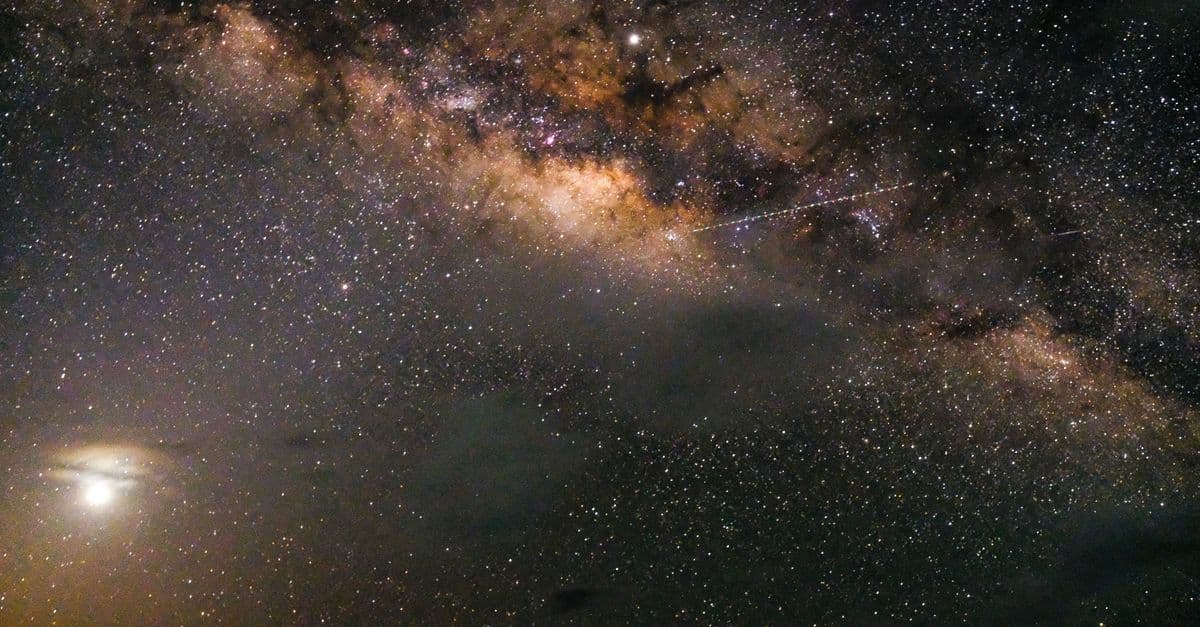
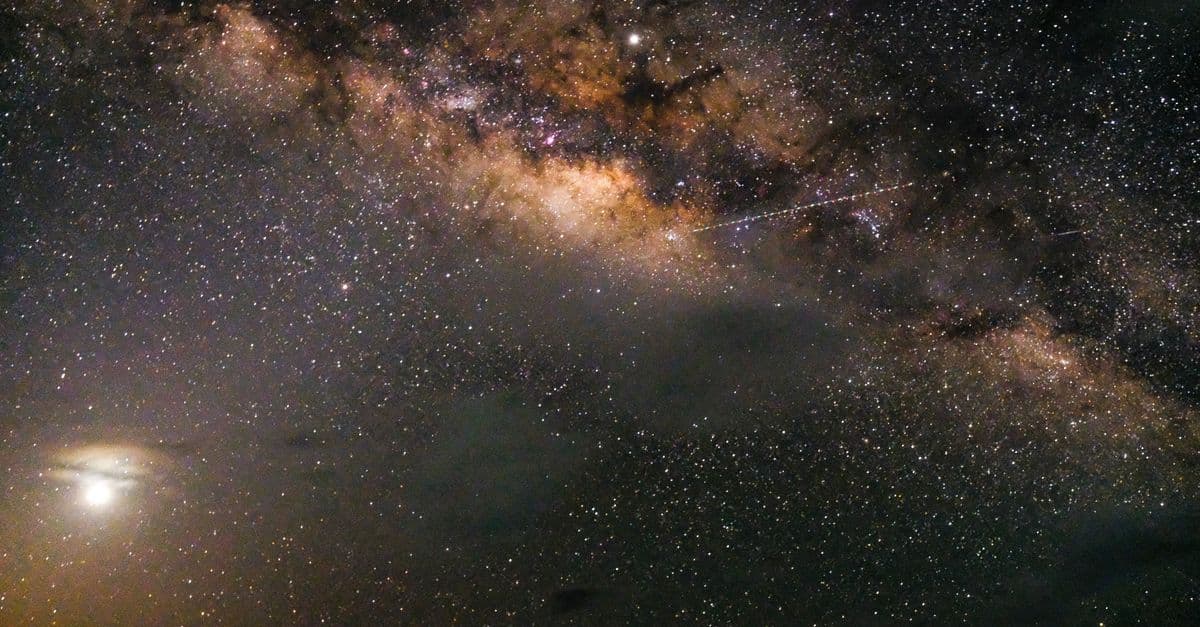
Photo: Jobert Enamno / Pexels
In 1963, astronomer Maarten Schmidt was puzzling over the spectrum of a point-like radio source called 3C 273. The spectral lines didn't match anything familiar — until he realised they were ordinary hydrogen lines shifted toward the red end of the spectrum by about 16%, a redshift of z = 0.158. A redshift that large meant 3C 273 was billions of light-years away. And if something that far away still looked like a reasonably bright star through a telescope, it had to be extraordinarily luminous — outshining entire galaxies by factors of hundreds.
The class of objects was soon named "quasi-stellar radio sources," shortened to quasar. A quasar is now understood to be one of the most extreme phenomena in nature: a supermassive black hole swallowing gas so voraciously that the surrounding matter outshines every star in its host galaxy combined.
Key takeaways
- Quasars are the extremely luminous centres of galaxies, powered by supermassive black holes actively accreting gas.
- The most luminous known, J0529-4351, shines more than 500 trillion times brighter than the Sun and gains about one solar mass per day (ESO, 2024).
- Quasar activity peaked when the universe was roughly 2–3 billion years old; quasars are rare nearby today.
- J0313-1806 (redshift 7.64, seen about 670 million years after the Big Bang) held the distance record from 2021 until 2026, when Euclid-survey quasars at redshift up to about 7.77 were reported.
- Quasars are used as cosmic backlights: DESI's first-year data used over 700,000 of them to map the universe's expansion.
How quasars were discovered
The story starts with radio astronomy, which grew quickly after the Second World War. Surveys such as the Third Cambridge Catalogue (the "3C" in 3C 273) found many radio sources whose positions were too imprecise to match with anything visible.
In 1962 Cyril Hazard and colleagues used the Parkes radio telescope in Australia to time the moment the Moon passed in front of 3C 273, pinning its position down precisely. That showed it coincided with a 13th-magnitude, star-like point of light with a faint jet. Schmidt, at Palomar Observatory, then took its spectrum and recognised the shifted hydrogen lines. His short paper in Nature in March 1963 set off a search that quickly found many more.
At first some astronomers doubted that the redshifts meant great distances, because the implied energies seemed impossible. Two lines of evidence settled the matter by the 1980s and 1990s: quasars were found sitting in the centres of host galaxies at the same redshift, and quasar spectra showed absorption by intervening gas at lower redshifts, which could only happen if the quasar was farther away.
It also soon became clear that most quasars are not strong radio sources. Only around 10% are radio-loud. The term "quasar" today generally means any very luminous active galactic nucleus, whether or not it shines strongly in radio.
What powers a quasar
A quasar is the most luminous type of active galactic nucleus (AGN) — the energetically active central region of a galaxy, where a supermassive black hole is accreting matter at a high rate.
The energy source is gravitational accretion. Gas falling toward a black hole has angular momentum, so it doesn't fall straight in. It settles into a flat, rotating accretion disc. Friction and magnetic turbulence within the disc transport angular momentum outward and let gas spiral inward, converting gravitational energy into heat. The inner disc reaches temperatures of tens of thousands to hundreds of thousands of kelvin for the largest black holes, glowing most strongly in ultraviolet light. A hot, tenuous "corona" above the disc scatters some of that light up to X-ray energies.
The efficiency of this process — energy released per unit mass — is extraordinary:
| Process | Fraction of rest-mass energy released |
|---|---|
| Chemical burning (e.g., coal) | About 0.00000001% |
| Nuclear fusion of hydrogen to helium | About 0.7% |
| Accretion onto a non-rotating black hole | About 6% |
| Accretion onto a maximally rotating black hole | Up to about 42% |
The accretion figures come from the location of the innermost stable circular orbit, inside which gas plunges into the black hole without radiating much further. A spinning black hole lets gas orbit closer before plunging, so more energy is extracted.
This efficiency is why quasars can be so bright. A black hole swallowing a few solar masses of gas per year, with 10% efficiency, produces around 10³⁹ watts — more than the starlight of a large galaxy.
The Eddington limit
There is a natural ceiling on how bright accretion can get. Radiation pushes outward on infalling gas; if the luminosity gets too high, radiation pressure balances gravity and starts to choke off the inflow. That balance point is the Eddington luminosity, which scales with black hole mass — about 1.3 × 10³¹ watts per solar mass. A billion-solar-mass black hole has an Eddington luminosity of about 10⁴⁰ watts. Most luminous quasars shine at a sizeable fraction of their Eddington limit, and the brightest ones press close to it.
The anatomy of a quasar
A typical quasar involves several nested structures, spanning a range of scales from a few times the black hole's size to hundreds of thousands of light-years.
| Component | Approximate scale | What it does |
|---|---|---|
| Supermassive black hole | Event horizon ~ light-hours for 10⁹ solar masses | Central engine |
| Accretion disc | Light-days to a few light-years | Converts infalling gas to radiation (UV/optical) |
| Corona | Close above the inner disc | Produces X-rays |
| Broad-line region | Light-days to light-months | Fast clouds emitting broad lines |
| Dusty torus | Light-years to tens of light-years | Absorbs and re-emits light in infrared |
| Narrow-line region | Hundreds to thousands of light-years | Slower gas emitting narrow lines |
| Relativistic jets (some quasars) | Up to hundreds of thousands of light-years or more | Beams of plasma, bright in radio |
The supermassive black hole ranges from millions to tens of billions of solar masses. Our guide to the biggest black holes ever found covers the heaviest known.
The broad-line region consists of gas clouds orbiting close to the black hole at thousands of kilometres per second. Doppler shifts from that motion smear emission lines across a wide range of wavelengths. Because the clouds respond to changes in the disc's brightness after a light-travel delay, astronomers can measure the size of the region by timing the echo — a technique called reverberation mapping. Combining that size with the line width gives the black hole's mass.
The narrow-line region lies much farther out, with slower gas producing narrow lines.
The dusty torus is a thick ring of dust and gas surrounding the inner regions. Depending on viewing angle, it may hide the central engine. This is the basis of the AGN unification model: many apparently different classes of active galaxy — quasars, type 1 and type 2 Seyfert galaxies, radio galaxies, blazars — are largely the same machine seen from different angles and at different power levels.
Relativistic jets are launched along the black hole's spin axis in a minority of quasars, likely powered by magnetic fields wound up by the spinning black hole and disc. Jets can extend far beyond the host galaxy.
The energy output
The most luminous quasars are almost beyond comprehension.
The quasar J0529-4351, announced by ESO in February 2024 as the most luminous object known, shines more than 500 trillion times brighter than the Sun. Its black hole has about 17 billion solar masses and is growing by just over one solar mass per day — the fastest growth rate known. Its accretion disc is estimated to be about seven light-years across, and the light we see left it more than 12 billion years ago (ESO press release eso2402).
It's also a lesson in how easily quasars hide in plain sight. The object appears in survey images from 1980, and the European Space Agency's Gaia mission's automated classification had flagged it as a star. It was only identified as a quasar in 2023 using the ANU 2.3-metre telescope at Siding Spring Observatory, then confirmed with the X-shooter spectrograph on ESO's Very Large Telescope.
| Object | Luminosity (approx., in solar luminosities) |
|---|---|
| The Sun | 1 |
| The Milky Way's starlight | Tens of billions |
| 3C 273 | Trillions |
| J0313-1806 (z = 7.64, 2021 distance record) | About 3.6 × 10¹³ |
| J0529-4351 (most luminous known) | More than 5 × 10¹⁴ |
Sources: ESO eso2402 (J0529-4351); Wang et al. 2021 (J0313-1806). Milky Way and 3C 273 values are order-of-magnitude.
In watts, the Sun emits about 3.8 × 10²⁶. J0529-4351 therefore emits roughly 2 × 10⁴¹ watts. The region producing most of that light is tiny on a galactic scale: an accretion disc a few light-years across outshines a galaxy roughly a hundred thousand light-years wide, many thousands of times over.
How we know the engine is small: variability
Quasars flicker. Their brightness changes over months, weeks, sometimes days. A source cannot vary coherently faster than light can cross it, so a quasar whose brightness changes noticeably in a few days must be no more than a few light-days across in its emitting region. That simple argument, made in the 1960s, was one of the first clues that quasars were powered by something extremely compact — and a black hole was the only candidate that could pack that much energy into so small a space.
Quasars and the early universe
Quasars are mostly a feature of the younger universe. Their numbers and total output peaked at redshifts around z ≈ 2–3, when the universe was roughly 2–3 billion years old. Since then, the population of luminous quasars has declined steeply.
J0313-1806, at redshift 7.642, seen about 670 million years after the Big Bang, was the distance record holder from 2021; in July 2026 a Euclid survey paper (Yang et al., Astronomy & Astrophysics) reported 31 new high-redshift quasars, the farthest at redshift about 7.77, which edges past it. J0313-1806 remains the best-studied of the very distant quasars. Its black hole has about 1.6 billion solar masses, and its spectrum shows outflowing gas moving at close to 20% of the speed of light (Wang et al., 2021).
That presents a puzzle. Growing a black hole to a billion solar masses in well under a billion years is hard. If a black hole grows at its Eddington limit, it doubles in mass every few tens of millions of years at best. Starting from a black hole left by a massive star of perhaps 100 solar masses, there is barely enough time. Wang and colleagues argued that J0313-1806's mass challenges standard growth models and points to a heavier "seed," perhaps a black hole of 10,000 solar masses or more formed by the direct collapse of a gas cloud. Our comparison of stellar and supermassive black holes explores where those seeds might come from.
Why were quasars more common in the past?
- The early universe had more cold gas available to feed black holes.
- Galaxies were closer together and merged more often, and mergers funnel gas toward galactic centres.
- Black holes were still growing; many have since run short of fuel relative to their size.
The Milky Way's central black hole, Sagittarius A*, about four million solar masses, is quiet today. It flares occasionally when gas or small objects fall in, but its luminosity is billions of times below a quasar's. There is evidence it was more active in the past: the Fermi bubbles, giant lobes of gas above and below the galactic plane, may be the relic of an outburst millions of years ago.
What JWST has added
The James Webb Space Telescope has not displaced wide-area surveys as the main way to find the most distant bright quasars, but it has transformed how they are studied. JWST can detect the starlight of quasar host galaxies at redshifts above 6, which is nearly impossible from the ground because the quasar's glare dominates. It has also revealed a population of compact, red sources in the early universe — nicknamed "little red dots" — that many researchers interpret as dust-reddened, growing black holes, though their nature is still debated. See our overview of the James Webb Space Telescope for the instrument behind these results.
How quasars shaped galaxies
Quasars don't just shine passively — they can reshape their host galaxies.
Quasar feedback. A quasar's radiation and winds can heat and expel gas from its host, shutting down star formation. This is thought to be a key reason the most massive galaxies today tend to be "red and dead" — dominated by old stars, with little new star formation. Without some form of feedback, simulations of galaxy formation produce far too many very massive, star-forming galaxies.
The M–sigma relation. The mass of a galaxy's central black hole correlates tightly with the velocity dispersion — the random speeds — of stars in the galaxy's bulge. The black hole's gravity directly influences only a tiny central region, so this correlation implies that black holes and galaxies grew together, regulating each other. Quasar feedback is the leading candidate for the regulating mechanism, though how precisely it works is still an active research question.
Jets heating clusters. In galaxy clusters, jets from active black holes inflate cavities in the hot gas that are visible in X-ray images. This heating appears to prevent the cluster gas from cooling and forming stars at the rates otherwise expected.
Quasars, blazars, Seyferts and radio galaxies
Astronomers use a zoo of names that turn out to describe the same basic engine.
| Name | What you're seeing | Typical distinguishing feature |
|---|---|---|
| Quasar | Very luminous AGN, central engine visible | Outshines host galaxy; broad lines |
| Seyfert galaxy | Lower-luminosity AGN in a spiral galaxy | Host galaxy clearly visible |
| Radio galaxy | AGN with large radio jets/lobes, often edge-on | Spectacular radio structure |
| Blazar | Jet pointed nearly at Earth | Rapid, extreme variability; gamma rays |
| Obscured (type 2) quasar | Luminous AGN viewed through the dusty torus | Bright in infrared and X-rays, weak in optical |
Blazars are a striking case. Because the jet is aimed almost at us and moving at nearly light speed, its light is Doppler-boosted and its variability compressed in time, so blazars can change brightness within hours and dominate the extragalactic gamma-ray sky. Features in such jets can also appear to move across the sky faster than light — an illusion of geometry and light-travel time rather than true superluminal motion.
Quasars as cosmological tools
Because quasars are so luminous, they're visible across most of cosmic history. That makes them valuable probes:
Backlights for the cosmic web. Gas between us and a distant quasar absorbs light at specific wavelengths, each cloud at its own redshift. Neutral hydrogen absorbs at the Lyman-alpha wavelength, so a high-redshift quasar's spectrum shows a dense thicket of absorption lines — the Lyman-alpha forest — that maps hydrogen along the line of sight. Since a spectrograph splits light by wavelength, spectroscopy turns a single quasar into a core sample through billions of years of intergalactic gas.
Measuring expansion. The Dark Energy Spectroscopic Instrument (DESI) used more than 420,000 Lyman-alpha forest spectra correlated with more than 700,000 quasars in its first year of data to measure the imprint of baryon acoustic oscillations at an effective redshift of 2.33, giving a roughly 2% measurement of the expansion rate at that epoch (DESI Collaboration, 2024). Those measurements feed into tests of dark energy.
Probing reionisation. The most distant quasars, at z > 6, show how much neutral hydrogen remained in the intergalactic medium. Complete absorption bands in their spectra mark the end of the epoch of reionisation, when ultraviolet light from the first stars and galaxies ionised the gas between them. More on that era is in what reionization was.
Lensed quasars. When a massive galaxy lies almost exactly between us and a quasar, gravitational lensing produces multiple images of the same quasar. Each image's light takes a different path, so a flicker appears in one image days or months before another. Measuring those time delays gives an independent estimate of the Hubble constant.
A fixed reference frame. Because quasars are so distant, they show no measurable motion across the sky. The International Celestial Reference Frame, used for spacecraft navigation and Earth-orientation measurements, is defined by the positions of hundreds of quasars and other compact radio sources measured by very-long-baseline interferometry.
Common misconceptions
"Quasars are a type of star"
They look star-like only because they're so far away that they appear as points. The light comes from gas around a black hole, not from a star.
"The black hole itself is shining"
No light escapes from inside the event horizon. Everything we see comes from gas outside it — in the disc, corona, clouds and jets — heated as it falls in.
"Quasars suck up everything around them"
A supermassive black hole's gravity dominates only a small central region. Stars elsewhere in the host galaxy orbit as they would around any equal mass. A quasar shines because gas happens to be flowing into the centre, not because the black hole is pulling in the whole galaxy.
"Quasars are all extinct"
Luminous quasars are much rarer nearby than in the past, but they still exist. 3C 273, at about 2.4 billion light-years, is among the closest bright quasars, and lower-power AGN are common in nearby galaxies.
Frequently asked questions
Q: What is a quasar in simple terms? A: It is the extremely bright centre of a distant galaxy, where gas spiralling into a supermassive black hole heats up and glows more brightly than all the galaxy's stars combined.
Q: Are quasars dangerous to nearby galaxies? A: Quasar radiation and jets can heat gas and suppress star formation within and around their host galaxies. The known quasars are all billions of light-years away, so they pose no danger to the Milky Way.
Q: Could our galaxy ever host a quasar again? A: Possibly, if a large supply of gas reached the galactic centre, such as during a merger. A 2025 study found the long-predicted Milky Way–Andromeda merger is less certain than thought, at roughly 50% within 10 billion years.
Q: How do we know quasars are so far away? A: Through redshift. Quasars sit in host galaxies at the same redshift, and their spectra show absorption from gas at lower redshifts lying in front of them, which confirms they are more distant.
Q: What is the brightest quasar known? A: J0529-4351, announced in 2024, shines more than 500 trillion times brighter than the Sun and is powered by a black hole of about 17 billion solar masses.
Q: Are blazars different from quasars? A: A blazar is an active galaxy whose jet points nearly at Earth. The jet's light is Doppler-boosted, so blazars vary rapidly and emit strong gamma rays. Many are quasars seen from that special angle.
Q: Can the James Webb Space Telescope see the first quasars? A: JWST studies known distant quasars in new detail, including their host galaxies, and has found compact red objects that may be early growing black holes. The record-distance quasars were found by wide-area surveys, most recently by ESA's Euclid telescope with ground-based follow-up, rather than by JWST.
The bottom line
Quasars are the universe's most powerful sustained engines: supermassive black holes fed so much gas that the surrounding disc outshines entire galaxies from a region a few light-years across. They were most common when the universe was a few billion years old, they helped regulate how galaxies grew, and the heaviest early examples still challenge theories of how black holes form. Today they serve as backlights, distance markers and reference points, letting astronomers read the history of the cosmos in light that left them billions of years ago.
Sources
- European Southern Observatory (2024). Astronomers discover the brightest object ever observed (eso2402).
- Wang, F. et al. (2021). A Luminous Quasar at Redshift 7.642. Astrophysical Journal Letters.
- DESI Collaboration (2024). DESI 2024 IV: Baryon Acoustic Oscillations from the Lyman Alpha Forest.
- Euclid Consortium (2026). Euclid scientists discover most distant known quasars (Yang et al., A&A 711, 104).
- UWA (2025). Astronomers thought the Milky Way was doomed to crash into Andromeda. Now they're not so sure.
Related Reading
Follow new articles
Add SciHub101 to your feed reader to see new science and technology stories.
About the Author
SciHub101 is an independent science and technology publication founded and edited by Buğra Sözeri, a software engineer and app developer based in Türkiye. AI tools assist with drafting and research. Source documentation in the existing archive is uneven, and articles are being reviewed and corrected. The Editorial Team byline identifies editorial responsibility; it does not certify specialist or independent human review. Where we compare products, anything built by our own team is labelled as such — see the editorial guidelines and About page for how corrections and disclosures work.
Related Articles
What Happens Inside a Black Hole — Beyond the Event Horizon
The event horizon is the point of no return — beyond it, not even light can escape. But what actually happens inside? The physics gets strange fast: time and space swap roles, the singularity may not be what we think, and quantum mechanics breaks everything.
Megastructures: Ringworlds and the Engineering of Impossible Scales
A ringworld would not break any law of physics, but it would break every material we know. The spin arithmetic shows exactly where each megastructure sits on the ladder from buildable to impossible.
Biggest Black Holes Ever Found
The most massive black holes challenge galaxy formation models. This article explains ultramassive black holes, how mass is measured, and why records change.
Sagittarius A*: The Black Hole at the Heart of the Milky Way
Four million solar masses packed into a region smaller than our solar system, sitting 27,000 light-years from Earth. For three decades, astronomers tracked stars swinging around it at nearly 3% of the speed of light. Then, in 2022, they photographed it.
Stellar vs. Supermassive Black Holes: The Mass Gap Mystery
Black holes come in sizes that span 10 orders of magnitude, from a few solar masses to tens of billions — but the range between roughly 65 and a few hundred solar masses appears nearly empty. A 2020 gravitational wave event punched straight through that forbidden zone, and nobody fully agrees on how.
The Hubble Constant Tension: A Crisis in Cosmology
Two carefully checked ways of measuring how fast the universe expands disagree by roughly 8 to 10 percent, a gap near 5 sigma. Either a hidden error remains, or standard cosmology is incomplete.