Dark Matter and Dark Energy Explained
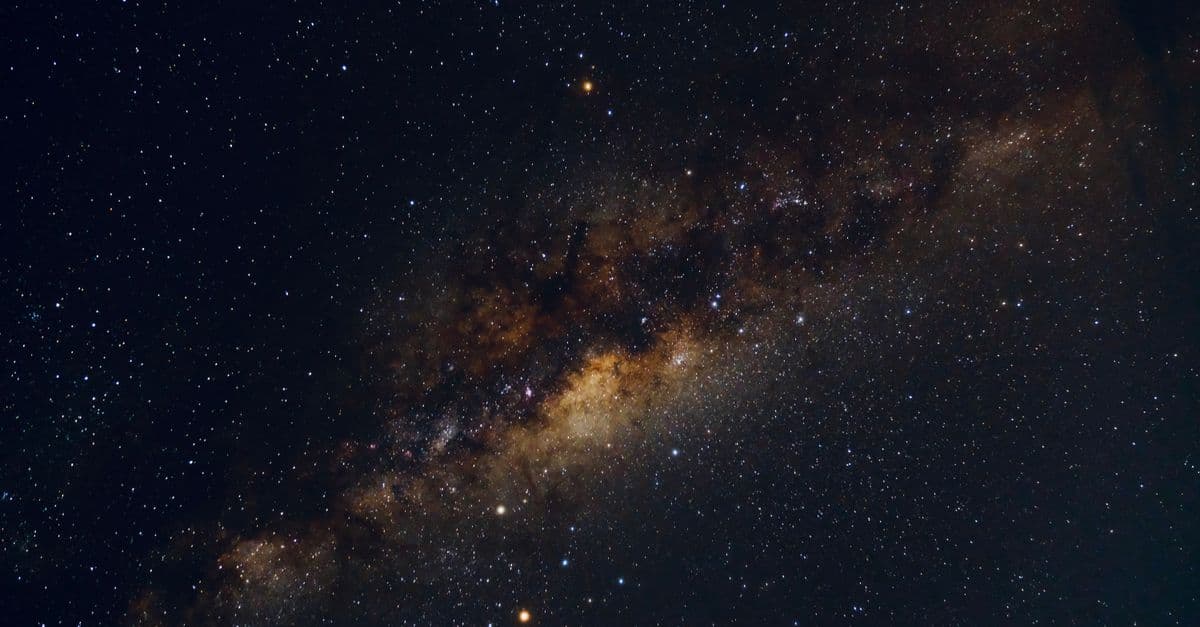
Photo: Jobert Enamno / Pexels
Everything you can see — every star, planet, galaxy, and atom — makes up just 5% of the universe. The remaining 95% is invisible, undetected by any instrument we have pointed at the sky, yet its gravitational and energetic fingerprints are stamped across the entire cosmos. That 95% is split between two profoundly mysterious components: dark matter (roughly 27%) and dark energy (roughly 68%), according to the European Space Agency's Planck satellite data published in 2018 (Planck Collaboration, Astronomy & Astrophysics, 2020).
Understanding what these two entities actually are stands as perhaps the greatest open question in modern physics. This article walks through the evidence that forced scientists to accept they exist, the leading candidate explanations, and why — despite decades of effort — we still do not have a definitive answer.
The Universe's Inventory: Where Do the Numbers Come From?
The 5/27/68 breakdown is not guesswork. It comes from multiple independent lines of evidence that converge on the same answer: precision measurements of the cosmic microwave background (CMB) — the faint afterglow of the Big Bang — combined with large-scale galaxy surveys, Type Ia supernova distances, and baryon acoustic oscillations.
The Planck satellite mapped the CMB's temperature fluctuations across the entire sky at unprecedented resolution. The pattern of those fluctuations encodes the universe's composition like a fingerprint. Fitting the standard cosmological model (ΛCDM — Lambda Cold Dark Matter) to Planck's data yields: ordinary (baryonic) matter 4.9%, cold dark matter 26.8%, and dark energy (as a cosmological constant, Λ) 68.3%.
These numbers were not expected. They emerged from the data, which is exactly what makes them so compelling — and so unsettling.
Part I: Dark Matter
The First Clue — Galaxy Rotation Curves
In the 1970s, astronomer Vera Rubin at the Carnegie Institution, working with colleague Kent Ford, measured the orbital speeds of stars at different distances from the centers of spiral galaxies. Newtonian gravity predicts that stars far from a galaxy's core — where visible mass thins out — should orbit more slowly, just as the outer planets of our solar system move slower than the inner ones.
They did not. Stars at the outer edges of galaxies orbit at nearly the same speed as stars near the center, producing a "flat" rotation curve rather than the expected decline. The only way to reconcile this with gravity is to assume that a massive, invisible halo of matter surrounds each galaxy, adding gravitational pull even where no stars shine. Rubin's observations, published in The Astrophysical Journal between 1970 and 1980, were not the first hint of hidden mass (Fritz Zwicky had seen anomalous galaxy cluster velocities in the 1930s), but they were systematic, precise, and impossible to dismiss.
Gravitational Lensing — Einstein Rings and Bent Light
Einstein's general relativity predicts that mass bends spacetime, and light follows those curves. Massive objects between us and a distant light source can therefore act as gravitational lenses, distorting and magnifying background galaxies into arcs, rings, or multiple images. The Einstein ring — a perfect circular arc — occurs when the alignment is exact.
By measuring how much background galaxies are distorted, astronomers can reconstruct the total mass of the lensing object. Again and again, the lensing mass vastly exceeds the mass of visible stars and gas. Dark matter is the only consistent explanation.
The Bullet Cluster — Direct Structural Evidence
The most compelling single piece of dark matter evidence came from a system called the Bullet Cluster (1E 0657-558), studied in detail from 2004 onward using the Chandra X-ray Observatory combined with gravitational lensing maps (Clowe et al., The Astrophysical Journal Letters, 2006).
The Bullet Cluster is the result of two galaxy clusters colliding and passing through each other. The hot gas — the bulk of ordinary matter — was slowed by electromagnetic interactions and left behind in the center, glowing in X-rays. But the gravitational lensing maps showed that most of the mass (the dark matter halos) had sailed straight through the collision without interacting, separated spatially from the gas. This direct structural separation of dark matter from normal matter is extraordinarily difficult to explain without actually invoking dark matter as a distinct, weakly interacting component.
What Dark Matter Is NOT
Before listing candidates, it is worth noting what has been ruled out:
- Ordinary dim objects (brown dwarfs, rogue planets, faint stars): Surveys of gravitational microlensing events — brief brightenings when a compact object passes in front of a background star — show these MACHOs (Massive Astrophysical Compact Halo Objects) cannot account for more than a small fraction of the missing mass.
- Stellar-mass black holes: LIGO gravitational wave detections constrain the population of black holes in this mass range. They cannot plausibly fill the dark matter budget.
- Hot gas: X-ray observations account for it. It is not enough.
Leading Candidates
WIMPs (Weakly Interacting Massive Particles) have been the dominant theoretical candidate for decades. WIMPs are hypothetical particles with masses roughly 10–1,000 times the proton mass that interact via the weak nuclear force and gravity but not electromagnetism. They arise naturally in supersymmetric extensions of the Standard Model. If they exist, they would have been produced in the right abundance in the early universe to explain today's dark matter density — a coincidence so striking it is called the "WIMP miracle."
Axions are ultralight particles originally proposed to solve a different physics problem (the strong CP problem). They could form a coherent field-like dark matter distribution rather than individual particles. Experimental searches use microwave cavities tuned to resonance with potential axion masses.
Sterile neutrinos are hypothetical heavier cousins of ordinary neutrinos that interact only via gravity. They are a viable candidate particularly for warm dark matter scenarios.
Experiments and the Hunt for WIMPs
The LUX-ZEPLIN (LZ) detector, located a mile underground at the Sanford Underground Research Facility in South Dakota, is currently the world's most sensitive WIMP detector. It uses 10 tonnes of liquid xenon cooled to cryogenic temperatures. When a WIMP strikes a xenon nucleus, it should produce a tiny flash of light and a charge signal simultaneously. The depth of the detector shields it from cosmic rays. LZ published its first results in 2022 and continues taking data — but no WIMP signal has been found.
AMS-02 (Alpha Magnetic Spectrometer) on the International Space Station searches for indirect evidence: if WIMPs annihilate each other in galaxy halos, they should produce excess positrons or antiprotons detectable in cosmic rays. AMS-02 did detect an excess of high-energy positrons, but the origin — WIMPs or pulsars — remains debated.
Collider searches at the Large Hadron Collider at CERN look for WIMPs produced directly in proton collisions and escaping as missing energy. No signal has emerged.
When the Obvious Candidate Keeps Hiding
The non-detection of WIMPs despite increasingly sensitive experiments has opened serious discussion of alternatives. Modified Newtonian Dynamics (MOND), proposed by Mordehai Milgrom in 1983, adjusts the law of gravity at very low accelerations rather than invoking new matter. MOND correctly predicts flat rotation curves and a correlation between the galaxy baryonic mass and its rotation speed (the radial acceleration relation). However, MOND fails at galaxy cluster scales — including the Bullet Cluster — without some form of additional dark matter, which undercuts its appeal as a complete alternative. The hunt for dark matter continues.
Part II: Dark Energy
1998 — The Universe Is Accelerating
The discovery of dark energy is one of the most shocking moments in the history of science. Two independent teams — the Supernova Cosmology Project (led by Saul Perlmutter) and the High-Z Supernova Search Team (led by Brian Schmidt and Adam Riess) — were using Type Ia supernovae as "standard candles" to measure cosmic distances. Because Type Ia supernovae have a well-known intrinsic brightness, their apparent brightness tells you how far away they are. Comparing distance to redshift measures the universe's expansion rate at different epochs.
Both teams, publishing in 1998 and 1999 in The Astrophysical Journal, found the same shocking result: distant supernovae were fainter than expected. The universe was not decelerating as gravity should slow it — it was accelerating. Something was pushing everything apart, overpowering gravity at the largest scales. Perlmutter, Schmidt, and Riess shared the Nobel Prize in Physics in 2011 for this discovery.
Einstein's Cosmological Constant — The "Greatest Blunder" That Wasn't
When Einstein formulated general relativity in 1915, he added a term to his field equations — the cosmological constant (Λ) — to make the universe static (since observation at the time suggested a non-expanding cosmos). After Hubble's 1929 discovery that galaxies were receding, Einstein reportedly called Λ his "greatest blunder" and abandoned it.
The 1998 supernova results resurrected the cosmological constant. A non-zero Λ represents a constant energy density of empty space — the vacuum itself contains energy that drives expansion. In the ΛCDM model, this cosmological constant fits the observations extremely well. The profound puzzle is that quantum field theory predicts the vacuum energy should be roughly 10^120 times larger than the observed value. This mismatch — the worst prediction in all of physics — is called the cosmological constant problem and remains unsolved.
Quintessence and Dynamic Dark Energy
An alternative to a fixed cosmological constant is quintessence — a hypothetical dynamic scalar field that permeates space and whose energy density and equation of state evolve over time. If dark energy is quintessence rather than a cosmological constant, its strength would vary across cosmic history, and the universe's acceleration history would differ from ΛCDM predictions.
The key parameter distinguishing the two is the equation of state w (the ratio of dark energy pressure to density). A cosmological constant gives exactly w = −1 at all times. Quintessence models allow w to drift. Measuring w and its evolution is a primary goal of current dark energy surveys.
The Hubble Tension
A growing crisis in cosmology centers on conflicting measurements of the universe's expansion rate, the Hubble constant (H₀). CMB-based measurements — anchored to early-universe physics as measured by Planck — give H₀ ≈ 67 km/s/Mpc. Direct, late-universe measurements — using Cepheid variable stars and Type Ia supernovae calibrated locally (the "distance ladder") — give H₀ ≈ 73 km/s/Mpc (Riess et al., The Astrophysical Journal Letters, 2022).
The discrepancy is now at roughly 5 sigma statistical significance — well above the threshold physicists usually require to claim a real disagreement rather than measurement error. Both measurements have been cross-checked repeatedly. If neither is wrong, the standard ΛCDM model is missing something — perhaps a new component of dark energy, an interaction between dark matter and dark energy, or early-universe physics not yet accounted for.
DESI 2024 — Is Dark Energy Evolving?
In April 2024, the Dark Energy Spectroscopic Instrument (DESI) collaboration released results from its first year of data, mapping the three-dimensional positions of 6 million galaxies to trace baryon acoustic oscillations across cosmic history. Their analysis found a mild but statistically interesting hint — at roughly 2–3 sigma — that dark energy's equation of state w may not be constant, potentially departing from w = −1 in a way consistent with evolving dark energy or quintessence (DESI Collaboration, The Astrophysical Journal Letters, 2024). This is far from a confirmed detection, but it adds fuel to the growing sense that ΛCDM may need revision.
The Euclid Telescope — Dark Energy Mapping
Launched in July 2023, ESA's Euclid space telescope is conducting a six-year survey of 15,000 square degrees of sky, measuring the shapes and positions of billions of galaxies to map dark energy's influence on cosmic structure over the past 10 billion years. Combined with weak gravitational lensing statistics, Euclid aims to measure the dark energy equation of state with percent-level precision — enough to definitively test whether dark energy is a cosmological constant or something that evolves.
Comparison: Dark Matter vs. Dark Energy
| Feature | Dark Matter | Dark Energy |
|---|---|---|
| Fraction of universe | ~27% (Planck 2018) | ~68% (Planck 2018) |
| Effect on gravity | Attractive — pulls matter together | Repulsive — drives accelerating expansion |
| Distribution | Clumped in halos around galaxies | Uniform across all of space |
| Key evidence | Rotation curves, lensing, Bullet Cluster | Type Ia supernovae brightness, CMB |
| Leading model | Cold dark matter (WIMPs, axions) | Cosmological constant (Λ) |
| Experimental status | No confirmed direct detection | Measured indirectly; equation of state uncertain |
| Alternative theories | MOND, modified gravity | Quintessence, modified gravity |
| Active experiments | LZ, AMS-02, LHC | DESI, Euclid, Vera Rubin Observatory |
Why This Matters
Dark matter and dark energy are not mere academic curiosities. Dark matter's gravitational scaffolding shaped the large-scale structure of the universe — without it, galaxies as we know them would not have formed, and Earth would not exist. Dark energy determines the definitive fate of the cosmos: depending on its true nature, the universe may expand forever at an ever-accelerating rate, or — in more exotic quintessence models — the expansion could eventually reverse or tear matter apart in a "Big Rip."
Solving these two mysteries would almost certainly require physics beyond the Standard Model. Whatever emerges from experiments like LZ, DESI, and Euclid will reshape our understanding not just of cosmology but of fundamental particle physics.
For further reading on how dark matter connects to the formation of the first stars and galaxies, see ./james-webb-telescope-discoveries-2022-2026. To understand how the expansion of the universe was first established, see ./hubble-space-telescope-legacy. For the broader context of how cosmology measures cosmic distances, see ./how-far-are-the-stars.
Frequently Asked Questions
Q: What is the difference between dark matter and dark energy? A: Dark matter is a form of matter — it has mass, clusters gravitationally around galaxies, and acts as an invisible scaffolding for cosmic structure. Dark energy is a property of space itself (in the leading model), uniformly distributed and driving the accelerating expansion of the universe. They are entirely distinct phenomena that happen to both be "dark" in the sense of being invisible to telescopes.
Q: Has dark matter ever been directly detected? A: No confirmed direct detection has been made as of 2026. The most sensitive experiments — including LUX-ZEPLIN with 10 tonnes of liquid xenon — have ruled out large regions of WIMP parameter space but found no signal. Dark matter's existence is inferred from its gravitational effects, which are overwhelming and consistent across many independent observations.
Q: Could dark matter just be regular matter we cannot see, like black holes or dim stars? A: Largely no. Microlensing surveys constrain the population of compact dark objects (MACHOs) to a small fraction of the required dark matter. LIGO gravitational wave data rules out stellar-mass black holes as the primary component. The CMB also requires a non-baryonic dark matter component with specific properties — ordinary matter (baryons) cannot fill the role.
Q: What is the Hubble tension and why does it matter? A: The Hubble tension is a statistically significant discrepancy (~5 sigma) between two ways of measuring the universe's expansion rate. The CMB gives ~67 km/s/Mpc; the local distance ladder gives ~73 km/s/Mpc. If neither measurement is systematically wrong, the standard ΛCDM cosmological model is incomplete and may require new physics — possibly involving dark energy that evolves over time, early dark energy, or new particle species.
Q: What did the DESI 2024 results actually show? A: DESI measured baryon acoustic oscillations — a standard ruler imprinted in galaxy clustering — across 6 million galaxies spanning billions of light-years. Their first-year data showed a 2–3 sigma hint that dark energy's equation of state w may deviate from −1 (the cosmological constant value) and may be evolving. This is suggestive but not conclusive; DESI's full five-year dataset will be far more decisive.
Q: What is quintessence? A: Quintessence is a hypothetical scalar field — similar in concept to the Higgs field — that permeates all of space and whose energy density changes over cosmic time. Unlike a true cosmological constant (fixed vacuum energy), quintessence would cause the universe's acceleration to vary throughout history. It is the leading alternative to a cosmological constant for explaining dark energy.
Q: Why is Einstein's cosmological constant called his "greatest blunder"? A: Einstein introduced Λ in 1917 to make his field equations permit a static universe, which he then believed in. When Hubble showed the universe was expanding in 1929, Einstein reportedly abandoned Λ as an unnecessary kludge. After the 1998 supernova discovery of accelerating expansion, it became clear that a positive cosmological constant — the very thing Einstein discarded — is precisely what the data demand. The "blunder" label is somewhat apocryphal, but the story captures the irony of discarding a correct answer for the wrong reasons.
Q: What would discovering dark matter particles actually tell us? A: It would be one of the most profound discoveries in the history of science. Identifying a dark matter particle — its mass, spin, and interaction cross-sections — would extend the Standard Model of particle physics into territory it currently cannot reach, potentially reveal connections to supersymmetry or extra dimensions, and explain the origin of cosmic structure from the earliest moments of the Big Bang. It would also validate decades of theoretical work and open entirely new directions in both particle physics and cosmology.
Sources
- Planck Collaboration (Aghanim et al.), "Planck 2018 results. VI. Cosmological parameters," Astronomy & Astrophysics 641, A6 (2020). DOI: 10.1051/0004-6361/201833910
- Rubin, V. C., Ford, W. K., & Thonnard, N., "Rotational properties of 21 SC galaxies with a large range of luminosities and radii," The Astrophysical Journal 238, 471 (1980).
- Clowe, D. et al., "A Direct Empirical Proof of the Existence of Dark Matter," The Astrophysical Journal Letters 648, L109 (2006). DOI: 10.1086/508162
- Perlmutter, S. et al. (Supernova Cosmology Project), "Measurements of Ω and Λ from 42 High-Redshift Supernovae," The Astrophysical Journal 517, 565 (1999).
- Riess, A. G. et al., "A Comprehensive Measurement of the Local Value of the Hubble Constant," The Astrophysical Journal Letters 934, L7 (2022). DOI: 10.3847/2041-8213/ac5c5b
- DESI Collaboration, "DESI 2024 VI: Cosmological Constraints from the Measurements of Baryon Acoustic Oscillations," The Astrophysical Journal Letters (2024). arXiv:2404.03002
- Mitsou, V. A., "Overview of searches for dark matter at the LHC," Journal of Physics: Conference Series 651, 012023 (2015).
- LZ Collaboration, "First Dark Matter Search Results from the LUX-ZEPLIN (LZ) Experiment," Physical Review Letters 131, 041002 (2023). DOI: 10.1103/PhysRevLett.131.041002
Read next:
Follow new articles
Add SciHub101 to your feed reader to see new science and technology stories.
About the Author
SciHub101 is an independent science and technology publication founded and edited by Buğra Sözeri, a software engineer and app developer based in Türkiye. AI tools assist with drafting and research. Source documentation in the existing archive is uneven, and articles are being reviewed and corrected. The Editorial Team byline identifies editorial responsibility; it does not certify specialist or independent human review. Where we compare products, anything built by our own team is labelled as such — see the editorial guidelines and About page for how corrections and disclosures work.
Related Articles
Black Holes Explained: How They Work
What is a black hole, really? Event horizons, Hawking radiation, spaghettification, the nearest known black holes, and the first images of M87* and Sgr A*.
SpaceX and the New Space Race: 2026 Status
SpaceX in 2026: Starship's V3 flights, Falcon 9 reuse, Starlink growth, a reshaped Artemis plan, and how China and rival rockets compete in the new space race.
Dark Matter in 2026: Evidence, Candidates, and Current Theories
A complete primer on dark matter — Vera Rubin's galaxy rotation curves, gravitational lensing, CMB, WIMP and axion candidates, what experiments have ruled out, the MOND debate, primordial black holes, and where the science stands in 2026.
What Are Galaxy Clusters? The Largest Gravitationally Bound Structures in the Universe
Galaxy clusters are the largest structures held together by their own gravity: hundreds to thousands of galaxies, a vast reservoir of X-ray-bright gas, and a dark matter halo that outweighs everything else. They also work as natural telescopes, bending and magnifying light from the early universe.
What If Dark Energy Suddenly Disappeared?
Dark energy makes up 68% of the universe's energy content and drives cosmic acceleration. If it vanished, the universe would no longer expand at an accelerating rate. Instead, gravity would decelerate expansion, and the universe would either stabilize into a steady expansion, re-contract (Big Crunch), or remain nearly stable — depending on the matter density.