What If Dark Energy Suddenly Disappeared?
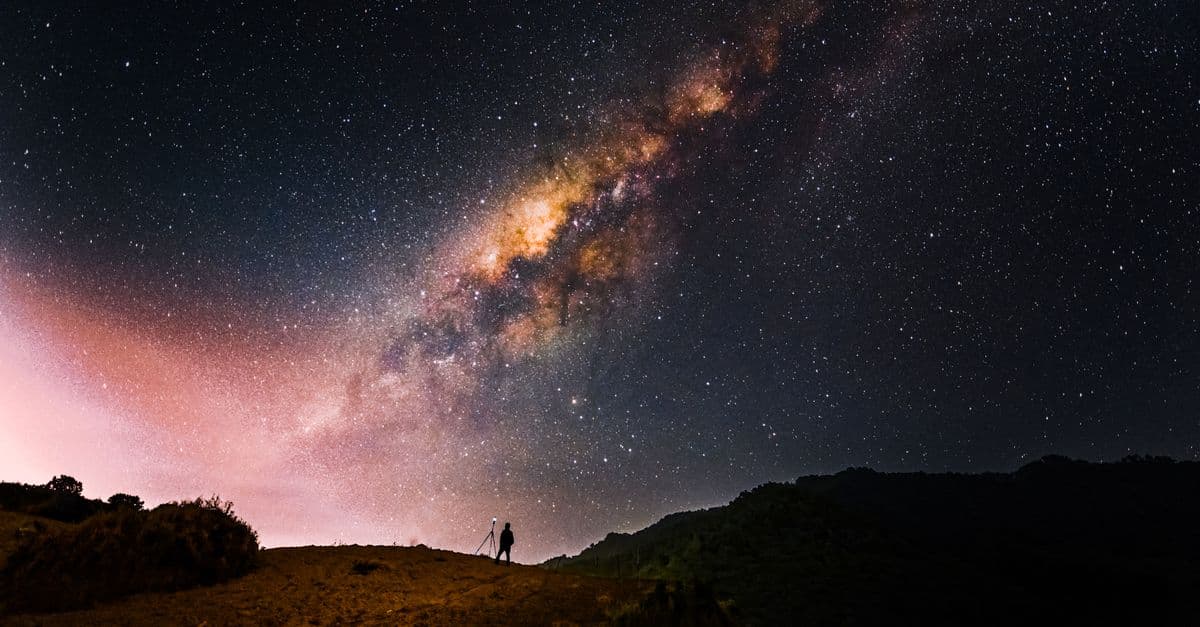
Photo: Timur Kozmenko / Pexels
Dark energy is the most mysterious component of the universe. We don't know what it is — a property of spacetime itself, a quantum field, or something else entirely. Yet observations show that it makes up ~68% of the universe's energy content and is driving an accelerating expansion. Without dark energy, the universe would behave fundamentally differently.
Thought experiment. This article explores a hypothetical scenario for educational and speculative purposes. The events described are not predictions and should not be interpreted as warnings, advocacy, or instructions.
If dark energy suddenly vanished, the fate of the universe would shift from "infinite expansion" to something else: either a re-contracting Big Crunch, a steady expansion decelerated by gravity, or a marginal state balanced on the knife's edge between contraction and expansion.
Key takeaways
- Immediate effects: none — dark energy's loss wouldn't affect galaxies, stars, or planets instantly (no light-speed causality violation).
- Long-term fate changes: from accelerating expansion to deceleration or re-contraction.
- Universe age uncertainty: depending on matter density, the universe might reach a maximum size in 10⁰ to 10¹⁰⁰ years, then re-contract.
- Observational timeline: cosmologists wouldn't detect the change for millions of years (distance scales of dark energy are cosmological).
- Anthropic consequence: if this occurred, humanity couldn't exist (fine-tuning argument).
What dark energy does now
The Friedmann equation describes cosmic expansion:
H² = (8πGρ/3) - k/a² + Λ/3
Where:
- H = Hubble parameter (expansion rate)
- ρ = total energy density (matter + radiation + dark energy)
- Λ = cosmological constant (related to dark energy)
- k = curvature parameter
- a = scale factor (size of universe)
Currently, observations show:
- ~5% ordinary matter (atoms)
- ~27% dark matter (gravity, not light)
- ~68% dark energy (accelerating expansion)
The dark energy term (Λ) is large enough that it dominates the expansion. This causes accelerating expansion — the expansion rate itself increases over time.
If dark energy disappeared (Λ → 0), the equation simplifies to the matter-dominated case, where only matter and radiation densities matter.
Immediately after dark energy vanishes
Year 0: Dark energy abruptly vanishes from existence.
Years 1–100: No observable change. The universe continues expanding at nearly the same rate as before (the transition is smooth because the expansion rate is continuous, even if its acceleration changes). Galaxies continue receding; no one notices yet.
Years 100–10 million: Cosmological observations begin to show anomalies. Distant supernovae have different brightness-distance relationships than expected. Astronomers realize the expansion is decelerating, not accelerating. Headlines: "Universe is slowing down — Big Crunch possible."
Fate of the universe
Without dark energy, the universe's fate depends on the total matter density.
Case 1: Matter density is high (critical density or above)
The universe is spatially closed (positive curvature). Gravity from matter is strong enough to eventually stop and reverse expansion.
Timeline:
- Current expansion rate: 70 km/s/Mpc (about 1 mm/s for every million light-years of distance)
- Deceleration: gravity slows expansion
- In 10¹¹ to 10¹³ years, expansion stops (maximum universe size)
- Then, re-contraction begins: universe collapses back toward a singularity (Big Crunch)
- In another 10¹¹ to 10¹³ years, the Big Crunch occurs
At high densities (as would be needed for re-contraction), the universe would reach temperatures and densities approaching the Big Bang, but in reverse.
Case 2: Matter density is exactly critical
The universe is spatially flat (zero curvature). Expansion continues forever but decelerates toward zero. The universe approaches a maximum size asymptotically but never quite reaches it.
Timeline:
- Expansion asymptotically approaches zero velocity
- Infinite time to "finish" expanding
- Universe size approaches but never exceeds ~10²⁶ meters (roughly)
- Temperature drops toward 0 K
Case 3: Matter density is low (open universe)
The universe is spatially open (negative curvature). Gravity is weak; expansion continues forever at a declining rate.
Timeline:
- Expansion continues indefinitely
- Final state resembles the current "Big Freeze" scenario, but expansion is slower (linearly declining with time, not accelerating)
- Over 10¹⁰⁰ years, the universe becomes infinitely large and infinitely cold
Current observations
Current measurements suggest the universe is very close to spatially flat (critical density). The Cosmic Microwave Background (CMB) measurements and Type Ia supernovae data strongly support a flat universe.
If dark energy vanishes and the universe is flat, the most likely scenario is Case 2: expansion continues forever, decelerating toward zero.
But there's an uncertainty: matter density might be slightly higher than critical. In that case, re-contraction is possible.
Long-term consequences
Stars and stellar evolution
Stars burn slowly in the current universe. The Sun will become a red giant in ~5 billion years. Without dark energy, the timeline doesn't change — gravity from matter dominates as before.
But the overall universe evolution is different. As the universe expands more slowly (with matter-only dynamics), the density of matter decreases more rapidly, and the universe cools faster.
In the long term (10¹⁰ years), the universe reaches a state of minimal density. Galaxies are separated by enormous distances; stars are rare; the universe is mostly empty.
Entropy and heat death
With matter-only expansion, the heat death scenario (Big Freeze) still occurs, but the timeline is different.
- Current scenario (with dark energy): infinite expansion, endless cooling, eventual temperature of 0 K
- Dark energy vanished scenario: expansion decelerates to nearly zero; universe approaches a maximum size (but never quite reaches it in infinite time, if flat); temperature approaches 0 K but takes longer
The end state is similar — a cold, empty, high-entropy universe — but the path is different.
Stellar remnants and black holes
White dwarfs and neutron stars have long lifetimes; black holes are extremely stable (evaporating only via Hawking radiation over 10⁶⁷ years).
Without dark energy, these objects still exist in the late universe. Their ultimate fate is the same.
Possible Big Crunch (if density > critical)
If the universe is denser than the critical density, dark energy's vanishing triggers re-contraction.
As the universe re-contracts:
- Galaxy clusters merge
- Galaxies collide and merge into giant ellipticals
- Stars are scattered by gravitational interactions; some are ejected; others collide or fall into central black holes
- The universe becomes increasingly opaque and hot
- Eventually, matter re-ionizes and temperatures soar
- The Big Crunch occurs: singularity forms, possibly leading to a Big Bounce (new universe)
This is the ultimate catastrophe — not just the end of the universe, but a complete collapse and potential restart.
Observational signatures
How would we detect dark energy's vanishing?
Short term (1–10 million years):
- Type Ia supernovae show different brightness-distance relations than expected
- The Hubble diagram (distance vs. redshift) deviates from the current accelerating model
- Hubble tension (discrepancy in local vs. cosmic expansion rate measurements) might resolve as we accumulate better data
Medium term (10–100 million years):
- Galaxy clustering patterns change as the universe transitions from acceleration to deceleration
- Baryon Acoustic Oscillation (BAO) measurements show deviation
- Cosmic Microwave Background observations might show changes in lensing patterns
Long term (billions of years):
- The expansion rate asymptotically approaches zero (if universe is flat)
- Or the universe begins re-contracting (if universe is dense)
- Observers billions of years hence would conclusively see the transition
Would we survive?
Short answer: yes, if dark energy vanished today.
The loss of dark energy would not directly affect Earth, the solar system, or galaxies. Gravity from matter would dominate, but gravity already dominates locally (we orbit the Sun due to its gravity, not dark energy).
Long-term (trillions of years): The fate depends on the universe's geometry. If re-contraction occurs, then in 10¹² to 10¹⁴ years, stars begin colliding, galaxies merge, and the environment becomes hostile. Eventually, all life ends in the heat and radiation of the approaching Big Crunch.
If expansion continues indefinitely (flat or open universe), then the universe becomes increasingly cold and empty. Stars burn out; the universe reaches maximum entropy (heat death). Life can't survive in this end state either.
Most likely scenario for humanity:
- First 10 billion years: civilization continues (if it survives climate change, AI, nuclear war, etc.)
- Years 10¹¹ to 10¹⁴: universe becomes increasingly cold and sparse. Stars are rare; civilizations face resource constraints
- Years 10¹⁴+: heat death scenario dominates. No more stars; no more energy; all life ends
What it tells us
The "dark energy disappears" thought experiment reveals how fundamental dark energy is to the current cosmological scenario. The universe's fate — infinite expansion or eventual re-contraction — hinges on this mysterious component.
It also illustrates the Anthropic Principle: we observe a universe with dark energy because universes without it might not be suitable for observers like us. If dark energy didn't exist, the universe would either be much younger (if re-contracting) or have very different structure (if matter-dominated from the start).
The fact that dark energy exists and has just the right value (not too strong, not too weak) to make the universe spatially flat is one of the deepest mysteries in physics. It raises the question: is this just luck, or is there a deeper explanation (multiverse, selection effects, undiscovered physics)?
Related thought experiments
Follow new articles
Add SciHub101 to your feed reader to see new science and technology stories.
About the Author
SciHub101 is an independent science and technology publication founded and edited by Buğra Sözeri, a software engineer and app developer based in Türkiye. AI tools assist with drafting and research. Source documentation in the existing archive is uneven, and articles are being reviewed and corrected. The Editorial Team byline identifies editorial responsibility; it does not certify specialist or independent human review. Where we compare products, anything built by our own team is labelled as such — see the editorial guidelines and About page for how corrections and disclosures work.
Related Articles

What If Mars Terraforming Actually Succeeded? Life on the Finished Planet
Suppose, for the sake of argument, that every terraforming obstacle got solved: enough imported gas, a working magnetic shield, centuries of patience. What would people actually build, grow, and become on a finished Mars — and how would its short year, low gravity, and two doomed moons reshape daily life?

What If Humans Developed a Hive Mind Consciousness?
Humans are individuals, but consciousness could theoretically be networked. What if technology allowed direct brain-to-brain communication, shared thoughts, and merged consciousness? A human hive mind would be radically more efficient — but would also eliminate individuality, privacy, and the diversity of thought that drives innovation.
What If Cosmic Expansion Suddenly Reversed?
The universe has been expanding for 13.8 billion years, and dark energy is currently accelerating that expansion. If it suddenly reversed and the universe began contracting, we would be heading toward a 'Big Crunch' — but the change would be too slow for any individual to notice.
What If You Fell Into a Black Hole?
Two perspectives, one terrifying destination. From spaghettification to the firewall paradox — the real physics of falling into a black hole.
What If Gravity Disappeared for One Second?
What if gravity vanished for one second? The math shows orbits shift by millimeters to meters, and the ground may carry you along. A thought experiment.
What If the Sun Disappeared for One Week?
Eight minutes after the Sun vanishes, Earth goes dark. What happens to life, physics, and civilization in the days that follow?