How Astronomers Weigh Galaxies
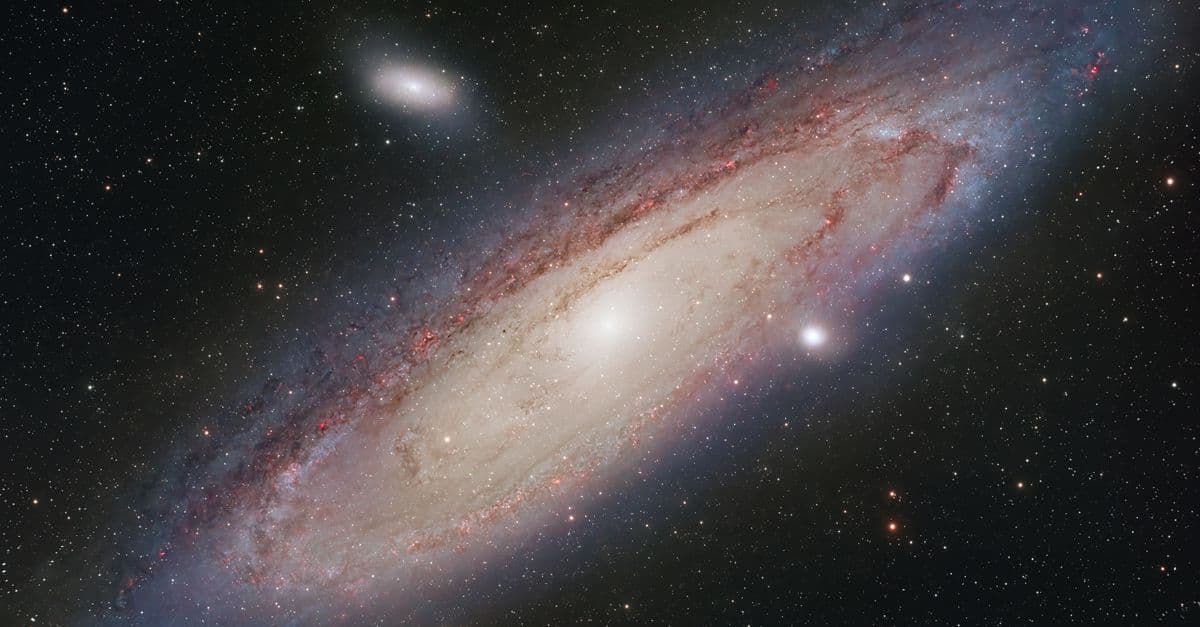
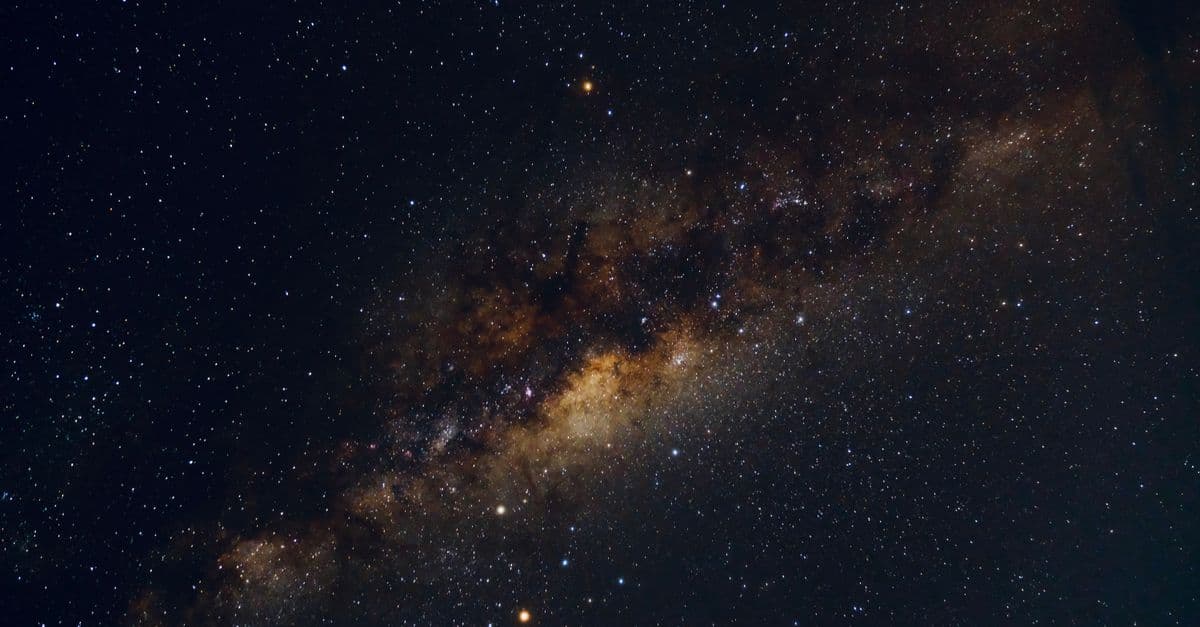
Photo: Luis Felipe Alburquerque Briganti / Pexels
No scale on Earth or in orbit can weigh a galaxy. Instead, astronomers measure how fast stars and gas orbit a galaxy's center and plug that speed into gravitational physics, the same physics that tells you a satellite's orbital speed reveals Earth's mass. That method, refined since the 1970s, keeps returning an uncomfortable answer: galaxies contain five to six times more mass than their visible stars, gas, and dust can account for. This article explains exactly how that measurement works, who discovered the anomaly, and why three independent techniques all agree that most of a galaxy's mass is invisible.
The physics: turning an orbital speed into a mass
Orbital dynamics — the branch of physics describing how objects move under mutual gravity, the same math that governs planets around the Sun and satellites around Earth. A galaxy's stars and gas clouds orbit its center the way planets orbit the Sun, just on a vastly larger scale and with mass distributed throughout the disk instead of concentrated at a single point.
Newton's law of gravitation gives astronomers a direct route from a measured orbital speed to a mass estimate. For an object moving in a roughly circular orbit at radius r with velocity v around a central mass, the gravitational force supplying the centripetal acceleration works out to a clean relationship: M(r) = v²r/G, where G is the gravitational constant (6.674 × 10⁻¹¹ N·m²/kg²) and M(r) is the total mass enclosed within radius r. This is a rearranged form of the same equation Johannes Kepler's third law of planetary motion describes empirically for the solar system, later given a physical explanation by Newton in the Principia (1687).
The elegance of this equation is that it does not care what the enclosed mass is made of. It could be stars, gas, black holes, or something that emits no light whatsoever. If you can measure v at a known r, you know M(r), full stop. That is what makes orbital velocity such a powerful diagnostic: it is mass-agnostic by design, which is exactly why it became the tool that first exposed the dark matter problem.
For a solar-system analogy: Mercury orbits the Sun at roughly 47 km/s, while Neptune, thirty times farther out, orbits at only about 5.4 km/s. Nearly all the Sun's mass sits at the center, so orbital speed falls off with distance following what astronomers call a Keplerian decline, a systematic slowdown predicted directly by M = v²r/G when M stays constant while r grows. If a galaxy's mass were similarly concentrated in its visible central bulge and disk, stars far out in the disk should show the same kind of falling rotation curve. They do not, and that mismatch is the whole story.
Vera Rubin, Kent Ford, and the discovery that changed astrophysics
Rotation curve — a plot of a galaxy's orbital velocity against distance from its center, built by measuring the Doppler shift of light from stars or gas at many radii. A rising curve near the center followed by a decline farther out is what Newtonian physics predicts if light traces mass; a curve that stays flat instead signals hidden mass.
Astronomer Vera Rubin and instrument-builder W. Kent Ford Jr. published the paper that broke this open in February 1970, in The Astrophysical Journal: "Rotation of the Andromeda Nebula from a Spectroscopic Survey of Emission Regions." Using a sensitive image-tube spectrograph Ford had built, they measured Doppler shifts from sixty-seven ionized-hydrogen emission regions across the disk of the Andromeda Galaxy (M31), spanning distances of roughly 3 to 24 kiloparsecs from its nucleus (Rubin & Ford, 1970, ApJ 159, 379). Instead of falling off at large radii the way a Keplerian curve would, Andromeda's outer rotation velocities stayed essentially flat, and the mass-to-light ratio implied by that flat curve was far higher in the outskirts than anywhere near the Sun's neighborhood in the Milky Way.
Rubin and Ford spent the following decade extending the survey. Their most influential paper, published in the Astrophysical Journal in June 1980, charted rotation curves for 21 spiral galaxies of varying size and luminosity (Rubin, Ford & Thonnard, 1980, ApJ 238, 471). Every single one showed the same pattern: velocity climbing near the core, then staying essentially constant far beyond where the visible starlight thinned out. If stars and gas were the only mass present, those outer curves should have been declining, not flat.
Rubin's observations were not the first hint of a mass discrepancy. Fritz Zwicky had already noted in 1933 that galaxies in the Coma Cluster moved too fast for the cluster's visible mass to hold them gravitationally bound, coining the term "dunkle Materie" (dark matter) in German. But Zwicky's cluster-scale measurement was statistical and easy to dismiss as measurement error. Rubin and Ford's galaxy-by-galaxy rotation curves, repeated across dozens of individual systems with consistent instrumentation, made the anomaly far harder to wave away. It is worth noting explicitly that Rubin herself was cautious about overinterpreting her data as proof of a new form of matter; she described what the observations showed and left the interpretation for the wider field to build on over subsequent decades.
Applying M = v²r/G in practice
Turning a rotation curve into an actual mass profile requires a few practical steps beyond the bare equation. Astronomers first need a distance to the galaxy, since angular separations on the sky only convert to physical radii (in kiloparsecs) once distance is known, typically established through standard candles like Cepheid variable stars or the Tully-Fisher relation. Second, they need the galaxy's inclination angle relative to our line of sight, because the Doppler shift only measures the velocity component along the line of sight; a galaxy seen edge-on gives the cleanest rotation-curve measurement, while a face-on galaxy gives almost no usable Doppler signal at all.
Once a rotation curve v(r) is in hand, plugging each (v, r) pair into M(r) = v²r/G produces a running total: the mass enclosed within each successive radius. Subtracting the mass expected from the visible stellar population, estimated from the galaxy's luminosity and an assumed stellar mass-to-light ratio, leaves a residual. In the outer disk of a typical spiral galaxy, that residual is large and grows with radius rather than shrinking, which is the direct numerical signature of a dark matter halo extending beyond the visible disk.
Why the method works for gas as well as stars
Radio astronomers extended Rubin's optical technique using the 21-centimeter emission line of neutral hydrogen gas (HI), which extends much farther from a galaxy's center than the visible stellar disk does. Because HI clouds trace nearly circular orbits far out into the halo, their Doppler-shifted 21-cm emission lets astronomers map rotation curves to radii well beyond where starlight fades, and those extended curves keep showing the same flat behavior Rubin found optically, reinforcing that the missing mass extends even farther than the visible galaxy.
Beyond rotation curves: velocity dispersion and the virial theorem
Rotation curves only work cleanly for spiral galaxies, where stars and gas move in a coherent, roughly circular disk. Elliptical galaxies lack that organized rotation; their stars instead move on eccentric, randomly oriented orbits, so there is no simple v(r) curve to measure. For these systems, astronomers instead measure the velocity dispersion, the statistical spread of stellar velocities around the galaxy's average, derived from the broadening of spectral absorption lines rather than their overall shift.
The virial theorem, a statistical-mechanics relationship stating that for a gravitationally bound system in equilibrium, twice the total kinetic energy equals the negative of the total gravitational potential energy, connects that velocity spread to total mass. In practical form, the virial mass estimate looks similar in spirit to the rotation-curve equation: M ≈ σ²R/G, where σ is the measured velocity dispersion and R is a characteristic radius of the system. This technique applies equally well to entire galaxy clusters, where individual galaxies play the role that individual stars play within a single elliptical galaxy, each one orbiting the cluster's combined gravitational potential.
Fritz Zwicky's original 1933 mass discrepancy came from exactly this method, applied to the Coma Cluster's galaxy velocities. Modern applications refine it considerably, correcting for projection effects (since only line-of-sight velocity components are directly measurable) and for the fact that clusters are not always in perfect dynamical equilibrium, but the core logic is unchanged: faster random motion within a bound system requires more gravitating mass to hold it together.
Gravitational lensing: a mass measurement independent of motion entirely
Gravitational lensing — the bending of light from a background object as it passes through the curved spacetime around a massive foreground object, a direct prediction of Einstein's general theory of relativity (1915), confirmed observationally by Arthur Eddington's 1919 solar eclipse expedition. Unlike rotation curves or velocity dispersion, lensing does not depend on how fast anything is moving. It measures gravitational mass through its effect on the geometry of spacetime itself, which makes it a genuinely independent cross-check on dynamical mass estimates.
Astronomers use two lensing regimes. Strong lensing produces dramatic, visible distortions, arcs, multiple images, even complete Einstein rings, when a background galaxy lines up closely behind a massive foreground cluster. Weak lensing produces much subtler distortions, a coherent stretching of thousands of background galaxy shapes by only a percent or two, that only becomes statistically detectable when astronomers average the shape distortions of large numbers of background galaxies across a field. Weak-lensing surveys can reconstruct a two-dimensional mass map, called a convergence map, of a cluster's total mass distribution without any assumption about what that mass is made of or how it is moving.
The clearest demonstration of lensing as an independent mass probe is the Bullet Cluster (formally 1E 0657-56), a system formed by a high-speed collision between two galaxy clusters roughly 3.8 billion light-years away. Douglas Clowe and colleagues combined strong and weak gravitational lensing data to build a high-resolution mass map of the system, published in 2006 in The Astrophysical Journal Letters (Clowe et al., 2006, ApJL 648, L109). Simultaneously, NASA's Chandra X-ray Observatory imaged the cluster's hot intracluster gas, which makes up the majority of the system's ordinary (baryonic) matter and produces most of its X-ray emission.
The two maps disagree dramatically, and that disagreement is the point. The X-ray gas, slowed by collisional drag during the cluster collision, lags visibly behind the two clusters' galaxies. But the lensing-derived mass map shows the bulk of the gravitating mass sitting with the collisionless galaxies, not with the gas that dominates the ordinary matter budget. Clowe's team measured this offset at a statistical significance of roughly eight sigma, a level far beyond what could plausibly be attributed to measurement noise. That spatial separation between where the ordinary matter sits and where the gravity actually is provides some of the most direct observational evidence that most of a cluster's mass is a form of matter that does not interact electromagnetically the way ordinary gas and stars do.
How does gravitational lensing measure mass that emits no light?
Gravitational lensing works because general relativity ties mass directly to spacetime curvature, and light follows that curved geometry regardless of whether the mass producing the curvature emits, absorbs, or reflects any light at all. By measuring exactly how much background light bends, astronomers back out the foreground mass through the same physics that predicts, and matches, the deflection of starlight by the Sun.
Comparing the three methods side by side
Each of the three main techniques measures mass through a different physical channel, which is precisely why their agreement carries so much weight. A single method with a hidden systematic error could mislead astronomers for decades; three independent methods converging on the same answer is a much harder result to explain away.
| Method | What it measures | Best suited to | Key limitation |
|---|---|---|---|
| Rotation curves | Orbital velocity vs. radius via Doppler shift | Spiral galaxies with organized disk rotation | Requires known distance and inclination angle; fails for face-on disks and non-rotating systems |
| Velocity dispersion + virial theorem | Spread of random stellar or galaxy velocities | Elliptical galaxies, galaxy clusters | Assumes dynamical equilibrium; projection effects can bias line-of-sight measurements |
| Gravitational lensing (strong and weak) | Distortion of background light by foreground gravity | Any massive foreground object, especially clusters | Weak lensing needs large background-galaxy samples for statistical significance; strong lensing needs a fortunate alignment |
| X-ray gas temperature | Hot intracluster gas temperature implies cluster gravitational potential | Galaxy clusters with substantial hot gas | Traces only the ordinary-matter gas component directly, not the total mass, and requires the gas be in hydrostatic equilibrium |
Four independent techniques for weighing galaxies and clusters, each sensitive to different physics, that consistently converge on the same mass discrepancy.
What people get wrong about the dark matter conclusion
A common misconception is that dark matter is simply a label astronomers slap on any measurement that does not add up, essentially a fudge factor for gravitational physics they do not fully understand. That framing gets the epistemics backward. The reason dark matter is treated as a well-established phenomenon in modern astrophysics is not any single measurement; it is that four methods relying on entirely different physics, orbital dynamics, statistical velocity spreads, spacetime curvature, and gas thermodynamics, all independently arrive at a consistent mass discrepancy in the same systems.
Another frequent confusion is treating "dark matter" and "black holes" as synonyms, or assuming the missing mass must simply be ordinary matter that is too faint to see, like dim red dwarf stars or cold gas clouds. Astronomers have specifically searched for and largely ruled out large populations of dim ordinary-matter objects (collectively called MACHOs, for massive compact halo objects) as the primary dark matter component, through gravitational microlensing surveys that would have detected them if they existed in sufficient numbers. The gas-galaxy separation in the Bullet Cluster is particularly hard to explain with any ordinary-matter candidate, since ordinary gas is exactly the component the lensing mass map does not track.
It is also worth being honest about what remains unresolved. Astronomers can measure that the extra mass exists, where it sits, and roughly how much of it there is, but they have not directly detected a dark matter particle in a laboratory, despite decades of dedicated underground detector experiments. Alternative explanations, most prominently modified gravity theories like MOND (Modified Newtonian Dynamics), remain active areas of research, though they generally struggle to explain cluster-scale evidence like the Bullet Cluster as cleanly as a particle dark matter model does. Good science writing about this topic distinguishes clearly between what is observationally solid (the mass discrepancy itself, measured four independent ways) and what remains genuinely open (the particle nature of the missing mass).
The takeaway
Astronomers weigh galaxies by measuring motion, not mass directly: how fast stars and gas orbit, how widely velocities scatter in a pressure-supported system, how much background light bends around a foreground cluster, and how hot intracluster gas gets. Each of those observables plugs into well-tested physics, Newtonian orbital mechanics, the virial theorem, or general relativity, to yield an independent mass estimate. Vera Rubin and Kent Ford's rotation-curve measurements of Andromeda and dozens of other spirals in the 1970s and 1980s were the observation that forced the field to take a mass discrepancy seriously rather than dismiss it, and every method developed since has only reinforced their conclusion. The genuinely open question left in this field is not whether the missing mass exists, but what it is made of, and that remains one of the most consequential unsolved problems in physics. Related reading: how gravitational lensing magnifies galaxies, how gyroscopes resist falling over, and how pulsars keep such accurate time. For another question about how objects in space behave near the Sun, see why comet tails point away from the Sun.
FAQ
Q: How do astronomers measure a galaxy's mass without touching it?
They measure the orbital velocity of stars or gas at a known radius from the galaxy's center, using the Doppler shift of light, and apply Newton's law of gravitation, M = v²r/G, to calculate the mass needed to hold those orbits together. Independent methods based on velocity spread and light bending provide cross-checks on the same underlying mass.
Q: What did Vera Rubin discover about galaxy rotation?
Rubin and Kent Ford found, starting with their 1970 study of Andromeda and extending through a 1980 survey of 21 spiral galaxies, that stars far from a spiral galaxy's center orbit just as fast as stars closer in, producing a flat rotation curve instead of the declining curve predicted if visible stars and gas were the only mass present. That result became a foundational piece of evidence for dark matter.
Q: What is the Bullet Cluster and why does it matter?
The Bullet Cluster is a system formed by a high-speed collision of two galaxy clusters roughly 3.8 billion light-years away. Chandra X-ray observations show the hot gas, most of the ordinary matter, lagging behind the region where a 2006 gravitational lensing mass map (Clowe et al.) shows the bulk of the mass actually sits, directly demonstrating that most of the cluster's mass does not track the ordinary gas.
Q: Can gravitational lensing measure mass that emits no light?
Yes. Gravitational lensing measures how strongly a foreground mass bends background light, a direct consequence of general relativity's link between mass and spacetime curvature, so it reveals total gravitating mass, including any dark matter, regardless of whether that mass emits light of its own.
Q: How much of a galaxy's mass is invisible dark matter?
Rotation-curve and lensing studies consistently find that visible stars and gas account for only a minority of a typical spiral galaxy's total mass, with the remainder attributed to an extended, invisible dark matter halo that extends well beyond the visible disk. The exact fraction varies by galaxy and by the radius out to which mass is measured.
Q: What is the difference between strong and weak gravitational lensing?
Strong lensing produces dramatic, individually visible distortions like arcs or multiple images when a background object aligns closely behind a very massive foreground lens. Weak lensing produces subtle shape distortions detectable only statistically across thousands of background galaxies, and is used to build large-scale mass maps of clusters.
Follow new articles
Add SciHub101 to your feed reader to see new science and technology stories.
About the Author
SciHub101 is an independent science and technology publication founded and edited by Buğra Sözeri, a software engineer and app developer based in Türkiye. AI tools assist with drafting and research. Source documentation in the existing archive is uneven, and articles are being reviewed and corrected. The Editorial Team byline identifies editorial responsibility; it does not certify specialist or independent human review. Where we compare products, anything built by our own team is labelled as such — see the editorial guidelines and About page for how corrections and disclosures work.
Related Articles
Dark Matter in 2026: Evidence, Candidates, and Current Theories
A complete primer on dark matter — Vera Rubin's galaxy rotation curves, gravitational lensing, CMB, WIMP and axion candidates, what experiments have ruled out, the MOND debate, primordial black holes, and where the science stands in 2026.
Dark Matter and Dark Energy Explained
What is dark matter and dark energy? Discover the invisible forces shaping 95% of the universe — from galaxy rotation curves to the accelerating cosmos.
What Is Gravitational Lensing? How Gravity Bends Light
Gravitational lensing, the deflection of light by mass, was predicted by general relativity and first measured during the 1919 solar eclipse. Strong lensing produces Einstein rings and multiple images, weak lensing maps dark matter statistically, and microlensing reveals planets through brief brightenings of background stars.
What Are Galaxy Clusters? The Largest Gravitationally Bound Structures in the Universe
Galaxy clusters are the largest structures held together by their own gravity: hundreds to thousands of galaxies, a vast reservoir of X-ray-bright gas, and a dark matter halo that outweighs everything else. They also work as natural telescopes, bending and magnifying light from the early universe.