The James Webb Space Telescope Explained — How It Works and What It's Found
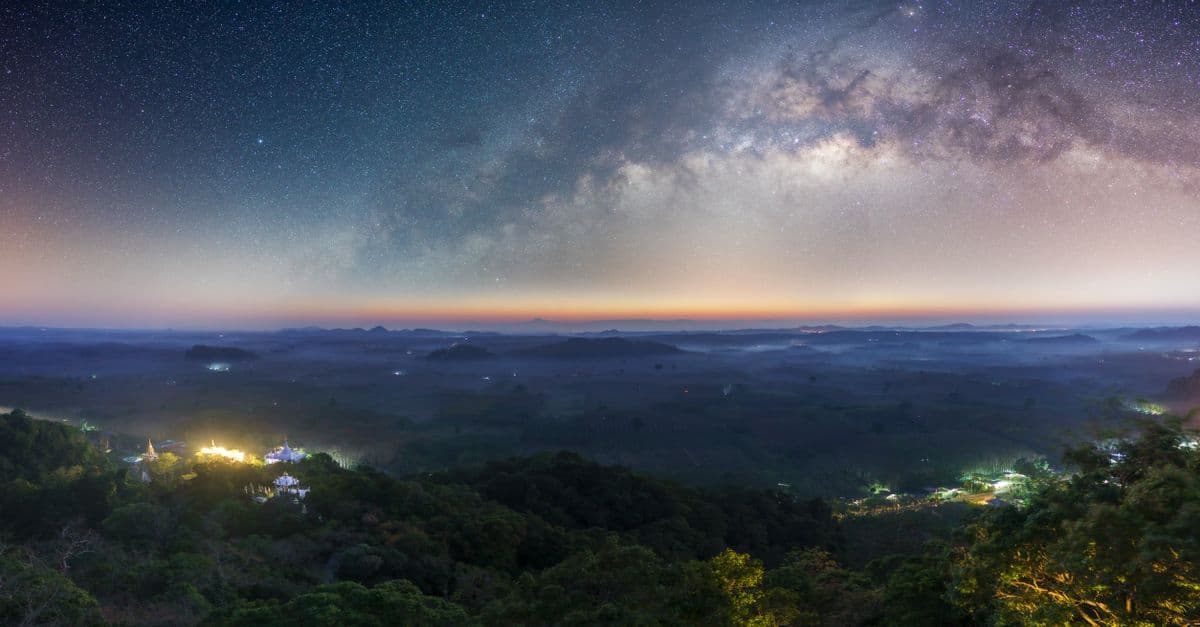
Photo: Luis Felipe Alburquerque Briganti / Pexels
The James Webb Space Telescope cost roughly $10 billion, took more than two decades to build, and had to survive 344 single points of mechanical failure during its first month in space with zero chance of a repair crew. It orbits a gravitational parking spot 1.5 million kilometers (930,000 mi) from Earth, sees the universe almost entirely in infrared light, and has already forced astronomers to rewrite parts of their models for how the earliest galaxies formed. Here's how it works, and what it has actually found since launch.
What JWST is built to see, and why that requires infrared
Every telescope is a trade-off between what it can see and what it must be built to survive. JWST's central design choice — infrared over visible light — comes from two separate problems in astrophysics, and solving both required inventing hardware that didn't exist when the mission was proposed in the 1990s.
The first problem is cosmic expansion. Light from very distant galaxies gets stretched as space itself expands during the billions of years it travels toward us, a phenomenon called redshift. A galaxy that emitted ordinary visible light 13 billion years ago has that light arrive at Earth stretched into infrared wavelengths. Think of it like a siren from a departing ambulance: the pitch drops as the source moves away, and the light from a receding galaxy "drops pitch" into longer, redder wavelengths. To see the first galaxies that formed after the Big Bang, a telescope has no choice but to be sensitive to infrared.
The second problem is dust. Stars are born inside dense clouds of gas and dust that visible light cannot penetrate, the same way headlights scatter uselessly in fog. Infrared light passes through that fog largely unimpeded, which is why JWST can photograph stellar nurseries, protoplanetary discs, and newborn stars that were completely invisible to Hubble's optical cameras.
The catch is that any warm object emits its own infrared radiation, including the telescope itself, the sun, and Earth. To detect infrared light from a galaxy 13 billion light-years away, JWST's instruments have to be colder than almost anything else humans have put into space, according to NASA's official Webb telescope science documentation.
How JWST actually works, piece by piece
The mirror: 18 hexagons acting as one
JWST's primary mirror is 6.5 meters (21.3 ft) across, built from 18 hexagonal segments made of beryllium — a lightweight metal chosen because it stays rigid across extreme temperature swings — each coated in a microscopically thin layer of gold to maximize infrared reflectivity. Combined, the segments give JWST 25.4 square meters of light-collecting area, about 6.25 times more than Hubble's single 2.4-meter mirror, per NASA's Webb mirror technology page.
The mirror was too large to fit inside any existing rocket fairing in one piece, so it launched folded like a piece of origami and unfolded automatically in space over roughly two weeks. Each of the 18 segments then had to be individually nudged into alignment by tiny motorized actuators until the whole array behaved as a single continuous mirror, accurate to a fraction of the wavelength of light it was designed to capture. NASA has described the full deployment sequence, involving 344 mechanisms that each had to work correctly, as the most complex robotic unfolding ever attempted in space.
The sunshield: five layers, the size of a tennis court
Behind the mirror sits a five-layer sunshield roughly the size of a tennis court when fully deployed. Each layer is made of Kapton, a polymer film thinner than a human hair, coated with aluminum and, on the two hottest-facing layers, doped silicon to reflect solar heat. Layered together, the shield blocks about a million times the heat and light that would otherwise reach the telescope's instruments, according to NASA's sunshield technical fact sheet.
Picture five layers of aluminum foil stacked with gaps of vacuum between them rather than touching directly. Each layer radiates absorbed heat sideways, out into space, before it can conduct through to the next layer — which is why five thin, separated sheets block heat far more effectively than one thick one. The result: while the sun-facing side of the shield can reach over 110 °C (230 °F), the instrument side sits at roughly −233 °C (−388 °F).
The instruments: four eyes tuned to different infrared bands
JWST carries four science instruments behind the mirror, each tuned to a slightly different slice of the infrared spectrum and a different scientific job.
| Instrument | Primary function | Operating temperature | Key use |
|---|---|---|---|
| NIRCam (Near-Infrared Camera) | Imaging | ~39 K (−234 °C) | Deep-field surveys, first galaxies, mirror alignment |
| NIRSpec (Near-Infrared Spectrograph) | Spectroscopy | ~39 K (−234 °C) | Chemical composition of distant galaxies and exoplanet atmospheres |
| MIRI (Mid-Infrared Instrument) | Imaging and spectroscopy | 7 K (−266 °C) | Cooler, more dust-penetrating observations; requires active cryocooling |
| NIRISS/FGS (Near-Infrared Imager and Slitless Spectrograph / Fine Guidance Sensor) | Spectroscopy and pointing | ~39 K (−234 °C) | Exoplanet transit spectroscopy, telescope aiming |
Table 1: JWST's four science instruments compared. Source: NASA Webb instrument specifications.
NIRSpec can observe up to roughly 100 objects simultaneously using a grid of microscopic programmable shutters, each one about the width of a few human hairs, that open only over the specific galaxies astronomers want to study in a given field. That capability is what lets JWST gather detailed spectra, essentially chemical fingerprints, of dozens of ancient galaxies in a single observation instead of one at a time.
Where it lives: the second Lagrange point
JWST orbits the second Lagrange point, or L2, a gravitational balance point roughly 1.5 million kilometers from Earth, on the side facing away from the sun. At L2, the combined gravity of the sun and Earth lets the telescope roughly match Earth's orbital pace around the sun without needing constant fuel-burning course corrections, the way a boat can hold position in a slow eddy of a river without paddling.
Positioning JWST at L2 also means the sun, Earth, and moon all stay on the same side of the telescope at all times, so a single sunshield can block all three heat sources simultaneously — something impossible for a telescope in low Earth orbit like Hubble, which passes in and out of Earth's shadow every 90 minutes. The trade-off is permanence: L2 is roughly four times farther than the moon, far beyond the reach of any crewed servicing mission with current technology, per NASA's L2 orbit explainer.
Getting the data home
JWST transmits its observations to Earth through NASA's Deep Space Network, the same global array of giant dish antennas used to communicate with Mars rovers and the Voyager probes. The telescope downlinks roughly 28.6 gigabytes of raw data during each of its two daily contact windows, which mission planners then calibrate and distribute to the international research teams awaiting it, according to NASA's Deep Space Network overview.
How JWST compares to Hubble
JWST did not replace Hubble. The two telescopes were designed to complement each other, observing different wavelengths of light from different vantage points, and both remain operational at the same time.
| Feature | Hubble Space Telescope | James Webb Space Telescope |
|---|---|---|
| Launched | April 24, 1990 | December 25, 2021 |
| Primary mirror | 2.4 m, single piece | 6.5 m, 18 segments |
| Light collected | Mostly visible, near-UV, near-IR | Near- and mid-infrared |
| Orbit | Low Earth orbit (~540 km) | L2 (~1.5 million km) |
| Approximate cost | ~$4.7 billion (2010 dollars, including servicing) | ~$10 billion |
| Servicing | Five crewed Space Shuttle missions | None possible |
| Operating temperature | Ambient/room temperature optics | As low as 7 K in MIRI |
Table 2: Hubble vs. JWST, side by side. Sources: NASA Hubble facts, NASA Webb mission overview.
Because Hubble sees mostly visible and ultraviolet light while JWST sees mostly infrared, astronomers routinely combine images from both to build a more complete picture of a single object — Hubble showing the light young, hot stars emit directly, and JWST showing the cooler dust and gas around them, or the redshifted light from far more distant, ancient structures Hubble simply cannot detect.
The discoveries: what JWST has actually found
The earliest galaxies are unexpectedly mature
JWST's deepest surveys have repeatedly broken their own distance records. In 2024, the JADES survey team confirmed a galaxy called JADES-GS-z14-0 shining from just 290 million years after the Big Bang. By 2025, a separate detection using JWST's MIRI instrument, nicknamed MoM-z14 and found through the "Mirage" survey program, pushed the record even further back to roughly 280 million years after the Big Bang, at a measured redshift of about z≈14.4, according to reporting on the peer-reviewed detection covered by Space.com and Live Science.
What makes these galaxies scientifically uncomfortable isn't just their distance, it's their maturity. Cosmological models built before JWST launched predicted the universe's first galaxies should be small, faint, and only just beginning to form stars at these early epochs. Instead, JWST keeps finding galaxies with substantial, already-established stellar populations far earlier than those models allow, which is actively pushing astrophysicists to revise their theories of how quickly the first stars and galaxies assembled after the Big Bang.
A high-resolution map of the universe's invisible skeleton
In a result published in May 2026, a team led by astronomers at the University of California, Riverside used JWST to trace roughly 164,000 galaxies across 13.7 billion years of cosmic history to build the most detailed map yet of the cosmic web, the filamentary structure of dark matter and gas that all visible matter is threaded through, extending back to when the universe was just one billion years old. The findings were published in The Astrophysical Journal on May 6, 2026, per UC Riverside's official release and independent coverage by Phys.org.
The map shows dense knots of dark matter connected by long, lower-density filaments, with matter concentrated in threads around enormous, nearly empty voids, the same weblike skeleton that theoretical models of dark matter have long predicted but that had never been directly traced this far back in cosmic time or in this much detail, according to a related January 2026 UC Riverside announcement.
Exoplanet atmospheres, in unprecedented chemical detail
Before JWST, astronomers could infer the rough size and orbit of an exoplanet, but rarely say much about what its atmosphere was actually made of. JWST changed that by observing the light of a host star filtering through a transiting planet's atmosphere and reading which wavelengths get absorbed, essentially a chemical fingerprint of the gases present. Confirmed detections now include carbon dioxide (the first direct CO₂ detection on any exoplanet, found on WASP-39b), water vapor, methane, and sulfur dioxide across a range of worlds, per NASA's exoplanet atmosphere findings summaries.
One of the more striking 2026 results involves TOI-199b, a rare giant planet found to have surprisingly Earth-like temperatures along with methane in its atmosphere, as reported by ScienceDaily. Separately, observations of the hot exoplanet WASP-121b published in mid-2026 revealed two completely different chemical "twilights" on its permanent day-night terminator, evidence of dramatically different atmospheric chemistry occurring simultaneously on opposite sides of the same planet as it rotates, according to ScienceDaily's coverage.
K2-18b: a cautionary tale about extraordinary claims
In 2023 and again in April 2025, a research team reported a tentative detection of dimethyl sulfide (DMS) in the atmosphere of K2-18b, a sub-Neptune roughly 124 light-years away. On Earth, DMS is produced almost exclusively by marine microbial life, which is why the initial announcement generated intense public interest as a potential biosignature.
That excitement did not hold up to scrutiny. Multiple independent reanalyses published through 2025, including a NASA-led study and a joint analysis combining JWST's NIRISS, NIRSpec, and MIRI instruments published in Astronomy & Astrophysics, found the DMS signal was not statistically robust: roughly 87.5% of retrieval methods using the preferred data-binning approach did not support the presence of DMS or its related compound DMDS at all, according to the peer-reviewed reanalysis and reporting from Astronomy.com. The signal sat too close to the instrument noise floor to distinguish DMS confidently from several other, more mundane sulfur- and carbon-bearing molecules that fit the data just as well.
Deep fields and stellar nurseries
JWST's deep-field images, built by staring at a single patch of sky for many hours to collect faint light, routinely reveal thousands of galaxies in a region of sky smaller than a grain of sand held at arm's length, with more galaxies visible per frame and in sharper detail than Hubble's deepest comparable images. The "Cosmic Cliffs" image of the Carina Nebula and the "Pillars of Creation" in the Eagle Nebula, both released in JWST's first year of science operations, revealed individual protostars, jets of ejected gas, and protoplanetary discs inside dust columns that appeared as featureless dark pillars in Hubble's earlier images.
Solar System close-ups
Closer to home, JWST has imaged Jupiter's auroras glowing in infrared above both poles, faint ring systems around Neptune not photographed in this much detail since Voyager 2's 1989 flyby, and infrared signatures of icy bodies in the outer solar system that complement data from spacecraft like New Horizons.
What people get wrong about JWST
"JWST disproved the Big Bang"
This claim circulated widely after the early-galaxy discoveries and is false. JWST found early galaxies more developed than pre-launch models predicted, which is a real and significant challenge to specific models of galaxy formation, but it has no bearing on the Big Bang itself. The cosmic microwave background radiation, the observed abundance of light elements like hydrogen and helium, and the large-scale expansion of the universe all remain independently confirmed evidence for the Big Bang, which JWST's data has not contradicted.
"JWST replaced Hubble"
They are complementary instruments observing different wavelengths from different orbits, and both are still active. Hubble still captures visible and ultraviolet light that JWST cannot see at all, and it remains in operational service as of 2026, per NASA's Hubble mission status page.
"The K2-18b life signal was confirmed"
As covered above, it was not. The original 2025 announcement described the DMS signal as tentative from the start, and the burden of a scientific process is to test that kind of claim against independent analysis before it counts as a discovery. Most of the follow-up analyses through late 2025 did not support the original detection.
"JWST can photograph exoplanet surfaces directly"
It cannot, for the same reason a lighthouse a kilometer away outshines a firefly next to it. Exoplanets are enormously fainter than the stars they orbit and sit at angular separations too small to resolve directly except in a handful of special cases involving very young, very large, widely separated planets. Nearly all of JWST's exoplanet science instead comes from transit spectroscopy, watching starlight filter through a planet's atmosphere as it crosses in front of its star.
Why JWST almost didn't happen
JWST's path to launch is arguably as remarkable as anything it has since discovered. The mission was originally proposed with a budget near $1.6 billion and a launch date in the early 2000s; by the time it actually launched on December 25, 2021, the cost had grown to roughly $10 billion after repeated redesigns, technology delays, and schedule slips spanning more than two decades, according to a Congressional Research Service summary of the mission's history.
The reason for the delays was straightforward: much of the hardware JWST needed simply did not exist when the project began. Engineers had to invent new methods for folding and precisely aligning a segmented mirror far larger than any prior space telescope's, new cryocooling technology to hold an instrument at 7 K in the vacuum of space, and an entirely new deployable sunshield architecture, all of which had to work correctly on the first try, with no possibility of a repair mission if something failed.
That first-try requirement made the deployment sequence itself a genuine engineering gamble. NASA identified 344 individual mechanisms, from pins to motors to hinges, where a single failure could have crippled or ended the mission outright. Every one of them functioned as intended during the roughly two-week deployment process following launch, a sequence NASA's own engineering team described as the most complex ever attempted in space.
What's next for JWST
JWST's mission was designed to last at least five years, with a goal of ten, a lifespan limited primarily by the finite propellant it carries for the small thruster burns needed to maintain its position and orientation at L2. Because its launch was unusually precise, NASA has since projected the telescope may have enough fuel to operate for roughly 20 years total, according to NASA's mission longevity statements.
Planned and ongoing campaigns include continued spectroscopy of the very earliest galaxies to further test and refine models of cosmic structure formation, expanded habitability surveys of nearby exoplanet systems including the seven rocky worlds of TRAPPIST-1, deeper mapping of the cosmic web using larger galaxy samples, and continued monitoring of solar system bodies including the outer planets and their moons. Unlike Hubble, JWST has no crewed servicing option, which means when its propellant eventually runs out, probably in the 2040s, the telescope will slowly drift out of its stable orbit and go dark, with no mission currently planned to extend its life beyond that point.
Frequently asked questions
Q: Can JWST see Earth-like exoplanets directly? A: No. Earth-sized planets are far too small and dim relative to their host stars to photograph directly with current technology. JWST instead studies their atmospheres indirectly, by analyzing starlight that passes through the atmosphere during a transit, which is still the most detailed exoplanet atmospheric data ever collected.
Q: Will JWST ever be serviced like Hubble was? A: No. JWST orbits roughly 1.5 million kilometers from Earth, four times farther than the moon, well beyond the reach of any current crewed spacecraft. It carries no docking hardware for a servicing mission, unlike Hubble, which was specifically designed for Space Shuttle astronauts to repair.
Q: Why did JWST take more than 20 years and $10 billion to build? A: Much of its core technology, including the segmented folding mirror, the multilayer sunshield, and the ultra-cold MIRI cryocooler, did not exist when the project was proposed. NASA and its partners had to invent, test, and validate entirely new engineering solutions, several of which had never been attempted in space before.
Q: Did JWST disprove the Big Bang? A: No. JWST found early galaxies that are more developed than some pre-launch models predicted, which challenges specific details of galaxy-formation theory. It has not produced any evidence contradicting the Big Bang itself, which remains supported by the cosmic microwave background and other independent lines of evidence.
Q: How is JWST different from the Hubble Space Telescope? A: Hubble observes mostly visible and ultraviolet light from low Earth orbit and has been serviced by astronauts five times. JWST observes mostly infrared light from 1.5 million kilometers away, has a mirror with about 6.25 times more light-collecting area, and cannot be serviced at all. The two operate simultaneously and are designed to complement each other.
Q: What is the most distant galaxy JWST has found? A: As of 2025, the record holder is a galaxy nicknamed MoM-z14, observed at a redshift of roughly z≈14.4, corresponding to about 280 million years after the Big Bang. It narrowly surpassed the previous record holder, JADES-GS-z14-0, found at roughly 290 million years after the Big Bang.
Q: Is JWST's K2-18b life detection confirmed? A: No. The original 2025 report of dimethyl sulfide, a potential biosignature gas, in K2-18b's atmosphere was described as tentative from the start. Subsequent independent reanalyses through late 2025, including a NASA-led study, found the signal was not statistically robust enough to confirm the detection.
Q: How cold does JWST have to be to work? A: Most of its instruments operate around 39 kelvin (−234 °C / −389 °F), while the mid-infrared instrument, MIRI, runs at just 7 kelvin (−266 °C / −447 °F) using an active cryocooler, making it the coldest instrument NASA has ever flown in space.
Q: How does JWST send its data back to Earth? A: JWST transmits observations to Earth through NASA's Deep Space Network, the same system of large dish antennas used to communicate with Mars rovers and deep-space probes, during two scheduled contact windows each day.
Q: What is the cosmic web that JWST mapped in 2026? A: The cosmic web is the large-scale structure of the universe: filaments of dark matter and gas connecting dense galaxy clusters, surrounding vast, nearly empty voids. In May 2026, a UC Riverside-led team used JWST to trace about 164,000 galaxies and produce the most detailed map of this structure yet, extending back to when the universe was roughly one billion years old.
The takeaway
JWST's real achievement isn't any single image, it's that it turned "what were the first galaxies like" and "what's actually in that exoplanet's atmosphere" from speculation into measurable, testable data. Some of what it has found confirms decades of theoretical work; some of it, like galaxies too mature to exist this early, is actively forcing astrophysicists to rebuild parts of their models. And some early headlines, like the K2-18b biosignature, are a reminder that a single tentative signal is not the same thing as a discovery until independent teams have tried hard to break it. The telescope has fuel for roughly two more decades of observing time, and the biggest questions it was built to answer, about habitability, about the true edge of the observable universe, are still open.
Read next:
Follow new articles
Add SciHub101 to your feed reader to see new science and technology stories.
About the Author
SciHub101 is an independent science and technology publication founded and edited by Buğra Sözeri, a software engineer and app developer based in Türkiye. AI tools assist with drafting and research. Source documentation in the existing archive is uneven, and articles are being reviewed and corrected. The Editorial Team byline identifies editorial responsibility; it does not certify specialist or independent human review. Where we compare products, anything built by our own team is labelled as such — see the editorial guidelines and About page for how corrections and disclosures work.
Related Articles
The Mysteries of Time: Why Aging Slows Down in Space
Astronauts return from space slightly younger than they would have been on Earth. The explanation is real physics — Einstein's theory of relativity — and it has measurable consequences for everything from GPS to interstellar travel.
How Big Is the Universe — and How Much of It Can We Actually See?
The observable universe is 93 billion light-years across. The full universe is bigger — possibly infinitely so. Here's what we can measure, what we can't, and why.
How Many Galaxies Are in the Universe?
Astronomers' galaxy counts have swung from 100 billion to 2 trillion and back to hundreds of billions. Here's why the number keeps changing, and what it actually means.
Nearest Exoplanets That Could Host Life
A guide to the nearest potentially habitable exoplanets, from Proxima b to TRAPPIST-1e, what JWST has found, and why 'habitable' rarely means confirmed.
Complete Space Guide 2026: Astronomy and Cosmology
Astronomy and cosmology explained: the Solar System, stars, black holes, galaxies, the Big Bang, exoplanets and how we observe, with a deep dive for each topic.
How Galaxies Form and Evolve: From the First Stars to Today
Galaxies are not eternal — they are born, grow through mergers, and eventually die. Here's how the universe built these island universes.