Complete Space Guide 2026: Astronomy and Cosmology
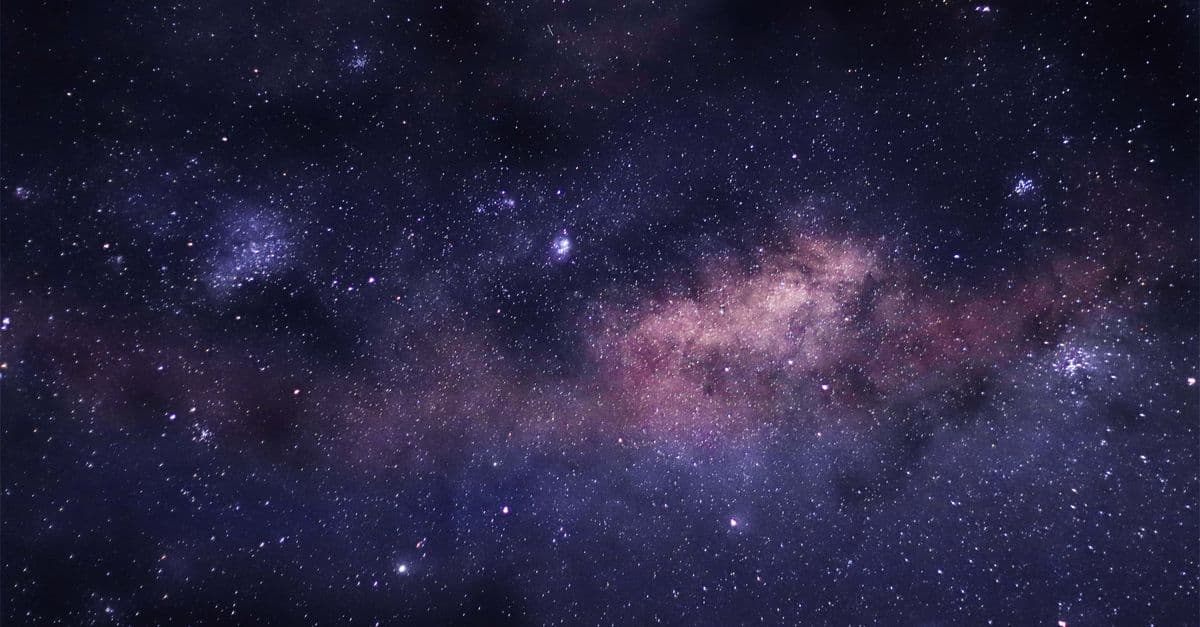
Photo: Francis Glenn Marciano / Pexels
Space is the biggest subject there is, and it is also one of the fastest-moving. In the last decade astronomers have heard colliding black holes, photographed the shadow of a black hole, watched the James Webb Space Telescope pick apart the atmospheres of planets around other stars, and flown humans around the Moon for the first time since 1972.
This guide is the hub for scihub101's space coverage. Each section gives you the core ideas in plain language and then points to the single best deep-dive article on that subtopic. Read it top to bottom as a crash course, or jump to the section you need and follow the links.
A note on numbers: some figures in astronomy are fixed by definition (the astronomical unit), some are measured with small uncertainties (the age of the universe), and some change every month (the count of confirmed exoplanets or known moons). Where a number moves, we date it or give it as approximate.
The Scale of the Universe
Everyday units collapse in space. A kilometre is useless for the distance to another galaxy, so astronomers use a ladder of units:
- Astronomical unit (AU) — the average Earth–Sun distance, fixed by the International Astronomical Union in 2012 at exactly 149,597,870,700 metres (about 150 million km). It is the natural unit inside the Solar System.
- Light-year — the distance light travels in one year, about 9.46 trillion km. It is used for stars and galaxies.
- Parsec — about 3.26 light-years. Professionals prefer it because it falls straight out of the parallax method used to measure distances to nearby stars.
The first serious attempts to measure the cosmos with geometry are older than telescopes. Around 240 BC, Eratosthenes estimated Earth's circumference from shadow angles, and earlier Aristarchus tried to work out the Sun–Moon distance ratio from the geometry of the half Moon. His answer was badly off, but the method was sound and the conclusion — that the Sun is far larger than Earth — was right.
A scale ladder from the Moon to the edge of what we can see
| Object | Approximate distance | Light travel time | Deep dive |
|---|---|---|---|
| The Moon | ~384,000 km | ~1.3 seconds | How the Moon formed |
| The Sun | 1 AU (~150 million km) | ~8.3 minutes | The Sun's future |
| Neptune | ~30 AU | ~4 hours | The planets (below) |
| Voyager 1 (2026) | more than 165 AU | close to one light-day | Voyager in interstellar space |
| Proxima Centauri | ~4.24 light-years | ~4.24 years | Exoplanets section |
| Milky Way's centre | ~26,000 light-years | ~26,000 years | The Central Molecular Zone |
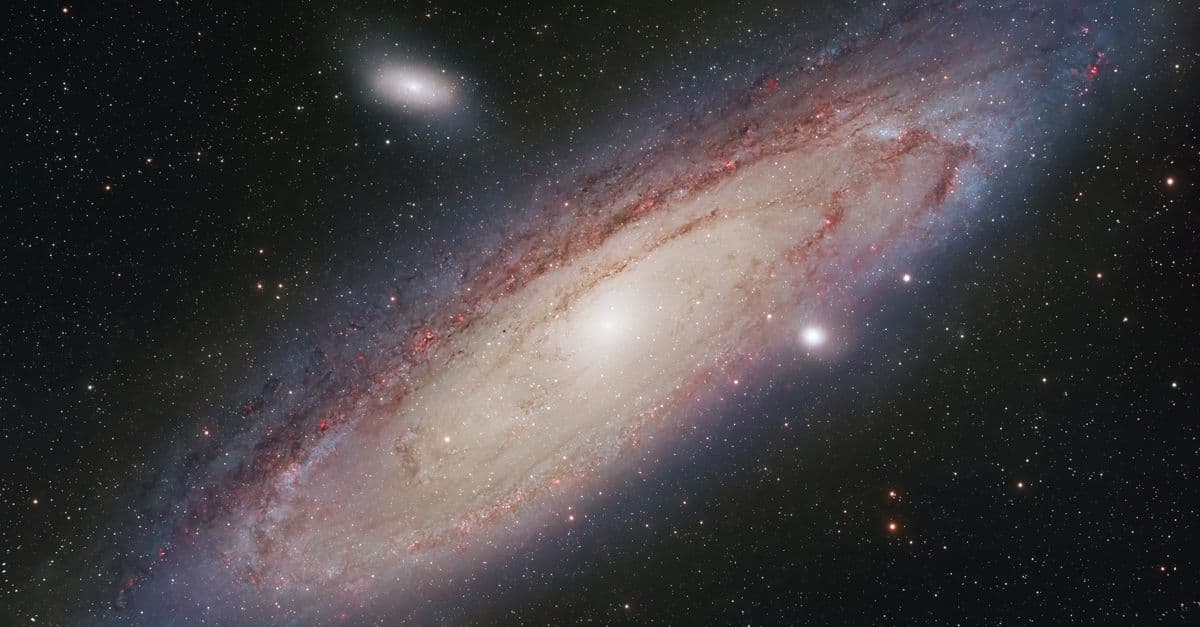
| Andromeda galaxy | ~2.5 million light-years | ~2.5 million years | Galaxies section |
| Edge of observable universe | ~46 billion light-years (radius) | — | How big is the universe? |
Why is the radius of the observable universe about 46 billion light-years if the universe is only about 13.8 billion years old? Because space itself has been expanding while the light was in transit. The galaxies that emitted the oldest light we see have since been carried much farther away. The universe as a whole may be far larger than the observable part, or even infinite; we simply cannot receive light from beyond our horizon.
How many galaxies sit inside that horizon? Estimates have swung over the years — a 2016 study suggested up to around two trillion, while later analyses of the darkness of the sky by the New Horizons team argued for a figure closer to hundreds of billions. Our article on how many galaxies are in the universe explains why the answer depends on how faint a galaxy you are willing to count.
The Solar System
The Sun
The Sun is an ordinary main-sequence star, about 4.6 billion years old, roughly halfway through its hydrogen-burning life. In its core, nuclear fusion turns hydrogen into helium; the energy takes a long, slow random walk outward before escaping as sunlight. The physics of that fusion chain was worked out in the late 1930s by Hans Bethe, and the realisation that stars are made mostly of hydrogen and helium came from Cecilia Payne-Gaposchkin's 1925 doctoral thesis.
The Sun is not quiet. Its magnetic activity rises and falls in a cycle of roughly 11 years, driving sunspots, flares and coronal mass ejections. The current cycle, Solar Cycle 25, reached its peak period in 2024–2025; our explainer on solar maximum covers what that meant for satellites and power grids, and why it produced vivid auroras at unusually low latitudes. NASA's Parker Solar Probe has flown closer to the Sun than any spacecraft before it, sampling the corona directly.
In roughly five billion years the Sun will run short of core hydrogen, swell into a red giant and eventually shed its outer layers, leaving a white dwarf.
The planets
The eight planets fall into two families. The inner four — Mercury, Venus, Earth and Mars — are small and rocky. The outer four are giants: Jupiter and Saturn are mostly hydrogen and helium, while Uranus and Neptune contain larger fractions of water, ammonia and methane "ices" and are called ice giants. Our guide to every planet in the Solar System walks through each one; a few stand out:
- Venus is the hottest planet even though Mercury is closer to the Sun. A thick carbon dioxide atmosphere traps heat in a runaway greenhouse, keeping the surface around 465 °C. See why Venus is hotter than Mercury and the chemistry of Venus's atmosphere.
- Mars is a cold desert today, but dry river valleys, lake beds and minerals that form in water show it was once wetter. Losing its global magnetic field left the atmosphere exposed to erosion by the solar wind — the story told in why Mars lost most of its atmosphere. It also hosts Olympus Mons, the largest volcano in the Solar System.
- Jupiter is the largest planet, and its Great Red Spot is a storm wider than Earth that has been shrinking over the past century; the science of the Great Red Spot explains why.
- Saturn has the most spectacular rings, made mostly of water ice. All four giant planets have ring systems — planetary rings explained covers them all. NASA's Cassini mission ended in 2017 by diving into Saturn after a final series of orbits between the planet and its rings; see the Cassini Grand Finale.
Pluto was reclassified as a dwarf planet by the IAU in 2006 because it has not cleared its orbital neighbourhood of other bodies. Why Pluto is not a planet lays out the definition and the ongoing debate.
Moons and ocean worlds
Some moons are more scientifically interesting than many planets. Jupiter and Saturn each have dozens of known moons, and the counts keep climbing as surveys find small irregular moons, so any exact number dates quickly. The headline moons:
- Europa (Jupiter) and Enceladus (Saturn) hide liquid-water oceans beneath their icy crusts. Cassini flew through plumes of water vapour and ice grains venting from Enceladus's south pole. These two are the prime targets in the search for life on the ocean moons; evidence for seafloor chemistry is covered in Enceladus's hydrothermal vents.
- Ganymede is the largest moon in the Solar System — bigger than Mercury — and likely also hosts a subsurface ocean (Ganymede explained).
- Io is the most volcanically active body known, heated by tidal flexing from Jupiter (Io explained).
- Titan (Saturn) has a thick nitrogen atmosphere and lakes of liquid methane and ethane.
- Triton (Neptune) orbits backwards relative to its planet's spin, a sign it was captured (Triton).
Our own Moon most likely formed from debris thrown off when a Mars-sized body struck the early Earth — the giant-impact hypothesis.
Small bodies: asteroids, comets and the outer reaches
Between Mars and Jupiter lies the asteroid belt; beyond Neptune lies the Kuiper Belt, home to Pluto and other icy bodies; and far beyond that, the hypothesised Oort Cloud is thought to supply long-period comets. Start with asteroids, comets and meteors explained, then the Kuiper Belt and Oort Cloud. Returned samples — from missions such as JAXA's Hayabusa2 (asteroid Ryugu) and NASA's OSIRIS-REx (asteroid Bennu) — are now letting scientists study pristine material from the early Solar System in the lab; see how asteroid samples reveal Solar System history.
Occasionally something arrives from outside the Solar System entirely. 2I/Borisov, found in 2019, was the first confirmed interstellar comet (Borisov explained).
For the innermost planet in detail, see Mercury explained. The geometry that governs all of these orbits is in Kepler's three laws, and the radiation zones trapped by Earth's own magnetic field are covered in the Van Allen belts.
Stars and Stellar Life Cycles
How stars are born
Stars form inside cold, dense clouds of gas and dust. When a clump of a molecular cloud becomes dense enough, gravity wins over gas pressure and it collapses, heating up until hydrogen fusion ignites in the core. The Orion Nebula, about 1,300–1,400 light-years away, is the nearest large star-forming region — see the Orion molecular cloud and our deeper guide to stellar nurseries. Leftover material often settles into a flat protoplanetary disk, where planets form.
Classifying stars
Astronomers sort stars by surface temperature using the spectral sequence O, B, A, F, G, K, M, from hottest and bluest to coolest and reddest. The Sun is a G-type star. This scheme grew out of work at Harvard Observatory in the early twentieth century. Plotting stars by temperature and luminosity — the Hertzsprung–Russell diagram — shows that most of them sit on a "main sequence" where they spend the bulk of their lives fusing hydrogen. Our guide to types of stars and stellar classification unpacks the system.
At Harvard, Henrietta Leavitt found that a class of pulsating stars, Cepheid variables, have a reliable relationship between their pulsation period and their true brightness. That made them "standard candles" — and the key to measuring distances to other galaxies.
The most common stars are red dwarfs: small, cool, dim and extremely long-lived. Because they are so numerous, and because their planets are easier to detect, they dominate the search for nearby habitable worlds — though their flares complicate the picture (why red dwarfs matter for life searches).
How stars die
A star's mass decides its fate:
- Low- and medium-mass stars like the Sun swell into red giants, pass through a late asymptotic giant branch phase, puff off their outer layers as a planetary nebula, and leave a hot, Earth-sized core called a white dwarf. About 97% of stars in the Milky Way are expected to end this way (white dwarfs: the fate of most stars).
- Massive stars, roughly more than eight times the Sun's mass, build up an iron core that cannot release energy through fusion. The core collapses in under a second and the star explodes as a core-collapse supernova, leaving a neutron star or a black hole.
Subrahmanyan Chandrasekhar showed in the early 1930s that a white dwarf cannot be more massive than about 1.4 solar masses — the Chandrasekhar limit. A white dwarf in a binary that pushes past that threshold can be destroyed in a thermonuclear explosion, a Type Ia supernova. The two main families of supernovae are compared in supernova types explained; the broader overview is what happens when a star dies.
Supernovae matter to us directly: they forge and scatter many of the heavy elements in planets and people (why supernovae matter to life on Earth). A well-studied example of the aftermath is Cassiopeia A, a young supernova remnant.
On the longest timescales, the last stars to shine will be red dwarfs burning slowly for trillions of years — the far future of stellar evolution.
Neutron Stars and Black Holes
Neutron stars and pulsars
When a massive star's core collapses but stays below the threshold for a black hole, it becomes a neutron star: typically more mass than the Sun compressed into a sphere about 20 km across, so dense that a teaspoon of its material would weigh billions of tonnes. Many spin rapidly and sweep beams of radio emission across space; when a beam crosses Earth we see regular pulses — a pulsar.
The first pulsar was spotted in 1967 by Jocelyn Bell Burnell, then a graduate student at Cambridge, in the chart recordings of a radio telescope she had helped build. The story is told in the Bell Burnell pulsar discovery. Some pulsars rotate so steadily that they rival atomic clocks (how pulsars keep such accurate time).
For the full picture — magnetars, internal structure and why neutron stars are natural laboratories for physics at extreme densities — read our consolidated article, neutron stars: the most extreme objects in the universe.
Black holes
A black hole is a region where gravity is so strong that nothing, not even light, can escape once it crosses the boundary called the event horizon. Albert Einstein's general relativity predicts them; Roger Penrose showed in 1965 that their formation is a robust consequence of the theory, work recognised with a share of the 2020 Nobel Prize in Physics.
Black holes come in broad mass classes:
- Stellar-mass black holes, from a few to tens of solar masses, born in the collapse of massive stars.
- Supermassive black holes, millions to billions of solar masses, at the centres of most large galaxies — including Sagittarius A* at the heart of the Milky Way, about four million solar masses.
- Intermediate-mass black holes, a gap class with growing but still debated evidence.
The differences between the first two are covered in stellar vs supermassive black holes, and the record-holders in the biggest black holes ever found. Our main explainer, black holes: formation and Hawking radiation, is the best starting point.
Stephen Hawking showed in 1974 that quantum effects should make black holes emit faint thermal radiation and very slowly lose mass. For a stellar-mass black hole, this Hawking radiation is far too weak to detect, so it remains unconfirmed by observation (Hawking radiation explained).
In April 2019 the Event Horizon Telescope collaboration released the first image of a black hole's shadow, the supermassive black hole in the galaxy M87, and in May 2022 it followed with an image of Sagittarius A*. How a planet-sized "virtual telescope" was built out of radio dishes worldwide is explained in the first image of a black hole.
Speculative relatives of black holes — wormholes — are allowed as mathematical solutions of general relativity but have no observational support; wormholes explained separates the physics from the science fiction.
Galaxies
A galaxy is a gravitationally bound system of stars, gas, dust and dark matter. In the 1920s Edwin Hubble used Leavitt's Cepheid relation to show that the Andromeda "nebula" lies far outside the Milky Way, settling the question of whether other galaxies exist. In 1929 he published evidence that more distant galaxies are receding faster — the observational foundation of the expanding universe.
Galaxies come in three broad shapes: spirals (like the Milky Way and Andromeda), ellipticals (smooth, often older and redder), and irregulars. Why spiral arms persist rather than winding up is a classic puzzle; the leading explanation is density waves, covered in why galaxies have spiral arms.
The Milky Way is a barred spiral about 100,000 light-years across, with a supermassive black hole at its centre and a halo of old globular clusters — dense balls of hundreds of thousands of ancient stars. It has grown by absorbing smaller galaxies, and is on course to merge with Andromeda in several billion years (galactic cannibalism covers both). In 2010 the Fermi gamma-ray telescope revealed two giant lobes of gamma-ray emission above and below the galactic centre, whose origin is still debated (the Fermi bubbles mystery).
How do you weigh something you can't put on a scale? By measuring how fast stars and gas orbit, how galaxy clusters bend background light, and how hot their gas is — techniques explained in how astronomers weigh galaxies. That last technique leads straight to one of the biggest puzzles in physics.
Cosmology: The Universe as a Whole
The Big Bang
The Big Bang theory says the universe was once extremely hot and dense and has been expanding and cooling ever since. It is not an explosion into pre-existing space; space itself stretches. Several independent lines of evidence support it: the expansion of the universe, the abundances of light elements such as helium and deuterium, and the cosmic microwave background (CMB).
George Gamow and colleagues worked out in the 1940s how the light elements would be produced in the first minutes and predicted that a cooled relic radiation should fill space. In 1965, Arno Penzias and Robert Wilson at Bell Labs found a persistent microwave hiss they could not eliminate — the CMB (the discovery of the cosmic microwave background). Today its temperature is measured at about 2.725 kelvin.
The European Space Agency's Planck satellite mapped the CMB in fine detail. Its final 2018 results give an age of the universe of about 13.8 billion years. For the overview, read the Big Bang theory explained; for the sequence of events in the first seconds, minutes and hundreds of thousands of years, see how the Big Bang actually happened. The later "cosmic dawn", when the first stars and galaxies reionised the hydrogen gas between galaxies, is covered in what is reionization.
A related puzzle: the Big Bang should have produced matter and antimatter in nearly equal amounts, yet the universe today is made of matter. Why is still unknown (what is antimatter).
Dark matter
In the 1970s Vera Rubin and Kent Ford measured how fast stars orbit in spiral galaxies and found that the outer regions rotate far too fast to be held together by the visible matter alone. Combined with earlier hints from galaxy clusters and later evidence from gravitational lensing and the CMB, this points to dark matter: material that has gravity but does not emit or absorb light. Gravitational lensing — the bending of light by mass, first tested during the 1919 Eddington eclipse expedition — is now one of the main ways dark matter is mapped (how gravitational lensing magnifies galaxies).
Decades of direct-detection experiments deep underground have not yet caught a dark matter particle. Dark matter in 2026: evidence and current theories summarises where the candidates stand, and dark matter detection experiments explains how the searches work.
Dark energy
In 1998 two teams studying distant Type Ia supernovae found that the expansion of the universe is speeding up, not slowing down — work awarded the 2011 Nobel Prize in Physics. Whatever drives the acceleration is called dark energy. According to Planck's results, ordinary matter makes up only about 5% of the universe's energy content, dark matter about 27%, and dark energy about 68%. Our dark matter and dark energy explainer covers both, including recent survey results hinting that dark energy may change over time — a claim that is still being tested.
The edges of cosmology
Some ideas sit at or beyond the edge of testable science. Several versions of the multiverse arise from inflation theory and string theory, but none has observational confirmation; multiverse theory explained sorts the versions by how testable they are.
A simple question, why the night sky is dark, turns out to be evidence for a universe of finite age: see Olbers' paradox.
Exoplanets and the Search for Life
Finding planets around other stars
The first planet around a Sun-like star, 51 Pegasi b, was announced in 1995 by Michel Mayor and Didier Queloz (Nobel Prize, 2019). As of early 2026, the NASA Exoplanet Archive lists more than 6,000 confirmed exoplanets; the archive passed the 6,000 mark in 2025 and the total grows every few weeks.
The two most productive methods are:
- Transits — a planet passing in front of its star dims it slightly and periodically. NASA's Kepler mission and its successor TESS have found thousands of planets this way. Machine learning now helps sift the light curves for faint signals (AI and exoplanet detection).
- Radial velocity — a planet's gravity makes its star wobble, shifting the star's spectral lines back and forth.
Most known exoplanets are types absent from our Solar System, such as "super-Earths" and "mini-Neptunes". Start with what exoplanets are and whether any could host life.
Habitability
The habitable zone is the range of distances from a star where a planet with the right atmosphere could keep liquid water on its surface. Being in the zone is not enough: size, atmosphere, magnetic field, tidal locking and stellar flares all matter (what makes a planet habitable). The nearest candidates, including planets around Proxima Centauri and TRAPPIST-1, are profiled in the nearest exoplanets that could host life.
Since JWST began science operations in 2022, astronomers have been able to read the chemistry of exoplanet atmospheres by watching starlight filter through them during transits — detecting carbon dioxide, water vapour and other molecules (the exoplanet atmosphere revolution; how astronomers detect water on exoplanets).
Are we alone?
There is no confirmed evidence of life beyond Earth. The field of astrobiology attacks the question from several sides: studying life in extreme environments on Earth, searching Mars and the ocean moons, looking for biosignature gases in exoplanet atmospheres, and listening for technological signals (astrobiology: life beyond Earth). Laboratory work matters too — the Miller–Urey experiment showed in 1952–53 that amino acids can form from simple chemistry under energetic conditions. The Viking landers ran the first life-detection experiments on Mars in 1976, with results that are still argued over (the Viking life-detection experiments).
The Drake equation frames the question of how many communicating civilisations might exist, though most of its terms are still unknown (the Drake equation). The tension between the apparent odds and the silence we observe is the Fermi paradox (why isn't the universe full of alien civilisations?). For a balanced overview of where the evidence stands, read the search for extraterrestrial life. Carl Sagan did more than anyone to bring these questions to a general audience.
How We Observe the Universe
Almost everything we know about space arrived as a signal: light across the electromagnetic spectrum, ripples in spacetime, or particles.
Telescopes across the spectrum
Galileo Galilei turned a telescope on the sky in 1609–1610 and found Jupiter's four large moons and the phases of Venus — strong evidence against an Earth-centred system. Modern telescopes cover the full spectrum, and each band shows something different:
| Band | What it reveals | Example instrument | Deep dive |
|---|---|---|---|
| Radio | Cold gas, pulsars, black-hole jets | Event Horizon Telescope network | Fast radio bursts |
| Microwave | The cosmic microwave background | ESA's Planck | Cosmology section |
| Infrared | Dust-hidden star formation, distant redshifted galaxies | JWST | How space telescopes see in infrared |
| Visible | Stars, galaxies, planets | Hubble | Seeing the early universe |
| Gamma rays | Extreme, high-energy events | Fermi Gamma-ray Space Telescope | Fermi telescope |
The James Webb Space Telescope launched on 25 December 2021 and operates near the Sun–Earth L2 point, about 1.5 million km from Earth, where its sunshield can keep its instruments cold. Its infrared vision lets it see galaxies whose light left them a few hundred million years after the Big Bang. Read how JWST works and what it has found, a running list of JWST discoveries 2022–2026, and why NASA parks telescopes at Lagrange points.
Ground telescopes face one obstacle space telescopes don't: the atmosphere. Turbulence makes stars twinkle and blurs images, which is why large observatories use adaptive optics (why stars twinkle).
Gravitational waves
On 14 September 2015, the two LIGO detectors in the United States recorded a gravitational-wave signal, GW150914, from two black holes merging about 1.3 billion light-years away — the first direct detection of ripples in spacetime, a century after Einstein predicted them. The 2017 Nobel Prize in Physics went to Rainer Weiss, Barry Barish and Kip Thorne. In August 2017 LIGO and Virgo detected a neutron-star merger (GW170817) that telescopes also saw across the spectrum, opening "multi-messenger" astronomy. See the first gravitational-wave detection, the broader gravitational waves explained, and how machine learning helps LIGO find signals.
Neutrinos
Neutrinos are nearly massless particles that pass through almost everything. They were first detected at a nuclear reactor in 1956 (the Cowan–Reines neutrino detection). In February 1987, underground detectors in Japan and the United States caught a burst of about two dozen neutrinos from Supernova 1987A in the Large Magellanic Cloud — direct confirmation that core collapse releases most of its energy as neutrinos.
Human Spaceflight and Exploration
The foundations
Konstantin Tsiolkovsky derived the rocket equation in the early twentieth century, and Robert Goddard launched the first liquid-fuelled rocket in 1926. The Soviet Union put Sputnik 1 into orbit in 1957 and Yuri Gagarin became the first human in space in 1961.
On 20 July 1969, Apollo 11 landed on the Moon. Across six landings between 1969 and 1972, twelve astronauts walked on the lunar surface and brought back 382 kg of samples that still drive lunar science (the Apollo program's science legacy). Precise orbital calculations by NASA mathematicians including Katherine Johnson were part of that effort.
Robotic explorers
Robots have gone much farther than people. Voyager 1 and 2, launched in 1977, flew past the giant planets; Voyager 1 crossed into interstellar space in August 2012 and Voyager 2 in November 2018. They remain the most distant human-made objects (Voyager 1 and 2; the Voyager Grand Tour).
On Mars, rovers have progressed from the small Sojourner in 1997 to Curiosity (landed 2012) and Perseverance (landed 2021), which is caching rock cores for possible return to Earth (Mars rovers from Sojourner to Perseverance). Because radio signals take minutes to travel each way, the rovers drive partly on their own (AI and autonomous rover navigation).
Living in space
The International Space Station has been continuously crewed since November 2000. It is a laboratory for how weightlessness and radiation affect the human body — muscle and bone loss, fluid shifts, vision changes (the International Space Station explained; how astronauts survive in space). Low Earth orbit is also increasingly crowded with satellites and debris (AI for space-debris tracking).
Back to the Moon, and on to Mars
NASA's Artemis program aims to return humans to the lunar surface. Artemis I flew an uncrewed Orion capsule around the Moon in 2022. Artemis II launched on 1 April 2026 with Reid Wiseman, Victor Glover, Christina Koch and Canadian astronaut Jeremy Hansen, flew around the Moon on a free-return trajectory, and splashed down in the Pacific on 10 April 2026, according to NASA. Landing plans for later missions have shifted several times, so check the Artemis program explained for the current schedule. SpaceX's Starship, the fully reusable vehicle selected as a lunar lander, is still in test flights (Starship explained).
Mars is the long-term goal. Radiation, low gravity, toxic perchlorate soil and a thin atmosphere make it a hard place to live (can humans live on Mars?). For the wider set of missions shaping this decade, see the most important space missions of the 2020s.
Common Misconceptions
- "Seasons happen because Earth is closer to the Sun in summer." No — they come from Earth's 23.4° axial tilt. Earth is actually closest to the Sun in early January (why we have seasons).
- "There is no gravity on the ISS." Gravity at the station's altitude is still about 90% of surface gravity. Astronauts float because they are in continuous free fall around Earth.
- "Black holes suck everything in." At a safe distance a black hole's gravity behaves like that of any object of the same mass. If the Sun were replaced by a black hole of equal mass, Earth's orbit would not change.
- "The Big Bang happened at a point in space." It happened everywhere; space itself has been expanding from a hot, dense state.
- "The Moon's phases are caused by Earth's shadow." They are caused by the changing angle between the Sun, Moon and Earth. Earth's shadow only falls on the Moon during a lunar eclipse (why the Moon has phases).
Where to Go Next
If you are new to astronomy, a good reading path is: the scale ladder above → the planets → types of stars → what happens when a star dies → black holes → the Big Bang → exoplanets. Readers who want the experimental side of physics behind all this should continue with our complete science experiments guide.
FAQ
Q: How old is the universe? A: About 13.8 billion years, based on the European Space Agency's Planck measurements of the cosmic microwave background combined with the standard cosmological model.
Q: How big is the observable universe? A: Its radius is about 46 billion light-years, so its diameter is roughly 93 billion light-years. It is larger than 13.8 billion light-years because space has expanded while light was travelling to us. The whole universe may be much larger, or infinite.
Q: How many exoplanets have been found? A: As of early 2026, the NASA Exoplanet Archive lists more than 6,000 confirmed exoplanets. The number rises every few weeks as new candidates are confirmed, mainly from transit surveys such as TESS.
Q: What is dark matter? A: Dark matter is the name for unseen mass that reveals itself only through gravity — in galaxy rotation speeds, gravitational lensing and the cosmic microwave background. It makes up about 27% of the universe's energy content, but no experiment has yet identified what it is made of.
Q: Can anything escape a black hole? A: Nothing that crosses the event horizon can escape as matter or light. Theory predicts black holes slowly emit Hawking radiation, but for black holes of stellar mass or larger it is far too faint to detect.
Q: Has life been found anywhere else? A: No. There is no confirmed evidence of life beyond Earth. The strongest places to search are Mars, the ocean moons Europa and Enceladus, and the atmospheres of nearby exoplanets.
Q: When did humans last go to the Moon? A: The last landing was Apollo 17 in December 1972. In April 2026, Artemis II carried four astronauts around the Moon without landing, the first crewed lunar flight since then.
Bottom Line
Space science runs on a few big ideas: gravity and fusion shape stars, stars make the elements and the planets, and the universe has been expanding from a hot, dense beginning for about 13.8 billion years. Most of its contents — dark matter and dark energy — remain unexplained, and the question of whether life exists elsewhere is still open. Those open questions are why this field keeps producing headlines. Use the links above to go as deep as you like on any of them.
Follow new articles
Add SciHub101 to your feed reader to see new science and technology stories.
About the Author
SciHub101 is an independent science and technology publication founded and edited by Buğra Sözeri, a software engineer and app developer based in Türkiye. AI tools assist with drafting and research. Source documentation in the existing archive is uneven, and articles are being reviewed and corrected. The Editorial Team byline identifies editorial responsibility; it does not certify specialist or independent human review. Where we compare products, anything built by our own team is labelled as such — see the editorial guidelines and About page for how corrections and disclosures work.
Related Articles
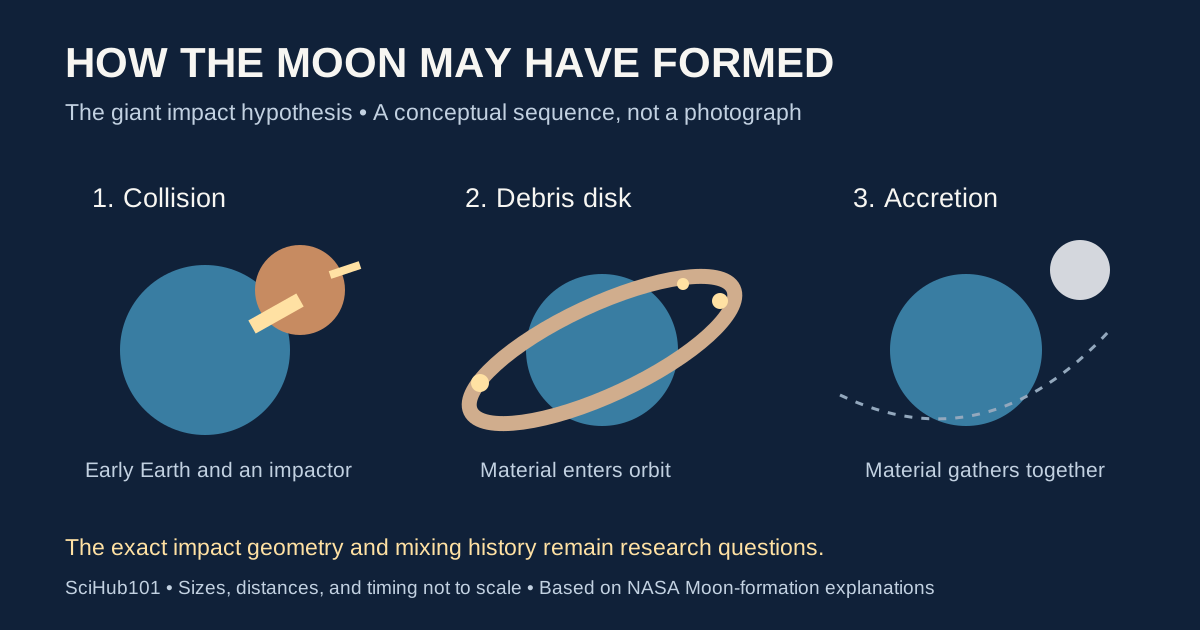
How the Moon Was Formed: Evidence for a Giant Impact
The Moon's origin is reconstructed from rocks, its interior, and orbital models. A giant impact leads the explanation, but the precise scenario is uncertain.
Black Holes Explained: How They Work
What is a black hole, really? Event horizons, Hawking radiation, spaghettification, the nearest known black holes, and the first images of M87* and Sgr A*.
How Galaxies Form and Evolve: From the First Stars to Today
Galaxies are not eternal — they are born, grow through mergers, and eventually die. Here's how the universe built these island universes.
Hubble Space Telescope: The Discoveries That Changed Astronomy
Hubble launched with a flawed mirror and came back from the brink to become humanity's greatest eye on the cosmos.
How AI and Machine Learning Are Revolutionizing Exoplanet Detection
Machine learning is transforming the search for alien worlds, helping scientists find thousands of exoplanets hidden in Kepler's vast data.
How Stars Are Born and Die: The Complete Story of Stellar Evolution
Every atom of iron in your blood was forged inside a dying star. Here's the full life cycle that made you possible.