The Orion Molecular Cloud: Our Closest Star Factory
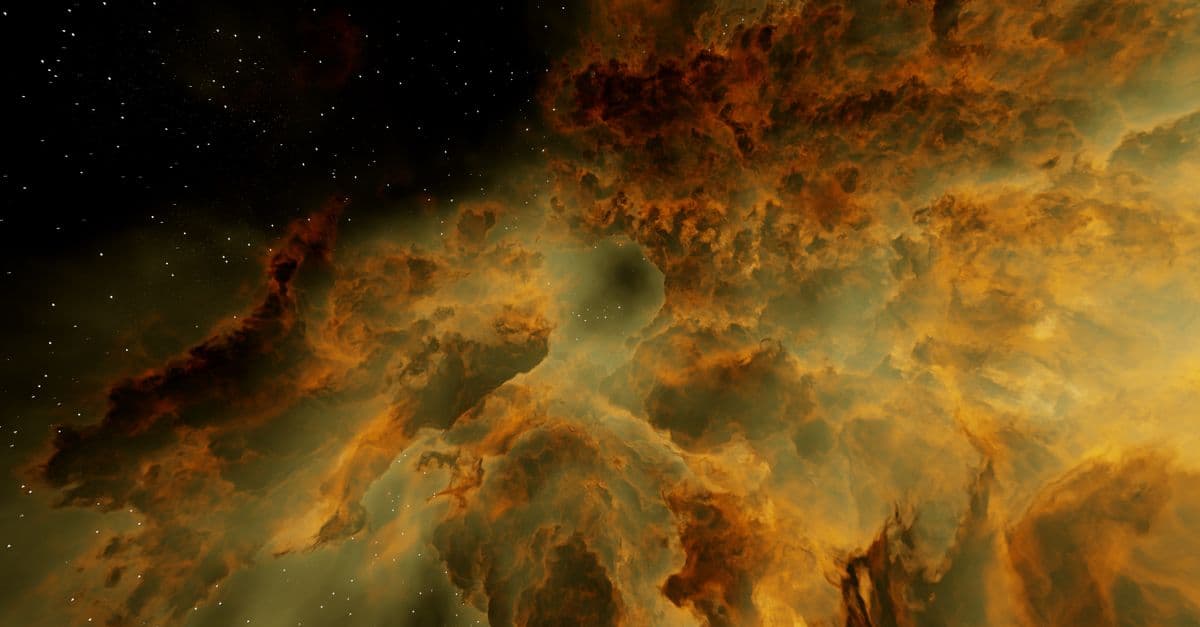
Photo: Marek Pavlík / Pexels
About 1,300 light-years away, in the sword of the constellation Orion, a stellar explosion went off roughly 500 years ago — not a supernova, but something almost as violent: a gravitational slingshot that flung multiple protostars apart at speeds of 30–40 km/s and released energy equivalent to 20 supernovae in shockwaves still spreading through the cloud today. Nobody saw it happen. We only know because ALMA radio observations in 2017 reconstructed the trajectories backward in time to a single origin point. That explosion, and the 500-year-old cavity it left behind, sits at the heart of the Orion Molecular Cloud — the nearest massive star-forming region on Earth's cosmic doorstep.
What the Orion Molecular Cloud Actually Is
Orion Molecular Cloud (OMC) — a giant molecular cloud complex roughly 240 light-years in diameter located in the constellation Orion, containing several hundred thousand solar masses of cold molecular hydrogen gas and dust at temperatures of 10–30 K (-263 to -243°C).
The OMC is not a single object but a hierarchy of nested structures. At the largest scale, the complex spans a region several degrees across in the sky — if it were visible to the naked eye, it would cover an area roughly 30 times the area of the full Moon. Inside the large-scale complex sit several distinct subregions, each at a different stage of star formation: Orion A (the southern cloud, which contains the Orion Nebula), Orion B (the northern cloud, containing the Horsehead Nebula), and several smaller associated clouds.
The Orion A cloud alone is roughly 120 light-years long and contains about 100,000 solar masses of gas. The Orion Nebula (Messier 42) occupies a cavity carved into the front face of Orion A — a place where the radiation from a handful of newly formed massive stars has blasted away the surrounding gas, creating a blister of ionized hydrogen glowing pink in photographs.
Source: Bally, Annual Review of Astronomy and Astrophysics (2008) — Comprehensive review of the Orion Molecular Cloud complex: structure, star formation history, stellar populations, and the role of triggered star formation.
The complex is notable not because it is unusually large (the Tarantula Nebula in the Large Magellanic Cloud is far more massive and active) but because it is close. At 1,300 light-years, it is the nearest region of ongoing massive star formation — a scale model of the processes that shaped our own solar system, near enough to resolve individual protoplanetary disks with current telescopes.
The Orion Nebula: A Cavity Lit From Within
Most people's first encounter with the Orion Molecular Cloud is the Orion Nebula itself: that fuzzy smudge visible to the naked eye in Orion's sword, resolved in binoculars into a hazy glow, and in photographs into a magnificent pink-and-blue cloud wreathing a knot of bright stars. The nebula is roughly 24 light-years across and sits about 1,344 light-years away.
H II region — a region of interstellar gas where hydrogen atoms have been ionized (electrons stripped) by ultraviolet radiation from nearby hot, massive stars, causing the gas to glow in characteristic emission lines (particularly H-alpha at 656 nm, producing the characteristic pink/red color in photographs).
The Orion Nebula is an H II region — a cavity of ionized gas blown into the face of the Orion A molecular cloud by four massive young stars called the Trapezium Cluster. The nebula is not a closed bubble but an open blister: the ionized gas on the front face of the cloud is expanding toward us at about 10 km/s, while the molecular cloud behind it is dense enough to resist ionization and expansion in that direction. We are looking into a bowl of luminous plasma.
The gas we see glowing in photographs is a tiny fraction of the mass in this region. The visible nebula is mostly hydrogen plasma at roughly 10,000 K. Behind it — invisible in optical light — is the far denser cold molecular cloud from which new stars are currently forming. The beautiful nebula is a surface effect; the action is deeper inside.
Source: Genzel & Stutzki, Annual Review of Astronomy and Astrophysics (1989) — Physical conditions, chemistry, and star formation activity in the Orion region, including the molecular cloud structure behind the visible nebula.
The Trapezium Cluster: Four Stars Running a Foundry
At the heart of the Orion Nebula sits the Trapezium — a tight cluster of four young, hot, massive stars that together produce essentially all the ultraviolet radiation ionizing the nebula. The four main stars, designated Theta1 Orionis A through D, are packed within a region about 1.5 light-years across and are among the hottest stars known, with surface temperatures of 30,000–45,000 K.
Theta1 Orionis C is the dominant member: a spectral type O6 star with a mass roughly 33 times the Sun's, a surface temperature around 45,000 K, and a luminosity about 200,000 times the Sun's. A single O-type star like this emits more ultraviolet photons per second than billions of cooler stars combined. Theta1 C is the primary source driving the nebula's ionization.
| Star | Spectral Type | Mass (M☉) | Temperature (K) | Luminosity (L☉) |
|---|---|---|---|---|
| Theta1 Ori A | B0.5 | ~15 | ~30,000 | ~10,000 |
| Theta1 Ori B | B1 | ~7 | ~28,000 | ~4,000 |
| Theta1 Ori C | O6 | ~33 | ~45,000 | ~200,000 |
| Theta1 Ori D | B0 | ~22 | ~32,000 | ~50,000 |
The Trapezium Cluster is young — no older than about 300,000 years, making it one of the youngest massive star clusters in the galaxy. At that age, the universe of terrestrial timescales barely registers: 300,000 years ago, Homo sapiens had only recently evolved. These stars have been ionizing the Orion Nebula for a geological eyeblink.
The full Orion Nebula Cluster (ONC) surrounding the Trapezium contains roughly 2,000 young stars within a few light-years, all formed in the last 1–2 million years from the same molecular cloud. The cluster is still embedded in the cloud gas; many of its stars are not yet on the hydrogen-burning main sequence. It is a star cluster in the act of coalescing from its birth material.
Source: Hillenbrand, Astronomical Journal (1997) — Mass function, age distribution, and pre-main-sequence status of 1,600+ stars in the Orion Nebula Cluster, establishing it as one of the best-studied young stellar populations.
OMC-1: The Explosion Behind the Nebula
Directly behind the Orion Nebula, roughly 0.1 light-years from the Trapezium, lies a region called OMC-1 — one of the most energetically active spots in the nearest few thousand light-years. In 2017, ALMA observations revealed something extraordinary: the molecular gas in OMC-1 is flying outward in all directions from a single point, with velocities of up to 150 km/s, in a pattern that looks exactly like an explosion frozen in time.
Tracing the gas trajectories backward, astronomers determined that roughly 500 years ago — sometime around 1500 CE — several protostars in the OMC-1 core underwent a dynamic interaction. The densely packed young protostars, likely in a multiple system, gravitationally interacted and some were ejected. The energy released in this interaction — from the tightening of orbits and the ejection of members — was deposited into the surrounding molecular gas, driving an outflow that has been expanding for five centuries.
Protostellar ejection event — a gravitational interaction among several young stars or protostars in which energy exchange causes some members to be flung outward at high velocity, with the remaining orbital energy released as a shockwave into the surrounding gas.
The total kinetic energy of the OMC-1 outflow is estimated at roughly 4 × 10⁴⁴ joules — comparable to 20 typical supernova explosions. The outflow is visible in carbon monoxide (CO) emission lines at radio wavelengths and in near-infrared H₂ (molecular hydrogen) emission, producing a spectacular pattern of glowing knots and fingers extending across roughly 0.1 light-years. JWST's 2022–2023 imaging resolved individual shockwave features within the outflow in extraordinary detail, identifying over 80 separate "bow shocks" where the outflowing gas plows into and compresses ambient material.
Source: Bally, Ginsburg, Arce et al., Astrophysical Journal (2017) — ALMA CO observations revealing the OMC-1 explosive outflow structure and reconstructing the protostellar ejection event ~500 years ago.
Proplyds: Solar Systems Caught in the Act
One of the Orion Nebula's most scientifically significant features is a population of objects first identified by Hubble in 1993: proplyds (protoplanetary disks), young solar systems in the act of forming, silhouetted against the bright nebular background or glowing as cometary teardrops around young stars.
Proplyd — a contraction of "protoplanetary disk"; a disk of gas and dust orbiting a young star that is being photoevaporated by radiation from nearby hot stars, producing a characteristic teardrop or comet-like appearance as the disk surface boils off.
The Hubble Space Telescope's 1993 images of the Orion Nebula showed, for the first time, small dark silhouettes — the shape of disks seen edge-on against the bright nebular gas — and bright cometary-shaped objects, each with a young star at the head and a tail pointing away from the Trapezium. These tails are the result of photoevaporation: ultraviolet radiation from Theta1 Orionis C strips material from the outer disk and drives it away as a wind, creating the tail morphology. Each tail carries roughly a Jupiter mass of material per million years — a disk can be significantly depleted in just a few million years by this process.
JWST has transformed proplyd science. By 2023, JWST had resolved more than 700 proplyds in the Orion Nebula Cluster, many of which were too small or too faint for Hubble to characterize. The JWST images reveal disk sizes, structures, and in some cases the presence of gaps and rings — features that indicate ongoing planet formation. A gap in a proplyd disk at a specific radius is the gravitational fingerprint of an unseen protoplanet sweeping material out of its orbital lane.
Source: McCaughrean & O'Dell, Astronomical Journal (1996) — Hubble Space Telescope census of protoplanetary disks in the Orion Nebula, identifying 153 proplyds and quantifying photoevaporation rates.
Source: Habart et al., Astronomy & Astrophysics (2023) — JWST NIRCam imaging of the Orion Nebula, the PDRs4All survey detecting over 700 proplyds and resolving detailed disk substructure for the first time.
The Orion proplyds represent something close to time travel: we are seeing solar-system-scale structures at the same evolutionary stage our own solar system occupied 4.5 billion years ago. The Sun almost certainly formed in a cluster environment similar to the Orion Nebula Cluster, surrounded by other young stars and subject to photoevaporation from nearby massive stars. The proplyds tell us what that early chapter looked like.
What the Proplyds Tell Us About Our Own Solar System
The analogy between Orion's proplyds and the young solar system runs deeper than morphology. Several lines of evidence suggest the early solar system was shaped by conditions similar to those in the Orion Nebula Cluster.
First, meteorites. Short-lived radioactive isotopes found in the oldest meteorites — specifically aluminum-26 (¹⁰⁶Al, half-life 720,000 years) and iron-60 (⁶⁰Fe, half-life 2.6 million years) — must have been injected into the solar nebula shortly before it collapsed, because they have completely decayed in all meteorite samples. The most plausible source is a nearby massive star: either a supernova or the stellar winds from an OB star in the same cluster as the proto-Sun. The Orion Nebula Cluster, where multiple massive stars are embedded within a stellar nursery, is exactly this kind of environment.
Second, disk truncation. The solar system's outer edge — the relatively sharp drop in density of the Kuiper Belt at about 50 AU — may reflect early truncation of the solar nebula by photoevaporation. Disks in the outer Orion Nebula Cluster (farther from the Trapezium, receiving less UV) are typically 100–200 AU in radius. Disks closer to the Trapezium are truncated to 30–50 AU by photoevaporation — the same size as our solar system's current outer boundary.
This is not proof that the Sun formed in an Orion-like cluster. It is circumstantial evidence, assembled from multiple independent sources, that points in the same direction: we are looking at Orion's proplyds and recognizing something familiar.
Source: Adams, Annual Review of Astronomy and Astrophysics (2010) — Review of environmental effects on protoplanetary disks, including photoevaporation by nearby OB stars and the implications for our solar system's early history.
The Horsehead and Beyond: Orion B's Different Story
While Orion A hosts the spectacular active star formation of the Orion Nebula, the northern cloud — Orion B — tells a different story. Orion B contains several of the most iconic dark nebulae in the sky, including the Horsehead Nebula (Barnard 33) and the Flame Nebula (NGC 2024).
The Horsehead Nebula is a pillar of dense cold gas and dust protruding from a larger molecular cloud, silhouetted against the bright glow of the emission nebula IC 434 behind it. It is not a stellar nursery in active collapse — it is a photodissociation region (PDR), a zone where the molecular cloud is being eroded by ultraviolet radiation from the nearby hot star Sigma Orionis. The photogenic shape results from differential erosion: the denser knot forming the horse's head erodes more slowly than the surrounding cloud.
Photodissociation region (PDR) — a zone at the boundary between an H II region and a molecular cloud, where ultraviolet photons energetic enough to dissociate molecules but not energetic enough to fully ionize hydrogen dominate the chemistry; characterized by complex molecular emission lines from species like polycyclic aromatic hydrocarbons (PAHs), CO, and H₂.
JWST's PDRs4All survey targeted the Orion Bar — another PDR within the Orion Nebula — as one of its first science targets in 2022, resolving the chemical transition from ionized gas to molecular cloud at sub-arcsecond scales for the first time. The images reveal a layered structure: ionized gas, then atomic, then molecular, compressed into a boundary zone just a few hundred AU thick.
Source: Peeters et al., Astronomy & Astrophysics (2024) — JWST PDRs4All survey of the Orion Bar photodissociation region, resolving the ionized-to-molecular transition at unprecedented spatial resolution.
The Orion OB1 Association: The Older Generation
The Orion Molecular Cloud complex sits within a much larger structure: the Orion OB1 Association, a loose grouping of hot young stars spread across roughly 300 light-years that represents multiple generations of star formation going back tens of millions of years.
OB association — a sparse, gravitationally unbound group of young, hot OB-type stars sharing a common origin, typically dispersing into the galactic field within a few tens of millions of years.
The Orion OB1 association is divided into four subgroups (OB1a through OB1d) with ages from roughly 2–3 million years (the youngest, OB1d — essentially the Orion Nebula Cluster) to 10–12 million years (the oldest, OB1a). The aging gradient across subgroups tells a story: star formation has been marching across the molecular cloud complex over tens of millions of years, with each generation of massive stars compressing gas and potentially triggering the next generation.
This sequential or triggered star formation model — older stars creating the conditions for younger stars — makes the Orion OB1 association a rare place where we can observe multiple chapters of the same story laid out across the sky simultaneously. The 10-million-year-old stars in OB1a are dispersing into the galaxy; the 300,000-year-old Trapezium stars are at peak ionizing power; and the OMC-1 protostars are in mid-formation. It is a time-lapse image of stellar evolution, played not in sequence but in parallel.
Source: Blaauw, Annual Review of Astronomy and Astrophysics (1964) — Original classification and analysis of the Orion OB1 association subgroups, establishing the framework for understanding sequential star formation.
What JWST Has Added to the Picture
Between 2022 and 2024, JWST targeted the Orion Nebula Cluster multiple times across multiple programs, with results that substantially advanced the field in several directions.
The PDRs4All survey resolved the Orion Bar photodissociation region at scales of a few AU — the first time the internal structure of a PDR has been seen in this detail. The images show that the boundary between ionized and molecular gas is not smooth but is corrugated at small scales, with dense knots and pillars projecting into the ionized zone. This small-scale structure affects how quickly molecular gas is destroyed, with implications for how long planet-forming disks survive in dense stellar clusters.
In the proplyd population, JWST identified a new class of objects: very faint, compact sources dubbed "Jupiter Mass Binary Objects" or JuMBOs. These are pairs of planetary-mass objects — roughly 1 to 13 Jupiter masses each — floating freely in space, not orbiting any star, and yet gravitationally bound to each other. Roughly 40 JuMBO pairs were identified in the JWST Orion survey. Their origin is unclear: they may be planets ejected from forming solar systems, or they may be the lowest-mass objects that can form directly from molecular cloud fragmentation. Either way, they were not predicted by standard models.
Source: Pearson & McCaughrean, arXiv (2023) — JWST discovery of Jupiter Mass Binary Objects (JuMBOs) in the Orion Nebula Cluster: 40 free-floating planetary-mass binary pairs with separations of 25–400 AU.
The JuMBOs represent a genuine puzzle. Standard planet formation theory does not naturally produce planet-mass objects in wide binary pairs floating freely in space. Standard star formation theory does not naturally produce objects below about 10 Jupiter masses from molecular cloud fragmentation. The JuMBOs fall uncomfortably between these two theories, requiring either revision of one or both or the addition of a new formation pathway.
What the Orion Complex Models for Cosmology
The Orion Molecular Cloud's proximity makes it more than a local curiosity. It is the reference case against which star formation theories for the entire universe are calibrated.
Every theoretical model of how star formation rates scale with gas density, turbulence, and magnetic field strength must be consistent with what we observe in Orion. Every model of how protoplanetary disks form, evolve, and are destroyed by stellar irradiation is tested against the Orion proplyd population. Every simulation of how stellar clusters disperse into the galactic field must reproduce the age gradients seen in Orion OB1.
This is why Orion appears in the reference lists of astrophysics papers studying galaxies billions of light-years away. The physics playing out 1,300 light-years from Earth is the same physics, at the same scales, that determines how many habitable planets can form in a given galaxy. Orion is not just the nearest star factory. It is the ground truth for the entire field of star formation.
For a broader picture of how these newborn stars evolve over their lifetimes, stellar evolution from main sequence to death traces the full arc. For the dense remnants left behind when massive Orion stars eventually explode, the properties of neutron stars show what awaits the most massive Trapezium members in roughly 5 million years.
The Takeaway
The Orion Molecular Cloud is not simply a pretty nebula. It is a 240-light-year laboratory operating 1,300 light-years away, running every phase of star and planet formation simultaneously. The Trapezium Cluster has been ionizing the Orion Nebula for 300,000 years. OMC-1's explosive outflow has been expanding for 500 years. The proplyds JWST resolves today are at the same stage our solar system occupied 4.5 billion years ago. The JuMBOs floating between them challenge every current model of how planetary-mass objects form. Orion is close enough to resolve, complex enough to be inexhaustible, and fundamental enough that understanding it means understanding how stars and planets form anywhere in the universe.
Frequently Asked Questions
Q: How far away is the Orion Molecular Cloud?
A: The Orion Nebula — the most prominent part of the cloud — is approximately 1,344 light-years away, measured using Hubble Space Telescope and radio VLBI parallaxes. The broader Orion Molecular Cloud complex spans a range of distances from roughly 1,000 to 1,500 light-years, depending on which subregion is measured.
Q: What is a proplyd and how many are in Orion?
A: A proplyd is a protoplanetary disk — a disk of gas and dust around a young star — that is being photoevaporated by ultraviolet radiation from nearby hot stars, giving it a teardrop or cometary appearance. The Hubble Space Telescope identified roughly 150–180 proplyds in the Orion Nebula Cluster. JWST's more sensitive infrared imaging has identified over 700 as of 2023, including many too small or faint for Hubble to resolve.
Q: What caused the OMC-1 explosion?
A: The OMC-1 explosion was not a nuclear event but a gravitational one. Roughly 500 years ago, several young protostars in a tight multiple system underwent a dynamical interaction in which some members were ejected at high velocity. The energy released — from the tightening of remaining orbits and the kinetic energy transferred to ejected stars — was deposited as shockwaves into the surrounding molecular gas, producing an expanding outflow still visible today. The total energy was equivalent to roughly 20 supernova explosions.
Q: Is the Orion Nebula visible to the naked eye?
A: Yes. Under dark skies, the Orion Nebula (M42) appears as a fuzzy, slightly bright patch in Orion's sword — the middle "star" of the three that form the sword hanging below Orion's Belt. It has a visual magnitude of about 4, making it detectable with the naked eye but much more impressive in binoculars, which reveal the nebular glow clearly. A small telescope shows the four Trapezium stars at its center.
Q: How does the Orion Nebula Cluster relate to how our solar system formed?
A: Several lines of evidence suggest the early solar system formed in a cluster environment similar to the Orion Nebula Cluster. Short-lived radioactive isotopes in primitive meteorites require a nearby massive star to have injected them into the solar nebula, consistent with formation in an OB-star cluster. The sharp outer edge of the Kuiper Belt at 50 AU may reflect truncation of the solar nebula by photoevaporation in the cluster. These are circumstantial but consistent with Orion-like birthplace conditions.
Q: What are JuMBOs and why are they surprising?
A: Jupiter Mass Binary Objects (JuMBOs) are pairs of planetary-mass objects (1–13 Jupiter masses each) floating freely in space in the Orion Nebula Cluster, not orbiting any star, yet gravitationally bound to each other. JWST identified about 40 pairs in 2023. They are surprising because neither standard planet formation theory (which produces planets orbiting stars) nor standard star formation theory (which has difficulty forming objects below about 10 Jupiter masses by direct collapse) predicts free-floating planetary-mass binaries at this frequency.
Q: How long will the Orion Nebula last?
A: The Orion Nebula as a glowing H II region will persist for roughly another few million years before the Trapezium stars exhaust their hydrogen fuel and die. The most massive Trapezium stars (particularly Theta1 Orionis C) will end their lives as supernovae in roughly 2–5 million years. Those explosions will disperse the remaining molecular cloud gas, ending star formation in this particular region. The stars already formed will disperse into the galactic disk over tens of millions of years as the Orion OB1 association dissolves.
Read next:
Follow new articles
Add SciHub101 to your feed reader to see new science and technology stories.
About the Author
SciHub101 is an independent science and technology publication founded and edited by Buğra Sözeri, a software engineer and app developer based in Türkiye. AI tools assist with drafting and research. Source documentation in the existing archive is uneven, and articles are being reviewed and corrected. The Editorial Team byline identifies editorial responsibility; it does not certify specialist or independent human review. Where we compare products, anything built by our own team is labelled as such — see the editorial guidelines and About page for how corrections and disclosures work.
Related Articles

The Pioneer Anomaly: 30 Years of Mystery, One Elegant Solution
For three decades, Pioneer 10 and Pioneer 11 were moving slightly wrong. Both spacecraft decelerated toward the Sun at a rate that Newtonian gravity and general relativity could not explain. The discrepancy was small — equivalent to losing 1 km/h of speed every decade — but it was real, consistent, and reproducible. Physicists proposed dark matter, modified gravity, new physics. The answer turned out to be heat.
The Central Molecular Zone: The Milky Way's Turbulent Heart
Within 500 parsecs of the Milky Way's center lies a region unlike anything else in the galaxy — the Central Molecular Zone. It contains roughly 10% of the entire galaxy's molecular gas compressed into less than 0.1% of its volume. Star formation there should be rampant, but it is strangely quiet. Giant molecular clouds orbit at velocities that defy simple physics. A cloud called the Brick should have already collapsed into thousands of stars, yet it has not. Understanding the CMZ means understanding what keeps the center of our galaxy from exploding with new stars — and what occasionally makes it erupt instead.
Stellar Nurseries: How Stars Are Born in the Dark
The Pillars of Creation are not killing stars — they are building them. Inside those towering columns of cold gas, dense knots called Bok globules are collapsing under their own weight, heating up toward nuclear ignition. The James Webb Space Telescope, in 2022, showed us the newborn stars Hubble never could.
Nearest Exoplanets That Could Host Life
A guide to the nearest potentially habitable exoplanets, from Proxima b to TRAPPIST-1e, what JWST has found, and why 'habitable' rarely means confirmed.
JWST's First Exoplanet Atmosphere: What WASP-39b Revealed
In July 2022, the James Webb Space Telescope detected carbon dioxide in the atmosphere of WASP-39b — a hot Jupiter 700 light-years away — with a clarity no previous telescope could match. It was the sharpest single spectrum ever taken of an exoplanet atmosphere and the opening demonstration of what JWST was built to do. But the CO₂ detection was only the beginning: the same data revealed sulfur dioxide formed by photochemistry, a chemical map of how the planet formed, and a template for reading the atmospheres of smaller, cooler, potentially habitable worlds.
Cassiopeia A: The Youngest Supernova Remnant in the Milky Way
Cassiopeia A is the expanding debris field of a star that exploded around 1680 CE — yet almost no one on Earth recorded it. Today, X-ray and infrared telescopes reveal a forensic masterpiece: shock waves, newly minted heavy elements still glowing from the blast, and a neutron star cooling at the center. Cas A is not just a beautiful object. It is the best laboratory we have for understanding what supernovae actually do to the universe.