Stellar Nurseries: How Stars Are Born in the Dark
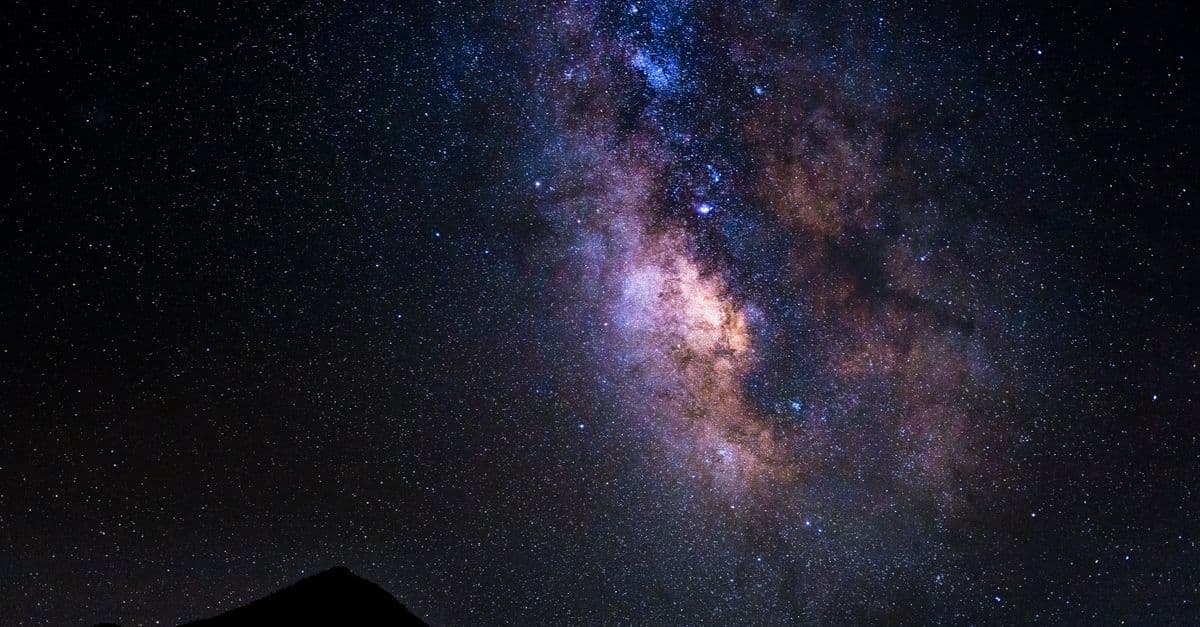
Photo: Brett Sayles / Pexels
The Pillars of Creation look like destruction. Three towers of gas and dust, each several light-years tall, being eaten away by the radiation and stellar winds from the hot young stars already blazing in front of them. What the visible-light Hubble image hides — because visible light cannot penetrate dust — is that the pillars are simultaneously a demolition site and a maternity ward. Inside the cold, dark interior of each column, gas is collapsing right now, heating up, and in a few hundred thousand years, some of those collapsed knots will ignite. The James Webb Space Telescope, imaging in infrared in 2022, showed us those protostars for the first time.
The Raw Material: Molecular Clouds
Stars do not form in ordinary space. The average density of interstellar space is about one hydrogen atom per cubic centimeter — too diffuse for gravity to dominate. Star formation requires giant molecular clouds (GMCs): vast, cold aggregations of mostly molecular hydrogen (H₂), with densities ranging from 100 to 100,000 molecules per cubic centimeter and temperatures of 10–30 K (-263 to -243°C). GMCs are the largest structures in the Milky Way by mass that are gravitationally self-bound.
Giant molecular cloud — a cold, dense region of interstellar space dominated by molecular hydrogen, with masses ranging from a few thousand to several million solar masses and diameters from 50 to 300 light-years.
The Milky Way contains roughly 6,000 giant molecular clouds with total mass around 1 billion solar masses. The Orion Molecular Cloud — the nursery behind the Orion Nebula — is roughly 1,500 light-years from Earth and spans about 240 light-years, containing perhaps 100,000 solar masses of gas. The Eagle Nebula (M16), home to the Pillars of Creation, is about 6,500 light-years away and contains several thousand solar masses of actively star-forming material.
What makes molecular clouds stand apart from ordinary interstellar gas is exactly what makes them invisible to optical telescopes: they are cold and dusty. Interstellar dust grains — mostly silicates and carbon compounds a few tenths of a micrometer in size — scatter and absorb visible light, rendering the interiors of molecular clouds optically opaque. This is why Hubble could photograph the surface and halo of the Pillars of Creation but not their star-forming cores. Infrared light, with longer wavelengths, passes through dust more readily — which is why JWST, operating at infrared wavelengths, changed the picture entirely.
Source: McKee & Ostriker, Annual Review of Astronomy and Astrophysics (2007) — Comprehensive review of molecular cloud properties, star formation efficiency, and the role of turbulence and magnetic fields in regulating star formation.
The Jeans Mass: When Gravity Wins
A molecular cloud does not spontaneously collapse everywhere at once. Most of the gas is in approximate equilibrium: gravitational attraction pulling inward is balanced by thermal pressure pushing outward, and often also by magnetic pressure from the interstellar magnetic field threading through the cloud. For collapse to begin, something must tip this balance.
The critical threshold is called the Jeans mass, named after British physicist Sir James Jeans who derived it in 1902. The Jeans mass is the minimum mass of a gas cloud at a given temperature and density for which gravity dominates over pressure:
M_J ≈ 5.6 × (T/10 K)^(3/2) × (n/1000 cm⁻³)^(-1/2) solar masses
where T is temperature in Kelvin and n is particle number density per cubic centimeter.
For a typical cold molecular cloud core at 10 K and density 10,000 molecules per cubic centimeter, the Jeans mass is roughly 1–5 solar masses — conveniently similar to the masses of typical stars. Pockets of gas that exceed this mass threshold will collapse gravitationally. Those below it will re-expand.
Think of the Jeans mass as the cloud's self-destruct threshold: once a pocket of gas grows dense and cold enough that its weight exceeds what its own thermal pressure can support, gravity takes over. The pocket begins to fall inward — slowly at first, then accelerating as collapse concentrates the mass into an ever-smaller volume.
Source: Jeans, Philosophical Transactions of the Royal Society A (1902) — Derivation of the gravitational instability criterion for gas clouds; seminal work establishing the Jeans mass and Jeans length.
What tips clouds over the Jeans threshold in the first place? Several triggers have been identified:
- Nearby supernova shockwaves compressing gas in the cloud
- Spiral arm density waves sweeping through the galactic disk
- Radiation and stellar winds from nearby massive stars (the irony: hot young stars can compress gas into collapse while also destroying the same clouds)
- Cloud-cloud collisions when two GMCs intersect
- Magnetic field dissipation via ambipolar diffusion, slowly reducing the magnetic support holding clouds up
The Pillars of Creation are being bombarded by ultraviolet radiation from the young star cluster NGC 6611 sitting nearby. This radiation is evaporating the pillars from the outside — a process called photoevaporation — but it is also compressing the dense cores within the pillars, potentially triggering new rounds of star formation at the same time it destroys the birthplace.
Bok Globules: The Simplest Stellar Nurseries
Not all star formation happens inside giant spectacular pillars. The simplest, most isolated star-forming structures in the galaxy are Bok globules: small, round, dark clouds of gas and dust, typically 0.1–2 light-years in diameter and containing 1–50 solar masses of material. They appear in optical images as dark patches against brighter background nebulae — holes in the stars, apparently.
Bok globule — a small, isolated, dark molecular cloud, roughly spherical, optically opaque due to dust, typically containing 1–50 solar masses of molecular hydrogen and dust; often the site of low-mass star formation.
Bok globules were catalogued by Dutch-American astronomer Bart Bok and his collaborator Edith Reilly in a 1947 paper in which they proposed — correctly, though it took decades to confirm — that these dark patches were the sites of ongoing star formation. In 1990, IRAS infrared observations confirmed that most Bok globules contain embedded infrared sources: protostars.
Because Bok globules are isolated and relatively simple — no complicated turbulent environment, no nearby OB stars heating and disrupting the gas — they are the cleanest laboratories for studying pure gravitational collapse. Models developed from Bok globule observations form the backbone of stellar formation theory that is then extended to messier environments like the Pillars of Creation.
A famous example is Barnard 68, a Bok globule roughly 500 light-years away in the constellation Ophiuchus. It is roughly 0.5 light-years in diameter, contains about 2 solar masses of gas, and is just below the Jeans mass — not yet collapsing, but on the verge. It appears in VLT optical images as a perfectly round black void punched into a field of background stars. Infrared imaging by the VLT shows the faint reddened stars behind it, confirming that it is dense dust rather than empty space.
Source: Alves, Lada, & Lada, Nature (2001) — Infrared extinction mapping of Barnard 68 revealing a density profile consistent with a pressure-confined, marginally stable Bonnor-Ebert sphere.
The Collapse: From Cloud to Protostar
When a Jeans-unstable cloud core begins to collapse, the physics proceeds in two distinct phases. In the first phase — isothermal collapse — the gas falls inward fast enough that the heat generated by compression escapes as radiation before it can build up pressure. The cloud collapses nearly freely, density increasing rapidly, temperature staying nearly constant at 10–30 K. This phase can last a few hundred thousand years.
In the second phase, the central density reaches roughly 10¹³ particles per cm³, at which point the cloud becomes optically opaque to its own infrared radiation. Heat can no longer escape. The collapse shifts to adiabatic behavior: pressure rises sharply as temperature rises, eventually halting the inward fall and creating a hydrostatic core — the embryonic protostar.
This hydrostatic core starts at roughly 5 AU in radius and a temperature of a few hundred Kelvin. It is not yet hot enough for nuclear fusion (that requires about 10 million K in the core). It shines only because of the gravitational energy released by infalling material. An enormous envelope of gas and dust continues to fall onto it, building mass over the next 100,000–500,000 years.
During this phase, the object is called a Class 0 protostar — embedded so deeply in its dusty cocoon that it emits no visible light whatsoever, only far-infrared and submillimeter radiation. The entire luminosity comes from accretion. Temperatures in the surrounding envelope range from a few thousand Kelvin near the central object to just above the cosmic microwave background temperature at the outer edges.
Source: André, Ward-Thompson, & Barsony, Protostars and Planets IV, ASP (2000) — Classification scheme for young stellar objects from Class 0 through III based on infrared spectral energy distributions and evolutionary stage.
A critical development during this accretion phase is the formation of an accretion disk and bipolar outflow jets. The infalling gas carries angular momentum — it cannot fall straight inward — and instead forms a rotating disk around the protostar, similar to water spiraling down a drain. Material in the disk gradually loses angular momentum through viscous and magnetic processes and spirals inward onto the star. Simultaneously, magnetic field lines threading the inner disk drive high-speed jets of gas along the rotation axis, perpendicular to the disk plane, at velocities of 100–400 km/s. These jets are visible as Herbig-Haro objects — bright knots and arcs of shocked gas where the jets plow into the surrounding cloud.
The T Tauri Phase: The Last Miles to the Main Sequence
After roughly 100,000–500,000 years of embedded accretion, the protostellar envelope thins as infalling gas is consumed or blown away. The young star becomes visible in optical light for the first time. At this stage — called a T Tauri star for low-mass protostars like the future Sun — the object sits above the main sequence on the Hertzsprung-Russell diagram, bloated and luminous compared to its eventual stable state.
T Tauri star — a young, pre-main-sequence star with mass below about 2 solar masses, characterized by irregular variability, strong magnetic activity, an accretion disk, and stellar winds, in the phase between protostar and hydrogen-burning main sequence star.
T Tauri stars are dramatic objects. They pulsate irregularly, showing brightness fluctuations of 1–3 magnitudes over days to weeks driven by variable accretion, rotating star spots, and disk occultations. Their spectra show emission lines from hot accreting gas and strong lithium absorption — lithium is rapidly destroyed by nuclear reactions once a star reaches the main sequence temperature, so its presence is a reliable youth indicator. They drive powerful stellar winds (T Tauri winds) that begin to disperse the remaining disk material.
The T Tauri phase for a solar-mass star lasts roughly 10–100 million years before the core temperature reaches the 10 million K needed to fuse hydrogen. During this time the star contracts under gravity (a process called Kelvin-Helmholtz contraction), heating the core gradually. When hydrogen fusion ignites, the outward radiation pressure from the core stabilizes against gravity and the star reaches the zero-age main sequence — the beginning of its stable hydrogen-burning life.
For a more massive star (above about 8 solar masses), this pre-main-sequence phase is far shorter: massive stars reach the main sequence in as little as 100,000 years, so massive protostars are essentially already on or near the main sequence while still accreting from their disks, a process quite unlike the more leisurely solar-mass scenario.
Source: Hartmann, Calvet, Gullbring & D'Alessio, Astrophysical Journal (1998) — Observational characterization of T Tauri star accretion rates, disk masses, and the evolutionary timeline to the main sequence.
What JWST Revealed in 2022: The Hidden Stars of the Pillars
On October 19, 2022, NASA released the James Webb Space Telescope's near-infrared image of the Pillars of Creation, taken with the NIRCam instrument at wavelengths from 1.4 to 4.6 micrometers. The difference from the 1995 and 2014 Hubble visible-light images was immediate and striking.
Where Hubble showed dark, opaque pillars against a glowing nebular background, JWST's infrared vision penetrated much of the dust. The pillars became partially transparent, and within them — and in the space around them — thousands of previously unseen young stars appeared. Many appear as brilliant points embedded in or near the pillar surfaces. A few can be identified by the orange-tipped protrusions they create as their stellar winds and outflows push against the pillars' dense gas — these are the Evaporating Gaseous Globules (EGGs) first identified by Hubble in 1995 but far more clearly resolved by JWST.
The most scientifically significant JWST detections were the young stellar objects (YSOs) scattered through the image — protostars still surrounded by protoplanetary disks, identifiable by their red colors (indicating thermal emission from warm dust) and by the faint red wisps extending from some of them, which are shocked jet emission from the earliest stages of bipolar outflow formation.
Source: NASA Science (2022) — JWST NIRCam image of the Pillars of Creation (M16/Eagle Nebula) revealing hundreds of young stellar objects and protostellar jets invisible to Hubble, published October 2022.
JWST also imaged the Pillars at mid-infrared wavelengths using MIRI (Mid-Infrared Instrument). At these longer wavelengths, the pillars practically glow — dust grains that absorb stellar radiation re-emit it in the mid-infrared, making the warmest, densest regions of the pillars brilliantly luminous. The MIRI image is nearly the photographic inverse of the Hubble image: bright where Hubble was dark, dark where Hubble's background nebula was bright.
The Eagle Nebula at JWST resolution effectively became a time-lapse frame in slow motion: the Hubble images showed stars already formed and pillars being destroyed; JWST added the missing chapter — the stars in the act of forming.
Stellar Feedback: How Stars Destroy Their Own Nurseries
The most paradoxical aspect of stellar nurseries is that star formation is its own worst enemy. As massive stars form within a molecular cloud, they emit enormous fluxes of ultraviolet radiation that ionize the surrounding hydrogen, creating H II regions — glowing bubbles of hot plasma. The expanding H II region exerts pressure on the surrounding molecular cloud, compressing some regions into star-forming cores while blowing other regions apart entirely.
Stellar feedback — the collective term for the ways that newly formed stars influence their environment through radiation, stellar winds, and eventually supernova explosions.
The net effect of stellar feedback is that molecular clouds are self-limiting. Models and observations both suggest that only 1–10% of the gas in any given molecular cloud actually forms stars before the remaining gas is dispersed by the feedback from the first generation of stars. This inefficiency is a fundamental feature of galaxy evolution — without it, the Milky Way would have converted all of its gas into stars in the first billion years and would contain no molecular clouds today.
The Pillars of Creation illustrate this feedback loop in an almost didactic way: NGC 6611, the star cluster whose radiation is destroying the pillars, formed from the Eagle Nebula's gas itself perhaps 5 million years ago. The first generation of massive stars formed there are now dismantling the cloud from which the next generation of stars — those in the pillars — is struggling to emerge.
Calculations suggest the outer pillars have perhaps 100,000 years left before they are photoevaporated away. Whether the protostars currently forming inside them will reach the main sequence before the pillars dissolve is an open question. Some will succeed. Others may be aborted — their natal envelopes blown away before enough mass accumulates to reach the hydrogen-burning threshold, leaving behind brown dwarfs or free-floating planetary-mass objects rather than true stars.
Source: Hester et al., Astronomical Journal (1996) — Hubble imaging of the Pillars of Creation revealing EGGs and the first quantitative analysis of photoevaporation timescales.
From Nursery to the Main Sequence: The Timescales
The duration of each stage of star formation depends strongly on mass. More massive stars form faster, live shorter lives, and die more violently — a relationship that governs the chemical evolution of entire galaxies.
| Stellar mass | Pre-main-sequence duration | Main sequence lifetime | Fate |
|---|---|---|---|
| 0.1 M☉ (red dwarf) | ~1 billion years | >10 trillion years | White dwarf (eventually) |
| 1 M☉ (Sun-like) | ~50 million years | ~10 billion years | Red giant → white dwarf |
| 5 M☉ | ~1 million years | ~100 million years | Red supergiant → white dwarf or neutron star |
| 15 M☉ | ~100,000 years | ~10 million years | Supernova → neutron star or black hole |
| 60 M☉ | ~10,000 years | ~3 million years | Hypernova → black hole |
The most massive stars that can form are constrained from above by the Eddington limit — the luminosity at which radiation pressure on a star's outer layers equals the inward pull of gravity. Above roughly 150–300 solar masses (depending on composition), stars would blow themselves apart faster than they could accrete mass. The most massive stars known, such as R136a1 in the Tarantula Nebula, approach 200–300 solar masses and are already losing mass at rates exceeding 10⁻⁵ solar masses per year via their violent stellar winds.
At the low end, the minimum mass for hydrogen fusion is about 0.08 solar masses (80 Jupiter masses). Below this threshold, thermal pressure from electron degeneracy halts the collapse before core temperatures reach fusion ignition — the object becomes a brown dwarf, fusing deuterium briefly but never hydrogen. The line between a very massive planet and a brown dwarf is defined by the deuterium-burning threshold at roughly 13 Jupiter masses.
Source: Kroupa, Science (2002) — The stellar initial mass function: the statistical distribution of stellar masses at birth, from 0.08 to several hundred solar masses, showing a characteristic peak near 0.3 solar masses.
JWST and the Next Chapter of Stellar Nursery Science
Beyond the Pillars of Creation, JWST has targeted dozens of stellar nurseries across the galaxy and in nearby galaxies, imaging their protostellar populations in detail never before possible. The Carina Nebula, Rho Ophiuchi, NGC 3603, and the Tarantula Nebula (in the Large Magellanic Cloud) have all been imaged at near and mid-infrared wavelengths, revealing populations of young stellar objects that tell us how star formation rate and initial mass function vary with environment.
One key JWST science goal is to determine whether star formation in metal-poor environments — as existed in the early universe, when heavy elements were scarce — produces systematically different initial mass functions. Early galaxies may have preferentially formed massive stars (so-called Population III stars), which would have had dramatic consequences for reionization and chemical enrichment. JWST's observations of nearby metal-poor dwarf galaxies serve as partial proxies for these early conditions.
The protoplanetary disks visible in JWST images of stellar nurseries are also targets of intense study. Disk sizes, masses, and chemical compositions vary systematically with the radiation environment: disks in the vicinity of massive stars are photoevaporated more quickly, potentially limiting the time available for planets to form. Disks farther from massive stars are more quiescent and longer-lived. Comparing disk properties across different nursery environments tells us which planetary systems are most likely to form — and potentially whether solar systems like ours are common or unusual.
As for the lives those stars will lead once they leave their nurseries — that is a separate story, as diverse as the mass spectrum from which the stars emerge.
Key takeaways
- Stars form when pockets of gas in giant molecular clouds exceed the Jeans mass and gravity overcomes thermal pressure, triggering gravitational collapse.
- The collapse proceeds through Class 0 protostars (fully embedded, no visible light) to T Tauri stars (pre-main-sequence, visible) over timescales of tens of millions of years for solar-mass stars.
- Bok globules are the simplest star-forming structures: small, isolated dark clouds where Jeans collapse can be studied with minimal environmental interference.
- JWST's 2022 infrared images of the Pillars of Creation revealed thousands of embedded young stellar objects and protostellar jets that Hubble's visible-light cameras could not penetrate the dust to see.
- Stellar feedback from newly formed massive stars disperses the parent molecular cloud, limiting star formation efficiency to 1–10% of available gas — a self-regulating cycle that controls the pace of star formation across cosmic time.
Frequently Asked Questions
Q: Why can't Hubble see protostars inside the Pillars of Creation?
A: The dusty interior of the Pillars of Creation is opaque to visible light — the dust absorbs and scatters photons at those wavelengths before they can escape. Infrared photons have longer wavelengths and interact less with dust grains of the typical 0.1–1 µm size range, allowing them to pass through. JWST observes at 1–28 µm wavelengths, making much of the pillar interior transparent and revealing embedded protostars that are invisible even in Hubble's deepest images.
Q: How long does it take for a star like the Sun to form?
A: The collapse from a Jeans-unstable cloud core to a Class 0 protostar takes roughly 100,000 years. The subsequent protostellar accretion phase lasts another 100,000–500,000 years. The T Tauri pre-main-sequence phase for a solar-mass star lasts roughly 30–50 million years. Total elapsed time from initial collapse to hydrogen-burning main sequence star: approximately 50 million years.
Q: What is a Bok globule made of?
A: Mostly molecular hydrogen (H₂), with roughly 1% by mass being small silicate and carbonaceous dust grains. The ratio mirrors the bulk composition of the interstellar medium in the Milky Way. Small amounts of CO, H₂O ice, NH₃, and other molecules are also present and are important as tracers for radio telescopes — molecular hydrogen itself does not radiate efficiently in cold conditions, so astronomers often map CO emission as a proxy for total cloud mass.
Q: Can stellar nurseries be seen in other galaxies?
A: Yes. JWST can resolve individual stellar nurseries and young stellar object populations in galaxies out to roughly 10 million light-years (the Local Group and nearby groups). The Tarantula Nebula in the Large Magellanic Cloud (160,000 light-years away) is the best-studied extragalactic stellar nursery — it is forming stars at rates far exceeding any nursery in the Milky Way, possibly due to triggered star formation from a recent collision with the Small Magellanic Cloud.
Q: Why do massive stars form in the same clouds as small stars?
A: Molecular clouds are turbulent, with density fluctuations spanning many orders of magnitude. The densest, most massive regions of a cloud — where convergent turbulent flows pile up gas — produce the most massive stars. Lower-density fluctuations produce lower-mass stars. The initial mass function (the statistical distribution of stellar birth masses) reflects the underlying turbulent density structure of the parent cloud.
Q: What happens to molecular clouds after star formation?
A: The feedback from newly formed massive stars — UV radiation, stellar winds, and ultimately supernova explosions — ionizes, heats, and disperses the surrounding gas, destroying the molecular cloud over timescales of 10–30 million years. The dispersed gas mixes back into the interstellar medium, enriched with heavy elements from stellar winds and supernova ejecta, eventually cooling and condensing into new molecular clouds, completing the galactic gas cycle.
Read next:
Weekly digest
Stay ahead of the curve
Get the best science, AI, and tech stories delivered to your inbox every week. No spam — unsubscribe any time.
About the Author
SciHub101 is an independent science and technology publication founded and edited by Buğra Sözeri, a software engineer and app developer based in Türkiye. Articles are drafted against peer-reviewed literature and primary sources, fact-checked, and edited by a human before publication. Where we compare products, anything built by our own team is labelled as such — see the editorial guidelines and About page for how corrections and disclosures work.
Related Articles
The Apollo Program's Science Legacy: What 842 Pounds of Moon Rocks Revealed
Six Apollo landings returned 842 pounds of lunar material to Earth — 2,196 samples collected from six different sites across the nearside. Fifty-five years later, those rocks are still generating new discoveries, the laser retroreflectors are still in use, and the fundamental questions they raised about the Moon's violent origin have only deepened.
Stellar vs. Supermassive Black Holes: The Mass Gap Mystery
Black holes come in sizes that span 10 orders of magnitude, from a few solar masses to tens of billions — but the range between roughly 65 and a few hundred solar masses appears nearly empty. A 2020 gravitational wave event punched straight through that forbidden zone, and nobody fully agrees on how.
The Orion Molecular Cloud: Our Closest Star Factory
At 1,300 light-years away, the Orion Molecular Cloud complex is the nearest site of massive star formation to Earth — a sprawling 240-light-year structure that contains everything from freshly ignited hot young stars to protoplanetary disks still assembling into planets. JWST has turned it into the best-resolved stellar nursery in the observable universe.
The Central Molecular Zone: The Milky Way's Turbulent Heart
Within 500 parsecs of the Milky Way's center lies a region unlike anything else in the galaxy — the Central Molecular Zone. It contains roughly 10% of the entire galaxy's molecular gas compressed into less than 0.1% of its volume. Star formation there should be rampant, but it is strangely quiet. Giant molecular clouds orbit at velocities that defy simple physics. A cloud called the Brick should have already collapsed into thousands of stars, yet it has not. Understanding the CMZ means understanding what keeps the center of our galaxy from exploding with new stars — and what occasionally makes it erupt instead.
What Are Stellar Nurseries? How Stars Are Born From Gas and Dust
Stellar nurseries are giant molecular clouds where gravity, turbulence, and magnetic fields compete to collapse gas into new stars. The Pillars of Creation — photographed by Hubble and Webb — are columns of gas in a stellar nursery 6,500 light-years away. A star the size of our Sun takes about 50 million years to fully form.
Nearest Exoplanets That Could Host Life
A guide to the nearest potentially habitable exoplanets, from Proxima b to TRAPPIST-1e, what JWST has found, and why 'habitable' rarely means confirmed.