Ganymede: The Largest Moon Is Also an Ocean World
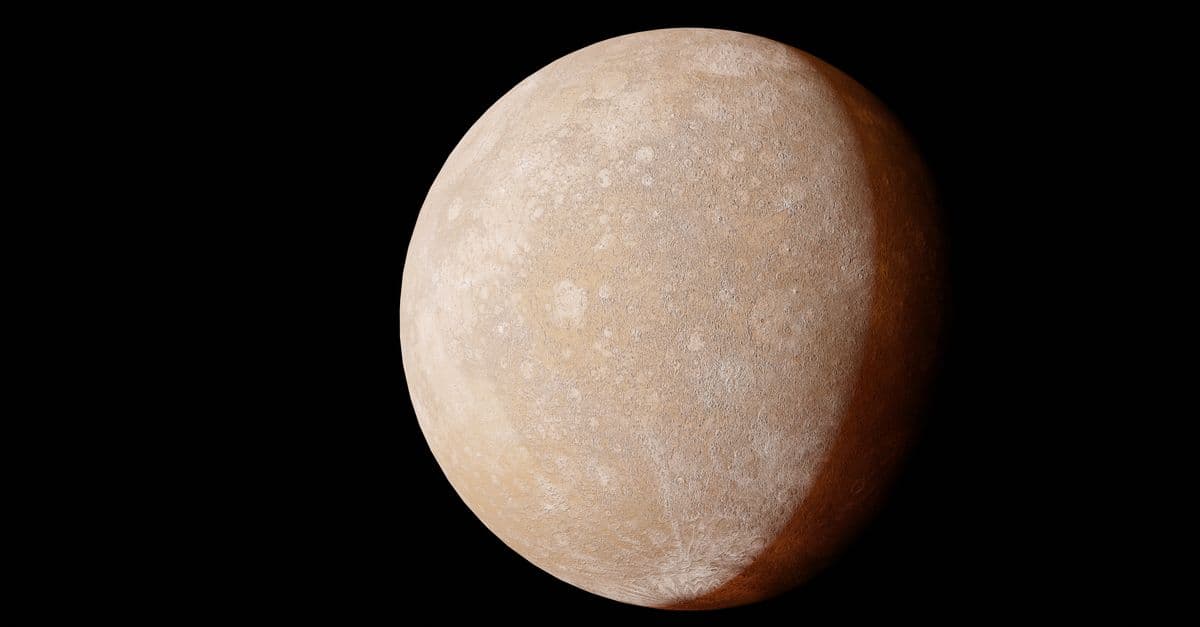
Photo: Zelch Csaba / Pexels
Jupiter's moon Ganymede is bigger than the planet Mercury and contains more liquid water than every ocean, lake, and river on Earth combined — except none of that water is on its surface. It is buried under roughly 150 km of ice, in a saltwater ocean kept liquid by Jupiter's tidal pull. Ganymede also generates its own magnetic field, making it the only moon in the solar system with an internally driven magnetosphere. A mission is on its way to orbit it.
A Moon That Outclasses Planets
Ganymede (diameter: 5,268 km) is the largest natural satellite in the solar system, and its size comparison to the inner planets is instructive: it is larger than Mercury (4,880 km) and significantly larger than the dwarf planet Pluto (2,376 km). If it orbited the Sun directly rather than Jupiter, astronomers would classify it as a planet without hesitation.
Galileo Galilei discovered Ganymede on January 7, 1610, alongside Io, Europa, and Callisto — the four Galilean moons. Through a small telescope, Ganymede appears as a bright dot accompanying Jupiter. Up close, it reveals a complex geology: roughly half the surface is ancient, heavily cratered dark terrain called regiones, dating back roughly 4 billion years, and half is younger, brighter, grooved terrain called sulci, sculpted by tectonic activity when the interior was hotter and more geologically active.
The grooved terrain is particularly striking. Parallel ridges and troughs, each hundreds of kilometers long, suggest that Ganymede went through a period of extensional tectonics — the icy surface being pulled apart as the interior expanded or convected. This implies a geologically active past even if Ganymede is largely dormant today.
Source: Pappalardo et al., Journal of Geophysical Research (2004) — Geological mapping of Ganymede's surface terrains and interpretation of grooved terrain as evidence of extensional tectonics.
Ganymede orbits Jupiter at a mean distance of about 1.07 million km with a period of 7.15 days. It is locked in a 1:2:4 resonance with its neighboring moons Europa and Io — meaning that for every one orbit Ganymede completes, Europa completes two and Io completes four. This Laplace resonance keeps the orbital eccentricities of all three moons pumped up, driving tidal heating that keeps Io volcanically active and likely keeps Europa's and Ganymede's oceans liquid.
The Magnetic Field That Should Not Exist
The most scientifically anomalous fact about Ganymede is its magnetosphere. Earth's magnetic field is generated by a dynamo: convecting liquid iron in the outer core drives electrical currents that produce a global magnetic field. For a large, geologically active planet, this makes sense. For a moon of Ganymede's age, it is deeply surprising.
Ganymede's magnetic field was discovered by NASA's Galileo spacecraft in 1996, during the first of 6 dedicated Ganymede flybys. The field has a dipole structure with a surface strength at the poles of roughly 719 nanoTesla (nT) — about 1% of Earth's surface field, but strong enough to deflect Jupiter's magnetospheric plasma and create a distinct magnetospheric bubble around the moon. The magnetic poles are inclined about 176 degrees to Ganymede's rotation axis, meaning the field is roughly anti-aligned with the orbital plane.
Source: Kivelson et al., Nature (1996) — Galileo magnetometer discovery of Ganymede's intrinsic magnetic field, the first confirmed dynamo-generated field in a moon.
For a dynamo to operate, three things are required: a conductive fluid, rotation, and a heat source to drive convection. Ganymede's iron core was thought too small and too cold to sustain a dynamo after 4 billion years of cooling. Yet the magnetic field is clearly intrinsic — its orientation and geometry are inconsistent with simple induction from Jupiter's field. Models now suggest that Ganymede's core contains a liquid iron-sulfur alloy, with sulfur depressing the melting point enough to keep part of the core liquid despite the low temperatures, and that residual tidal heating provides just enough energy to sustain weak convection.
Understanding how Ganymede maintains its dynamo is a central objective of the JUICE mission (see below), because a working dynamo in a small, old icy moon has broad implications for planetary science.
Magnetopause — the boundary where a magnetosphere meets the surrounding plasma environment. In Ganymede's case, this boundary sits about 1.5 Ganymede radii (about 3,950 km) above the surface on the Jupiter-facing side.
The Hubble Trick That Found an Ocean
The confirmation of Ganymede's subsurface ocean came not from a flyby, not from radar, but from watching the magnetic field interact with Jupiter's. It is a beautiful example of using remote observations to infer interior conditions.
Here is the logic. Ganymede sits inside Jupiter's immense magnetosphere. As Jupiter rotates (every 10 hours), its magnetic field rocks back and forth relative to Ganymede. This rocking field induces currents in any conductive fluid inside Ganymede — the same induction that generates a current in a copper wire moved through a magnetic field. A saltwater ocean would be an excellent conductor; ice would not.
If no ocean existed, Ganymede's auroras — produced when charged particles from Jupiter spiral along Ganymede's field lines and hit the atmosphere — would rock back and forth by about 6 degrees as Jupiter's magnetic field oscillated. If a large, conductive saltwater ocean existed, its induced currents would partially oppose Jupiter's field changes, damping the rocking to about 2 degrees.
In 2015, Joachim Saur of the University of Cologne led a team that analyzed Hubble Space Telescope ultraviolet observations of Ganymede's auroral ovals taken across a full Jupiter rotation. The measured rocking was 2 degrees — precisely what an ocean model predicted, and half what a no-ocean model predicted.
Source: Saur et al., Journal of Geophysical Research: Space Physics (2015) — HST UV observations of Ganymede's auroral rocking constrain a global saltwater ocean with conductivity of 0.09–1.5 S/m and thickness likely exceeding 100 km.
The ocean is estimated to be roughly 800 km deep — nearly 10 times deeper than Earth's deepest ocean trench. It sits beneath roughly 150 km of ice and above a rocky seafloor. The total volume of water is estimated at several hundred million cubic kilometers — dwarfing Earth's total surface water inventory of about 1.4 billion km³ at the upper end of current models.
How Ganymede Differs from Europa
Europa gets more attention in astrobiology discussions than Ganymede, partly because of the dramatic Galileo imagery of Europa's chaotic surface and partly because Europa's ice shell is thinner and its ocean-to-surface communication is plausibly more active. But the comparison reveals Ganymede as a distinct and equally compelling target.
| Feature | Ganymede | Europa |
|---|---|---|
| Diameter | 5,268 km | 3,121 km |
| Ice shell thickness | ~150 km | ~10–30 km |
| Ocean depth (estimated) | ~800 km | ~60–150 km |
| Surface age (dark terrain) | ~4 billion years | ~40–90 million years |
| Intrinsic magnetic field | Yes (dynamo) | No (induction only) |
| Active surface features | None confirmed | Possible chaos terrain activity |
| Hydrothermal vents possible | Possible (rocky seafloor) | Possible (rocky seafloor) |
| Tidal heating intensity | Lower than Europa | Higher than Ganymede |
Europa's thinner ice shell and younger, actively resurfacing terrain make it a better candidate for near-surface ocean-surface exchange — important because such exchange could bring nutrients from the irradiated surface down into the ocean. Ganymede's vastly thicker ice shell may thermally insulate the ocean more effectively and limit surface-ocean communication. Whether that helps or hinders habitability depends on factors still unknown.
One important difference: Ganymede's ocean floor may be in contact with ice below as well as rock below — models suggest the ocean may be sandwiched between a high-pressure ice layer at its base and the overlying water-ice shell. In Europa, the ocean likely sits directly on silicate rock throughout. Direct rock-water contact at the seafloor favors chemical exchange and potentially hydrothermal venting — the same conditions that make Enceladus compelling. Whether Ganymede's ocean has this configuration throughout, or only in parts, is one of JUICE's investigation targets.
Source: Vance et al., Planetary and Space Science (2014) — Interior structure models of Ganymede suggesting ocean sandwiched between high-pressure ice below and water-ice shell above, with implications for habitability.
Ganymede's Thin Atmosphere and Radiation Environment
Ganymede has a tenuous atmosphere discovered by the Hubble Space Telescope in 1998, composed primarily of molecular oxygen (O₂) and atomic oxygen. The oxygen does not come from biology — it is produced by charged particles from Jupiter's magnetosphere bombarding the surface ice and splitting water molecules, with hydrogen escaping to space and oxygen accumulating.
The atmospheric pressure at the surface is roughly 10 microbar, about one ten-thousandth of Earth's sea-level pressure. It is far too thin for any conventional definition of habitability at the surface. Any life consideration for Ganymede, as with Europa, focuses entirely on the deep subsurface ocean.
Ganymede's position within Jupiter's radiation belts means its surface receives substantial particle radiation — roughly 50 millisieverts per day at the equatorial surface. Human exposure limits for occupational radiation in a year are about 50 millisieverts. The surface of Ganymede would expose a human to a year's permissible dose in one day, and the polar regions near the auroral zones are even more intense. Any spacecraft visiting Ganymede long-term needs radiation-hardened electronics.
JUICE — the Jupiter Icy Moons Explorer (ESA) — is designed accordingly, with a radiation-hardened payload and a mission timeline that spends most observation time beyond the most intense radiation belts before entering Ganymede orbit.
Source: Cooper et al., Icarus (2001) — Radiation dose and surface chemistry on Ganymede and Europa from energetic particle bombardment; implications for surface habitability and instrument design.
The JUICE Mission: First Dedicated Orbiter
ESA's JUICE spacecraft launched on April 14, 2023, aboard an Ariane 5 rocket from French Guiana. Its trajectory includes a Venus gravity assist followed by two Earth gravity assists, with arrival at the Jovian system in 2031. After an initial science phase studying Europa, Callisto, and Ganymede during multiple flybys, JUICE will insert into Ganymede orbit in late 2034 — the first spacecraft in history to orbit a moon other than Earth's.
The scientific payload addresses Ganymede's interior from multiple angles simultaneously:
- GALA (Ganymede Laser Altimeter): Maps the surface topography at centimeter precision, detecting tidal deformation. If the icy shell flexes measurably as Ganymede orbits Jupiter, the deformation amplitude reveals ocean depth and viscosity.
- J-MAG (JUICE Magnetometer): Characterizes Ganymede's intrinsic field and the induction signature of the ocean, pinning down conductivity and thickness.
- RIME (Radar for Icy Moons Exploration): Ice-penetrating radar at 9 MHz, capable of imaging structures to depths of 9 km in the ice — potentially reaching interfaces between different ice layers and, at the ice-ocean boundary if it is shallow enough, the top of the ocean.
- SWI (Sub-millimetre Wave Instrument): Probes the thermal structure of the atmosphere and surface.
- MAJIS (Moons And Jupiter Imaging Spectrometer): Maps surface composition at visible and near-infrared wavelengths.
The mission ends with a deliberate impact into Ganymede's surface in 2035, planned to avoid contaminating Europa with Earth microbes.
Source: ESA Science & Technology (2022) — JUICE mission science objectives and instrument descriptions for Ganymede orbital phase, including tidal deformation and magnetic induction measurements.
What Ganymede Tells Us About Ocean World Formation
Ganymede's existence reshapes how planetary scientists think about the conditions required for subsurface oceans. Before the Galileo mission, the prevailing assumption was that liquid water required either proximity to a star or very large planetary mass (to retain internal heat). Ganymede violates both constraints — it is 5.2 AU from the Sun, small by planetary standards, and yet has more liquid water than Earth.
The mechanism that makes this possible is tidal heating via orbital resonance. Ganymede's ocean would freeze without the continuous tidal energy delivered by the Laplace resonance with Europa and Io. This suggests that ocean worlds may be far more common than previously assumed — any icy moon caught in a resonant configuration around a giant planet could sustain a subsurface ocean indefinitely.
By extension, the moons of giant exoplanets — particularly those orbiting within resonant systems — are now considered serious candidates for habitability. We cannot observe their interiors directly, but the Ganymede example provides proof that the physics works.
Think of tidal resonance as a continuously replenished hot water bottle inserted into Ganymede's interior: the orbital mechanics of the Laplace resonance prevent Ganymede from settling into a circular orbit, keeping a slight eccentricity that causes the tidal stress on the interior to vary each orbit, dissipating heat. Without Jupiter and the resonance, Ganymede would be a frozen, geologically dead ball of rock and ice.
JUICE: Europe's Mission to Ganymede and the Jupiter System
ESA's Jupiter Icy Moons Explorer — universally called JUICE — lifted off on April 14, 2023, aboard an Ariane 5 rocket from the Guiana Space Centre in Kourou, French Guiana. It is the first large-class mission in ESA's Cosmic Vision science program dedicated to the outer solar system, and when it enters Ganymede orbit in late 2034, it will become the first spacecraft in history to orbit a moon other than Earth's.
Source: ESA Science & Technology (2023) — JUICE mission overview and launch confirmation; spacecraft entered interplanetary cruise phase following Ariane 5 deployment on April 14, 2023.
The trajectory is a gravitational billiard shot requiring more than eight years of cruise time. From Earth, JUICE swings past Venus once and Earth twice to gain the energy needed to reach Jupiter without carrying prohibitive propellant mass. It will arrive at Jupiter in July 2031, spending approximately three and a half years conducting 35 flybys of Ganymede, Europa, and Callisto before finally braking into Ganymede orbit in December 2034. The Europa flybys are limited to two — by international planetary protection agreements designed to prevent Earth microbes from contaminating a world considered high-priority for life detection — but those two passes will still return more science than any previous dedicated Europa observation.
The Ganymede Orbital Phase is the mission's scientific heart, and its instrument suite is designed to answer three nested questions: does the ocean exist as firmly predicted, how deep and how salty is it, and does the seafloor have rock-water contact that could support chemistry analogous to Earth's hydrothermal systems?
JANUS (Joviann Moons After New Standard) is a visible-wavelength camera with a resolution capable of resolving surface features down to 2.4 meters per pixel from low orbit — a nearly 50-fold improvement over the best Galileo images of Ganymede. Its primary function is geological mapping: identifying terrains, fault systems, impact melt sheets, and any fresh resurfacing that might indicate recent activity. By comparing the grooved terrain sulci at high resolution, JANUS should settle whether those structures formed by extension in Ganymede's distant past or whether any remnant geological movement continues today.
GALA (Ganymede Laser Altimeter) fires infrared laser pulses at the surface and times their return to map topography at centimeter vertical precision. Its most important measurement is tidal deformation. As Ganymede orbits Jupiter in its slightly elliptical path, Jupiter's gravity distorts the moon's shape by a small but measurable amount each orbit. The size of that deformation — called the tidal Love number — depends directly on whether a liquid layer exists beneath the ice. A rigid, fully frozen Ganymede would deform by roughly 60 cm over each orbital period; a Ganymede with a deep liquid ocean would deform by about 7 meters. The difference is orders of magnitude above GALA's detection threshold. This is a direct, model-independent ocean detection test — no assumptions about electromagnetic conductivity required.
SWI (Sub-millimetre Wave Instrument) operates at terahertz frequencies to probe Ganymede's tenuous atmosphere and the thermal structure of the upper ice. Its primary atmospheric target is water vapor and oxygen abundance profiles versus altitude, which trace the balance between sublimation, particle sputtering from Jupiter's radiation belts, and escape to space. SWI can also detect stratification in Ganymede's ionosphere, which in turn constrains the conductivity of any ocean below.
Salinity is the variable that bridges ocean detection and habitability. The Hubble auroral measurement that confirmed Ganymede's ocean in 2015 constrains the ocean's electrical conductivity to between 0.09 and 1.5 siemens per meter (S/m). Earth's ocean has a conductivity of about 4–5 S/m, mostly from dissolved sodium chloride. Ganymede's lower conductivity estimate could indicate a less salty ocean — or it could indicate a saltier ocean with a different ionic composition (magnesium sulfate rather than sodium chloride, for example). JUICE's magnetometer, J-MAG, will measure the induction signal with enough precision to narrow this range by a factor of roughly ten, mapping how the ocean's conductivity varies with depth and latitude.
Conductivity — a measure of how easily a material conducts electricity; in a subsurface ocean, conductivity is primarily set by the concentration and type of dissolved ions (salts), making it a direct proxy for ocean chemistry.
Why does salinity matter for habitability? An ocean's ionic chemistry governs which minerals can remain dissolved at the seafloor, which biochemical reactions are thermodynamically favorable, and whether water activity — the effective availability of liquid water to support biochemistry — is high enough to permit life. Extremely salty oceans (like Earth's Dead Sea, at roughly 33% salinity) suppress water activity enough to inhibit most microorganisms. A Ganymede ocean with moderate salinity and magnesium or sodium chloride chemistry would be broadly hospitable to chemolithotrophic life, provided a heat source and rock-water contact at the seafloor exist. If JUICE's data constrain the salinity to within an Earth-ocean-like range, the habitability case for Ganymede strengthens considerably — even though Ganymede's thick ice shell and the uncertain presence of rock-water contact at depth remain the primary obstacles.
The mission concludes with a deliberate controlled impact into Ganymede's surface in 2035. The impact site is chosen to avoid any future landing zone of scientific interest and to ensure that JUICE — potentially carrying Earth microbes despite sterilization — does not contaminate Europa, which remains in JUICE's orbital vicinity.
Key takeaways
- Ganymede is the largest moon in the solar system at 5,268 km diameter, larger than Mercury, and is the only moon with an internally generated magnetic field.
- Its subsurface saltwater ocean was confirmed in 2015 via Hubble measurements of auroral rocking, which was damped from 6 degrees to 2 degrees by the ocean's electromagnetic induction.
- The ocean is estimated at ~800 km deep, beneath ~150 km of ice, and contains more water than Earth's entire surface water inventory.
- Tidal heating from the Laplace resonance with Europa and Io keeps the ocean liquid at 5.2 AU from the Sun.
- ESA's JUICE spacecraft (launched April 2023) will become the first dedicated Ganymede orbiter in 2034.
Frequently Asked Questions
Q: Why does Ganymede have a magnetic field when other moons of similar size do not?
A: The dynamo requires a liquid conducting core, rotation, and heat. Ganymede's core likely contains a sulfur-iron alloy with a lower melting point than pure iron, allowing part of the core to remain liquid after billions of years of cooling. Residual tidal heating from the Laplace resonance provides just enough energy to sustain core convection. Callisto, a similar-sized moon at the same orbital distance but not in the resonance, does not generate its own magnetic field.
Q: Could life survive in Ganymede's ocean?
A: Possibly, but Ganymede is considered less favorable than Europa or Enceladus for near-term biosignature detection. The primary concern is the very thick ice shell (~150 km), which may suppress ocean-surface chemical exchange and limit the delivery of oxidants from the irradiated surface to the ocean. Additionally, if the ocean floor is sandwiched by high-pressure ice rather than silicate rock in some regions, hydrothermal vent activity may be limited. Liquid water and a chemical energy source are necessary but not sufficient.
Q: Why is the Hubble auroral measurement considered conclusive proof of an ocean?
A: The measurement is not technically "conclusive" — it is the strongest available evidence given current technology. The 2-degree rocking amplitude is inconsistent with a no-ocean model at high statistical confidence and consistent with an ocean model with specific conductivity ranges. Alternative explanations (a highly conductive but non-aqueous interior) cannot be entirely ruled out but would be geologically unprecedented. JUICE's direct measurements will provide far stronger evidence.
Q: What is the Laplace resonance, and how does it keep Ganymede's ocean liquid?
A: The Laplace resonance is a 1:2:4 orbital period ratio among Ganymede, Europa, and Io. The gravitational interactions prevent the orbits from becoming perfectly circular, maintaining small eccentricities. An eccentric orbit means the distance from Jupiter — and thus the tidal stretching force — varies over each orbit. This periodic flexing dissipates as heat inside the moons, with Io receiving the most (driving intense volcanism), Europa receiving intermediate tidal heating, and Ganymede receiving the least but still enough to maintain a liquid ocean.
Q: When will JUICE reach Ganymede orbit?
A: JUICE is scheduled to enter Ganymede orbit in late 2034, after spending approximately three years making flybys of Ganymede, Callisto, and Europa in the Jovian system. It will orbit Ganymede for approximately nine months before the mission concludes with a controlled impact in 2035.
Q: How does Ganymede compare to Titan as a candidate for life?
A: They are very different environments. Titan has a dense nitrogen atmosphere, hydrocarbon lakes on its surface, and a possible subsurface ocean, but its chemistry is dominated by cold organic reactions unlike Earth. Ganymede's ocean is a more Earth-like saltwater environment but is more deeply buried. Neither has been confirmed to be habitable, and neither offers an easy path to biosignature detection.
Read next:
Follow new articles
Add SciHub101 to your feed reader to see new science and technology stories.
About the Author
SciHub101 is an independent science and technology publication founded and edited by Buğra Sözeri, a software engineer and app developer based in Türkiye. AI tools assist with drafting and research. Source documentation in the existing archive is uneven, and articles are being reviewed and corrected. The Editorial Team byline identifies editorial responsibility; it does not certify specialist or independent human review. Where we compare products, anything built by our own team is labelled as such — see the editorial guidelines and About page for how corrections and disclosures work.
Related Articles
Jupiter's Auroras: The Most Powerful Light Show in the Solar System
Jupiter's auroras are not scaled-up versions of Earth's. They are a fundamentally different phenomenon: driven not primarily by the solar wind but by the volcanic output of Io, a moon so geologically active it pumps a ton of sulfur dioxide per second into space. The resulting plasma torus is the actual engine of Jupiter's polar glow — producing auroral emissions roughly 1,000 times more energetic than anything Earth generates, visible in UV and X-ray from telescopes hundreds of millions of kilometers away.

Galactic Cannibalism: The Milky Way's History of Mergers
The Milky Way did not grow peacefully. It reached its current size by absorbing smaller galaxies — tearing them apart with tidal forces, stripping their stars into long streams, and incorporating their material into the disk and halo. One major collision 10 billion years ago reshaped the Milky Way's entire inner halo. Another is happening right now. A third, larger one is coming in 4 billion years, and there is nothing that can stop it.
Nearest Exoplanets That Could Host Life
A guide to the nearest potentially habitable exoplanets, from Proxima b to TRAPPIST-1e, what JWST has found, and why 'habitable' rarely means confirmed.
Ceres: The Asteroid Belt's Dwarf Planet Has Brine and Organics
Ceres is the largest object in the asteroid belt — so large that it qualifies as a dwarf planet. NASA's Dawn spacecraft arrived in 2015 and found something extraordinary: bright white spots in a crater, fed by a subsurface reservoir of salty brine erupting to the surface within the last 2 million years.

Enceladus's Hydrothermal Vents and the Case for Life
Saturn's tiny moon Enceladus shoots plumes of water vapor and hydrogen gas into space from cracks in its icy crust. Those plumes carry direct evidence of 90°C hydrothermal vents on the ocean floor — the same kind of environment where life on Earth may have started.
Planetary Rings Explained: Not Just Saturn
Saturn's rings are the solar system's most famous structure, but they are far from unique. Uranus has 13 dark, narrow rings discovered by accident in 1977. Neptune has incomplete arcs instead of full circles. Jupiter has a faint ring made of dust blasted off its innermost moons by meteorite impacts. All four giant planets have rings — and they all work differently. Saturn's may be geologically young, which raises a question nobody has fully answered: where did they come from?