Jupiter's Auroras: The Most Powerful Light Show in the Solar System
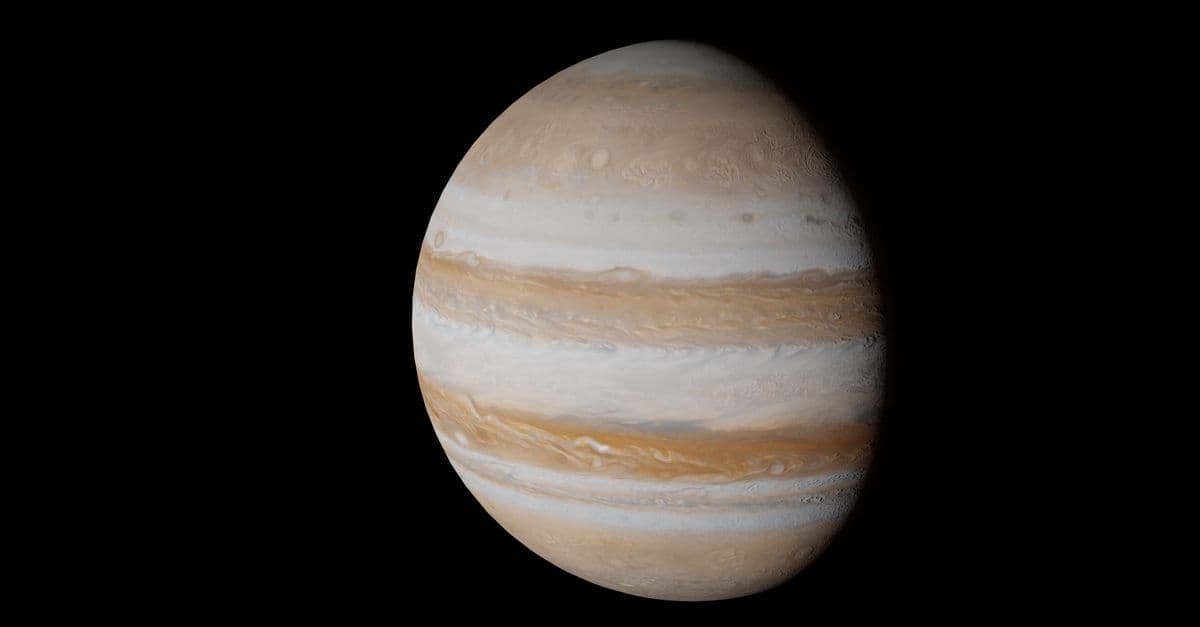
Photo: Zelch Csaba / Pexels
Earth's auroras — the northern and southern lights — are driven by the solar wind slamming charged particles into the upper atmosphere along magnetic field lines. They are beautiful and occasionally intense, but they are powered by an external source. Jupiter's polar auroras are something else entirely: they are powered from within the Jovian system itself, fueled by the volcanic fury of a moon that pumps sulfur dioxide into space at roughly one ton per second. The resulting aurora is not a gentle curtain of light. It is a continuous, X-ray-emitting, UV-blazing, 2-trillion-watt electrical storm raging permanently over both poles of the largest planet in the solar system — a storm that would dwarf Earth's entire disk if you could hold both side by side.
What Makes Jupiter's Magnetosphere Unique
To understand Jupiter's auroras, start with the magnetosphere — the volume of space dominated by Jupiter's magnetic field. Jupiter's magnetic field is roughly 20,000 times stronger than Earth's at the planet's surface and extends some 700 million kilometers in the direction away from the Sun (roughly to Saturn's orbit when Jupiter and Saturn are aligned). It is the largest structure in the solar system after the Sun's own heliosphere.
Magnetosphere — the region of space around a planet where the planet's magnetic field dominates over the solar wind's magnetic field; Jupiter's magnetosphere is by far the largest planetary magnetosphere in the solar system, spanning hundreds of millions of kilometers.
Earth's magnetosphere is driven primarily by the solar wind — the stream of charged particles flowing outward from the Sun at 400–800 km/s. The solar wind compresses Earth's magnetosphere on the dayside and stretches it into a long tail on the nightside. Auroras result when solar wind particles follow magnetic field lines down into the upper atmosphere.
Jupiter's magnetosphere is driven differently. The solar wind matters, but it is not the dominant energy source. The dominant source is internal: the continuous injection of plasma from Io.
Source: Bagenal, Annual Review of Earth and Planetary Sciences (2013) — Comprehensive review of Jupiter's magnetosphere structure, plasma sources, and aurora-driving mechanisms; Io's plasma contribution quantified at ~1,000 kg/s.
Io: The Volcano That Runs a Planetary Aurora
Io is the innermost of Jupiter's four Galilean moons — the large moons discovered by Galileo in 1610. At 421,700 km from Jupiter's center, Io orbits Jupiter in 1.77 Earth days. The gravitational tug-of-war between Jupiter, Europa, and Ganymede keeps Io's orbit slightly elliptical, and the varying tidal forces from that elliptical orbit flex Io's interior continuously. The result is the most volcanically active body in the solar system: over 400 active volcanic structures, sulfur dioxide geysers, and lava lakes. Surface temperatures at active vents reach 1,600°C (2,900°F), hotter than any surface environment on Earth.
Io's volcanoes continually eject material into space. Most of this material — sulfur, oxygen, sodium, and their compounds — is quickly ionized by solar ultraviolet radiation and by electron bombardment. Once ionized, these particles are captured by Jupiter's rotating magnetic field and pulled into orbit around Jupiter, forming a ring of plasma at Io's orbital distance from the planet.
Io plasma torus — a donut-shaped cloud of ionized sulfur and oxygen surrounding Jupiter at approximately Io's orbital radius (~5.9 Jupiter radii from the planet's center), maintained by Io's continuous volcanic mass loss; contains roughly 1–3 × 10³⁶ ions and is the primary plasma source for Jupiter's magnetosphere.
The mass input rate from Io is approximately 1,000 kilograms per second — one ton of ionized material injected into the Jovian magnetosphere every second. This is the engine. Earth's magnetosphere runs on solar wind; Jupiter's runs on a volcanic moon.
Source: Thomas et al., Journal of Geophysical Research (2004) — Measurement and modeling of Io's mass loss rate and plasma torus density; canonical value of ~1,000 kg/s established through Voyager and Galileo mission data.
The Electrical Circuit Between Io and Jupiter
Here is where the physics produces something remarkable. As Jupiter's rapidly rotating magnetic field sweeps past Io (Jupiter rotates in about 10 hours, while Io takes 42.5 hours to orbit), the field moves faster than Io does. This creates a relative motion between the plasma torus and Io, which acts like a conductor moving through a magnetic field — generating an electromotive force. The result is a powerful electrical current that flows along Jupiter's magnetic field lines between Io and the planet's ionosphere, forming what is called the Io flux tube.
Io flux tube — the magnetic flux tube connecting Io to Jupiter's ionosphere, through which a field-aligned current of approximately 2–5 million amperes flows, carrying energy from the Io-torus interaction down to Jupiter's upper atmosphere where it generates the Io footprint aurora.
This circuit generates approximately 2 trillion watts (2 × 10¹² W) of power. For comparison, global human electricity generation is roughly 2.8 × 10¹³ W — Jupiter's Io-driven aurora runs at about 7% of humanity's total power output, produced by a single moon's interaction with a magnetic field. Earth's entire aurora produces perhaps 100 billion watts on an active night. Jupiter's Io footprint alone is 20 times that.
The electrical current follows the magnetic field lines from Io down to Jupiter's polar regions, where it dumps its energy into the upper atmosphere, accelerating electrons to kiloelectronvolt energies and producing intense ultraviolet and X-ray emission at the "Io footprint" — a glowing auroral spot that trails behind Io's magnetic conjugate point in both the north and south polar regions simultaneously.
Source: Connerney et al., Science (1993) — First observation and characterization of the Io footprint aurora; identification of the field-aligned current connecting Io to Jupiter's ionosphere.
The Main Auroral Oval: Where the Power Really Lives
The Io footprint is impressive, but the most powerful part of Jupiter's aurora is the main auroral oval — a ring of emission encircling each pole at a latitude of about 15–20 degrees from the magnetic pole. This is where the comparison with Earth's aurora breaks down completely.
Earth's main auroral oval is driven by reconnection of magnetic field lines at the far tail of the magnetosphere, powered by solar wind input. Jupiter's main auroral oval is driven by an internal process called magnetosphere-ionosphere coupling: the corotation breakdown.
As plasma from the Io torus diffuses outward through the magnetosphere, Jupiter's magnetic field tries to keep it corotating with the planet (spinning at Jupiter's 10-hour rotation rate). Far out in the magnetosphere — beyond about 20 Jupiter radii — the plasma can no longer be accelerated to full corotation speed. The lag generates a flow of field-aligned current from the magnetosphere into the ionosphere that is much larger than the Io flux tube current — this is the main oval current system.
Unlike Earth's aurora, which brightens during solar storms, Jupiter's main oval is active continuously, whether the solar wind is weak or strong. It is internally powered by the rotation of the planet and the plasma loading by Io. Jupiter does not need a solar storm to produce its aurora; it produces it every second of every day.
Source: Clarke et al., Nature (2002) — Hubble Space Telescope UV observations establishing the corotation breakdown as the primary driver of Jupiter's main auroral oval; comparison with Earth's solar-wind-driven aurora.
| Feature | Jupiter's Aurora | Earth's Aurora |
|---|---|---|
| Primary power source | Io plasma torus / corotation breakdown | Solar wind |
| Total power | ~10¹⁴ W | ~10¹¹ W (active night) |
| Active continuously? | Yes, 24/7 | No — requires solar activity |
| UV bright? | Extremely — detectable from Earth orbit | Moderately |
| X-ray emission? | Yes — 0.1–2 keV pulsing | None significant |
| Size relative to Earth | Auroral ovals larger than Earth's disk | Earth-sized ring |
| Primary particle source | Io's volcanic SO₂ ions | Solar wind protons and electrons |
The X-Ray Pulses: A 45-Minute Heartbeat
Jupiter's aurora emits X-rays. That alone is unusual — Earth's aurora produces some X-ray emission during intense solar storms, but nothing like what Jupiter generates continuously. Observations by NASA's Chandra X-ray Observatory and ESA's XMM-Newton have detected X-ray pulses from Jupiter's northern polar region (the southern region is offset and behaves differently) with a quasi-periodicity of approximately 45 minutes.
The 45-minute pulsation had been known since the early 2000s, but its origin was debated for two decades. The breakthrough came from a coordinated campaign published in 2021 combining Chandra X-ray data with Juno spacecraft measurements in the magnetosphere.
The Juno measurements revealed that the X-ray pulses coincide with the arrival at Jupiter's poles of electromagnetic ion cyclotron waves — a type of low-frequency plasma wave generated in the outer magnetosphere, specifically near the equatorial current sheet where the plasma sheet compressed by magnetic forces interacts with inflowing magnetospheric plasma from the tail. These waves propagate along field lines to the polar regions, where they accelerate heavy ions (sulfur and oxygen from the Io torus) downward into the atmosphere at energies sufficient to produce X-ray emission when they collide with atmospheric atoms.
Electromagnetic ion cyclotron (EMIC) waves — plasma waves generated near the magnetic equator when plasma pressure builds up, oscillating at the cyclotron frequency of ions; at Jupiter, these waves are generated in the outer magnetosphere by the Io-loaded plasma sheet and propagate to the poles where they accelerate particles into the atmosphere, producing X-ray aurora.
The 45-minute period reflects the timescale of wave compression and relaxation in the outer magnetosphere — a regular, internally driven oscillation, not a response to the solar wind.
Source: Dunn et al., Science Advances (2021) — Combined Chandra/XMM-Newton X-ray observations with simultaneous Juno magnetospheric measurements; identification of EMIC waves as the driver of Jupiter's quasi-periodic 45-minute X-ray aurora.
What Juno Has Revealed Since 2016
NASA's Juno spacecraft entered Jupiter orbit in July 2016 and has been executing close polar passes (called "perijoves") every 53 days (later modified to 43-day orbits). Each perijove takes Juno directly through the auroral field-aligned current regions at altitudes of just a few thousand kilometers above the cloud tops — closer than any previous Jupiter orbiter.
Juno's instruments have transformed understanding of the auroral current systems. Key findings include:
The auroral electrons are accelerated to much higher energies than expected. Pre-Juno models predicted electron energies of roughly 10–30 keV (kiloelectronvolts) driving the main oval aurora. Juno's particle instruments measured electrons arriving at the atmosphere with energies up to 400 keV — an order of magnitude higher than predicted, implying a more powerful acceleration mechanism operating at higher altitudes than the models assumed.
Juno also detected what mission scientists called "diffuse aurora" — a faint, rapidly evolving ring-shaped emission that appears to move outward from the pole at 2–4 km/s. These transient features, first detected by Juno-UVS (the ultraviolet spectrograph), are unlike any auroral form seen at Earth and their exact origin is still being characterized.
Source: Mauk et al., Nature (2017) — First Juno perijove electron energy measurements; discovery that auroral electrons are accelerated to energies far exceeding pre-mission model predictions, implying multiple acceleration mechanisms.
Source: Gladstone et al., Science (2017) — Juno-UVS first results from polar passes; ultraviolet aurora mapping at resolutions not achievable from Earth orbit; detection of diffuse, transient auroral features.
The Southern Aurora: Why It's Different
Jupiter's north and south auroras are not mirror images. Earth's conjugate auroral zones are roughly symmetrical because Earth's magnetic field is close to a tilted dipole. Jupiter's internal magnetic field is far more complex — it has significant quadrupole and octupole components that distort the field structure. The result is that the south polar auroral oval is offset from the south magnetic pole differently than the north oval is offset from the north magnetic pole.
The southern polar region also shows less intense X-ray emission than the north. The 45-minute X-ray pulsation is strong in the north and nearly absent in the south. This asymmetry traces back to the detailed geometry of the outer magnetosphere — specifically, which regions of the current sheet connect magnetically to the north versus south pole — and is still an active area of research.
Juno's polar orbit takes it over both poles alternately, giving it the first opportunity to compare the north and south auroras in situ rather than from a distance.
Source: Connerney et al., Journal of Geophysical Research (2018) — Juno magnetic field measurements establishing the complexity of Jupiter's non-dipolar internal field and its implications for north-south auroral asymmetry.
What Jupiter's Aurora Tells Us About Exoplanets
Jupiter's aurora is not just a planetary science curiosity. It is a working model of how magnetospheric systems operate when driven by internal plasma sources rather than stellar wind — a configuration that may be common around giant exoplanets orbiting close to their host stars, where plasma from moons or from the star itself could form analogous torus structures.
Radio emission from Jupiter's magnetosphere (at decametric and hectometric wavelengths) is detectable from Earth. Similar radio bursts from exoplanet magnetospheres have been tentatively detected, with the expectation that identifying the periodic signature of a plasma-loaded magnetosphere could reveal the presence of volcanically active moons around other stars — moons that would be far too small to detect directly. Jupiter's aurora, studied close-up by Juno, is providing the physics framework for interpreting those eventual detections.
The stellar radiation environment that drives the Io-Jupiter interaction also connects to how how stars are born and die — the properties of the central star directly determine how powerful the UV bombardment of a plasma torus would be, and thus how much energy is available to drive an aurora. And for comparison, magnetars: extreme magnetic fields shows what happens when planetary-scale magnetic field strengths are amplified by orders of magnitude in compact stellar remnants.
The Takeaway
Jupiter's aurora is not Earth's aurora at a larger scale. It is a fundamentally different physical system, powered by the interior of the Jovian system rather than by the Sun. Io's volcanism — one ton of sulfur and oxygen per second ejected into space — builds the plasma torus that drives a 2-trillion-watt electrical circuit to Jupiter's poles, producing continuous UV and X-ray emission at power levels dwarfing anything Earth generates naturally. Juno has revealed that the electrons arriving at Jupiter's atmosphere carry 10 times more energy than models predicted, that X-ray pulses repeat every 45 minutes driven by magnetospheric wave oscillations, and that the north and south auroras are not symmetric because Jupiter's magnetic field is genuinely non-dipolar at depth. Every perijove Juno completes adds detail to the picture of the largest aurora in the solar system — an aurora that has been running continuously since Jupiter formed.
Frequently Asked Questions
Q: How much more powerful is Jupiter's aurora than Earth's?
A: Jupiter's total auroral power output is on the order of 10¹³ to 10¹⁴ watts — roughly 1,000 times more powerful than Earth's aurora during an active night (approximately 10¹¹ watts). The Io flux tube alone — just the electrical circuit driven by one moon — produces about 2 trillion watts. Jupiter's auroral ovals are also physically larger than Earth's entire disk.
Q: Why is Io so important to Jupiter's aurora?
A: Io's volcanoes eject approximately 1,000 kilograms of sulfur and oxygen compounds per second into space. Once ionized, this material is trapped by Jupiter's magnetic field and forms the Io plasma torus — a ring of plasma at Io's orbital distance. This torus is the primary source of plasma for Jupiter's entire magnetosphere and drives the field-aligned currents that power the main auroral oval. Without Io's volcanism, Jupiter's aurora would be much weaker and driven primarily by the solar wind, like Earth's.
Q: What are Jupiter's X-ray auroras and why do they pulse?
A: Jupiter's polar regions emit X-rays (at 0.1–2 keV energies) produced when heavy ions from the Io plasma torus — sulfur and oxygen — are accelerated along field lines and collide with Jupiter's atmosphere at high enough energies to produce X-ray photons. The northern polar X-ray aurora pulses with approximately 45-minute periodicity, driven by electromagnetic ion cyclotron waves generated in the outer magnetosphere. This was confirmed in 2021 by combining Chandra X-ray observations with simultaneous Juno measurements.
Q: What has Juno discovered about Jupiter's aurora that Earth-based observations missed?
A: The most significant Juno discovery is that the electrons driving Jupiter's main auroral oval are accelerated to energies of up to 400 keV — an order of magnitude higher than pre-mission models predicted. Juno also detected transient ring-shaped UV auroral features expanding outward from the pole at 2–4 km/s that had not been observed before, and provided the first in-situ measurements that directly linked magnetospheric wave activity to X-ray auroral pulses.
Q: Is Jupiter's aurora always on?
A: Yes. Unlike Earth's aurora, which requires solar wind input and brightens during geomagnetic storms, Jupiter's main aurora is powered by the rotation of the planet and the continuous injection of plasma from Io. It is on continuously, 24 hours a day, independent of solar activity. Solar wind variations do modulate Jupiter's aurora to some degree — particularly the outer regions of the magnetosphere — but the core oval is persistent.
Q: Can Jupiter's aurora be seen from Earth?
A: Not in visible light. Jupiter's UV aurora is detectable by the Hubble Space Telescope, and the X-ray aurora is detected by Chandra and XMM-Newton. Jupiter also emits intense radio waves (at decametric wavelengths) from its magnetosphere that can be detected with a backyard radio receiver — this radio emission is partly linked to the Io-Jupiter electrical circuit and varies as Io moves around its orbit.
Read next:
Follow new articles
Add SciHub101 to your feed reader to see new science and technology stories.
About the Author
SciHub101 is an independent science and technology publication founded and edited by Buğra Sözeri, a software engineer and app developer based in Türkiye. AI tools assist with drafting and research. Source documentation in the existing archive is uneven, and articles are being reviewed and corrected. The Editorial Team byline identifies editorial responsibility; it does not certify specialist or independent human review. Where we compare products, anything built by our own team is labelled as such — see the editorial guidelines and About page for how corrections and disclosures work.
Related Articles
JWST's First Exoplanet Atmosphere: What WASP-39b Revealed
In July 2022, the James Webb Space Telescope detected carbon dioxide in the atmosphere of WASP-39b — a hot Jupiter 700 light-years away — with a clarity no previous telescope could match. It was the sharpest single spectrum ever taken of an exoplanet atmosphere and the opening demonstration of what JWST was built to do. But the CO₂ detection was only the beginning: the same data revealed sulfur dioxide formed by photochemistry, a chemical map of how the planet formed, and a template for reading the atmospheres of smaller, cooler, potentially habitable worlds.
Ganymede: The Largest Moon Is Also an Ocean World
Ganymede is bigger than Mercury, has its own magnetic field, and hides a saltwater ocean containing more water than all of Earth's surface oceans combined. It took a Hubble telescope observation of auroral lights rocking back and forth to prove it.
Aurora Explained — How the Northern Lights Form
How auroras form: solar wind, Earth's magnetic field, atmospheric collisions, why they're green or red, and where and when to see them.
What Is Jupiter's Great Red Spot — And Is It Dying?
Jupiter's Great Red Spot is a storm larger than Earth that has raged for at least 350 years, but it has been shrinking dramatically — from 40,000 km wide in the 1800s to just 14,000 km today. Scientists are debating whether it is dying or simply transforming into something new.
2I/Borisov: The First Confirmed Interstellar Comet
In August 2019, an amateur astronomer in Crimea spotted a faint smudge moving at impossible speed. It turned out to be a comet from another star system — only the second interstellar object ever confirmed in our solar system, and the first one to look genuinely familiar.
Long-Period Comets: Messengers From the Edge of the Solar System
Comet Hale-Bopp, which dominated the 1997 night sky, had not been seen by any human being before. Its previous perihelion passage was in approximately 2215 BCE, before writing systems existed in most of the world. It had spent the intervening 4,200 years falling inward from the outer solar system at speeds so slow that a bicycle could have overtaken it. When it finally arrived, its pristine composition — unchanged since the solar system formed 4.5 billion years ago — gave scientists a direct sample of the raw material from which planets were built. Long-period comets are the oldest, least-altered objects available for study. They are time capsules from the beginning.