Aurora Explained — How the Northern Lights Form
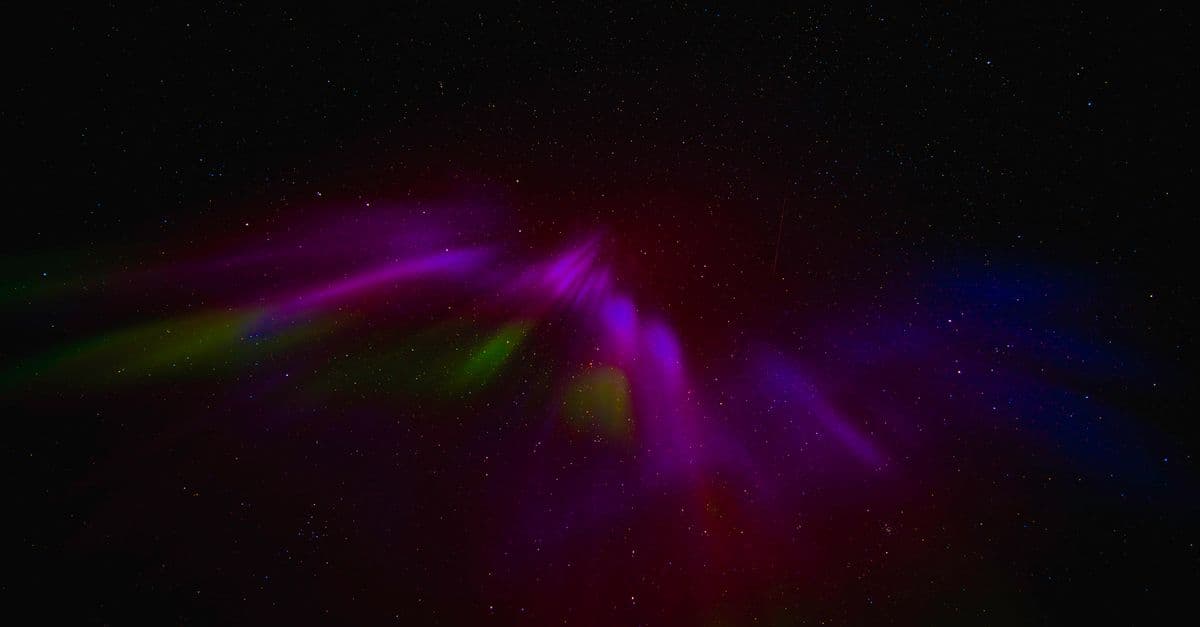
Photo: Raul Ling / Pexels
On the night of May 10–11, 2024, people in Mexico, Texas, the south of France, and even parts of northern India looked up to see the sky burning green, pink, and red. The Gannon Storm — the strongest geomagnetic storm in two decades — pushed the aurora thousands of kilometers from its usual home above the Arctic Circle. For one night, the northern lights belonged to almost everyone.
Auroras have fascinated humans for as long as we have written things down. Galileo gave them their modern name in 1619 (after Aurora, the Roman dawn goddess, and Boreas, the Greek north wind). But the physics — that they are atoms in our atmosphere being struck by charged particles from the Sun — wasn't worked out until the 20th century.
What an Aurora Actually Is
The aurora is light emitted by atoms and molecules in Earth's upper atmosphere after they have been excited by collisions with charged particles. The full chain looks like this:
- The Sun continuously emits a stream of charged particles (mostly protons and electrons) called the solar wind, typically moving at 400–800 km/s. Coronal mass ejections (CMEs) and high-speed streams from coronal holes can boost this dramatically.
- The solar wind slams into Earth's magnetosphere — the bubble of magnetic field around our planet generated by the molten iron core.
- Most particles are deflected, but the magnetic field funnels some down along the field lines toward the magnetic poles, where the field lines plunge into the atmosphere.
- At altitudes between roughly 100 and 400 km, these high-energy particles collide with oxygen and nitrogen atoms and molecules, kicking their electrons into excited states.
- When those electrons drop back down, they emit a photon of a specific wavelength — and that is the light we see.
This is the same physics as a neon sign or a fluorescent tube: excited gas atoms emitting characteristic colors as they relax. The aurora is essentially Earth's upper atmosphere acting as a planet-sized vacuum tube.
Why Auroras Have Specific Colors
Each color is the fingerprint of a particular atom in a particular energy transition at a particular altitude.
| Color | Source | Wavelength | Altitude | Notes |
|---|---|---|---|---|
| Green | Atomic oxygen | 558 nm | ~100–250 km | By far the most common — bright, often dominates displays |
| Red | Atomic oxygen | 630 nm | ~200–400 km | Long-lived excited state; visible only when atmosphere is thin enough for atoms to emit before colliding |
| Blue / violet | Molecular nitrogen (N₂⁺) | 391–470 nm | ~100 km and below | Often seen near lower edges during intense storms |
| Pink / magenta | N₂ + oxygen mix | ~600–700 nm | Lower edge | Mix of red oxygen and blue nitrogen emissions |
The reason red auroras need such thin air is subtle: the excited oxygen state that emits red light has a long lifetime (~110 seconds). At lower altitudes, the atom collides with something else before it can emit, and the energy is lost as heat. Only above ~200 km is the air sparse enough that the photon actually gets out.
The classic green oxygen emission, by contrast, comes from a state with a lifetime of ~0.7 seconds — short enough that it usually emits before being collisionally quenched.
The Aurora Oval
Auroras don't happen at the geographic poles. They happen along an oval-shaped band around the magnetic poles, called the aurora oval, typically centered between geomagnetic latitudes 65° and 75°. This is where the open field lines from the magnetotail (the long magnetic tail dragged out by the solar wind) reconnect and dump their particle load.
During quiet conditions, the oval is narrow and sits at high latitudes — best viewed from northern Norway, northern Finland and Sweden, Iceland, Greenland, northern Canada, Alaska, and on the southern hemisphere side, Antarctica, Tasmania, and southern New Zealand.
During strong geomagnetic storms, the oval expands toward the equator. The Gannon Storm of May 2024 pushed it to roughly 30° geomagnetic latitude — far enough to be visible from Florida and the Mediterranean.
Solar Cycle and When to See Them
Solar activity rises and falls on roughly an 11-year cycle. We are currently near the maximum of Solar Cycle 25, which peaked around 2024–2026 — meaning auroras have been more frequent and farther south than at any point in two decades. The next minimum is expected around 2030, and aurora hunters tend to plan trips around the maximum years.
For more on the underlying solar physics see our article on space weather.
Where (and How) to See Them
Best viewing locations:
- Iceland — easy to reach, dark skies, classic aurora-tourism destination
- Tromsø, Norway — sits right under the aurora oval
- Abisko, Sweden — famous "blue hole" of clear skies
- Rovaniemi/Saariselkä, Finland — Lapland with frequent activity
- Fairbanks, Alaska — directly under the oval, often clear
- Yellowknife, Canada — high probability, dry continental climate
- Antarctica / southern Tasmania — for the aurora australis
Forecasting tools:
- NOAA SWPC (Space Weather Prediction Center) — Kp index forecast (0–9 scale; Kp 5+ = geomagnetic storm)
- Aurora alert apps (My Aurora Forecast, AuroraWatch UK)
- Real-time solar wind data from NASA's ACE and DSCOVR satellites at the L1 Lagrange point — they give roughly a 30–60 minute warning of the solar wind arriving at Earth
Practical tips: new moon and dark skies help enormously. Aurora is faint to the eye even when bright on camera — a long exposure (10–20 seconds at high ISO) reveals colors the eye can barely register, because human cones perform poorly at low light.
Auroras on Other Planets
Earth is not unique. Any planet with both a magnetic field and an atmosphere produces auroras:
- Jupiter has the most powerful auroras in the solar system. Hubble and Juno have imaged them in ultraviolet — driven not just by solar wind but by particles from the volcanic moon Io.
- Saturn has spectacular auroras at both poles, imaged by Cassini.
- Uranus and Neptune — faint auroras seen by Voyager and Hubble.
- Mars — has weak, patchy auroras around remnant crustal magnetic fields (it lost its global field billions of years ago).
- Venus — has induced auroras even without a global magnetic field.
For the bigger picture of planetary fields see Earth's magnetism.
Aurora Substorms and Magnetic Reconnection
A substorm is a sudden brightening and expansion of the aurora — sometimes lasting tens of minutes — driven by magnetic reconnection in Earth's magnetotail. The magnetotail is the region downwind of Earth in the solar wind where magnetic field lines point away from the planet. Energy from the solar wind accumulates in this tail. Every 30 minutes to a few hours, the field lines abruptly reconnect — stored magnetic energy converts to kinetic energy of particles, which are accelerated back toward Earth and into the atmosphere. This is why aurora hunters often spend hours staring at a faint green arc that suddenly explodes into a violent wall of dancing curtains. The expansion phase of a substorm can release the equivalent energy of thousands of nuclear bombs.
Source: Akasofu (2002), "Aurora: From Mythology to Modern Science," International Press; modern understanding from THEMIS and other magnetospheric satellites.
The predictability of substorms remains a frontier problem in space physics. Current models can detect precursors (sudden changes in magnetic field measured on the ground) with 10-30 minute lead time, which is enough for automated aurora alerts but too short for planned observing trips.
The Magnetosphere: Earth's Magnetic Shield
The aurora is just the visible consequence of a much larger phenomenon: Earth's magnetosphere. The magnetosphere is the region of space where Earth's magnetic field dominates over the solar wind's magnetic field. Without it, the solar wind would strip away our atmosphere over time (as likely happened to Mars billions of years ago).
Structure: The magnetosphere has several key regions:
- The bow shock marks the boundary where solar wind is slowed to subsonic speeds
- The magnetosheath is the turbulent transition region between the shock and magnetosphere
- The magnetopause (~10 Earth radii sunward) is the actual boundary of the magnetosphere
- The magnetotail extends downwind millions of kilometers (most of the volume of the magnetosphere lies on the nightside)
- The plasmasphere is the inner region, corotating with Earth, containing cold plasma of ionospheric origin
Auroras occur because of the particular geometry of the magnetic field and how it interconnects. The field lines that lead to aurora-generating regions are "open" lines that originate in the magnetotail and dip down into the upper atmosphere.
Photography and Why Auroras Look Different to Your Eye vs. Your Camera
Aurora photography is deceptive. An 8-second exposure at ISO 1600 reveals vivid green, red, and magenta that the naked eye barely registers. This happens because:
- Human vision is poor in dim light: Our eyes have mostly rod receptors, which are sensitive to brightness but can't distinguish color well at low light levels (this is called the Purkinje effect)
- Long camera exposures accumulate photons: A camera integrates light for seconds; your eye does not
- Color sensitivity: Our peripheral vision (which is most sensitive at night) is nearly colorless. Only the fovea (center of vision) has color sensitivity, and it is less sensitive than peripheral rods to dim light
In practice, a strong aurora (Kp 5-6) visible to the naked eye shows mostly green. Red is rarely visible to the naked eye even in very strong auroras, because red light is intrinsically dim (longer wavelength = fewer photons), and the red-emitting oxygen level (>200 km) is farther away. Photography reveals reds that are genuinely there but too faint for the human eye.
Aurora Forecasting and the Kp Index
The Kp index (Planetary K-index) is the standard metric for aurora intensity, ranging from 0 (quiet) to 9 (extreme). It's derived from measurements of Earth's magnetic field disturbance at a network of ground stations.
| Kp | Event | Likely Aurora Latitude |
|---|---|---|
| 0-1 | Quiet | 70°+ only |
| 2-3 | Unsettled | 65°+ |
| 4 | Minor storm | 60°+ |
| 5 | Moderate storm | 50°+ |
| 6 | Strong storm | 40°+ |
| 7 | Severe storm | 30°+ |
| 8 | Very severe storm | 20°+ |
| 9 | Extreme storm | 10°+ (visible from tropics) |
NOAA's Space Weather Prediction Center (SWPC) issues forecasts 3 days in advance based on solar imagery, and real-time forecasts based on solar wind data from satellites at the L1 Lagrange point (~1.5 million km sunward), which provide 30-60 minute warning. Experienced aurora chasers monitor solar wind density, speed, and magnetic field orientation in real-time and watch for specific signatures (southward magnetic field) that trigger substorms.
Historical Observations and Cultural Significance
Human records of auroras stretch back thousands of years. Chinese imperial records from ~600 BCE document "red vapors" in the sky, which were likely auroras viewed from unusually southern latitudes during an extreme geomagnetic storm. Aurora descriptions appear in:
- Ancient Egypt (~1500 BCE): Papyri describe "reddish pillars of light"
- Medieval Europe: Auroras were interpreted as portents of war or divine intervention
- Norse mythology: Auroras were imagined as Valkyries' armor, or reflections from Bifrost (the rainbow bridge)
- Indigenous Arctic peoples: Auroras feature in spiritual and practical contexts; some traditions held that auroras respond to behavior (loud noises, bright lights attract them)
Scientifically, the first rigorous observations came from the 17th century with the invention of the telescope. Galileo was the first to apply the name "aurora borealis" in 1619. The first quantitative study of auroral morphology (shape and structure) came in the 19th century via photography.
The 1859 Carrington Event — the most powerful geomagnetic storm on record — produced auroras visible globally. Observers reported them from Cuba, Hawaii, and the southern hemisphere. Telegraph systems worldwide failed, and fires broke out due to induced electrical currents. This event remains the benchmark for "extreme space weather" — a repeat today would cause trillions of dollars in damage to modern electrical grids and satellites.
Today, auroras remain a major driver of tourism in the Arctic, generating hundreds of millions of dollars annually and driving scientific interest that benefits space physics more broadly.
Source: Siscoe, G., & Crooker, N. U. (2011) — "Auroral geomagnetic storms," Ch. 4 in Extreme Space Weather, University of Chicago Press.
Aurora's Effect on the Ionosphere and Atmospheric Chemistry
Auroras aren't just light — they alter the chemistry and physics of Earth's upper atmosphere:
Ionization and conductivity: Auroral particles ionize nitrogen and oxygen, creating free electrons and ions. This dramatically increases the electrical conductivity of the ionosphere during auroral substorms. Conductivity patterns shape how electric currents flow in the ionosphere and couple to the magnetosphere.
Nitrous oxide (NOₓ) and ozone loss: Energetic particles from auroras produce nitrous oxides (NO, NO₂) in the thermosphere and mesosphere. These NOₓ species can drift downward into the stratosphere over weeks and catalytically destroy ozone. Studies (e.g., Randall et al., 2005) suggest that extreme geomagnetic storms can cause measurable ozone depletion at polar latitudes, though this is a small effect compared to chlorofluorocarbon (CFC)-driven ozone loss.
Atmospheric heating: Auroral particle collisions heat the upper atmosphere locally. Energy deposition during a major substorm (~1000 GJ — equal to a small nuclear explosion) raises upper-atmosphere temperatures by 100s of degrees Kelvin in the auroral zone. This can affect atmospheric circulation patterns and polar stratospheric cloud formation.
Ionospheric disturbances: Auroral electric fields create irregularities (density structures) in the ionosphere that scatter radio waves. This causes interference with High Frequency (HF) radio communication and can degrade GPS accuracy — critical for precision agriculture, power grids, and surveying.
Unlike stratospheric ozone depletion (which persists long-term), these auroral ionospheric effects are transient and local. However, during extreme geomagnetic storms, cumulative effects on high-altitude chemistry can persist for weeks.
Source: Randall, C.E., et al. (2005) — "Stratospheric effects of mesospheric HOₓ and NOₓ — 2D model results," Journal of Geophysical Research.
Geomagnetic Storms and Technological Damage
While auroras are beautiful, the geomagnetic storms that produce them pose serious hazards to modern technology:
Satellite damage: Geomagnetic storms increase atmospheric drag on satellites in low Earth orbit (due to thermospheric expansion), causing unplanned deorbit. Solar panel degradation and electronic component failures are common. The 2003 Halloween Storms damaged multiple weather and communications satellites worth billions of dollars.
Power grid failures: Geomagnetic storms induce currents in power transmission lines, particularly at high latitudes. The most famous case: March 13, 1989, the Hydro-Québec blackout. A moderate geomagnetic storm induced currents that tripped circuit breakers, and 6 million people lost power for 9 hours. A similar event today could cause $1-2 trillion in direct and cascading economic loss if it affects major power hubs like the northeastern U.S. or northern Europe.
GPS and communication disruption: Geomagnetic storms create ionospheric scintillation (rapid fluctuations in ionospheric electron density), which degrades GPS accuracy from meters to hundreds of meters. For precision agriculture, autonomous vehicles, and surveying, this is disruptive. Commercial airline operations over polar routes lose HF radio and must rely on satellite communication systems.
Radiation exposure: Geomagnetic storms allow higher-energy cosmic rays and solar energetic particles to penetrate closer to Earth, increasing radiation dose to airline crews and astronauts. A strong event (Kp 8-9) increases radiation dose at flight altitudes to levels equivalent to additional chest X-rays.
The 2012 Carrington-class storm missed Earth by ~9 days in its orbital path. Simulations suggest it would have caused $0.6-2.4 trillion in damages to the U.S. economy alone, with recovery taking 4-10 years. Space weather forecasting and protective measures (power grid management, satellite positioning, communication redundancy) are now critical infrastructure priorities.
Source: National Academies of Sciences (2016) — "Severe Space Weather Events — Understanding Societal and Economic Impacts."
Aurora Australis and Hemisphere Differences
The aurora australis (southern lights) is the aurora's southern-hemisphere counterpart, occurring in the same geomagnetic latitudes but around the south magnetic pole.
Similarities: Identical physics, same colors, same geomagnetic drivers. Aurora australis occurs in Tasmania, southern New Zealand, southern Chile, and Antarctica.
Differences:
- Geography: The south magnetic pole is in the Antarctic, a region of low population density, making southern aurora observation logistically harder than northern Aurora viewing. Most aurora tourism and scientific observation is in the north.
- Aurora oval expansion: During extreme storms, the aurora oval expands equatorward in both hemispheres, but the asymmetric landmass distribution means more people see the aurora in the north. A Kp 9 storm makes aurora visible to millions in North America and Europe; in the south, visibility is primarily from Antarctica and remote southern ocean locations.
- Ionospheric structure: Subtle differences in the north-south asymmetry of Earth's magnetosphere can cause small differences in auroral intensity between hemispheres during the same storm, but these are minor.
Modern satellite-based observations show that the aurora occurs simultaneously in both hemispheres during any geomagnetic event — the magnetosphere couples them together magnetically.
Source: Davis, T.N., & Sugiura, M. (1966) — "Auroral electrojet activity index," Journal of Geophysical Research.
Frequently Asked Questions
Q: Can you actually hear the aurora, or is that just folklore?
A: Anecdotal reports of crackling or hissing sounds have existed for centuries in Scandinavian and Indigenous traditions. For decades, this was dismissed as psychological. A 2016 Finnish study (Keiling et al., Geophysical Research Letters) used sensitive audio equipment and recorded faint sounds correlated with aurora activity, possibly from electric discharges in cold air layers near the ground. The mechanism remains unclear, and the sounds are very faint—most people do not report hearing them even during bright auroras. It's a genuine phenomenon but subtle and not universal.
Q: Is the aurora dangerous to people on the ground?
A: Direct exposure to aurora is not dangerous—you're looking at light emitted by atoms in the upper atmosphere, at altitudes of 100+ km. The energetic particles causing the aurora are stopped by the atmosphere and do not reach the surface. However, geomagnetic storms that cause auroras have indirect effects: they can damage or disable satellites, induce harmful currents in power grids (most famously, Quebec 1989 power grid collapse), disrupt GPS and radio communication, and expose astronauts and airline crews to increased radiation. So the aurora itself is safe; the geomagnetic storms that produce it have hazards for technology and high-altitude workers.
Q: Why are auroras shaped like curtains or waves instead of just a diffuse glow?
A: Auroras trace the geometry of Earth's magnetic field lines. The "curtains" are sheets of incoming particles aligned along nearly vertical field lines—you're looking edge-on at a thin glowing wall. The "waves" are Alfvén waves (a type of wave in magnetized plasma) traveling along the field lines. The specific shapes—curtains, arcs, pillars, diffuse patches—correspond to different particle acceleration and field-line configurations. The visual structure directly reveals the underlying magnetic and plasma physics.
Q: How far in advance can auroras be accurately predicted?
A: 3 days at most, and only if a coronal mass ejection (CME) is observed erupting from the Sun. Reliable predictions require observing the CME (which narrows the arrival window to 1-4 days based on solar wind speed), and real-time refinement from solar wind monitors at the L1 Lagrange point (giving 30-60 minute lead time before solar wind impacts Earth). Large geomagnetic storms arrive with little warning (~30-60 minutes) if solar wind parameters suddenly become favorable. This is why sudden aurora alerts on the evening of a forecast are common.
Q: Why does the aurora occur at high magnetic latitudes rather than the geographic North and South Poles?
A: Because it follows the magnetic poles, not geographic poles. Earth's magnetic dipole is tilted approximately 11° from the rotational axis, placing the north magnetic pole in the Canadian Arctic (currently drifting toward Siberia at about 50 kilometers per year). The aurora oval is centered at approximately 65-75° geomagnetic latitude, which corresponds to regions like northern Norway, Finland, Alaska, and the Canadian Arctic. During strong storms, the oval expands equatorward, but it remains centered on the magnetic poles. The magnetic axis, not the geographic axis, determines where the aurora occurs because the aurora is caused by particles guided along Earth's magnetic field lines.
Q: What is STEVE, and is it an aurora?
A: STEVE stands for "Strong Thermal Emission Velocity Enhancement." It's a purple-pinkish ribbon sometimes observed across the nighttime sky, often alongside aurora, and was documented extensively by citizen scientists starting in 2016. STEVE is not technically an aurora—it's a hot, fast-moving ribbon of plasma in the ionosphere (~300 km altitude) glowing thermally from collisions rather than atomic excitation. It's sometimes accompanied by a green "picket fence" structure below it, creating a striking visual effect. STEVE appears to be associated with energy dissipation in the ionosphere during geomagnetic storms but was only recently recognized and remains an area of active research. It's a reminder that the high-altitude environment during auroras is more complex than classical aurora theory captured.
The takeaway
Auroras are nature's most dramatic display of the interaction between the Sun and Earth. They result from a chain of physics: solar wind particles stream toward us, Earth's magnetosphere funnels them toward the poles, they collide with atmospheric atoms, and those atoms emit characteristic colors. The process happens 100+ kilometers overhead but involves energies comparable to nuclear events. We are living through a solar maximum (2024-2026), making this an optimal time for aurora viewing. Photography reveals subtleties the human eye cannot quite capture, and forecasting—once purely observational—is now accurate enough for planning trips. The aurora remains science's most beautiful bridge between solar physics and Earth's upper atmosphere.
Read next
Follow new articles
Add SciHub101 to your feed reader to see new science and technology stories.
About the Author
SciHub101 is an independent science and technology publication founded and edited by Buğra Sözeri, a software engineer and app developer based in Türkiye. AI tools assist with drafting and research. Source documentation in the existing archive is uneven, and articles are being reviewed and corrected. The Editorial Team byline identifies editorial responsibility; it does not certify specialist or independent human review. Where we compare products, anything built by our own team is labelled as such — see the editorial guidelines and About page for how corrections and disclosures work.
Related Articles
Asteroids, Comets, and Meteors — What's the Difference?
Asteroids, comets, meteoroids, meteors, and meteorites — what each one is, where they come from, and how scientists study them.
Planets of the Solar System — Complete Guide
All 8 planets and 5 dwarf planets explained — sizes, atmospheres, moons, missions, and what makes each world unique in our solar system.
Jupiter's Auroras: The Most Powerful Light Show in the Solar System
Jupiter's auroras are not scaled-up versions of Earth's. They run mostly on plasma from the volcanic moon Io and on the planet's own rapid spin, and they glow in ultraviolet, infrared, and X-rays whether or not the Sun is active.
Solar Maximum 2025: How Solar Cycle 25 Outran Every Prediction
In May 2024, auroras appeared over Florida, the Yucatán Peninsula, and Puerto Rico. Northern lights were photographed from latitudes that had not seen them in decades — triggered by the strongest geomagnetic storm since March 1989. The storm was rated G5, the maximum on NOAA's five-point geomagnetic disturbance scale. Solar Cycle 25, which government forecasters had predicted would be 'average,' had quietly become one of the most active solar cycles in a century — and the official models did not see it coming until it was already happening.
What Are the Van Allen Belts? Earth's Trapped Radiation
The Van Allen belts are zones where Earth's magnetic field traps radiation. How Explorer 1 found them, how they work, and how Apollo and Artemis crossed them.