Asteroids, Comets, and Meteors — What's the Difference?
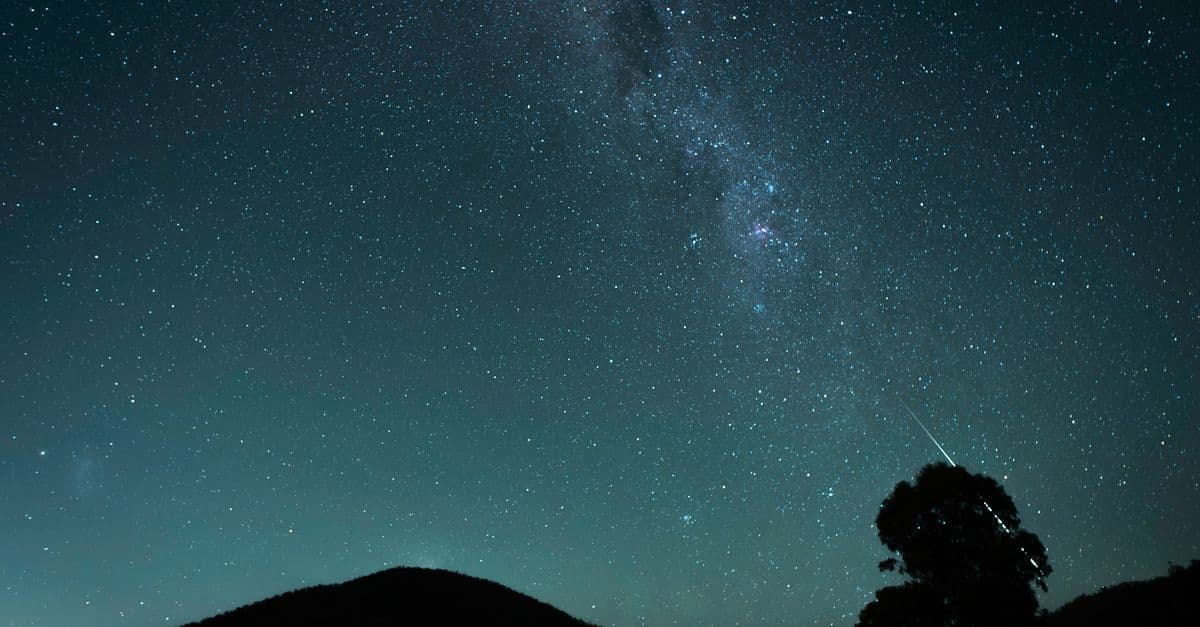
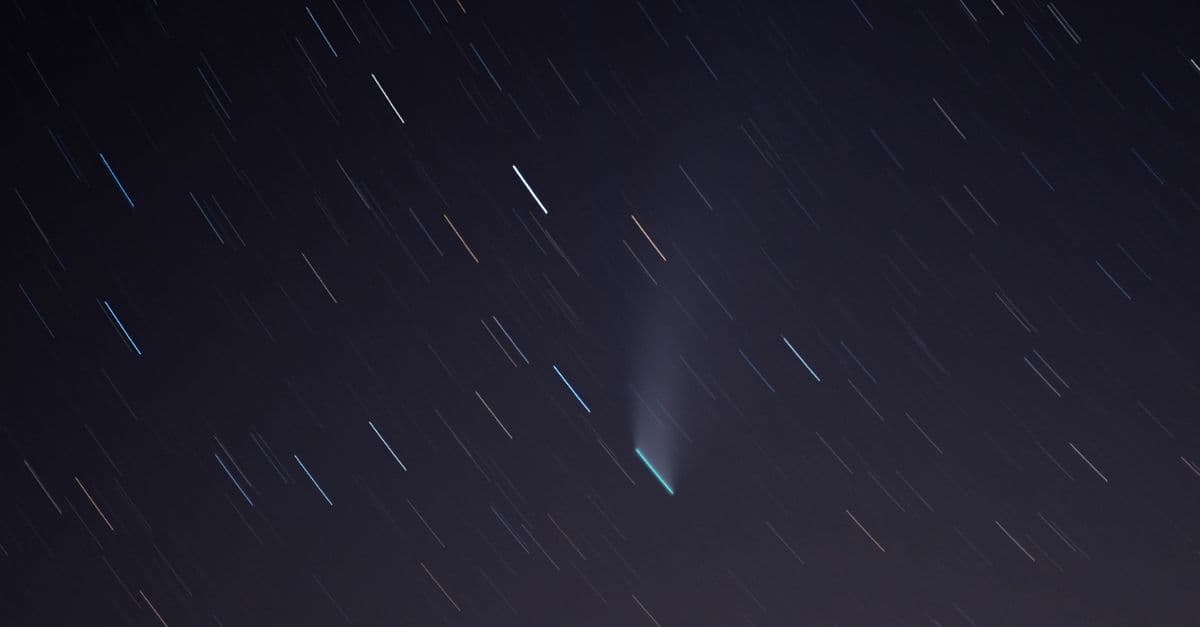
Photo: Nate Biddle / Pexels
Every year, roughly 17 meteorites large enough to survive the trip land somewhere on Earth's surface, and on average one asteroid the size of a house sails past closer than the Moon every few weeks without most people noticing. The words we use for all this incoming rock — asteroid, comet, meteoroid, meteor, meteorite — get swapped around constantly, even in professional news coverage. They are not interchangeable. Each term describes a specific kind of object, or a specific stage in that object's life, and getting the distinction straight also answers the more urgent question: which of these things could actually hit us, and what is anyone doing about it.
What actually separates an asteroid from a comet
The simplest way to think about it is where each object formed in the solar system's early, chaotic first few million years. Around 4.6 billion years ago, the Sun was surrounded by a spinning disk of gas and dust. Close to the Sun, it was too hot for ice to survive, so material there condensed into rock and metal. Farther out, past what astronomers call the "frost line," ices could stay solid, and that material accreted into icy bodies instead. Everything since has been a story of what happened to the leftovers.
Asteroids are the rocky and metallic leftovers from the inner, warmer part of that disk — planetesimals that clumped partway toward becoming a planet and then stalled, mostly because Jupiter's gravity kept stirring the region and preventing anything from settling down. According to NASA's Jet Propulsion Laboratory, which runs the Center for Near-Earth Object Studies, more than 1.4 million asteroids have been catalogued as of 2024, the overwhelming majority sitting in the main asteroid belt between Mars and Jupiter, roughly 2.2 to 3.2 astronomical units (AU) from the Sun (one AU is the average Earth–Sun distance, about 150 million kilometers or 93 million miles).
Comets are the icy leftovers from the outer, colder part of the disk — what planetary scientists sometimes describe, informally, as "dirty snowballs": frozen water, carbon dioxide, methane, and ammonia mixed with embedded dust and rock. They live much farther out, in two reservoirs that never got swept up into planets: the Kuiper Belt beyond Neptune and the far more distant Oort Cloud.
Composition is really the tell. If you could scoop up a sample from the main belt and a sample from a comet nucleus and put them side by side, the asteroid sample would look like ordinary terrestrial rock or, in some cases, metal alloy. The comet sample would look more like a dirty, compacted snowbank, and it would start hissing and venting the moment it warmed up. Neither behaves like the other once you understand what each is actually made of.
How a comet grows a tail — and why it has two
A comet spends most of its multi-thousand-year orbit as an inert, frozen nucleus, typically 1 to 60 kilometers across, indistinguishable from a dark asteroid at a distance. Everything changes as it falls toward the Sun. Once a comet crosses roughly the orbit of Jupiter, solar heating becomes strong enough to sublimate its surface ices — turning solid ice directly into gas without passing through a liquid phase, the way dry ice does on a warm table. That escaping gas drags dust off the nucleus with it, and together they form the coma, a glowing envelope of gas and dust that can swell to be larger than the Sun itself, even though the solid nucleus underneath might be only a few kilometers wide.
Think of a comet's nucleus like an ice cube dropped on a hot skillet: as it melts, it doesn't just shrink quietly, it hisses, spits, and throws off a visible cloud of vapor around itself. That cloud is the coma. The skillet, in this analogy, is the Sun's radiation, and the closer the comet gets, the more violently it "cooks."
From the coma, two separate tails emerge, and they point in genuinely different directions because two different forces are pushing them.
- Ion tail — composed of electrically charged gas, blown in a straight line directly away from the Sun by the solar wind (the constant stream of charged particles the Sun emits). It typically glows blue from ionized carbon monoxide.
- Dust tail — composed of heavier dust particles that are pushed more gently by sunlight pressure and lag behind along the comet's orbital path, curving and appearing yellowish-white because it reflects sunlight rather than glowing on its own.
This is why comet tails in long-exposure photos often look like they're forking into two distinct arcs. They are not one tail splitting — they are two physically separate phenomena governed by two different kinds of force, radiation pressure on light dust versus the solar wind's push on charged gas, that happen to originate from the same coma.
Where do comets come from?
Short-period comets, which complete an orbit in under 200 years, generally originate in the Kuiper Belt, a disk-shaped region of icy bodies beyond Neptune's orbit, roughly 30 to 50 AU from the Sun. Halley's Comet, with its 76-year orbit, is the most famous example and was last seen from Earth in 1986; it will not return until 2061, according to NASA's Solar System Exploration program.
Long-period comets, some with orbits lasting thousands or millions of years, come from the far more distant Oort Cloud, a roughly spherical shell of icy bodies thought to extend from about 2,000 AU out to 100,000 AU or more — nearly a quarter of the way to the nearest star. Comet Hale-Bopp, spectacularly visible to the naked eye in 1997, is an Oort Cloud object; based on its orbital mechanics, it will not swing back into view until roughly the year 4380.
Meteoroid, meteor, meteorite: same object, three different moments
This trio causes the most confusion because, unlike asteroid versus comet, it isn't a difference of composition or origin at all — it's a difference of location and behavior. The same tiny fragment of space rock earns three different names depending on exactly where it is and what it's doing at any given moment.
- Meteoroid — the object itself, while it is still out in space: a fragment of rock or metal ranging from roughly a millimeter to about a meter across, generally chipped off an asteroid by a collision or shed by a comet as its ices sublimate.
- Meteor — the streak of light produced when that same meteoroid slams into Earth's atmosphere at extreme speed and burns up from friction, commonly called a "shooting star." The meteor is the light show, not the object.
- Meteorite — the surviving fragment, if any survives, that makes it through the atmosphere and lands on the ground.
A useful analogy: think of a piece of mail traveling through a postal system. While it's in a truck in transit, call it a "package." The moment it's being scanned and processed through the sorting facility (the atmosphere), briefly visible on the conveyor, call that stage "processing." Once it arrives at your doorstep and you can pick it up, it's a "delivery." Same physical object throughout, three different names because it's in three different phases of a single journey. That's essentially the meteoroid-meteor-meteorite relationship: one rock, three names, defined entirely by where it is in its trip.
Why do meteors glow?
A meteoroid entering the atmosphere is typically traveling somewhere between 11 and 72 kilometers per second (about 25,000 to 160,000 mph). At that speed, compression and friction with air molecules heat the meteoroid's surface to thousands of degrees almost instantly, vaporizing its outer layers and ionizing the surrounding air. That ionized, glowing channel of air, not the rock itself glowing, is what produces the visible streak, typically at an altitude of 80 to 120 kilometers. Most meteors you see are caused by objects no larger than a grain of sand or a pea; they simply vaporize completely and never reach the ground as meteorites at all.
A side-by-side comparison
Table 1. Core properties of asteroids, comets, meteoroids, and meteorites.
| Property | Asteroid | Comet | Meteoroid | Meteorite |
|---|---|---|---|---|
| Composition | Rock and/or metal | Ice, dust, and frozen gas | Fragment of rock or metal | Rock and/or metal that survived entry |
| Origin | Main asteroid belt, Trojans, near-Earth population | Kuiper Belt (short-period) or Oort Cloud (long-period) | Debris shed by asteroids or comets | A meteoroid that reached the ground |
| Typical size | 1 meter to 940 km (Ceres, the largest) | 1 km to about 60 km nucleus | Millimeters to about 1 meter | Grams to several tons |
| Visible tail | No | Yes, when near the Sun | No | No |
| Where found | Interplanetary space | Interplanetary space | Interplanetary space or atmosphere | Earth's surface |
| Well-known example | Vesta, Bennu, Ceres | Halley's Comet, Hale-Bopp | Perseid stream particles | The Chelyabinsk fragments (2013) |
Beyond the main belt, a handful of other asteroid populations matter for how the solar system is organized. Trojans share Jupiter's orbit entirely, clustered at two gravitationally stable points 60 degrees ahead of and behind the planet, called the L4 and L5 Lagrange points. Near-Earth asteroids, or NEAs, have orbits that bring them within roughly 1.3 AU of the Sun, meaning they cross or approach Earth's own orbit; NASA's CNEOS program had catalogued more than 35,000 of these by 2024. Centaurs occupy the gap between Jupiter and Neptune and behave like a hybrid, sometimes showing comet-like activity despite an asteroid-like orbit, which is one reason the asteroid/comet line isn't always perfectly clean in practice.
What meteorites tell us once they reach the ground
Not all meteorites are alike, and their internal structure is essentially a fossil record of how the solar system's building blocks separated out billions of years ago.
Table 2. Meteorite classification by type and approximate share of falls.
| Type | Approximate share of falls | What it's made of |
|---|---|---|
| Stony — chondrites | About 86% | Silicate minerals, frequently containing chondrules, millimeter-sized droplets that froze from the earliest molten material in the solar system |
| Stony — achondrites | About 8% | Igneous silicate rock with no chondrules, meaning it came from a body that melted and differentiated, like Vesta or Mars |
| Iron | About 5% | Iron-nickel alloy, thought to be fragments of the metallic cores of shattered protoplanets |
| Stony-iron | About 1% | A mix of silicate and metal, including pallasites (olivine crystals embedded in an iron-nickel matrix) |
Chondrites, and especially the subgroup called carbonaceous chondrites, are prized by researchers because they are essentially unaltered since the solar system's birth. Some contain amino acids, water-bearing clay minerals, and other organic compounds, which is a major reason space agencies have spent billions of dollars sending spacecraft to physically retrieve samples from carbon-rich asteroids rather than waiting for meteorites to fall.
Meteor showers: predictable fireworks from comet debris
A meteor shower happens when Earth's orbit carries it through the trail of dust and debris that a comet (or, in a couple of cases, an asteroid) has scattered along its own orbital path over many past passes near the Sun. Because Earth crosses the same debris trails at the same points in its orbit every year, meteor showers are annual and predictable down to the date.
Table 3. Major annual meteor showers and their parent bodies.
| Shower | Typical peak | Parent body | Typical rate (meteors per hour under dark skies) |
|---|---|---|---|
| Quadrantids | Early January | Asteroid 2003 EH1 | 60–120 |
| Lyrids | April 22 | Comet Thatcher | 10–20 |
| Perseids | August 12–13 | Comet Swift-Tuttle | 50–100 |
| Orionids | October 21 | Comet 1P/Halley | 15–25 |
| Leonids | November 17 | Comet Tempel-Tuttle | 10–20 (storms of thousands per hour roughly every 33 years) |
| Geminids | December 13–14 | Asteroid 3200 Phaethon | 100–150 |
The Geminids are an interesting exception worth pausing on: their parent, 3200 Phaethon, is classified as an asteroid, not a comet, yet it sheds debris the way a comet does. Some researchers suspect Phaethon experiences brief, weak bursts of dust ejection when it swings unusually close to the Sun, blurring the tidy asteroid/comet divide once again. The Leonids, meanwhile, occasionally produce true meteor "storms," with rates spiking into the thousands per hour, when Earth passes through an especially dense clump of debris shed by Comet Tempel-Tuttle on a recent orbit; this happened dramatically in 1833, 1866, and 1966, and again, less intensely, in 2001.
When the rock doesn't burn up completely: notable impacts
Most meteoroids never make it past the "streak of light" stage. Occasionally, though, something large enough and dense enough survives, or explodes with enough force in the atmosphere, that the event becomes historic.
Chicxulub, roughly 66 million years ago. An asteroid estimated at about 10 to 15 kilometers across struck what is now the Yucatán Peninsula in Mexico. The impact, and the climate disruption that followed from dust and sulfur thrown into the atmosphere, is considered the leading explanation for the mass extinction that ended the age of non-avian dinosaurs, according to the peer-reviewed consensus summarized in a 2010 Science review led by Peter Schulte and dozens of co-authors.
Tunguska, 1908. An object estimated at 50 to 60 meters across exploded in an air burst over the Podkamennaya Tunguska River in Siberia. There was no impact crater, because the object detonated in the atmosphere rather than striking the ground, but the blast flattened an estimated 2,000 square kilometers of forest, according to NASA's ongoing analysis of the event.
Chelyabinsk, 2013. A roughly 20-meter asteroid entered the atmosphere over Chelyabinsk, Russia, and exploded at an altitude of about 30 kilometers with an energy release estimated by NASA at around 440 kilotons of TNT equivalent — more than 20 times the energy of the atomic bomb dropped on Hiroshima. The shockwave shattered windows across the city, injuring roughly 1,500 people, mostly from flying glass. Crucially, the object was not detected before it hit, because it approached from the direction of the Sun, where ground-based telescopes cannot easily look.
Planetary defense: what's actually being tracked, and how
Tracking potentially hazardous objects has evolved from a niche academic pursuit into a coordinated international effort involving NASA, the European Space Agency (ESA), and observatories on multiple continents. According to NASA's Center for Near-Earth Object Studies, more than 95 percent of near-Earth asteroids larger than 1 kilometer across — the size capable of causing global, civilization-level damage — have now been found and catalogued, and none of them pose a known impact threat for at least the next century.
The much harder problem is the size range between roughly 50 and 140 meters: too small to reliably detect with current all-sky surveys from any meaningful distance, but large enough that an impact could flatten a metropolitan area. NASA estimates only a modest fraction of this population has been found so far, which is why upcoming infrared survey missions matter for closing the gap.
The most direct real-world test of what to actually do about a hazardous asteroid came in September 2022, when NASA's DART (Double Asteroid Redirection Test) spacecraft deliberately slammed into Dimorphos, a small moonlet orbiting the larger asteroid Didymos, at roughly 6.1 kilometers per second. Neither asteroid posed any threat to Earth; the pair was chosen purely as a safe, measurable test target. The impact shortened Dimorphos's orbital period around Didymos by about 32 minutes, a far larger deflection than mission planners had predicted, according to NASA's published results in Nature in 2023. It was the first time humanity had deliberately and measurably altered the trajectory of a celestial body, proving that a purely kinetic impact — essentially a very fast, very targeted collision, with no explosives involved — can meaningfully nudge an asteroid's path if applied years or decades before a potential impact.
ESA's follow-up mission, Hera, launched in October 2024 and arrived at the Didymos-Dimorphos system in late 2026 to study the aftermath of DART's impact in far greater detail than the original mission's cameras could capture on their own, including the size, shape, and depth of the crater DART left behind. That data will help engineers calibrate exactly how much force a kinetic impactor of a given mass and speed transfers to an asteroid of a given composition and structure, information that is essential for planning any future real deflection mission with confidence rather than educated guesswork.
Why can't we just blow up an incoming asteroid?
Popular film plots aside, planetary defense researchers generally favor deflection over destruction. Fragmenting a large asteroid with a nuclear device could turn one dangerous object into many smaller, harder-to-track objects still on a collision course, and nuclear devices are considered a last-resort option reserved for very short-warning scenarios. A gentle nudge applied years in advance, changing an asteroid's velocity by even a few centimeters per second, is enough to shift where it will be on the day it would otherwise have crossed Earth's path.
How much warning would we actually get?
It depends entirely on the object's size and orbit. A kilometer-scale asteroid on a collision course would likely be spotted years to decades in advance, since most of that population is already catalogued. A Chelyabinsk-sized object in the 20-meter range could still arrive with essentially no warning at all, exactly as it did in 2013, because current surveys are not yet sensitive enough to catch every object that small.
Sample return missions: touching the source material directly
Rather than waiting for a meteorite to fall and hoping it hasn't been contaminated by Earth's atmosphere, oceans, and biosphere, space agencies have increasingly sent spacecraft to retrieve pristine material directly from asteroids and comets, then bring it home under controlled conditions.
- Hayabusa2 (JAXA) returned approximately 5.4 grams of material from the near-Earth asteroid Ryugu in December 2020, the first subsurface asteroid sample ever collected, after the spacecraft fired a small explosive charge to create an artificial crater and expose material that had never been exposed to space weathering.
- OSIRIS-REx (NASA) returned approximately 121.6 grams of material from the carbon-rich near-Earth asteroid Bennu in September 2023, the largest asteroid sample ever brought to Earth, and early analysis published by NASA in 2024 confirmed the presence of both amino acids and the mineral building blocks associated with water, several of which are essential to life as it's understood on Earth.
- Stardust (NASA), decades earlier in 2006, returned dust grains collected directly from the coma of Comet Wild 2, giving researchers their first direct physical samples of cometary material rather than relying solely on meteorites or telescope spectra.
These missions matter because contamination is a serious scientific problem for meteorites that fall naturally: by the time a rock is picked up off the ground, it has already been exposed to Earth's atmosphere, rainwater, and microbial life, all of which can alter or mask its original chemistry. A sample collected in space and sealed immediately in a sterile canister avoids that problem entirely, which is why the amino acids and organic compounds found in Ryugu and Bennu samples are considered far more reliable evidence for how water and life's chemical building blocks may have been delivered to the early inner solar system than similar findings in meteorites alone.
Common mix-ups, cleared up
Isn't Pluto just a giant comet? No. Pluto is classified as a dwarf planet, roughly 2,377 kilometers in diameter according to NASA measurements, orders of magnitude larger than any known comet nucleus, and it has five known moons of its own. It happens to sit within the Kuiper Belt, the same general region that supplies many short-period comets, which is likely the source of the confusion, but scale and composition put it in an entirely different category.
Don't all meteorites come from comets, since comets are the ones with the dramatic tails? Actually the opposite is more common. The meteorites that reach the ground overwhelmingly derive from asteroid collisions, not comets. Cometary material is generally too fragile and icy to survive atmospheric entry intact; the fast-moving dust that creates meteor showers almost always burns up completely rather than landing as identifiable meteorites.
If I find a meteorite, is it automatically mine to keep? It depends entirely on where you find it and where you live. In the United States, meteorites generally belong to whoever owns the land where they're found, subject to some federal land exceptions. In several other countries, including Switzerland and Denmark, meteorites are treated as cultural or scientific property of the state regardless of who finds them, so it's worth checking local law before assuming ownership.
Does a big, bright fireball mean a big object hit the ground? Not necessarily. Brightness depends on speed and composition as much as size; a small, fast, metal-rich meteoroid can produce a spectacular fireball while burning up completely, leaving nothing on the ground at all.
FAQs
Q: What's the fundamental difference between a comet and an asteroid? A: Composition and place of origin. Asteroids are rocky or metallic bodies from the warmer inner solar system, mostly found in the main asteroid belt between Mars and Jupiter. Comets are icy bodies from the cold outer solar system, originating in the Kuiper Belt or Oort Cloud, and they develop a glowing coma and tail only when solar heating causes their ices to sublimate.
Q: Could a comet actually hit Earth? A: It's possible but far rarer in the historical and geological record than an asteroid impact, largely because there are simply far fewer comets passing through the inner solar system at any given time. Long-period comets from the Oort Cloud are also harder to detect with much warning, since they arrive from essentially random directions at very high speed rather than following the well-mapped orbits of catalogued asteroids.
Q: Why doesn't the asteroid belt look crowded, the way movies show it? A: Because it is overwhelmingly empty space. The belt's total mass is only about 4 percent of the Moon's, spread across a region roughly a billion kilometers wide, so the average distance between individually tracked asteroids is hundreds of thousands to millions of kilometers, not the dense field of tumbling boulders shown in film.
Q: Can I legally keep a meteorite I find? A: Laws vary significantly by country. In the United States, meteorites generally belong to the landowner where they're discovered. In several other countries, including Switzerland and Denmark, meteorites are treated as state cultural property regardless of who finds them, so local law matters more than the fact of discovery.
Q: What exactly makes a "shooting star" glow? A: Friction and compression as a meteoroid slams into the atmosphere at 11 to 72 kilometers per second heats and ionizes the surrounding air, and that glowing, ionized channel of air is the visible streak, not the rock itself burning. Most meteors are produced by objects no bigger than a grain of sand.
Q: Is Pluto a comet, since it's out past Neptune with all the icy bodies? A: No. Pluto is a dwarf planet roughly 2,377 kilometers across with five known moons, far larger and more complex than any comet nucleus. It shares the Kuiper Belt neighborhood with many comet-source bodies, which is probably why the confusion persists, but its size and structure put it in a completely different category.
Q: How often does a city-threatening asteroid actually hit Earth? A: Objects in the Chelyabinsk size range, around 20 meters, are estimated by NASA to enter the atmosphere roughly once every few decades on average, though most burn up over oceans or unpopulated areas and go unnoticed. Objects large enough to threaten an entire region, in the 140-meter-plus range, are far rarer, with average intervals estimated in the tens of thousands of years for any given impact site.
Q: What's the difference between the Kuiper Belt and the Oort Cloud? A: The Kuiper Belt is a relatively flat, disk-shaped region of icy bodies just beyond Neptune, roughly 30 to 50 AU from the Sun, and it's the source of most short-period comets. The Oort Cloud is a vastly more distant, roughly spherical shell of icy bodies thought to extend from about 2,000 AU to more than 100,000 AU, and it's the source of long-period comets on orbits that can last thousands to millions of years.
Q: Did NASA's DART mission prove we can actually stop an asteroid? A: It proved a specific technique, kinetic impact, works and can be more effective than predicted. DART shortened target moonlet Dimorphos's orbital period by about 32 minutes after a deliberate 2022 collision, confirming that a targeted, high-speed impact can meaningfully change an asteroid's trajectory if it's applied with enough lead time before a potential Earth impact.
Q: Why are some meteor showers more reliable than others? A: Reliability depends on how much and how evenly the parent body has distributed debris along its orbit over past passes near the Sun. Showers like the Perseids and Geminids come from parent bodies with dense, well-established debris trails that Earth crosses at nearly the same density every year, while showers with sparser or clumpier trails, like the Leonids, vary more dramatically and occasionally produce dramatic short-lived storms instead of a steady annual rate.
The takeaway
Asteroids and comets are defined by where they formed and what they're made of, rock and metal from the inner solar system versus ice and dust from the outer solar system, while meteoroid, meteor, and meteorite describe three stages of one fragment's journey from space to the ground. That distinction isn't pedantic trivia. It shapes how scientists search for hazardous objects, why some are nearly impossible to spot before they arrive, and why the current planetary defense strategy favors an early, gentle nudge over any last-minute dramatic intervention. The next time a bright streak crosses the night sky, it's worth remembering that it's very likely already over by the time you can point at it, since the entire show, from meteoroid to meteor, typically lasts well under a second.
Read next:
Sources
- NASA Center for Near-Earth Object Studies (CNEOS) — public catalog and impact risk tables, cneos.jpl.nasa.gov
- NASA Jet Propulsion Laboratory — asteroid and comet fact sheets, solarsystem.nasa.gov
- Schulte, P. et al. (2010). "The Chicxulub Asteroid Impact and Mass Extinction at the Cretaceous-Paleogene Boundary." Science, 327(5970).
- NASA — DART mission results, Daly, R. T. et al. (2023). "Successful kinetic impact into an asteroid for planetary defense." Nature, 616.
- NASA/JAXA — Hayabusa2 Ryugu sample return mission documentation
- Lauretta, D. S. et al. (2024). OSIRIS-REx Bennu sample analysis, published via NASA and Meteoritics & Planetary Science
- ESA — Hera mission documentation (2024–2026)
- American Meteor Society — meteor and meteorite survival statistics
- International Astronomical Union (IAU) Minor Planet Center — orbital element database
Read next:
Follow new articles
Add SciHub101 to your feed reader to see new science and technology stories.
About the Author
SciHub101 is an independent science and technology publication founded and edited by Buğra Sözeri, a software engineer and app developer based in Türkiye. AI tools assist with drafting and research. Source documentation in the existing archive is uneven, and articles are being reviewed and corrected. The Editorial Team byline identifies editorial responsibility; it does not certify specialist or independent human review. Where we compare products, anything built by our own team is labelled as such — see the editorial guidelines and About page for how corrections and disclosures work.
Related Articles
How the Moon Formed — Theia Impact Theory
The giant impact hypothesis explains how a Mars-sized body called Theia struck the proto-Earth and formed the Moon ~4.5 billion years ago.
Aurora Explained — How the Northern Lights Form
How auroras form: solar wind, Earth's magnetic field, atmospheric collisions, why they're green or red, and where and when to see them.
Long-Period Comets: Messengers From the Edge of the Solar System
Comet Hale-Bopp, which dominated the 1997 night sky, had not been seen by any human being before. Its previous perihelion passage was in approximately 2215 BCE, before writing systems existed in most of the world. It had spent the intervening 4,200 years falling inward from the outer solar system at speeds so slow that a bicycle could have overtaken it. When it finally arrived, its pristine composition — unchanged since the solar system formed 4.5 billion years ago — gave scientists a direct sample of the raw material from which planets were built. Long-period comets are the oldest, least-altered objects available for study. They are time capsules from the beginning.
2I/Borisov: The First Confirmed Interstellar Comet
In August 2019, an amateur astronomer in Crimea spotted a faint smudge moving at impossible speed. It turned out to be a comet from another star system — only the second interstellar object ever confirmed in our solar system, and the first one to look genuinely familiar.
The Zodiacal Light: The Solar System's Hidden Glow
Before dawn in a dark-sky location, a ghostly pyramid of light rises from the eastern horizon along the path of the zodiac. Ancient observers thought it was a meteorological phenomenon — moisture in the upper atmosphere catching the sun. It is not. It is sunlight scattered off trillions of interplanetary dust particles spread across the entire inner solar system, the ground-down debris of comets and asteroids, and it is far stranger than it looks. In 2021, a camera on NASA's Parker Solar Probe detected that this dust does not extend all the way to the Sun.
'Oumuamua: The First Interstellar Visitor and the Mystery of Its Acceleration
On October 19, 2017, astronomers found the first object confirmed to have come from outside our solar system. It tumbled, looked extremely elongated or flat, showed no gas or dust, and still sped up slightly as it left the Sun. Scientists have proposed a hydrogen iceberg, a nitrogen shard, and an alien lightsail. Here is what the evidence supports.