How the Moon Formed — Theia Impact Theory
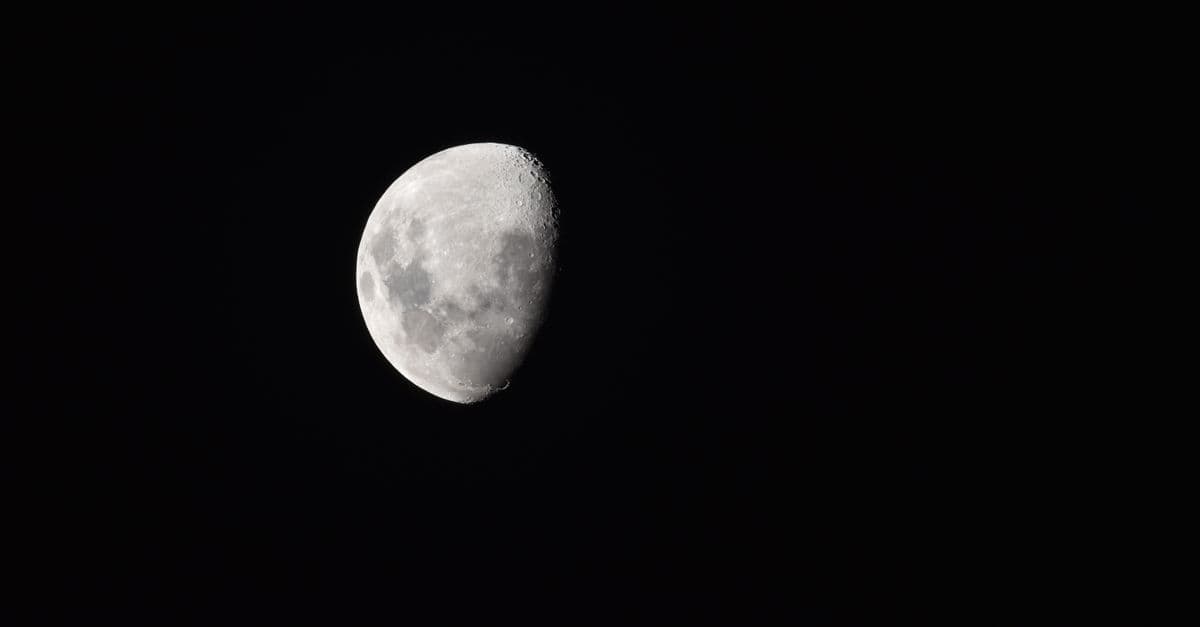
Photo: Fernanda Gomez de la torre / Pexels
Every night the Moon rises as if it had always been there, but it hasn't. Roughly 4.51 billion years ago, a Mars-sized world slammed into the still-forming Earth, vaporized a chunk of both planets, and left behind a ring of molten debris that condensed into our only natural satellite within a few decades to a century. That single collision explains the Moon's odd chemistry, Earth's tilted axis, our 24-hour day, and even the seasons. This is how scientists pieced that story together, and where the picture still has holes.
The giant impact hypothesis, in plain terms
The dominant scientific explanation for the Moon's origin is the giant impact hypothesis: about 60 million years after the solar system began forming, a protoplanet roughly the size of Mars — nicknamed Theia, after the mythological mother of the Moon goddess Selene — struck the young Earth. The strike wasn't head-on. Simulations consistently show a glancing blow, more like a car sideswiping another car than two vehicles meeting bumper to bumper.
That distinction matters enormously. A direct hit would have simply merged the two bodies into one slightly larger planet with little left in orbit. A glancing blow instead sprayed vaporized rock and molten debris into space, some of which stayed gravitationally bound to Earth. Within an astonishingly short window — some models suggest less than a century, others put the disk-to-Moon accretion timeline at up to a few thousand years — that debris disk cooled, clumped, and pulled itself into a single sphere: the Moon (Canup & Asphaug, 2001, Nature).
Think of it like a potter's wheel flinging wet clay outward when spun too fast. The clay that flies off doesn't vanish; some of it settles into a ring around the wheel's edge, spinning in its own orbit before it either falls back or coalesces. Earth after the Theia impact behaved similarly: a spinning, molten mess that shed a disk of debris, which then gathered itself into a new, smaller body.
The energy released in the impact is difficult to overstate. Estimates put the collision energy at roughly 100 million times that of the asteroid impact that ended the age of non-avian dinosaurs 66 million years ago. Both Earth's outer layers and Theia itself were partially vaporized on contact, producing temperatures possibly exceeding 10,000 degrees Celsius (18,000 degrees Fahrenheit) in the impact zone — hot enough to vaporize rock outright rather than simply melt it.
What changed on Earth because of the impact
Four consequences of the Theia collision still shape life on Earth today.
- Earth's spin sped up dramatically. Before the impact, Earth's rotation period is thought to have been longer; afterward, models suggest a day may have lasted only about five hours, a rate that has been slowing ever since due to tidal drag from the Moon.
- Earth's axial tilt was set. The glancing angle of the strike likely knocked Earth's spin axis to roughly its current 23.5-degree tilt, which is the direct cause of Earth's seasons.
- Theia's iron core sank into Earth's core. Because iron is dense, most of Theia's metallic core merged with Earth's, while the lighter silicate mantle material of both bodies ended up in the debris disk that formed the Moon.
- The Moon started out very close. Early estimates place the newborn Moon at only 20,000 to 30,000 kilometers (12,400–18,600 miles) from Earth, about 15 times closer than its average distance today of roughly 384,400 kilometers (238,900 miles).
The evidence that convinced scientists
The giant impact hypothesis isn't the only idea anyone ever proposed for the Moon's origin. Three older ideas — capture, fission, and co-accretion — were taken seriously for decades before geochemistry from actual lunar rock samples ruled them out one by one. Here's the evidence, in the order it typically gets presented to skeptics.
1. Isotopic fingerprints match Earth almost exactly
Between 1969 and 1972, the six crewed Apollo landings returned 382 kilograms (842 pounds) of lunar rock and soil samples, according to the NASA Apollo Sample Catalog maintained by the Lunar and Planetary Institute. When geochemists measured the isotope ratios of oxygen, titanium, tungsten, and chromium in those samples, the results were startling: lunar rock is nearly indistinguishable from Earth's mantle in these ratios, far closer than any class of meteorite in the solar system.
This single fact eliminates the old "capture theory," which proposed the Moon formed elsewhere in the solar system and was later snagged by Earth's gravity. If that were true, lunar rock should carry an isotopic signature distinct from Earth's, the way Mars meteorites carry a signature distinct from both. It doesn't. The Moon and Earth's mantle share a chemical fingerprint that points to a shared origin, or at minimum a thoroughly mixed origin — exactly what a giant impact that vaporizes and blends material from both bodies would produce.
2. The Moon is oddly iron-poor
Earth is a relatively dense planet because its core, made mostly of iron and nickel, makes up about 32 percent of its total mass. The Moon's core, by contrast, is estimated at only 1 to 2 percent of its mass — a huge discrepancy for two bodies with such similar mantle chemistry.
The giant impact hypothesis explains this cleanly. During the Theia collision, dense iron from both Theia's core and (to a lesser degree) Earth's outer layers sank rapidly toward Earth's center rather than escaping into the debris disk. The Moon then accreted mostly from lighter silicate material — the rocky mantle stuff, not the metallic core stuff — of both Earth and Theia. A Moon built overwhelmingly from mantle material, with almost none of either planet's iron core, is exactly what the impact model predicts, and exactly what the Apollo samples show.
3. The Moon is still drifting away, and that trajectory points backward to a close, violent birth
Since the Apollo astronauts left retroreflector panels on the lunar surface, scientists have bounced laser pulses off them from Earth-based observatories in an experiment called Lunar Laser Ranging. That technique measures the Earth-Moon distance to within a few centimeters and shows the Moon receding from Earth at 3.8 centimeters (1.5 inches) per year, according to a long-running analysis published by JPL researchers (Williams et al., 2014).
Run that recession rate backward and the Moon was dramatically closer to Earth in the distant past — consistent with a birth in tight, chaotic orbit just outside Earth's Roche limit, the point past which a body's own gravity can't resist Earth's tidal forces. A moon that formed far away and was later captured wouldn't show this kind of steady, physically consistent recession history tracing back to an origin near Earth.
4. Tidal locking: a shared fingerprint of violent birth and long-term gravitational sculpting
The Moon shows only one face to Earth, a phenomenon called synchronous rotation or tidal locking: its rotation period (about 27.3 days) exactly matches its orbital period around Earth. This isn't a coincidence baked in at formation. Early in its history, the Moon likely rotated much faster, but tidal forces from Earth's gravity created a slight bulge on the near side of the Moon that acted like a brake, gradually slowing its spin over hundreds of millions of years until the two periods matched.
This isn't unique to the Moon. Most large moons of Jupiter and Saturn, including Io, Europa, Ganymede, Callisto, and Titan, are also tidally locked to their host planets, and Pluto and its moon Charon are mutually tidally locked to each other. That pattern across the solar system supports the underlying physics rather than being evidence for the impact origin specifically, but it confirms that the same tidal mechanics shaping the Earth-Moon system today are universal, testable physics — not a story invented to fit one planet's data.
Where Theia's remains might still be hiding
One of the more striking developments in Moon-formation research came in November 2023, when a team led by Caltech geophysicist Qian Yuan published a paper in Nature proposing that pieces of Theia never left Earth at all. Deep inside Earth, near the boundary between the mantle and the molten outer core roughly 2,900 kilometers (1,800 miles) down, sit two continent-sized, unusually dense structures called Large Low-Velocity Provinces, or LLVPs — one beneath Africa, one beneath the Pacific Ocean, each estimated to be roughly twice the size of the Moon.
Geophysicists have known about the LLVPs since seismic imaging first revealed them in the 1980s, because earthquake waves slow down when passing through the material, hinting it's denser or chemically distinct from the surrounding mantle. What nobody had was a convincing explanation for what the blobs actually are. Yuan's team modeled the giant impact and found that a fraction of Theia's mantle material, being 2.0 to 3.5 percent denser than proto-Earth's original mantle, would sink under its own weight and settle into thermochemical piles atop the core, then survive there largely undisturbed for over four billion years (Yuan et al., 2023, Nature).
If the model holds up, it means a piece of the world that made the Moon is still sitting underneath your feet right now, roughly halfway between the surface and the planet's center. It's a striking bridge between two of the biggest questions in planetary science: what shaped the Moon and what shapes Earth's deep interior and its volcanic hotspots, since some researchers suspect the LLVPs influence where mantle plumes rise to the surface as volcanic activity.
Cracks in the model: the "isotope crisis" and where research stands now
The giant impact hypothesis is the best-supported model of Moon formation, but "best-supported" isn't the same as "fully solved," and a good writer on this topic should say so plainly. The core sticking point researchers call the isotope crisis: in the simplest, "canonical" version of the giant impact model, the Moon should be built mostly from Theia's material, with Earth contributing comparatively little to the debris disk. But if that were true, lunar rock should carry an isotopic signature closer to Theia's than to Earth's — and instead it's nearly identical to Earth's mantle, as the Apollo evidence above shows.
Two broad classes of updated models have emerged to resolve that mismatch.
Higher-energy, higher-angular-momentum impacts ("synestia" models). Proposed by planetary scientists Simon Lock and Sarah Stewart, this version imagines a much more violent collision that briefly vaporizes so much of both Earth and Theia that the two blur into a single, doughnut-shaped, partially vaporized structure called a synestia — essentially a planet spun into a puffed-out disk shape by extreme angular momentum. Inside that shared, thoroughly mixed structure, material from Theia and Earth blends almost completely before the Moon condenses out of it as it cools, which naturally explains why lunar rock and Earth's mantle look so alike. A 2025 review in Space: Science & Technology found that recent evidence for near-identical refractory lithophile element abundances between Earth and the Moon is consistent with exactly this kind of thorough synestia mixing (Zhou et al., 2024).
Multiple, smaller impacts rather than one giant blow. A newer line of research argues the "one dramatic collision" framing may itself be part of the problem. Under a multiple-impact hypothesis, the Moon and Earth grew together gradually through several more modest impacts rather than a single extreme event, each contributing debris to a disk that slowly built up the Moon over time. This softer, staged version is less visually dramatic than a single Theia strike but may fit the geochemical evidence more comfortably, since repeated mixing events would blend Earth and impactor material more evenly than one single glancing blow.
Neither model has fully displaced the classic single-impact Theia story — it remains the version taught in textbooks and cited by NASA and most planetary science curricula — but the debate itself shows that Moon formation research is still an active field, not settled history. A useful mental model: the giant impact hypothesis is less like a finished painting and more like a well-drafted blueprint that engineers keep refining as better instruments arrive.
Comparison of Moon formation theories
| Theory | Core mechanism | Current status | Main problem |
|---|---|---|---|
| Giant Impact (Theia) | Mars-sized body collides with proto-Earth, debris disk forms and accretes | Dominant model | Isotope crisis — canonical version underpredicts Earth-like composition |
| Synestia (impact variant) | Extreme-energy impact vaporizes both bodies into a shared, doughnut-shaped structure | Leading refinement of the impact model | Requires very specific, high-energy, high-angular-momentum conditions |
| Multiple impacts | Moon grows gradually from several smaller collisions rather than one giant strike | Active research direction | Harder to model computationally; less direct observational test |
| Capture | Moon formed elsewhere in the solar system, later caught by Earth's gravity | Rejected | Isotope ratios don't match; orbital mechanics make stable capture implausible |
| Co-accretion (double planet) | Earth and Moon formed side-by-side from the same disk of material | Rejected | Fails to explain the Moon's iron deficiency relative to Earth |
| Fission | A fast-spinning young Earth flung off a piece of itself | Rejected | Earth's spin, even at its fastest plausible early rate, was insufficient |
Table: Status of major hypotheses for lunar formation, from the rejected 19th- and 20th-century models to the leading 21st-century refinements of the giant impact hypothesis.
The far side is a different world
The Moon's far side, the hemisphere permanently turned away from Earth, was completely unseen by humanity until the Soviet probe Luna 3 photographed it in October 1959. What it revealed surprised planetary scientists: the far side looks almost nothing like the familiar near side.
The most obvious difference is the near-total absence of maria, the dark, smooth volcanic plains that cover roughly 31 percent of the near side's surface and form the eye, nose, and mouth patterns humans have projected onto the "man in the moon" for millennia. On the far side, maria cover only about 1 percent of the surface. The far side's crust is also noticeably thicker, averaging around 60 kilometers (37 miles) compared to roughly 30 kilometers (19 miles) on the near side, which likely explains the maria gap: thicker crust made it harder for molten rock from deep in the mantle to break through and flood the surface the way it did on the thinner near side.
The far side also holds the South Pole–Aitken Basin, one of the largest confirmed impact craters in the entire solar system at roughly 2,500 kilometers (1,550 miles) across and up to 13 kilometers (8 miles) deep. One hypothesis for the near side/far side asymmetry proposes that a second, smaller moon briefly coexisted with the main Moon in a stable Earth-orbit configuration before slowly colliding with the far side at low velocity, plastering extra crustal material onto that hemisphere rather than excavating a crater the way a fast impact would.
In June 2024, China's Chang'e 6 mission accomplished something no prior mission had: it landed inside the South Pole–Aitken Basin and returned 1,935.3 grams (about 4.3 pounds) of far-side material to Earth, the first far-side lunar samples ever collected. Laboratory analysis published in 2024 and 2025 found volcanic basalt fragments dated to roughly 2.8 billion years old, plus older evidence of volcanic activity stretching back to around 4.2 billion years ago — meaning volcanism persisted on the far side for at least 1.4 billion years (Nature, 2024; Science, 2025). The samples also turned out to be surprisingly dry and chemically depleted compared to near-side basalts, adding new detail to the puzzle of why the two hemispheres diverged so sharply.
Water, ice, and why the Moon isn't the dead rock people assumed
For most of the 20th century, the Moon was considered essentially bone-dry, a conclusion drawn from the Apollo samples, which showed no obvious hydration when first analyzed with older instruments. That assumption has been overturned piece by piece over the past two decades.
- Chandrayaan-1 (2009). India's first lunar orbiter carried NASA's Moon Mineralogy Mapper instrument, which detected spectral signatures consistent with hydroxyl (OH) and water molecules distributed across much of the lunar surface, concentrated toward the poles (Pieters et al., 2009, Science).
- LCROSS impactor (2009). NASA deliberately crashed a spent rocket stage into the permanently shadowed Cabeus crater near the lunar south pole, then flew a following spacecraft through the resulting debris plume. Spectral analysis of that plume confirmed water ice mixed into the crater's regolith.
- SOFIA airborne observatory (2020). NASA's Stratospheric Observatory for Infrared Astronomy, a modified 747 carrying a telescope, detected molecular H2O — not just the hydroxyl seen earlier, but actual water molecules — on sunlit portions of the lunar surface, showing that water exists even outside the permanently dark polar craters.
The polar cold traps are the real prize for future missions. Inside permanently shadowed craters near both poles, sunlight never reaches the floor, and temperatures stay below minus 170 degrees Celsius (minus 274 degrees Fahrenheit) year-round, cold enough that any water ice deposited by comet or asteroid impacts over billions of years has simply stayed frozen in place rather than sublimating away.
That ice matters well beyond scientific curiosity. Water can be split via electrolysis into hydrogen and oxygen, and hydrogen and oxygen are precisely the propellant combination used in many rocket engines. A functioning ice-mining operation at a lunar pole could, in principle, refuel spacecraft without the enormous cost of launching that propellant from Earth's much deeper gravity well. NASA's Artemis program has explicitly targeted the lunar south pole for this reason.
Lunar regolith holds other resources worth noting. Apollo 11 samples measured helium-3 concentrations around 13 parts per billion in surface soil, with estimates running higher, potentially 20 to 30 parts per billion, in undisturbed regolith and even higher near the poles, according to NASA technical research on lunar helium-3 extraction concepts. Helium-3 is a candidate fuel for future fusion reactors, though no fusion reactor capable of using it exists yet, and mining it at any meaningful scale remains a purely theoretical proposition for now rather than a near-term plan.
Artemis: humanity's return to the Moon, status as of mid-2026
NASA's Artemis program is the modern effort to put humans back on the lunar surface for the first time since Apollo 17 in December 1972. The program has moved in real, verifiable steps, though not always on the original timeline.
Artemis I, launched uncrewed in November 2022, successfully sent an Orion capsule around the Moon and back to test the Space Launch System rocket and the capsule's heat shield during a high-speed reentry.
Artemis II launched crewed astronauts on a lunar flyby mission on April 1, 2026, after slipping from its original 2024 target — the first crewed test of the full Orion/SLS stack and the first time humans have traveled beyond low Earth orbit since Apollo 17.
Artemis III, the mission intended to land astronauts back on the lunar surface, has also slipped from its earlier targets and is now aimed at no earlier than late 2027, with NASA continuing to target early 2028 for the actual crewed landing according to agency statements. The announced Artemis III crew includes NASA astronauts Andre Douglas, Frank Rubio, and Randy Bresnik, alongside European Space Agency astronaut Luca Parmitano. The mission will test rendezvous and docking between Orion and a commercial lunar lander, with both Blue Origin and SpaceX developing competing lander systems, including SpaceX's Starship Human Landing System variant.
Supporting infrastructure is also under development in parallel, most notably the planned Lunar Gateway, a small space station intended to orbit the Moon and serve as a staging point for surface missions, though its own timeline has shifted alongside the rest of the program. The overall pattern across Artemis, worth noting honestly, is one of steady technical progress paired with repeated schedule slippage — a pattern common to nearly every major crewed spaceflight program in history, including Apollo itself in its early years.
What people get wrong about Moon formation
"The Moon used to be part of Earth." This is only partly true and often stated too simply. The Moon isn't a chunk that was literally torn out of Earth the way the old fission hypothesis proposed. It formed from a blended disk of vaporized material from both Earth's outer layers and Theia, condensed together after the collision. Some of that material was originally Earth's, some was originally Theia's, and a great deal of it was thoroughly mixed at the atomic level during the impact itself, which is precisely why isotope ratios can't cleanly separate "Earth stuff" from "Theia stuff" in lunar rock today.
"Since the giant impact hypothesis is the leading theory, it must be settled science." As the isotope crisis section above shows, the canonical, simplest version of the model has a real, still-unresolved mismatch with the geochemical evidence. Scientists aren't debating whether some kind of giant impact happened — the isotopic and dynamical evidence for that is very strong — but they are actively debating exactly how energetic it was, how thoroughly it mixed the two bodies, and whether one impact or several better explains the data.
"The far side of the Moon is the 'dark side' and never gets sunlight." This mixes up two different things. Every part of the Moon experiences day and night over its 29.5-day cycle, including the far side; "dark" in "dark side of the Moon" (a phrase popularized by the Pink Floyd album, not an astronomical term) really means unseen or unknown, not permanently unlit. What genuinely never sees sunlight are specific permanently shadowed craters near the poles, on both the near and far sides, where the local terrain blocks the low-angle sunlight the Moon receives near its poles.
"Tidal locking means the Moon doesn't rotate at all." It does rotate — once every 27.3 days, which happens to exactly match the time it takes to complete one orbit of Earth. If the Moon didn't rotate at all relative to the distant stars, we would eventually see all sides of it as it orbited Earth. Because its rotation period matches its orbital period, the same hemisphere stays pointed at Earth throughout the orbit, even though the Moon is very much spinning.
What this means
The Theia collision was, on any human timescale, an act of planetary violence: a Mars-sized world hitting Earth hard enough to vaporize rock, and within a matter of decades to centuries, that debris became the object that has stabilized Earth's tilt, driven our tides, and hung in the sky through every chapter of human history. The evidence for it, drawn from Apollo rock chemistry, laser-ranged orbital mechanics, and now deep-Earth seismology, is genuinely convergent rather than circumstantial. What isn't settled is the fine print: exactly how energetic the impact was, whether it happened once or several times, and how thoroughly Earth and Theia blended before the Moon condensed out of the debris. That's not a weakness in the science. It's what an active, evidence-driven field looks like from the inside, and it's why missions like Chang'e 6 and Artemis keep sending hardware back to a rock we've already visited nine times.
Frequently asked questions
Q: How old is the Moon exactly? A: The most precise estimate, from uranium-lead dating of zircon crystals in Apollo 14 samples, puts the Moon's formation at 4.51 billion years, plus or minus about 10 million years — roughly 60 million years after the solar system itself began forming (Barboni et al., 2017, Science Advances).
Q: Will the Moon keep moving away from Earth forever? A: No. The 3.8-centimeter-per-year recession, measured by Lunar Laser Ranging, will gradually slow as Earth's rotation slows and the tidal forces driving the recession weaken. Models suggest Earth and the Moon would eventually become mutually tidally locked, though that endpoint would take tens of billions of years, far longer than the Sun's remaining lifespan of roughly 5 billion years.
Q: Why doesn't the Moon have an atmosphere? A: The Moon's surface gravity is only about one-sixth of Earth's, which is too weak to retain gas molecules against thermal escape into space over geological timescales. It does have an extremely thin exosphere containing trace sodium, potassium, and helium, but nothing resembling a true, retained atmosphere.
Q: Could pieces of Theia still exist inside Earth? A: A 2023 study in Nature by Caltech researchers proposes that two continent-sized, unusually dense structures deep in Earth's mantle, called LLVPs, may be preserved remnants of Theia's mantle material that sank and settled near the core-mantle boundary during the giant impact.
Q: Why does the Moon look bigger near the horizon? A: This is the Moon illusion, a purely perceptual effect rather than a physical one. Photographs confirm the Moon's angular size is essentially identical near the horizon and overhead; the brain misjudges its scale when foreground reference objects like trees or buildings are present in the field of view.
Q: What is the synestia model, and how is it different from the classic Theia impact story? A: The synestia model, developed by Simon Lock and Sarah Stewart, proposes a more energetic collision that briefly vaporizes and merges Earth and Theia into a single doughnut-shaped, partially molten structure before the Moon condenses out of it as the structure cools. It's a refinement of the same basic impact idea, designed to better explain why lunar rock and Earth's mantle are chemically almost identical.
Q: Did Chang'e 6 change what we know about the Moon's far side? A: Yes. The mission's 2024 sample return, the first from the lunar far side, revealed volcanic basalt as young as 2.8 billion years old and evidence of volcanic activity persisting for over 1.4 billion years, along with a surprisingly dry, chemically depleted mantle source compared to near-side rock, according to 2024 and 2025 analyses published in Nature and Science.
Q: Is the Moon's water usable for future space missions? A: In principle, yes. Water ice trapped in permanently shadowed polar craters, first confirmed by NASA's LCROSS impactor mission in 2009, can theoretically be split into hydrogen and oxygen for rocket propellant or life support. NASA's Artemis program has targeted the lunar south pole partly because of this resource potential, though no operational ice-mining system exists yet.
Q: Could the Moon have formed without a giant impact at all? A: The isotopic and dynamical evidence strongly disfavors the alternatives. Capture and co-accretion models fail to explain the near-identical Earth-Moon isotope ratios and the Moon's iron deficiency, and the fission model requires a rotation rate faster than Earth could plausibly have sustained. Some kind of major impact event remains the best-supported explanation, even as scientists debate its exact energy and whether it was a single strike or several.
Q: How does the Moon's formation connect to Earth having seasons? A: The glancing angle of the Theia impact is thought to have set Earth's axial tilt at roughly its current 23.5 degrees. That tilt, not Earth's distance from the Sun, is the direct cause of seasons, since it determines how directly sunlight strikes each hemisphere throughout the year.
Read next:
- How the Solar System Formed: From Spinning Dust to Eight Planets
- Exoplanets: How We Find Other Worlds Beyond Our Solar System
- What If an Asteroid Hit Earth Tomorrow?
Sources
- Canup, R. M., & Asphaug, E. (2001). Origin of the Moon in a giant impact near the end of Earth's formation. Nature.
- NASA Apollo Sample Catalog, Lunar and Planetary Institute.
- Williams, J. G., et al. (2014). Lunar Laser Ranging: Recent results based on refined 2003 model. JPL/NASA.
- Pieters, C. M., et al. (2009). Character and Spatial Distribution of OH/H2O on the Surface of the Moon (Chandrayaan-1 M3). Science.
- Barboni, M., et al. (2017). Early formation of the Moon 4.51 billion years ago. Science Advances.
- Yuan, Q., et al. (2023). Moon-forming impactor as a source of Earth's basal mantle anomalies. Nature.
- Zhou, C., et al. (2024). Research Advances in the Giant Impact Hypothesis of Moon Formation. Space: Science & Technology.
- Li, Q., et al. (2024). Lunar farside volcanism 2.8 billion years ago from Chang'e-6 basalts. Nature.
- Chang'e-6 basalt petrogenesis analysis (2025). Science.
- NASA Artemis II and Artemis III mission updates, NASA.gov (2026).
- NASA lunar helium-3 mining concepts overview, NASA Technical Reports Server.
Follow new articles
Add SciHub101 to your feed reader to see new science and technology stories.
About the Author
SciHub101 is an independent science and technology publication founded and edited by Buğra Sözeri, a software engineer and app developer based in Türkiye. AI tools assist with drafting and research. Source documentation in the existing archive is uneven, and articles are being reviewed and corrected. The Editorial Team byline identifies editorial responsibility; it does not certify specialist or independent human review. Where we compare products, anything built by our own team is labelled as such — see the editorial guidelines and About page for how corrections and disclosures work.
Related Articles
The Big Bang Explained — Origin of the Universe
The Big Bang explained: evidence from Hubble's law, the CMB, and primordial element abundances, plus the timeline of cosmic history and the universe's fate.
Asteroids, Comets, and Meteors — What's the Difference?
Asteroids, comets, meteoroids, meteors, and meteorites — what each one is, where they come from, and how scientists study them.
The Apollo Program's Science Legacy: What 842 Pounds of Moon Rocks Revealed
Six Apollo landings returned 842 pounds of lunar material to Earth — 2,196 samples collected from six different sites across the nearside. Fifty-five years later, those rocks are still generating new discoveries, the laser retroreflectors are still in use, and the fundamental questions they raised about the Moon's violent origin have only deepened.

How Does the Moon Affect Earth? Tides, Climate, and the Conditions for Life
The Moon raises the ocean tides, slows Earth's rotation, and is drifting away at about 3.8 cm per year. Whether it also keeps Earth's tilt stable enough for a mild climate is a live scientific debate, and this article lays out both sides.
What If Earth Had No Moon?
The Moon is more than a nightlight. It holds Earth's tilt steady, drives our tides, and may have made complex life possible.