What If Earth Had No Moon?
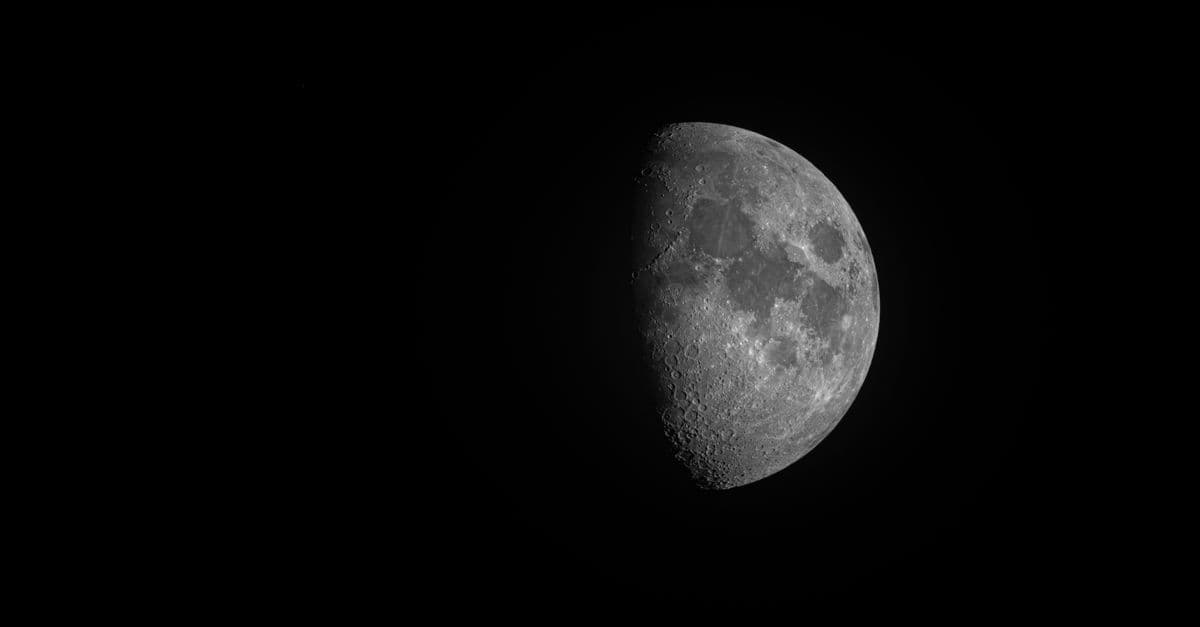
Photo: Marek Pavlík / Pexels
On a moonless night, you can sometimes glimpse it — that faint feeling that something vast should be there and isn't. But strip the Moon from Earth's story entirely, and the absence runs far deeper than dark nights. The Moon is not a passive decoration. It is an active planetary partner, and without it, Earth might be an alien world entirely — one where complex life either never arose or evolved into something we wouldn't recognize.
Thought experiment. This article explores a hypothetical scenario for educational and speculative purposes. The events described are not predictions and should not be interpreted as warnings, advocacy, or instructions.
Key takeaways
- Without the Moon, Earth's axial tilt would wobble chaotically between roughly 0° and 85°, according to a landmark 1993 study in Nature by Jacques Laskar and colleagues
- Tides would still exist but would be about 46% as strong, driven only by solar gravity
- The loss of strong lunar tides may have significantly slowed the emergence of complex life, including the fish-to-tetrapod transition onto land
- Days would be shorter — geologic evidence puts Earth's rotation at roughly 19 hours for a billion years in the mid-Proterozoic and closer to 21.9 hours around 620 million years ago, both far shorter than today's 24-hour day
- Complex multicellular life might still exist on a moonless Earth, but the evolutionary path — and possibly the odds of it happening at all — would be radically different
Why the Moon is not just a nightlight
Most people think of the Moon the way they think of a streetlamp: nice to have, not structurally important. That framing misses what the Moon actually does mechanically. It is a 3,474-kilometer-diameter body orbiting close enough that its gravity reaches down and grabs Earth's oceans, its crust, and — critically — its spin axis.
The leading explanation for how we ended up with a moon this large relative to its parent planet is the giant-impact hypothesis. Around 4.5 billion years ago, a Mars-sized protoplanet named Theia is thought to have collided with the young Earth. The impact ejected a ring of vaporized and molten debris into orbit, and that debris coalesced into the Moon within a geologically short span. The hypothesis is supported by the near-identical oxygen isotope ratios in lunar and terrestrial rocks, the Moon's unusually small iron core, and evidence from Apollo samples that its surface was once molten to great depth (Natural History Museum; Wikipedia summary of the peer-reviewed consensus).
That single collision, in other words, is why Earth has both a moon this large and — very possibly — a tilt stable enough for seasons that don't spiral into chaos. Remove the Moon from the story and you're not subtracting scenery. You're subtracting a structural support beam.
The first 24 hours
If the Moon vanished right now — not gradually but instantly, as a thought experiment requires — the immediate effects would be subtle but measurable. The night sky would darken dramatically. Tides would shrink to about 46% of their current strength, driven now only by the Sun's gravitational pull, since solar tides are real but roughly half as powerful as lunar ones. Coastal ecosystems would begin adjusting immediately: intertidal zones would shrink, and species that depend on the rhythm of strong tidal ebbs and flows would face sudden stress.
The gravitational absence would also cause small perturbations in Earth's orbital dynamics, since the Moon's mass currently factors into the combined Earth-Moon barycenter that orbits the Sun. Over months and years, these effects would stay negligible. The catastrophic consequences of a Moon-free Earth don't play out on a human timescale — they unfold over hundreds of thousands to millions of years, the same way a bridge missing one support cable doesn't collapse the instant the cable snaps but slowly loses its ability to resist load.
Think of the Moon less like a spotlight and more like a gyroscope bolted to a spinning top. Remove the gyroscope, and the top doesn't fall over immediately — but every small nudge that used to get corrected now compounds.
The long-term reality: an unstable tilt
The most dramatic consequence would be axial instability. Earth currently tilts at about 23.5 degrees relative to its orbital plane — the source of our seasons. The Moon acts as a gravitational anchor that keeps this tilt from varying by more than roughly 1.3 degrees around a mean of 23.3 degrees over tens of thousands of years, according to the 1993 Nature study "Stabilization of the Earth's Obliquity by the Moon" by Jacques Laskar, F. Joutel, and P. Robutel (Nature, 1993).
Without the Moon, their models show Earth's tilt would wander through a chaotic zone extending from close to 0 degrees up to about 85 degrees. At the low end, a planet with essentially no axial tilt has almost no seasons at all, but suffers extreme, unrelenting temperature contrasts between equator and poles. At the high end, a planet tilted 85 degrees would have each pole point almost directly at the Sun during its respective "summer," producing months of continuous blazing daylight followed by months of absolute darkness — an apocalyptic swing rather than a season.
We don't have to speculate entirely in the abstract here. Mars is the natural control experiment. It has no large stabilizing moon — only the tiny, irregular Phobos and Deimos, which are far too small to exert meaningful torque. Mars's obliquity has likely varied chaotically between roughly 0 and 60 degrees over its history, and for much of that history its tilt exceeded 25 degrees, producing summers and winters far more extreme than the mild ones it experiences today (Laskar et al., "The Chaotic Obliquity of Mars," Nature, 1993). Earth without the Moon would likely behave the same way — a planet whose seasons aren't a gentle annual rhythm but an unpredictable roulette wheel spun by the combined gravity of Jupiter, Venus, and the Sun.
These aren't quick changes. They unfold over hundreds of thousands to millions of years, but on that timescale they would completely destabilize Earth's climate. Ice ages would become more extreme and less predictable, arriving and departing on a chaotic schedule rather than the roughly 100,000-year Milankovitch cycles we experience now. The long, stable climate windows that allowed complex land life to establish deep evolutionary roots and diversify might be far shorter, more disrupted, or effectively nonexistent.
Would seasons still exist without the Moon?
Yes, in a limited sense — Earth's orbit around the Sun would still be elliptical enough to produce mild seasonal variation, and whatever axial tilt Earth happened to have at any given moment would still create some hot/cold contrast. But instead of a predictable annual cycle, the tilt itself would drift over geologic time, meaning the character and severity of seasons would shift unpredictably across tens of thousands of years, sometimes producing near-total seasonlessness and sometimes producing violent extremes.
A faster-spinning planet
Earth's rotation would also be faster without the Moon, because the Moon has spent 4.5 billion years acting as a brake. Tidal friction between Earth's oceans and the Moon's gravity transfers angular momentum from Earth's spin into the Moon's orbit, which is why the Moon is measurably receding from Earth today at 3.8 centimeters per year — a rate confirmed by five decades of lunar laser ranging data bounced off retroreflectors the Apollo astronauts left on the lunar surface (NASA Goddard's Eclipse pages; recent laser-ranging analysis cited by Eos.org).
That same braking effect is why Earth's day has been lengthening throughout its history. Geologic evidence backs this up directly. Sedimentary layers called tidal rhythmites — fine banding in ancient tidal mudflats that geologists can literally count, the way you'd count tree rings — show that roughly 620 million years ago, a year contained about 400 days, meaning each day was only about 21.9 hours long. A more recent and precise method called cyclostratigraphy, which reads rhythmic orbital signals preserved in rock layers, found that Earth's day length appears to have stalled at around 19 hours for roughly a billion years during the mid-Proterozoic, likely because lunar tidal braking was temporarily offset by an opposing solar atmospheric tide — a phenomenon described in a 2023 Nature Geoscience study, "Mid-Proterozoic Day Length Stalled by Tidal Resonance" (Nature Geoscience, 2023; coverage via Phys.org).
Without the Moon's continued braking effect, Earth would likely still be spinning at something close to its primordial rate — plausibly somewhere in the range of 6 to 10 hours per day, though the exact figure depends on assumptions about early solar tidal effects and how quickly Earth's rotation would have stabilized on its own. A faster-spinning Earth means a stronger Coriolis effect, the force that deflects moving air and water and organizes storm systems. Hurricane-strength rotational storms would likely be a routine feature of the climate system rather than a seasonal, regional threat — something closer to the perpetual storm bands seen on fast-rotating gas giants like Jupiter, scaled down to a rocky world.
| Time period | Estimated day length | Source of evidence |
|---|---|---|
| ~620 million years ago | ~21.9 hours | Tidal rhythmite layering, South Australia |
| ~2 billion–1 billion years ago | ~19 hours (stalled) | Cyclostratigraphy, Nature Geoscience 2023 |
| Today | 24 hours | Atomic clock / astronomical measurement |
| Moonless Earth (hypothetical) | ~6–10 hours | Extrapolated from tidal braking physics |
Table: How the length of Earth's day has changed as the Moon has slowed our rotation, and what a moonless Earth's day length might look like by comparison.
How much would tides actually weaken without the Moon?
Solar tides are real and would remain after the Moon's disappearance, but they are weaker than lunar tides because although the Sun is vastly more massive than the Moon, it's also much farther away, and tidal force falls off with the cube of distance, not just the inverse square. The result is that solar tides alone produce roughly 46% of the tidal range we experience today, meaning total tidal range would drop to about a third to a half of current levels, and the familiar spring/neap cycle — caused by the Sun and Moon's tides reinforcing or canceling each other — would disappear entirely, replaced by a flatter, more monotonous tidal rhythm tied only to Earth's orbit around the Sun.
The evolutionary stakes: tides and the rise of complex life
This is where the thought experiment gets genuinely consequential rather than merely aesthetic. Strong tides do more than move water around twice a day. They create intertidal zones — areas of shoreline that are alternately submerged and exposed — and those zones may have played an outsized role in two of the biggest transitions in the history of life on Earth: the origin of life itself, and the move of vertebrates from water onto land.
On the origin-of-life question, the physicist Jacques Laskar (the same researcher behind the obliquity work) and collaborators have argued that early tidal pools, repeatedly wetted and dried by strong tides from a much-closer ancient Moon, may have acted as natural concentrators for the weak solutions of organic molecules dissolved in the primordial ocean. Repeated evaporation cycles concentrate dissolved chemistry and encourage polymerization — the chemical stitching-together of simple molecules into longer chains, a step widely considered necessary for the origin of self-replicating systems (arXiv preprint, "The Moon and the Origin of Life"). Because the Moon was closer to Earth billions of years ago, ancient tides were considerably stronger than today's, meaning this concentrating effect would have been unusually powerful during exactly the window when life first needed it.
The second transition is even better documented in the fossil record. A 2020 study led by researchers at Uppsala University and UK institutions, published in Proceedings of the Royal Society A, modeled ancient tides during the Late Silurian through Devonian periods (roughly 420 to 380 million years ago) and found that some coastlines, particularly around what is now South China, experienced tidal ranges exceeding four meters. That's the same region and time period that produced the earliest important fossils of bony fish. The researchers argue that being repeatedly stranded in shrinking, oxygen-poor tidal pools during low tide may have driven the evolution of air-breathing lung-like organs in fish, and that navigating the exposed, uneven terrain of tidal flats may have favored the evolution of sturdier, weight-bearing limbs — precursors to the legs that let the earliest tetrapods eventually walk on land (University of Oxford news release; Sci.News summary). The oldest known tetrapod trackways date to about 393 million years ago, squarely inside that high-tide window.
None of this proves tides were strictly necessary for the vertebrate move onto land — evolution is rarely a single-cause story, and researchers are careful to frame tides as one plausible environmental driver among several rather than an irreplaceable trigger. But it does mean a moonless Earth, with roughly a third to a half the tidal range and no strong intertidal cycling, removes one of the environmental pressures that appears to correlate closely with when and where this transition actually happened in the fossil record.
Would complex life still evolve without the Moon?
Possibly, but likely on a different timeline and along a different path. The Laskar team's obliquity work suggests the resulting climate instability from an unstabilized tilt could make it harder for any single climate regime to persist long enough for complex ecosystems to establish and diversify. Combined with weaker tidal forcing removing one plausible driver of the fish-to-land transition, a moonless Earth's route to anything resembling animal life on land looks slower, less certain, and structurally different from our own.
The unexpected silver linings
Not every consequence of losing the Moon is negative. Weaker tidal forces mean calmer shallow coastal zones, and some ecosystems that currently endure punishing tidal stress — certain coral reef margins and intertidal habitats that suffer mass die-offs during extreme low tides — might actually be more stable in a moonless world. The catastrophic exposure that currently kills large numbers of intertidal organisms during unusually low spring tides would be far less severe without the Sun-Moon tidal reinforcement that produces those extremes.
Human culture would also have developed very differently, though this is necessarily speculative rather than a claim rooted in physical evidence. Without the Moon's reliable roughly 29.5-day cycle as a natural calendar, ancient civilizations would have needed a different anchor for tracking time across seasons — likely relying more heavily on solar and stellar observation, which conceivably could have accelerated the development of certain kinds of astronomical and mathematical knowledge, or alternatively could have simply produced different calendar systems with no clear advantage either way.
There's also a commonly repeated claim that the Moon acts as a meaningful "shield," absorbing asteroid impacts that would otherwise strike Earth. This deserves a more careful treatment than it usually gets: the Moon's gravitational cross-section is small compared to Earth's, and most of the impact craters visible on the Moon's surface reflect its own long, undisturbed geologic history rather than strikes it "intercepted" on Earth's behalf. Planetary scientists generally regard the Moon's shielding effect as real but modest, not a dominant factor in Earth's impact history — so this often-cited "silver lining" is weaker than popular science writing sometimes suggests.
What people get wrong about the Moon
The most common misconception is that the Moon's primary influence is aesthetic or cultural — moonlight, tides at the beach, werewolf folklore — rather than mechanical and geophysical. In reality, the tilt-stabilizing effect documented by Laskar's team is arguably the single most consequential thing the Moon does for Earth's long-term habitability, and it gets far less popular attention than tides do, despite being the more scientifically load-bearing claim.
A second common myth is that the Moon exerts meaningful, measurable effects on human physiology and behavior — the idea that full moons increase births, crime, or erratic behavior. The evidence for this is weak. Reviews of the relevant literature find that any correlations between lunar phase and human behavior are small, inconsistent across studies, and likely explained by chance, confirmation bias, or other confounding variables rather than any physical mechanism, since the Moon's gravitational and light-based influence on a human body is negligible compared to, say, standing near a large building. What is real and well documented is the cultural and psychological weight humans have assigned to the Moon throughout history — a separate phenomenon from any physiological effect.
A third misconception worth correcting: people sometimes assume a "moonless Earth" scenario means an Earth that formed without ever having a moon, as opposed to an Earth that had the Moon removed after the fact. These are different starting conditions. Since the Moon likely also stripped away part of Earth's primordial atmosphere during the giant impact and influenced Earth's early thermal and geochemical evolution, a planet that genuinely never had a Moon-forming impact might differ from modern Earth in additional ways — atmospheric composition, core structure, or crustal chemistry — that go beyond the tidal and obliquity effects covered in this thought experiment.
Could another body do the Moon's job?
In principle, yes. Any sufficiently massive nearby companion — whether a large moon or, more speculatively, a close planetary neighbor — could, in theory, provide comparable gravitational torque to stabilize a planet's obliquity, since the physics governing the stabilization is about mass and proximity, not about the object specifically being "a moon" in any special sense. This has real implications for the search for life beyond our solar system: some astrobiologists have suggested that rocky exoplanets with large, close-orbiting moons in their star's habitable zone could be meaningfully more likely to develop and sustain complex life than similar moonless worlds, since they'd enjoy the same long-term climate stability Earth has had.
This remains a hypothesis rather than a settled finding, partly because detecting exomoons is extraordinarily difficult with current instruments — we have only a small number of unconfirmed candidate detections to date. It's a genuinely open question in astrobiology, and one of the more interesting arguments for why our search for habitable worlds might need to start paying closer attention to what orbits the exoplanets we already know about, not just the planets themselves.
The takeaway
The Moon's most important job isn't lighting up the night or pulling the tides in and out twice a day — it's acting as a gravitational anchor that has kept Earth's axial tilt, and therefore its climate, stable enough for complex life to establish itself over hundreds of millions of years. Take the Moon away, and you don't just lose a pretty object in the sky; you lose the mechanism that has plausibly kept Earth's seasons predictable, its tides strong enough to shape early evolution, and its spin slow enough for a 24-hour day. Mars, with no comparable moon and a chaotically wandering tilt, is a working reminder of what that absence can look like on a real planet. None of this means complex life on a moonless Earth would be impossible — but it would very likely be slower to arrive, harder to sustain, and unrecognizably different from what evolved on the world we actually live on.
Read next:
FAQ
Q: Would there be any tides at all without the Moon? A: Yes — solar tides would still exist, but they're weaker than lunar tides, producing about 46% of the tidal force. Total tidal range would drop to roughly a third to a half of today's levels, and the spring/neap tidal cycle, which depends on the Sun and Moon's tides interacting, would disappear entirely.
Q: Would humans have evolved without the Moon? A: Almost certainly not in our current form. Research suggests strong ancient tides may have been an environmental driver behind the fish-to-tetrapod transition onto land around 380 to 420 million years ago. Weaker tides on a moonless Earth remove one plausible pressure behind that transition, meaning even if complex land life eventually emerged, the timeline and evolutionary path would likely differ substantially from our own.
Q: Is the Moon actually moving away from Earth? A: Yes. Lunar laser ranging measurements, using reflectors left on the Moon by Apollo astronauts, show it receding at about 3.8 centimeters per year, driven by the same tidal friction that slows Earth's rotation. Over billions of years this recession will continue, though it does not threaten to detach the Moon within any timescale relevant to human civilization.
Q: How would a moonless Earth's day length compare to today's? A: Without lunar tidal braking, Earth would likely still spin close to its early rate, plausibly around 6 to 10 hours per day rather than 24. Geologic evidence already shows Earth's day was about 19 hours long for roughly a billion years in the mid-Proterozoic and closer to 21.9 hours around 620 million years ago — direct proof of how much the Moon has slowed our rotation over time.
Q: Could another planet or moon stabilize Earth's tilt the way the Moon does? A: In principle, any sufficiently massive, sufficiently close companion body could provide similar gravitational torque, since the stabilizing effect depends on mass and proximity rather than the object specifically being a "moon." This is part of why some astrobiologists consider large, close-orbiting moons a potentially important factor in assessing which exoplanets might be capable of sustaining long-term climate stability.
Q: Does the Moon affect human biology or behavior? A: Scientific evidence for direct physiological or behavioral effects of the lunar cycle on humans is weak and inconsistent across studies. Any observed correlations, such as claims about full moons and erratic behavior, are generally attributed to chance or confounding factors rather than an established physical mechanism. The Moon's cultural and psychological significance throughout human history is real and well documented, but that's a separate phenomenon from a direct biological effect.
Q: Is Mars a good real-world example of what a moonless Earth might look like? A: It's the closest comparison available. Mars has no large stabilizing moon — only the tiny, irregularly shaped Phobos and Deimos — and its axial tilt has likely varied chaotically between roughly 0 and 60 degrees over its history, producing far more extreme long-term climate swings than Earth experiences today.
Q: Did the Moon's formation affect Earth in ways beyond tides and tilt? A: Likely yes. The giant-impact hypothesis, the leading explanation for the Moon's origin, suggests the Theia collision may have also stripped away part of Earth's primordial atmosphere and shaped its early thermal and geochemical evolution. That means a planet that genuinely never experienced a Moon-forming impact could differ from modern Earth in ways beyond the tidal and obliquity effects covered in the tides-and-tilt scenario.
Q: How much stronger were tides when the Moon was closer to Earth billions of years ago? A: The Moon has receded steadily via tidal friction, so it was significantly closer — and tides correspondingly stronger — during Earth's early history. Researchers studying the origin of life have argued that these unusually strong ancient tides could have created larger, more dynamic tidal pools capable of concentrating organic chemistry through repeated wetting and drying cycles, a process some hypotheses consider important for the emergence of self-replicating molecules.
Q: Would losing the Moon have any positive effects on Earth's ecosystems? A: Some, plausibly. Weaker tides would mean calmer shallow coastal zones, potentially reducing the tidal stress that currently causes mass die-offs in certain intertidal and reef-margin ecosystems during extreme low tides. That said, this localized benefit would be dwarfed by the much larger destabilizing effects on long-term climate and evolutionary pressure described above.
Follow new articles
Add SciHub101 to your feed reader to see new science and technology stories.
About the Author
SciHub101 is an independent science and technology publication founded and edited by Buğra Sözeri, a software engineer and app developer based in Türkiye. AI tools assist with drafting and research. Source documentation in the existing archive is uneven, and articles are being reviewed and corrected. The Editorial Team byline identifies editorial responsibility; it does not certify specialist or independent human review. Where we compare products, anything built by our own team is labelled as such — see the editorial guidelines and About page for how corrections and disclosures work.
Related Articles
What If We Could Teleport Matter?
Step in here, step out there — instantly. Teleportation sounds like sci-fi, but the physics gets stranger than fiction.
What If Humans Stopped Sleeping? — Science Explained
What would actually happen if humans stopped sleeping? Within days: hallucinations. Within weeks: organ failure. A rare disease called fatal familial insomnia makes this experiment real — and terrifying.
What If the Moon Disappeared Tomorrow?
If the Moon vanished overnight, Earth's tides, axial tilt, and life itself would change forever. Here's the science of what happens next.
What If Earth Had Two Moons? The Science of a Twin-Moon World
A second moon would change tides, eclipses, calendars, and possibly life itself. Here's exactly what would happen — based on real orbital physics — if we suddenly had two moons.
What Causes Tides? Moon, Sun, and Earth
What causes ocean tides? The Moon's differential gravity, why there are two high tides daily, spring and neap tides, and tidal locking — explained.
What If Earth Lost Its Axial Tilt?
Earth's 23.5° tilt creates seasons and stabilizes climate. What would happen if it vanished — or flipped to 90°?. Learn the science, key examples, and...