How Does the Moon Affect Earth? Tides, Climate, and the Conditions for Life

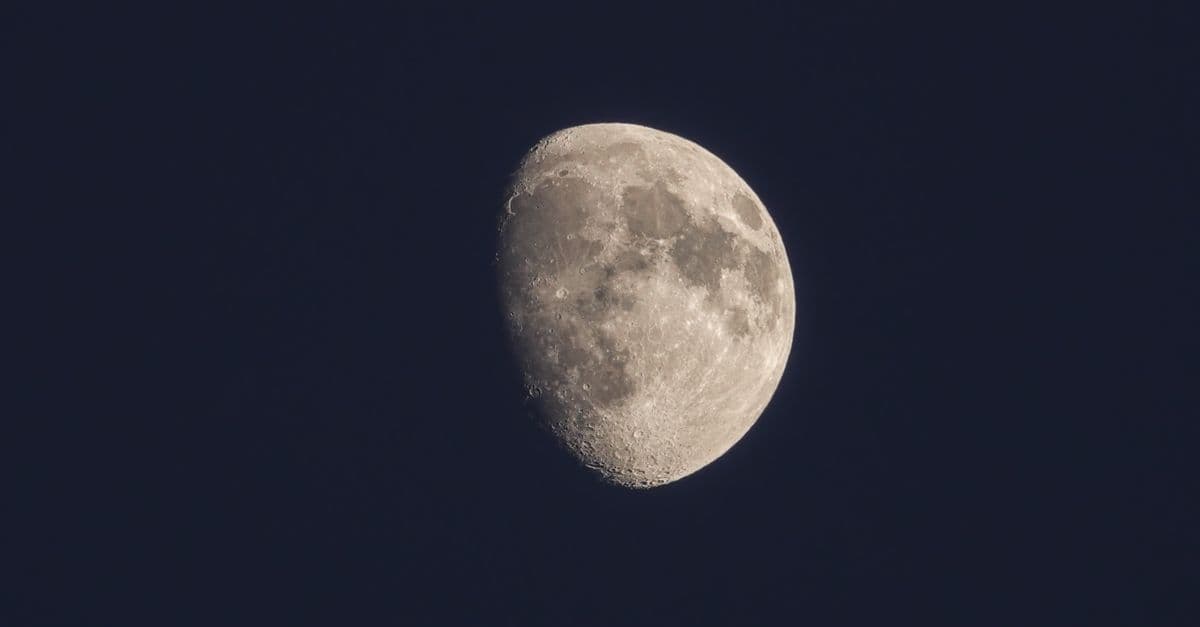
Photo: Eser Tokas / Pexels
The Moon does three measurable things to Earth, and one more that scientists still argue about. It raises the tides in the oceans and, less obviously, in the solid ground. It slows Earth's rotation, lengthening the day by a couple of milliseconds per century, and in return it is pushed outward by about 3.8 centimeters every year. And it probably helps hold Earth's axial tilt steady, though how much is a live debate.
A moon that is oddly large for its planet
The Moon has a mean radius of 1,737.4 km and a mass of about 7.35 × 10²² kg, according to NASA's Moon fact sheet. That is 27 percent of Earth's radius and 1.23 percent of its mass. Mars has two tiny moons, only about 12 and 22 km across, and Mercury and Venus have none, so among the four rocky planets Earth's companion is in a class of its own.
Its density tells a story too. The Moon averages 3,344 kg/m³, about 61 percent of Earth's mean density. A body that light for its size is short of iron, and that detail turns out to be one of the strongest clues to where the Moon came from.
The Moon also sits close. Its average distance is about 384,400 km, and it circles Earth every 27.32 days relative to the stars. Because Earth is moving around the Sun in the meantime, the cycle of phases takes longer: 29.53 days from one new moon to the next, as the same NASA table lists.
Where the Moon came from, and why it matters for everything else
Most planetary scientists favor the giant-impact hypothesis. A Mars-sized protoplanet, often called Theia, struck the young Earth, and the debris that was thrown into orbit gathered into the Moon. The timing is still being refined. Different lines of evidence put the event somewhere between 4.4 and 4.5 billion years ago, including a 2015 meteorite-based estimate of about 4.47 billion years by Bottke and colleagues, and a 2014 simulation study by Jacobson and colleagues that placed it roughly 95 million years after the Solar System began to form.
Three observations keep the idea alive. The first is the Moon's small iron core, which several independent measurements put at under about 25 percent of the Moon's radius, against roughly 50 percent for most rocky bodies. If the Moon was built mostly from the rocky mantles of the two colliding bodies, while the iron sank into Earth's core, that is the expected result.
The second is chemistry. Moon rocks and Earth rocks have nearly identical oxygen isotope ratios, something that is unusual because most bodies in the Solar System carry their own isotopic signature. If Theia had been very different from Earth, the Moon should look more like Theia, and it does not.
The third is angular momentum. The Earth-Moon system spins more than a simple collision of two modest bodies would explain, which is why a glancing blow onto a fast-spinning young Earth is attractive.
The isotope puzzle and the synestia
The isotope match is awkward in the original version of the story, which has the Moon built mainly from Theia. Two later ideas try to repair it. Young and colleagues argued in 2016 that a steep, energetic impact would have mixed the material from both bodies thoroughly before the Moon formed. Lock and colleagues proposed in 2018 that a still more violent collision could have turned the whole Earth into a vaporized, doughnut-shaped cloud called a synestia, which then cooled into the planet and the Moon from a single reservoir.
Canup's 2012 model takes a third route, in which two bodies each larger than Mars collided and then merged. None of these has won. They share one useful implication, though: the Moon was born hot, from a violently stirred Earth, and that is the starting point for everything it has done since.
Early on, the impact would also have left Earth spinning fast. Stevenson's 1987 analysis suggested a day of about five hours right afterward. The slow lengthening of the day to 24 hours is the long tail of this story, and the Moon is the main reason it happened.
Why the ocean rises twice a day
Tides are the Moon's most visible effect, and the explanation most people learn is slightly wrong. The Moon does not simply pull water toward itself. What matters is that its pull is uneven across Earth.
The side facing the Moon is about 6,400 km closer than Earth's center, and gravity weakens with distance. So the near-side ocean is tugged harder than the planet as a whole, and the far-side ocean is tugged less. Relative to Earth's center, the water on the near side is pulled toward the Moon and the water on the far side is left behind. The result is two bulges, one on each side.
An analogy helps. Picture three runners tied by loose rubber bands to a car that is slowly pulling away. The runner closest to the car gets yanked hardest, the one in the middle moderately, and the one at the back gently. Relative to the middle runner, the front one is stretched forward and the back one drifts backward. Tides are the stretch, not the pull.
Why the difference matters more than the pull
This is why the distance dependence is so steep. The pull of gravity falls with the square of distance, but the difference in pull across a body falls with the cube. NOAA's tide primer puts numbers on it: the Sun's gravitational attraction on Earth is more than 177 times the Moon's, but the Sun is about 390 times farther away. Dividing one by the other gives a tide-raising force of roughly 0.45 times the Moon's, which NOAA rounds to "about half." You can read the details in the NOAA explanation of what causes tides.
The timing follows from the same geometry. As Earth rotates, a coastline passes under each bulge in turn, so most places see two high tides and two low tides per lunar day. A lunar day lasts 24 hours and 50 minutes, because the Moon moves in its orbit while Earth turns and the planet needs about 50 more minutes to catch up. High tides are therefore about 12 hours and 25 minutes apart, according to the NOAA page on the lunar day. That is why tide tables shift later each day.
Local coastlines complicate the textbook picture. The ocean is not a smooth film covering a sphere, so real tides slosh around ocean basins like water in a bathtub, and some places get one high tide per day instead of two. The worldwide average tidal range is only around one meter.
For more on the mechanics, see What Causes Tides? Moon, Sun, and Earth.
Spring tides, neap tides, and the supermoon effect
The Sun's tide is weaker than the Moon's but far from negligible, and the two combine. At new moon and full moon, the Sun, Earth, and Moon line up, and the two bulges reinforce each other, producing spring tides. At the quarter phases the Sun's bulge sits at right angles to the Moon's and partly fills in its troughs, producing neap tides.
Using the 0.45 ratio from above, a simple model gives a spring-tide range proportional to 1 + 0.45 = 1.45 and a neap range proportional to 1 − 0.45 = 0.55. That is a spring-to-neap ratio near 2.7. Real coasts depart from this idealized value, sometimes by a lot, but the pattern of a fortnightly cycle is robust.
The Moon's orbit is not a perfect circle either. NASA lists an eccentricity of 0.0549 and a semi-major axis of 384,400 km, which puts the nearest point (perigee) around 363,300 km and the farthest (apogee) around 405,500 km. Because the tidal force scales as one over distance cubed, a perigee Moon raises a tide about 39 percent stronger than an apogee Moon. When perigee coincides with a spring tide, coastal flooding risk rises, and that is the real effect behind the popular "supermoon."
| Situation | Moon-Sun geometry | Relative tidal range (simple model) |
|---|---|---|
| Spring tide | New or full moon, aligned | About 1.45 |
| Neap tide | First or third quarter, at 90° | About 0.55 |
| Moon alone at mean distance | Reference | 1.00 |
| Sun alone (no Moon) | Reference | About 0.45 |
| Perigee vs. apogee Moon | Distance 363,300 km vs. 405,500 km | Perigee tide about 1.39 times apogee tide |
The last two lines of the table preview a question we return to later: what the oceans would do on a moonless Earth. Sun-only tides would be less than half the size of today's average lunar tide.
Why the Bay of Fundy reaches 16 meters
The Bay of Fundy, between New Brunswick and Nova Scotia in Canada, has the largest tidal range on Earth, around 16 meters according to the NOAA figure quoted in the Wikipedia overview of the bay. About 100 billion tonnes of water move in and out during one half-day tidal cycle, a flow said to be about twice the combined discharge of all the world's rivers over the same time.
The reason is resonance, not extra lunar muscle. The bay is a long, funnel-shaped basin, and water sloshing along it has a natural rhythm. When that rhythm lines up with the roughly 12.4-hour pulse of the tide, each incoming wave arrives just as the last one is reflecting back, and the oscillation builds. It is the same logic as pushing a child on a swing at exactly the right moment.
Any strong coastal tide combines the Moon's forcing with local geometry. That is also why tide predictions come from decades of measurements at each harbor rather than from a single formula.
The ground tides too
The solid Earth is not rigid, and the same differential pull flexes it. These "body tides" lift and lower the crust by tens of centimeters twice a day. The principal lunar component has an amplitude of roughly 38 cm and the largest combined displacements approach half a meter, though the exact figure depends on location, per the IERS conventions summarized in the Earth tide entry.
You never feel this because everything around you moves too. But a GPS receiver doing survey-grade work has to subtract it, and laser-ranging stations tracking the Moon must account for their own station rising and falling. The weight of the ocean tide pressing on the crust adds a smaller correction, typically about a tenth the size of the body tide.
Tidal friction: how the Moon slows Earth and drifts away
Here the tides start to have consequences on geological timescales. The tidal bulges do not sit directly under the Moon, because Earth rotates faster than the Moon orbits and drags the water ahead. The leading bulge pulls forward on the Moon and the Moon pulls back on the bulge, so the Moon is accelerated into a higher orbit and Earth's rotation is braked.
Think of a spinning flywheel with someone's hand resting lightly against the rim. The hand slows the wheel, and the wheel in turn drags the hand along. Earth is the flywheel, the water bulges are the hand, and the Moon is the arm that gets dragged. In this exchange the total angular momentum is conserved. Earth loses spin, and the Moon gains orbital angular momentum by moving outward.
How much energy is involved
Laser ranging and orbital modeling give a clear energy budget, summarized in the tidal acceleration article from the work of Williams and Boggs (2016):
| Quantity | Value |
|---|---|
| Earth's loss of rotational energy | About 3.78 terawatts |
| Dissipated as heat by tidal friction | About 3.64 terawatts, mostly in shallow seas |
| Transferred to the Moon's orbital energy | About 0.12 terawatts (roughly one thirtieth) |
| Share from flexing of the solid crust | About 4 percent of the heat |
Notice how little goes into lifting the Moon. Nearly all the energy that tidal friction extracts from Earth's spin turns into heat, mostly in shallow seas where tidal currents drag against the sea floor. The 3.64 terawatts is about 15,000 times the peak output of the La Rance tidal station in France, which is rated at 240 megawatts.
The numbers on the Moon's departure
The Apollo 11, 14, and 15 crews, along with two Soviet Lunokhod rovers, left retroreflectors on the lunar surface. Observatories on Earth fire laser pulses at them and time the return, and the distance can be measured to within millimeters. The lunar laser ranging experiment has shown that the Moon is receding at about 3.8 cm per year. A fit to data from 1970 to 2015 gives 38.30 millimeters per year, with a tiny uncertainty.
One small wrinkle: NASA's own Moon facts page rounds the recession to about 1 inch (2.5 cm) per year. The laser-ranging figure, which is the measured value, is 3.8 cm, or roughly 1.5 inches.
The day is lengthening too, but the situation is more tangled. The tidal calculation alone gives about 2.4 milliseconds added to the day each century. Historical eclipse and astronomical records over 2,700 years show a net increase of about 1.72 milliseconds per day per century. The gap exists because the land is still rising after the last ice age, which makes Earth slightly rounder and slightly faster, offsetting about 0.6 milliseconds.
Why you cannot run the film backward at today's rate
It is tempting to extrapolate. If the Moon is 384,400 km away and recedes at 3.8 cm per year, dividing gives about 10 billion years to travel from touching Earth to today's orbit. That is more than twice the Moon's age, so the recession must have been slower on average in the past.
The geological record agrees. Averaged over the last 620 million years, the recession rate was about 2.17 centimeters per year, roughly half the present value, according to Williams's 2000 analysis cited in the same source. Reviews of the laser-ranging data describe the current rate as anomalously high. The size and shape of the ocean basins control how efficiently tides dissipate energy, so the rate cannot be treated as a constant.
This also means the common claim that the Moon once raised tides hundreds of meters high does not have a firm quantitative basis. Early tides were almost certainly larger and the day was shorter, but the exact figures depend on a continental and ocean geography that no one has reconstructed that far back.
What ancient rocks and shells say about days and months
Earth keeps a diary of its own rotation. Tidal rhythmites are layers of sand and silt laid down in tidal environments, and a thick, regular stack of them preserves the pattern of daily, fortnightly, and seasonal tides. Counting layers in a sequence deposited about 620 million years ago, Williams reconstructed a day of about 21.9 hours, with 13.1 synodic months and about 400 days in a year.
Younger records agree in direction. In 2020, de Winter and colleagues measured growth lines in fossil rudist mollusc shells from about 70 million years ago and found a year of roughly 372 days, with a day of about 23.5 hours. Coral growth bands, studied since the 1960s, point the same way.
None of this changes your calendar. A day that lengthens by about 1.7 milliseconds per century takes a long time to matter. But it is physical, measured, and the same mechanism that carries the Moon away.
Does the Moon really hold Earth's tilt steady?
This is the claim most often repeated in popular accounts, and it deserves a careful look because the science has shifted.
What the tilt does
Earth's rotation axis is tilted about 23.4 degrees from perpendicular to its orbit. That tilt is the reason for the seasons, a point developed in Why Do We Have Seasons?. Over the past five million years the tilt has swung between about 22.0 and 24.5 degrees on a 41,040-year cycle, according to Berger's 1976 calculation cited in the axial tilt overview. Those swings of about 2.5 degrees help pace the ice ages.
The case for a stabilizing Moon
In 1993, Jacques Laskar and colleagues ran long numerical integrations of the planets and reported in Nature that a moonless Earth could see its tilt wander chaotically, in their simulations reaching 90 degrees in as little as a few million years. The mechanism is resonance. The tilted axis of a planet wobbles like a spinning top, a motion called precession, and the Moon contributes the larger share of the torque that drives it. By the same distance-cubed arithmetic as the tides, the Moon provides roughly two-thirds of the combined lunar and solar torque.
Earth's precession period is about 26,000 years. That rate is far from the frequencies at which the other planets tug on Earth's orbit, so the perturbations average out. Without the Moon, precession would be slower and could drift into resonance with planetary frequencies, and the tilt would be pumped to large values. Think of a pendulum being pushed at its natural swing rate, a little at a time, until it swings wildly.
Mars is the comparison case. Mars has no large moon, and its tilt varies by tens of degrees over millions of years, from roughly 0 to 60 degrees by Laskar and Robutel's and Touma and Wisdom's calculations, both published in 1993. That variation is a plausible reason the polar ice on Mars has repeatedly moved around.
The case against overstating it
Here is the twist. Later work found the moonless Earth might be calmer than Laskar's first results suggested. Lissauer, Barnes, and Chambers (2012) re-ran the simulations and found that without the Moon, Earth's tilt might vary by only about 20 to 25 degrees. Li and Batygin (2014) examined the diffusion of the tilt and concluded that it could take billions of years for it to approach 90 degrees.
The summary is that the Moon almost certainly narrows the range of Earth's tilt, but whether a moonless Earth would have been hostile to life is not settled. Even a 20 to 25 degree swing, however, would be much larger than the 2.5 degrees the real Earth experiences, with consequences for seasons and ice sheets.
The Moon's protection also has an expiration date. As the Moon recedes, the resonances may eventually return. Laskar's 1993 analysis suggested the stabilizing effect would last less than two billion years.
What a moonless Earth would look like
Combining the pieces gives a sober picture, not a catastrophe movie.
- Tides: Only the Sun would raise them, at about 45 percent of the current lunar tide. Intertidal zones would still exist, but narrower.
- Day length: Because tidal dissipation scales roughly with the square of the tide height, the Sun's tide would supply only about a fifth of the lunar braking in a first-order estimate. Earth would likely rotate faster than it does now, though by how much depends on its early spin, which we do not know.
- Tilt: Less stable, with the size of the wander disputed between Laskar's chaos and Lissauer's modest 20 to 25 degrees.
- Night sky: Darker nights, which would matter for nocturnal animals and for sailors and storytellers alike.
For a longer thought experiment, see What If Earth Had No Moon?.
The Moon and the origin of life: ideas, not facts
Several hypotheses connect the Moon to life's beginnings, and each is speculation that has not been confirmed.
Charles Darwin, in an 1871 letter, imagined life starting in a "warm little pond." Tidal pools are an appealing version of that pond. Each tide cycle would concentrate organic molecules as water evaporated, then dilute and remix them, a built-in wet-dry loop that some laboratory experiments suggest can help chemistry produce longer polymers. Whether early Earth's tides were large or small, a wet-dry cycle could also come from ordinary evaporation in pools without a Moon, and that is the weakness of the argument.
The intertidal zone is also a plausible stepping stone for life moving onto land. An organism that endures drying twice a day has a head start on one that never sees air. Many modern corals schedule mass spawning around the lunar cycle, which shows how deeply tides and moonlight are built into reef ecology today.
The honest status: the Moon's role in life's origin is an open research question, not a result. Astrobiologists treat large moons as one of several factors for habitability, alongside the planet's distance from its star and its plate tectonics. See What Is the Habitable Zone and Why Earth Is In It? for the other pieces of that puzzle.
What the Moon gave human civilization
The Moon's 29.53-day cycle of phases is the origin of the month. The Islamic calendar is purely lunar, with 12 months of 29 or 30 days adding up to 354 days, while the Hebrew and traditional Chinese calendars are lunisolar and insert extra months to keep in step with the seasons.
At sea, the Moon was a clock. Before reliable chronometers were affordable, navigators measured the angle between the Moon and a reference star to work out Greenwich time and hence longitude. The story of the instrument that eventually replaced the method is in Why the Chronometer Solved Longitude.
Tidal power plants draw directly on the Earth-Moon system's energy. The La Rance station in France opened in 1966 with a peak output of 240 megawatts, and it was the world's largest tidal station for 45 years until South Korea's Sihwa Lake station opened in 2011 with 254 megawatts. Harvesting tidal energy removes a very small portion of the 3.64 terawatts that friction already dissipates, which is why the effect on the Moon's recession is negligible.
Finally, the Moon is a science lab. Apollo seismometers, rock samples, and laser reflectors have taught us about lunar interiors, the Solar System's early bombardment, and general relativity. For the research that came out of the crewed missions, read The Apollo Program's Science Legacy, and for why the surface is so scarred, Why the Moon Has So Many Craters.
How the story ends
Tidal friction will keep operating until Earth's rotation matches the Moon's orbital period, so that each always shows the other the same face. Williams and Boggs estimate this lock would take about 50 billion years under idealized assumptions. Pluto and Charon are already in that state.
The idealization fails in practice. The Sun is expected to brighten enough in roughly one to one and a half billion years to evaporate the oceans, and without oceans most tidal friction disappears. The Sun's later red-giant phase would probably destroy both bodies before the lock completes. So the 50-billion-year figure describes a physics-only endpoint, not a prediction of what will happen.
The Moon's stabilizing influence on the tilt, whatever its size, is also finite. Earth is at a comfortable moment in a long process that began with the giant impact.
Common misconceptions
"The Moon pulls the water toward it, so there is one bulge." The second bulge on the far side is real and follows from the differential pull described above.
"The Moon causes the seasons." The tilt does. The Moon's main influence on seasons is possibly steadying the tilt.
"Without the Moon there would be no seasons." The tilt would still exist. The question is whether it would wander over geological time.
"The Moon will eventually drift away entirely." Tidal friction raises the orbit only until the day matches the month, and the Sun's evolution intervenes before that.
"The Moon once raised tides hundreds of meters high." Early tides were probably larger, but no sourced reconstruction supports a figure like that, and the rate of recession was not constant.
FAQ
Q: Does the Moon really stabilize Earth's tilt? A: Probably, to a degree. Laskar's 1993 simulations showed a moonless Earth's tilt wandering chaotically, but later work by Lissauer and colleagues (2012) and by Li and Batygin (2014) found a calmer outcome, perhaps 20 to 25 degrees of variation. The Moon narrows the range, yet how hostile a moonless Earth would be remains unsettled.
Q: How fast is the Moon moving away from Earth? A: About 3.8 centimeters per year, measured by bouncing lasers off retroreflectors left by Apollo 11, 14, and 15 and by Soviet Lunokhod rovers. A fit to 1970 to 2015 data gives 38.30 millimeters per year. Over the past 620 million years the average was lower, around 2.17 centimeters per year.
Q: Why are there two high tides a day? A: Because there are two tidal bulges, one facing the Moon and one on the opposite side, and Earth rotates through both. A lunar day lasts 24 hours and 50 minutes, so high tides come about 12 hours and 25 minutes apart.
Q: Is the Sun's effect on tides bigger or smaller than the Moon's? A: Smaller. The Sun pulls on Earth with more than 177 times the Moon's force but is about 390 times farther away. Because tides depend on the difference in pull across Earth, the Sun's tide comes out at about half the Moon's, or roughly 45 percent by the simple ratio.
Q: How long was a day when the Moon was young? A: Right after the giant impact, models suggest about five hours. About 620 million years ago, tidal rhythmites indicate roughly 21.9 hours, and about 70 million years ago, fossil shells suggest about 23.5 hours. Today the day is lengthening by about 1.7 milliseconds per century.
Q: Could the Moon be moved or destroyed by human activity? A: No realistic activity comes close. Tidal power plants remove a negligible fraction of the 3.64 terawatts that tidal friction already dissipates, and the Moon's mass is about 7.35 × 10²² kg.
Sources
- NASA Space Science Data Coordinated Archive, Moon Fact Sheet
- NASA, Earth's Moon facts
- NOAA National Ocean Service, What causes tides? and The lunar day
- Williams, J. G. and Boggs, D. H. (2016), Celestial Mechanics and Dynamical Astronomy 126, as summarized in Tidal acceleration
- Laskar, J., Joutel, F., and Robutel, P. (1993), "Stabilization of the Earth's obliquity by the Moon," Nature 361, summarized with later work (Lissauer et al. 2012; Li and Batygin 2014) in Axial tilt
- Giant-impact hypothesis and Lunar Laser Ranging experiment
Related Reading
Follow new articles
Add SciHub101 to your feed reader to see new science and technology stories.
About the Author
SciHub101 is an independent science and technology publication founded and edited by Buğra Sözeri, a software engineer and app developer based in Türkiye. AI tools assist with drafting and research. Source documentation in the existing archive is uneven, and articles are being reviewed and corrected. The Editorial Team byline identifies editorial responsibility; it does not certify specialist or independent human review. Where we compare products, anything built by our own team is labelled as such — see the editorial guidelines and About page for how corrections and disclosures work.
Related Articles
How Do Black Holes Form? Every Pathway, From Stars to Seeds
Black holes form through several distinct pathways: massive stars collapsing after fusion ends, neutron star mergers that exceed the mass limit, direct collapse of gas clouds in the early universe, and possibly primordial black holes from density fluctuations just after the Big Bang. Supermassive black holes remain partly mysterious in origin, but likely grew through a mix of heavy seeds, mergers, and accretion.
What Are Exomoons? The Hunt for Moons Beyond Our Solar System
Exomoons are moons orbiting planets beyond our solar system. None has been confirmed, despite two serious candidates, because their signals are tiny and easily mimicked. If they exist around giant planets, some could hold liquid water through tidal heating, even far from any star.
Why Do We Have Seasons? The Science of Earth's Tilt
Earth's 23.5-degree axial tilt, not its elliptical orbit, is why we have seasons. The tilt means each hemisphere receives more direct sunlight and longer daylight hours for part of the year (summer), then less direct light and shorter days for another part (winter). The two hemispheres always experience opposite seasons simultaneously. Solstices and equinoxes mark the extremes and midpoints of this tilt cycle.
What Causes Tides? Moon, Sun, and Earth
What causes ocean tides? The Moon's differential gravity, why there are two high tides daily, spring and neap tides, and tidal locking — explained.
What If All Water on Earth Disappeared?
What would happen if every drop of water on Earth vanished? Explore the catastrophic consequences for life, atmosphere, and planet.
What If the Moon Disappeared Tomorrow?
If the Moon vanished overnight, Earth's tides, axial tilt, and life itself would change forever. Here's the science of what happens next.