What Is Planetary Differentiation? How Worlds Get Their Layers
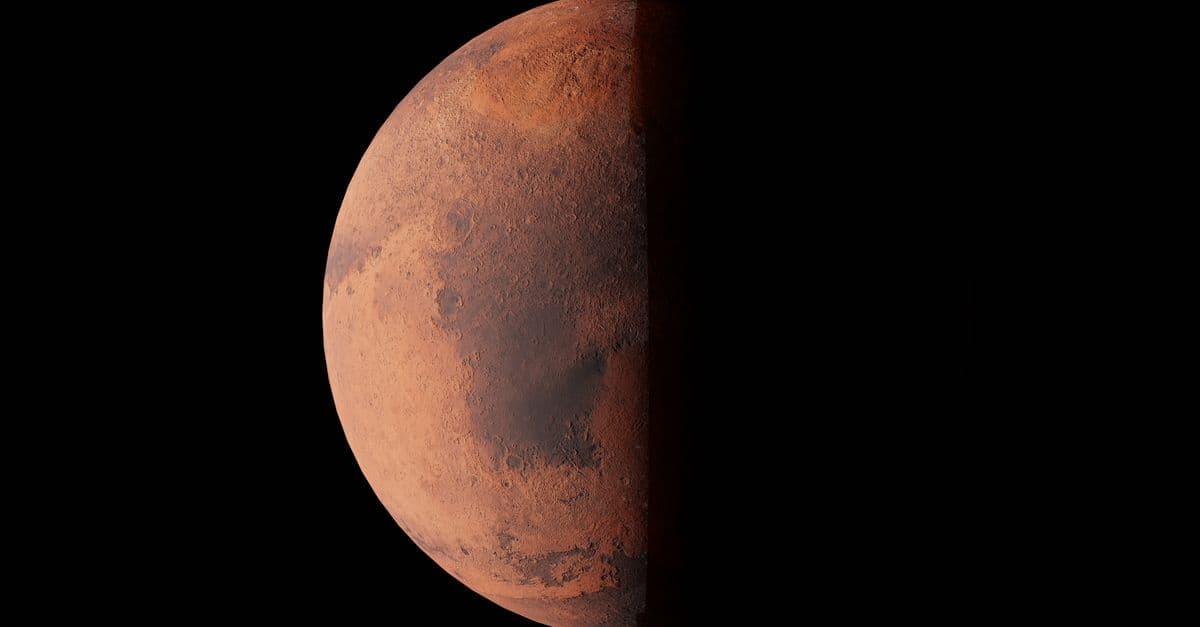
Photo: Zelch Csaba / Pexels
Planetary differentiation is the process that turned a lump of mixed dust and rock into a planet with an iron core, a rocky mantle, and a thin crust. It happened early: within a few million years for small asteroids and within tens of millions for Earth. The sorting follows one simple rule, that dense material sinks and light material rises, but it only works if the body gets hot enough to flow. This article explains what heats a young world, how scientists date the event, and why the result shapes a planet's magnetic field.
What planetary differentiation actually is
Differentiation is the separation of a planetary body's chemical elements into distinct regions according to their density and chemical behavior. In the standard description, it is driven by partial melting, with heat from radioactive decay, impacts, and gravitational compression, and it has affected planets, dwarf planets, large asteroids such as Vesta, and moons including our own, according to the reference summary of planetary differentiation.
A kitchen analogy gets you most of the way. Shake a jar of oil and vinegar and the oil floats back to the top as the mixture settles. A planet works the same way, with one crucial difference: the "jar" is a ball of rock and metal that is solid at birth. Nothing can sort until the material is soft or liquid enough for the heavy parts to move. That is why the heating comes first and the layering second.
The result is a body with chemically distinct layers instead of a uniform mixture. Earth's core, mantle, and crust are the textbook case, with the hydrosphere and atmosphere forming the outermost, lightest layers. The same reference summary gives representative densities: about 2,700 kilograms per cubic meter for the crust, about 3,400 for the mantle, and about 5,515 for the planet as a whole, which tells you the core must be far denser than either.
Undifferentiated bodies are the contrast. They never got hot enough, or stayed hot long enough, to sort, so they preserve the raw mixture of dust that formed them. Meteorites known as chondrites come from such bodies, which is why they are treated as samples of the early solar system. The story of how the building blocks assembled in the first place is told in how the solar system formed and in our look at protoplanetary disks and how planets form.
Why density sorts a planet
Averaged over its whole volume, Earth is mostly four elements. By mass it is about 32.1 percent iron, 30.1 percent oxygen, 15.1 percent silicon, and 13.9 percent magnesium, with smaller shares of sulfur, nickel, calcium, and aluminum, according to the Earth reference article. Yet the planet's surface is almost entirely oxygen, silicon, and magnesium compounds, with very little free iron. The missing iron is in the core, which the same article reports is about 88.8 percent iron, 5.8 percent nickel, and 4.5 percent sulfur.
Here is why the metal ended up in the middle. Iron metal has a density of about 7,900 kilograms per cubic meter at ordinary conditions, and silicate rock, the combination of silicon and oxygen with magnesium and other metals, is roughly 2,700 to 4,000. In a molten mixture, the denser fluid sinks and the lighter one rises, in the same way that a stone sinks in water. Put enough of that process together and you get a metal core with a stony shell around it.
Chemistry adds a second layer to the sorting. Geochemists divide elements by what they bond with when both rock and metal are molten:
- Siderophile ("iron-loving") elements, such as nickel, gold, platinum, and tungsten, dissolve readily into liquid iron and travel with it to the core.
- Lithophile ("rock-loving") elements, such as hafnium, aluminum, calcium, and most of the rare earths, stay in the silicate.
- Chalcophile elements prefer sulfur-rich phases, and some of those also end up in the core.
This chemical sorting happens even when density alone would not predict it. The reference summary points out that uranium, for example, is far more at home in Earth's silicate crust than in the metal core, so the planet's heat-producing elements ended up near the top. That fact matters later, because it shapes how a planet cools.
The practical payoff is that the same sorting leaves chemical fingerprints. The abundance of nickel, gold, and tungsten left in Earth's mantle records the pressures and temperatures at which metal and rock last equilibrated, and the ratios of hafnium to tungsten act as a clock, as explained below.
What melts a planet?
A planet needs heat to differentiate, and a newborn one has several sources.
Accretion. Every collision converts motion into heat. As dust clumped into pebbles, pebbles into planetesimals, and planetesimals into protoplanets, the kinetic energy of impacts warmed the growing body. The bigger the object and the faster the impacts, the more heat stayed behind.
Radioactive decay. The early solar system contained short-lived radioactive isotopes that have long since vanished. The most important was aluminum-26, which has a half-life of about 717,000 years, according to the aluminum-26 reference. The canonical initial ratio of aluminum-26 to stable aluminum-27 in the oldest solar system solids was about 5 in 100,000. That is a tiny fraction, but aluminum is abundant in rock and the decay releases energy steadily, so it was enough to melt small bodies from the inside. The isotope probably supplied the main early heat for planetesimals, and its role in warming Ceres and Vesta is noted in the same reference. Where the aluminum-26 came from is a separate question; one candidate source is a nearby massive star, which connects to the physics in what happens when a star dies.
Gravitational energy. Compressing a body and, later, sinking the iron to its center converts gravitational potential energy to heat. Core formation is partly self-reinforcing: the more metal drains inward, the more heat is released, and the easier it is for more metal to move.
Tidal heating. A moon orbiting a giant planet is flexed by changing gravity, and the friction warms its interior. This is the dominant heat source for several moons today, a process shown at its most dramatic in Io, Jupiter's volcanic moon.
The balance between these sources depends on size and timing. A large body is heated mostly by accretion and gravity; a small one depends heavily on aluminum-26 and therefore on how early it formed. A planetesimal that finished building only a few million years after the first solids had missed most of the radioactive fuel, and it may never have melted.
The magma ocean and the iron rain
Once a body is hot enough, its outer region can turn into a magma ocean, a deep layer of molten rock. The early Moon had one, and Earth, Mars, and probably every large rocky body passed through something similar after major impacts. Inside a magma ocean the metal can separate quickly, because droplets of liquid iron are much denser than the silicate melt around them.
Researchers describe several routes for metal to reach the center. The reference summary lists percolation (metal trickling through a partly molten rock matrix), diking (metal-filled cracks propagating downward), diapirism (large blobs of dense material sinking through weaker rock), and direct delivery of a core by a large impactor. In a fully liquid magma ocean, models often picture an "iron rain," with droplets falling and merging as they go. Which mechanism dominated depends on the body's size, temperature, and how much of it was liquid.
Whatever the mechanism, the metal does not simply fall without interacting. As it descends it exchanges elements with the silicate around it, picking up siderophile elements and leaving lithophile ones behind. A planet's mantle therefore carries a record of the depth, temperature, and pressure at which that exchange stopped. This is one reason the abundance of gold or platinum in the mantle has been a topic of study: a simple model of core formation leaves too little of them in the rock, and the size of the discrepancy tells scientists about the conditions involved. A 2026 paper in Science Advances proposes that core formation itself can resolve Earth's excess of these elements without a later delivery by impacts, in Core formation resolves Earth's siderophile excess without a late veneer, which shows how active the debate is.
How fast does a planet differentiate?
Fast, by geological standards, and the timing depends strongly on size. Scientists measure it with a radioactive clock based on hafnium and tungsten.
Hafnium-182 decays to tungsten-182 with a half-life of 8.9 million years, per the hafnium-tungsten dating reference. Hafnium is lithophile and tungsten is moderately siderophile, so core formation separates them: tungsten goes into the metal, and hafnium stays in the rock. If the core formed while hafnium-182 was still abundant, the rock keeps the hafnium and it decays to tungsten-182 there, leaving the mantle with a measurable excess of that isotope. If the core formed later, most of the hafnium had already decayed while tungsten was still free to move into the core, and the mantle ends up depleted. Comparing the tungsten isotope ratio in a planet's rocks with that in primitive meteorites therefore dates the event.
Think of it as an hourglass that is only running while the isotope lasts. Turn the glass at the moment the core forms, and the sand left on each side tells you when. The method has an important limit: the simple version assumes the core formed instantly. That suits a small asteroid, but a planet the size of Earth built up over many millions of years, so more elaborate models are needed. For a broader introduction to the dating principle, see how radiometric dating works.
| Body | When the core formed (after the first solids) | Source |
|---|---|---|
| Parent bodies of magmatic iron meteorites | about 1 to 3 million years | Hf-W dating reference, 2025 review |
| Allende carbonaceous chondrite | about 2.2 million years (a chondrite, not a core) | Hf-W dating reference |
| Mars | fully formed within about 10 million years | Hf-W dating reference |
| Earth | roughly 30 to 100 million years, model dependent | Hf-W dating reference |
The first row is the key. A 2025 review in Space Science Reviews concluded that the parent bodies of both inner and outer solar system iron meteorites segregated their cores within about 1 to 3 million years after the formation of calcium-aluminum-rich inclusions, the oldest solids in the solar system, and that their accretion took less than 1 million years. Silicate differentiation was well under way within the first few million years. In other words, small bodies sorted themselves almost immediately, while the aluminum-26 was still hot.
Earth's wide range reflects genuine uncertainty. The reference notes that the answer depends on assumptions, especially how giant impacts such as the one thought to have formed the Moon remixed the core and mantle. Earlier collisions may have delivered cores that merged with Earth's, so there is no single moment at which "the" core formed.
Earth as a differentiated planet
The resulting structure is well mapped by seismology. Earth has three chemical layers, a silicate crust, an iron- and magnesium-rich mantle, and an iron-nickel core, and five mechanical zones, according to the internal structure of Earth reference.
| Layer | Extent | State | Notes |
|---|---|---|---|
| Crust | roughly 5 to 70 km thick | Solid | Thin and dense under oceans, thicker and lighter under continents |
| Mantle | down to about 2,890 km | Solid but flows over long timescales | About 45 percent of Earth's radius; convection drives plate tectonics |
| Outer core | about 2,260 km thick | Liquid iron-nickel | Convection here is thought to generate the magnetic field |
| Inner core | radius about 1,220 km | Solid iron-nickel | Discovered by Inge Lehmann in 1936 |
Adding the last two rows gives a core radius of about 3,480 kilometers, a little more than half of Earth's radius. The inner core is solid even though it is hotter than the outer core because the pressure at the center is enormous; the Earth article puts the central temperature at about 6,000 degrees Celsius.
Two features of Earth's crust deserve mention. Continental crust is old, light, and rich in silica, and it floats; some of the oldest mineral grains known on Earth, zircons from Western Australia, survive in it. Oceanic crust is dense, young, and constantly recycled, because plate motions carry it back into the mantle. This two-crust system is the product of further differentiation after the core formed, as the mantle partially melted and the light fraction rose to the surface, and it is described in more detail in what is inside Earth and in plate tectonics explained.
Differentiation across the solar system
Every large rocky body has been through some version of this process, but the results differ with size, composition, and timing.
| Body | What we know | Interesting detail |
|---|---|---|
| Moon | Differentiated; small core; mean density 3.344 g/cm³ | Moment of inertia factor 0.3929, close to a uniform sphere |
| Mars | Differentiated; core radius about 1,780 to 1,810 km | Core density 6.2 to 6.3 g/cm³ |
| Mercury | Core radius about 2,020 km, about 83 percent of the planet's radius | Core is about 57 percent of the volume |
| Vesta | Iron-nickel core, olivine mantle, basaltic crust | Source of HED meteorites |
| Callisto | Partly differentiated | Moment of inertia factor about 0.345 to 0.355 |
| Ceres | Rocky core under an ice- and water-rich mantle | Layers less sharply defined than the terrestrial planets |
The Moon. The Moon's low mean density, 3.344 grams per cubic centimeter, and a small core, about 350 kilometers in radius or less, are consistent with its formation from the outer layers of Earth and the impactor in the giant impact described in how the Moon was formed, according to the Moon reference article. As the lunar magma ocean crystallized, heavy minerals such as olivine and pyroxene sank to form the mantle, and after about three-quarters of the ocean had crystallized, a lighter mineral, plagioclase feldspar, floated to the top and formed the pale anorthosite crust that makes up the lunar highlands. The last dregs of liquid, rich in elements that do not fit into the common minerals, were trapped between crust and mantle, a layer geologists call KREEP.
Mars. Mars differentiated early and has a substantial iron core. A 2023 study in the Proceedings of the National Academy of Sciences used seismic waves from NASA's InSight lander that traveled through the core and reported a median core radius of 1,780 to 1,810 kilometers and a core density of 6.2 to 6.3 grams per cubic centimeter, implying 20 to 22 percent by weight of lighter elements mixed with the iron, in First observations of core-transiting seismic phases on Mars. Mars has no global magnetic field today; the remnant magnetism in its oldest crust indicates that it once had one, a story covered in how planetary magnetic fields work. That loss is part of the reason the planet lacks protection from the Sun's particles, a consequence examined in why Mars lost most of its atmosphere.
Mercury. Mercury is the outlier. Its core radius of about 2,020 kilometers makes up about 83 percent of the planet's radius and about 57 percent of its volume, against roughly 17 percent for Earth, and the planet as a whole is about 70 percent metal by mass, according to the Mercury reference article. One leading explanation is that a giant impact stripped away much of an originally thicker mantle. But MESSENGER found more potassium and sulfur on the surface than that scenario predicts, since those volatile elements should have been driven off, so other explanations, including the removal of lighter particles from the solar nebula, remain in contention. The BepiColombo mission, scheduled to enter orbit around Mercury in November 2026, is expected to help decide. More detail is in Mercury explained.
Vesta. Vesta is a differentiated asteroid with a mean diameter of about 525 kilometers. It has a metallic iron-nickel core estimated at 90 to 220 kilometers across, an olivine mantle, and a crust similar to the meteorites called HED (howardites, eucrites, and diogenites), per the Vesta reference article. More than 1,200 HED meteorites have been collected, and roughly one in 16 meteorites is thought to be Vestan. Its south pole is dominated by the Rheasilvia basin, about 500 kilometers wide, formed roughly a billion years ago, which exposed deeper layers. How sorted Vesta is internally remains debated, since the same reference describes the interior as only partly differentiated in some analyses.
Bodies that stopped partway
Differentiation is not a switch. A body can melt partially, stop, and freeze with a half-sorted interior, and there are good examples.
The measuring stick is the moment of inertia factor, a number that describes how mass is spread inside a sphere. For a uniform ball it is 0.4. The lower the number, the more the mass is concentrated toward the center. Earth's is 0.3307, per the Earth reference article, which reflects a dense core. Mercury's is about 0.346, and the Moon's is 0.3929, nearly uniform.
Callisto, the outer large moon of Jupiter, is the classic partial case. Gravity measurements from the Galileo spacecraft gave a moment of inertia factor of about 0.3549, and a reanalysis gave 0.345, both below 0.4 but well above Earth's, indicating rock increasing with depth without a clean separation, as the Callisto reference article summarizes. The article adds that a 2011 reanalysis argued for a more fully differentiated interior instead, so the picture is not settled.
Ceres is another intermediate case. NASA's overview says it probably has a solid core and a mantle with abundant water ice, with layers less clearly defined than those of the terrestrial planets, in the NASA Ceres facts. Our article on Ceres, the dwarf planet with brine and organics shows what that partial sorting produced at the surface.
At the other extreme are objects that may be the exposed cores of bodies that were smashed apart. The asteroid Psyche is a candidate: the mission team describes it as possibly the remnant core of an early differentiated planetesimal, in the Psyche mission overview. Meteorites called pallasites, which are mixtures of olivine and metal, tell a similar story of collisions among differentiated bodies. A 2022 study of their isotopes concluded that they formed when an impact mixed a planetary core with another body's mantle, with the impactor itself having differentiated within about 1 to 2 million years of the start of the solar system and the impact occurring between roughly 1.5 and 9.5 million years after the oldest solids, in Isotopic evidence for pallasite formation.
The meteorites tell us about a hierarchy. A study of iron meteorites in 2024 found that cores from bodies in the outer solar system were smaller, richer in siderophile elements, and crystallized more simply than those from the inner solar system, which the authors link to differences in the disk itself, in Compositions of iron-meteorite parent bodies constrain the structure of the protoplanetary disk. In other words, where a body formed shapes how it sorted.
For more on what meteorites and returned samples can tell us, see how asteroid samples reveal solar system history and the overview of asteroids, comets, and meteors. Interior structure also matters for defense: a dense iron body and a loose rubble pile respond very differently to a deflection attempt, which is a theme in how planetary defence works.
How scientists study layers they cannot visit
No one can drill to the core of even one planet, so researchers rely on indirect methods that complement one another.
- Moment of inertia. The factor can be calculated from a body's rotation, its wobble, and its gravity field. A value well below 0.4 signals a dense core.
- Seismology. Waves from earthquakes or impacts bend and reflect at boundaries between layers. Shear waves cannot pass through liquid, which is how seismologists established that Earth's outer core is liquid. The Apollo seismometers did the first such work on the Moon, and InSight did it on Mars, including the core-transiting waves described above. See how scientists know what is inside Earth for the terrestrial case.
- Magnetic fields. A strong, organized field points to a convecting liquid metal core, and a weak, patchy field suggests an old dynamo that has since shut down.
- Gravity mapping. Orbiting spacecraft detect small changes in their orbit that reveal mass concentrations beneath the surface.
- Meteorites. Samples that arrive on Earth carry the isotope clocks that date the process in the first place.
Each method has blind spots, which is why the best interior models combine several of them. Mercury's interior, for instance, rests on its spin, its gravity, and its magnetic field together.
Why differentiation matters for habitability
A planet's layered structure sets many of the conditions that allow life to persist.
A magnetic field. A liquid, convecting metal core can generate a magnetic field that deflects the solar wind. Earth's field is a product of motion in its liquid outer core. Whether a core stays liquid and convecting depends on its size, composition, and how fast the planet loses heat. Mars's core appears to have lost its dynamo while Mercury's, despite the planet's small size, still produces a weak field.
Volcanism and outgassing. The composition of the mantle determines which gases erupt from volcanoes, and early outgassing built atmospheres. Differentiation fixed which elements ended up where.
Plate tectonics. Whether a planet develops moving plates depends on mantle strength, water content, and heat flow, all of which trace back to differentiation. Venus is similar to Earth in size and composition but appears to lack plate tectonics, and the reason is still debated; water content in the mantle and surface temperature are leading candidates.
Chemical cycling. On Earth, the long-term carbon cycle moves carbon between the atmosphere, oceans, and rock, and tectonics and volcanism keep it turning. That cycle needs a mantle that melts and a crust that recycles.
The links are probabilistic, not deterministic. A differentiated world is more likely to have the conditions that support complex chemistry, but no single layer guarantees life. Our overview of what makes a planet habitable puts the interior alongside the other requirements, and the discussion of whether humans could live elsewhere in can humans live on Mars shows how Mars's differentiation history shapes what its surface offers.
Icy worlds sort too, with different ingredients
Differentiation is not limited to rock and metal. Icy bodies sort into rock and ice, with dense silicates sinking and water ice rising. A fully differentiated icy moon may have a rocky core, a liquid water ocean heated by tides or radioactivity, and a frozen outer shell.
Europa and Enceladus are the best-studied examples, and both are considered strong candidates for subsurface oceans. Callisto shows what happens when the sorting stops early. The relevant science, including how oceans interact with rocky seafloors, is covered in the search for life on Europa and Enceladus. Whether liquid water persists under a given shell depends on the same things as for rocky planets: how much heat there is, and how long it lasts.
Common confusions
"Earth's interior is a ball of liquid." Only the outer core is liquid. The mantle is solid rock that flows over millions of years, and the inner core is solid. Most of the planet by volume is solid.
"Differentiation is something that happened long ago and finished." The process is largely complete, but its effects continue. The inner core grows as the planet cools, the mantle churns, and the core's heat sustains the magnetic field.
"Asteroids are all unsorted rubble." Many are, but some, like Vesta and the parent bodies of iron meteorites, melted and separated within a few million years of the start of the solar system.
"Heavy elements sank because gravity pulled them down, so the light ones are only leftovers." Chemistry matters as much as density. Elements split between rock and metal according to how they bond, which is why gold went into the core and uranium stayed in the crust.
"Every planet's core formed at once." Earth accreted over many millions of years, and cores likely formed in stages, some brought in by impactors, which is why the dates for Earth span a range.
What we still do not know
Several questions are open. The exact composition of Earth's core is uncertain: it is mostly iron and nickel, but the light elements that make up the rest, such as sulfur, oxygen, silicon, and hydrogen, are debated. Mars's core results suggest 20 to 22 percent light elements by weight, which is a large fraction.
Timing is another. The tungsten clock gives tight answers for small asteroids and wide ranges for Earth, because the answer depends on how giant impacts mixed the planet. The age of the Moon itself is contested, with estimates between 4.35 and 4.51 billion years depending on the method, as a 2024 paper in Nature notes in Tidally driven remelting around 4.35 billion years ago indicates the Moon is old.
Mercury's origin remains unresolved until more data arrive. And the reasons some worlds, like Callisto, stalled halfway are still being tested by new reanalyses of old spacecraft data. These are not gaps in the basic idea so much as places where the details change the story.
Frequently asked questions
Q: What is planetary differentiation in simple terms? A: It is the sorting of a hot, partly molten world by density. Heavy iron sinks to form a core, lighter silicate rock rises to form a mantle and crust, and the lightest materials form the oceans and atmosphere.
Q: What causes a planet to differentiate? A: Heat. The main sources are energy from impacts as the planet grew, radioactive decay of short-lived isotopes such as aluminum-26, and gravitational energy released as metal sinks. Tidal heating matters for some moons.
Q: How long did it take Earth to differentiate? A: Hafnium-tungsten dating puts Earth's core formation at roughly 30 to 100 million years after the first solids, depending on model assumptions. Small asteroid parent bodies separated their cores in about 1 to 3 million years.
Q: Are all asteroids differentiated? A: No. Some, such as Vesta and the parent bodies of iron meteorites, melted and separated. Others, whose meteorites are chondrites, never got hot enough and preserve the original mixture.
Q: How do scientists know what is inside planets? A: They combine methods: seismic waves, gravity and moment of inertia measurements, magnetic field observations, and meteorite chemistry. InSight's seismometer, for instance, gave Mars a core radius of roughly 1,780 to 1,810 kilometers.
Q: Why does differentiation matter for life? A: It sets up the magnetic field, volcanic outgassing, and plate tectonics that can regulate climate and recycle chemicals. A layered interior makes these more likely, though no one layer guarantees habitability.
Q: Do icy moons differentiate? A: Yes. Rock sinks and ice rises, which can produce a rocky core, an ocean, and an ice shell. Callisto appears only partly sorted, with a moment of inertia factor of about 0.345 to 0.355.
The takeaway
Differentiation is the first great event in a planet's life, and it is nearly irreversible. In the first few million years for an asteroid and the first tens of millions for Earth, density and chemistry sorted a uniform ball into layers, and everything afterward, from the magnetic field to plate tectonics, worked within the structure that sorting created. The same process explains why meteorites come in such different kinds, why Mercury is mostly metal, and why Callisto looks half-finished. What remains unsettled is mostly the timing and the details, and those are being tightened by tungsten isotopes, seismometers on other worlds, and samples from asteroids.
Related Reading
- What Are Asteroids vs Comets vs Meteors?
- Can Humans Live on Mars?
- The Search for Life on Europa and Enceladus
- What Happens When a Star Dies
- How Planetary Defence Works
Sources
- "Initial Conditions of Planet Formation: Time Constraints from Small Bodies and the Lifetime of Reservoirs in the Solar Protoplanetary Disk," Space Science Reviews 221 (2025): doi.org/10.1007/s11214-025-01216-z.
- "First observations of core-transiting seismic phases on Mars," PNAS 120 (2023): doi.org/10.1073/pnas.2217090120.
- "Isotopic evidence for pallasite formation by impact mixing of olivine and metal during the first 10 million years of the Solar System," PNAS Nexus 1 (2022): doi.org/10.1093/pnasnexus/pgac015.
- "Compositions of iron-meteorite parent bodies constrain the structure of the protoplanetary disk," PNAS 121 (2024): doi.org/10.1073/pnas.2306995121.
- "Tidally driven remelting around 4.35 billion years ago indicates the Moon is old," Nature 636 (2024): doi.org/10.1038/s41586-024-08231-0.
- "Core formation resolves Earth's siderophile excess without a late veneer," Science Advances 12 (2026): doi.org/10.1126/sciadv.aef0411.
- NASA Science, Ceres facts.
- Reference summaries: Planetary differentiation, Hafnium-tungsten dating, Aluminium-26, Internal structure of Earth, Earth, Moon, Mercury, Vesta, Callisto.
Follow new articles
Add SciHub101 to your feed reader to see new science and technology stories.
About the Author
SciHub101 is an independent science and technology publication founded and edited by Buğra Sözeri, a software engineer and app developer based in Türkiye. AI tools assist with drafting and research. Source documentation in the existing archive is uneven, and articles are being reviewed and corrected. The Editorial Team byline identifies editorial responsibility; it does not certify specialist or independent human review. Where we compare products, anything built by our own team is labelled as such — see the editorial guidelines and About page for how corrections and disclosures work.
Related Articles
How Old Is the Universe — And How Do We Actually Know?
The universe is 13.8 billion years old. But how do we know? Three independent methods — the cosmic microwave background, the oldest stars, and Hubble's constant — converge on the same answer. Here's the evidence.
How Do Radio Telescopes Work? Listening to the Universe at Every Frequency
Radio telescopes collect faint radio waves from pulsars, galaxies, hydrogen gas, and black holes. Because radio waves are long, sharp images need either a giant dish like China's 500-meter FAST or an array of dishes combined by interferometry, like the VLA.
Asteroids, Comets, and Meteors — What's the Difference?
Asteroids, comets, meteoroids, meteors, and meteorites — what each one is, where they come from, and how scientists study them.
Long-Period Comets: Messengers From the Edge of the Solar System
Comet Hale-Bopp, which dominated the 1997 night sky, had not been seen by any human being before. Its previous perihelion passage was in approximately 2215 BCE, before writing systems existed in most of the world. It had spent the intervening 4,200 years falling inward from the outer solar system at speeds so slow that a bicycle could have overtaken it. When it finally arrived, its pristine composition — unchanged since the solar system formed 4.5 billion years ago — gave scientists a direct sample of the raw material from which planets were built. Long-period comets are the oldest, least-altered objects available for study. They are time capsules from the beginning.
'Oumuamua: The First Interstellar Visitor and the Mystery of Its Acceleration
On October 19, 2017, astronomers found the first object confirmed to have come from outside our solar system. It tumbled, looked extremely elongated or flat, showed no gas or dust, and still sped up slightly as it left the Sun. Scientists have proposed a hydrogen iceberg, a nitrogen shard, and an alien lightsail. Here is what the evidence supports.
Olympus Mons — Solar System's Biggest Volcano
Olympus Mons on Mars: 21.9 km tall, 600 km base diameter, fed by a stationary hotspot for 4 billion years. Why Mars's gravity and lack of plate tectonics enable giants.