How Do Radio Telescopes Work? Listening to the Universe at Every Frequency
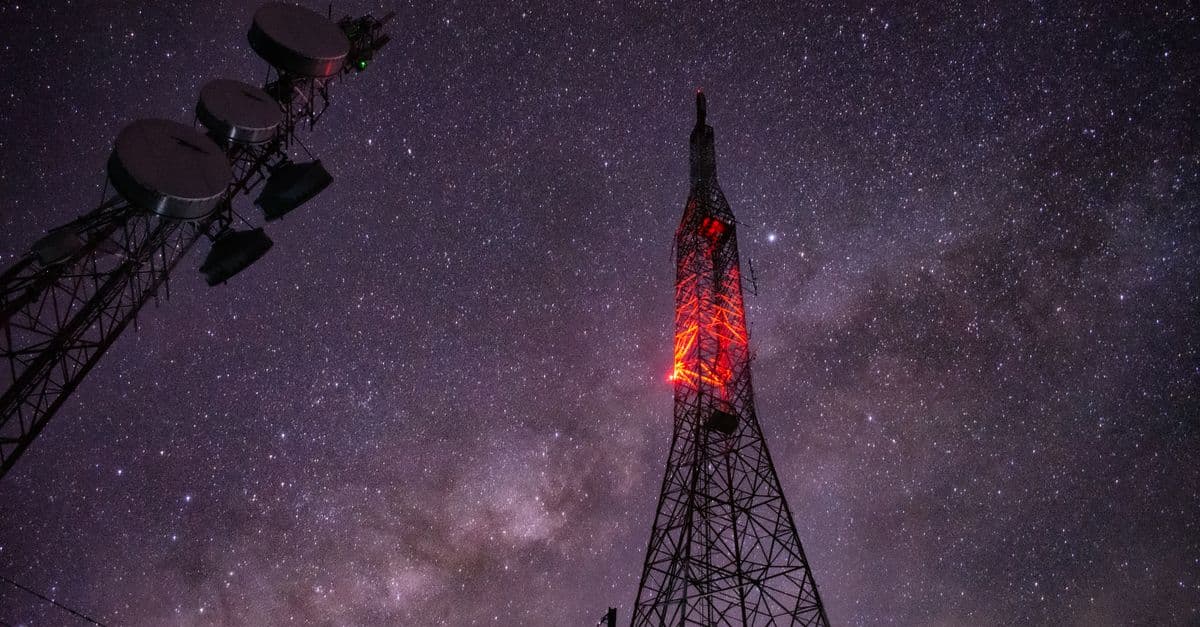
Photo: Juan Martin Gomez / Pexels
In the early 1930s, Karl Jansky, an engineer at Bell Labs, set out to find the source of static that was garbling transatlantic radio telephone calls. Beyond the thunderstorm crackle he found a faint, steady hiss that came back every 23 hours and 56 minutes, the length of a sidereal day (one rotation of Earth relative to the stars, about four minutes shorter than the solar day). Its source was fixed among the stars. The rest of this piece explains how radio telescopes work, why the dishes are so large, and what they have found since.
Jansky traced the hiss to the densest part of the Milky Way, in the direction of Sagittarius. He announced the result in April 1933 and published it that October. Four years later an amateur, Grote Reber, built a 9-meter parabolic dish in his backyard in Wheaton, Illinois, and made the first radio survey of the sky (Wikipedia, "Radio astronomy"). Radio astronomy had begun with an engineer chasing noise.
Key takeaways
- A radio telescope has three jobs: a dish gathers and focuses radio waves, a cooled receiver amplifies them without adding much noise, and a digital backend turns the voltage into spectra, images, or pulse timings.
- Sharpness depends on wavelength divided by aperture. Radio waves are millions of times longer than light waves, so a single dish gives a blurry view unless it is enormous.
- Interferometry combines separated antennas so the array behaves like one telescope as wide as its widest spacing. The VLA's 27 antennas form 351 pairs at once.
- Radio astronomy produced pulsars, the cosmic microwave background, the first image of a black hole's shadow, and 2023 evidence for a background of gravitational waves.
- Radio searches for alien technology have produced one famous unexplained signal, from 1977, and no confirmed detection.
Why radio waves show a different sky
Human vision covers a sliver of the electromagnetic spectrum, from roughly 380 nanometers (violet) to 700 nanometers (red). Radio astronomers work at the other end. The National Radio Astronomy Observatory (NRAO) describes the band of interest as running from about 3 kilohertz to about 900 gigahertz, which corresponds to wavelengths from around 100 kilometers down to less than a millimeter (NRAO). That is a span of about eight orders of magnitude in wavelength, and different parts of it reveal different physics.
Objects produce radio waves in four main ways:
- Thermal emission. Anything above absolute zero radiates. Cold interstellar gas at around 10 kelvins (about minus 263 degrees Celsius) is nearly invisible to optical telescopes but shows up at radio and millimeter wavelengths.
- Synchrotron radiation. Electrons spiraling around magnetic field lines at close to the speed of light emit a smooth, broad radio glow. It is the main reason jets from black holes and the remnants of supernovae shine in radio.
- Spectral lines. Atoms and molecules emit or absorb at precise frequencies when they change energy state. The hydrogen line at 21 centimeters is the most important, and we return to it below.
- Coherent emission. Pulsars and fast radio bursts produce radio beams through mechanisms that are still being worked out, and the signals are far brighter than thermal physics would allow.
Radio also sees through things. Interstellar dust grains are about the size of smoke particles, and they scatter and absorb visible light very effectively. Radio waves are far longer than the grains, so they pass through almost untouched. The comparison is a foghorn and a flashlight: the low, long-wavelength sound carries through fog that stops the beam completely. That is why radio and infrared telescopes can map the Milky Way's center, which is hidden from optical telescopes behind thick dust lanes.
The atmosphere imposes limits on both sides of the band. At the long end, the ionosphere reflects waves below its plasma frequency, so ground-based observations bottom out around 15 megahertz. At the short end, water vapor absorbs millimeter waves, which is why millimeter observatories sit on high, dry plateaus. Human transmitters add interference (radio-frequency interference, or RFI), which is why many observatories are deliberately placed in remote valleys (Wikipedia, "Radio astronomy"). The United States even keeps a National Radio Quiet Zone around the Green Bank telescope in West Virginia.
How a dish turns a whisper into data
Most radio telescopes borrow the shape of a satellite TV dish, only far larger. A parabolic reflector has the useful property that every ray arriving parallel to its axis bounces to the same point, the focus. Cup your hand behind your ear and you are doing a crude version of the same trick: you collect sound from a wide area and funnel it into a small opening.
The reflector and its surface
The dish has to be smooth, but only relative to the wavelength being observed. An optical mirror must be accurate to a small fraction of a wavelength of light, which means nanometers. At 21 centimeters, errors of a centimeter or so are tolerable, and the surface can even be wire mesh. At 1.3 millimeters, as used for black hole imaging, the tolerances shrink to fractions of a millimeter. This is why low-frequency dishes can be gigantic while millimeter dishes are smaller and more expensive per square meter.
The feed and the receiver
At the focus sits a feed, usually a horn-shaped antenna matched to the wavelength range. It converts the focused waves into a tiny electrical signal. Then comes the hard part, because that signal is almost absurdly weak.
Radio astronomers measure source brightness in janskys, a unit named after Jansky: 10⁻²⁶ watts per square meter per hertz. Here is a worked example. Take a 100-meter dish, assume about 60 percent of its geometric area is effective (roughly 4,700 square meters), and point it at a source of 1 jansky. Over a 1-megahertz slice of the spectrum, the incoming flux is 10⁻²⁰ watts per square meter, so the dish collects about 5 × 10⁻¹⁷ watts. A single polarization receives half of that. For comparison, a 60-watt light bulb uses roughly 10¹⁸ times more power. Many interesting sources are fainter than 1 jansky.
Amplifying such a signal means fighting noise generated by the electronics themselves. The standard solution is to cool the first amplifier cryogenically, often to a few kelvins up to a few tens of kelvins, so that thermal jostling of electrons in the circuit stops swamping the signal. In the best receivers the noise is dominated not by the amplifier but by the sky, the atmosphere, and the ground spilling past the dish edge.
The backend
After amplification, the signal is converted to numbers. Modern digital backends split the band into many thousands of narrow frequency channels at once, so that a single observation records the full spectrum, including any sharp spectral lines. For pulsar work the backend also preserves the arrival time of each pulse to a tiny fraction of a millisecond. Everything downstream is software.
Mounts and pointing
Dishes must point at a source and follow it as Earth rotates. An equatorial mount has one axis parallel to Earth's rotation, so tracking needs only a constant-rate turn about that axis. An altitude-azimuth mount uses a vertical and a horizontal axis and needs both to move in coordination, but it is mechanically simpler for massive structures and is almost universal among large modern dishes.
Why radio dishes have to be so big
Any telescope blurs a point source into a small disk because waves diffract at the edge of the aperture. For a filled circular aperture, the smallest angle it can distinguish is about 1.22 × λ / D radians, where λ is the wavelength and D is the diameter. The longer the wavelength relative to the aperture, the blurrier the view.
Think of a wave of water meeting a gap in a harbor wall. If the gap is much wider than the wavelength, the wave passes through as a narrow beam. If the gap is only a few wavelengths wide, the wave spreads out in a broad fan. Light waves, at about half a micrometer, meet apertures that are millions of wavelengths wide. Radio waves, at tens of centimeters, meet apertures that are only hundreds of wavelengths wide, so the fan is much wider.
The table puts numbers on it. The first three rows use the formula above, and the last two use the interferometer rule of thumb, resolution of about λ divided by the longest baseline B. An arcsecond is 1/3,600 of a degree, and a microarcsecond is a millionth of that.
| Instrument | Wavelength | Aperture or longest baseline | Approximate resolution |
|---|---|---|---|
| 1-meter optical telescope | 550 nm (visible) | 1 m | 0.14 arcsecond |
| 100-meter single dish | 21 cm | 100 m | 528 arcseconds (about 8.8 arcminutes) |
| FAST, 300-meter illuminated aperture | 21 cm | 300 m | 176 arcseconds (about 2.9 arcminutes) |
| VLA, A configuration (36.4 km) | 21 cm | 36.4 km | 1.2 arcseconds |
| VLA, A configuration | 7 mm | 36.4 km | 0.04 arcsecond |
| Event Horizon Telescope | 1.3 mm | about 12,700 km (Earth's diameter) | about 21 microarcseconds |
Source: author's calculations from the diffraction formulas above. The NRAO quotes 0.2 to 0.04 arcsecond for the VLA, and the EHT is described as reaching roughly 20 microarcseconds (NRAO VLA page; Wikipedia, "Event Horizon Telescope").
Read the first two rows together. To match the sharpness of a modest 1-meter optical telescope at the 21-centimeter hydrogen wavelength, a single dish would need to be about 380 kilometers (240 miles) wide. No such structure can be built, and it is the reason radio astronomers turned to a different approach.
How interferometry builds a giant dish from small ones
If you cannot build a 380-kilometer dish, build a few dozen small ones spread over that distance and combine their signals. This is interferometry. Picture a giant mirror that has been smashed, with a few shards left in place. Each shard still reflects light from the whole sky, but with only a sample of the mirror, you must work out what the missing pieces would have added. Radio astronomers do exactly that with mathematics.
Each pair of antennas is a baseline. The signals from the pair are multiplied together in a computer called a correlator. The result measures one component of the sky's pattern, with a fineness set by the distance between the two antennas. With N antennas there are N × (N − 1) / 2 pairs. The VLA's 27 antennas give 351 pairs at once, and as Earth turns, each baseline sweeps out an arc and samples new components. This trick, called Earth-rotation aperture synthesis, was developed at Cambridge in the 1950s. The first radio interferometer observations of the sky date to 1946, and the principles of aperture synthesis were published by an Australian group in 1947 (Wikipedia, "Radio astronomy").
The cost is that gaps remain. A sparse array can miss the large, smooth glow of a nebula because the antennas are never close enough to sample it. Designers fill that gap with compact arrays of smaller dishes. The proposed next-generation VLA, for example, is designed to include a compact core of smaller dishes to measure the large-scale structure the main 18-meter dishes would miss.
Very Long Baseline Interferometry (VLBI) extends the principle to telescopes on different continents. They cannot be wired together, so each records its data alongside a timestamp from an atomic clock, and the recordings are combined later. That makes the effective telescope as wide as Earth.
The big instruments: FAST, the VLA, MeerKAT, and the EHT
| Facility | Type | Size | Frequency or wavelength | Notes |
|---|---|---|---|---|
| FAST (China) | Single dish | 500 m dish, 300 m illuminated | 70 MHz to 3 GHz | Fully operational January 11, 2020 |
| Arecibo (Puerto Rico) | Single dish | 305 m | to about 10 GHz | Collapsed December 1, 2020 |
| VLA (New Mexico) | Interferometer | 27 dishes of 25 m | 74 MHz to 50 GHz | Jansky VLA upgrade finished 2012 |
| MeerKAT (South Africa) | Interferometer | 64 dishes of 13.5 m | About 23 cm used for the 2019 bubbles map | Completed 2018 |
| Event Horizon Telescope | VLBI network | Earth-sized | 1.3 mm | M87* image published 2019 |
| SKA-Low and SKA-Mid | Interferometers | 131,072 antennas; 197 dishes | 50 to 350 MHz; 350 MHz to about 14 GHz | Under construction |
FAST: the largest single dish
China's Five-hundred-meter Aperture Spherical Telescope (FAST) sits in a natural karst depression in Guizhou province. Its reflector is 500 meters across, built from about 4,450 triangular panels. Winches under the panels reshape a 300-meter patch of the dish into a parabola in real time, and that patch is what actually collects signal at any one moment. A cabin hangs 140 meters above the reflector on cables from six towers, carrying the receivers (Wikipedia, "FAST").
Because the dish itself does not tilt, FAST reaches different parts of the sky by moving the illuminated patch and the cabin. It can observe up to 40 degrees from the zenith, with a smaller effective aperture at the largest angles. The last panel was installed on July 3, 2016, first light came in September 2016, and the telescope was declared fully operational on January 11, 2020, after about three years of testing.
How much better is it than the Arecibo dish it surpassed? Arecibo's full aperture was 305 meters, but its effective aperture was about 221 meters at the zenith. FAST's 300-meter illuminated circle therefore has roughly 1.8 times the effective collecting area. FAST's first two pulsars were detected in August 2017, and the count of new discoveries passed 1,000 by November 2024. Its frequency range, 70 megahertz to 3 gigahertz, covers the 21-centimeter hydrogen line at 1.42 gigahertz.
Arecibo: 57 years and an abrupt end
The Arecibo Observatory in Puerto Rico opened on November 1, 1963, and had a 305-meter dish in a natural sinkhole. A receiver platform of about 820 metric tons hung 150 meters above it. Its list of results is long: in 1964 it showed that Mercury rotates once in about 59 days, not 88; in 1974 it found the binary pulsar PSR B1913+16, whose orbit's slow shrinkage matched gravitational wave emission and earned a Nobel Prize; in 1992 it showed that the pulsar PSR B1257+12 hosts planets, the first confirmed planets outside our solar system. The 1974 Arecibo message, a short radio transmission aimed at the globular cluster Messier 13, was a symbolic broadcast.
Failure came in 2020. On August 10, an auxiliary cable slipped out of its socket on one tower and tore a gash in the dish. On November 7, one of the two main cables from that tower snapped. On December 1, the second main cable from the same tower failed and the platform, antenna, and dome fell onto the dish (Wikipedia, "Arecibo Telescope").
The Very Large Array: 27 dishes acting as one
The VLA stands on the Plains of San Agustin in New Mexico. It has 28 antennas, of which 27 observe at once and one is a spare. Each dish is 25 meters wide and weighs 209 metric tons. They sit along three arms in a Y shape, each arm 21 kilometers long, and are moved on rails between four standard configurations. The largest, A, is 22.62 miles (36.4 kilometers) across. The smallest, D, is 0.64 miles (about 1 kilometer). Its first antenna was put in place in 1975 and it was formally inaugurated in 1980. It covers 74 megahertz to 50 gigahertz and reaches resolutions of 0.2 to 0.04 arcsecond (NRAO VLA page; Wikipedia, "Very Large Array").
An upgrade of the electronics, the Expanded VLA project, ran from 2001 to 2012 and gave the array far wider bandwidth. The instrument was renamed the Karl G. Jansky Very Large Array in March 2012. A successor, the next-generation VLA (ngVLA), is planned as a much larger array. It is planned to use more than two hundred 18-meter dishes, with baselines reaching thousands of kilometers. Its construction schedule has shifted several times, so treat any start date with caution.
MeerKAT: South Africa's sharp-eyed precursor
MeerKAT has 64 dishes, each 13.5 meters across, in South Africa's Karoo region. The last dish was completed in May 2018. In 2019 its images revealed a pair of radio-emitting bubbles towering hundreds of light-years above and below the Milky Way's center, a structure that had been hidden by the bright central glare. The authors think it was inflated by a violent eruption near the central black hole a few million years ago (NRAO release, September 2019).
The Event Horizon Telescope
The Event Horizon Telescope (EHT) is a VLBI network of millimeter-wavelength dishes spread across the globe. It observes at 1.3 millimeters (230 gigahertz), and its baselines span nearly Earth's diameter, giving a resolution of roughly 20 microarcseconds. The observations were made in April 2017, and the first image, of the supermassive black hole in the galaxy M87, was published on April 10, 2019. The ring in it is about 42 microarcseconds across (Event Horizon Telescope, arXiv:1906.11238). A second image, of the black hole at the center of our own galaxy, Sagittarius A*, followed in 2022. You can read about the experiment in our article on the first image of a black hole.
What radio telescopes have found
The 21-centimeter hydrogen line
Hydrogen atoms in space radiate at a very particular frequency, 1,420.405751 megahertz, a wavelength of about 21.1 centimeters. It comes from a spin flip: the electron's spin turns from parallel to antiparallel with the proton's. The transition is extraordinarily rare. An individual excited atom waits a mean of about 11 million years before it emits. Hydrogen is so abundant that the glow adds up across the sky regardless.
Dutch astronomer Hendrik van de Hulst predicted the line in 1944. Harold Ewen and Edward Purcell detected it at Harvard in 1951, and Dutch astronomers Muller and Oort confirmed it soon after. Since then it has been used to map the Milky Way's spiral structure, measure how fast gas in galaxies rotates, and probe the early universe (Wikipedia, "Hydrogen line"). Rotation measurements of other galaxies show speeds that stay high far beyond the visible disk, one of several lines of evidence for dark matter. Future low-frequency arrays aim to catch the same line, stretched by cosmic expansion, from the era when the first stars lit up and reionized the universe.
Pulsars and the timing of gravity
Radio astronomers discovered pulsars in 1967, when graduate student Jocelyn Bell Burnell recognized a strange, regular signal in her data at Cambridge. They turned out to be rapidly rotating neutron stars sweeping a beam across Earth, as explained in our guide to pulsars and neutron stars. The fastest, the millisecond pulsars, keep time so regularly that they rival atomic clocks, a property covered in how pulsars keep such accurate time.
That regularity is a tool. If a gravitational wave passes between Earth and a pulsar, it stretches space slightly and shifts the pulse arrival times. A single pulsar cannot be trusted, but a network of them, a pulsar timing array, can reveal a pattern. In June 2023, the NANOGrav collaboration reported evidence of a gravitational wave background in 15 years of timing data from 67 pulsars. The pulsars' timing residuals showed the correlation pattern (the Hellings-Downs curve) expected for gravitational waves, at a significance of about 3 to 4 sigma. That is evidence, not a definitive detection. The signal is consistent with the combined hum of supermassive black hole pairs, though the authors say more exotic sources cannot be excluded (NANOGrav, arXiv:2306.16213). Other pulsar timing groups reported consistent hints around the same time.
Fast radio bursts
A fast radio burst (FRB) is a flash of radio waves lasting about a millisecond. The first one was found in 2007 by Duncan Lorimer and his student David Narkevic in archival Parkes Telescope data recorded in 2001. The signal's frequencies arrived staggered, with lower frequencies later, which is what happens when a pulse crosses large amounts of ionized gas. The delay was far larger than the Milky Way's gas could cause along that line of sight, implying a source far outside our galaxy (Lorimer, McLaughlin and Bailes, arXiv:2405.19106). Details of what is known are in our explainer on fast radio bursts.
On April 28, 2020, a burst from within the Milky Way coincided with an X-ray flash from the soft gamma repeater SGR 1935+2154, tying at least some bursts to a magnetar. Not all FRBs necessarily share that origin. One repeating source, FRB 20180916B, was found by the CHIME telescope to be active in a cycle of about 16.35 days, an unexplained clockwork.
The afterglow of the Big Bang
In 1964 and 1965, Arno Penzias and Robert Wilson, working with a horn antenna at Bell Labs in New Jersey, found a faint microwave hiss coming from every direction. It was the cosmic microwave background, the cooled afterglow of the early universe. They found it with an instrument built for satellite communication, much like Jansky found the Milky Way with equipment built for telephone service. The full story is in the cosmic microwave background discovery.
How radio SETI works, and why the Wow signal still stands alone
Radio telescopes are the main tool of the Search for Extraterrestrial Intelligence (SETI). The logic is that a transmitter built by another civilization might be a narrowband carrier, a tone confined to a tiny range of frequencies, which natural sources almost never produce. Searches concentrate on a quiet part of the spectrum, the "water hole," between the hydrogen line near 1,420 megahertz and the hydroxyl lines near 1,612 to 1,720 megahertz.
The Wow signal is the most famous candidate. It was recorded on August 15, 1977, by Ohio State University's Big Ear radio telescope in Delaware, Ohio. The signal lasted 72 seconds, the entire time the telescope's fixed beam could stay on that patch of sky as Earth rotated. Astronomer Jerry Ehman noticed it days later in the printout, circled the character code 6EQUJ5, and wrote the word "Wow" beside it. The frequency was about 1,420.456 megahertz, close to the hydrogen line, and the direction was in Sagittarius. Repeated searches, including some with the VLA in 1995 and 1996, found nothing, and a targeted Breakthrough Listen search on May 21, 2022, found no technosignature candidates. A proposal that a comet's hydrogen cloud caused it was rejected by astronomers, including members of the original Big Ear team (Wikipedia, "Wow signal"). For a longer treatment, see the Wow signal of 1977.
Breakthrough Listen, announced in July 2015 and funded with $100 million over 10 years from a foundation co-founded by Yuri Milner, is the largest modern effort. It uses the Green Bank Telescope in West Virginia and the Parkes Telescope in Australia, with other facilities, including FAST and MeerKAT, joining coordinated campaigns. The Green Bank recorder alone captures 24 gigabytes per second, and the reduced data total roughly a petabyte per year (Wikipedia, "Breakthrough Listen").
The hardest problem is not sensitivity but interference. In April 2017, an analysis of 692 nearby stars turned up 11 significant events, and all were traced to RFI. In December 2020, a narrowband signal near Proxima Centauri, called BLC1, drew attention, but terrestrial interference was judged the most likely cause. The lesson is that a real detection must pass a strict checklist: it should move with the star as Earth rotates, vanish when the telescope looks away, and reappear on a second telescope.
What the Square Kilometre Array will add
The Square Kilometre Array (SKA) is a global project to build two enormous interferometers. SKA-Low in Western Australia is planned to have 131,072 antennas arranged in stations of 256 elements each, covering 50 to 350 megahertz, with the most distant antennas about 74 kilometers apart. Its first image, in March 2025, used about 1,000 antennas. SKA-Mid in South Africa's Karoo will have 197 dishes spread across about 150 kilometers and will cover 350 megahertz to roughly 14 gigahertz (SKA Observatory; Wikipedia, "Square Kilometre Array").
The name promises a collecting area of one square kilometer, and that was the original design goal. The first phase is smaller: the dish collecting area of SKA-Mid is about 21,000 square meters, or 0.021 square kilometers, so claims that the SKA is already a square-kilometer instrument are premature. Construction officially began on December 5, 2022, and one account projects science operations for the first phase around 2032, though schedules for large projects are routinely revised.
What will the SKA be good for? Its designers target the hydrogen signal from the early universe, the timing of many more pulsars to sharpen gravitational wave searches, and deeper surveys of galaxies. It also complements infrared instruments. The James Webb Space Telescope sees starlight and warm dust, while radio arrays see cold gas and magnetic fields.
What people get wrong about radio telescopes
"Radio telescopes listen to sounds." They detect electromagnetic waves, the same kind of wave as light, not pressure waves in air. The "listening" metaphor comes from the signal being an electrical voltage that can be played through a speaker, as pulsars famously can. Any sound you hear is a choice made in software.
"The pictures are photographs." A radio image is a map of intensity at a chosen frequency, with colors assigned by the scientist. It represents something real, but nobody sees it that way. The black hole image is a reconstruction from sparse interferometric data, not a snapshot.
"Bigger dish always means better science." A bigger dish gathers more signal, so it is more sensitive, but it does not by itself make images sharper in the way an array does. A giant dish such as FAST collects a great deal of signal, while the VLA, with far less collecting area, produces much sharper images. Different questions call for different designs.
"Radio telescopes work only at night." Radio waves pass through clouds and daylight. Most radio observations run around the clock, though high-frequency work is affected by water vapor, and the Sun is itself a strong radio source.
"A strong narrowband signal means aliens." Most narrowband signals that SETI searches pick up turn out to be human interference, as the 2017 survey of 692 stars showed. That is why the Wow signal is so awkward: it was never seen again, so it cannot be checked.
FAQ
Q: How does a radio telescope work in simple terms? A: A dish focuses incoming radio waves onto a feed antenna. A cooled amplifier boosts the weak signal, and a digital system converts it into numbers that software turns into spectra, images, or pulse timings. Arrays of dishes combine their signals to mimic one much wider telescope.
Q: Why are radio telescopes so much bigger than optical telescopes? A: Resolution depends on wavelength divided by aperture, and radio waves are millions of times longer than visible light. A single dish would need to be about 380 kilometers across to match a 1-meter optical telescope at the 21-centimeter hydrogen wavelength, so astronomers combine many dishes instead.
Q: What is the largest radio telescope in the world? A: The largest single-dish telescope is China's FAST, with a 500-meter reflector and a 300-meter illuminated aperture. The largest interferometers are arrays such as the VLA and MeerKAT, and the SKA is under construction. Arecibo, once the record holder at 305 meters, collapsed on December 1, 2020.
Q: How did astronomers photograph a black hole with radio waves? A: The Event Horizon Telescope linked millimeter-wavelength dishes across the globe using VLBI. Each site recorded data against an atomic clock, and the recordings were combined later. With baselines nearly Earth's diameter, the array reached about 20 microarcseconds, enough to resolve the ring around M87*.
Q: Why are radio telescopes built in remote places? A: Human transmitters, from phones to satellites, produce interference far stronger than cosmic signals. Remote valleys shield dishes with mountains and distance, and the United States even maintains a radio quiet zone around Green Bank. Millimeter telescopes also need high, dry sites to avoid water vapor absorption.
Q: Have radio telescopes ever detected an alien signal? A: No confirmed detection exists. The Wow signal of August 15, 1977, remains unexplained because it was never seen again, and later searches found nothing. Candidate signals such as BLC1 in 2020 were most likely terrestrial interference.
Q: Can radio telescopes see through clouds and dust? A: Yes. Radio waves are much longer than dust grains and pass through them, so radio telescopes can map hidden regions such as the Milky Way's center. Clouds do not block most radio frequencies either, though water vapor absorbs millimeter waves.
The takeaway
A radio telescope is a very sensitive receiver, a very large collecting surface, and a lot of arithmetic. The physics that makes the dishes large, the long wavelength of radio waves, is the same physics that lets radio see through dust, follow cold gas, and time pulsars with clocklike precision. The workaround, interferometry, turned a limitation into a method, and it is now the reason we can image a black hole's shadow and test gravity with a galaxy-sized detector.
The next decade is likely to be shaped by the SKA, the ngVLA, and continued growth in pulsar timing. Each new array will also face the oldest problem in the field: the same radio spectrum that tells us about the cosmos is crowded with human transmitters. Jansky began as an engineer trying to get rid of noise, and radio astronomy still depends on telling the cosmic noise from our own.
Sources
- NRAO, "The Science of Radio Astronomy" and NRAO, Very Large Array
- NRAO news release on MeerKAT's Galactic Center bubbles, September 2019
- NANOGrav 15-year data set, arXiv:2306.16213
- First M87 Event Horizon Telescope Results I, arXiv:1906.11238
- Lorimer, McLaughlin and Bailes, "The discovery and significance of fast radio bursts," arXiv:2405.19106
- SKA Observatory, telescopes
- Encyclopedia references used for facility specifications: FAST, Arecibo, VLA, SKA, hydrogen line, Wow signal, Breakthrough Listen
Related Reading
Follow new articles
Add SciHub101 to your feed reader to see new science and technology stories.
About the Author
SciHub101 is an independent science and technology publication founded and edited by Buğra Sözeri, a software engineer and app developer based in Türkiye. AI tools assist with drafting and research. Source documentation in the existing archive is uneven, and articles are being reviewed and corrected. The Editorial Team byline identifies editorial responsibility; it does not certify specialist or independent human review. Where we compare products, anything built by our own team is labelled as such — see the editorial guidelines and About page for how corrections and disclosures work.
Related Articles
What Is Planetary Differentiation? How Worlds Get Their Layers
Planetary differentiation is how a hot, partly molten world sorts itself by density, with iron sinking to a core and lighter rock rising to form a mantle and crust. Here is what drives it, how fast it happens, and how we know.
What Is a Binary Star System? When Two Suns Orbit Each Other
Roughly 44% of Sun-like stars have a companion, and the share climbs past 80% for the most massive stars. Binary stars let astronomers weigh stars, produce Type Ia supernovae and millisecond pulsars, and generate the gravitational waves LIGO detects.
The Wow Signal 1977: 72 Seconds That Still Haunt Astronomy
On August 15, 1977, a radio telescope in Ohio detected a signal so precisely matched to the expected frequency of extraterrestrial contact that the astronomer who found it circled it in red ink and wrote one word. The signal never repeated. Nearly five decades later, astronomers still cannot fully agree on what caused it.
Machine Learning and Radio Telescopes: The AI Hunt for Alien Signals
From the MeerKAT array to Breakthrough Listen, machine learning is transforming how radio telescopes search for extraterrestrial intelligence — and strange cosmic phenomena.
Hubble Space Telescope: The Discoveries That Changed Astronomy
Hubble launched with a flawed mirror and came back from the brink to become humanity's greatest eye on the cosmos.
Chandra X-Ray Observatory: Revealing the High-Energy Universe
Since 1999, Chandra has mapped X-rays from black holes, neutron stars, and galaxy clusters, transforming understanding of the universe's most violent phenomena.