The Cosmic Microwave Background Discovery: Hearing the Big Bang
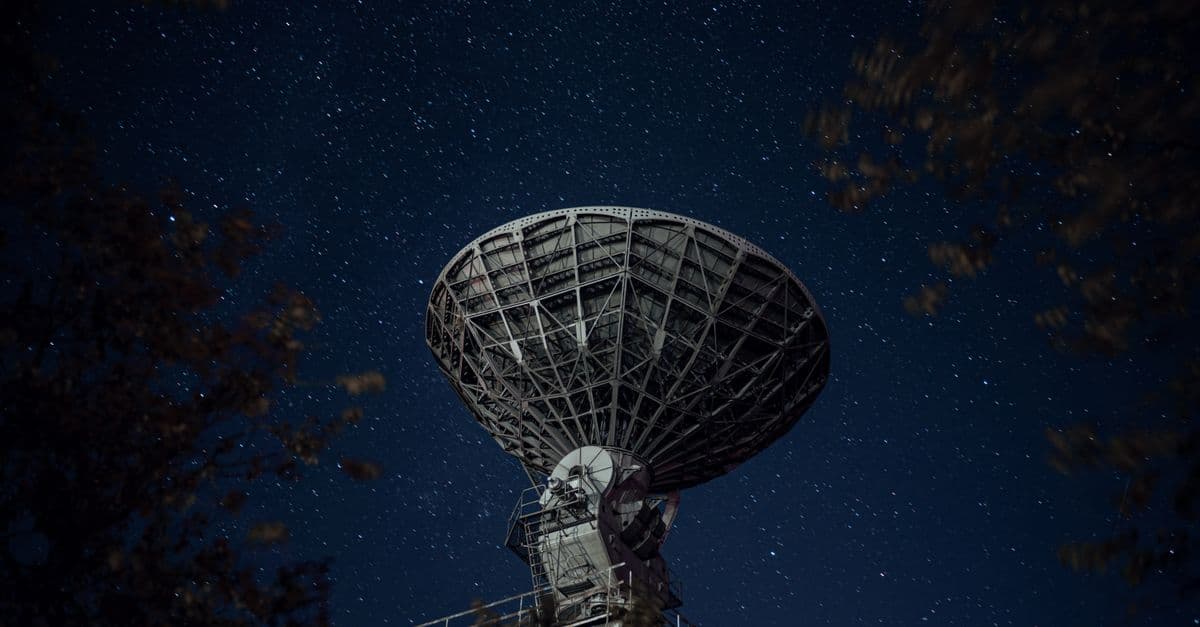
Photo: Krishna Mantripragada / Pexels
In 1964, Arno Penzias and Robert Wilson were trying to eliminate noise from a radio antenna at Bell Laboratories in Holmdel, New Jersey. The noise persisted after they cleaned the instrument, recalibrated their equipment, and evicted a pair of pigeons nesting inside the horn. It came from every direction equally, at the same intensity day and night, in every season. It was not noise. It was the faint afterglow of the universe's formation, a signal that had been traveling for 13.8 billion years. The discovery confirmed the Big Bang model and earned Penzias and Wilson the 1978 Nobel Prize in Physics.
The Two Theories of the Universe
To understand why the discovery mattered, you need to know what the competing cosmological models were in 1964.
The Big Bang model held that the universe began in an extremely hot, dense state roughly 13–14 billion years ago and has been expanding and cooling ever since. This idea grew out of Einstein's general relativity and the 1929 observations by Edwin Hubble that distant galaxies are receding — and receding faster the farther away they are. George Gamow, Ralph Alpher, and Robert Herman developed the quantitative Big Bang model in the late 1940s, including the prediction that the early universe was hot enough to be opaque to radiation, and that the universe would have cooled enough by now that this radiation would be detectable as microwave-wavelength electromagnetic radiation with a temperature of a few Kelvin.
Big Bang model — the cosmological theory that the observable universe originated in a state of extreme density and temperature approximately 13.8 billion years ago and has been expanding ever since.
The Steady State model was the major competing theory in the mid-20th century, developed by Fred Hoyle, Hermann Bondi, and Thomas Gold in 1948. It held that the universe has no beginning and no end — it has always looked roughly the same. As the universe expands and galaxies move apart, new matter is continuously created to fill the gaps, maintaining constant average density. The Steady State model made no prediction of any cosmic background radiation.
The two models made one crucial, distinguishing prediction: the Big Bang model said a background radiation field should exist; the Steady State model said it should not. Finding the background radiation would be a decisive test.
Source: NASA Cosmic Times — "Murmur of a Bang" (imagine.gsfc.nasa.gov/educators/programs/cosmictimes/online_edition/1965/murmur.html)
Source: Britannica — "Cosmic Microwave Background" (britannica.com/science/cosmic-microwave-background)
The Forgotten Prediction
Alpher and Herman's 1948 prediction of the background radiation had a specific quantitative content: based on the observed abundance of helium in the universe and the Big Bang nucleosynthesis model, the relic radiation should have a temperature of approximately 5 Kelvin. This was a published, specific, falsifiable prediction.
The prediction was largely ignored by the radio astronomy community for fifteen years. Partly this was a sociology of science problem — Gamow, Alpher, and Herman were not radio astronomers, and radio astronomers were not following cosmology journals closely. Partly it was a technology problem — the receivers available in the late 1940s and 1950s were not sensitive enough to detect 5 K radiation above their own thermal noise. Partly it was a problem of institutional separation between theorists and experimentalists.
By 1964, a group at Princeton led by Robert Dicke had independently reinvented the prediction. Dicke, Jim Peebles, David Wilkinson, and Peter Roll calculated that a Big Bang relic radiation should exist at approximately 10 Kelvin and began building a receiver on the roof of the Princeton physics building to search for it.
While the Princeton group was building their receiver, Penzias and Wilson had already found the signal — they just did not know what it was.
Source: EBSCO Research Starters — "Penzias and Wilson Discover Cosmic Microwave Background Radiation" (ebsco.com/research-starters/physics/penzias-and-wilson-discover-cosmic-microwave-background-radiation)
Source: arXiv — "Ralph A. Alpher, Robert C. Herman, and the Cosmic Microwave Background Radiation" (researchgate.net/publication/257315887_Ralph_A_Alpher_Robert_C_Herman_and_the_Cosmic_Microwave_Background_Radiation)
The Antenna: Built for Echo Satellites, Repurposed for Discovery
The Holmdel Horn Antenna was built by Bell Telephone Laboratories in 1959 to support the Echo satellite program. The Echo satellites were large, metallic balloon satellites designed to reflect radio signals from one point on Earth to another — an early approach to telecommunications relaying before active relay satellites existed.
The antenna was a 6-meter (20-foot) horn radiometer — a funnel-shaped structure that gathered microwave radiation efficiently while minimizing noise pickup from the warm ground below. Horn antennas are good at rejecting ground radiation because the horn's geometry limits the angle of sky from which the antenna accepts signals. This made the Holmdel antenna unusually clean — a good property for measuring faint cosmic signals, as well as for communications.
By 1963, the Echo satellite program had wound down and Penzias and Wilson had access to the antenna for their own research. They planned to use it to map radio sources in the Milky Way and to calibrate the antenna's sensitivity for future radio astronomy work. To do accurate radio astronomy, you need to know your instrument's noise temperature precisely — how much "noise" the antenna itself contributes to any measurement, as distinguished from the sky signal.
Noise temperature — a way of expressing the thermal noise power produced by a radio receiver, expressed as the temperature of a resistor that would produce the same noise power. Lower noise temperature means a quieter, more sensitive receiver.
The antenna and receiver system had an expected total noise temperature that Penzias and Wilson calculated from the known properties of the components. When they turned the system to the sky and measured the actual noise, they found a persistent excess: about 3.5 Kelvin more noise than they expected. Every direction they pointed the antenna gave the same excess. Removing one potential source of noise after another — the antenna, the cables, the receiver components — made no difference.
Source: Wikipedia — "Discovery of cosmic microwave background radiation" (en.wikipedia.org/wiki/Discovery_of_cosmic_microwave_background_radiation)
The Pigeon Problem and the Systematic Elimination
The story of the pigeons is accurate but often distorted in the telling. A pair of pigeons — what Penzias and Wilson described in their lab notes as "white dielectric material" deposited on the inside of the horn — had taken up residence in the antenna. Penzias and Wilson carefully removed the birds and cleaned the antenna. The dielectric deposit (bird droppings) would slightly increase the antenna's microwave emission. After cleaning, the noise was unchanged. The pigeons were not the source.
Penzias and Wilson worked through the list of candidate explanations systematically.
New York City. Manhattan is visible from Crawford Hill, Holmdel, and its radio-frequency emissions from broadcast stations and radar installations were a real concern. The team tested this by noting that the excess noise was completely isotropic — equally strong in every direction, including away from New York City. City radio noise would be stronger in the direction of the city.
The Milky Way. The galactic plane is a strong radio emitter. But galactic radio emission is concentrated along the galactic plane and has a characteristic spectrum (it is stronger at lower frequencies). The excess was uniform across the sky and had the wrong spectral character for galactic emission.
Nuclear test fallout. Above-ground nuclear weapons tests had been conducted in the early 1960s, and there was some concern that radioactive material in the upper atmosphere might contribute anomalous radiation. Penzias and Wilson checked that the signal did not change over the years following the 1963 Partial Test Ban Treaty, ruling this out.
The receiver itself. They cooled parts of the receiver to check that thermal emission from warm components was not leaking into the measurement. No improvement.
After more than a year of this work, the excess 3.5 K remained stubbornly present. It was not noise. It was signal.
Source: Galileo Physics Course — "Penzias and Wilson's Discovery is One of the Century's Key Advances" (galileo.phys.virginia.edu/classes/USEM/Origin/notes/03/cosmology.html)
The Phone Call That Changed Cosmology
In early 1965, Penzias mentioned the mysterious noise to Bernard Burke of MIT, who was aware of the work being done by Dicke's group at Princeton. Burke told Penzias about Jim Peebles's theoretical prediction — that a Big Bang relic radiation should exist at roughly 10 K, the same order of magnitude as the excess Penzias and Wilson had found.
Penzias phoned Dicke. The Princeton group, in the middle of building a receiver to search for the very signal that Penzias and Wilson had already found, drove to Holmdel to meet with Penzias and Wilson and review the data. The conclusion was rapid and mutual: Penzias and Wilson had found the cosmic microwave background.
In July 1965, the Astrophysical Journal published two papers back to back. The Penzias-Wilson paper was a simple, spare measurement paper: "A Measurement of Excess Antenna Temperature at 4080 Mc/s" — noting the 3.5 K excess and its isotropy without claiming to know what caused it. The Dicke-Peebles-Roll-Wilkinson paper, published alongside it, provided the cosmological interpretation: this was the Big Bang relic radiation.
The deliberate understatement of Penzias and Wilson's paper — stating the observation without the conclusion — is sometimes cited as a model of careful scientific writing. They did not know for certain what they had found. They reported what they had measured.
Source: Springer Nature — "Arno Penzias — Co-discoverer of the cosmic microwave background radiation" (link.springer.com/article/10.1007/s11224-024-02289-2)
What the CMB Actually Is: The Physics of the Afterglow
The cosmic microwave background is electromagnetic radiation — light — that was released approximately 380,000 years after the Big Bang, at the moment the universe cooled enough for electrons and protons to combine into neutral hydrogen atoms.
Before this moment, the universe was a plasma: protons and electrons were separate, and photons (light particles) scattered continuously off the free electrons, unable to travel more than a short distance before being deflected again. The universe was opaque, like the interior of a dense cloud.
When the temperature dropped to about 3,000 K — cool enough for electrons and protons to combine into neutral hydrogen — the scattering stopped. Photons could suddenly travel freely across the universe. This moment is called recombination (a slightly misleading term, since the electrons and protons had never been combined before).
Recombination — the epoch approximately 380,000 years after the Big Bang when the universe cooled enough for protons and electrons to form neutral hydrogen atoms, making the universe transparent to radiation for the first time.
The photons released at recombination had a blackbody spectrum corresponding to a temperature of about 3,000 K. Since then, the universe has expanded by a factor of about 1,100. This expansion stretched the wavelengths of the photons by the same factor, cooling the radiation to its current temperature of approximately 2.725 K. Photons that were visible light at recombination are now microwaves — hence the name "cosmic microwave background."
The CMB is not coming from any particular point in the sky. It comes from every direction because every region of the universe was opaque at recombination and emitted radiation when it became transparent. Looking at the CMB is like standing inside a sphere whose entire inner surface is glowing simultaneously — and that sphere's surface is the recombination epoch, 13.4 billion light-years away in every direction.
Source: University of Oregon Glossary — "Cosmic Microwave Background" (pages.uoregon.edu/jschombe/glossary/cosmic_microwave_background)
A Timeline of the CMB Discovery and Its Legacy
| Year | Event |
|---|---|
| 1927 | Lemaître proposes expanding universe from a "primeval atom" |
| 1929 | Hubble publishes evidence of galaxy recession; expanding universe confirmed |
| 1948 | Gamow, Alpher, Herman develop Big Bang nucleosynthesis; Alpher-Herman predict ~5 K relic radiation |
| 1948 | Hoyle, Bondi, Gold propose Steady State model (no prediction of background radiation) |
| 1959 | Holmdel Horn Antenna built for Echo satellite program |
| 1963–1964 | Penzias and Wilson use antenna for radio astronomy; find 3.5 K excess noise |
| 1964 | Dicke, Peebles, Roll, Wilkinson at Princeton independently reinvent the CMB prediction; begin building receiver |
| Jul 1965 | Back-to-back papers in Astrophysical Journal: Penzias-Wilson measurement + Dicke-Peebles interpretation |
| 1978 | Penzias and Wilson receive Nobel Prize in Physics |
| 1989 | COBE satellite launched; maps CMB temperature across whole sky |
| 1992 | COBE detects temperature fluctuations in CMB at the level of 1 part in 100,000 |
| 2001 | WMAP satellite launched; maps CMB with 35 times better resolution than COBE |
| 2009 | Planck satellite launched; highest-precision CMB map to date |
| 2013 | Planck results: universe is 13.82 billion years old; CMB temperature is 2.7255 K |
Source: NASA — Cosmic Times educational resource (imagine.gsfc.nasa.gov/educators/programs/cosmictimes)
The COBE, WMAP, and Planck Satellites: Reading the Map in Detail
Penzias and Wilson's original measurement was a single number: approximately 3.5 K. Later instruments measured not just the average temperature but its variation across the sky — the temperature fluctuations that encode the seeds of all structure in the universe.
The COBE (Cosmic Background Explorer) satellite, launched in 1989, found that the CMB follows an almost perfect blackbody spectrum — the theoretical curve for thermal radiation from a body at a single temperature. The agreement between the measured CMB spectrum and the theoretical blackbody curve is the best agreement between a theoretical prediction and experimental data in all of physics: the residuals are less than 50 parts per million.
COBE also detected temperature anisotropies — spatial variations in the CMB temperature at the level of about 1 part in 100,000. These tiny fluctuations are the imprints of density fluctuations in the early universe, regions that were slightly denser or slightly less dense than average. Gravity later amplified these fluctuations into the galaxies, galaxy clusters, and cosmic voids we observe today.
The 2006 Nobel Prize in Physics was awarded to John Mather and George Smoot for their work on COBE — a second Nobel specifically for CMB research, thirty years after Penzias and Wilson's first.
Source: NED IPAC — "The Cosmic Microwave Background" by A. Kosowsky (ned.ipac.caltech.edu/level5/Kosowsky2/Kosowsky2.html)
The Planck satellite, launched in 2009 by the European Space Agency, produced the highest-precision CMB map available. Its measurements determined the age of the universe to be 13.82 billion years, the Hubble constant (the current rate of expansion) to be 67.4 km/s/Mpc, and the composition of the universe to be approximately 5% ordinary matter, 27% dark matter, and 68% dark energy. These numbers come directly from fitting models to the pattern of temperature fluctuations in the CMB.
Source: Space.com — "What is the cosmic microwave background?" (space.com/33892-cosmic-microwave-background.html)
What People Get Wrong About the CMB
The most common misconception is that the CMB is coming from the Big Bang itself — from the point where the Big Bang occurred. This is wrong in two ways. First, the Big Bang was not an explosion at a point in space; it was the entire universe expanding from a state of high density and temperature. There is no "center" from which the Big Bang happened. Second, the CMB is not from the Big Bang itself but from 380,000 years after it, when the universe first became transparent.
A second misconception involves what "temperature" means for the CMB. The CMB is not a hot object radiating microwaves at 2.725 K — it is a population of photons whose wavelength distribution (their spectrum) has the same shape as radiation from a blackbody at 2.725 K. The photons themselves have a range of energies; the temperature is a way of characterizing that distribution. A human body would feel no warmth from CMB photons because the energy per photon is extremely small — about 6 × 10⁻⁴ eV, far below the threshold needed to trigger temperature-sensitive nerve receptors.
A third common error is attributing the discovery entirely to Penzias and Wilson while forgetting the Dicke group. Penzias and Wilson made the measurement; Dicke, Peebles, Roll, and Wilkinson provided the interpretation and were simultaneously building the apparatus that would have confirmed the prediction within months had they not been scooped. The Nobel committee's decision to recognize only Penzias and Wilson has been criticized by historians of science who argue that Peebles at minimum deserved shared recognition (though Peebles ultimately received the 2019 Nobel Prize in Physics for "theoretical discoveries in physical cosmology," in part for his CMB and large-scale structure work).
Source: Physics Today — "Correcting the history of the CMB idea" (physicstoday.aip.org/letters/correcting-the-history-of-the-cmb-idea)
The CMB and the Standard Cosmological Model
The CMB discovery did not merely confirm the Big Bang — it provided the data that eventually pinned down every major parameter of the universe's history. The pattern of temperature fluctuations in the CMB is sensitive to the early universe's composition, geometry, and rate of expansion in a way that no other observation matches.
Baryon acoustic oscillations — patterns in the CMB temperature and in the distribution of galaxies, produced by sound waves that propagated through the early universe before recombination. These waves left imprints in the distribution of matter that can be measured today.
The CMB temperature power spectrum — a graph of fluctuation amplitude versus angular scale on the sky — shows a series of peaks and troughs called acoustic peaks. The positions and heights of these peaks encode the universe's geometry (the first peak position tells you whether the universe is spatially flat, open, or closed), the baryon density, the dark matter density, and the dark energy content. Fitting the measured peaks to theoretical predictions gives all the cosmological parameters simultaneously.
The current consensus model — Lambda-CDM (Lambda Cold Dark Matter) — fits the Planck CMB data with extraordinary precision. Lambda refers to the cosmological constant (Einstein's dark energy term) and CDM refers to cold dark matter. The model has only six free parameters and reproduces thousands of measured CMB data points. No competing cosmological model comes close to this performance.
For more on the expansion of the universe that the CMB encodes, see the Hubble 1929 redshift observation. For how modern telescopes probe cosmic structure, see how telescopes work.
FAQs
Q: Why are Penzias and Wilson famous if they did not know what they had found?
A: The measurement itself — a precise, calibrated, isotropic excess radio temperature of 3.5 K — was the contribution. Identifying its cosmological significance was the work of the Dicke group at Princeton, which published simultaneously. Science distinguishes between the observation and its interpretation. Penzias and Wilson made an extraordinarily careful measurement and correctly characterized the signal's properties. That this happened to be the most important cosmological measurement of the 20th century is not diminished by the fact that they needed theorists to tell them what they had found.
Q: Why is the CMB temperature 2.725 K rather than 3,000 K?
A: At the moment of recombination, the CMB photons had a blackbody temperature of about 3,000 K. Since then, the universe has expanded by a factor of approximately 1,100, stretching the wavelengths of the photons by that same factor. When wavelengths are stretched, the photon energies decrease and the effective blackbody temperature decreases proportionally: 3,000 K / 1,100 ≈ 2.7 K. The current measured value is 2.7255 K.
Q: What are the CMB temperature anisotropies and why do they matter?
A: The CMB is not perfectly uniform — it has temperature variations at the level of about 30 microkelvin (roughly 1 part in 100,000). These variations were first detected by COBE in 1992 and mapped in detail by WMAP and Planck. They correspond to density fluctuations in the early universe just before recombination. Regions that were slightly denser collapsed under gravity after recombination to form galaxies, galaxy clusters, and the large-scale structure of the universe. The CMB anisotropies are effectively a photograph of the seeds from which all structure grew.
Q: Why did the Nobel committee award only Penzias and Wilson, not Dicke's group?
A: The Nobel committee cited Penzias and Wilson "for their discovery of cosmic microwave background radiation." The committee may have reasoned that Dicke's group did not actually detect the CMB — they were building a detector when informed by Penzias, and their paper was an interpretation rather than a measurement. Critics of the decision note that Gamow, Alpher, and Herman — who predicted the CMB seventeen years earlier — were also not recognized. Jim Peebles, who was central to the theoretical prediction in 1964, received a Nobel in 2019 for broader contributions to physical cosmology.
Q: Is the CMB visible to the naked eye or to consumer electronics?
A: In a sense. About 1% of the static noise on an analog television tuned between channels comes from the CMB. More precisely, a non-trivial fraction of that static is CMB photons absorbed by the antenna. You cannot separate CMB static from other noise sources without careful calibration, but the photons are genuinely there. They are not visible to the naked eye because the CMB wavelengths (millimeters to centimeters) are in the microwave range, far from the visible spectrum.
Q: How does the CMB support the Big Bang model over alternatives like the Steady State model?
A: The Steady State model predicts no isotropic background radiation, since there is no hot early epoch. The Big Bang model specifically predicts an isotropic, thermal (blackbody) radiation field at a temperature of a few Kelvin. The CMB is exactly that. Furthermore, the CMB spectrum agrees with a blackbody to better than 50 parts per million — requiring that the early universe had sufficient time and high enough photon number density to reach thermal equilibrium, which only a hot Big Bang provides. No Steady State mechanism can produce a blackbody CMB without the equivalent of a Big Bang.
The Takeaway
Penzias and Wilson were not looking for the Big Bang. They were troubleshooting a radio antenna. The signal they could not eliminate — 3.5 K of isotropic excess noise that survived cleaning, recalibration, and pigeon eviction — turned out to be photons that had been traveling through space for 13.4 billion years, released when the universe was 380,000 years old and first became transparent. The discovery converted the Big Bang from a plausible theory with strong circumstantial evidence into the confirmed framework for all of modern cosmology. Every cosmological parameter we know precisely — the age of the universe, the proportions of ordinary matter, dark matter, and dark energy, the geometry of space itself — was measured from detailed analysis of the faint, cold afterglow that two Bell Labs engineers found in a horn antenna they were trying to quiet.
Read next:
Weekly digest
Stay ahead of the curve
Get the best science, AI, and tech stories delivered to your inbox every week. No spam — unsubscribe any time.
About the Author
SciHub101 is an independent science and technology publication founded and edited by Buğra Sözeri, a software engineer and app developer based in Türkiye. Articles are drafted against peer-reviewed literature and primary sources, fact-checked, and edited by a human before publication. Where we compare products, anything built by our own team is labelled as such — see the editorial guidelines and About page for how corrections and disclosures work.
Related Articles
The Davisson-Germer Experiment: Electrons Proven to Be Waves
In 1927, Davisson and Germer fired electrons at a nickel crystal and found a diffraction pattern — direct proof of wave-particle duality. Here is how the experiment worked and what it confirmed.

The Chadwick Neutron Discovery: Finding the Particle That Makes Nuclei Possible
In 1932, James Chadwick proved the neutron exists in just 10 days of experiments using polonium, beryllium, and paraffin wax. Learn exactly how he did it.
The Big Bang Explained — Origin of the Universe
The Big Bang explained: evidence from Hubble's law, the CMB, and primordial element abundances, plus the timeline of cosmic history and the universe's fate.
What Are Fast Radio Bursts? The Universe's Brightest Millisecond Flashes
Fast radio bursts emit as much energy in a few milliseconds as the Sun does in days, yet last only briefly and come from across the universe. Their origin remained hidden for 17 years until a breakthrough discovery revealed that repeating FRBs originate from magnetars.
Jocelyn Bell Burnell: The Astronomer Who Found Pulsars
Jocelyn Bell Burnell discovered pulsars in 1967 as a PhD student. Her Nobel Prize snub became science's most debated injustice. Here is the full story.
The Big Bang: How the Universe Began
What was the Big Bang? Explore the evidence, timeline, and science behind the origin of the universe — from CMB to cosmic inflation.