How Do Radio Telescopes Work? Listening to the Universe at Every Frequency
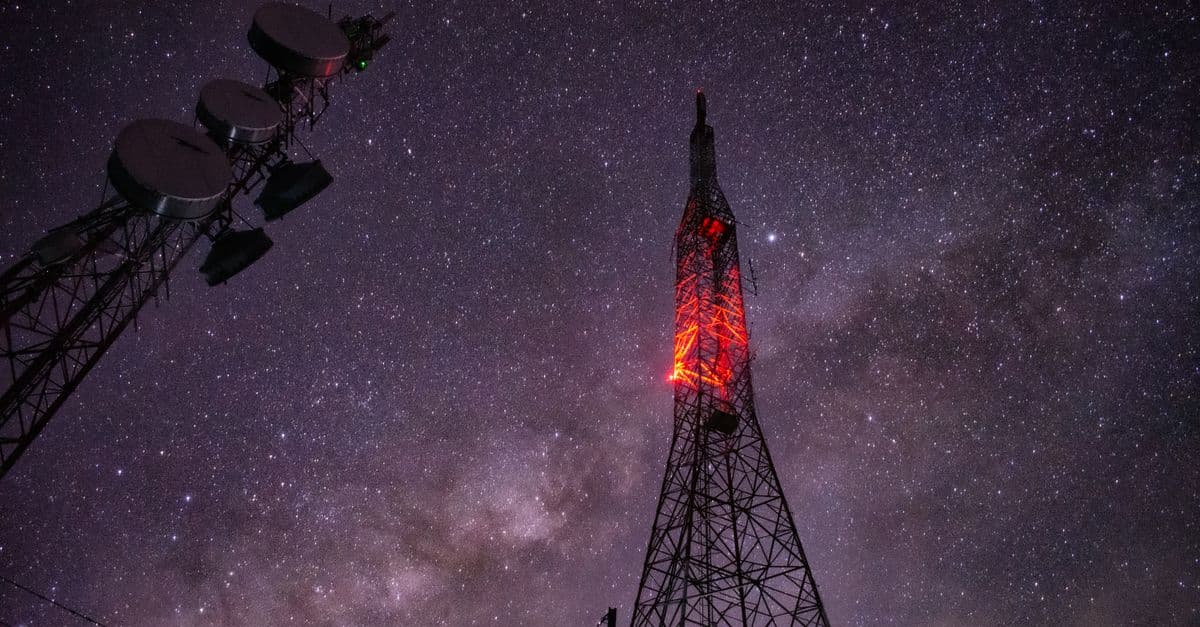
Photo: Juan Martin Gomez / Pexels
In 1932, a Bell Labs engineer named Karl Jansky was trying to identify the source of radio interference affecting transatlantic telephone calls. He built a rotating antenna array and systematically catalogued radio noise sources. He found the expected: static from nearby thunderstorms, distant storms, manmade interference. And he found something unexpected: a steady hiss that peaked once every 23 hours, 56 minutes — a sidereal day, the period of Earth's rotation relative to the stars rather than the Sun. The source was fixed in the sky, rotating overhead daily.
Jansky had discovered radio emission from the centre of the Milky Way. He had accidentally invented radio astronomy — the field that would go on to discover pulsars, quasars, the cosmic microwave background, and provide the strongest evidence yet for the existence of dark matter.
Today's radio telescopes are instruments of extraordinary sensitivity and resolution. Some are single dishes the size of multiple sports stadiums. Others are continent-spanning arrays of small antennas whose signals are combined to achieve resolution better than any optical telescope. Together, they observe the universe across a wavelength range from millimetres to kilometres — revealing phenomena completely invisible to human eyes.
What is radio astronomy?
The electromagnetic spectrum spans a vast range of wavelengths — from gamma rays (wavelength ~10⁻¹² metres) to radio waves (wavelengths from millimetres to kilometres). Human vision occupies a tiny window: visible light from approximately 380 nm (violet) to 700 nm (red).
Radio waves are electromagnetic radiation with wavelengths longer than approximately 1 millimetre. Objects in the universe emit radio waves for many reasons:
- Thermal emission: Any object with temperature above absolute zero emits thermal radiation; very cold objects (like interstellar gas at 10 K) emit primarily in radio wavelengths
- Synchrotron radiation: Electrons spiralling in magnetic fields at near-light speed emit synchrotron radiation — one of the most important radio emission mechanisms in astrophysics
- Spectral lines: Atoms and molecules emit radio waves at specific frequencies when electrons transition between energy states — the hydrogen 21-cm line is the most cosmologically important
- Pulsar emission: Rapidly rotating neutron stars emit beams of radio waves that sweep across Earth like a lighthouse
Radio waves penetrate dust clouds that block optical light — radio astronomy sees through the Milky Way's dust to the galactic centre, and sees through dust clouds surrounding newly forming stars.
The anatomy of a radio telescope
The dish (parabolic reflector)
Most radio telescopes use the same basic principle as optical reflecting telescopes: a parabolic dish that focuses incoming radio waves to a point (the focus), where a detector collects them.
But radio waves present different challenges than optical light:
Wavelength scale: A telescope's angular resolution — its ability to distinguish nearby objects as separate — scales as λ/D, where λ is wavelength and D is dish diameter. Radio waves are millions of times longer than optical light. To achieve the same resolution as a modest optical telescope, a radio telescope must be millions of times larger.
A 1-metre optical telescope resolves objects 0.1 arcseconds apart. To achieve the same resolution at 21 cm (hydrogen line), you'd need a dish approximately 500 kilometres across.
This is why radio telescopes are so large — and why the technique of interferometry (combining multiple telescopes) is so essential.
Surface accuracy: The dish must be smooth on the scale of the observed wavelength. For optical telescopes, surface errors must be nanometres. For radio telescopes, surface errors can be millimetres to centimetres (depending on observed frequency). This makes large radio dishes feasible to construct — metre-thick panels are adequate for metre-wavelength observations.
The feed: At the focus of the dish, a feed antenna collects the focused radio waves. The feed's design is matched to the wavelength range of interest. Common designs include horn antennas (tapered waveguide tubes) and dipole arrays.
The receiver (low-noise amplifier): The collected radio signal is extraordinarily weak — often equivalent to the power of a snowflake falling. Receivers must amplify this signal while adding as little noise as possible. Modern cryogenic receivers are cooled to near absolute zero (4 K) to minimise thermal noise from the electronics themselves. The receiver's sensitivity is limited by quantum mechanics — the quantum noise floor.
Backend processing: The amplified signal is digitised and processed. Modern backends use GPU-based digital spectrometers that split the signal into thousands of frequency channels simultaneously, allowing detailed spectral analysis.
The mount and pointing
Dishes must point accurately at celestial sources and track them as Earth rotates. Two mounting configurations are common:
Equatorial mount: One axis aligned with Earth's rotation axis (polar axis); the other perpendicular. Tracking requires moving only the polar axis at constant rate. Mechanically complex for large dishes.
Azimuth-elevation (alt-az) mount: One axis vertical, one horizontal. Simpler mechanically but requires coordinated movement of both axes for tracking. Almost universal for large modern radio telescopes.
The world's major radio telescopes
FAST — Five-hundred-metre Aperture Spherical Telescope
Located in Guizhou province, China, FAST is the world's largest single-dish radio telescope — a 500-metre dish constructed in a natural karst depression (a sinkhole-shaped valley). Operational since 2016.
FAST is not a fully steerable dish — you can't point it at arbitrary positions. Instead, the spherical reflector is fixed; a moveable receiver platform suspended above the dish at 140 metres height by cables attached to towers on the rim can be positioned to observe sources within ~40° of zenith. The dish illuminated area can be steered by moving the receiver and adjusting the shape of active surface panels.
At 500 metres, FAST collects 2.5 times more radio light than the previous record-holder (Arecibo, 305 metres, which collapsed in 2020). FAST's sensitivity is extraordinary — it has discovered over 900 new pulsars since operation began, detected fast radio bursts with unprecedented precision, and is a central facility in China's SETI (Search for Extraterrestrial Intelligence) programme.
FAST's operating frequencies: 70 MHz to 3 GHz. It can observe hydrogen 21-cm emission, pulsars, and neutral hydrogen surveys of the Milky Way and nearby galaxies with unparalleled sensitivity.
Arecibo (1963–2020)
For 57 years, the Arecibo Observatory in Puerto Rico was the world's largest radio telescope — a 305-metre spherical dish also built into a natural depression. Arecibo made foundational contributions to radio astronomy:
- First pulsar timing studies (timing of pulsar PSR 1913+16 confirmed gravitational wave energy loss — earning Hulse and Taylor the 1993 Nobel Prize)
- Detection of the first extrasolar planet (orbiting a pulsar)
- Arecibo message — the famous 1974 broadcast toward globular cluster M13 as a symbolic SETI transmission
- SETI@home signal analysis
- Radar imaging of asteroids and Venus
Arecibo's cable support structure failed catastrophically in November 2020, dropping the 900-tonne instrument platform onto the dish and destroying it. Reconstruction has been debated but not yet funded.
The Very Large Array (VLA)
Twenty-seven 25-metre dishes arranged in a Y-shaped configuration on the Plains of San Agustín in New Mexico, USA. Each arm of the Y extends 21 km; the dishes can be repositioned on rails to change the array's configuration.
The VLA achieves angular resolution through interferometry — the 27 dishes observe simultaneously, and the signals are combined using the principle of interference. The angular resolution equals that of a single dish with diameter equal to the maximum separation of the antennas — up to 36 km in A-configuration, achieving resolution of 0.04 arcseconds at 7 mm wavelength (comparable to the Hubble Space Telescope in optical).
The VLA is one of the most productive astronomical facilities in history. Famous contributions: first imaging of the radio jets from active galactic nuclei; discovery of Einstein rings (gravitational lensing); detailed imaging of supernova remnants; the first detection of gravitational waves' electromagnetic counterpart (with optical telescopes in 2017 for the neutron star merger GW170817).
The VLA was upgraded to the Karl G. Jansky Very Large Array (ngVLA) — new digital backends dramatically increased bandwidth and sensitivity. Plans for the next-generation VLA (ngVLA) would extend to baselines of 1,000 km and add 244 dishes.
MeerKAT (South Africa)
64 offset Gregorian dishes, each 13.5 metres, located in the Karoo desert of South Africa. MeerKAT is the precursor to the Square Kilometre Array (SKA) South Africa component.
Despite being "only" 64 dishes, MeerKAT has produced some of the most extraordinary radio images ever — particularly of the galactic centre. In 2019, MeerKAT images revealed a complex system of radio-emitting "bubbles" and filaments near the Milky Way's centre, likely produced by past activity of the central black hole Sgr A*.
MeerKAT's sensitivity and wide field of view have made it ideal for pulsar surveys, fast radio burst detection, and 21-cm hydrogen mapping.
VLBI — Very Long Baseline Interferometry
the definitive extension of interferometry is Very Long Baseline Interferometry (VLBI) — combining signals from radio telescopes on different continents (or even on Earth-orbiting satellites) to achieve angular resolutions of milliarcseconds or microarcseconds.
The Event Horizon Telescope (EHT) — the collaboration that produced the first image of a black hole's shadow (M87* in 2019, then Sgr A* in 2022) — used VLBI linking telescopes across four continents, including observatories in Hawaii, Chile, Spain, and the South Pole. At 1.3 mm wavelength, the EHT achieved an angular resolution of approximately 20 microarcseconds — fine enough to read a newspaper in New York from Paris.
Space VLBI: The Japanese VSOP mission (1997–2003, the HALCA satellite) and the RadioAstron mission (Russia, 2011–2019) extended VLBI baselines into Earth orbit — achieving angular resolutions of 7 microarcseconds at some frequencies. RadioAstron used a 10-metre deployable dish aboard a satellite in a highly elliptical orbit (apogee up to 330,000 km), creating baselines 30 times Earth's diameter.
The key science of radio astronomy
The 21-cm hydrogen line
The most cosmologically important radio spectral line is the 21-cm line (1,420.405 MHz) — emitted when the single electron in a hydrogen atom "flips" from a spin-parallel to spin-antiparallel orientation relative to the proton.
This transition is extraordinarily rare — an average hydrogen atom in space waits 11 million years between emissions. But hydrogen is so abundant in the universe that the cumulative emission is detectable across intergalactic distances.
The 21-cm line allows radio astronomers to:
- Map neutral hydrogen in the Milky Way — revealing the spiral arm structure that optical astronomers can't see through dust
- Measure galactic rotation curves — the Doppler shift of 21-cm emission reveals how fast gas at different distances rotates, providing the evidence for dark matter that explains why outer galactic regions rotate too fast for the visible mass
- Map cosmic large-scale structure — hydrogen in distant galaxies, detected via 21-cm at redshifted frequencies, traces the cosmic web
- Study the Epoch of Reionisation — the 21-cm line from neutral hydrogen in the very early universe (redshifted to metre wavelengths) is a window into the first billion years of cosmic history
Pulsars
Pulsars — rapidly rotating neutron stars emitting radio beams — were discovered by radio telescope in 1967 (Jocelyn Bell Burnell and Antony Hewish, Cambridge). They are among the most precisely timed objects in the universe.
Radio telescope timing of pulsar pulses has produced:
- The first indirect evidence for gravitational waves (Hulse-Taylor binary pulsar — Nobel 1993)
- Tests of general relativity in strong gravitational fields
- The most precise measurements of neutron star masses
- Pulsar Timing Arrays (PTAs) — networks of millisecond pulsars used as a galactic gravitational wave detector. In 2023, multiple PTA collaborations announced evidence for a gravitational wave background — the accumulated gravitational wave noise from supermassive black hole binaries throughout the universe — detected as correlated timing residuals in dozens of pulsars.
Fast Radio Bursts (FRBs)
Fast Radio Bursts — millisecond-duration radio flashes of extraordinary intensity — were discovered in 2007 by Duncan Lorimer in archival Parkes Telescope data. They appear to be extragalactic — their signals are dispersed (lower frequencies arrive later than higher frequencies) in a way consistent with travel through enormous amounts of plasma, implying distances of billions of light-years.
FRBs release in milliseconds the energy the Sun emits in days to months. Their origin is still being investigated — the leading model is that most are produced by magnetars (highly magnetised neutron stars). A magnetar in our galaxy (SGR 1935+2154) produced an FRB detected in 2020, confirming the magnetar connection.
FAST has detected more FRBs than all other telescopes combined, including the first periodic repeating FRB (FRB 180916, which repeats on a 16.35-day cycle).
SETI: The search for artificial signals
Radio telescopes are the primary tool for the Search for Extraterrestrial Intelligence (SETI). The rationale: if other civilisations exist and transmit radio signals, we could detect them with radio telescopes.
The hydrogen line at 1,420 MHz is considered a natural channel for SETI — it's a universal frequency known to any civilisation with radio technology, in a quiet part of the spectrum bounded by the "cosmic noise" of hydrogen and hydroxyl emission (the "water hole" from 1,420 to 1,720 MHz).
The WOW! Signal (1977): The most famous candidate SETI signal — a narrowband signal at 1,420 MHz detected for 72 seconds by Jerry Ehman at the Big Ear Radio Observatory. Ehman wrote "Wow!" in the margin of the computer printout. The signal has never been detected again. It remains unexplained.
Breakthrough Listen: The most comprehensive modern SETI programme — $100 million, 10-year initiative announced by Yuri Milner and Stephen Hawking in 2015. Uses FAST, MeerKAT, Parkes, and other telescopes. Has analysed petabytes of data without confirmed detection of artificial signals.
The next generation: SKA
The Square Kilometre Array (SKA) — an international project building the world's most powerful radio telescope — represents the next leap in radio astronomy capability.
SKA-Low (in Western Australia): 512 stations each containing 256 individual antennas, operating 50–350 MHz. Will observe the Epoch of Reionisation — the period when the first stars ionised the universe's neutral hydrogen.
SKA-Mid (in South Africa): 197 dishes, each 15 metres, combined with 64 existing MeerKAT dishes. Operating 350 MHz to 15 GHz. Will conduct the deepest hydrogen surveys, observe pulsars with unprecedented sensitivity, and search for biosignatures.
The SKA's combined collecting area will be approximately 1 square kilometre — 10 times FAST's collecting area. Its sensitivity will enable detecting an airport radar on a planet 2 light-years away (within range of any star system within 2 light-years — which means the Alpha Centauri system).
The invisible universe made visible
Radio astronomy revealed a universe undetectable by naked human senses — pulsars, quasars, cosmic background radiation, hydrogen bridges between galaxies, the hot gas filling galaxy clusters, and the first images of black holes. The 21-cm hydrogen line showed that the Milky Way is a spiral galaxy and that galaxies rotate too fast for their visible mass — introducing dark matter not as a theoretical construct but as an observational necessity.
From Karl Jansky's rotating antenna in a New Jersey field to FAST's 500-metre depression in the Chinese karst, the 90-year history of radio astronomy has been a continuous expansion of what we can perceive. The universe speaks in frequencies far beyond human hearing — radio telescopes are our ears.
Related Reading
- The James Webb Space Telescope Explained
- Gravitational Waves Explained
- What Are Neutron Stars?
- The Fermi Paradox: Where Is Everybody?
- What Are Quasars?
Weekly digest
Stay ahead of the curve
Get the best science, AI, and tech stories delivered to your inbox every week. No spam — unsubscribe any time.
About the Author
SciHub101 is an independent science and technology publication founded and edited by Buğra Sözeri, a software engineer and app developer based in Türkiye. Articles are drafted against peer-reviewed literature and primary sources, fact-checked, and edited by a human before publication. Where we compare products, anything built by our own team is labelled as such — see the editorial guidelines and About page for how corrections and disclosures work.
Related Articles
What Is the Oort Cloud? The Solar System's Outer Shell We've Never Seen
The Oort Cloud is a vast spherical shell of icy bodies surrounding the solar system at distances up to 100,000 AU from the Sun — nearly two light-years away. No spacecraft has ever reached it. It is the source of long-period comets like Hale-Bopp, and may contain trillions of icy objects totalling several Earth masses.
What Is a Binary Star System? When Two Suns Orbit Each Other
More than half of all Sun-like stars exist in binary or multiple-star systems — orbiting a companion star. Binary stars are responsible for Type Ia supernovae, millisecond pulsars, and some of the most extreme objects in the universe. Alpha Centauri — the nearest star system — is a triple star.
The Wow Signal 1977: 72 Seconds That Still Haunt Astronomy
On August 15, 1977, a radio telescope in Ohio detected a signal so precisely matched to the expected frequency of extraterrestrial contact that the astronomer who found it circled it in red ink and wrote one word. The signal never repeated. Nearly five decades later, astronomers still cannot fully agree on what caused it.
Machine Learning and Radio Telescopes: The AI Hunt for Alien Signals
From the MeerKAT array to Breakthrough Listen, machine learning is transforming how radio telescopes search for extraterrestrial intelligence — and strange cosmic phenomena.
Hubble Space Telescope: The Discoveries That Changed Astronomy
Hubble launched with a flawed mirror and came back from the brink to become humanity's greatest eye on the cosmos.
Chandra X-Ray Observatory: Revealing the High-Energy Universe
Since 1999, Chandra has mapped X-rays from black holes, neutron stars, and galaxy clusters, transforming understanding of the universe's most violent phenomena.