The First Image of a Black Hole
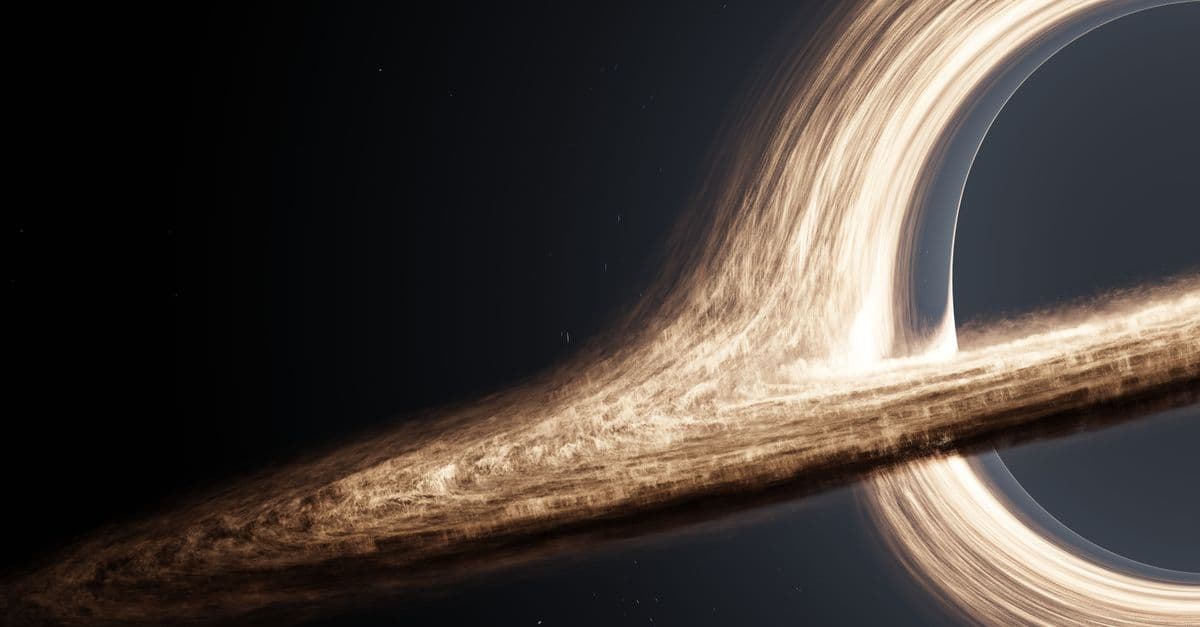
Photo: Adis Resic / Pexels
On April 10, 2019, a team of more than 200 scientists released a blurry orange ring and called it the first picture of a black hole. It was not a photograph in the normal sense. No camera pointed at the object at the center of the galaxy Messier 87, some 55 million light-years from Earth. Instead, eight radio telescopes scattered from Hawaii to the South Pole spent years turning a planet's worth of dishes into a single virtual instrument roughly the size of Earth itself. What they produced was not a picture of a black hole so much as a picture of the black hole's shadow, and understanding the difference explains almost everything interesting about how the experiment worked.
What the Event Horizon Telescope actually captured
A black hole, by definition, emits no light. Nothing crosses the event horizon and comes back out, which is why calling this experiment a "photograph of a black hole" is technically imprecise, even though it is the phrase that stuck. What the Event Horizon Telescope (EHT) collaboration actually imaged was the glowing ring of superheated gas and radiation swirling just outside the event horizon, silhouetted by the black hole's dark shadow at the center (Event Horizon Telescope press release, April 10, 2019).
The target was the supermassive black hole at the heart of M87, a giant elliptical galaxy. According to the EHT collaboration's own published results, that black hole is about 6.5 billion times the mass of the Sun, and the resulting ring in the image measures roughly 40 microarcseconds across (First M87 Event Horizon Telescope Results I: The Shadow of the Supermassive Black Hole, Astrophysical Journal Letters, 2019). A microarcsecond is an almost unusable unit of angle for everyday life. To make it concrete: 40 microarcseconds is roughly the angular size of a doughnut sitting on the surface of the Moon, viewed from Earth. Resolving something that small is the entire reason the experiment had to be so strange.
Three years later, on May 12, 2022, the same collaboration released a second image: Sagittarius A*, the supermassive black hole at the center of our own Milky Way. It is far closer, about 27,000 light-years away, but also far smaller, at roughly 4 million solar masses (Event Horizon Telescope blog, "Astronomers Reveal First Image of the Black Hole at the Heart of Our Galaxy"). Smaller mass and closer distance happened to cancel out almost perfectly, which is why Sagittarius A* appears roughly the same apparent size in the sky as M87's black hole, despite the two objects differing in mass by a factor of more than 1,500.
Why you need a telescope the size of a planet
A telescope's ability to resolve fine detail, its angular resolution, depends on two things: the wavelength of light it observes and the diameter of its mirror or dish. Bigger dish, sharper image. This is the same principle that makes a wide-aperture camera lens better at capturing distant detail than a phone camera, just scaled up by billions.
The problem is that no single dish on Earth, and arguably no single dish that could ever be built, is large enough to resolve 40 microarcseconds at radio wavelengths. Even the 100-meter Green Bank Telescope, one of the largest steerable dishes on the planet, falls dramatically short on its own. So the EHT team did not build a bigger dish. They built a bigger array, and used a technique called very-long-baseline interferometry, or VLBI, to make many separate telescopes act as one.
Think of VLBI like clapping your hands at two different points in a large room and having a computer figure out, from the tiny difference in when each microphone across the room hears the clap, exactly where in the room you were standing. Each radio telescope in the EHT array is a microphone. Instead of sound, they capture radio waves from the black hole's surroundings, and instead of one clap, they record continuously for hours. A supercomputer later combines every telescope's data and works out, from the minuscule timing differences between them, what an Earth-sized dish would have seen (Sky & Telescope, "How Does the Event Horizon Telescope Work?").
That "minuscule timing difference" is the hardest engineering problem in the whole project. The array's effective resolution depends on knowing, to within a fraction of a wavelength, exactly when each photon arrived at each site. Radio waves at the EHT's observing wavelength of 1.3 millimeters travel one wavelength in about 4 picoseconds, four trillionths of a second. To make the math work, every telescope station in the array carries its own hydrogen maser atomic clock, a device accurate enough that it will not lose or gain a full second in roughly 10 million years (Sky & Telescope, VLBI explainer).
How does very-long-baseline interferometry work?
VLBI links radio telescopes that are thousands of kilometers apart so their combined data behaves like one giant dish. Each site records incoming radio signals with an atomic-clock-stamped timestamp; supercomputers later correlate every pair of signals, using the tiny timing offsets between distant sites to reconstruct fine angular detail no single telescope could resolve alone.
Which telescopes made up the Event Horizon Telescope array?
For the 2017 observing campaign that produced the M87 image, the EHT array combined eight facilities: the Atacama Large Millimeter Array and the Atacama Pathfinder Experiment in Chile, the IRAM 30-meter telescope in Spain, the James Clerk Maxwell Telescope and Submillimeter Array in Hawaii, the Large Millimeter Telescope in Mexico, the Submillimeter Telescope in Arizona, and the South Pole Telescope in Antarctica (First M87 EHT Results II: Array and Instrumentation, ApJL 2019).
How raw radio static became a picture
Capturing the signal was only half the problem. Each station's dish recorded roughly 350 terabytes of data per day of observing, in April 2017, across four nights, at multiple sites (NSF media toolkit). Altogether the campaign generated an estimated 4 petabytes of raw data, so much that flying hard drives on commercial jets to the correlation centers, at MIT Haystack Observatory in Massachusetts and the Max Planck Institute for Radio Astronomy in Germany, was faster than sending it over any available network connection. One shipment from the South Pole Telescope was delayed for months simply because winter flights out of Antarctica do not run year-round.
Once correlated, the data still was not an image. It was a sparse, noisy set of measurements, akin to having only a few dozen scattered brushstrokes and needing to infer the full painting behind them. Turning that sparse data into a picture is a mathematically underdetermined problem: many different images can technically fit the same limited measurements. To handle this, the collaboration did not rely on a single reconstruction method. Four independent teams, working with different algorithms and without comparing notes, each produced their own image reconstruction from the same raw dataset. One widely known method used in this process, CHIRP (Continuous High-resolution Image Reconstruction using Patch priors), was developed by then-MIT graduate student Katie Bouman and applies machine-learning-style "patch prior" techniques, essentially statistical assumptions about what realistic astronomical images tend to look like, to fill in the gaps between sparse measurements (Phys.org, "Scientist superstar Katie Bouman designed algorithm for black hole image"; University of Michigan ECE profile of Bouman's talk).
The four independent teams reconvened after roughly a month of blind, separate work. When they compared results, all four had converged on the same asymmetric ring, brighter on the southern side than the northern side, a strong sign the reconstruction was capturing something real rather than an artifact of any one algorithm's assumptions (First M87 EHT Results IV: Imaging the Central Supermassive Black Hole, ApJL 2019). That brightness asymmetry itself carries physical meaning: it is consistent with gas orbiting the black hole at relativistic speed, with the side moving toward Earth appearing brighter due to an effect called relativistic beaming.
Why the result mattered
The EHT image did more than confirm that black holes exist, which physicists already considered settled based on decades of indirect evidence, including the orbital motion of stars near the Milky Way's center and the gravitational-wave detections from LIGO starting in 2015. What the image added was a direct visual test of general relativity in the most extreme gravitational environment humans have ever probed.
Albert Einstein's 1915 field equations predict a specific shape and size for the shadow a black hole should cast, given its mass and distance. The ring's measured diameter of about 40 microarcseconds for M87's black hole matched that prediction closely, providing what the collaboration itself described as strong evidence supporting general relativity in this new, extreme regime (ESO press release, "Astronomers Capture First Image of a Black Hole," April 2019). Every previous test of general relativity, from Mercury's orbital precession to gravitational lensing during the 1919 solar eclipse to LIGO's gravitational-wave chirps, tested the theory in a different regime. This was the first time anyone tested it by literally looking at the boundary of a black hole's shadow.
The achievement was recognized quickly and broadly. The journal Science named the image its 2019 Breakthrough of the Year (AAAS, "Science's 2019 Breakthrough: First Image of Supermassive Black Hole"), and the EHT collaboration won the 2020 Breakthrough Prize in Fundamental Physics, one of the most valuable science prizes in the world.
There is a second, subtler kind of significance too. The 2022 Sagittarius A* image let researchers compare two black holes that differ enormously in mass and environment, sitting in different types of galaxies, yet whose shadows look remarkably similar once scaled for size and distance. That similarity is itself a prediction of general relativity: black hole shadows should look alike regardless of the black hole's mass, because the underlying physics of how gravity bends light near the event horizon does not change with scale. Confirming that prediction across two very different objects strengthened the case that general relativity, rather than some alternative theory of gravity, correctly describes these extreme environments.
What people get wrong about the image
The most common misconception is treating the ring as a literal photograph, the way a picture of the Moon is a photograph. It is a reconstructed image built from radio-wave measurements and statistical inference, not visible light captured on a sensor. That does not make it less real or less rigorous. Every step of the reconstruction was checked against synthetic test data with known "ground truth" images before the team trusted the pipeline with the real observations, and the four-team blind comparison process was designed specifically to catch any algorithm-driven artifacts. But it does mean the image is closer to a scientifically validated inference than a snapshot, and calling it a photograph without that context invites confusion about what VLBI can and cannot do.
A second misconception is that the dark center of the ring is the black hole's actual size. It is not. The dark region is the black hole's "shadow," which is larger than the event horizon itself because light bends around the black hole before reaching the observer. General relativity predicts the shadow should be roughly 2.6 times the diameter of the event horizon for a non-rotating black hole, a magnification effect caused entirely by gravitational lensing. The ring of light surrounding the shadow is not the edge of the black hole either. It is superheated plasma in the accretion disk and surrounding corona, glowing at millions of degrees as it spirals inward, some of it moving at a substantial fraction of the speed of light.
A third common error is assuming the image shows what M87's black hole looks like "right now." Because M87 is 55 million light-years away, the light captured in April 2017 left that galaxy roughly 55 million years ago, well before humans existed. The image is a snapshot of the black hole's environment in the deep past, not the present.
Finally, some readers assume any black hole could eventually be imaged this way. In practice, only black holes that are both extremely massive and relatively close, so their event horizon subtends a large enough angle in the sky, are candidates. M87* and Sagittarius A* were chosen specifically because they offered the two largest apparent shadow sizes visible from Earth, even though M87's black hole is over a thousand times more massive, its far greater distance shrinks its apparent size back down to a comparable scale. Stellar-mass black holes, the far more common kind formed from collapsed stars, are simply too small and too distant for any current or foreseeable VLBI array to resolve.
Limits, controversies, and what comes next
No experiment of this scale escapes methodological scrutiny, and the EHT collaboration invited plenty of it by publishing extensive technical papers alongside the headline image. One legitimate limitation is sparse coverage: with only eight sites in 2017, the array sampled a small fraction of the possible "baselines," the virtual dish's surface, compared to what a literal Earth-sized telescope would capture continuously. That sparsity is precisely why the image-reconstruction algorithms, and the choice to run four independent teams blind to one another's results, mattered so much to the credibility of the final image.
A second limitation is time resolution versus mass. Sagittarius A* is small enough, and its surrounding gas moves fast enough, that its appearance can change meaningfully within minutes, faster than the hours-long observing windows used to build up the image. The EHT team had to develop new methods specifically to average out this variability without blurring away real structure, a technical challenge that did not apply to the more slowly evolving, more massive M87 system (Event Horizon Telescope Sgr A* results, NSF release, May 2022).
The array has also expanded since 2017. Additional telescopes, including in Greenland, France, and Arizona's Kitt Peak, have since joined observing campaigns, and the collaboration has published follow-up polarization studies of the M87 ring's magnetic field structure, which offer clues about how the black hole launches its enormous relativistic jet, a separate, even more energetic phenomenon extending thousands of light-years beyond the galaxy (First M87 EHT Results VII: Polarization of the Ring, ApJL 2021). The long-term goal for the collaboration is a black hole "movie," capturing how the shadow and surrounding gas evolve over time rather than a single static frame, which would require a denser array and faster data-processing pipelines than existed in 2017 or 2022.
The Event Horizon Telescope, at a glance
| Category | M87* (2019 image) | Sagittarius A* (2022 image) |
|---|---|---|
| Location | Center of galaxy Messier 87 | Center of the Milky Way |
| Distance from Earth | ~55 million light-years | ~27,000 light-years |
| Mass | ~6.5 billion solar masses | ~4 million solar masses |
| Announcement date | April 10, 2019 | May 12, 2022 |
| Observation campaign | April 2017 | April 2017 |
| Raw data volume | ~4 petabytes across the campaign | Part of the same 2017 dataset |
| Key challenge | Sparse angular coverage from 8 sites | Rapid gas variability within minutes |
| Recognized as | Science's 2019 Breakthrough of the Year | Confirmed general relativity across a second, very different black hole |
Table: Key facts comparing the Event Horizon Telescope's two headline black hole images, sourced from EHT collaboration press materials and peer-reviewed results papers.
The takeaway
The first image of a black hole was never really a photograph. It was a triumph of turning Earth itself into a measuring instrument, synchronizing atomic clocks to trillionths of a second, shipping petabytes of data on airplanes, and reconstructing a picture from mathematically incomplete evidence using four independently developed algorithms that had to agree before anyone trusted the result. The ring of light in that image is not the black hole. It is the glowing evidence of one, bent and shaped by gravity exactly as Einstein's century-old equations predicted. That agreement between prediction and observation, tested twice now on two wildly different black holes, is the real result. The picture is just the part people remember.
Read next:
- The Double-Slit Experiment: How Light Proved the Universe Is Weird
- Black Holes Explained: How They Work
- Quantum Mechanics Foundations Explained
Frequently Asked Questions
Q: What was the first image of a black hole actually a picture of? A: It was a picture of the glowing ring of superheated gas and light bent around the black hole's shadow, not the black hole itself. Black holes emit no light, so the dark central region is the shadow cast against the bright ring of surrounding material.
Q: Which black hole was imaged first, and when? A: The supermassive black hole at the center of galaxy M87 was imaged first, with the result announced on April 10, 2019, by the Event Horizon Telescope collaboration.
Q: How does very-long-baseline interferometry let telescopes act as one giant dish? A: Each telescope records radio signals with an atomic-clock timestamp accurate to trillionths of a second. Supercomputers later combine every station's data, using the tiny timing differences between distant sites to reconstruct detail that no single dish could resolve alone.
Q: Why did it take so long to process the data into an image? A: The 2017 observing campaign generated roughly 4 petabytes of data, too much to transfer over any network, so hard drives were physically flown to processing centers. Reconstructing an image from sparse measurements also required four independent teams working separately for about a month before comparing results.
Q: Is the black hole image a real photograph or a computer-generated reconstruction? A: It is a scientifically validated reconstruction built from radio-wave measurements, not a photograph captured by a lens and sensor. The reconstruction methods were tested extensively against synthetic data with known answers before being applied to real observations.
Q: How big does a black hole's shadow appear compared to its event horizon? A: General relativity predicts a non-rotating black hole's shadow should appear roughly 2.6 times larger than its actual event horizon, because light bends around the black hole before reaching the observer. That magnification effect is why the dark region in the image is larger than the black hole itself.
Q: What is the difference between the M87 black hole and Sagittarius A?* A: M87's black hole is about 6.5 billion solar masses and 55 million light-years away, while Sagittarius A*, at the Milky Way's center, is about 4 million solar masses and 27,000 light-years away. Their vastly different masses and distances happen to produce a similar apparent size in Earth's sky.
Q: Why couldn't scientists just build one giant telescope instead? A: A single dish large enough to resolve the needed angular detail, tens of microarcseconds, would need to be roughly the size of Earth, which is not physically buildable. Linking existing telescopes across the globe with very-long-baseline interferometry achieves the same effective resolution without one impossible structure.
Q: Did the black hole image prove Einstein's theory of general relativity? A: It did not prove general relativity in an absolute sense, since no single experiment does that, but it provided the first direct visual test of the theory's predictions for extreme gravity near an event horizon, and the measured shadow size matched those predictions closely.
Q: Can every black hole eventually be imaged this way? A: No. Only black holes that are both extremely massive and comparatively close, so their shadow subtends a large enough angle in the sky, are realistic targets. Far smaller stellar-mass black holes, the most common type, remain too small and distant for current very-long-baseline interferometry arrays to resolve.
Sources
- Event Horizon Telescope, Press Release: "Astronomers Capture First Image of a Black Hole" (April 10, 2019)
- First M87 Event Horizon Telescope Results I: The Shadow of the Supermassive Black Hole, Astrophysical Journal Letters (2019)
- First M87 Event Horizon Telescope Results II: Array and Instrumentation, Astrophysical Journal Letters (2019)
- First M87 Event Horizon Telescope Results IV: Imaging the Central Supermassive Black Hole, Astrophysical Journal Letters (2019)
- First M87 Event Horizon Telescope Results VII: Polarization of the Ring, Astrophysical Journal Letters (2021)
- European Southern Observatory, "Astronomers Capture First Image of a Black Hole" (April 2019)
- AAAS, "Science's 2019 Breakthrough: First Image of Supermassive Black Hole"
- Event Horizon Telescope, "Astronomers Reveal First Image of the Black Hole at the Heart of Our Galaxy" (2022)
- U.S. National Science Foundation, "We got it! Astronomers reveal first image of the black hole at the heart of our galaxy"
- U.S. National Science Foundation, Event Horizon Telescope media toolkit
- Sky & Telescope, "How Does the Event Horizon Telescope Work?"
- Phys.org, "Scientist superstar Katie Bouman designed algorithm for black hole image"
- University of Michigan ECE, "Katie Bouman wows U-M community with insider's look at the black hole imaging project"
Follow new articles
Add SciHub101 to your feed reader to see new science and technology stories.
About the Author
SciHub101 is an independent science and technology publication founded and edited by Buğra Sözeri, a software engineer and app developer based in Türkiye. AI tools assist with drafting and research. Source documentation in the existing archive is uneven, and articles are being reviewed and corrected. The Editorial Team byline identifies editorial responsibility; it does not certify specialist or independent human review. Where we compare products, anything built by our own team is labelled as such — see the editorial guidelines and About page for how corrections and disclosures work.
Related Articles
The First Nuclear Reactor: Chicago Pile-1
Chicago Pile-1 achieved the first controlled nuclear chain reaction. This guide explains the graphite, uranium, control rods, and risk.

The First Gravitational Wave Detection
LIGO's first gravitational-wave detection confirmed a century-old prediction of general relativity and opened a new way to observe the universe.
Why Do Stars Twinkle? The Science of Atmospheric Seeing
Stars twinkle because Earth's turbulent atmosphere bends starlight in constantly shifting ways. Because stars are infinitely distant, they act as point sources, so even tiny bends in light rays cause dramatic brightness and color flickers. Planets, being much closer, show a small disk that averages out the jitter. Twinkling is worst near the horizon and is why the best observatories sit on mountaintops or in orbit.
Why Do We Have Seasons? The Science of Earth's Tilt
Earth's 23.5-degree axial tilt, not its elliptical orbit, is why we have seasons. The tilt means each hemisphere receives more direct sunlight and longer daylight hours for part of the year (summer), then less direct light and shorter days for another part (winter). The two hemispheres always experience opposite seasons simultaneously. Solstices and equinoxes mark the extremes and midpoints of this tilt cycle.
Why Does the Moon Have Phases? The Science Explained
Half the Moon is always sunlit; phases are how much of that lit half we see as the Moon orbits Earth. The synodic month lasts 29.5 days, moving through new, crescent, quarter, gibbous, and full phases. Phases are NOT Earth's shadow—that's an eclipse. The Moon always shows us the same near side due to tidal locking, a gravitational dance between Earth and Moon.

Why Is Mars Red? The Science of the Red Planet
Mars looks red because iron in its dust and surface rocks has oxidized into rust-colored minerals. A 2025 study argues the main pigment is ferrihydrite, a water-bearing iron mineral, and that planet-wide winds spread the fine powder that gives Mars its color.