Why Is Mars Red? The Science of the Red Planet

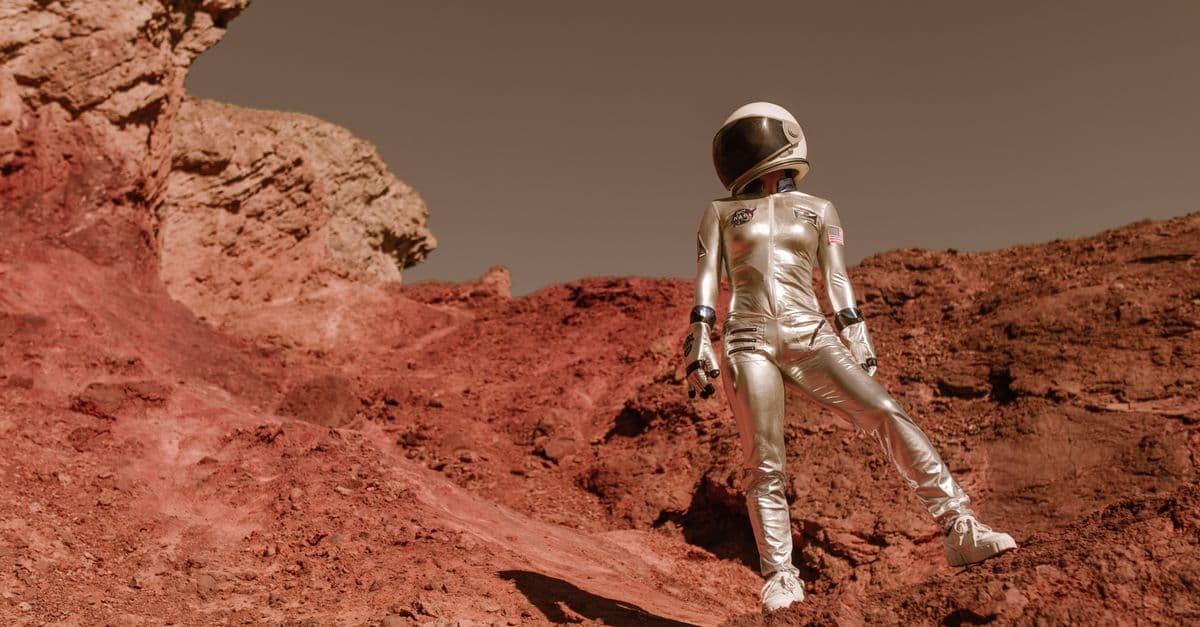
Photo: RDNE Stock project / Pexels
Mars looks red because iron in its dust and surface rocks has rusted. Iron-bearing minerals reacted with oxidants, possibly with the help of liquid water long ago, and produced iron oxides that tint the fine powder blanketing the planet. A February 2025 study in Nature Communications argues that the main pigment is ferrihydrite, a water-bearing iron mineral, rather than the hematite long assumed. This article explains which minerals do the coloring, how dust storms spread the pigment, and why the rocks underneath stay dark.
Mars is rusty, but not the way a nail is
NASA's short answer is that iron minerals in the Martian dirt oxidize, or rust (NASA, Mars facts). That one sentence hides a lot of chemistry. On Earth, rusting usually means metallic iron meeting oxygen and water. On Mars, nearly all the iron sits inside volcanic minerals such as olivine and pyroxene, the dark crystals that make up basalt. When those crystals weather, the iron loses electrons and becomes ferric iron (iron with a 3+ charge), which forms the red-brown and yellow-brown minerals we call rust.
A better comparison than a nail left in the rain is a copper roof that turns green. The color is a thin chemical skin on the outside of something darker. Beneath the surface coating, many Martian rocks are dark gray basalt, the same family of volcanic rock that makes up the Hawaiian islands and the Moon's dark maria. The red is a coat of paint, not the color of the planet's bones.
The coat is thin but the planet is dusty. Mars has a radius of 3,390 kilometers, roughly half Earth's, and the same winds that move sand around its surface also lift the finest grains high into the sky and carry them around the globe. That is why the whole disk looks rusty through a telescope even where the bedrock underneath is dark. For a wider tour of the planet, see Mars Explained: Geology, Water, Atmosphere, and the Challenge of Colonization.
Which iron minerals color Mars?
Several iron-bearing minerals contribute, and they do not all look the same. The table below summarizes the ones that matter most for color, with the spacecraft that identified each.
| Mineral | Chemistry | Typical color | Where it shows up on Mars |
|---|---|---|---|
| Hematite | Fe₂O₃ (ferric oxide) | Red when very fine-grained, gray to black when coarse | Orbital maps of Meridiani Planum, the "blueberry" spherules found by Opportunity in 2004, Vera Rubin Ridge in Gale Crater |
| Goethite | FeO(OH) (iron oxyhydroxide) | Yellow-brown | One of the leading candidates for the nanophase ferric oxide in Pathfinder's soil spectra |
| Ferrihydrite | Poorly crystalline, water-bearing iron oxyhydroxide | Reddish brown | Proposed in 2025 as the main pigment of global dust |
| Magnetite | Fe₃O₄ | Black, strongly magnetic | Part of the airborne dust captured by magnets on the Mars Exploration Rovers |
Sources: NASA/JPL, March 2004; Fraeman et al., 2020, Journal of Geophysical Research: Planets; USGS, Mars Pathfinder soil and dust results; USGS, Mars Exploration Rover magnet experiments.
Most of these minerals are ferric, meaning the iron has already been oxidized and has no strong chemical urge to change further. That stability is why the color lasts. A Martian surface that has been rusting for billions of years is not about to rust back to gray.
Mars-orbiting spectrometers and rover instruments identify these minerals by the way each one absorbs light. Every mineral has a spectral fingerprint, a pattern of dips in the infrared and visible spectrum caused by how its atoms vibrate and how its electrons move. The technique is the same one astronomers use on stars, explained in What Is Spectroscopy? How Light Reveals Everything About the Universe.
Why grain size changes the color
The same mineral can look completely different depending on how finely it is ground. The Curiosity team put numbers on this for hematite at Vera Rubin Ridge: red hematite has fine grains, from roughly 10 to 100 nanometers up to about 3 to 5 micrometers, while gray hematite has coarser grains above that range and appears gray to black (Fraeman et al., 2020). One chemical formula, two colors, and the difference is only the size of the crystals.
A familiar parallel is a brick. A whole brick is a dull brownish lump. Grind it into powder and the powder looks brighter and more orange-red, because the light now bounces off millions of tiny surfaces instead of one big one. Martian dust is the powder and many Martian rocks are the brick.
NASA describes the dust that storms lift as particles about the size of talcum powder grains (NASA, June 20, 2018). At that size, grains are small enough to ride the wind for long distances and fine enough that the iron oxides on and in them dominate the color of the whole pile.
The dust is also a mixture, not a single pigment. The USGS summary of the magnet experiments on the Mars Exploration Rovers found that the strongly magnetic part of the airborne dust looked dark brown to black in rover camera images, while the weakly magnetic part looked bright red. Mössbauer spectra, which identify iron-bearing minerals, showed a mix of magnetite, olivine, pyroxene, and nanophase oxides, with proportions that vary by wind regime and landing site (USGS, Mars Exploration Rover magnetic properties). The global color is the sum of all of it, weighted toward the reddest component.
How the iron got oxidized: two competing stories
The color question splits into a second question: what supplied the oxygen? The thin modern atmosphere is mostly carbon dioxide, with smaller amounts of nitrogen and argon, and almost no free oxygen (NASA, Mars facts). Researchers have offered two broad answers, and they predict different minerals.
Water-driven oxidation. If liquid water moved across the surface, it carried dissolved oxygen and other oxidants to iron-bearing rock, and the iron came out of solution as ferric minerals. Opportunity's hematite spherules are one example. Scientists concluded the "blueberries" are concretions that grew in water-soaked deposits, and Opportunity's Mössbauer spectrometer identified hematite as the major iron-bearing mineral in them. JPL's Daniel Rodionov called it "the fingerprint of hematite" (NASA/JPL, March 18, 2004).
Dry oxidation. In the second story, the rusting happened slowly without much liquid water, as oxidants produced in the thin atmosphere reacted with iron-bearing grains over very long times. Such a process would explain a red planet without requiring a wet early Mars, which is why the question of which mineral dominates the dust matters.
The Viking and Pathfinder landers measured soil that looks similar at distant sites. Pathfinder's alpha proton X-ray spectrometer found soil remarkably similar to the average composition derived from the Viking landers, and its camera spectra fit poorly crystalline or nanophase ferric oxide (USGS, Mars Pathfinder results). That similarity across landing sites is part of why scientists describe Martian dust as globally mixed by wind.
The two stories are not mutually exclusive. The water-driven story can explain rust in specific places, such as lake sediments and ancient groundwater zones. The open question is which process produced the pigment of the global dust, and that is where the 2025 study comes in.
What the 2025 ferrihydrite study actually showed
In February 2025, a team led by Adomas Valantinas, who began the work as a University of Bern PhD student and later moved to Brown University, published a paper in Nature Communications titled "Detection of ferrihydrite in Martian red dust records ancient cold and wet conditions on Mars" (ScienceDaily summary, February 2025). John Mustard of Brown University was senior author.
The team compared light-reflection spectra from several sources. Spectra from orbit came from the Mars Reconnaissance Orbiter, Mars Express, and the Trace Gas Orbiter. Ground-level measurements came from the Curiosity and Opportunity rovers and the Pathfinder lander. In the lab, the researchers ground ferrihydrite and basalt to submicron particle sizes to mimic Martian dust, then compared the lab spectra to the Mars observations. A fine mixture of ferrihydrite and basalt matched the dust better than the hematite-based models that had been standard.
Ferrihydrite is a poorly crystalline iron oxide that holds water in its structure. It forms in water-rich settings. According to the press summary, hematite typically forms under warmer, drier conditions, while ferrihydrite forms in cool water. If ferrihydrite is the main pigment of Martian dust, then the dust records a time when liquid water was around, before the planet shifted to the hyper-arid state we see now.
Valantinas said, "From our analysis, we believe ferrihydrite is everywhere in the dust." Mustard was careful about the limits of the work: the result cannot be confirmed until Mars samples are returned to Earth, and he noted that samples collected by Perseverance could be used to test the hypothesis (ScienceDaily).
That caveat matters. A good fit between spectra and a mixture is strong evidence but not proof, because other mixtures might produce similar spectra and because the instruments see only the top layer of dust. Think of it as identifying a paint color by comparing it to swatches under different lights. If one swatch matches in every light, you have a good candidate, but the only way to be certain is to analyze a chip of the paint in a lab. Perseverance has been sealing rock and regolith samples in tubes, and bringing them back is the lab test this hypothesis is waiting for. For the rover's science goals, see Perseverance Rover: Astrobiology Search on Mars.
| Line of evidence | What it contributes | Limits |
|---|---|---|
| Orbital spectra (MRO, Mars Express, Trace Gas Orbiter) | Global coverage of the dusty surface | Sees only the top layer; dust dominates what the orbiters detect |
| Surface spectra (Curiosity, Opportunity, Pathfinder) | Ground-truth color and mineral signatures at specific sites | A few landing sites out of the whole planet |
| Lab-made ferrihydrite and basalt mixtures | Direct comparison with measured spectra | Lab particles are analogs, not real Martian dust |
| Returned samples (not yet available) | Would allow direct chemical and structural analysis | Depends on a future Mars sample return mission |
How dust storms paint the whole planet
Martian dust does not stay put. The most dramatic mover is the dust storm, and the 2018 global storm is the best documented example. On June 20, 2018, NASA described it as "planet-encircling," having engulfed much of Mars in about two weeks. NASA scientist Scott Guzewich said that if the storm were on Earth, it would cover North America and Russia combined (NASA, June 20, 2018).
The numbers behind that statement are striking. Atmospheric haze is measured with a quantity called tau, an optical depth where higher means less sunlight reaches the ground. At Gale Crater, tau rose above 8.0, the highest Curiosity had ever recorded, and it more than doubled over a single weekend. Over Opportunity's location, tau was last measured near 11, too thick for accurate measurements, and the solar-powered rover suspended science operations because the dust blocked sunlight. NASA said the haze over Curiosity was roughly six to eight times thicker than normal for the season.
Why does this happen? NASA's explanation has several parts:
- Winds driven by surface temperature contrasts pick up dust particles about the size of talcum powder grains.
- Carbon dioxide evaporating from the winter polar cap thickens the atmosphere and raises surface pressure, which helps keep dust suspended.
- Dust clouds can reach about 60 kilometers (40 miles) in altitude or higher.
- Storms are most common in southern spring and summer, when Mars is closest to the Sun.
That last point links the storms to the planet's orbit. Mars follows a more elongated path than Earth, so the southern summer is shorter and hotter than the northern one, and the extra solar heating drives stronger winds. If you want to see how orbit shapes climate on other planets, How the Solar System Formed covers the origin of those orbits.
A planet-encircling storm works like a giant blender and sifter at once. It lifts the finest material from regions where it has settled, mixes it with dust from other regions, and drops it again somewhere else. Repeated over millions of years, this mixing homogenizes the dust. That is a plausible reason a global spectral signature like the one in the 2025 study can describe the whole planet instead of a single location. It is also why the red is so even from a distance: the surface is, in effect, regularly repainted by the same shared pigment.
Why the sky is yellow-orange and the sunset is blue
Dust does more than coat the ground. Suspended in the air, it changes the color of the sky. On Earth, tiny gas molecules scatter blue light more than red, which is why the daytime sky is blue and the sunset is red; the full explanation is in Why Is the Sky Blue? Scattering, Sunsets, and Perception. Mars reverses the pattern.
Mark Lemmon, a Curiosity science team member at Texas A&M University, explained the blue sunset Curiosity photographed on April 15, 2015, the end of the mission's 956th Martian day. Fine dust in the Martian air is "the right size so that blue light penetrates the atmosphere slightly more efficiently," and the scattered blue light stays near the direction of the Sun, so the sunset looks blue. The rest of the sky, Lemmon said, is "yellow to orange" (Spaceflight Now, May 11, 2015, quoting NASA/JPL).
During the 2018 storm, the light itself changed. NASA reported that the light at Curiosity turned a cherry-red color because the red dust grains let red light through while blocking green and blue (NASA, June 20, 2018). The sky color is therefore a live readout of how much dust is in the air and what that dust is made of.
The two effects fit together. Red iron-oxide dust colors the ground, gets lofted into the sky, tints the daytime light, and, because of its grain size, bends blue light forward around the Sun at dusk. Earth's sky and Mars's sky are both just light scattering off tiny particles. The difference is that on Earth the particles are air molecules and on Mars they are mineral dust.
Up close: the dark rock under the red coat
Rovers have a different view than telescopes. At a landing site, the panorama is a patchwork. Dark gray basalt boulders sit in tan and orange sand, with darker patches where the wind has swept the dust away. The red of the telescope view survives only as a tint on everything, and it is strongest where dust is thickest.
The Mars Exploration Rover Opportunity found spherules at Meridiani Planum that look gray, not red or blue. They are about the size of BBs and, as the Mössbauer measurements showed, rich in hematite. Because hematite in coarse grains is gray, these spherules show why a mineral commonly called "iron rust" does not always look rusty. Orbital observations had detected hematite over an area about the size of Oklahoma at Meridiani, which was the main reason NASA sent the rover there (NASA/JPL, 2004).
Curiosity's long climb up Mount Sharp in Gale Crater tells a related story. Vera Rubin Ridge is a roughly 6.5-kilometer-long ridge on the lower slopes of the mountain, first noticed from orbit because of its hematite signal. Rover data showed that red hematite is dispersed through much of the ridge bedrock, which is what orbiters detected, while gray hematite appears in patches roughly 1 to 10 meters across. One drilled gray sample contained about 9 percent hematite by weight, and a red sample contained about 15 percent, the most of any drilled sample at the time of the study. The ridge rocks are thinly laminated sediments interpreted as lake deposits, and the authors concluded the color differences come from diagenesis, meaning chemical changes after the sediments were laid down (Fraeman et al., 2020).
One more detail from that study runs against intuition. Bulk iron did not increase in the ridge despite the strong orbital hematite signal. In other words, the ridge looks special from orbit because of how its iron is arranged and crystallized, not because it contains more iron. Color is a statement about mineral form, not mineral quantity. For the rovers that made these measurements, Mars Rovers Explained: From Sojourner to Perseverance tells the story mission by mission.
How we learned what makes Mars red
The explanation did not arrive in one step. Each generation of spacecraft added a piece, and the 2025 paper reinterpreted measurements that were decades old.
| Year | Mission or event | What it added |
|---|---|---|
| 1976 | Viking landers | First direct chemical analysis of Martian soil; later work found soils at distant sites to be similar |
| 1997 | Mars Pathfinder | Camera spectra consistent with poorly crystalline or nanophase ferric oxides; soil composition similar to Viking's |
| 2004 | Opportunity at Meridiani Planum | Hematite identified in the spherules, supporting formation in water-soaked deposits |
| 2018 | Global dust storm | Showed dust lifted to about 60 km and the sky and light turning red |
| 2020 | Curiosity's Vera Rubin Ridge synthesis | Quantified red versus gray hematite and tied color to grain size and diagenesis |
| 2025 | Valantinas et al. | Argued a ferrihydrite and basalt mixture best fits global dust spectra |
Sources: USGS, Mars Pathfinder; NASA/JPL, 2004; NASA, 2018; Fraeman et al., 2020; ScienceDaily, 2025.
The Viking landers, which reached Mars in 1976, are better known for their life-detection experiments than for their soil chemistry, but the same landers also analyzed the dirt. The Mars Viking Life Detection Experiments article covers why those experiments produced puzzling results, and part of the answer is that Martian soil is chemically reactive in ways Earth soil is not.
What people get wrong about the red planet
"Mars is red because it is full of rust like a junkyard." Partly true, but the picture is misleading. The rust is a thin coat and a fine powder, formed from iron that was already in volcanic rock. Nothing on Mars was manufactured or abandoned. The planet simply has a lot of basalt and a long history of surface chemistry.
"The red means Mars once had oxygen in its air like Earth's." Not necessarily. Oxidation needs an oxidant, but it does not need an atmosphere like ours. Water-borne oxidants and reactive molecules produced at the surface can do the job. The red color constrains Martian chemistry, but it does not by itself prove a thick oxygen-rich atmosphere. For what happened to the air Mars did have, see Why Mars Lost Most of Its Atmosphere.
"Every part of Mars is red." No. Rover photos show gray basalt, dark sand, and pale veins, and even telescopes reveal darker and brighter regions across the disk. The red is a property of the dust, so it is strongest where dust is thickest and weakest where bare rock shows through.
"The red dust is a sign of life." No. Iron oxide forms without any biology, and nothing in the color points to living things. The color tells us about oxidation and, if the 2025 result holds, about early water. Whether life ever existed on Mars is a separate question that rovers are investigating with different instruments.
"The new study overturned everything." The 2025 result is a significant challenge to the hematite-based picture of global dust, but it is a hypothesis awaiting sample return, as Mustard stated. Hematite is still real and abundant at specific sites, as Opportunity and Curiosity showed. The new claim concerns what dominates the fine global dust.
What the red color says about habitability
If ferrihydrite is a major component of global dust, then liquid water mattered at least as a participant in how Mars got its color. That does not tell us how long water lasted, how much there was, or whether it supported life. It sets a chemical boundary: the dust is an archive, and the archive points toward a wet interval that ended.
The lake sediments of Gale Crater give the same message from a different angle. Vera Rubin Ridge's thinly laminated rocks formed in and near lakes, and later fluids altered them. Water shaped the minerals twice: once when the sediments were deposited and again when diagenesis changed their iron. Understanding that sequence helps scientists decide where a future sample return should look.
Scientists are also careful about the opposite problem. The surface today is cold, extremely dry, and bathed in radiation, with reactive oxidant chemistry in the soil. Temperatures at the surface range from as high as about 20 degrees Celsius (70 degrees Fahrenheit) to as low as about minus 153 degrees Celsius (minus 225 degrees Fahrenheit) (NASA, Mars facts). Habitable conditions in the past and habitable conditions now are different questions. For the practical side of those questions, see Can Humans Live on Mars? The Real Challenges.
The dust itself also matters for exploration. Fine particles coat solar panels and cameras, infiltrate mechanisms, and cut sunlight during storms, which is exactly what forced Opportunity to suspend science operations in 2018. Dust on the Moon causes related problems, as explained in Why Moon Dust Is Dangerous, though lunar dust is sharp and unweathered, while Martian dust has been tumbled and chemically altered for eons.
The takeaway
Mars is red because iron in volcanic rock oxidized into ferric minerals that, ground to powder, tint the whole planet. Hematite, goethite, and, according to a 2025 study, probably a large share of ferrihydrite combine into a fine dust that wind has mixed across the globe, while magnetite darkens parts of it. The most useful lesson is that color is a clue about history. A planet is red when its iron met an oxidant, and the particular minerals tell us whether that oxidant arrived with water. The honest status of the 2025 result is "best current fit, awaiting samples," and the samples sealed in Perseverance's tubes are how that gets settled.
Frequently Asked Questions
Q: Why is Mars red and Earth is not, even though both have iron? A: Earth has plenty of iron oxide too, but most of Earth's surface is covered by oceans, vegetation, and cloud, and Earth's active geology keeps burying and recycling rock. Mars has no oceans or plants today, so its dust-covered surface is what we see. A red-brown tint is visible on Earth in places like deserts, but it does not dominate the planet's color.
Q: Is the rust on Mars the same as rust on Earth? A: Chemically, the key compounds are the same families, iron oxides and oxyhydroxides such as hematite and goethite. The context differs. A car rusts when metallic iron meets oxygen and water. Martian rust formed from iron already locked in volcanic minerals, and it mostly exists as very fine dust rather than a flaking layer on metal.
Q: What is ferrihydrite and why does it matter? A: Ferrihydrite is a poorly crystalline iron oxide that contains water in its structure and forms in water-rich settings. A 2025 Nature Communications study argued that a fine mixture of ferrihydrite and basalt matches the spectra of Martian dust better than hematite does. If confirmed, it would mean the global dust records a time when liquid water was present.
Q: Why does the Martian sunset look blue? A: Mark Lemmon of Texas A&M, a Curiosity team member, explained that the very fine dust in the air is the right size for blue light to penetrate the atmosphere slightly more efficiently. The scattered blue light stays near the Sun's direction, so the sunset looks blue while the rest of the sky is yellow to orange.
Q: Could the red color of Mars be something other than iron oxide? A: Iron oxides are the established explanation, supported by spectra from orbiters and rovers and by direct measurements at landing sites. What is still debated is which iron mineral dominates the global dust. Hematite was the long-standing candidate, and the 2025 ferrihydrite study proposed an alternative that needs Mars samples to confirm.
Q: Will Mars stay red if people terraform it? A: The oxidized iron is chemically stable, so the red minerals would not simply revert to gray. Even if the atmosphere changed, the dust and rock would stay iron oxide unless they were buried, washed away, or chemically altered. How realistic terraforming is at all is the subject of What If We Terraformed Mars?.
Sources
- NASA, "Mars Facts." science.nasa.gov/mars/facts
- NASA, "Martian Dust Storm Grows Global; Curiosity Captures Photos of Thickening Haze," June 20, 2018. nasa.gov
- NASA/JPL, "Mineral in Mars 'Berries' Adds to Water Story," March 18, 2004. jpl.nasa.gov
- Valantinas et al., "Detection of ferrihydrite in Martian red dust records ancient cold and wet conditions on Mars," Nature Communications, 2025, summarized by ScienceDaily.
- Fraeman et al., "Evidence for a Diagenetic Origin of Vera Rubin Ridge, Gale Crater, Mars," Journal of Geophysical Research: Planets, 2020. PubMed Central
- USGS, "Mineralogic and compositional properties of Martian soil and dust: results from Mars Pathfinder." pubs.usgs.gov
- USGS, "Overview of the magnetic properties experiments on the Mars Exploration Rovers." pubs.usgs.gov
- Spaceflight Now, "Curiosity rover sees blue on the red planet," May 11, 2015. spaceflightnow.com
Read next:
Follow new articles
Add SciHub101 to your feed reader to see new science and technology stories.
About the Author
SciHub101 is an independent science and technology publication founded and edited by Buğra Sözeri, a software engineer and app developer based in Türkiye. AI tools assist with drafting and research. Source documentation in the existing archive is uneven, and articles are being reviewed and corrected. The Editorial Team byline identifies editorial responsibility; it does not certify specialist or independent human review. Where we compare products, anything built by our own team is labelled as such — see the editorial guidelines and About page for how corrections and disclosures work.
Related Articles
Asteroid Mining Economics Explained
Asteroid mining sounds inevitable, but physics and markets are unforgiving. This guide explains metals, water, launch cost, robotics, and realistic business cases.
Why Does the Moon Have Phases? The Science Explained
Half the Moon is always sunlit; phases are how much of that lit half we see as the Moon orbits Earth. The synodic month lasts 29.5 days, moving through new, crescent, quarter, gibbous, and full phases. Phases are NOT Earth's shadow—that's an eclipse. The Moon always shows us the same near side due to tidal locking, a gravitational dance between Earth and Moon.
Water Evidence in Martian Rocks: Mars' Watery Past
Orbiters and rovers have read Mars' wet history in clay minerals, sulfate salts, river deltas, and lake mudstones. Here is what each clue shows and where it stops.
Martian Soil Analysis: Mars Geology from Rover Studies
Rover soil analysis shows Mars' surface is crushed basalt, oxidized iron, water-bearing minerals, and perchlorate salt. Here is what each finding means.
Why Do Stars Twinkle? The Science of Atmospheric Seeing
Stars twinkle because Earth's turbulent atmosphere bends starlight in constantly shifting ways. Because stars are infinitely distant, they act as point sources, so even tiny bends in light rays cause dramatic brightness and color flickers. Planets, being much closer, show a small disk that averages out the jitter. Twinkling is worst near the horizon and is why the best observatories sit on mountaintops or in orbit.
Why Do We Have Seasons? The Science of Earth's Tilt
Earth's 23.5-degree axial tilt, not its elliptical orbit, is why we have seasons. The tilt means each hemisphere receives more direct sunlight and longer daylight hours for part of the year (summer), then less direct light and shorter days for another part (winter). The two hemispheres always experience opposite seasons simultaneously. Solstices and equinoxes mark the extremes and midpoints of this tilt cycle.