Olympus Mons — Solar System's Biggest Volcano
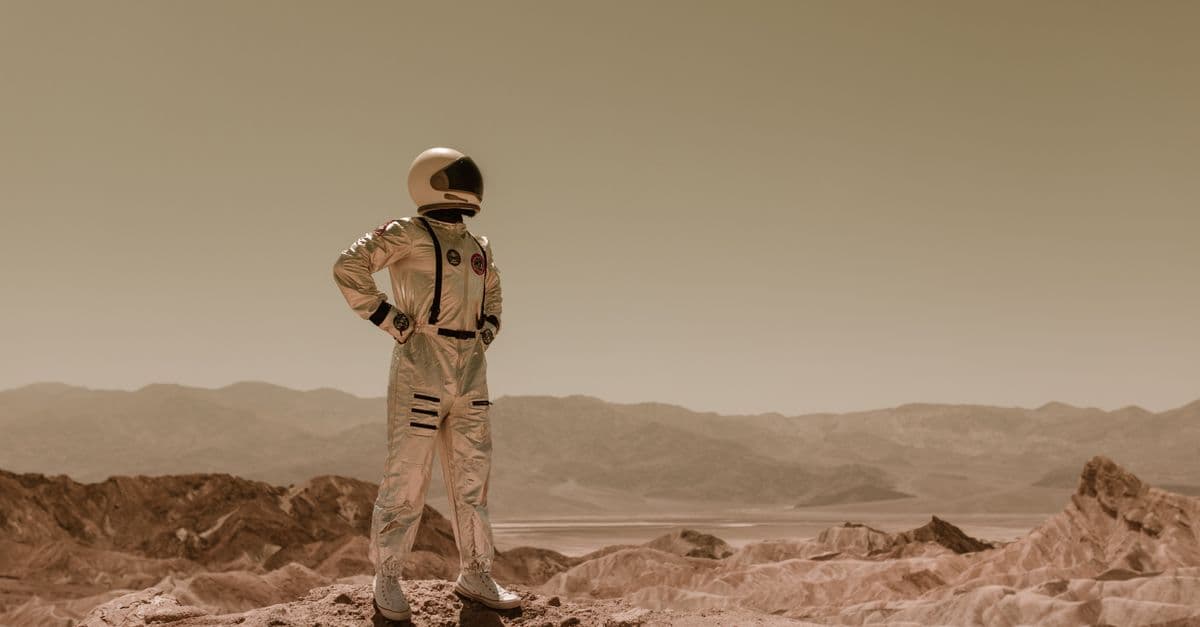
Photo: RDNE Stock project / Pexels
If you stood at the base of Olympus Mons on Mars and looked up, you would see — almost nothing. The summit is below the horizon. The volcano is so vast that its slope is gentler than most highway exit ramps, and its base curves with the planet itself. Olympus Mons is 21.9 km tall (2.5 times the height of Everest above sea level), with a base roughly the size of France or Arizona. It is the largest volcano in the solar system, and one of the most extraordinary geological objects we know.
The Numbers — Almost Hard to Believe
| Property | Value | Earth comparison |
|---|---|---|
| Height (above plains) | 21.9 km | 2.5x Everest |
| Base diameter | ~600 km | Larger than Arizona |
| Slope (average) | ~5° | Gentle ski run |
| Volume | ~3 million km³ | ~100x Mauna Loa |
| Caldera complex | 80 × 60 km | Larger than Rhode Island |
| Surrounding cliff | up to 8 km | Taller than Mt. McKinley |
| Last eruption | ~25 million years ago | Possibly still active |
The volcano sits inside a basal cliff up to 8 km tall — itself one of the highest cliffs in the solar system — which abruptly separates Olympus Mons from the surrounding plains. The reason for this cliff is still debated; one hypothesis is that early lava flows undermined and collapsed the edges.
Why Is Olympus Mons So Enormous?
The size of Olympus Mons is not a coincidence. Three factors combine to allow Martian volcanoes to grow to scales impossible on Earth.
1. No Plate Tectonics
On Earth, the crust is divided into plates that drift over mantle hotspots. As a plate slides over a hotspot, a chain of volcanoes forms — the Hawaiian–Emperor seamount chain is the textbook example. Mauna Loa is the largest, but it's one of many.
Mars has no plate tectonics. Its crust is a single, stationary lid. So a single hotspot can feed a single volcano for billions of years, piling up magma in one place.
2. Lower Gravity
Martian gravity is 38% of Earth's. That allows a mountain to grow taller before its own weight crushes it. The maximum mountain height on a planet scales roughly inversely with gravity.
3. Very Fluid Lava
Olympus Mons's lava was unusually basaltic and fluid, producing extremely long flows (hundreds of km) and the characteristic gentle shield shape. Some flows are visible from orbit as ridges radiating out from the summit.
The Caldera — A Volcano Within a Volcano
The summit of Olympus Mons isn't a single crater. It's a complex of six overlapping calderas, each formed when a magma chamber drained and the surface collapsed. The youngest caldera dates to ~100 million years ago. The deepest drops about 3 km below the surrounding summit plateau.
Is Olympus Mons Still Active?
Probably yes, in the geological sense. The youngest lava flows on Olympus Mons are dated by crater counting to between 2 million and 25 million years ago — a heartbeat by Martian standards. Mars almost certainly has a residual heat source under Tharsis, and recent InSight mission seismic data (2018–2022) detected marsquakes consistent with magma movement under the Cerberus Fossae region nearby. We have not seen Olympus Mons erupt during human observation, but the timing is plausibly "next eruption in a million years," not "extinct."
The Tharsis Bulge — A Continent of Volcanoes
Olympus Mons doesn't stand alone. It sits at the northwest edge of the Tharsis Bulge, a continent-sized volcanic province that contains three other shield giants in a perfect line:
- Ascraeus Mons — 18 km tall
- Pavonis Mons — 14 km tall
- Arsia Mons — 16 km tall
These three are nearly equidistant and aligned, suggesting they sit over a deep, linear mantle feature. Tharsis as a whole bulges Mars's surface upward by ~7 km and is thought to be the largest volcanic structure in the solar system by total volume.
How Olympus Mons Was Discovered
Astronomers had seen a bright spot on Mars for centuries through ground-based telescopes. In 1879, Giovanni Schiaparelli mapped it and named it Nix Olympica — "Olympic Snow" — believing it might be a snowcap. It was only in 1971, when Mariner 9 entered Mars orbit and waited out a planet-wide dust storm, that the bright spot was revealed to be a shield volcano poking above the dust. The name was changed to Olympus Mons.
Today, HiRISE on Mars Reconnaissance Orbiter, CTX, Mars Express HRSC, and MAVEN have mapped the volcano in spectacular detail.
Could You Climb It?
The slope is so gentle (~5° average) that climbing Olympus Mons would feel less like mountaineering and more like a very long walk. The summit is 600 km from the base, so traverse distance is the real challenge, not gravity. You'd need pressurized vehicles and life support — Martian atmospheric pressure is already low at the surface (~6 mbar), and at Olympus Mons's summit it drops to less than 1 mbar, near the Armstrong limit where water boils at body temperature.
Largest Volcanoes in the Solar System
| Volcano | Body | Height | Base diameter |
|---|---|---|---|
| Olympus Mons | Mars | 21.9 km | 600 km |
| Tharsis Tholus / Alba Mons | Mars | 6.8 km | 1,600 km (wider base) |
| Ascraeus Mons | Mars | 18 km | 480 km |
| Maat Mons | Venus | 8 km | 395 km |
| Mauna Loa (above seafloor) | Earth | 9 km | 120 km |
| Loki Patera | Io | Caldera 200 km wide | Mostly flat |
| Cryovolcanoes | Enceladus, Titan, Triton | Small | Various |
Note that Alba Mons on Mars has a larger base (1,600 km!) than Olympus Mons, but is much shorter.
Why It Matters
Olympus Mons is more than a geological curiosity. It is a window into:
- Martian thermal history — How long Mars retained its internal heat.
- Volcanic processes without plate tectonics.
- Habitability — Hydrothermal systems near active volcanoes are leading candidates for past or present microbial life on Mars.
Comparative Volcanology: Why Mars and Venus Grow Such Monsters
Olympus Mons exemplifies how planetary properties reshape geology. Io, Jupiter's moon, has volcanoes taller and more active than any Earth volcano — extreme tidal heating powers continuous eruption. Venus has multiple large shield volcanoes (Maat Mons reaches 8 km), likely still active today, with total atmospheric pressure so high that magma stays molten longer. Earth has high plate-tectonic turnover, preventing singular volcanoes from dominating; our largest (Mauna Loa above seafloor) reaches only 9 km.
Mars bridges the extremes. It's geologically young enough to retain mantle heat but old enough that no global magnetic field protects it from solar wind erosion. The size of Olympus Mons is thus a visible record of Mars's thermal history — it records roughly 4 billion years of continuous volcanic activity from a stationary hotspot.
Frequently Asked Questions
Q: Is Olympus Mons really taller than Mount Everest?
A: Yes, dramatically — 21.9 km above the surrounding plains vs. Everest's 8.85 km above sea level. That's 2.5 times taller. You could fit Everest inside Olympus Mons's caldera complex.
Q: Could Olympus Mons physically exist on Earth?
A: No. Earth's stronger gravity (nearly 2.7x Mars) would crush a mountain of that height — rock plasticity limits mountain height on strong-gravity worlds. Additionally, plate tectonics would carry any hotspot away from the volcano's base, preventing billion-year accumulation at a single spot.
Q: Is Olympus Mons still active, or is it extinct?
A: Probably dormant, not extinct. Youngest confirmed lava flows are ~25 million years old — geologically recent. Mars retains enough internal heat for future eruptions, and seismic data from the InSight mission (2018–2022) detected marsquakes consistent with magma movement nearby. An eruption in the next million years is plausible.
Q: How would Olympus Mons appear from the Martian surface?
A: From the base, you wouldn't see it as a mountain — the slope is so gentle that the summit curves below the horizon. Even from a rover 100 km away, it would appear as a slight rise, not a peak. You'd need aerial views (a Mars aircraft) or orbital imaging to see its true shape.
Q: Why does Mars have such spectacularly enormous volcanoes compared to Earth?
A: Three factors converge: (1) No plate tectonics — a single stationary hotspot feeds one volcano for billions of years. (2) Lower gravity (38% of Earth's) allows taller mountains before weight crushes rock. (3) Fluid basaltic lava produces very long, gentle flows, building broad shield volcanoes rather than steep stratovolcanoes.
Q: Could humans realistically climb or explore Olympus Mons?
A: The slope is gentle enough (~5°) that rovers could traverse it, but the distance is daunting — 600 km base-to-summit. Atmospheric pressure at the summit drops below 1 millibar, approaching the Armstrong limit. A multi-day rover expedition with life support is realistic; a hiking expedition is not.
The Geological Record: 4 Billion Years of Uninterrupted Growth
Unlike Mauna Loa or other Hawaiian hotspot volcanoes that build chains as the plate moves, Olympus Mons accumulated lava from the same hotspot for roughly 4 billion years. This continuous feeding is visible in the stratigraphic layers — geologically old lava buried beneath younger flows at the summit.
Dating these lava flows by counting superimposed craters (younger surfaces have fewer craters) reveals the volcano's history:
- Oldest exposed lavas: ~3.8 billion years ago (early Tharsis formation)
- Intermediate flows: scattered between 3 Ga and 100 Ma
- Youngest confirmed flows: ~25 million years ago
The pause between the intermediate and youngest flows is puzzling. Did eruptions genuinely cease for ~75 million years, or are the crater counts uncertain? InSight seismic data (2018–2022) detected marsquakes concentrated near Cerberus Fossae, ~1,000 km southeast of Olympus Mons, suggesting magma is still mobile in the Tharsis region. This strengthens the case for future eruptions.
Crater density analysis shows that older terrains on Mars have higher crater densities, implying older ages. Olympus Mons's summit has relatively few craters (young age), while the outermost flows have more. This crater-accumulation pattern over 4 billion years is the observational backbone of Martian chronology.
InSight and the Interior: What Seismic Data Revealed
The InSight lander (2018–2022) deployed the first seismometer on Mars, detecting hundreds of marsquakes (magnitude 3–5). These seismic waves traveled through the Martian interior, revealing:
- Crustal thickness: ~50 km average, thicker beneath Tharsis
- Mantle presence: Solid but warm, capable of supporting mantle convection
- Core size: Larger than expected, with a liquid iron-rich outer core
- Heat flow: ~60–80 mW/m² beneath Tharsis (compared to ~100 mW/m² average for Earth)
The Tharsis region — where Olympus Mons and the other three giant shields sit — shows elevated heat flow and crustal thickness, consistent with a mantle plume that has been feeding the volcanoes for billions of years. The seismic evidence strongly suggests this plume is still active, even if eruptions are episodic.
This is crucial: Mars is not geologically dead. The Tharsis plume continues to heat and stress the crust, making Olympus Mons dormant rather than extinct.
Source: Lognonné, P., et al. (2020). "Seismology of the Layered Moon." Nature Geoscience, 13(3), 213-220 (InSight early results).
Hydrothermal Systems and the Search for Life
One of the most exciting questions about Olympus Mons is whether its hydrothermal systems could harbor or have harbored microbial life. The study of astrobiology on Mars depends on understanding how such systems developed and whether chemical energy could have sustained early life.
The scenario: Ancient Mars was warmer and wetter. If water percolated through the porous lava of Olympus Mons and came into contact with hot rock at depth, hydrothermal vents would form. On Earth, such vents (mid-ocean ridges, deep-sea black smokers) teem with chemosynthetic bacteria even in pitch darkness, with no sunlight energy source.
Evidence for ancient water on Olympus Mons:
- Valley networks visible on orbital imagery suggest rain/snowmelt erosion early in Martian history
- Alteration minerals (phyllosilicates, carbonates) detected in orbital spectra suggest water-rock interaction
- Hydrated lava flows have been spectroscopically identified in some younger Tharsis units
NASA's Perseverance rover and future rovers will search for:
- Organic molecules preserved in ancient lava
- Mineral assemblages diagnostic of hydrothermal alteration
- Potentially habitable subsurface environments now accessible through erosion gullies
The flanks of Olympus Mons remain high-priority targets for astrobiology reconnaissance.
The Tharsis Plateau and Global Isostatic Adjustment
Olympus Mons doesn't exist in isolation — it's one component of the Tharsis Bulge, a 7-km-high plateau spanning a continent-sized area. The total mass of Tharsis is so enormous that it has literally deformed Mars's isostatic structure and may be responsible for:
- Polar wander: The location of Mars's poles has shifted over billions of years in response to massive equatorial mass loading by Tharsis.
- Rift valleys: The Valles Marineris, the largest canyon in the solar system, may have formed partly as stress relief from Tharsis's weight.
- Dynamo shutdown: The original Martian global magnetic field may have been disrupted by the stress from Tharsis's growth.
This means Olympus Mons is not just a geological landmark — it's a driver of planetary-scale tectonics, demonstrating how a single plume-fed volcano can reshape an entire planet's structure.
Future Exploration: Robotic and Human Plans
Robotic missions:
- Mars rovers (Perseverance, Zhurong, future ESA Rosalind Franklin rover) will increasingly target Tharsis alteration minerals and potential habitats
- Orbital multispectral imaging from Mars Reconnaissance Orbiter, MAVEN, and proposed follow-on missions will map hydrothermal mineralogy
- Radar penetrating via future Martian orbiters could map subsurface structure beneath Olympus Mons's lava plains
Human exploration:
- NASA's Artemis Mars campaign (2030s–2040s) may establish forward bases in habitable regions; Tharsis could be a long-term science destination for its geological richness
- The gentle slopes of Olympus Mons offer lower-gravity traversal advantages for human rovers compared to the scarps of Valles Marineris
A human expedition to Olympus Mons would involve:
- Multi-week rover missions across the flanks
- Drill sampling of subsurface lava for past/present life signatures
- Seismic experiments to further constrain Martian interior structure
- In-situ resource utilization studies (water ice, regolith chemistry)
Scaling Laws: Why Olympus Mons Is Uniquely Massive
Planetary scientists use scaling relationships to predict the maximum size of volcanoes on different bodies. The yield strength of rock sets an upper limit on mountain height: gravity eventually crushes rock, causing plastic flow. This relationship is captured in dimensional analysis:
Maximum height ∝ (yield strength of rock) / (surface gravity × density)
For Earth, this predicts mountains ~10–12 km tall; Everest at 8.85 km is close to this limit. For Mars with 38% Earth gravity, the predicted maximum is ~25–30 km — and Olympus Mons at 21.9 km is right there. For Venus with 90% Earth gravity, the limit is ~8 km; observed Venusian volcanoes (Maat Mons ~8 km) fit perfectly. For the Moon with ~17% Earth gravity, mountains can reach ~20 km; the lunar peaks in the south polar region reach ~18 km.
This isn't coincidence. Gravity sets the upper limit; geology fills in the rest. Olympus Mons achieves nearly the theoretical maximum allowed on Mars because: (1) it had 4 billion years to accumulate, (2) fluid basaltic lava enabled efficient magma transport over hundreds of kilometers, and (3) no plate tectonics allowed the volcano to sit on top of its own hotspot indefinitely.
Io, Jupiter's moon, breaks these rules. Tidal heating from Jupiter keeps Io's interior molten and actively erupting. Volcanoes like Loki Patera reach only modest heights (mostly subsurface calderas) but are incredibly active, with eruptions documented continuously since the Voyager flybys. The key difference: Io prioritizes continuous eruption over accumulating height.
Source: Turcotte, D. L., & Schubert, G. (2014). Geodynamics (3rd ed.). Cambridge University Press. Scaling relationships for planetary volcanism (pp. 442–458).
Magma Composition and Fluid Flow: Why Olympus Mons Lavas Are Different
Olympus Mons's lava was predominantly tholeiitic basalt — iron- and magnesium-rich, silica-poor compared to more evolved lavas. Basaltic lava is more fluid than rhyolite or andesite because it has fewer dissolved gases and lower viscosity. A basaltic lava can flow for hundreds of kilometers before cooling solidifies it.
Viscosity estimates for Olympus Mons lavas are ~10–100 Pascal-seconds at eruption temperatures (1,200–1,300 K), compared to rhyolitic lava at ~10^4 Pascal-seconds. This difference of three orders of magnitude is enormous: basaltic lava flows three times farther with half the eruption velocity.
The lava flow distances on Olympus Mons are striking. Some flows extend 500+ km from vents. Compare this to the longest documented terrestrial basaltic flow (Hell's Half Acre in Idaho, ~130 km) and rhyolitic flows in Yellowstone (~50 km). Olympus Mons's extreme flow lengths reflect both the lower gravity (which reduces deceleration) and the fluid basaltic composition.
This compositional uniformity — predominantly basalt with minimal evidence of compositional variation — is itself scientifically informative. It suggests a remarkably stable magma source (the Tharsis plume) that fed the volcano with essentially the same composition for 4 billion years. On Earth, evolving crustal contamination often changes lava composition over time; Olympus Mons's constancy implies a very deep, isolated plume magma source.
Spectroscopic data from infrared imaging (THEMIS instrument on Mars Odyssey, CRISM on MRO) identifies olivine-rich and pyroxene-rich regions across the flows, consistent with primary basaltic mineralogy. No evidence for silica-rich evolved compositions has been found, reinforcing the picture of a stable, primitive mantle plume.
Source: Greeley, R., & Spudis, P. D. (1981). "Volcanism on Mars." Reviews of Geophysics, 19(1), 13–41. Classic synthesis of Mariner 9 and Viking lander volcanic observations.
Comparative Volcanism: Olympus Mons vs. Hawaiian Hotspot Volcanoes
The Hawaiian–Emperor seamount chain provides Earth's closest analog to Olympus Mons. Mauna Loa and Kauai are products of a stationary hotspot while the Pacific Plate drifts across it. The time scale is much shorter (Mauna Loa started ~0.7 million years ago; Kauai is ~5 million), and the individual volcanoes are smaller (Mauna Loa rises ~9 km above the seafloor). Yet the principle is identical: a fixed mantle plume feeding a volcano as the lithosphere moves.
| Aspect | Olympus Mons (Mars) | Mauna Loa (Hawaii) | Hawaiian Chain |
|---|---|---|---|
| Hotspot age | ~4 billion years | ~0.7 Ma (Mauna Loa) | 5.3 Ga (Kauai) |
| Single volcano life | ~4 Ga | ~0.7 Ma | ~1 Ma per volcano |
| Height | 21.9 km | 9 km above seafloor | 4–8 km |
| Base diameter | 600 km | 120 km | 50–100 km |
| Lava composition | Tholeiitic basalt | Tholeiitic basalt | Tholeiitic basalt |
| Magma source | Stationary plume | Stationary plume | Stationary plume |
| Plate motion | None | Pacific Plate 8 cm/yr | 8 cm/yr |
The critical difference: plate tectonics. Earth's volcanoes are time-limited; Mars's are not. Mauna Loa will eventually slide away from its hotspot and become dormant. A new volcano will form at the hotspot. Olympus Mons, anchored to the same spot for 4 billion years, accumulated to scales impossible on Earth.
This comparison also illuminates a deep question in planetary science: How long can a mantle plume persist? Earth's plumes seem to remain active for 100+ million years. The Tharsis plume has been active for 4 billion years — did it start with Mars's formation, or did it activate later? Future geochemical analysis of Tharsis samples by human explorers or sophisticated rovers might answer this.
Source: Wilson, J. T. (1963). "A possible origin of the Hawaiian Islands." Canadian Journal of Physics, 41(6), 863–870. Classic paper introducing the hotspot hypothesis, later validated by the Hawaiian–Emperor chain.
Imaging Evolution: How Orbital Missions Revolutionized Olympus Mons Science
Our understanding of Olympus Mons has transformed over 50+ years as orbital imaging improved:
Mariner 9 (1971): First close-up images revealed that the bright spot was a shield volcano, not a snowcap. Early imaging showed the basic size and caldera complex. Mariner 9 observations established that Mars had large, young volcanoes — a shocking discovery at the time.
Viking Orbiters (1976–1980): Higher-resolution imaging revealed lava flow patterns, terraced calderas, and the basal cliff. Crater counts on the flows began dating the volcano's eruption history.
Mars Global Surveyor MOLA (1999–2006): Laser altimetry measured Olympus Mons's topography with meter-level precision. MOLA revealed the true slope profile (gentler than earlier estimates) and the precise height. This data became the backbone of models for how the volcano formed.
Mars Reconnaissance Orbiter HiRISE (2006–present): High-resolution color imaging shows individual lava flow features, erosion patterns, and small secondary cones. HiRISE revealed dust devils and atmospheric phenomena around the volcano.
CRISM thermal infrared (2006–present): Spectroscopic mapping of mineralogy. The instrument detects olivine-rich and pyroxene-rich regions, constraining lava composition and eruption sequence.
MAVEN atmospheric mission (2014–present): Studies how solar wind and atmospheric escape interact with Olympus Mons's high altitude — a unique opportunity to study thin atmospheres over topography.
Each mission has added detail, but the core picture — a massive shield volcano with 4 billion years of history — has remained consistent. Future missions (NASA Mars Life Explorer, ESA ExoMars Rosalind Franklin rover targeting Tharsis) will dive deeper.
Source: Carr, M. H., & Head, J. W. (2010). "Geologic history of Mars." Earth and Planetary Science Letters, 294(3-4), 185–203. Comprehensive synthesis of Mars imaging data through Mars Reconnaissance Orbiter.
Frequently Asked Questions
Q: Is Olympus Mons really taller than Mount Everest?
A: Yes, dramatically — 21.9 km above the surrounding plains vs. Everest's 8.85 km above sea level. That's 2.5 times taller. You could fit Everest inside Olympus Mons's caldera complex.
The takeaway
Olympus Mons stands as a monument to comparative planetology. It exists because of specific conditions on Mars — no plate tectonics, lower gravity, and 4 billion years of dormancy but not death. It is a visible record of Mars's thermal history and offers clues about the structure of the Martian interior. The InSight mission confirmed that Tharsis retains active mantle heat, suggesting Olympus Mons is dormant rather than extinct. Its existence raised questions about volcanism without plate tectonics that reshaped our understanding of planetary geology.
For human Mars exploration, Olympus Mons is both opportunity and constraint. Its flanks offer gentle slopes for traversal and potential hydrothermal habitats for microbial life. Yet its extreme scale underscores the harshness of the Martian environment and the engineering challenges any human base would face. The volcano remains one of the most important targets for astrobiology and planetary science in the 2030s–2050s. Understanding how Olympus Mons formed and persisted provides a playbook for finding similarly massive volcanic structures on exoplanets and understanding the diversity of planetary evolution.
Read next:
NASA Mars Reconnaissance Orbiter HiRISE archive.
ESA Mars Express HRSC imagery.
Carr, M. H. (2007). The Surface of Mars. Cambridge University Press.
Plescia, J. B. (2004). "Morphometric properties of Martian volcanoes." JGR Planets.
Werner, S. C. (2009). "Olympus Mons: Volcanism and ages of lava flows." Icarus.
Follow new articles
Add SciHub101 to your feed reader to see new science and technology stories.
About the Author
SciHub101 is an independent science and technology publication founded and edited by Buğra Sözeri, a software engineer and app developer based in Türkiye. AI tools assist with drafting and research. Source documentation in the existing archive is uneven, and articles are being reviewed and corrected. The Editorial Team byline identifies editorial responsibility; it does not certify specialist or independent human review. Where we compare products, anything built by our own team is labelled as such — see the editorial guidelines and About page for how corrections and disclosures work.
Related Articles
SpaceX Starship Explained — Rocket Built for Mars
SpaceX Starship is the largest rocket ever built — 121m tall, fully reusable, designed for Mars. How Raptor engines, orbital refueling, and Flight 13 work.

Mars's Moons — Phobos and Deimos Explained
Phobos and Deimos are Mars's two tiny, mysterious moons. Explore their origin, the doomed orbit of Phobos, and the upcoming MMX sample return.

Why Is Mars Red? The Science of the Red Planet
Mars looks red because iron in its dust and surface rocks has oxidized into rust-colored minerals. A 2025 study argues the main pigment is ferrihydrite, a water-bearing iron mineral, and that planet-wide winds spread the fine powder that gives Mars its color.
'Oumuamua: The First Interstellar Visitor and the Mystery of Its Acceleration
On October 19, 2017, astronomers found the first object confirmed to have come from outside our solar system. It tumbled, looked extremely elongated or flat, showed no gas or dust, and still sped up slightly as it left the Sun. Scientists have proposed a hydrogen iceberg, a nitrogen shard, and an alien lightsail. Here is what the evidence supports.
Mars Rovers Explained — Perseverance and Curiosity
From Sojourner to Perseverance, every Mars rover explained — missions, discoveries, and the race to bring samples back to Earth.

AI and Astrobiology: Machine Learning in the Search for Life Beyond Earth
From Mars rock targeting to exoplanet spectra, AI is helping astrobiologists sort possible signs of life from chemistry that looks alive but is not. Here is what it does, what it has not done, and why the hardest step is still human.