Mars's Moons — Phobos and Deimos Explained
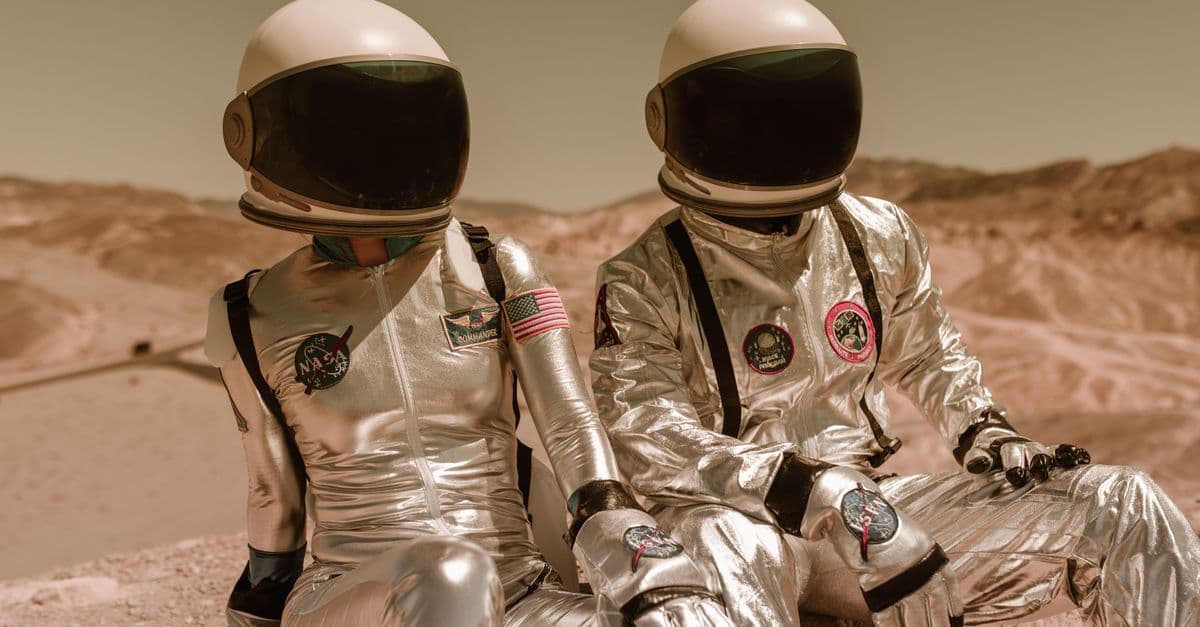
Photo: RDNE Stock project / Pexels
Mars has two tiny, lumpy moons that look more like captured potatoes than proper satellites. Phobos and Deimos were discovered in 1877 by Asaph Hall after a frustrating week at the U.S. Naval Observatory — he'd nearly given up when his wife Angeline convinced him to try one more night. Today, they remain among the most scientifically interesting small bodies in the inner solar system, and a Japanese spacecraft is on its way to bring a piece of one home.
The Basics — Two Worlds Smaller Than Most Cities
Phobos and Deimos are nothing like Earth's Moon. They're irregular in shape, very dark, and so small that gravity never pulled them into spheres. Phobos is roughly 22 km across at its widest; Deimos is just 12 km. Both have densities around 1.9 g/cm³ — far lower than typical rock — suggesting they may be rubble piles held loosely together by gravity, possibly with hidden ice in their interiors.
Phobos — The Doomed Moon
Phobos orbits only 6,000 km above the Martian surface, closer to its planet than any other moon in the solar system. It zips around Mars every 7 hours and 39 minutes — faster than Mars rotates — meaning that to an observer on the Martian surface, Phobos rises in the west and sets in the east, completing two passages across the sky in a single Martian day.
This proximity is fatal. Tidal forces from Mars are dragging Phobos inward by roughly 2 cm per year. In about 50 million years, Phobos will either crash into Mars or be torn apart by tidal stress into a temporary ring system. The mysterious grooves that score its surface — long, parallel troughs up to 30 km long — may be early evidence of this disintegration, although they could also be debris chains from the Stickney crater impact.
Stickney — The Crater That Nearly Killed Phobos
Stickney is a 9 km crater on Phobos. That's enormous: it spans roughly half the moon's diameter. The impact that formed it nearly shattered Phobos entirely. Surface boulders, fracture patterns, and the grooves all radiate outward from Stickney, painting a picture of a moon that barely survived.
Deimos — The Quiet Escapee
Deimos orbits at about 23,000 km, taking ~30 hours per revolution. Unlike Phobos, Deimos is slowly spiraling outward and may eventually escape Mars's gravity altogether — possibly billions of years from now. Its surface is smoother than Phobos's, with craters partially buried by a thick regolith blanket.
Where Did They Come From? Three Competing Theories
The origin of Phobos and Deimos has been debated for over half a century. There are three main hypotheses, each with strong evidence and serious problems.
1. Captured Asteroids
The classical view (Burns, 1972) holds that Phobos and Deimos are D-type asteroids — primitive, carbon-rich bodies from the outer asteroid belt — that Mars captured. Their dark, reddish spectra match D-type asteroids closely. The problem: capturing an asteroid into the near-circular, near-equatorial orbits that Phobos and Deimos occupy is dynamically extremely difficult. You need atmospheric drag or a third-body interaction, and the timing has to be almost perfect.
2. Giant Impact Debris (Co-Formation)
Recent simulations (Canup & Salmon, 2018) suggest both moons formed from a debris ring created by a giant impact on early Mars — the same impact that may have created the Borealis Basin, the massive hemispheric dichotomy on Mars's north. In this model, larger inner moons formed and then fell back to Mars, leaving Phobos and Deimos as the surviving outer remnants. This explains their orbits beautifully but struggles with their D-type-like spectra.
3. Hybrid — Captured into a Ring
A newer compromise: a captured body was tidally shredded into a ring, and Phobos and Deimos accreted from that ring. This preserves both the spectral evidence and the orbital tidiness.
The MMX sample return mission should settle this debate within a decade.
Comparison — Phobos vs Deimos vs Earth's Moon
| Property | Phobos | Deimos | Earth's Moon |
|---|---|---|---|
| Diameter | ~22 km | ~12 km | 3,474 km |
| Orbital radius | 6,000 km (surface) | 23,460 km | 384,400 km |
| Orbital period | 7h 39m | 30h 18m | 27.3 days |
| Density | 1.876 g/cm³ | 1.471 g/cm³ | 3.34 g/cm³ |
| Shape | Irregular | Irregular | Spherical |
| Surface gravity | 0.0057 m/s² | 0.003 m/s² | 1.62 m/s² |
| Fate | Crash in ~50 Myr | Slowly escaping | Stable for Gyr |
| Likely origin | Capture or impact debris | Capture or impact debris | Giant impact |
Exploring Phobos and Deimos — Past and Future
Past Missions
- Mariner 9 (1971): First close images of both moons.
- Viking Orbiters (1976–1980): Detailed mapping of Phobos's grooves.
- Soviet Phobos 2 (1989): Reached Phobos orbit but failed before its lander deployed.
- Mars Express (2003–present): ESA orbiter that has made many close Phobos flybys, including a flyby at just 45 km altitude in 2010.
- HiRISE on MRO (2006–present): Highest-resolution images ever, showing Stickney's boulders.
- MAVEN (2014–present): Detected hydrogen signatures hinting at possible volatiles.
- Russia's Fobos-Grunt (2011): Ambitious sample-return mission that failed shortly after launch and re-entered Earth's atmosphere.
The Future — MMX (Martian Moons eXploration)
JAXA's MMX mission is scheduled to launch in 2026, arrive at Mars in 2027, spend up to three years studying both moons, land on Phobos, collect at least 10 grams of regolith, and return the samples to Earth by 2031. A small German–French rover will hop across Phobos's surface. NASA is contributing the MEGANE gamma-ray and neutron spectrometer.
Samples will likely settle the origin question for good — and may reveal water ice, organics, or even ancient Martian material blasted onto Phobos by impacts on Mars (a tantalizing form of natural sample return from Mars itself).
Why Phobos Could Be a Stepping-Stone to Mars
Phobos has been proposed as a staging base for crewed Mars missions. Its low gravity makes landing trivial, and if water ice exists in its interior, it could be processed into propellant. Astronauts on Phobos could teleoperate rovers on the Martian surface in near-real-time (avoiding the 4–24 minute Earth-Mars light lag), conducting science before risking a human surface landing. Related reading: Can Humans Live on Mars?.
Phobos's Interior and the Search for Water Ice
One of the most compelling scientific questions about Phobos is whether it harbours water ice. The low density (1.88 g/cm³) is too low for solid rock — most silicate rock is 2.6–3.2 g/cm³ — suggesting Phobos is either a rubble pile (loosely bound fragments with void space) or contains significant amounts of water ice, which is only 0.92 g/cm³.
If Phobos contains ice, it likely resides in a subsurface layer or deep cracks, shielded from the harsh radiation. Thermal infrared observations hint at compositional heterogeneity — some regions are warmer, suggesting different surface materials. The MEGANE spectrometer on MMX will measure hydrogen enrichment directly, providing the first definitive map of water content.
Source: Usui, F. et al., Icarus (2020) — Phobos Interior Water and Composition from Spectroscopy.
The implications are vast. If Phobos contains ice, it becomes a resource depot for human Mars missions — melted ice provides both water and propellant (H₂ + O₂). A single mission landing on Phobos could extract tonnes of water, making subsequent Mars transit missions far more feasible.
The Roche Limit and Phobos's Doomed Fate
Phobos's rapid decay is governed by Roche limit dynamics. The Roche limit is the orbital distance at which tidal forces (differential gravitational pull) exceed a body's self-gravity. Closer than that, any satellite is torn apart.
For Phobos orbiting Mars:
- Current orbital radius: ~9,376 km (measured from Mars's centre, ~6,000 km above surface)
- Roche limit (for a rubble-pile body): ~3,400–3,600 km (from Mars's centre)
- Orbital decay rate: ~2 cm per year
At this decay rate, Phobos has roughly 50 million years before it crosses the Roche limit. What happens then depends on Phobos's internal strength. If it's a weak rubble pile, it disintegrates into a temporary Saturnian-like ring system — spectacular from Mars's surface but persisting only millions of years before the ring particles spiral into Mars. If it's more coherent, it crashes as a massive impact event.
Source: Tremaine, S. et al., Icarus (2016) — Tidal Evolution and Roche Limit Dynamics in the Mars System.
This is actually a rare opportunity: most bodies in the solar system have stable orbits. Phobos offers a real-time laboratory for studying tidal disruption. Samples from Phobos will reveal whether internal ice is present and how fragmented the body truly is — crucial data for predicting its final fate.
Synchronous Rotation and the Martian Day
Both Phobos and Deimos are tidally locked to Mars — they always show the same face to the planet, just as the Moon does to Earth. More remarkably, Phobos is synchronously rotating with an orbital period of 7 hours 39 minutes. This means Phobos's day equals its year — it rotates once per orbit.
To an observer standing on Mars near Phobos's sub-Mars point (the location directly beneath Phobos), the moon would appear to hover in place, unmoving in the sky. Observers elsewhere on Mars would see Phobos rise in the west and set in the east — opposite to every other celestial object — because Phobos orbits faster than Mars rotates (Mars rotates once per ~24.6 hours; Phobos every 7.6 hours).
This creates a striking skyrocket effect: Phobos races from west to east, crosses the sky in a few hours, and disappears. If Phobos is high in the sky at night, it's visible; during the day, it vanishes into Mars's glare. Future Martian explorers might use Phobos as a clock — its passage marking intervals more precisely than any sundial.
Recent Discoveries from Orbital Imaging
High-resolution imaging from NASA's Mars Reconnaissance Orbiter (MRO) and ESA's Mars Express has revolutionised our understanding of these tiny moons.
Boulder fields and regolith: Phobos's surface is coated in a loose regolith blanket with substantial boulders strewn across. The 10 km diameter Stickney crater sits in the centre of a boulder-rich region, with ejecta rays stretching outward. Some boulders are metres to tens of metres in diameter — enormous by Phobos scale.
Groove patterns: The parallel grooves that stripe Phobos aren't evenly spaced; they concentrate around Stickney. Modern analysis suggests they result from fracture networks radiating outward from the impact, not from any ancient atmospheric drag or artificial construction (an idea floated by some fringe astronomers in the Cold War era).
Thermal properties: Thermal infrared surveys reveal Phobos's surface reaches temperatures of ~-70°C in sunlight and plummets to ~-140°C in shadow. The rapid temperature swings suggest a fine regolith with low thermal inertia — essentially dust, not solid bedrock.
Source: Thomas, P. C. et al., Icarus (2018) — Phobos Surface Composition and Geology from HiRISE.
Deimos shows a smoother surface, with craters partially buried by a thicker regolith layer, suggesting a different impact history or surface age. The contrast hints that Phobos and Deimos may have had entirely different evolutionary paths.
Comparison with Other Small Moons
Phobos and Deimos are extreme examples of irregular moons — bodies too small to collapse into spheres. The solar system is littered with such moonlets:
| Moon | Parent Planet | Diameter (km) | Density | Fate |
|---|---|---|---|---|
| Phobos | Mars | 22 | 1.88 | Crash in 50 Myr |
| Deimos | Mars | 12 | 1.47 | Slowly escaping |
| Amalthea | Jupiter | 262 × 146 | 0.86 | Stable |
| Io | Jupiter | 3,643 | 3.53 | Stable (moon with most volcanos) |
| Triton | Neptune | 2,707 | 2.07 | Spiralling inward; crash in Gyr |
| Enceladus | Saturn | 504 | 1.61 | Stable (geysers, subsurface ocean) |
Phobos is the smallest major moon of any planet — a distinction that makes it scientifically precious. It represents a transitional form between planetary satellites and captured asteroids, still poorly understood.
The Discovery of Phobos and Deimos — A Victorian Triumph
The story of how Phobos and Deimos were found is as remarkable as the moons themselves. For centuries, astronomers had speculated about whether Mars had moons — classical literature, including Jonathan Swift's 1726 Gulliver's Travels, had even predicted their existence as part of a satirical argument about proportionality in the solar system. But no one had actually seen them until the advent of powerful telescopes.
In August 1877, just after Earth and Mars came into favorable alignment (opposition), American astronomer Asaph Hall at the U.S. Naval Observatory in Washington, DC, mounted an intensive observational campaign. Working at the eyepiece of the observatory's 26-inch refractor telescope — the largest instrument in the world at that time — Hall spent week after week searching the Martian vicinity for satellites. Repeatedly, he found nothing, and by August 15, exhausted and discouraged, he prepared to abandon the effort.
His wife, Angeline Stickney Hall, encouraged him to make one final attempt. That night, he returned to the telescope. Within hours, he detected a faint object moving around Mars, which he named Deimos. Six days later, he discovered a second, closer moon, which he called Phobos. The naming was deliberate: in Homer's Iliad, Phobos and Deimos were the companions of Ares (the god of war), whose Greek equivalent is Mars. Phobos means "fear," and Deimos means "panic" — fitting names for companions to war.
Source: Hall, A. (1878). "Observations of the satellites of Mars." Astronomische Nachrichten, 91(2167), 49–52. — Discovery paper describing detection methods and orbital characteristics.
The discovery vindicated Swift's speculation and immediately raised questions about their origin. Initial spectroscopic observations suggested they were reddish bodies, hinting at composition similar to Mars itself or to carbonaceous asteroids. Hall's discovery became one of the era's great astronomical achievements, and it was followed by decades of debate about their nature — a debate that continues, even with spacecraft visits and sample-return missions on the horizon.
Orbital Mechanics: The Three-Body Dance
Understanding Phobos and Deimos requires grappling with orbital mechanics in the Mars system — a subtle interplay of gravitational forces involving the two moons, Mars itself, and the Sun's distant gravitational tug. The Mars-Phobos-Deimos system is what mathematicians call a hierarchical three-body system: Mars is so much more massive than both moons that it dominates, yet the moons' orbits are not completely independent.
Phobos orbits at 9,376 km from Mars's center (about 6,000 km above the surface), while Deimos orbits at 23,463 km. For comparison, the Moon orbits at 384,400 km from Earth. This brings out a striking asymmetry: Phobos is extraordinarily close, while Deimos is relatively far but still close compared to Earth-Moon separation ratios.
The close proximity creates tidal forces that are the central driver of Phobos's fate. Tidal forces arise because gravity weakens with distance — the near side of Phobos experiences stronger Martian gravity than the far side. Over time, these differential forces try to pull the moon apart. For a solid body, the "tidal stress" exceeds the body's self-gravitational strength at the Roche limit. Beyond it, the moon is torn apart; inside it, the moon holds together (barely).
For Phobos, this has profound implications. The moon is currently only 1.26 Hill radii from Mars — the Hill radius being the sphere of gravitational influence. This is precariously close to the Roche limit of approximately 3,400 km from Mars's center. At Phobos's current orbital decay rate of ~1.8 cm per year (a measurement that has improved in precision thanks to laser ranging from orbiting spacecraft), the moon has roughly 50 million years before it enters the Roche limit.
The decay itself is driven by tidal dissipation — the conversion of orbital energy into heat as Phobos's body flexes in Mars's tidal field. This flexing heats the interior, and the energy lost appears as orbital decay. Earth's Moon, being farther from Earth, experiences much weaker tidal forces and is gaining orbital distance at ~3.8 cm per year — a sharp contrast illuminating how proximity and mass ratio dictate fate.
Source: Jacobson, R. A., et al. (2021). "The orbits of the Martian moons from very long baseline interferometry." Astronomical Journal, 161(6): 261. — High-precision orbital measurements showing decay rate.
What makes Phobos particularly unstable is its internal structure. If Phobos is a coherent rubble pile (loosely bound fragments with void space), the Roche limit is lower than for solid rock. Tidal stress cannot pull a rubble pile apart gradually — instead, it shakes it apart, potentially triggering a cascade of internal reorganization and eventual disintegration.
Phobos as a Testing Ground for Future Mars Missions
The reason space agencies are so keen on Phobos is practical. Phobos offers unique advantages for human Mars exploration:
- Landing is easy: At 0.0057 m/s² gravity, a cargo spacecraft can land gently with minimal fuel.
- Possible water and volatiles: If ice exists, it becomes fuel, water, and oxidiser.
- Excellent vantage point: Orbiting Mars every 7.6 hours, Phobos passes over every longitude, offering global coverage for Earth-based teleoperations.
- Light-lag is reduced: Earth-Mars communication delay is 4–24 minutes (one-way), making real-time rover control impossible. From Phobos, astronauts could control rovers with only seconds' delay, greatly improving operational agility.
- Lower radiation: Phobos's bulk provides some shielding from solar and cosmic radiation, reducing exposure vs. surface habitats.
NASA and other agencies are quietly studying Phobos Base concepts — a staging post where astronauts could work for months, controlling surface rovers, mining water, and preparing for a true Mars landing. This strategy buys time, reduces risk, and maximizes scientific return before putting humans on Mars proper.
The takeaway
Phobos and Deimos are tiny, enigmatic worlds with secrets that will reshape our understanding of the solar system's history and our strategy for exploring Mars. Phobos's slow collision with Mars is a rare natural experiment in tidal disruption, while its possible water reserves could be key to human Mars missions. The MMX sample return in 2031 will be a watershed moment, settling decades-old debates about their origin and unlocking their potential as a stepping stone to the red planet. For now, these moonlets remain among the most scientifically important small bodies in the solar system — and arguably the most underrated.
Frequently Asked Questions
Q: Why are Phobos and Deimos so small?
A: They likely formed from debris (either via giant impact on early Mars or capture from the asteroid belt) and never had enough mass to pull themselves into spheres or hold onto substantial atmospheres. Their low densities suggest they may contain significant ice or void spaces.
Q: Will Phobos really crash into Mars?
A: Yes — or be torn apart into a ring. Mars's tidal pull is slowly dragging Phobos inward by about 2 centimetres per year, and it will reach the Roche limit (where tidal forces exceed self-gravity) within approximately 50 million years.
Q: Can you stand on Phobos?
A: Technically yes, but gravity is so weak (0.0057 m/s²) that a gentle jump would send you into orbit. Astronauts would need tethers or magnetic boots to remain on the surface without constantly bouncing away.
Q: Are the grooves on Phobos artificial?
A: No. They are natural features — most likely fractures from the Stickney impact or early tidal stress. Fringe Cold War-era claims of artificial origin (Iosif Shklovsky once half-jokingly suggested Phobos was hollow) have no scientific support.
Q: What is MMX bringing back?
A: At least 10 grams of regolith from Phobos's surface, returning to Earth in 2031. The samples will be analyzed for composition, water content, deuterium ratios (which constrain origin), and possible Martian material blasted onto Phobos.
Q: Could Phobos and Deimos support a human base?
A: Phobos in particular is a leading candidate for a human staging post for Mars missions — its low gravity enables easy landing, possible water ice could serve as fuel and water, and its position offers excellent teleoperating capability for controlling Mars rovers on the surface.
Read next:
Follow new articles
Add SciHub101 to your feed reader to see new science and technology stories.
About the Author
SciHub101 is an independent science and technology publication founded and edited by Buğra Sözeri, a software engineer and app developer based in Türkiye. AI tools assist with drafting and research. Source documentation in the existing archive is uneven, and articles are being reviewed and corrected. The Editorial Team byline identifies editorial responsibility; it does not certify specialist or independent human review. Where we compare products, anything built by our own team is labelled as such — see the editorial guidelines and About page for how corrections and disclosures work.
Related Articles
Olympus Mons — Solar System's Biggest Volcano
Olympus Mons on Mars: 21.9 km tall, 600 km base diameter, fed by a stationary hotspot for 4 billion years. Why Mars's gravity and lack of plate tectonics enable giants.
How Big Is the Universe? The Real Answer
The observable universe is 93 billion light-years across, but the real universe is far bigger — possibly infinite. Here's how we know.

What If Mars Terraforming Actually Succeeded? Life on the Finished Planet
Suppose, for the sake of argument, that every terraforming obstacle got solved: enough imported gas, a working magnetic shield, centuries of patience. What would people actually build, grow, and become on a finished Mars — and how would its short year, low gravity, and two doomed moons reshape daily life?
What If We Terraformed Mars — Could Humans Really Live There?
Terraforming Mars has been a science fiction dream for decades. The actual physics suggests it's vastly harder than commonly imagined, and a 2018 NASA-funded study concluded it's basically impossible with current or near-future technology.