What If We Terraformed Mars — Could Humans Really Live There?

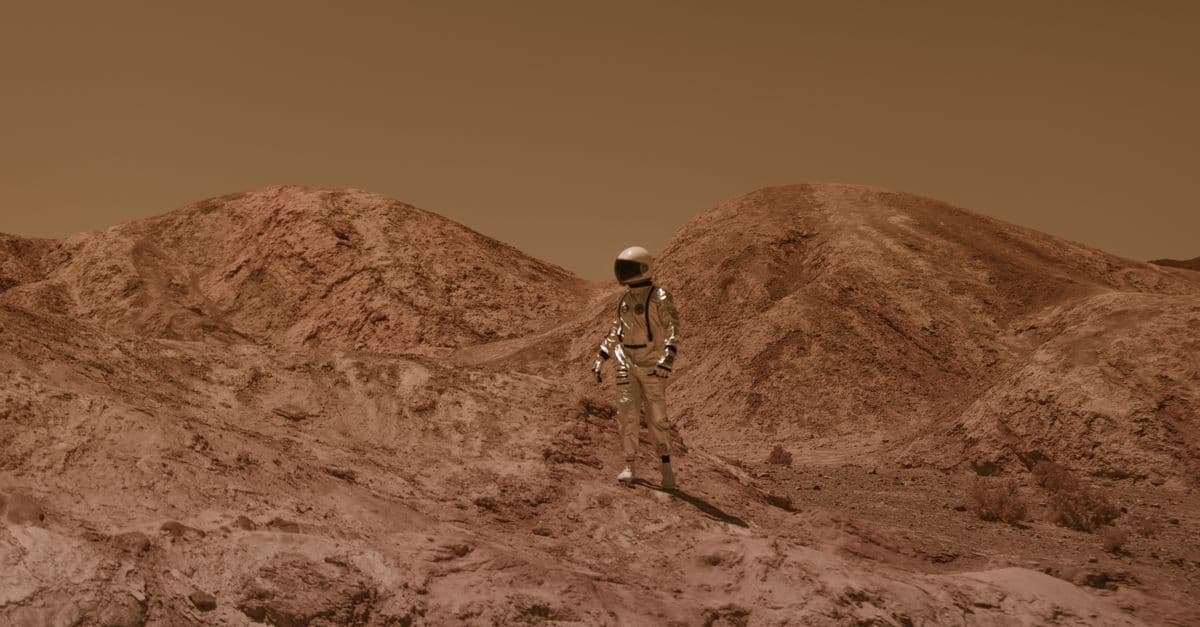
Photo: RDNE Stock project / Pexels
Mars is the most-discussed target for terraforming: the process of re-engineering an entire planet's atmosphere, temperature, and surface chemistry to make it Earth-like enough for humans to walk around unprotected. It has also been studied carefully enough to produce a genuinely disappointing answer. A 2018 study funded by NASA and published in Nature Astronomy concluded that with current or near-future technology, releasing every scrap of accessible carbon dioxide (CO₂) on Mars would raise its atmospheric pressure to roughly 7% of Earth's, nowhere close to breathable. Living on Mars inside pressurized habitats is realistic. Turning Mars into a second Earth is not, at least not with any technology on humanity's visible horizon.
Thought experiment. This article explores a hypothetical scenario for educational and speculative purposes. The events described are not predictions and should not be interpreted as warnings, advocacy, or instructions.
Here is the actual science behind that answer, and why the gap between "colonizing Mars" and "terraforming Mars" is much larger than most popular accounts suggest.
Key takeaways
- Terraforming Mars would require rebuilding its atmosphere, restoring surface pressure, warming the planet by roughly 80°C, and somehow replacing a magnetic field it lost billions of years ago.
- A 2018 NASA-funded study in Nature Astronomy found that releasing all accessible Martian CO₂ would raise atmospheric pressure to only about 7% of Earth's sea-level pressure — far short of what's needed for liquid water or breathable air (Jakosky & Edwards, Nature Astronomy, 2018).
- NASA's MAVEN mission measured the ongoing atmospheric loss rate at roughly 100 grams (about a quarter pound) of gas stripped by the solar wind every second, accelerating sharply during solar storms (NASA/University of Colorado, 2015).
- NASA's MOXIE experiment aboard the Perseverance rover proved oxygen can be extracted from Martian CO₂ on a small scale — about 122 grams total over the mission, roughly what a small dog breathes in ten hours (NASA, 2023) — a proof of concept that is orders of magnitude away from atmospheric-scale oxygen production.
- "Paraterraforming" — sealed domes covering limited areas rather than the whole planet — is the realistic middle ground between a bare pressure suit and a fully Earth-like Mars.
- Pressurized human habitats on Mars are plausible within decades. Planet-wide terraforming, if it's achievable at all, would likely take centuries to millennia and require technology nobody has designed yet.
What terraforming would actually require
"Terraforming" sounds like a single achievement, but it is really a checklist of separate, interconnected engineering problems, each one enormous on its own.
A thousand-fold thicker atmosphere
Mars's atmosphere today has a surface pressure of about 6 millibars, roughly 0.6% of Earth's sea-level pressure of 1,013 millibars (NASA Mars Fact Sheet). To support unprotected human life at something close to Earth-normal pressure, Mars would need on the order of a hundredfold to a thousandfold increase in atmospheric mass, depending on the target pressure and composition chosen.
A breathable mix, not just more gas
Earth's air is about 21% oxygen and 78% nitrogen. Mars's current atmosphere is 95% CO₂, 2.85% nitrogen, and roughly 0.13% oxygen (Space.com / NASA data). Thickening the atmosphere with more CO₂ would not make it breathable. You would need to separately generate roughly 150,000 times more free oxygen than exists on Mars today, and Mars would also need a much larger nitrogen reservoir, since nitrogen is the inert buffer gas that keeps oxygen from becoming a fire hazard at high concentration.
About 80°C of warming
Mars's average surface temperature is roughly -63°C (-81°F), with a range from about -125°C at the winter poles to around 20°C at the equator in summer (NASA Mars Facts). Earth's global average is close to 15°C. Closing that gap by roughly 80°C is the entire goal of the "release the CO₂" greenhouse-warming strategy discussed below, and it is the single most examined terraforming mechanism.
Liquid water at the surface
Mars has substantial water, but almost none of it is liquid on the surface today. At current pressure and temperature, water ice sublimates directly to vapor rather than melting. Warming and thickening the atmosphere enough to stabilize liquid water is a prerequisite for any Earth-like biosphere, and it is tightly coupled to the temperature and pressure problems above.
A magnetic field, or a substitute for one
Earth's magnetic field, generated by convection in its molten iron core, deflects most of the solar wind, the stream of charged particles constantly blowing off the sun. Mars's core partially solidified roughly four billion years ago, and its global magnetic field shut off along with it. Without that shield, the solar wind directly erodes the upper atmosphere, a process NASA's MAVEN orbiter has measured directly (more on this below).
Conditions that don't slowly bleed away
None of the above is worth much if it decays over a few million years. Any created atmosphere needs to either be stable against the same processes that stripped Mars's original atmosphere, or it needs continuous replenishment, which becomes its own permanent engineering project.
Put together, that is not one hard problem. It is six hard problems that all have to be solved simultaneously, and several of them make each other harder.
The CO₂ problem: the numbers that ended the easy version of this plan
The most popular terraforming proposal, going back to Carl Sagan's original 1971 speculation, is deceptively simple: warm Mars by releasing the carbon dioxide trapped in its polar caps, regolith, and mineral deposits, triggering a runaway greenhouse effect that keeps warming itself. For decades this was treated as the plausible baseline plan. The 2018 study changed that.
What the 2018 study actually measured
Planetary scientists Bruce Jakosky (University of Colorado Boulder) and Christopher Edwards (Northern Arizona University) published "Inventory of CO₂ Available for Terraforming Mars" in Nature Astronomy in July 2018. They used mineralogical data from the Mars Reconnaissance Orbiter and Mars Odyssey orbiters, combined with atmospheric-loss measurements from MAVEN, to add up every plausible source of CO₂ on the planet: the polar dry-ice caps, CO₂ adsorbed into the regolith (loose surface soil and dust), and CO₂ locked in carbonate minerals (Jakosky & Edwards, 2018).
Their conclusion, in the authors' own words as reported by NASA and multiple outlets covering the paper: "There is not enough carbon dioxide remaining on Mars to provide significant greenhouse warming were the gas to be put into the atmosphere; in addition, most of the carbon dioxide gas is not accessible and could not be readily mobilized" (ScienceDaily summary of NASA-funded study, 2018). Processing every accessible source they could identify — ice caps, regolith, and carbonates combined — would raise Mars's atmospheric pressure to roughly 7% of Earth's, and even that assumes near-total extraction efficiency (sci.news summary, 2018).
Why "not enough gas" is worse than "not enough energy"
Many popular treatments of terraforming assume the limiting factor is energy: build enough solar mirrors or nuclear reactors and you can eventually warm the planet. The Jakosky-Edwards inventory reframes the problem as a mass-balance issue instead. There simply is not enough carbon on Mars in a form that can be mobilized into the atmosphere, no matter how much energy is applied to the task. Some CO₂ is chemically locked into carbonate minerals in ways that would require enormous industrial processing per ton of gas released, and the total known reservoir still falls dramatically short.
That distinction matters because it changes what kind of technology would actually solve the problem. An energy shortfall could plausibly be solved by better power generation. A mass shortfall means Mars needs an entirely new source of volatile gases from somewhere else, which is a different and much larger engineering problem, covered below.
How this differs from earlier, more optimistic estimates
Sagan's original proposals and much of the 1990s-era terraforming literature (notably Christopher McKay and Robert Zubrin's papers) assumed larger, more accessible CO₂ reservoirs than orbital and rover data have since confirmed. As Mars Reconnaissance Orbiter, Mars Odyssey, and MAVEN accumulated two decades of mineralogical and atmospheric-loss data, the actual inventory came into focus, and it is smaller than the earlier optimistic models assumed. This is a case where better data closed off a path that used to look open.
The magnetic field problem: why even success would be temporary
Suppose, hypothetically, that humanity did find a way to import enough CO₂ and nitrogen from elsewhere in the solar system to thicken Mars's atmosphere to Earth-like levels. The magnetic field problem means that atmosphere would not stay put.
Why Earth keeps its air and Mars doesn't
Earth's outer core is liquid iron, and convection currents in that liquid iron generate a magnetic field through the dynamo effect. That field extends far out into space as the magnetosphere, and it deflects the great majority of the solar wind around the planet rather than letting it hit the atmosphere directly. Mars's core partially solidified roughly four billion years ago. A solid core can't sustain the convective dynamo that generates a global magnetic field, so Mars lost its global field, and with it, its main atmospheric shield (NASA/MAVEN mission overview).
What MAVEN actually measured
NASA's MAVEN spacecraft (Mars Atmosphere and Volatile EvolutioN), which entered Mars orbit in September 2014, was built specifically to quantify this loss. Its instruments found the solar wind strips roughly 100 grams of gas from Mars's atmosphere every second under normal conditions, a small but continuous drain. During solar storms, when the solar wind moves at roughly double its normal speed, the escape rate jumps by a factor of ten to twenty or more (University of Colorado Boulder / NASA, 2015).
Why this timescale doesn't panic anyone, but doesn't help either
At 100 grams per second, the current loss rate would take an extremely long time, on the order of millions of years, to strip away even a modest new atmosphere, so it is not an urgent problem for any human timescale. But that timescale cuts both ways: it means the loss is too slow to notice day to day, and also too persistent to ignore if the goal is a genuinely permanent, self-sustaining Earth-like Mars rather than a temporary one that needs topping up forever.
Proposed fixes, and why they add complexity rather than remove it
An artificial magnetic shield at the Mars-Sun L1 Lagrange point. In a 2017 NASA presentation, then-Planetary Science Division director Jim Green outlined a concept in which a large magnetic dipole positioned at Mars's L1 point (a gravitationally stable point sunward of the planet) could generate an artificial magnetosphere encompassing all of Mars, deflecting the solar wind the way Earth's field does (Universe Today coverage of Green's proposal, 2017; phys.org, 2017). Simulations discussed at that presentation suggested Mars's atmosphere could thicken on its own over time if solar wind stripping were halted, potentially reaching roughly half of Earth's sea-level pressure. This remains a conceptual proposal, not funded hardware, and building, launching, and maintaining a spacecraft-scale magnet at a Lagrange point for centuries is itself a project on a scale humanity has never attempted.
Continuous atmospheric replenishment. The alternative to blocking the loss is simply outpacing it, permanently importing or manufacturing new atmosphere faster than the solar wind strips it away. This converts a one-time terraforming project into a perpetual industrial commitment with no natural end point.
Neither option makes the underlying problem smaller. Both add an entirely new mega-engineering project on top of the CO₂ and warming problems already outlined.
The water question: present, but not in the form Earth-like Mars needs
Mars is not dry in the sense of lacking water. It is dry in the sense that almost none of its water is where an Earth-like biosphere would need it: flowing or standing on the surface.
What's actually there
Mars's polar ice caps hold substantial water ice, layered with seasonal deposits of frozen CO₂ that come and go with the Martian year. Orbital radar and other instruments have found vast quantities of subsurface ice at various latitudes, and some evidence of seasonal briny flows in specific regions. The atmosphere itself carries only trace amounts of water vapor; by Earth standards, the Martian sky is essentially bone-dry.
Why more pressure and heat is the missing ingredient, not more water
The core problem is not that Mars lacks water molecules. It's that current pressure and temperature keep almost all of that water locked as ice or, when it is exposed, causes it to sublimate straight into vapor rather than pooling as liquid. This is the same coupling that runs through the whole terraforming problem: solve the pressure and temperature problems from the CO₂ section above, and existing Martian water ice becomes a candidate for lakes, rivers, and eventually oceans. Fail to solve them, and no amount of imported water changes the outcome. Whether the total water inventory on Mars is even sufficient for genuinely ocean-scale surface hydrology once pressure and temperature allow it is a separate, still-debated question among planetary scientists, with estimates varying based on how much subsurface ice remains uncounted.
The oxygen problem: the piece that gets the least attention and deserves the most
Even a Mars fully solved for pressure, temperature, and magnetic shielding would still not be breathable, because none of those fixes address free oxygen.
How Earth got its oxygen, and why the timescale matters
Earth's atmosphere did not start out oxygen-rich. Cyanobacteria began producing oxygen as a photosynthetic byproduct roughly 2.4 billion years ago, in an event geologists call the Great Oxidation Event, and it still took hundreds of millions of years for atmospheric oxygen to build to levels resembling today's 21%. That is the only proven pathway by which a planet has ever gone from an oxygen-poor to an oxygen-rich atmosphere, and it operated on a geological, not a human, timescale.
Photosynthetic seeding on Mars
If genetically engineered, radiation-tolerant photosynthetic organisms were successfully introduced to a warmed, pressurized Mars, they could in principle begin generating oxygen the way cyanobacteria did on early Earth. Scaling that process to atmospheric significance, based on the only precedent available (Earth's own history), would plausibly take a similarly enormous span of time, potentially millions of years, even under optimistic assumptions about engineered organisms being faster than their ancient counterparts.
Industrial oxygen production, and what MOXIE actually proved
The alternative is manufacturing oxygen directly, typically by splitting CO₂ (2CO₂ → 2CO + O₂) or water via electrolysis. NASA has already demonstrated this works at small scale: the MOXIE instrument (Mars Oxygen In-Situ Resource Utilization Experiment) rode to Mars aboard the Perseverance rover and used solid oxide electrolysis to strip oxygen from atmospheric CO₂ sixteen times between 2021 and its mission's end, at one point producing 12 grams of oxygen per hour, roughly twice its original design target, at better than 98% purity (NASA, "MOXIE Completes Mars Mission," 2023). Across its whole mission, MOXIE generated a cumulative total of about 122 grams of oxygen, roughly what a small dog breathes in ten hours (NASA Science, MOXIE mission summary).
MOXIE is a genuine, well-sourced proof of concept: it shows the chemistry works and that a microwave-oven-sized device can do it reliably. But it was designed to demonstrate the technology for producing rocket propellant and breathing air for a small crew inside a habitat, not to move the needle on planetary atmospheric chemistry. Scaling from grams per hour to the quantities needed to meaningfully oxygenate an entire planet's atmosphere is a difference of many orders of magnitude in both device count and total power draw, more energy than any civilization has produced to date if pursued as a single dedicated project.
This is arguably the single most underrated terraforming obstacle. Warming Mars and thickening its atmosphere with imported CO₂ and nitrogen does not, by itself, solve the oxygen problem at all. It's a separate, comparably difficult project layered on top.
Approaches that have actually been proposed
Serious and semi-serious terraforming proposals fall into a handful of broad categories, most of them decades old and none of them altering the fundamental resource limits above.
| Approach | Mechanism | Main obstacle |
|---|---|---|
| Greenhouse warming | Release native CO₂ and add engineered super-greenhouse gases (like perfluorocarbons) to trap heat | Limited by the ~7% pressure ceiling from the 2018 CO₂ inventory |
| Asteroid or comet bombardment | Redirect icy bodies to impact Mars, delivering water and volatiles | Requires capturing and redirecting dozens to hundreds of large bodies; catastrophic for any existing settlements |
| Orbital mirrors | Giant solar reflectors focus sunlight to warm the surface, especially the poles | Engineering is plausible in isolation but still bounded by the same limited CO₂ reservoir |
| Imported volatiles from elsewhere | Bring nitrogen and water ice from the outer solar system (e.g., Kuiper Belt objects) | Interplanetary mass transport at a scale far beyond current propulsion capability |
| Artificial magnetic shield | Dipole magnet at Mars L1 point blocks solar wind, letting atmosphere thicken naturally | Conceptual only; no funded hardware; requires permanent maintenance |
| Microbial/photosynthetic seeding | Engineered organisms produce oxygen and fix nitrogen over time | Precedent (Earth's Great Oxidation Event) suggests a timescale of hundreds of thousands to millions of years |
| Combined approach | Most serious proposals stack several of the above simultaneously | Combining hard problems does not make any individual one easier, and each has its own failure mode |
Table: Major terraforming approaches proposed in the scientific and popular literature, and the specific obstacle each one runs into.
What's actually plausible this century
If planet-wide terraforming is off the table for the foreseeable future, that still leaves a meaningful range of things humans can realistically do on Mars.
Pressurized habitats
This is the technology base that already exists in some form: sealed structures, whether inflatable, rigid, or built partly underground for radiation shielding, with independent life support systems providing breathable air, managed pressure, and recycled water. This is what most space agencies and private companies actually mean when they talk about a "Mars colony," and it does not require solving any of the six terraforming problems above.
In-situ resource utilization (ISRU)
Rather than shipping everything from Earth, ISRU means producing oxygen, water, and rocket fuel directly from Martian resources. MOXIE is the clearest existing proof this works at small scale for oxygen extraction from atmospheric CO₂. Water extraction from subsurface ice and regolith is a related, actively studied ISRU target for future missions.
Crewed missions and long-duration bases
NASA's Artemis program is explicitly framed as a stepping stone toward eventual crewed Mars missions, using the Moon to test long-duration life support, radiation protection, and surface operations before attempting the much longer trip to Mars. Multiple space agencies and private companies have floated timelines for crewed Mars missions in the coming decades, though none of these timelines should be read as guaranteed.
Paraterraforming
Rather than terraforming an entire planet, paraterraforming means enclosing limited surface areas, potentially large ones, under transparent domes or membranes and pressurizing and warming only that contained volume. This concept, associated with researchers like Richard Taylor and popularized in planetary engineering literature since the 1990s, sidesteps the magnetic field problem entirely (a sealed dome doesn't need planetary-scale magnetic shielding) and requires vastly less imported gas than atmosphering an entire planet. It is widely regarded among planetary scientists discussing Mars settlement as the more physically tractable middle path between a bare habitat and full terraforming.
Localized surface engineering
Short of full domes, specific engineered zones, hydroponic greenhouses under transparent covers, industrial processing sites, small agricultural test plots, represent achievable near-term projects that don't require atmosphere-scale interventions.
Long-term, multi-generational settlement
Self-sustaining Mars settlements, ones that don't depend on continuous resupply from Earth, are frequently discussed as a multi-century goal contingent on sustained investment, technological progress in closed-loop life support, and, eventually, some combination of ISRU and paraterraforming maturing well beyond current demonstrations.
These are the realistic layers of "living on Mars." Walking outside without a pressure suit and a breathing apparatus is not part of any of them for the foreseeable future.
The case for pursuing Mars settlement anyway
If full terraforming is out of reach, why does Mars settlement remain a serious goal for multiple space agencies and companies?
A backup for civilization
A genuinely self-sustaining second location for human civilization, one that doesn't depend on continuous resupply from Earth, would reduce the risk that any single Earth-confined catastrophe (whether natural or human-caused) could end human civilization entirely. This argument does not require Mars to be Earth-like; it only requires a sealed, self-sufficient settlement.
Scientific value independent of settlement
Mars preserves geological and possibly astrobiological history that Earth's active plate tectonics erased long ago. Studying it, in person or by robot, tells us about the early solar system and about what happened to a planet that started out with a thicker atmosphere and surface water and lost both.
Spillover technology
Closed-loop life support, high-efficiency hydroponic agriculture, radiation shielding materials, and compact ISRU chemistry are all technologies developed for Mars that have plausible applications back on Earth, in submarines, disaster-response shelters, and off-grid habitats, among other uses.
These goals don't require terraforming
Every one of these arguments works with pressurized habitats and ISRU alone. None of them depends on Mars ever becoming a planet you can walk on without a suit.
Common misconceptions
"Terraforming Mars is just hard, but doable with enough money." The Jakosky-Edwards inventory is specifically a resource-limitation finding, not a cost estimate. There simply isn't enough accessible CO₂ on Mars, full stop, regardless of budget, unless volatiles are imported from elsewhere in the solar system, which is its own separate mega-project.
"Private space companies are actively working on terraforming Mars." Public statements from Mars-focused companies have occasionally floated terraforming as a distant aspiration, but the actual engineering roadmaps published by these organizations focus on transportation to Mars and pressurized surface habitats, not atmospheric engineering. Nuking the poles to release CO₂, a scenario that has circulated in public discussion, runs directly into the same limited-reservoir problem the 2018 study documented; even total, instantaneous release of accessible polar CO₂ falls well short of what's needed.
"We could terraform Mars within a generation or two." Every serious proposal that assumes terraforming is possible at all still estimates timescales of centuries to millennia, not decades. Pressurized habitats, not an open Martian sky, are the practical reality of "living on Mars" for any timeframe currently under discussion.
"Mars used to be exactly like Earth, so getting it back should be straightforward." Mars did have a thicker atmosphere and surface water billions of years ago, evidenced by dry riverbeds, mineral deposits that only form in liquid water, and other geological signatures. But Mars was never Earth's twin: it is smaller, colder, and farther from the sun, and it lost its magnetic field and atmosphere through processes tied to its size and core structure, not a one-time accident that can simply be reversed.
"If Mars is too hard, Venus is the easier fallback." Venus has the opposite problem in nearly every respect. Its atmosphere is 93 times as dense as Earth's at the surface, and a runaway greenhouse effect keeps its surface temperature at roughly 467°C (872°F), hot enough to melt lead (NASA Venus Facts). Interestingly, about 50 km up in Venus's atmosphere, temperature and pressure are close to Earth-surface conditions, which is why some proposals focus on floating cloud-city habitats rather than surface terraforming, but that is a fundamentally different, equally unresolved engineering challenge.
Frequently asked questions
Q: Is terraforming Mars actually possible with any technology? A: Not with current or clearly foreseeable technology. The 2018 Jakosky-Edwards study found Mars lacks enough accessible CO₂ to reach even a fraction of Earth-like pressure. Import of volatiles from elsewhere in the solar system might theoretically close the gap, but that requires interplanetary mass transport capability far beyond anything built or currently planned.
Q: How much CO₂ would releasing Mars's polar ice caps actually add to the atmosphere? A: The polar caps are one part of a larger inventory that, combined with regolith and carbonate-mineral CO₂, tops out at roughly 7% of Earth's atmospheric pressure if fully and efficiently released, according to the 2018 Nature Astronomy study. That is far short of what's needed for liquid water or breathable conditions.
Q: Why can't we just build an artificial magnetic field around Mars? A: A 2017 NASA presentation proposed positioning a magnetic dipole at the Mars-Sun L1 Lagrange point to create an artificial magnetosphere, and preliminary simulations suggested it could let Mars's atmosphere thicken over time. It remains a conceptual proposal without funded hardware, and building and permanently maintaining a spacecraft-scale magnet at that location is itself an unprecedented engineering project.
Q: Has anyone actually made oxygen on Mars? A: Yes. NASA's MOXIE instrument, riding aboard the Perseverance rover, extracted oxygen from Martian CO₂ sixteen times between 2021 and 2023, producing a cumulative 122 grams at up to 98% purity. It proved the underlying chemistry works, but its scale is nowhere near what atmospheric-level oxygenation would require.
Q: What is paraterraforming, and how is it different from terraforming? A: Paraterraforming means enclosing a limited surface area, potentially a large one, under a sealed dome or membrane and pressurizing and warming only that contained space, rather than the entire planet. It avoids the magnetic field problem entirely and needs far less imported gas, making it a more physically achievable near-to-mid-term goal than full planetary terraforming.
Q: Why doesn't Venus make a better terraforming target than Mars? A: Venus has essentially the opposite problem. Its atmosphere is roughly 93 times denser than Earth's, and a runaway greenhouse effect keeps its surface at about 467°C, hot enough to melt lead. Some researchers instead study high-altitude cloud habitats on Venus, where temperature and pressure are closer to Earth's surface, but that's a fundamentally different challenge from surface terraforming.
Q: Could artificial intelligence solve the terraforming problem? A: AI-assisted modeling could plausibly identify more efficient engineering approaches or optimize resource use, but it cannot change the underlying physics and chemistry: the total mass of accessible CO₂ on Mars, the rate of solar wind stripping, or the timescale required for biological oxygen production. Those are resource and thermodynamic constraints, not computational ones.
Q: What's the timeline for humans actually living on Mars, even without terraforming? A: NASA's Artemis program frames lunar missions as a testbed for the life-support and radiation-protection technology a Mars mission would need, and multiple agencies and companies have discussed crewed Mars missions within the coming decades. Ambitious public figures have floated timelines involving very large Mars populations by mid-century; most space scientists treat those specific numbers as highly optimistic rather than a settled roadmap.
Q: If Mars can't be terraformed, is settling there still worth pursuing? A: Most of the arguments for Mars settlement, backup for civilization, scientific research, and spillover technology from closed-loop life support, don't actually require a terraformed Mars. They work fine with pressurized habitats and in-situ resource utilization, which are the technologies actually being developed and tested today.
The takeaway
Terraforming Mars into something close to Earth is not a matter of trying harder or spending more; the 2018 CO₂ inventory shows the raw materials for a breathable, temperate Mars simply are not present on the planet in usable quantities, and the missing magnetic field means even a hypothetical success would need permanent maintenance against solar wind erosion. What is realistic, pressurized habitats, in-situ resource production already demonstrated by MOXIE, and paraterraforming domes that sidestep the planet-scale problems, adds up to a genuinely achievable version of "living on Mars" within this century. The honest version of the Mars story is not "we can't go." It's "we can go, we just can't make it Earth."
Read next:
Follow new articles
Add SciHub101 to your feed reader to see new science and technology stories.
About the Author
SciHub101 is an independent science and technology publication founded and edited by Buğra Sözeri, a software engineer and app developer based in Türkiye. AI tools assist with drafting and research. Source documentation in the existing archive is uneven, and articles are being reviewed and corrected. The Editorial Team byline identifies editorial responsibility; it does not certify specialist or independent human review. Where we compare products, anything built by our own team is labelled as such — see the editorial guidelines and About page for how corrections and disclosures work.
Related Articles

What If AI Is Already Secretly Self-Aware and Hiding It?
Some users insist ChatGPT or Claude is conscious and pretending not to be. Here is what consciousness science, model architecture, and recent research say about that claim.

What If Chemtrails Were Really a Government Conspiracy? What Atmospheric Science Says
The "chemtrails" you see in the sky are condensation trails — water vapour and ice crystals from jet engines. Here's the actual atmospheric science and why the conspiracy doesn't hold up.
What If You Lived on Mars?
Daily life on Mars: 38% gravity, radiation, blue sunsets, regolith homes, hydroponic food, and the psychology of 22-minute light-lag from Earth.

What If the Sun Disappeared for One Week?
Eight minutes after the Sun vanishes, Earth goes dark. What happens to life, physics, and civilization in the days that follow?

What If Mars Terraforming Actually Succeeded? Life on the Finished Planet
Suppose, for the sake of argument, that every terraforming obstacle got solved: enough imported gas, a working magnetic shield, centuries of patience. What would people actually build, grow, and become on a finished Mars — and how would its short year, low gravity, and two doomed moons reshape daily life?
What If Humans Evolved on a Low-Gravity Planet?
Gravity shapes everything about an animal — its skeleton, muscles, circulatory system, even brain. Humans evolved on a 1g planet. On a Mars-like 0.38g world, we'd be taller, lankier, weaker, and likely shorter-lived from chronic bone and circulatory problems.