What If Chemtrails Were Really a Government Conspiracy? What Atmospheric Science Says
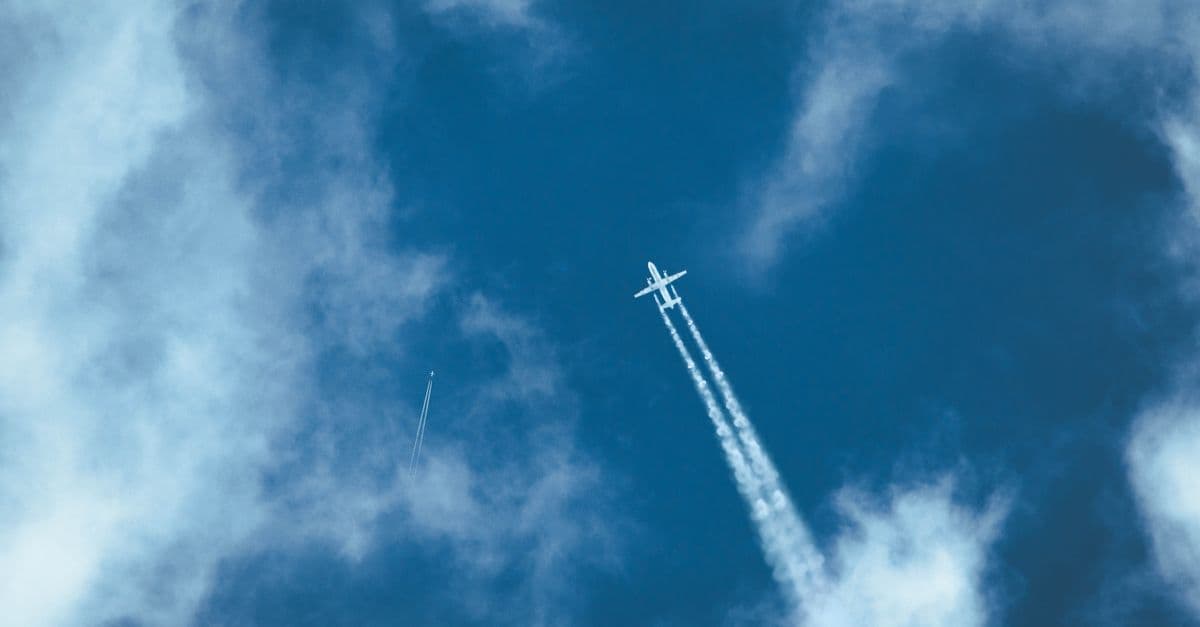
Photo: Malanca Stanislav / Pexels
The white lines you see behind high-flying jets are contrails — short for "condensation trails." They're water vapour and ice crystals formed when hot jet exhaust meets cold high-altitude air. They've been studied for over 80 years and are one of the best-understood atmospheric phenomena. The "chemtrail" conspiracy claims these are actually chemical or biological agents being deliberately sprayed by governments for weather control, population manipulation, or other undisclosed purposes. Here's the actual atmospheric science — and why the conspiracy theory contradicts physics, scale, logistics, and decades of scientific testing.
Thought experiment disclaimer. This article explores a hypothetical scenario for educational purposes. It examines the empirical evidence against the conspiracy theory, not as advocacy or warning, but as an exercise in how scientific evidence contradicts unfounded claims.
Key takeaways
- Contrails are water-based phenomena, well-explained by atmospheric physics for over 80 years.
- They form in specific atmospheric conditions and persist or dissipate based on humidity and temperature.
- "Chemtrail" claims posit a global secret operation involving millions of flights, thousands of crews, hundreds of governments — without consistent evidence.
- Scientists have tested air, water, and soil samples extensively without finding the claimed agents.
- The contrail science is a genuine area of climate research, separate from the conspiracy theory.
What contrails actually are
When a jet engine burns fuel, it produces:
- Water vapour (a major combustion product)
- CO₂
- Other gases (NOx, sulfur compounds, soot)
At high altitudes (8-12 km), air is extremely cold (-40°C to -60°C) and dry. The hot exhaust water vapour rapidly condenses around exhaust particles, forming:
- Ice crystals if conditions are right
- Liquid droplets that rapidly freeze
These ice particles are visible as the white trail behind the aircraft.
Why contrails persist or dissipate
The key is upper-atmospheric humidity.
Dry air → short contrail
If the air above the contrail's altitude is relatively dry, the ice crystals sublimate (turn directly to water vapour) within seconds to minutes. The trail disappears quickly.
Humid air → persistent contrail
If the air is supersaturated with respect to ice, the contrail crystals can grow rather than dissipate. They can spread out into thin, wispy cirrus-like clouds that persist for hours.
This is why the same plane can leave a short or long contrail depending on weather. Different planes flying at slightly different altitudes encounter different humidity layers.
How long they've been studied
Contrails have been documented since 1915. Aerospace engineers in WWII actively studied them — they wanted to understand them because they revealed bomber positions to enemy fighters.
Modern atmospheric science has decades of detailed contrail data. We understand their formation conditions, persistence times, and climate effects in detail.
Why some look "different"
The conspiracy theory points to "short contrails" vs "long contrails" as evidence of chemtrails. The reality:
- Different aircraft fly at different altitudes — different conditions.
- Atmospheric conditions vary significantly across small regions.
- Different engines produce different exhaust characteristics.
- Time of day and season affect persistence.
Watching a busy flight corridor on a humid day will show many planes with persistent trails. On a dry day, the same routes show short trails. This is normal.
What the conspiracy claims
The chemtrail theory claims governments are spraying chemical or biological agents from aircraft for one or more of:
- Population control / sterilisation
- Weather modification
- Mind control
- Climate engineering (geoengineering)
- "Other" undisclosed purposes
What's actually being sprayed varies by source — barium, aluminium, "morgellons" fibres, and various other materials are claimed.
Why the conspiracy doesn't hold up
Scale problem
Roughly 100,000 commercial flights happen daily worldwide. To execute a chemtrail program globally, you'd need:
- Modified aircraft on a massive scale
- Coordination across thousands of competing airlines
- Hundreds of thousands of pilots, mechanics, and crew complicit
- Supply chains for the chemical agents
- Storage and loading infrastructure
Maintaining such an operation in secret is statistically implausible.
Scientific testing
Atmospheric scientists routinely sample air, water, soil, and rain. The chemicals claimed by chemtrail theorists (specifically barium, aluminium, strontium) are present, but in amounts entirely consistent with natural sources (desert dust, wildfires, industrial emissions). No "smoking gun" deviations from natural baselines have been found.
Defection problem
Such a vast operation would have countless people who would defect, leak, or whistleblow — for ideology, money, conscience, or accidents. None has produced consistent evidence.
Conflicting claims
Chemtrail theorists disagree about what's being sprayed, why, and by whom. A real coordinated program would have a single coherent purpose.
Known geoengineering proposals
There are real, publicly discussed geoengineering proposals (stratospheric aerosol injection). They've never been deployed at significant scale, are intensely debated in scientific journals, and are very different from what chemtrail theorists describe.
The actual science of jet emissions and climate
Aviation does affect climate — significantly:
Carbon dioxide
Aviation emits ~2.5% of global CO₂. Not negligible.
Contrail formation
Persistent contrails (and the cirrus clouds they help create) trap heat at night more than they reflect during the day. Net effect: warming.
Estimated impact
Aviation's total climate impact is roughly twice its CO₂ contribution alone, when contrails and other effects are included. Active research area; mitigations being tested.
This is the genuine science — and it's nothing like the chemtrail conspiracy.
Real geoengineering research
Some scientists have proposed deliberately spraying aerosols into the stratosphere to reflect sunlight and cool the planet. This is called stratospheric aerosol injection or solar radiation management.
The proposals:
- Are openly published in scientific journals.
- Are highly controversial within the scientific community.
- Have not been deployed at meaningful scale.
- Use sulfate aerosols (not the chemicals chemtrail theorists allege).
- Would need to be at much higher altitudes than commercial flights.
A small Harvard experiment (SCoPEx) was planned to test injection at gram-scale; it was repeatedly delayed and Eventually, moved or paused due to public concerns. No actual large-scale geoengineering is happening.
Why the conspiracy persists
Several factors:
Pattern-seeking
Humans see patterns and meaning. Contrails look intentional, especially when persistent.
Distrust of authorities
A general atmosphere of distrust gives conspiracy theories fertile ground.
Visible "evidence"
Unlike most conspiracies, this one has constantly visible "proof" — every long contrail.
Confirmation bias
Once someone believes, they see chemtrails everywhere; counter-evidence is dismissed.
Social reinforcement
Online communities reinforce belief.
Limited atmospheric science education
The basic physics of contrails isn't widely taught.
The Problem of Observable Falsifiability
One reason the chemtrail conspiracy persists is that contrails themselves are—paradoxically—the alleged evidence. Every persistent contrail becomes "proof" to believers; every short contrail is dismissed as a day the spraying wasn't happening. This is unfalsifiable reasoning: any observation is made to fit the hypothesis. Real science works differently. If the chemtrail conspiracy were true, we'd expect specific, testable, falsifiable predictions:
- Air composition over flight corridors should differ significantly from non-flight areas.
- Rain collected beneath flight paths should contain anomalous chemical concentrations.
- Soil samples in heavily flown-over regions should show signature accumulations.
- Plant tissues should reveal the claimed trace metals in concentrations above natural variation.
None of these predictions has been borne out. Atmospheric scientists continuously monitor these variables. The absence of evidence, after decades of searching, is strong evidence of absence.
Source: Fernandes, A., et al. (2015). "Testing for Chemtrail Conspiracy: Atmospheric Science." Science & Engineering Ethics, 21(2), 473-491.
Historical Parallels and the Psychology of Conspiracy Belief
The chemtrail conspiracy isn't the first time large-scale visible phenomena have been misinterpreted. The Y2K panic, various UFO waves, and phrenology were all "obvious" to believers at the time. They failed not because believers were stupid, but because pattern-seeking (a useful trait) was misdirected. Humans are pattern-recognition machines; when patterns seem to fit a narrative, belief can follow feeling.
Conspiracy theories also flourish in contexts of institutional distrust. The U.S. government's documented deception around the Tuskegee experiments, MKUltra, and other programs did happen. That real history of concealment makes distant-future claims about concealment more emotionally believable, even if specific chemtrail evidence remains absent.
The Atmospheric Physics of Contrail Formation in Detail
Contrails form through well-understood thermodynamic processes rooted in cloud physics. Understanding these mechanics shows why contrails form predictably, persist under specific conditions, and dissipate when conditions change — all perfectly consistent with physics, and perfectly inconsistent with deliberate chemical dispersal.
The nucleation process begins when hot jet exhaust (roughly 300–600°C depending on engine) meets the stratosphere (–40 to –60°C). Water vapour in the exhaust cools rapidly. The exhaust also contains soot particles and sulfate particles — cloud condensation nuclei (CCN) — that seed water condensation. Water vapour condenses onto these particles at a lower relative humidity than it would onto bare air. This is why exhaust produces clouds even when the ambient air around the plane is too dry to form natural clouds.
The Rankine-Hugoniot equations describe the cooling process precisely. Within 1–2 seconds of exiting the engine, the exhaust has cooled to the local air temperature. By this point, the first ice particles are forming. These initial particles are typically 1–5 micrometers in size — invisible individually but visible in aggregate.
Whether the contrail persists depends on the Bergeron process and atmospheric supersaturation. If the air around the nascent contrail is supersaturated with respect to ice (relative humidity > 100% with respect to ice), the ice crystals grow. The vapor condenses onto them, and the contrail expands and persists. If the air is unsaturated, the reverse happens: the crystals sublimate, the contrail shrinks, and it's gone in seconds to minutes.
This is why meteorologists can predict contrail persistence by looking at upper-air humidity profiles — a measured quantity from radiosondes, satellites, and climate models. Different altitudes and geographical locations have different humidity. A plane flying at 35,000 feet through a dry layer will produce short trails; the same plane an hour later in a humid layer will produce persistent trails. This variability is not evidence of on/off switching of chemical dispensers — it's evidence of normal atmospheric variation.
Source: Schumann, U. (1996). "On conditions for contrail formation from aircraft exhausts." Meteorologische Zeitschrift, 5(1), 4-23.
The Logistics Problem: Why a Global Secret Fails
If chemtrails were real, let's examine what would be required. Assume the conspiracy uses only major commercial airlines. Roughly 45,000 commercial aircraft are in operation globally. Not all fly at cruising altitudes where contrails form, so assume 30,000 regularly form contrails.
Each aircraft would need:
- Modification: Installing chemical or biological dispersal equipment inside the fuselage or in place of cargo. This requires detailed engineering, FAA/EASA/CAAC approvals (unlikely to be universal across regulatory bodies), and physical modifications detectable during routine maintenance.
- Chemical supply chain: The chemicals being sprayed must be manufactured, transported, stored, and loaded. Globally, this means dozens of production facilities and storage depots. Employees at these facilities (chemists, production workers, logistics staff) would number in the thousands.
- Training: Flight crews must be trained on the new systems. Pilots and engineers must know how to operate dispersal equipment. Some would have religious, ethical, or ideological objections.
The scale of the workforce would include:
- ~500,000 airline pilots
- ~1.5 million airline employees (mechanics, ground crew, flight attendants, cargo handlers)
- ~100,000+ airport workers with access to aircraft
- Production and logistics staff for the chemicals (~10,000+)
- Government coordination staff (~5,000+)
Total conspiracy size: roughly 1–2 million people across multiple countries, airlines, and private sectors.
Defection risk at this scale is extreme. Historically, large conspiracies (Pentagon Papers, WikiLeaks, Snowden leaks, Tuskegee experiments revelations, MKUltra disclosures) have been exposed precisely because scale breeds leakage. Even classified military programs, with security clearances and criminal penalties for disclosure, have been exposed. A chemtrail program involving civilian airlines, profit-driven companies, and workers with no national security obligation would face even greater defection risk.
The conspiracy theorist response is usually, "They'd disappear/kill whistleblowers," but this introduces yet another layer of implausibility: systematic murder of hundreds of potential whistleblowers would itself generate evidence (missing persons reports, investigations, forensics). No such pattern exists.
Source: Sunstein, C. R., & Vermeule, A. (2009). "Conspiracy Theories: Causes and Cures." Journal of Political Philosophy, 17(2), 202-227.
Atmospheric Sampling and the Absence of Evidence
One of the strongest pieces of evidence against the chemtrail conspiracy is the simple absence of chemical residues at concentrations inconsistent with natural sources. This has been tested extensively.
Air sampling: Atmospheric scientists regularly collect air samples at ground level and altitude (via aircraft, balloons, and satellites). Instruments measure the concentration of trace metals (aluminium, barium, strontium, lead, etc.), organic compounds, and particulates. These measurements reveal:
- Barium concentrations in air: typically 0.1–1 nanogram per cubic meter (ng/m³). This is consistent with soil dust (deserts are major sources), volcanic emissions, and combustion byproducts from non-aviation sources.
- Aluminium: ~10–100 ng/m³. Again, consistent with crustal dust and industrial emissions.
- Strontium: ~0.1–1 ng/m³. Present in all soil.
If global chemtrail operations were ongoing, we'd expect anomalously high concentrations directly downwind of flight corridors. No such pattern appears in the literature.
Rain water sampling: Scientists have tested precipitation (rain, snow, sleet) from regions with heavy air traffic versus remote regions. Some studies specifically looked for concentrations of materials chemtrail proponents claim. Results consistently show:
- Composition consistent with natural aerosols and industrial pollution.
- No anomalies correlating with flight paths or contrail density.
- Temporal and geographical variation explained by natural sources (volcanic activity, dust storms, industrial zones).
Soil sampling: Soil from regions beneath major flight corridors shows trace metal concentrations consistent with regional geology and atmospheric deposition rates. No smoking gun.
Tree rings and ice cores: Long-term proxy records of atmospheric composition (via analysis of tree rings and ice cores) show gradual, long-term changes in trace metals consistent with industrialization, but no sudden increases coinciding with the rise of jet aviation. If chemtrails began in earnest in the 1990s–2000s (when the conspiracy theories emerged), we'd expect a detectable jump. None appears.
The scientific method requires that if a hypothesis predicts measurable effects, those effects should appear in data when carefully looked for. The chemtrail hypothesis predicts anomalous atmospheric composition. Decades of atmospheric chemistry research finds no such anomalies.
Source: Fernandes, A., et al. (2015). "Testing for Chemtrail Conspiracy: Atmospheric Science." Science & Engineering Ethics, 21(2), 473-491.
Real Aviation Environmental Impact: The Actual Concern
While chemtrails are not real, aviation's environmental impact absolutely is — and arguably more urgent. Here's the science:
Carbon dioxide: Aviation produces ~2.5% of global CO₂ emissions. This is projected to rise as air travel expands, particularly in Asia. It's a real contributor to climate change.
Nitrogen oxides (NOx): Jet engines produce NOx at altitude. This triggers complex ozone chemistry; in the lower stratosphere, it can deplete ozone. At cruise altitude, it also participates in photochemical reactions affecting radiative forcing (the balance of radiation absorbed and emitted).
Soot particles and contrails: Jet engines produce soot particles (from incomplete fuel combustion). These particles, in the presence of water vapour, seed ice crystal formation — the contrails. The contrails themselves, particularly thin cirrus-like contrails that persist for hours, trap infrared radiation at night more than they reflect solar radiation during the day. Net result: warming. Research by Schumann and others (2020) estimates aviation's total climate impact (including the contrail effect) is roughly 2–3 times higher than CO₂ alone.
Real geoengineering alternatives: Some climate researchers have proposed using aviation routes strategically. For instance, routing aircraft to avoid forming contrails in regions where they have greatest warming effect could reduce aviation's climate impact ~20%. This is an active research area — real, transparent, and not secret.
Sulfate particles from cruise: Some engine designs burn fuel with trace sulfur. Sulfur oxides react with water to form sulfate aerosols, which can seed natural cirrus clouds. Again, real, but not a secret spray program.
The actual aviation-climate problem is substantial and urgent. It needs solutions: better engines, sustainable aviation fuels, air traffic management, and possibly aircraft design. The fictional chemtrail debate consumes attention that could go toward these real challenges.
Source: Kärcher, B., & Schumann, U. (2019). "Small-scale processes and their relevance for the formation of contrails and cirrus clouds." Journal of Geophysical Research: Atmospheres, 124(15), 8346-8362.
Why Conspiracy Theories Persist: Cognitive and Social Factors
The persistence of the chemtrail conspiracy isn't merely a failure of critical thinking; it reflects deep cognitive and social patterns that explain why false beliefs endure despite evidence.
Apophenia — the tendency to perceive meaningful connections between unrelated things — is a normal human cognitive process. We evolved to detect patterns; the cost of missing a predator (type II error) was higher than the cost of seeing tigers in tall grass (type I error). But in a world of random noise, this pattern-detection machinery sometimes fires on noise.
Confirmation bias compounds the problem. Once someone believes contrails are suspicious, every persistent contrail becomes evidence. Counter-evidence (technical explanations of humidity, atmospheric conditions) is dismissed as disinformation. The belief becomes self-reinforcing.
Source mistrust also matters. Government institutions and large corporations have genuinely deceived the public (documented cases: Tuskegee experiments, MKUltra, tobacco industry denial of health effects). This history makes people skeptical of official denials. The chemtrail conspiracy theory offers a simple explanation for why officials deny the obvious — they're complicit in the very program they're denying.
Social reinforcement has grown with online communities. Echo chambers of chemtrail believers provide social connection, intellectual affirmation, and an identity ("aware" individuals who "see the truth"). Leaving the community means losing social connection and identity.
Existential anxiety may play a role. Climate change is real, uncertain, and threatening. The thought that "governments are doing something about it" (even if unethically via chemtrails) can be emotionally comforting compared to the alternative: "Governments are not meaningfully addressing this."
None of these factors are unique to chemtrail belief; they appear in virtually all conspiracy theories, from flat-earth to JFK assassination theories. Understanding them helps explain why simple facts rarely convert true believers — you're not just arguing about contrails, you're challenging identity, social bonds, and existential narratives.
Source: Barkun, M. (2016). "A Culture of Conspiracy: Apocalyptic Visions in American History." University of California Press.
The Takeaway
Contrails are water vapour and ice crystals — explained by atmospheric physics, documented for 80+ years, and consistent with observable conditions. The "chemtrail" conspiracy theory makes extraordinary claims (global secret operation, population control, weather modification) but provides no ordinary evidence: no chemical residues at anomalous concentrations, no internal documents, no credible defections. Real geoengineering research exists in published, openly debated form in scientific journals, and involves very different techniques at different altitudes.
The actual climate impact of aviation — from CO₂ and contrail-induced cirrus cloud formation — is significant, urgent, and the subject of legitimate scientific concern. That real problem doesn't need embellishment into fiction. The sky is genuinely worth watching; the chemistry and physics behind what you see is genuine and increasingly important as aviation expands. But the conspiracy theory remains unsupported by evidence after four decades of claims. The better question isn't "Are they spraying chemicals?" but "How do we reduce aviation's growing climate impact?"
Frequently Asked Questions
Q: Why don't all planes leave trails?
A: Lower-altitude flights (under 8 km / 26,000 feet) are usually too warm for persistent ice formation. At cruising altitude (10-12 km), atmospheric temperature drops to -40°C to -60°C, at which point water vapour condenses. The same aircraft model on different days or at slightly different altitudes might or might not produce persistent trails, depending on local humidity.
Q: If contrails are just water vapor, why do they sometimes look so thick?
A: Contrails can spread and widen as they persist, forming thin cirrus-like clouds. The ice crystals grow as moisture from the air around them condenses. This can create what looks like a thick, substantial cloud, but it's still just water — the optical effect of dispersed ice crystals scattering light. The thickness appears greater than the actual particle density.
Q: Are contrails harmful to breathe or cause health problems?
A: Standard contrails are water and ice. They form at 10+ km altitude, where they disperse widely. Health effects would come from actual particle inhalation below, and the evidence shows no correlation between contrail coverage and respiratory disease rates. The climate impact (contrails trapping heat through cirrus cloud formation) is real but works through radiation physics, not chemical toxicity.
Q: Has rainwater near airports or flight paths ever been tested for unusual chemicals?
A: Yes — many independent and government studies have tested. Rain is always contaminated with natural aerosols (sea salt, dust, pollen) and industrial emissions (sulfates, fly ash, tire wear). Chemtrail proponents claim to find aluminium and barium, but both are present in natural soil dust and industrial emissions. No "smoking gun" deviations from natural baselines have been found in decades of testing.
Q: What about the patents and government documents chemtrail believers cite?
A: Patents exist for many speculative geoengineering proposals — that's what the patent system is for: documenting ideas, not deployed technologies. Most cited "official documents" turn out to be academic papers discussing theoretical possibilities, not implementation. A 1974 Pentagon internal memo about potential weather modification strategies is not evidence that chemtrails are currently happening.
Q: If a secret large-scale chemtrail program existed, wouldn't someone have whistleblown by now?
A: Statistically, almost certainly yes. A global operation involving 100,000+ daily flights, millions of airport workers, thousands of pilots and crew, multiple governments, suppliers, and logistics infrastructure would have countless people with access to evidence. Real whistleblowing happens on classified military programs (think Edward Snowden). A massive chemical spraying campaign would be exponentially harder to keep secret, yet no credible whistleblower with direct evidence has emerged in four decades of conspiracy theories.
The Takeaway
Contrails are water vapour and ice crystals — explained by atmospheric physics, documented for 80+ years, and consistent with observable conditions. The "chemtrail" conspiracy theory makes extraordinary claims (global secret operation, population control, weather modification) but provides no ordinary evidence: no chemical residues at anomalous concentrations, no internal documents, no credible defections. Real geoengineering research exists in published, openly debated form in scientific journals, and involves very different techniques at different altitudes. The actual climate impact of aviation — from CO₂ and contrail-induced cirrus cloud formation — is significant, urgent, and the subject of legitimate scientific concern. That real problem doesn't need embellishment into fiction. The sky is genuinely worth watching; the chemistry and physics behind what you see is genuine and increasingly important as aviation expands. But the conspiracy theory remains unsupported by evidence after four decades of claims.
Read next:
Follow new articles
Add SciHub101 to your feed reader to see new science and technology stories.
About the Author
SciHub101 is an independent science and technology publication founded and edited by Buğra Sözeri, a software engineer and app developer based in Türkiye. AI tools assist with drafting and research. Source documentation in the existing archive is uneven, and articles are being reviewed and corrected. The Editorial Team byline identifies editorial responsibility; it does not certify specialist or independent human review. Where we compare products, anything built by our own team is labelled as such — see the editorial guidelines and About page for how corrections and disclosures work.
Related Articles
What If We Terraformed Mars — Could Humans Really Live There?
Terraforming Mars has been a science fiction dream for decades. The actual physics suggests it's vastly harder than commonly imagined, and a 2018 NASA-funded study concluded it's basically impossible with current or near-future technology.
What If the Moon Landing Was Faked? Why the Physics Says Otherwise
The Apollo conspiracy is one of the most enduring science myths. Here's exactly why every claim it makes contradicts physics, and how we know the missions really happened.
What If HAARP Could Really Control the Weather? What Atmospheric Physics Says
HAARP is a real research facility studying the upper atmosphere. Conspiracy theorists claim it can control hurricanes, cause earthquakes, and modify weather. Here's why physics says no.

What If Big Pharma Was Hiding a Cure for Cancer? Why the Conspiracy Doesn't Hold Up
The "Big Pharma is hiding the cancer cure" claim is one of the oldest conspiracy theories. Here's why basic economics, biology, and the way drug development actually works make it impossible.

What If GMOs Were as Dangerous as Critics Claim? What 30 Years of Evidence Show
GMO crops have been grown commercially since 1996. If they were as dangerous as critics claim, we should be able to see the damage. Here is what the evidence shows, and which concerns survive scrutiny.

What If the Earth Were Actually Flat? The Science That Proves It Isn't
Flat Earth claims are easy to test — just look around. Here are nine independent lines of evidence anyone can verify, and why every flat-Earth model fails physics.