Atmospheric Composition Studies on Mars: Understanding Thin Air
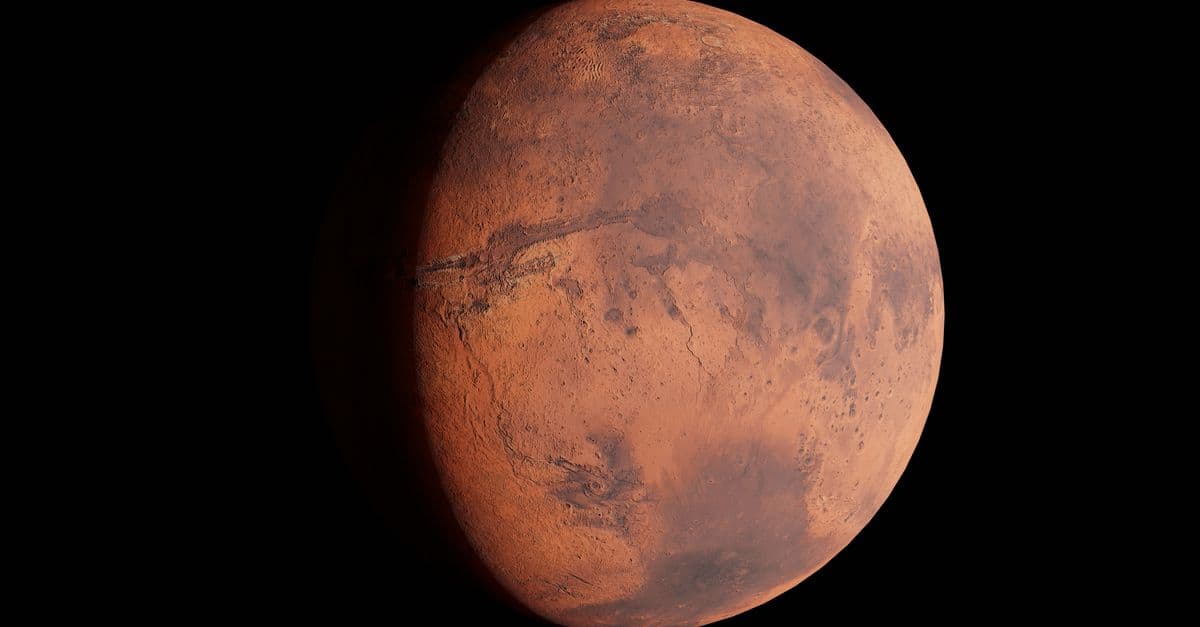
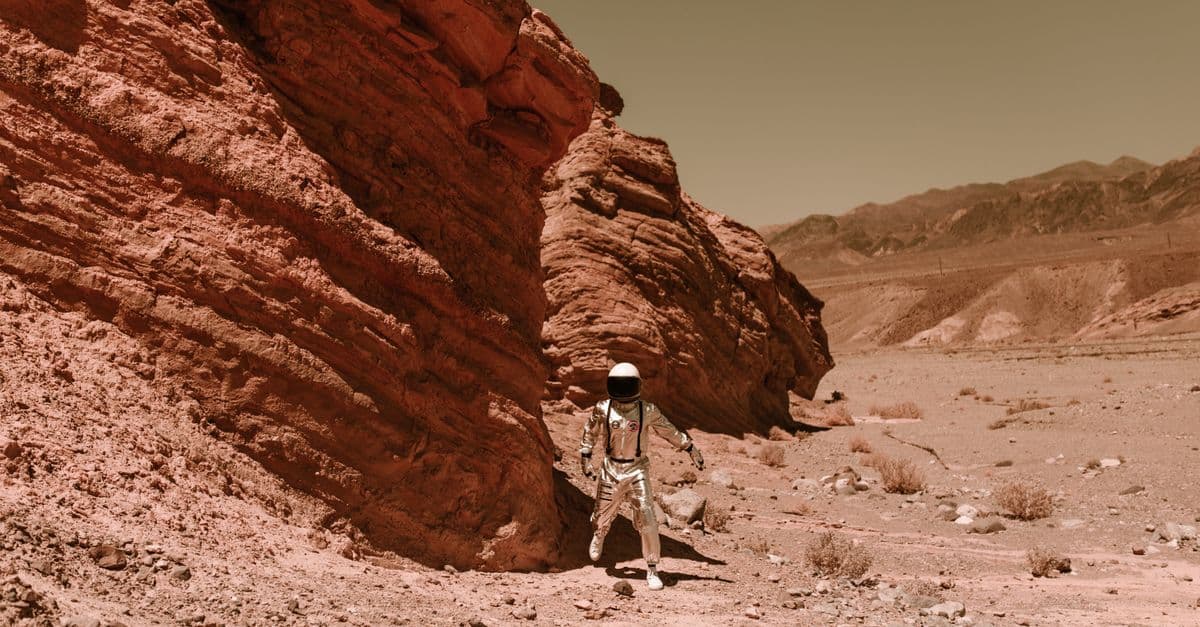
Photo: Zelch Csaba / Pexels
The Mars atmosphere composition looks nothing like the air in your lungs right now. NASA's fact sheet lists it as 95.1% carbon dioxide, 2.59% nitrogen, 1.94% argon, and only 0.16% oxygen, pressing on the surface with about 636 pascals (Pa) of force where Earth manages 101,325 Pa. Every number in that sentence has a history behind it: a core that cooled, a magnetic field that died, and a planet that slowly lost its air to space. This article walks through what Mars's air contains, how instruments measured it, and what the leftovers reveal.
What Mars's air is made of
Start with the headline numbers. The table below sets NASA's published values for Mars next to Earth's, both by volume, so you can see how different two rocky planets' air can be.
| Gas | Mars (percent by volume) | Earth, dry air (percent by volume) |
|---|---|---|
| Carbon dioxide (CO2) | 95.1% | 0.042% (420 ppm) |
| Nitrogen (N2) | 2.59% | 78.08% |
| Argon (Ar) | 1.94% | 0.934% (9,340 ppm) |
| Oxygen (O2) | 0.16% | 20.95% |
| Carbon monoxide (CO) | 0.06% | not listed |
| Water vapor (H2O) | 210 ppm, variable | about 1%, variable |
Sources: NASA Goddard Mars Fact Sheet and Earth Fact Sheet. Other compilations give slightly different Mars percentages (for example 94.9% CO2 and 1.9% argon) because the numbers come from different instruments and sites.
Percentages hide something important, though. Earth's air is thick, so even its tiny fractions add up to a lot of molecules. Mars's air is thin, so a percentage there means far fewer molecules. A better comparison is partial pressure, the share of total pressure that each gas contributes. The arithmetic below uses the NASA percentages above, Mars's 636 Pa, and Earth's 101,325 Pa.
| Gas | Mars partial pressure | Earth partial pressure | Ratio |
|---|---|---|---|
| CO2 | about 605 Pa | about 43 Pa | Mars has roughly 14 times more |
| Argon | about 12 Pa | about 946 Pa | Earth has roughly 77 times more |
| Nitrogen | about 16 Pa | about 79,100 Pa | Earth has roughly 4,800 times more |
| Oxygen | about 1 Pa | about 21,200 Pa | Earth has roughly 21,000 times more |
Calculated by SciHub101 from the NASA fact-sheet percentages and surface pressures cited above.
Look at the first row. Mars has more carbon dioxide pressing on each square meter of its surface than Earth does, despite having an atmosphere that is about 160 times thinner overall. That is why the planet's air is a plausible raw material for oxygen and fuel, and also why it cannot keep the planet warm. Carbon dioxide is a greenhouse gas, but a thin layer of it only does so much.
The thinnest air is not the biggest surprise. Mars's atmosphere holds more carbon dioxide per square meter of surface than Earth's does, yet it still warms the planet by only about 5 °C, compared with about 33 °C of greenhouse warming on Earth (figures compiled in Wikipedia's Atmosphere of Mars article, citing Haberle 2015).
The trace gases that matter more than their size
Below the major gases sit trace species that punch above their weight. NASA's fact sheet lists nitrogen oxide at 100 ppm, neon at 2.5 ppm, krypton at 0.3 ppm, and xenon at 0.08 ppm. Heavy water (HDO, water with one hydrogen replaced by deuterium) appears at 0.85 ppm. None of these will matter to a future crew breathing or driving. All of them matter to scientists, because noble gases and isotopes are chemical fingerprints. They do not react with rock, and they do not get consumed by life, so they preserve records of what the atmosphere has been through.
Why 636 pascals changes everything
Pressure is the force that gas molecules exert on a surface, measured in pascals (one pascal is one newton of force per square meter). NASA's fact sheet gives a surface pressure of 6.36 millibars (636 Pa) at Mars's mean radius, ranging from 4.0 to 8.7 millibars (400 to 870 Pa) across the seasons. Earth's sea-level pressure is 101,325 Pa, so the ratio is about 160 to one. Surface density tells the same story: NASA lists roughly 0.016 kilograms per cubic meter on Mars against 1.217 on Earth, so Mars's surface air is only about one percent as dense.
Think of Earth's atmosphere as a thick wool blanket and Mars's as a sheet of tissue paper. The blanket holds heat, blocks most meteoroids, and presses on liquid water hard enough to stop it boiling away. The tissue paper does none of those things well. NASA notes that Mars's sparse air gives little protection against meteorites, asteroids, and comets, and that because the atmosphere is so thin, heat from the Sun easily escapes the planet.
Why liquid water cannot last
Water needs enough pressure to stay liquid at a given temperature. On Mars the surface pressure is low enough that liquid water is unstable across most of the planet: it freezes, or it evaporates (or sublimates, going straight from ice to vapor). NASA's Mars facts page says the thin atmosphere means liquid water cannot persist on the surface for long. This is a planetary-scale effect of composition and pressure, not just of temperature. It is also why ancient river valleys and lake deposits, documented in the article on Mars water evidence, imply an atmosphere that was once very different.
What the temperature range says
The thin air also cannot even out temperature between day and night. NASA's fact sheet gives an average of about 214 K (minus 59 °C), and a diurnal range at the Viking 1 lander site of 184 K to 242 K (minus 89 °C to minus 31 °C). NASA's broader Mars facts page says temperatures can reach about 20 °C at the warmest and fall to roughly minus 153 °C at the coldest. Standing at the equator at noon, NASA says, your feet would be near 24 °C while your head sat near 0 °C. On Earth, air mixes that gradient away within minutes. On Mars, it persists.
Could a person simply breathe filtered Martian air?
No, and the reason is pressure, not chemistry. The Armstrong limit is the pressure at which water boils at body temperature, about 6.25 kilopascals, or 6,250 Pa. Below that, exposed fluids such as saliva, tears, and the moisture lining the lungs' air sacs boil away unless the person wears a full-body pressure suit. (This is a common point of confusion: blood inside the circulatory system is not part of the effect.) Mars's surface pressure is around a tenth of the Armstrong limit, so even a hypothetical mask that supplied pure oxygen would fail. Humans on Mars need pressurized suits and habitats, whatever the gas mix.
For perspective on how little oxygen is available, 0.16% of 636 Pa is roughly one pascal of oxygen. Earth's air supplies about 21,000 Pa. See the challenges laid out in the article on whether humans can live on Mars.
How rovers and orbiters measure a thin atmosphere
Measuring something that thin, on another planet, is a real engineering problem. The record comes from several kinds of instrument that agree with each other more often than not.
Landers and rovers sample the air directly. Curiosity landed in Gale crater on August 6, 2012. Its Sample Analysis at Mars (SAM) instrument suite contains three main tools: a quadrupole mass spectrometer (QMS), a gas chromatograph (GC), and a tunable laser spectrometer (TLS). The mass spectrometer sorts molecules by their mass-to-charge ratio, like a sieve that separates gravel by size. The gas chromatograph separates mixtures by how fast each component moves through a column. The laser spectrometer shines light through a gas sample and measures which wavelengths are absorbed, which is how it measures isotope ratios in carbon dioxide and methane precisely enough to help distinguish geochemical sources from biological ones.
Orbiters sample from above. NASA's MAVEN (Mars Atmosphere and Volatile EvolutioN) spacecraft launched on November 18, 2013, and entered Mars orbit in September 2014. It was the first mission devoted to understanding the Martian upper atmosphere. According to NASA, contact with MAVEN was lost on December 6, 2025, and the agency declared the end of the mission on June 3, 2026, after a review board determined the spacecraft was not recoverable. Why multiple methods matter. A rover measures one location and one season. An orbiter measures global columns of gas. A laser can see isotopes that a mass spectrometer struggles to separate. When three methods point to the same answer, scientists trust it. When they do not, as with methane, a debate begins (more on that below).
Dating the measurements
Many composition values have been refined over decades. NASA's fact sheet, for example, reports wind speeds and the diurnal temperature range from the Viking landers, while recent isotope values come from Curiosity. When you read a Mars figure, check which instrument and which season it describes. The same gas can read differently in different places, because Mars's air changes with the seasons.
The carbon dioxide cycle: a planet that breathes
Mars's atmosphere is not static. A large fraction of it freezes onto the poles every winter and returns to the air in spring. Wikipedia's compilation (citing published seasonal-cycle studies) puts the annual pressure swing at about 25%, and NASA's fact sheet range of 400 to 870 Pa is consistent with a variation of that order. In the winter polar regions, carbon dioxide condenses into a dry ice layer roughly one to two meters thick. Surface air density in southern winter runs about 25% lower than in spring and autumn, because carbon dioxide freezes into the south polar cap. The northern winter effect is smaller because of Mars's eccentric orbit.
Imagine a tire that deflates and reinflates every year, with the air going into a freezer instead of leaking out. That is a rough picture of the carbon dioxide cycle. It matters for three reasons.
- It sets the weather. Pressure differences between hemispheres drive winds, and seasonal winds lift dust. See Mars dust storm research for what follows.
- It changes what any instrument measures. The same site reads differently in the thick-air season and the thin-air season, so a single reading is a snapshot.
- It reveals how little buffer exists. If a quarter of the air can freeze out and return each year, there is clearly little reservoir of gas to hold the atmosphere steady.
The other gases do not freeze at these temperatures, so they become more concentrated in the remaining air when carbon dioxide condenses. That means the percentages in the table above are annual averages for a moving target, not constants.
Argon and nitrogen as fossils of a lost atmosphere
If Mars once had a thicker atmosphere, as the geology suggests, where did it go? The best evidence is not in the carbon dioxide, which can hide in rock and ice. It is in the isotopes of lighter and heavier gases, which tell the story of what escaped.
An isotope is a version of an element with a different number of neutrons. Lighter isotopes escape into space more easily than heavier ones, in the same way that a small ball is easier to throw over a wall than a large one. If a planet loses a lot of atmosphere to space, the remaining gas becomes enriched in the heavier isotopes. Mars shows exactly that pattern, according to values compiled in Wikipedia's Atmosphere of Mars article:
| Ratio | Mars | Earth | What it suggests |
|---|---|---|---|
| Nitrogen-14 to nitrogen-15 (atoms of the lighter isotope per atom of the heavier) | 173 (plus or minus 9) | 272 | Lower on Mars, so the heavy isotope is relatively more abundant |
| Argon-40 to argon-36 | 1,900 (plus or minus 300) | 298.56 | Light argon-36 escaped preferentially |
| Deuterium to hydrogen (in water) | 9.3 (plus or minus 1.7) x 10^-4 | 1.56 x 10^-4 | About six times more deuterium than Earth |
Two of those rows read cleanly. The argon-40 to argon-36 ratio on Mars is about six times Earth's, which is what you expect if the lighter argon-36 leaked away faster over billions of years. The deuterium-to-hydrogen ratio is about six times Earth's as well, consistent with ordinary hydrogen escaping faster than its heavier twin. Estimates cited in the same compilation put the water lost this way at a global layer 12 meters to more than 30 meters deep.
The nitrogen row reads the other way around, so take care with it. Here the ratio counts light atoms per heavy atom, which means a smaller number is a heavier mix. Mars scores 173 against Earth's 272. The compilation describes Mars as enriched in nitrogen-15, "likely from mass-selective escape." The takeaway is the same as for argon: the lighter nitrogen left first, and the heavier kind stayed behind.
How much was lost
Numbers here are estimates and they vary by method. The compilation cites work on MAVEN data suggesting that Mars may have lost up to 65% of its argon through sputtering, a process in which fast solar-wind ions slam into the upper atmosphere and knock atoms out of it, like a cue ball breaking a rack. One early model cited in the same article estimated that impacts alone could have removed up to 99% of the initial atmosphere by the end of the Late Heavy Bombardment. These are not competing facts so much as different parts of a larger puzzle, and they carry real uncertainty. The deeper treatment lives in Why Mars Lost Most of Its Atmosphere.
The magnetic field connection
Earth's magnetic field deflects much of the solar wind. NASA states that Mars has no global magnetic field today, but some southern-hemisphere crust is strongly magnetized, which indicates a field existed about 4 billion years ago. Without a global field, the upper atmosphere is exposed directly to the solar wind and to ultraviolet light. MAVEN's observations helped scientists identify factors such as ultraviolet light and stellar wind and storms that increase atmospheric escape. The mission team reported in 2015 that atmospheric loss increases during solar storms.
Mars's low gravity also matters. NASA gives surface gravity of 3.73 meters per second squared on Mars (9.82 on Earth) and an escape velocity of 5.03 kilometers per second (11.186 on Earth). A molecule needs to reach 5.03 km/s to leave Mars for good, less than half what it needs on Earth.
The methane puzzle
Methane (CH4) is the most argued-over molecule in Mars science. On Earth, much atmospheric methane is made by living things, though geology contributes as well. Mars's methane is far scarcer, and the measurements disagree.
Here is what is known, according to the sources compiled in Wikipedia's atmosphere article and NASA's Curiosity coverage:
- Curiosity's spike. Four measurements over two months in late 2013 and early 2014 averaged about 7.2 parts per billion (ppb) by volume, according to a 2015 study. Readings before and after were roughly one-tenth of that.
- A seasonal pattern. Curiosity's SAM instrument detected seasonal variation in methane over nearly three Mars years (almost six Earth years). NASA describes low methane levels that rise in warm months and fall in winter each year, a seasonal "breathing."
- A missing signal from orbit. The ESA-Roscosmos Trace Gas Orbiter reported no methane, with a detection limit of 0.05 ppb.
- A long expected lifetime. The compilation cites a lifetime of about 400 years for methane in the Martian atmosphere under standard photochemistry.
- Local detections. The seasonal rover detections come from Gale crater, a single site.
Notice the tension. If methane lasts centuries, it should be well mixed and nearly uniform, not spiking and vanishing within weeks. If an orbiter sees none in the whole atmosphere while a rover sees a seasonal rhythm at one crater, the methane may be local, near the ground, or removed by a process nobody has identified yet. Researchers have proposed several explanations, none confirmed: gas seeping from underground, released during warm months, then trapped again when the ground cools; chemistry that destroys methane near the surface faster than expected; or measurement artifacts. A related puzzle is covered in Curiosity Rover: Methane Mystery on Mars.
Does methane mean life?
Not by itself. NASA notes that water-rock chemistry might have produced the methane, but biological origins cannot be ruled out. Methane can form when certain minerals react with water, and also as a by-product of some microbes. A trace gas cannot settle that, and the isotope ratios in the methane (which SAM's laser spectrometer is designed to measure) are one of the tools scientists use to tell sources apart. On its own, methane is a lead, not a finding.
Curiosity also found organic molecules in an ancient mudstone from a lake bed in Gale crater. NASA reported organic carbon concentrations of about 10 parts per million or more, roughly 100 times greater than earlier surface detections on Mars, with molecules including thiophenes, benzene, toluene, and small carbon chains. As NASA points out, organic molecules can form through non-biological processes, so they are not necessarily signs of life.
Oxygen: a trace gas that varies, and a gas we can make
Oxygen makes up 0.16% of Mars's air by NASA's fact-sheet figure (other compilations put it at 0.174%). Two observations make that small number interesting.
First, oxygen is not constant. Wikipedia's compilation reports a rise of about 30% in spring and summer at Gale crater, according to Curiosity data published in 2019. Seasonal changes in oxygen do not match what simple atmospheric models predict, which means something is adding or removing the gas, and the source is not yet settled. Think of it as a household budget where the balance rises and falls each year and nobody can find the receipts.
Second, humans have already made oxygen from the carbon dioxide on Mars, which brings us to MOXIE.
How MOXIE splits carbon dioxide
MOXIE (the Mars Oxygen In-Situ Resource Utilization Experiment) rode on the Perseverance rover. It compresses and heats Martian air, then uses solid oxide electrolysis at about 800 °C. Electricity drives the carbon dioxide molecule apart into oxygen ions and carbon monoxide. The ions combine into O2 at the anode. The net reaction is 2 CO2 turning into 2 CO plus one O2, and inert gases such as nitrogen and argon pass through unseparated.
According to Wikipedia's summary of the experiment:
| MOXIE fact | Value |
|---|---|
| First run | April 20, 2021, in Jezero crater, producing 5.37 g of oxygen |
| Total runs | 16, ending in August 2023 |
| Total oxygen produced | 122 g |
| Maximum rate | 12 g per hour (twice NASA's original goal) |
| Purity | 98% or better at its most efficient |
| Mass | 15 to 17 kg, depending on the specification cited |
For scale, 122 grams over the whole experiment is a tiny amount: at the 12 grams per hour ceiling it would take about 10 hours of running at maximum rate to make it. MOXIE was a proof of concept, not a production plant.
The scale-up problem
The same source describes a proposed system about 200 times larger, with a 25 to 30 kilowatt power plant, producing at least 2 kilograms of oxygen per hour for a crewed mission in the 2030s. At that rate, a year of running would yield roughly 17.5 metric tons, which is SciHub101's arithmetic from the stated rate, not a figure from the source. The source also estimates about 25 metric tons of oxygen needed for return propulsion versus about one metric ton for life support for four astronauts over a year.
The surprising part is that breathing is the small demand. Most of the oxygen a crew would need is for rocket propellant to get home. That is why oxygen production is central to settlement planning, discussed in more depth in Mars Settlement Engineering, and why the experiment on Perseverance is covered in Perseverance Rover: Astrobiology Search on Mars.
Nitrogen is a harder case. At 2.59% of a very thin atmosphere, it is a sparse resource (about 16 Pa, as calculated above), and plants and breathable air both need it. Any settlement would need to concentrate nitrogen from the air or find it in the ground. Mission planners have to account for it.
Dust, wind, and storms
Mars is known for dust, and the atmosphere's composition and density explain why storms there behave differently than on Earth.
Wind is gentle in force, strong in speed. NASA's fact sheet reports wind speeds at the Viking lander sites of 2 to 7 meters per second in summer, 5 to 10 in fall, and 17 to 30 during a dust storm. Those are respectable numbers: 30 meters per second is about 108 kilometers per hour. But force scales with air density, and Mars's air is about one percent as dense as Earth's. A 30 m/s wind on Mars pushes with only a small fraction of the force of the same wind on Earth. Wikipedia's compilation notes that winds above about 30 m/s are needed to lift dust.
Dust is fine and stays up. The same compilation gives an effective particle radius of 0.6 to 2 micrometers and a background dust optical depth of 0.15, which can exceed 4 during global events. NASA says that after the planet-wide storms, it can be months before the dust settles.
Storms come in sizes. Local storms cover about 1,000 square kilometers, and the compilation estimates around 2,000 occur per Martian year. Regional storms cover about a million square kilometers. Global storms occur on average once every three Martian years, roughly 5.5 Earth years. The 2018 global storm was detected on June 1, 2018, covered about a quarter of the planet by June 12, and ended the Opportunity rover's mission.
Dust affects composition too. It absorbs sunlight and heats the air. During dusty conditions, the day-night temperature swing can drop to about 5 °C, the compilation says. Dust also provides surfaces on which chemistry occurs. For the full story, read Mars Dust Storm Impact Research.
Why Mars cannot have an Earth-like hurricane
Hurricanes on Earth are heat engines. They draw energy from warm oceans and condense moist air into towers of cloud. Mars has no oceans, little water vapor (210 ppm per NASA), and thin air with little heat capacity. Dust can create strong local winds and warm the atmosphere, but the physical ingredients for an Earth-style hurricane are absent.
What the composition means for settlement and terraforming
Atmospheric composition frames almost every practical question about living on Mars.
- Carbon dioxide is plentiful. It is a raw material for oxygen, as MOXIE shows. With about 605 Pa of partial pressure, it is the one gas that is easy to collect.
- Oxygen is scarce, so it must be made. A gas that supplies about 1 Pa of oxygen cannot be filtered into breathable air.
- Nitrogen and argon are modest. They make up the buffer gas in a habitat, but have to be gathered from thin air or from soil.
- Pressure is the biggest hurdle. Habitats must hold pressure against a near-vacuum, and every suit must keep pressure above the Armstrong limit.
- Dust is part of the atmosphere. Fine particles with an effective radius under 2 micrometers hang in the air, and NASA says it can take months for the dust to settle after a planet-wide storm.
Can Mars be given a thicker atmosphere?
Proposals exist, but they run into arithmetic and physics. NASA's fact sheet lists the total atmospheric mass at about 2.5 times 10^16 kilograms, which looks large until you realize how much more would be needed to reach even a fraction of Earth's pressure. And as the isotope evidence shows, the planet has a long record of losing gas to space. Any thickened atmosphere would face the same escape processes unless something replaced the lost magnetic protection. The scenario is explored in more detail in What If We Terraformed Mars.
There is also a warming problem. A thicker carbon dioxide atmosphere would warm Mars, but the compilation notes that today's greenhouse warming is only about 5 °C. You would need a great deal more gas, and other sources of heat, to move the planet into a range where liquid water is stable.
Common misconceptions about the Martian atmosphere
"Mars has no atmosphere." It does, just a thin one. NASA lists a mass of about 2.5 times 10^16 kilograms of gas, enough for winds, dust storms, and aurora. MAVEN has detected several aurora events in the upper atmosphere, according to the compilation cited above.
"Your blood would boil." Not exactly. Below the Armstrong limit, exposed fluids boil at body temperature, but blood inside the circulatory system does not. The real danger is rapid unconsciousness, followed by death unless pressure is restored within about 60 to 90 seconds.
"Mars has a blue sky like ours." It does not. NASA says the sky would be hazy and red because of suspended dust, rather than blue.
"Methane proves there is life." It does not. Both geological and biological pathways can produce methane, and the observed pattern has not been explained.
"Carbon dioxide ought to make Mars warm." A greenhouse effect needs a lot of gas. At 636 Pa, even a 95% carbon dioxide atmosphere adds only about 5 °C of warming according to the compiled figures.
Frequently Asked Questions
Q: What is the Mars atmosphere composition?
A: According to NASA's Mars Fact Sheet, Mars's atmosphere is 95.1% carbon dioxide, 2.59% nitrogen, 1.94% argon, 0.16% oxygen, and 0.06% carbon monoxide by volume, with water vapor around 210 parts per million. Other compilations give slightly different percentages because instruments, locations, and seasons differ.
Q: How thin is the atmosphere of Mars compared with Earth?
A: NASA lists a surface pressure of about 636 pascals at Mars's mean radius, varying from 400 to 870 pascals with the seasons. Earth's sea-level pressure is 101,325 pascals, so Mars's air is about 160 times thinner. Surface density is about 0.016 kilograms per cubic meter versus 1.217 on Earth.
Q: Could we breathe Mars' atmosphere with a filter?
A: No. Mars has about 1 pascal of oxygen, and the total pressure is around a tenth of the Armstrong limit (about 6,250 pascals), where water boils at body temperature. A pressurized suit is required whatever gas you supply.
Q: Is methane evidence of Martian life?
A: Not on its own. Curiosity has detected seasonal methane at Gale crater, but the Trace Gas Orbiter found none with a detection limit of 0.05 parts per billion. Water-rock chemistry can make methane, so geological sources remain possible, and biological sources cannot be ruled out.
Q: How did Mars lose its atmosphere?
A: The best-supported explanation is escape to space, driven by solar wind and ultraviolet light acting on an upper atmosphere that lost magnetic protection. Heavy isotope enrichment in argon, nitrogen, and hydrogen supports it, and MAVEN observed that loss rises during solar storms. Total loss estimates carry large uncertainty.
Q: What is MOXIE and what did it achieve?
A: MOXIE was an oxygen-making experiment on the Perseverance rover. It used solid oxide electrolysis at about 800 degrees Celsius to split carbon dioxide. Across 16 runs from April 2021 to August 2023 it produced 122 grams of oxygen, at up to 12 grams per hour and 98% purity or better.
Q: How do rovers measure atmospheric composition?
A: Curiosity's Sample Analysis at Mars suite uses a quadrupole mass spectrometer, a gas chromatograph, and a tunable laser spectrometer on air drawn into the instrument. Orbiters such as MAVEN and the Trace Gas Orbiter measure the upper and global atmosphere remotely, which lets scientists cross-check results.
The takeaway
Mars's atmosphere is a record of what the planet used to be. Its carbon dioxide dominance, its starved oxygen and nitrogen, and its isotope ratios all point to a world that lost much of its air to space after it lost its global magnetic field. That same thin layer is also an opportunity: it holds more carbon dioxide per square meter than Earth does, and MOXIE showed on Perseverance that oxygen can be pulled from it. The open questions, from the methane that comes and goes to the oxygen that rises every spring, remind us that even the best-studied alien atmosphere still has unexplained behavior.
Read next:
- Perseverance Rover: Astrobiology Search on Mars
- Mars Water Evidence in Martian Rocks
- Mars Dust Storm Impact Research
- Why Mars Lost Most of Its Atmosphere
- Mars Rovers Explained: From Sojourner to Perseverance
Sources:
- NASA Goddard Space Flight Center, Mars Fact Sheet: composition, pressure, density, temperature, wind, gravity, escape velocity, total atmospheric mass.
- NASA Goddard Space Flight Center, Earth Fact Sheet: Earth comparison values.
- NASA Science, Mars facts: temperature range, dust storms, magnetic field, liquid water.
- NASA Science, MAVEN mission page: launch, orbit insertion, end of mission.
- NASA, NASA Finds Ancient Organic Material, Mysterious Methane on Mars: seasonal methane and organic molecules in Gale crater.
- Wikipedia, Atmosphere of Mars: compilation of isotope ratios, escape estimates, dust, and methane studies with their primary citations.
- Wikipedia, MOXIE: experiment design, runs, output, and scale-up proposals.
- Wikipedia, Armstrong limit: pressure threshold and physiological effects.
- Wikipedia, Curiosity (rover): landing date and Sample Analysis at Mars instruments.
Follow new articles
Add SciHub101 to your feed reader to see new science and technology stories.
About the Author
SciHub101 is an independent science and technology publication founded and edited by Buğra Sözeri, a software engineer and app developer based in Türkiye. AI tools assist with drafting and research. Source documentation in the existing archive is uneven, and articles are being reviewed and corrected. The Editorial Team byline identifies editorial responsibility; it does not certify specialist or independent human review. Where we compare products, anything built by our own team is labelled as such — see the editorial guidelines and About page for how corrections and disclosures work.
Related Articles
Dust Storm Impact Research: Mars Global Storms and Settlement Challenges
Mars dust storms can wrap the whole planet, as the 2018 storm did. Here is how they start, what they did to Opportunity and Curiosity, and what they mean for future bases.
Lunar Soil Analysis: What We Learned from Moon Dust
Apollo lunar soil samples revealed the Moon's weathering processes, mineral composition, and the effects of cosmic rays—knowledge essential for future lunar settlement.
Curiosity Rover: Methane Mystery on Mars
NASA's Curiosity rover detected methane spikes in Mars' atmosphere—evidence of possible microbial life or geological processes that challenge understanding of the Red Planet.
Radiation Measurement on Mars: Health Risks for Settlement
Curiosity's radiation detector has logged the Martian surface dose since August 2012. Here is what it measured, what that means for human health, and how much shielding settlers would need.
Temperature and Pressure Monitoring on Mars: Seasonal Changes and Habitability
Mars air is roughly 160 times thinner than Earth's, and its temperature swings by more than 50 degrees in a day. Here is what rovers measure and why it matters.
Water Evidence in Martian Rocks: Mars' Watery Past
Orbiters and rovers have read Mars' wet history in clay minerals, sulfate salts, river deltas, and lake mudstones. Here is what each clue shows and where it stops.