Radiation Measurement on Mars: Health Risks for Settlement
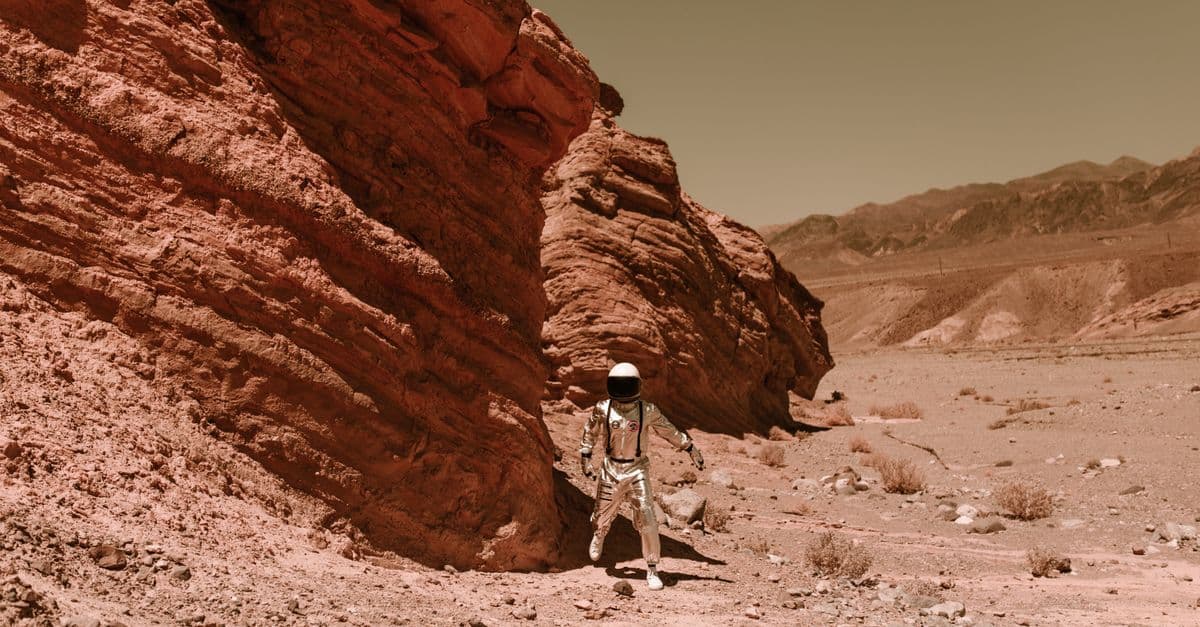
Photo: RDNE Stock project / Pexels
Mars radiation is the quiet hazard that no amount of fuel or food can fix. Since August 2012, a detector bolted inside NASA's Curiosity rover has recorded the particle dose at the surface, and the answer is about 0.64 millisieverts per day: roughly 100 times Earth's average natural background and slightly above what astronauts absorb on the International Space Station. That is a manageable number for a visit and a serious one for a lifetime. This article walks through what the instrument measured, what the dose does to the body, and how much rock, water, or soil would keep settlers safe.
What is actually hitting the surface of Mars?
Radiation in this context means ionizing radiation: particles or photons energetic enough to knock electrons off atoms. When that happens inside a cell, it can break chemical bonds in DNA, and the damage is what makes space radiation a health issue. Three sources matter on Mars, and they behave very differently from one another.
Galactic cosmic rays (GCR) are atomic nuclei accelerated to enormous speeds by supernova remnants and other violent sources outside the solar system. By count they are roughly 90 percent protons, about 9 percent helium nuclei, and about 1 percent heavier nuclei, according to the standard summary of galactic cosmic ray composition. Their energy distribution peaks near 300 million electron volts, with a long tail reaching far higher. The heavy nuclei are a small share of the particles but a large share of the biological damage, because a fast iron nucleus leaves a dense trail of ionization through tissue. For a deeper look at where these particles come from, see our explainer on cosmic rays and the high-energy particles raining down from space.
Solar energetic particles (SEPs) come from the Sun in bursts. Solar flares and coronal mass ejections (huge clouds of magnetized plasma thrown off the Sun) accelerate protons and some heavier ions to high energies. An SEP event can raise the dose rate sharply for hours to days, then vanish. Cosmic rays are a constant drizzle; solar particle events are a thunderstorm that arrives with little warning.
Secondary radiation is what you get when either of the first two collides with something. A cosmic-ray proton striking an atom in the Martian air or soil shatters it, producing a spray of neutrons, lighter fragments, and gamma rays. On Mars this shower continues all the way to the ground, and the neutrons in particular are a large part of the dose that a person inside a habitat would receive.
The surprising part: Curiosity's detector recorded a surface dose equivalent of about 0.64 millisieverts per day, against 1.84 millisieverts per day during the cruise from Earth. Per day, the trip is the more dangerous leg of the journey, because the spacecraft has no planet beneath it to block half the sky.
Why Mars has no umbrella
Earth gets two layers of protection almost for free. The first is the magnetosphere, the region around Earth dominated by the planet's magnetic field. Charged particles spiral around magnetic field lines, so low-energy ones are deflected or trapped before they reach the atmosphere. Some of the trapped particles form the Van Allen radiation belts, a hazard in themselves but one that sits far above the ground.
The second layer is the atmosphere. At sea level, the air above each square meter of ground has a mass of roughly 10 tonnes. A cosmic-ray proton arriving from space has to pass through that much material, and most of them break apart on the way down. Think of it as standing under a thick roof during a hailstorm: a few of the biggest stones may get through, but the bulk of the energy is absorbed overhead.
Mars has neither. Its global magnetic field switched off billions of years ago, leaving only patches of magnetized crust, and its atmosphere is thin enough that the pressure at the surface is below 1 percent of Earth's. Using the usual average surface pressure of roughly 600 pascals and Martian gravity of 3.71 meters per second squared, the overhead column works out to something like 160 kilograms per square meter, about 60 times less than on Earth. Our articles on why Mars lost most of its atmosphere and how planetary magnetic fields work cover the history of how Mars ended up this exposed.
That thin air is not nothing. A 160 kilogram-per-square-meter column is enough to turn part of the incoming primary radiation into secondaries, and it makes the Martian surface somewhat safer than open space. It simply does not come close to matching what Earth provides. For the composition and pressure of that air, see atmospheric composition studies on Mars.
How Curiosity's radiation detector works
The instrument is called the Radiation Assessment Detector, or RAD. It was the first of the Mars Science Laboratory's ten instruments to be switched on, and it measured the radiation inside the spacecraft during the cruise to Mars before it ever touched down, according to the Mars Science Laboratory mission summary. Curiosity landed in Gale crater on August 6, 2012, and RAD began its surface measurements on August 7, 2012, per the NASA Technical Reports Server record of the first surface results.
RAD was built to answer a practical question rather than a purely scientific one: how much radiation would a human standing on Mars receive, and how much of that would a shelter remove? That is why it reports in units that connect to health. Two quantities matter, and they are easy to confuse.
- Absorbed dose is the energy deposited per kilogram of matter, measured in grays (Gy). It is a physical quantity, like measuring how much heat a stove puts into a pot.
- Dose equivalent multiplies absorbed dose by a quality factor that reflects how biologically damaging each kind of particle is, and it is measured in sieverts (Sv). It is closer to measuring how badly the pot's contents were burned, since a gray of heavy-ion radiation does more harm to tissue than a gray of gamma rays.
A millisievert (mSv) is one thousandth of a sievert. The distinction matters because the cosmic-ray heavy ions that dominate the biological risk are only a modest share of the absorbed dose. A dose equivalent figure is therefore always larger than the absorbed dose in the same instrument, and a fair comparison between environments has to use the same one.
The first full analysis of the surface data, published in Science in 2014 as Hassler and colleagues' paper on Mars' surface radiation environment, covered the first months of surface observation, during a period of high solar activity. Its stated aims were to give the dose from galactic cosmic rays and solar energetic particles, to set a reference for modeling the radiation below the surface, and to inform how long microbial life or organic molecules could survive near the surface. The companion paper on the trip out, Zeitlin and colleagues' measurements of energetic particle radiation in transit, reported the cruise dose.
What the numbers say
The headline figures are an average surface dose equivalent of about 0.64 mSv per day and a cruise dose of about 1.84 mSv per day, as summarized in the Mars article that cites the RAD results. Low Earth orbit, where the International Space Station flies, is about 0.5 mSv per day in the same summary. For Earth's surface, the UN Scientific Committee on Atomic Radiation puts the worldwide average natural dose at about 2.4 mSv per year, according to the overview of background radiation.
Multiplying the Mars figure by 365 gives roughly 234 mSv per year, which is about 100 times the Earth average. The table below puts the environments side by side.
| Environment | Dose equivalent | Per year, if sustained | Source |
|---|---|---|---|
| Earth surface, worldwide average natural background | about 2.4 mSv per year | 2.4 mSv | UNSCEAR via background radiation summary |
| Low Earth orbit (ISS altitude) | about 0.5 mSv per day | about 180 mSv (calculated) | Mars article summary |
| Mars surface, average | about 0.64 mSv per day | about 234 mSv (calculated) | Curiosity RAD, as summarized in the Mars article |
| Earth-to-Mars cruise | about 1.84 mSv per day | about 670 mSv (calculated) | Curiosity RAD cruise data, same summary |
Two points stand out. First, the surface is not the worst place to be; at 0.64 mSv per day it is a bit more than a third of the cruise rate, because the planet itself blocks roughly half of the sky and the thin atmosphere removes a further share. Second, an astronaut on the station absorbs somewhat less per day than one on the Martian surface, but the station orbit is partly within the protection of Earth's magnetosphere and missions there are short.
An earlier orbital measurement fits the picture. The MARIE instrument on Mars Odyssey recorded about 220 micrograys of absorbed dose per day in Mars orbit, which the summary of Mars colonization research puts at about 2.5 times the dose on the space station. Because gray and sievert measure different things, those numbers cannot be lined up directly with the sievert figures above, but they point the same way.
How the round-trip total adds up
The cruise figure of 1.84 mSv per day multiplied over a year-long round trip gives roughly 660 mSv, which matches the commonly quoted figure of 0.66 sievert for the shortest round trip with comparable shielding in the overview of spaceflight radiation carcinogenesis. Add a surface stay and the total grows. As an illustration only, 500 days at 0.64 mSv per day contributes about 320 mSv, so a crew that spends that long on an unshielded surface would approach 1 sievert before any habitat shielding is counted. A habitat with real mass overhead reduces that substantially.
Do dust storms, seasons, and solar storms change the dose?
They do, and the changes are a useful reminder that the dose is not one number. The Martian atmosphere shields a little, and its thickness changes with the seasons as carbon dioxide freezes out at the poles and returns. A slightly thicker atmosphere stops slightly more radiation. The effect is real but modest, which is itself a measure of how little the atmosphere does. Pressure variations over the Martian year are covered in our piece on temperature and pressure monitoring on Mars.
Solar activity works in two opposite ways. When the Sun is more active, its expanded magnetic field pushes more galactic cosmic rays away from the inner solar system, so the GCR dose falls. The same period brings more flares and coronal mass ejections, so the risk from SEP events rises. This is why neither solar minimum nor solar maximum is simply safe, and why mission planners treat the two threats separately. For a longer look at the Sun's part in this, see our explainer on solar storms and space weather or the account of how the solar wind shapes the solar system.
A concrete example came in September 2017, when a large solar storm temporarily doubled the radiation levels measured at the Martian surface, as noted in the overview of Mars colonization research. A doubling for a day or two is not by itself dangerous to a sheltered crew, but it shows why a settlement would need a storm shelter with more mass than the everyday living quarters.
The location on the planet also matters. Dose scales with the overhead mass of atmosphere, so low-lying terrain is better protected than high terrain. Modeling work cited in the Mars article puts the dose in Hellas Planitia, the deepest basin on the planet, at about 0.342 mSv per day, roughly half the average. The same modeling suggests that lava tubes southwest of Hadriacus Mons might bring the dose as low as 0.064 mSv per day, similar to the rate on some commercial flights. These are model estimates, not measurements from inside a tube, and they remain one of the clearest reasons to explore subsurface voids.
What does this dose do to the human body?
Radiation harm comes in two broad forms, and they behave differently.
Deterministic effects appear when a dose is high enough to kill or disable many cells at once. They have a threshold, below which they do not occur. Radiation sickness after a severe solar particle event is the classic space example, and it is the reason a crew on Mars needs a storm shelter.
Stochastic effects are chance events with no clear threshold. A single particle can damage a cell's DNA in a way that is later copied into a cancer. The risk grows with the total dose rather than switching on at a certain level, which is why agencies set limits on lifetime accumulated dose instead of a single safe number.
Cancer risk and NASA's limits
Cancer is the best-studied long-term risk. NASA historically capped astronaut exposure so that the lifetime risk of dying from radiation-induced cancer (called the risk of exposure-induced death, or REID) stayed at or below 3 percent at a 95 percent confidence level, according to the overview of spaceflight radiation carcinogenesis. That framework made limits depend on age and sex, because younger people have more years in which a cancer could develop and risk models differ between sexes.
A recent review in the journal Tomography notes that the current NASA standard instead sets a single career effective dose limit of 600 mSv, regardless of sex or age, as laid out in the 2026 review of space radiation and cancer risk in astronauts. NASA's own radiation protection technical brief describes the same universal career limit, set to hold the risk of radiation-induced cancer death to about 3 percent.
Put 600 mSv next to the numbers in the table. A year-long round trip at about 1.84 mSv per day already uses more than the entire career limit on its own, at about 660 mSv, if there is no extra shielding beyond what Curiosity had. That does not mean the trip is impossible, because a crewed spacecraft can carry more shielding than a rover and can add a dedicated storm shelter. It does mean that the limit is a hard engineering target and not an afterthought. Every extra day on an unshielded surface adds to a budget the cruise has mostly spent.
Other risks
Cancer is not the only concern, and the evidence for the others is thinner.
- Central nervous system effects. Heavy-ion exposure has produced cognitive and behavioral changes in laboratory animals, and a debate continues about whether doses expected on a Mars mission would matter for people. The honest summary is that the risk is uncertain, not that it is absent.
- Cataracts. The lens of the eye is sensitive to radiation, and astronauts as a group show higher rates of lens opacities than comparable ground populations.
- Cardiovascular disease. A 2026 review in Communications Medicine lists dysrhythmias, altered vascular compliance, and a pro-inflammatory state among the known effects of deep-space exposure and notes that the field is still working out how much radiation specifically contributes, as covered in the review of cardiovascular risks of deep space exploration.
- Reproductive effects. Radiation damage to germ cells (the cells that become eggs and sperm) is a concern for any long stay, and there is no human data from this environment.
This article describes the state of research; it is not medical advice. Anyone interested in the health literature should read the primary reviews cited here, because the risk estimates have moved considerably over the past two decades and continue to do so.
How much shielding is enough?
Shielding works by making particles interact with matter before they reach a person. The principle is the same as putting more floors between you and a leaky pipe: the more material in the way, the fewer drops reach you. Unlike a pipe, though, a cosmic-ray proton that smashes into the roof can break into several lower-energy pieces that continue downward, so a thin or badly chosen shield can actually increase the dose from secondaries.
According to the summary of research on Mars colonization, blocking galactic cosmic rays substantially would take about 15 centimeters of steel, about 1 meter of rock, or about 3 meters of water. Those numbers are a useful benchmark, and they explain why most settlement concepts put people under a thick layer of material.
| Shielding approach | What it offers | Main drawback |
|---|---|---|
| Regolith (Martian soil) cover | Local material, no launch mass, thick layers are practical | Needs excavation and construction equipment |
| Water walls or tanks | Excellent per kilogram at stopping particles, doubles as life-support supply | Heavy, has to be moved or made on site |
| Hydrogen-rich plastics such as polyethylene | Low-mass layer that produces fewer secondaries than metal | Must be launched from Earth or manufactured locally |
| Lava tubes and caves | Rock overhead already exists | Locations, stability, and access are mostly unknown |
| Magnetic or electrostatic fields | Could deflect charged particles in principle | Power and mass requirements are far beyond current designs |
| Wearable vests | Protect the torso during a solar storm | Do little against steady cosmic rays; tested on Artemis I |
On the last row, a 2026 Science Advances study of the AstroRad vest flown on Artemis I estimated that it cut the effective dose by about 60 percent for an event resembling the August 1972 solar storm and by nearly 40 percent for one like October 1989, as reported in the Artemis I wearable protection evaluation. Those figures are for solar particle events, which have comparatively low-energy protons. Galactic cosmic rays are far more penetrating, so the vest is not a substitute for a thick shelter.
Why hydrogen is the best shield per kilogram
A particle loses energy fastest when it strikes something of similar mass. A proton hits a hydrogen nucleus, which is also a single proton, and shares its energy efficiently, so materials full of hydrogen stop radiation well and shatter heavy ions with fewer secondary neutrons than a dense metal such as lead. Water and polyethylene are therefore good choices, and a habitat design that stores its water supply in the outer walls gets two jobs from the same mass. This is why water tanks appear in many settlement concepts as both a consumable and a shield.
Living underground, in lava tubes, and under regolith
The most practical near-term answer is also the oldest one, which is to dig in or pile material on top. A habitat covered with a few meters of regolith has a thick shield for the price of moving dirt, and robotic equipment could do much of the work before people arrive. Because most of the dose reduction comes from the first few meters, the returns drop quickly after that, and a design can trade thickness against effort.
Lava tubes are the more ambitious option. These are hollow channels left behind when the surface of a lava flow hardened while molten rock drained out beneath it, and Mars has volcanoes large enough to have produced very big ones. If a tube is intact, its roof may provide tens of meters of rock overhead without any construction. The tradeoffs are access, structural stability, and the fact that nobody has yet entered a Martian tube. For now they are a hypothesis that orbital imaging supports and a robot has yet to test.
The broader engineering picture, including power, air, and food, is covered in Mars settlement engineering and in our look at the real challenges of living on Mars. Radiation is one constraint among several, and the others often interact with it: more shielding means more mass to move, and water used for shielding cannot also be drunk or turned into propellant.
Medicine, monitoring, and mission design
Shielding is not the only tool. A few others help at the margins.
- Schedule. Missions can be timed to avoid the busiest parts of the solar cycle for flares, though that tends to increase cosmic-ray dose, as described above. Shorter transit times reduce cruise dose directly.
- Shelters. A small, heavily shielded room that the crew can retreat to within minutes of a storm warning does most of the work against SEP events. Space weather forecasting is a practical need as much as a research topic.
- Monitoring. Personal dosimeters (wearable dose meters) let crews and flight surgeons track accumulated dose against career limits.
- Pharmaceutical countermeasures. Researchers are studying antioxidants and other protective compounds. None has been shown to protect against space radiation in people, and none replaces shielding. This is an area of active research, not an available fix.
- Electronics. Radiation also upsets computers by flipping bits in memory and degrading components. Rovers use radiation-hardened parts, and a settlement would need the same for life-support controllers.
What people often get wrong about Mars radiation
"Mars radiation is lethal on the first day." It is not. At about 0.64 mSv per day, a month on the surface adds about 19 mSv, which sits at the upper end of the 1 to 20 mSv range quoted for a single CT scan and is far too low to cause acute illness. The risk is cumulative and shows up as higher lifetime cancer probability, not immediate injury.
"The surface is worse than deep space." The opposite is true. RAD measured the cruise at 1.84 mSv per day against 0.64 mSv per day at the surface. The planet blocks about half the sky and the air removes more.
"A spacesuit protects you." Suits are designed for pressure, temperature, and dust, and their walls are too thin to matter against cosmic rays. Time outside is time spent unshielded.
"Radiation makes Mars uninhabitable." It makes unprotected living on the surface a poor idea. It does not rule out a base, because the countermeasure is to put mass overhead, and mass overhead is something Mars has in abundance.
"The 100 times figure is exact." Comparisons depend on which Earth number is used. Against average natural background of 2.4 mSv per year the Mars surface is close to 100 times higher; against the dose a frequent flyer or a person living at altitude receives it is a smaller multiple. A single multiplier hides that choice.
What we still do not know
Curiosity sits in one crater at a moderate elevation, and it measures the dose in the open, not the dose a person would receive inside a layered shelter. Predicting the second from the first relies on particle transport models. A 2025 study in npj Microgravity tested such models blind against measurements from the space station, the Orion capsule, a cubesat, and the Martian surface during Artemis I, and reported that they predicted absorbed dose rates well across complex shielding, as described in the Artemis I validation of space radiation exposure predictions. That is encouraging, but it was one mission over one stretch of the solar cycle.
The biggest open question is biological, not physical. Dose is measured precisely, but the cancer and neurological risk estimates built on it carry wide uncertainty, because no human has been exposed to cosmic-ray heavy ions at Mars-mission levels and the evidence comes from animal studies, cell experiments, and extrapolation from atomic-bomb survivors. Better biomarkers of individual sensitivity would let agencies set limits that fit the person instead of a population average.
Rover results from other missions will help fill in the surface side. Perseverance, which landed in Jezero crater in 2021, carries its own sensors, and its science is covered in Perseverance Rover: astrobiology search on Mars. For comparison with the older workhorse, see Mars rovers explained, Perseverance and Curiosity. The radiation dose also matters to the science itself: the same particle flux that threatens a settler slowly destroys organic molecules near the surface, which is one reason rovers drill into rock for samples. Our article on Curiosity's methane mystery shows how this instrument fleet is used.
Frequently asked questions
Q: How much radiation does Mars receive compared with Earth? A: Curiosity's detector found an average dose equivalent of about 0.64 millisieverts per day on the Martian surface. Earth's worldwide average natural background is about 2.4 millisieverts per year, so Mars is roughly 100 times higher when both are expressed per year.
Q: Is the trip to Mars more dangerous than living there? A: Per day, yes. The cruise measured about 1.84 millisieverts per day, nearly three times the surface rate, because the spacecraft is exposed from all directions. A shortest-trip round journey with comparable shielding adds up to roughly 0.66 sievert, so the cruise can use up a large share of an astronaut's career allowance before any surface stay.
Q: What is NASA's current limit for astronaut radiation exposure? A: A 2026 review reports that the current NASA standard sets a career effective dose limit of 600 millisieverts for every astronaut, regardless of age or sex. It replaced an older approach that held lifetime cancer risk to 3 percent and varied the limit by age and sex.
Q: How much material would protect people on Mars? A: Estimates for blocking galactic cosmic rays substantially are about 15 centimeters of steel, 1 meter of rock, or 3 meters of water. Thick regolith cover, water walls, or a lava tube all aim at the same result.
Q: Could lava tubes make Mars safer? A: Possibly. Modeling cited in summaries of Mars research suggests a dose as low as 0.064 millisieverts per day in tubes near Hadriacus Mons. These are model estimates, and no spacecraft has entered a Martian lava tube to measure it.
Q: Does the Sun make Mars radiation better or worse? A: Both. High solar activity reduces galactic cosmic ray dose by pushing particles away, but it produces more solar particle events. In September 2017 a large solar storm temporarily doubled the dose measured at the surface.
Q: Can medicine remove the need for shielding? A: No medicine has been shown to protect people from space radiation at mission doses. Researchers are studying antioxidants and other compounds, but shielding remains the main defense.
The takeaway
The measured number is smaller than the headlines and larger than the comfort zone. At about 0.64 millisieverts per day, the Martian surface does not injure anyone quickly, but a settler who lived unshielded for a year would absorb about 234 millisieverts, and NASA's career limit is 600. That arithmetic shows why Mars radiation is a design problem and not a barrier: the dose is dominated by particles that matter and mass overhead stops them. The planet supplies the mass for free as dirt, rock, and ice, and the work is to place it between people and the sky. The unsettled part is no longer the physics of the dose but the biology of what a lifetime of it does.
Read next:
- Atmospheric Composition Studies on Mars: Understanding Thin Air
- Mars Temperature and Pressure Monitoring
- Perseverance Rover: Astrobiology Search on Mars
Sources:
- Hassler, D. M. et al., "Mars' surface radiation environment measured with the Mars Science Laboratory's Curiosity rover," Science 343 (2014): doi.org/10.1126/science.1244797; record at NASA Technical Reports Server.
- Zeitlin, C. et al., "Measurements of energetic particle radiation in transit to Mars on the Mars Science Laboratory," Science 340 (2013): doi.org/10.1126/science.1235989.
- Space radiation and cancer risk in astronauts, Tomography (2026): doi.org/10.3390/tomography12070106.
- First evaluation of wearable radiation protection flown on Artemis I, Science Advances (2026): doi.org/10.1126/sciadv.adz1892.
- Validated space radiation exposure predictions from Earth to Mars during Artemis I, npj Microgravity (2025): doi.org/10.1038/s41526-025-00459-y.
- Cardiovascular risks and hazards associated with deep space exploration, Communications Medicine (2026): doi.org/10.1038/s43856-026-01728-x.
- Reference summaries for dose figures and shielding benchmarks: Mars, Colonization of Mars, Spaceflight radiation carcinogenesis, Background radiation, Galactic cosmic ray, and Mars Science Laboratory.
Follow new articles
Add SciHub101 to your feed reader to see new science and technology stories.
About the Author
SciHub101 is an independent science and technology publication founded and edited by Buğra Sözeri, a software engineer and app developer based in Türkiye. AI tools assist with drafting and research. Source documentation in the existing archive is uneven, and articles are being reviewed and corrected. The Editorial Team byline identifies editorial responsibility; it does not certify specialist or independent human review. Where we compare products, anything built by our own team is labelled as such — see the editorial guidelines and About page for how corrections and disclosures work.
Related Articles
Temperature and Pressure Monitoring on Mars: Seasonal Changes and Habitability
Mars air is roughly 160 times thinner than Earth's, and its temperature swings by more than 50 degrees in a day. Here is what rovers measure and why it matters.
Dust Storm Impact Research: Mars Global Storms and Settlement Challenges
Mars dust storms can wrap the whole planet, as the 2018 storm did. Here is how they start, what they did to Opportunity and Curiosity, and what they mean for future bases.
Curiosity Rover: Methane Mystery on Mars
NASA's Curiosity rover detected methane spikes in Mars' atmosphere—evidence of possible microbial life or geological processes that challenge understanding of the Red Planet.
Martian Soil Analysis: Mars Geology from Rover Studies
Rover soil analysis shows Mars' surface is crushed basalt, oxidized iron, water-bearing minerals, and perchlorate salt. Here is what each finding means.
Perseverance Rover: Astrobiology Search on Mars
NASA's Perseverance rover is reading Jezero Crater's rocks for signs of ancient microbial life, caching samples for a return trip that no longer has an approved mission, and testing oxygen-making technology for crews.
Bone Loss in Weightlessness: ISS Research on Osteoporosis
ISS astronauts lose bone density faster than aging populations, revealing mechanisms of osteoporosis and informing prevention and treatment strategies.